air condition BMW M3 COUPE 2001 E46 User Guide
[x] Cancel search | Manufacturer: BMW, Model Year: 2001, Model line: M3 COUPE, Model: BMW M3 COUPE 2001 E46Pages: 183, PDF Size: 1.65 MB
Page 107 of 183

107n
IndexDataTechnologyRepairsCar careControlsOverview
Brake system Brake fluid level
If the brake warning lamp
comes on with the parking
brake released:
The brake fluid level is too low in the
reservoir (refer to page 126).
If the brake fluid level is too low and
brake pedal travel has become notice-
ably longer, there may be a defect in
one of the brake system's hydraulic
circuits.
Brake warning lamp for Cana-
dian models.
Proceed to the nearest BMW
center. Higher brake application
pressure may be necessary under these
conditions, and brake pedal travel may
be significantly longer. Please
remember to adapt your driving style
accordingly.<
Brake pads
If the warning lamp for the brake
pads lights up: only the
minimum pad thickness still
remains on the brake pads. Proceed to
the nearest BMW center as soon as
possible to have the pads replaced.
For your own safety: use only
brake pads which BMW has
approved for your specific vehicle
model. BMW cannot evaluate non-
approved brake pads to determine if
they are suited for use, and therefore
cannot ensure the operating safety of
the vehicle if they are installed.<
Page 109 of 183

109n
IndexDataTechnologyRepairsCar careControlsOverview
Winter operationBrakingWinter road conditions substantially
reduce the amount of traction available
between the tires and the road surface;
the resulting increase in braking
distance is considerable and should
always be kept in mind.
ABS is intended to prevent the wheels
from locking during brake applications,
thus helping to maintain vehicle stability
and steering response.
If the ABS does not respond in a critical
braking situation and the wheels lock:
Reduce the pressure on the brake
pedal until the wheels just start to roll
again while still maintaining enough
force to continue braking. Then
increase the pressure, reduce the pres-
sure when the wheels lock, reapply
pressure etc.
This staggered braking procedure will
reduce stopping distances while
helping you maintain steering control.
You can then attempt to steer around
hazards after you have reduced pres-
sure on the brake pedal. Do not shift down on slick road
surfaces. Doing so could cause
the rear wheels to lose traction and
skid, which could result in the loss of
vehicle control.<
Depress the clutch during hard
braking on road surfaces which
provide only poor or uneven traction.<
Skid control Depress the clutch and let up on the
gas. Countersteer carefully and attempt
to regain control of the vehicle.
ParkingEngage first or reverse gear. Depending
on the steepness of the incline, you can
apply the parking brake as well. In order
to prevent the parking brake pads from
locking due to frost or corrosion, dry
them by gently applying the parking
brake as the vehicle is coming to a
stop. Make sure that following traffic
is not endangered.
The brake lamps do not light up
when the parking brake is
applied.<
Page 111 of 183
111n
IndexDataTechnologyRepairsCar careControlsOverview
Information for your safetyThe factory-approved radial tires are
matched to the vehicle and have been
selected to provide optimum safety and
driving comfort on your vehicle.
It is not merely the tire's service life, but
also driving comfort and Ð above all else
Ð driving safety that depend on the
condition of the tires and the mainte-
nance of the specified tire pressure.
Incorrect inflation pressure is a frequent
cause of tire damage. It also signifi-
cantly influences the roadholding ability
of your BMW.
Check tire inflation pressures on a
regular basis (refer to page 27), at
least every two weeks and before
beginning a longer trip. If this is not
done, incorrect tire pressures can
cause driving instability and tire
damage, ultimately resulting in acci-
dents.<
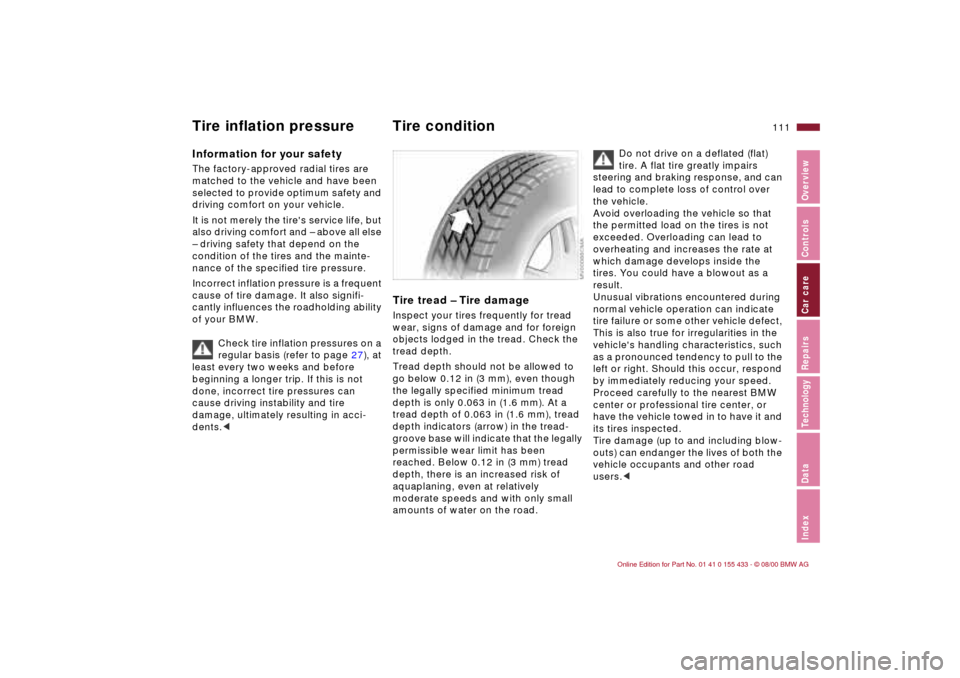
Tire tread Ð Tire damageInspect your tires frequently for tread
wear, signs of damage and for foreign
objects lodged in the tread. Check the
tread depth.
Tread depth should not be allowed to
go below 0.12 in (3 mm), even though
the legally specified minimum tread
depth is only 0.063 in (1.6 mm). At a
tread depth of 0.063 in (1.6 mm), tread
depth indicators (arrow) in the tread-
groove base will indicate that the legally
permissible wear limit has been
reached. Below 0.12 in (3 mm) tread
depth, there is an increased risk of
aquaplaning, even at relatively
moderate speeds and with only small
amounts of water on the road.
Do not drive on a deflated (flat)
tire. A flat tire greatly impairs
steering and braking response, and can
lead to complete loss of control over
the vehicle.
Avoid overloading the vehicle so that
the permitted load on the tires is not
exceeded. Overloading can lead to
overheating and increases the rate at
which damage develops inside the
tires. You could have a blowout as a
result.
Unusual vibrations encountered during
normal vehicle operation can indicate
tire failure or some other vehicle defect,
This is also true for irregularities in the
vehicle's handling characteristics, such
as a pronounced tendency to pull to the
left or right. Should this occur, respond
by immediately reducing your speed.
Proceed carefully to the nearest BMW
center or professional tire center, or
have the vehicle towed in to have it and
its tires inspected.
Tire damage (up to and including blow-
outs) can endanger the lives of both the
vehicle occupants and other road
users.<
Tire inflation pressure Tire condition
Page 112 of 183

112n
To maintain good handling and vehicle
response, use only tires of a single
tread configuration from a single manu-
facturer. BMW tests and approves
wheel/tire combinations. Refer to
page 116.
DOT Quality Grades Treadwear
Traction AA A B C
Temperature A B C
All passenger vehicle tires must
conform to Federal Safety
Requirements in addition to these
grades.< Tread wearThe tread wear grade is a comparative
rating based on the wear rate of the tire
when tested under controlled condi-
tions on a specified government test
course.
For example, a tire graded 150 would
wear one and one-half (1 g) times as
well on the government course as a tire
graded 100. The relative performance
of tires depends upon the actual condi-
tions of their use, however, and may
depart significantly from the norm due
to variations in driving habits, service
practices and differences in road char-
acteristics and climate.
TractionThe traction grades, from highest to
lowest, are AA, A, B, and C.
Those grades represent the tire's ability
to stop on wet pavement as measured
under controlled conditions on speci-
fied government test surfaces of
asphalt and concrete. A tire marked C
may have poor traction performance.
The traction grade assigned to
this tire is based on straight-
ahead braking traction tests, and does
not include acceleration, cornering,
aquaplaning, or peak traction charac-
teristics.< TemperatureThe temperature grades are A (the
highest), B, and C, representing the
tireÕs resistance to the generation of
heat and its ability to dissipate heat
when tested under controlled condi-
tions on a specified indoor laboratory
test wheel.
Sustained high temperature can cause
the material of the tire to degenerate
and reduce tire life, and excessive
temperature can lead to sudden tire
failure. The grade C corresponds to a
level of performance which all
passenger vehicle tires must meet
under the Federal Motor Vehicle Safety
Standard No. 109. Grades B and A
represent higher levels of performance
on the laboratory test wheel than the
minimum required by law.
The temperature grade for this tire
is established for a tire that is
properly inflated and not overloaded.
Excessive speed, under-inflation, or
excessive loading, either separately or
in combination, can cause heat buildup
and possible tire failure.<< < <
Uniform Tire Quality Grading Quality grades can be found where
applicable on the tire sidewall between
tread shoulder and maximum section
width. For example:
Tread wear 200 Traction AA
Temperature A
Do not use retreaded tires, since
driving safety may be impaired by
their use. This is due to the possible
variations in casing structures and, in
some cases, to their extreme age,
factors that can lead to a decrease in
their durability.<
Tire replacement
Page 113 of 183

113n
IndexDataTechnologyRepairsCar careControlsOverview
Tire replacement Tire rotationTire ageThe date on which the tire was manu-
factured is indicated by the code on the
sidewall:
DOT ... 4 100 means that the tire was
produced in the 41st week of the year
2000.
BMW recommends the replacing all
tires after 6 years at the latest, even if a
tire life of 10 years is possible. Re-initialize the Tire Pressure Warning
(RDW) after rotating the tires. See
page 78 for further information.
Summer tires
Due to different tire sizes on the
front and rear axles (refer to
page 116), the tires may not be rotated
from one axle to the other.<
Winter tiresThe tread wear patterns at the front end
differ from those at the rear Ð the actual
patterns will vary according to indi-
vidual driving conditions. In the inter-
ests of safety and maintaining optimal
handling characteristics, tire rotation is
not recommended.
If a proposed interaxle rotation of tires
is based on economic considerations,
one should consider whether the costs
for the rotation are likely to be recap-
tured by any increase in the service life
of the tires that might be realized.
Rotation must always be carried out
at short intervals (max. 3,000 miles/
5,000 km). Consult your BMW center
for more information.
Should you decide to rotate the tires, it
is essential that you comply with the
following: rotate tires on the same side
only, since braking characteristics and
road grip could otherwise be adversely
affected.
Following rotation, correct the tire infla-
tion pressure.
Page 115 of 183

115n
IndexDataTechnologyRepairsCar careControlsOverview
Winter tires Snow chainsChoosing the right tire BMW recommends winter tires (M+S
radial tires) for operation under inclem-
ent winter driving conditions. While
so-called all season tires (M+S desig-
nation) provide better winter traction
than summer tires with the load ratings
H, V, W, Y and ZR, they generally do
not achieve the performance of winter
tires.
In the interests of safe tracking and
steering response, install radial tires
made by the same manufacturer and
with the same tread configuration on all
four wheels if you elect to mount winter
tires. Do not exceed specified
maximum speedsIn Germany: attach a corresponding
sign in accordance with the Federal
Motor Vehicles Safety Standards in
your field of vision if the maximum
speed of the vehicle is higher. This
sticker is available from the tire dealer
or your BMW center. Never exceed the maximum speed
for which the tires are rated.
Unprofessional attempts by laymen to
service tires can lead to damage and
accidents.
Have this work performed by skilled
professionals only. Your BMW center
will be glad to assist you with both their
expertise and the proper equipment for
your vehicle.<
Tire condition, tire pressureWinter tires display a perceptible loss in
their ability to cope with winter driving
conditions once the tread wears to
below 0.16 in (4 mm), and should thus
be replaced.
Comply with the specified tire inflation
pressure and be sure to have the
wheels balanced each time a tire or
wheel is changed. In addition, also have
the Tire Pressure Warning (RDW) reini-
tialized, for details refer to page 78.
The use of narrow-link BMW snow
chains on winter tires is approved only
in pairs and only on the rear wheels.
Comply with all manufacturer's safety
precautions when mounting the chains.
Deactivate the Tire Pressure
Warning (RDW) when using snow
chains. The snow chains can lead to
malfunction warnings and undetected
losses in pressure.
For further information, refer to
page 78.<
Page 123 of 183
123n
IndexDataTechnologyRepairsCar careControlsOverview
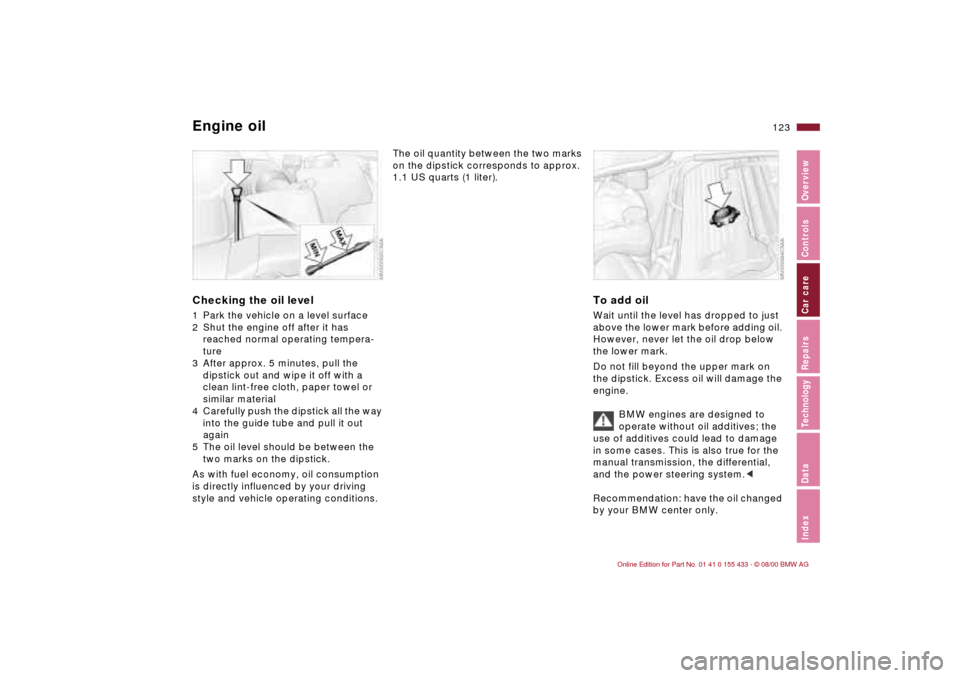
Engine oilChecking the oil level 1 Park the vehicle on a level surface
2 Shut the engine off after it has
reached normal operating tempera-
ture
3 After approx. 5 minutes, pull the
dipstick out and wipe it off with a
clean lint-free cloth, paper towel or
similar material
4 Carefully push the dipstick all the way
into the guide tube and pull it out
again
5 The oil level should be between the
two marks on the dipstick.
As with fuel economy, oil consumption
is directly influenced by your driving
style and vehicle operating conditions.
The oil quantity between the two marks
on the dipstick corresponds to approx.
1.1 US quarts (1 liter).
To add oil Wait until the level has dropped to just
above the lower mark before adding oil.
However, never let the oil drop below
the lower mark.
Do not fill beyond the upper mark on
the dipstick. Excess oil will damage the
engine.
BMW engines are designed to
operate without oil additives; the
use of additives could lead to damage
in some cases. This is also true for the
manual transmission, the differential,
and the power steering system.<
Recommendation: have the oil changed
by your BMW center only.
Page 127 of 183
127n
IndexDataTechnologyRepairsCar careControlsOverview
The BMW Maintenance System has
been designed as a reliable means of
providing maximum driving and operat-
ing safety Ð and as cost-effectively as
possible for you.
Please keep in mind that regular main-
tenance is not only necessary for the
safety of your vehicle, but also plays a
significant role in maintaining the resale
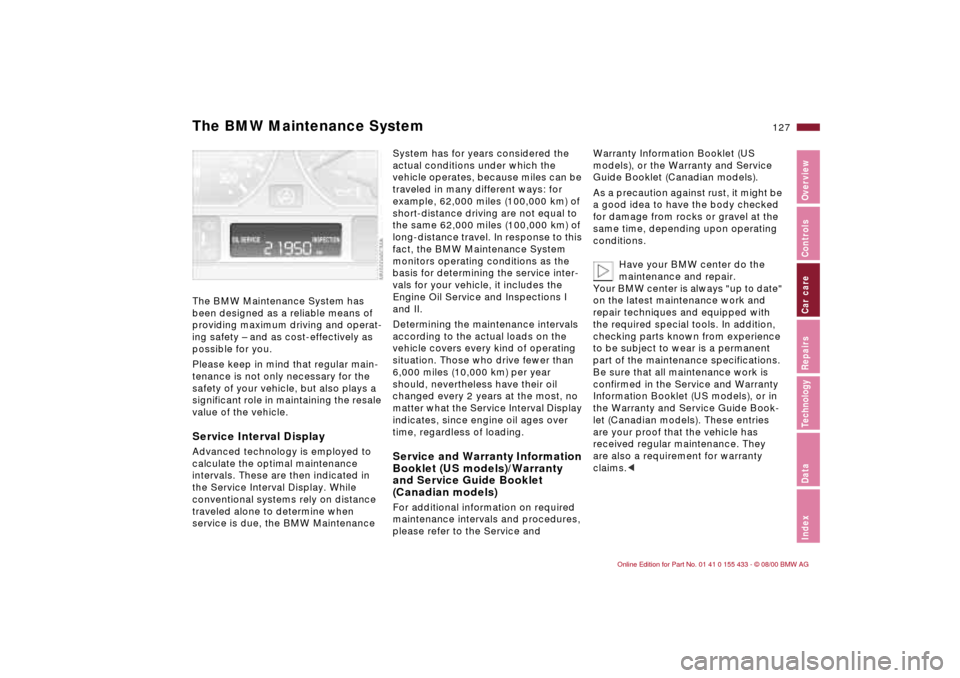
value of the vehicle. Service Interval DisplayAdvanced technology is employed to
calculate the optimal maintenance
intervals. These are then indicated in
the Service Interval Display. While
conventional systems rely on distance
traveled alone to determine when
service is due, the BMW Maintenance
System has for years considered the
actual conditions under which the
vehicle operates, because miles can be
traveled in many different ways: for
example, 62,000 miles (100,000 km) of
short-distance driving are not equal to
the same 62,000 miles (100,000 km) of
long-distance travel. In response to this
fact, the BMW Maintenance System
monitors operating conditions as the
basis for determining the service inter-
vals for your vehicle, it includes the
Engine Oil Service and Inspections I
and II.
Determining the maintenance intervals
according to the actual loads on the
vehicle covers every kind of operating
situation. Those who drive fewer than
6,000 miles (10,000 km) per year
should, nevertheless have their oil
changed every 2 years at the most, no
matter what the Service Interval Display
indicates, since engine oil ages over
time, regardless of loading. Service and Warranty Information
Booklet (US models)/Warranty
and Service Guide Booklet
(Canadian models)For additional information on required
maintenance intervals and procedures,
please refer to the Service and Warranty Information Booklet (US
models), or the Warranty and Service
Guide Booklet (Canadian models).
As a precaution against rust, it might be
a good idea to have the body checked
for damage from rocks or gravel at the
same time, depending upon operating
conditions.
Have your BMW center do the
maintenance and repair.
Your BMW center is always "up to date"
on the latest maintenance work and
repair techniques and equipped with
the required special tools. In addition,
checking parts known from experience
to be subject to wear is a permanent
part of the maintenance specifications.
Be sure that all maintenance work is
confirmed in the Service and Warranty
Information Booklet (US models), or in
the Warranty and Service Guide Book-
let (Canadian models). These entries
are your proof that the vehicle has
received regular maintenance. They
are also a requirement for warranty
claims.<
The BMW Maintenance System
Page 129 of 183

129n
IndexDataTechnologyRepairsCar careControlsOverview
Caring for your vehicleExterior finish To provide effective corrosion protec-
tion, multilayer paintwork is applied at
the factory. Cataphoretic immersion
priming techniques are supplemented
with special body-cavity protectants, by
applying specially developed and
extensively tested materials.
A layer of flexible PVC is first applied to
the undercarriage. Following this, a
comprehensive undercoating treat-
ment with a wax-based protectant is
applied. Regular maintenance makes
an important contribution to maintaining
the safety and value of your vehicle.
Increasing awareness of the effects of
harmful environmental factors on
vehicle finishes have led paint and
vehicle manufacturers to initiate
programs designed to further improve
the durability of their finishes. Despite
this, regional environmental factors can
have negative effects on your vehicle's
finish. These should guide you in deter-
mining the frequency and extent of your
efforts to maintain the vehicle finish.
Depending upon material and type of
impact (perforation of paint layer),
physical stresses from sand, road salt,
gravel etc., can cause corrosion to
extend beneath the finish, starting at
the point of impact.Road dirt, tar spots, dead insects,
animal droppings (strong alkali effect)
and tree excretions (resins and pollen)
all contain substances capable of
causing damage when allowed to
remain on the finish of your vehicle
for any period of time (spots, etching,
flaking, separation in the top coat).
In industrial areas, deposits of flue dust,
lime, oily soot, precipitation containing
sulfur-dioxide (acid rain) and other
environmental pollutants will damage
the vehicle's finish unless adequate
care is provided Ð even though this
is generally limited to the outside hori-
zontal surfaces.
In coastal regions, high levels of
atmospheric salt and humidity promote
corrosion.
In tropical zones, high humidity and
heavy ultraviolet radiation prevail, in
addition to temperatures of over 105 7
(+40 6) in the shade. Under these
conditions, light paints can reach tem-
peratures up to 175 7 (+80 6) and
dark ones up to 250 7 (+120 6).
Caring for the vehicle finish Regular washing is a preventive
measure against long-term effects from
substances that are harmful to the
vehicle's finish, especially if you drive
your vehicle in areas with high levels
of air pollution or aggressive natural
substances (tree resins, pollen).
Nevertheless, you should immediately
remove especially aggressive
substances. Failure to do so can lead to
changes in the paint's chemical
structure or to discoloration. Gasoline
spilled during refueling, oil, grease and
brake fluid should always be cleaned
away immediately, as should bird
droppings (finish damage).
Any contamination remaining on the
surface of the vehicle will be especially
conspicuous after washing. Use
cleaning fluid or alcohol with a clean
cloth or cotton pad to remove. Remove
tar spots with tar remover. After
cleaning, the affected areas should be
waxed to ensure continued protection.
Use the cleaning and car-care
products that you can obtain at
your BMW center.<
Page 149 of 183
IndexDataTechnologyRepairsCar careControlsOverview
149n
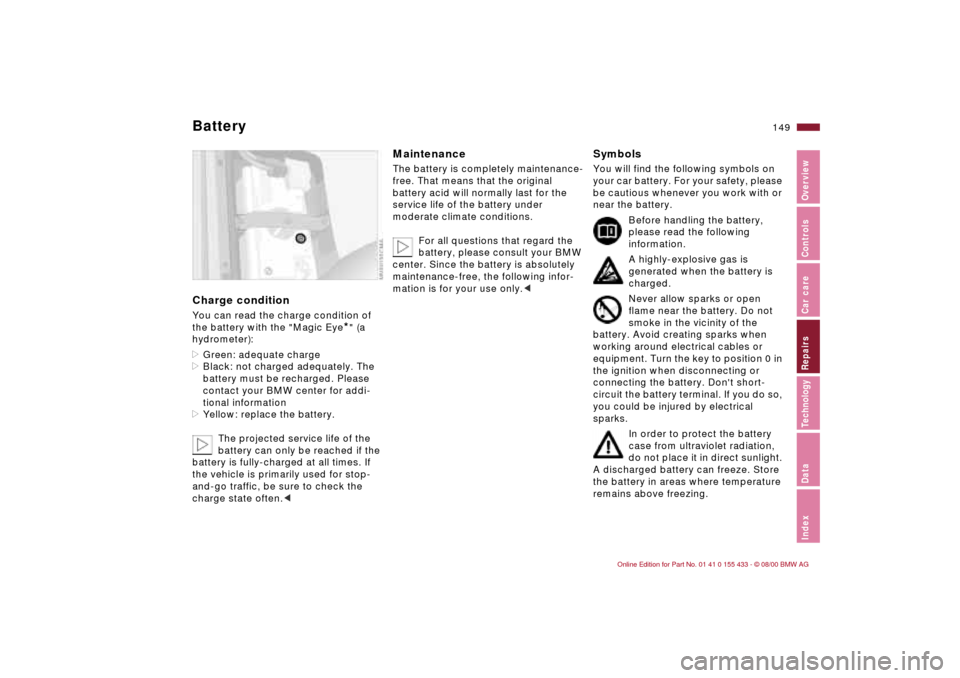
BatteryCharge conditionYou can read the charge condition of
the battery with the "Magic Eye
*" (a
hydrometer):
>Green: adequate charge
>Black: not charged adequately. The
battery must be recharged. Please
contact your BMW center for addi-
tional information
>Yellow: replace the battery.
The projected service life of the
battery can only be reached if the
battery is fully-charged at all times. If
the vehicle is primarily used for stop-
and-go traffic, be sure to check the
charge state often.<
MaintenanceThe battery is completely maintenance-
free. That means that the original
battery acid will normally last for the
service life of the battery under
moderate climate conditions.
For all questions that regard the
battery, please consult your BMW
center. Since the battery is absolutely
maintenance-free, the following infor-
mation is for your use only.<
SymbolsYou will find the following symbols on
your car battery. For your safety, please
be cautious whenever you work with or
near the battery.
Before handling the battery,
please read the following
information.
A highly-explosive gas is
generated when the battery is
charged.
Never allow sparks or open
flame near the battery. Do not
smoke in the vicinity of the
battery. Avoid creating sparks when
working around electrical cables or
equipment. Turn the key to position 0 in
the ignition when disconnecting or
connecting the battery. Don't short-
circuit the battery terminal. If you do so,
you could be injured by electrical
sparks.
In order to protect the battery
case from ultraviolet radiation,
do not place it in direct sunlight.
A discharged battery can freeze. Store
the battery in areas where temperature
remains above freezing.