lock BMW M3 COUPE 2001 E46 Owner's Guide
[x] Cancel search | Manufacturer: BMW, Model Year: 2001, Model line: M3 COUPE, Model: BMW M3 COUPE 2001 E46Pages: 183, PDF Size: 1.65 MB
Page 72 of 183
72n
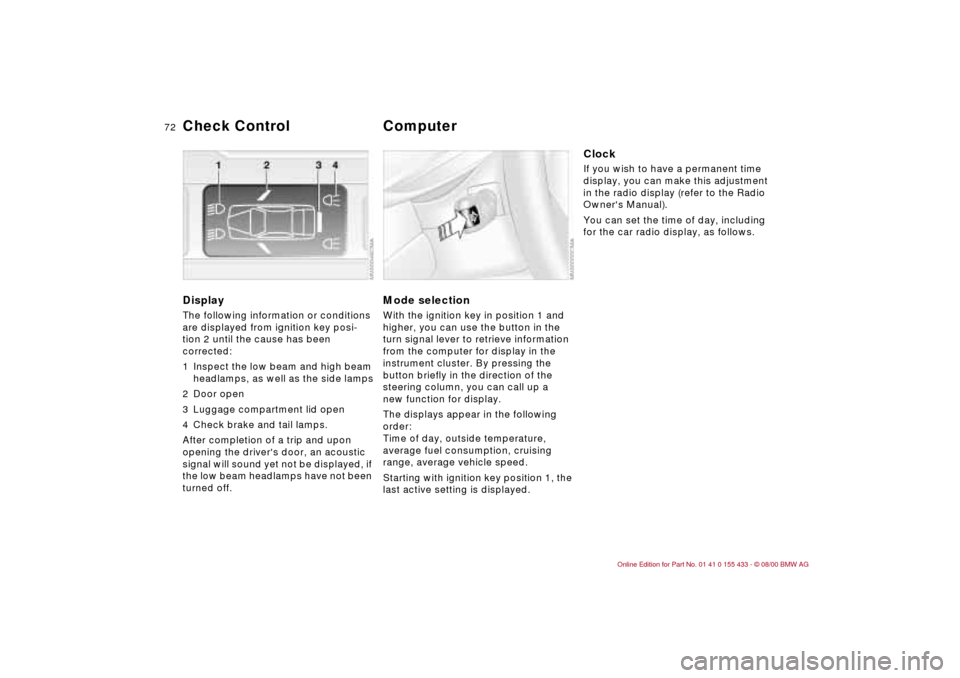
DisplayThe following information or conditions
are displayed from ignition key posi-
tion 2 until the cause has been
corrected:
1 Inspect the low beam and high beam
headlamps, as well as the side lamps
2 Door open
3 Luggage compartment lid open
4 Check brake and tail lamps.
After completion of a trip and upon
opening the driver's door, an acoustic
signal will sound yet not be displayed, if
the low beam headlamps have not been
turned off.
Mode selectionWith the ignition key in position 1 and
higher, you can use the button in the
turn signal lever to retrieve information
from the computer for display in the
instrument cluster. By pressing the
button briefly in the direction of the
steering column, you can call up a
new function for display.
The displays appear in the following
order:
Time of day, outside temperature,
average fuel consumption, cruising
range, average vehicle speed.
Starting with ignition key position 1, the
last active setting is displayed.
ClockIf you wish to have a permanent time
display, you can make this adjustment
in the radio display (refer to the Radio
Owner's Manual).
You can set the time of day, including
for the car radio display, as follows.
Check Control Computer
Page 73 of 183
73n
IndexDataTechnologyRepairsCar careControlsOverview
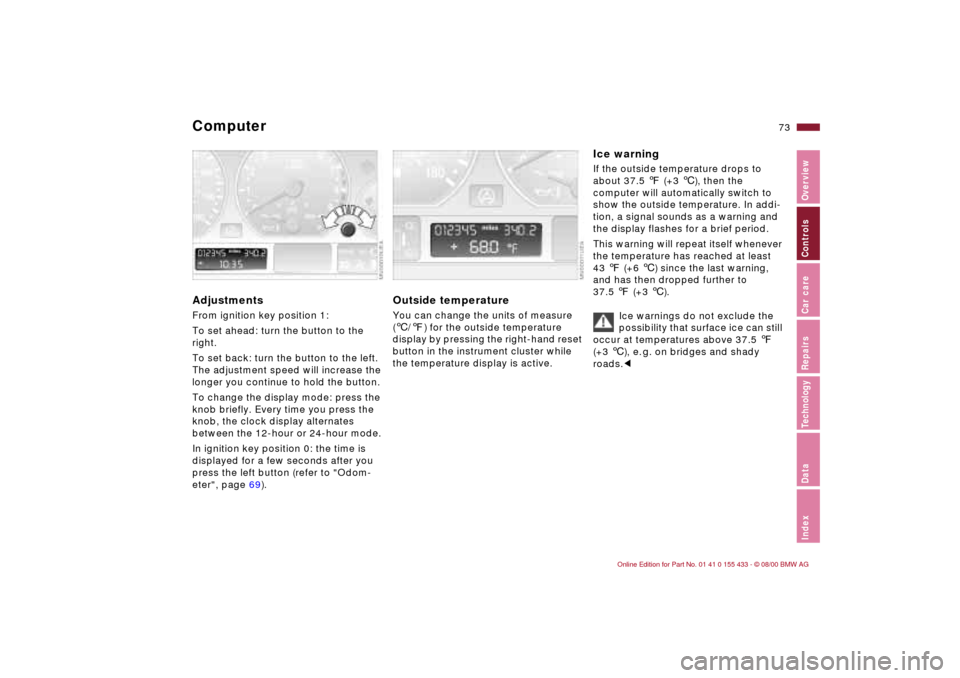
ComputerAdjustments From ignition key position 1:
To set ahead: turn the button to the
right.
To set back: turn the button to the left.
The adjustment speed will increase the
longer you continue to hold the button.
To change the display mode: press the
knob briefly. Every time you press the
knob, the clock display alternates
between the 12-hour or 24-hour mode.
In ignition key position 0: the time is
displayed for a few seconds after you
press the left button (refer to "Odom-
eter", page 69).
Outside temperature You can change the units of measure
(6/7) for the outside temperature
display by pressing the right-hand reset
button in the instrument cluster while
the temperature display is active.
Ice warning If the outside temperature drops to
about 37.5 7 (+3 6), then the
computer will automatically switch to
show the outside temperature. In addi-
tion, a signal sounds as a warning and
the display flashes for a brief period.
This warning will repeat itself whenever
the temperature has reached at least
43 7 (+6 6) since the last warning,
and has then dropped further to
37.5 7 (+3 6).
Ice warnings do not exclude the
possibility that surface ice can still
occur at temperatures above 37.5 7
(+3 6), e. g. on bridges and shady
roads.<
Page 86 of 183

86n
Automatic climate controlTips for pleasant drivingUse the automatic system (switch on
AUTO Ð button 7).
>Select an interior temperature that is
comfortable for you, e. g. 72 7
(+22 6)
>Whenever the outside temperature is
above 41 7 (+5 6), you can also
use the air conditioner 12. This will
dry the air as well as preventing
condensation on the window
surfaces Ð if there are passengers
with damp clothing, for example
>Set the outlets 2 so that the air flows
past you and is not directed straight
at you
>Set the rotary dial between the air
outlets 2 for the upper body to a
medium position, since air that is
somewhat cooler promotes driving
without fatigue.
Detailed setting options are described
for you in the following sections.
Your vehicle is set in such a
manner that, when you unlock the
vehicle with your individualized remote
control, your own personalized setting
for the automatic climate control is initi-
ated.<
Automatic air distribution
The automatic program will take
over
>automatically distributing the air
supply to the vents, as well as
>automatically adjusting the amount of
incoming air.
It will adapt to the settings you have
made for the temperature desired in the
passenger compartment Ð taking
outside influences into account
(summer, winter) Ð and will provide you
with a comfortable climate in the
vehicle at any time of the year.
>Select an interior temperature that is
comfortable for you e. g. 72 7
(+22 6). The temperature selected
and AUTO for air supply will
appear in the display 10. Refer to the
overview on page 84
>Open up the vents for the upper body
>Switch on the air conditioner in warm
weather. The maximum cooling
capacity is achieved when you set
rotary dial 3 (refer to page 88) to cold.
Individual air distribution
You can cancel the AUTO
program by selecting specific
distribution patterns to suit your
own individual requirements.
You can direct air to flow onto the
windows , toward the upper body
and into the footwell .
Temperature
The figures in the display
provide a general indication of
interior temperature. We recommend
72 7 (+22 6) as a comfortable setting,
even if the air conditioner is on. When
you start the vehicle, the system
ensures that the selected temperature
is reached as quickly as possible. It
then maintains this temperature,
regardless of the season.
Set rotary dial 3 (refer to "Draft-free
ventilation" on page 88) to a medium
setting, since air that is somewhat
cooler promotes driving without fatigue.
You can use this setting for mixing air to
make minor comfort modifications.
You can set uncontrolled heater
output up to 90 7 (+32 6). The
air conditioner is at full cooling output
at 60 7 (+16 6).<
Page 87 of 183

87n
IndexDataTechnologyRepairsCar careControlsOverview
Automatic climate control Air supply (fan)
By pressing the left or right half
of the button, you can vary the
air supply. By doing this, you switch off
the automatic control of the air supply.
Nevertheless, the automatic air distri-
bution remains unchanged.
When you set the lowest blower speed
by pressing the left half of the button,
all of the displays are canceled: the
blower, heating and air conditioner are
switched off, and the air supply is
stopped. You can reactivate the system
by pressing any button for the auto-
matic climate control.
Defrosting the windshield and
removing condensation from the
windows
This program quickly removes
ice and condensation from the
windshield and side windows.
Air conditioner
The air is cooled and dehumidi-
fied and Ð depending on the
temperature setting Ð rewarmed when
the air conditioner system is switched
on.
Depending on the weather, the wind-
shield may fog over briefly when the
engine is started.
Use the button to switch the air condi-
tioner off at outside temperatures
below approx. 41 7 (+5 6). This will
prevent the windows from fogging over.
If the windows fog over after switching
the air conditioner off, switch it back
on.
Condensation forms in the air
conditioner system during opera-
tion, that then exits under the vehicle.
Traces of condensed water of this kind
are thus normal.<
Automatic recirculated air control
(AUC)
If there are unpleasant odors or
pollutants in the outside air, you
can temporarily block the airflow from
the outside. The system then recircu-
lates the air already within the vehicle.
By repeatedly pressing the button, you
can select one of three different opera-
tion modes.
>Indicator lamps off: outside air always
flowing into the vehicle
>Left-hand indicator lamp on Ð Auto-
matic mode: the system detects
pollutants in the outside air and
responds by deactivating the outside
airflow as required. The system then
recirculates the air already within the
vehicle.
Depending on air quality require-
ments, the system automatically
switches between outside air supply
and recirculation of the air already
within the vehicle
>Right-hand indicator lamp on: the
flow of outside air is permanently
blocked. The system recirculates the
air already within the vehicle.
Page 90 of 183
90n
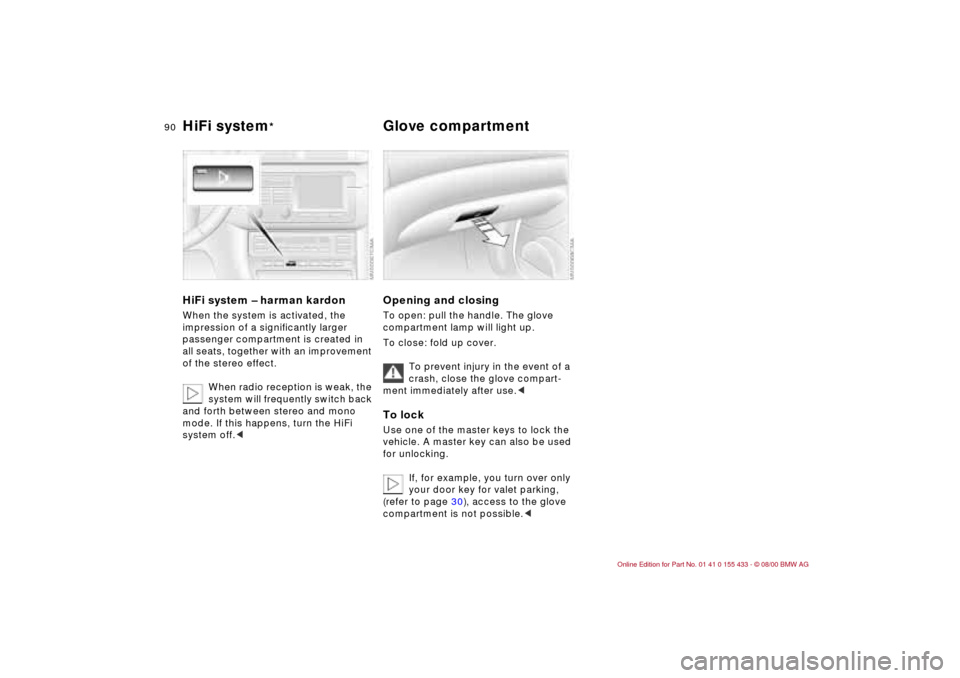
HiFi system Ð harman kardonWhen the system is activated, the
impression of a significantly larger
passenger compartment is created in
all seats, together with an improvement
of the stereo effect.
When radio reception is weak, the
system will frequently switch back
and forth between stereo and mono
mode. If this happens, turn the HiFi
system off.<
Opening and closingTo open: pull the handle. The glove
compartment lamp will light up.
To close: fold up cover.
To prevent injury in the event of a
crash, close the glove compart-
ment immediately after use.< To lockUse one of the master keys to lock the
vehicle. A master key can also be used
for unlocking.
If, for example, you turn over only
your door key for valet parking,
(refer to page 30), access to the glove
compartment is not possible.<
HiFi system
* Glove compartment
Page 95 of 183
95n
IndexDataTechnologyRepairsCar careControlsOverview
Through-loading systemThe rear backrest is divided into two
sections, one-third and two-thirds of
the seat respectively. For carrying
longer objects, you can fold down
either section of the backrest sepa-
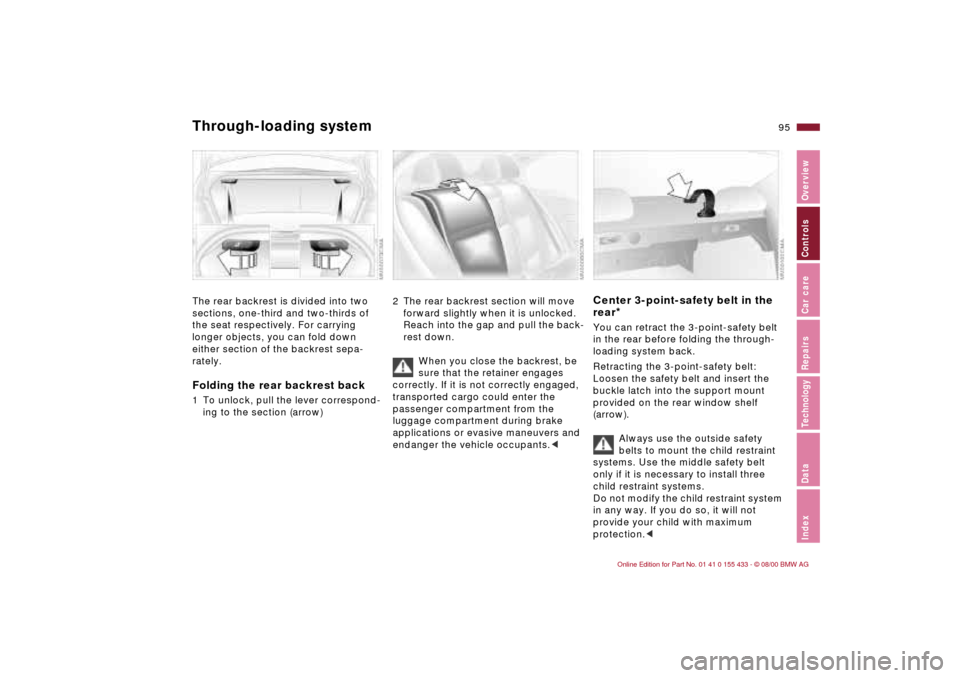
rately.Folding the rear backrest back1 To unlock, pull the lever correspond-
ing to the section (arrow)
2 The rear backrest section will move
forward slightly when it is unlocked.
Reach into the gap and pull the back-
rest down.
When you close the backrest, be
sure that the retainer engages
correctly. If it is not correctly engaged,
transported cargo could enter the
passenger compartment from the
luggage compartment during brake
applications or evasive maneuvers and
endanger the vehicle occupants.<
Center 3-point-safety belt in the
rear
*
You can retract the 3-point-safety belt
in the rear before folding the through-
loading system back.
Retracting the 3-point-safety belt:
Loosen the safety belt and insert the
buckle latch into the support mount
provided on the rear window shelf
(arrow).
Always use the outside safety
belts to mount the child restraint
systems. Use the middle safety belt
only if it is necessary to install three
child restraint systems.
Do not modify the child restraint system
in any way. If you do so, it will not
provide your child with maximum
protection.<
Page 96 of 183
96n
Ski bag
*
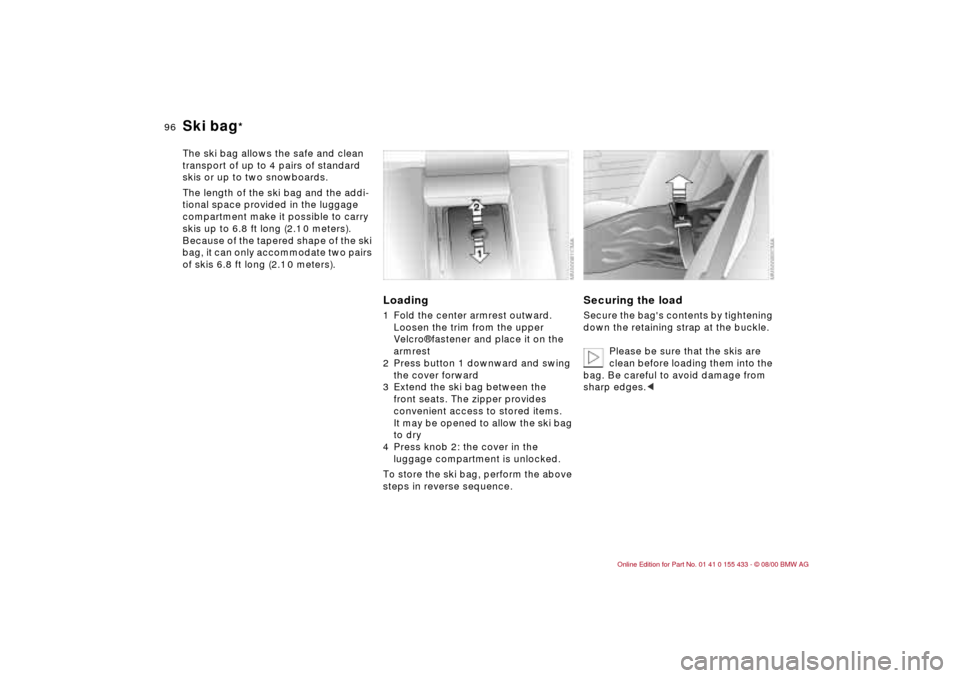
The ski bag allows the safe and clean
transport of up to 4 pairs of standard
skis or up to two snowboards.
The length of the ski bag and the addi-
tional space provided in the luggage
compartment make it possible to carry
skis up to 6.8 ft long (2.1 0 meters).
Because of the tapered shape of the ski
bag, it can only accommodate two pairs
of skis 6.8 ft long (2.1 0 meters).
Loading1 Fold the center armrest outward.
Loosen the trim from the upper
Velcro¨ fastener and place it on the
armrest
2 Press button 1 downward and swing
the cover forward
3 Extend the ski bag between the
front seats. The zipper provides
convenient access to stored items.
It may be opened to allow the ski bag
to dry
4 Press knob 2: the cover in the
luggage compartment is unlocked.
To store the ski bag, perform the above
steps in reverse sequence.
Securing the loadSecure the bag's contents by tightening
down the retaining strap at the buckle.
Please be sure that the skis are
clean before loading them into the
bag. Be careful to avoid damage from
sharp edges.<
Page 101 of 183
Overview
Controls and features
Operation, care
and maintenance
Owner service procedures
Technical data
Index Advanced technology
101n
IndexDataTechnologyRepairsCar careControlsOverview
Special operating instructions:
Break-in procedures102
Driving notes103
Catalytic converter103
Antilock Brake System
(ABS)104
Disk brakes106
Brake system107
Winter operation108
Power steering110
Cellular phones110
Radio reception110
Wheels and tires:
Tire inflation pressure111
Tire condition111
Tire replacement112
Tire rotation113
Wheel and tire
combinations114
Winter tires115
Snow chains115
Approved wheel and tire
specifications116Under the hood:
Hood118
Engine compartment120
Washer fluids122
Washer nozzles122
Engine oil123
Coolant125
Brake fluid126
Vehicle Identification
Number126
Care and maintenance:
The BMW Maintenance
System127
Caring for your vehicle128
Airbags133
Vehicle storage133
Laws and regulations:
Technical modifications134
California Proposition
65 Warning134
OBD connector135
Car care
Page 104 of 183

104n
Antilock Brake System (ABS)The concept ABS keeps the wheels from locking
while braking, thereby enhancing active
driving safety. The reason: locked
wheels are dangerous. When the front
wheels slide, the driver loses steering
control over the vehicle. Traction loss at
the rear wheels can cause the rear end
to break into an uncontrolled skid.
Based on current road conditions, ABS
can brake the vehicle within the
shortest possible distance and with the
greatest possible driving stability (on
straight-aways and curves, asphalt, ice,
wet road surfaces, etc.).
ABS is designed to meet two essential
requirements during every brake appli-
cation:
>To help provide vehicle stability
>To help maintain steering control and
maneuverability Ð on all types of road
surfaces (asphalt, concrete, mud,
wet, snow, ice). Braking with ABSThe system becomes operative once
the vehicle exceeds a speed of approx.
6 mph (10 km/h). Whenever the
vehicle's speed drops below approx.
4 mph (6 km/h), the ABS is deactivated.
This means that the wheels can lock in the final phase of a panic stop Ð a factor
of no significance in actual use.
The ABS system works best in situa-
tions requiring maximum pressure on
the pedal ("panic stop"). Do not let up
on the brake pedal even after it starts
pulsating. Since the vehicle maintains
steering responsiveness, you can
nevertheless avoid possible obstacles
with a minimum of steering effort.
The ABS closed-loop control circuit
cycles in fractions of a second. Pulsa-
tion at the brake pedal shows you that
ABS is active, that you are braking
within the ABS' braking range and that
you are thus pushing the limit of the
system. In addition, a pulsation Ð a
result of the control function cycles Ð
indicates to the driver that the vehicle
speed should be reduced to adapt to
road surface conditions when there is
reduced traction and grip between tires
and road surface (slippery road
surface).
On road surfaces with a loose surface
layer over a firm base, e.g. on gravel or
snow, as well as when driving with
snow chains on, braking distances may
be longer for a locked-wheel condition.
However, ABS continues to provide
enhanced vehicle stability and steering
response under these conditions.
Information for your safetyNot even ABS can suspend the laws of
physics. The consequences of hitting
the brakes when there is inadequate
distance between vehicles, when the
vehicle is driven at excessive speeds
through curves, or during aquaplaning,
remain the driver's responsibility. You
should never allow the added safety of
ABS to lull you into a false sense of
security, or mislead you into taking risks
that could affect your own safety and
that of others.
Do not make any modifications to
the ABS system.
Service procedures on ABS are to be
performed by authorized technicians
only.< Antilock Brake System (ABS)/
Cornering Brake Control (CBC) CBC is an advanced engineering
design of the ABS. When braking while
cornering at high speed or braking
during high lateral acceleration, or
when braking during a lane change,
vehicle stability is improved and
steering response is enhanced.
Page 105 of 183
105n
IndexDataTechnologyRepairsCar careControlsOverview
Antilock Brake System (ABS)In the event of a malfunction
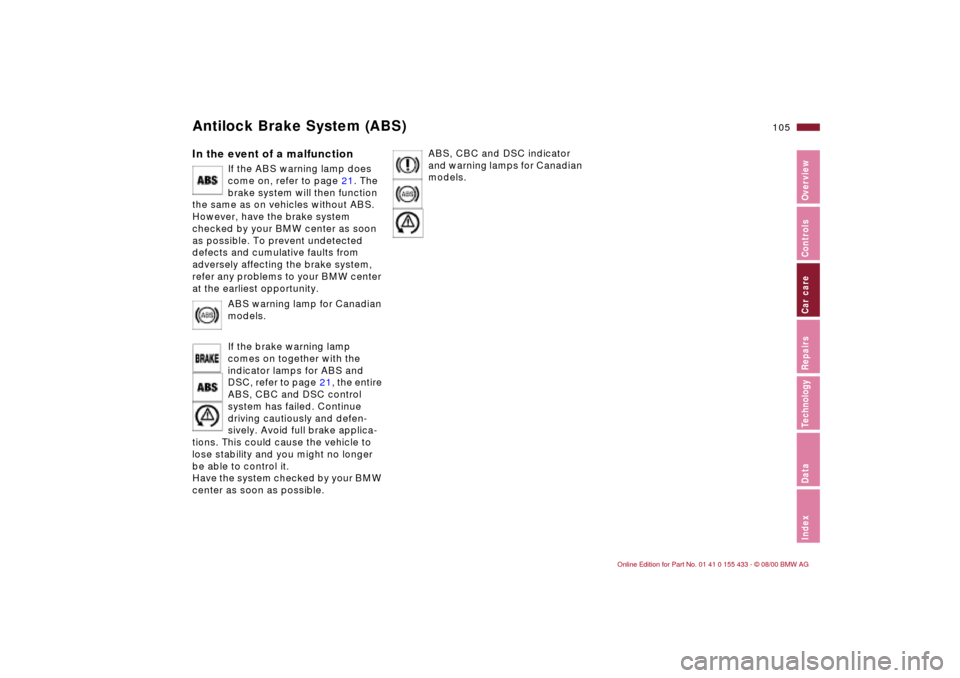
If the ABS warning lamp does
come on, refer to page 21. The
brake system will then function
the same as on vehicles without ABS.
However, have the brake system
checked by your BMW center as soon
as possible. To prevent undetected
defects and cumulative faults from
adversely affecting the brake system,
refer any problems to your BMW center
at the earliest opportunity.
ABS warning lamp for Canadian
models.
If the brake warning lamp
comes on together with the
indicator lamps for ABS and
DSC, refer to page 21, the entire
ABS, CBC and DSC control
system has failed. Continue
driving cautiously and defen-
sively. Avoid full brake applica-
tions. This could cause the vehicle to
lose stability and you might no longer
be able to control it.
Have the system checked by your BMW
center as soon as possible.
ABS, CBC and DSC indicator
and warning lamps for Canadian
models.