tire pressure BMW M3 COUPE 2003 E46 User Guide
[x] Cancel search | Manufacturer: BMW, Model Year: 2003, Model line: M3 COUPE, Model: BMW M3 COUPE 2003 E46Pages: 158, PDF Size: 4.18 MB
Page 109 of 158
109 Wheels and tires
Tire inflation pressureInformation for your safetyThe factory-approved tires are matched
to your vehicle and have been selected
to provide optimum safety and driving
comfort when used properly.
It is not merely the tire's service life, but
also driving comfort and – above all else
– driving safety that depend on the con-
dition of the tires and the maintenance
of the specified tire pressure.
Incorrect tire inflation pressure is
a frequent cause of tire damage. It
also significantly influences the road-
holding ability of your BMW. Check tire
inflation pressures on a regular basis,
refer to page 25, at least every two
weeks and before beginning a longer
trip. Incorrect tire pressure can other-
wise lead to driving instability, tire dam-
age and accidents.<
Tire conditionTire tread – tire damageInspect your tires frequently for tread
wear, signs of damage and for foreign
objects lodged in the tread. Check the
tread depth.
Tread depth should not be allowed to
go below 1/8 in / 3 mm, even though
the legally specified minimum tread
depth is only 1/16 in / 1.6 mm.
Below 1/8 in / 3 mm tread depth, there
is a great risk of hydroplaning, even at
relatively moderate speeds and with
only small amounts of water on the
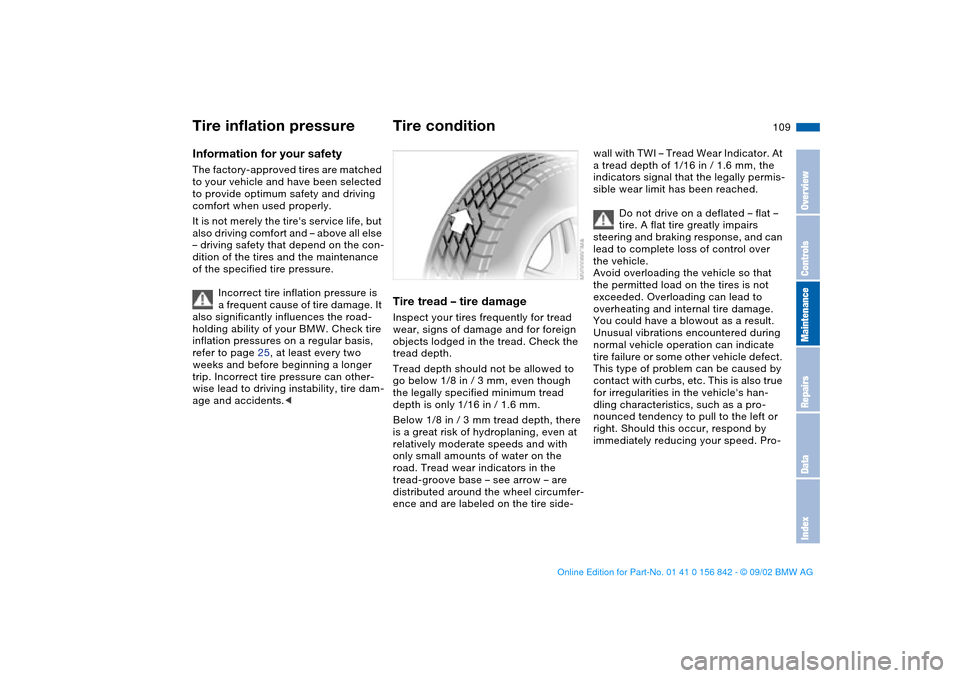
road. Tread wear indicators in the
tread-groove base – see arrow – are
distributed around the wheel circumfer-
ence and are labeled on the tire side-
wall with TWI – Tread Wear Indicator. At
a tread depth of 1/16 in / 1.6 mm, the
indicators signal that the legally permis-
sible wear limit has been reached.
Do not drive on a deflated – flat –
tire. A flat tire greatly impairs
steering and braking response, and can
lead to complete loss of control over
the vehicle.
Avoid overloading the vehicle so that
the permitted load on the tires is not
exceeded. Overloading can lead to
overheating and internal tire damage.
You could have a blowout as a result.
Unusual vibrations encountered during
normal vehicle operation can indicate
tire failure or some other vehicle defect.
This type of problem can be caused by
contact with curbs, etc. This is also true
for irregularities in the vehicle's han-
dling characteristics, such as a pro-
nounced tendency to pull to the left or
right. Should this occur, respond by
immediately reducing your speed. Pro-
OverviewControlsMaintenanceRepairsDataIndex
handbook.book Page 109 Saturday, July 27, 2002 1:12 PM
Page 113 of 158
113
Do not exceed specified
maximum speeds
Never exceed the maximum
speed for which the winter tires
are rated.
Unprofessional attempts by laymen to
service tires can lead to damage and
accidents.
Have this work performed by skilled
professionals only. Your BMW center
will be glad to assist you with both their
expertise and the proper equipment for
your vehicle.<
Tire condition, tire pressureAt tread depths below approx. 3/16 in /
4 mm, their performance under winter
driving conditions deteriorates notice-
ably. Worn tires should therefore be
replaced for safety considerations.
Comply with the specified tire inflation
pressures – and be sure to have the
wheel and tire assembly balanced
every time you change a tire or wheel.
Snow chains*Only certain snow chains have been
tested by BMW and determined and
approved as roadworthy. Consult your
BMW center for more information.
BMW recommends using only these
approved fine-link snow chains. Use
them in pairs on winter tires, but only on
both rear wheels.
Comply with all manufacturer's safety
precautions when mounting the chains.
Do not exceed a maximum speed of
30 mph / 50 km/h when using snow
chains.
After mounting or removing snow
chains, always reinitialize the sequential
M gearbox SMG II, refer to page 69.
It is not possible to mount snow
chains on tires with 18-inch and
19-inch wheels.
Deactivate the Flat Tire Monitor when
using snow chains. Malfunction warn-
ings and undetected losses in pressure
are a possibility when driving with snow
chains.
For additional information, refer to
page 82.<
Winter tires
OverviewControlsMaintenanceRepairsDataIndex
handbook.book Page 113 Saturday, July 27, 2002 1:12 PM
Page 133 of 158
133
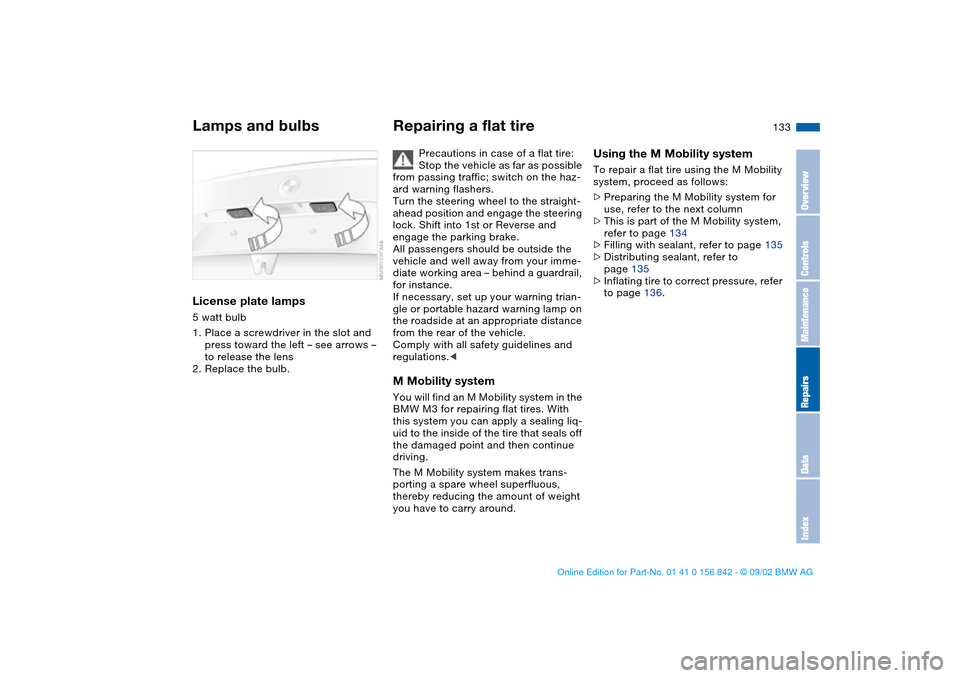
License plate lamps5 watt bulb
1. Place a screwdriver in the slot and
press toward the left – see arrows –
to release the lens
2. Replace the bulb.
Repairing a flat tire
Precautions in case of a flat tire:
Stop the vehicle as far as possible
from passing traffic; switch on the haz-
ard warning flashers.
Turn the steering wheel to the straight-
ahead position and engage the steering
lock. Shift into 1st or Reverse and
engage the parking brake.
All passengers should be outside the
vehicle and well away from your imme-
diate working area – behind a guardrail,
for instance.
If necessary, set up your warning trian-
gle or portable hazard warning lamp on
the roadside at an appropriate distance
from the rear of the vehicle.
Comply with all safety guidelines and
regulations.<
M Mobility systemYou will find an M Mobility system in the
BMW M3 for repairing flat tires. With
this system you can apply a sealing liq-
uid to the inside of the tire that seals off
the damaged point and then continue
driving.
The M Mobility system makes trans-
porting a spare wheel superfluous,
thereby reducing the amount of weight
you have to carry around.
Using the M Mobility systemTo repair a flat tire using the M Mobility
system, proceed as follows:
>Preparing the M Mobility system for
use, refer to the next column
>This is part of the M Mobility system,
refer to page 134
>Filling with sealant, refer to page 135
>Distributing sealant, refer to
page 135
>Inflating tire to correct pressure, refer
to page 136.
Lamps and bulbs
OverviewControlsMaintenanceRepairsDataIndex
handbook.book Page 133 Saturday, July 27, 2002 1:12 PM
Page 134 of 158
134
Preparing the M Mobility system
for useThe M Mobility system is located in the
luggage compartment under the floor
panel:
1. Lift the floor panel
2. Loosen the M Mobility system from
its storage location.
Before you use the M Mobility sys-
tem, read the warnings and dan-
ger notices on the device carefully.<
If possible, leave the foreign object in
the tire.
Pull off the sticker 5, refer to the second
column on the right, for the speed limit
and apply it to the steering wheel.
Please keep in mind that the fluids
bottle in the system's sealant con-
tainer has to be changed every 3 years
by your BMW center, if the unit has not
been used.<
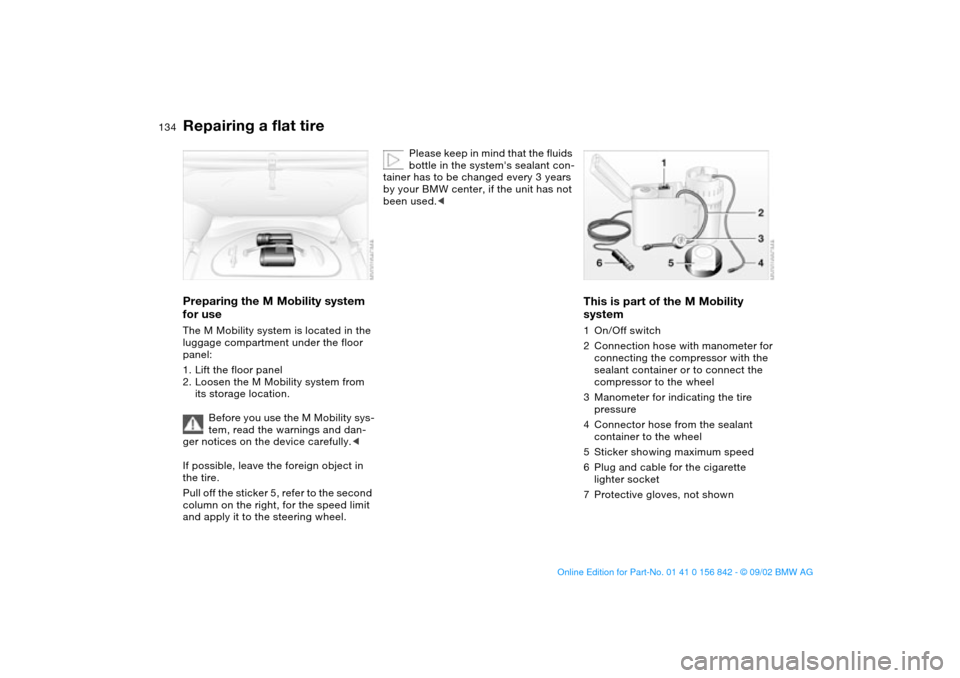
This is part of the M Mobility
system1On/Off switch
2Connection hose with manometer for
connecting the compressor with the
sealant container or to connect the
compressor to the wheel
3Manometer for indicating the tire
pressure
4Connector hose from the sealant
container to the wheel
5Sticker showing maximum speed
6Plug and cable for the cigarette
lighter socket
7Protective gloves, not shown
Repairing a flat tire
handbook.book Page 134 Saturday, July 27, 2002 1:12 PM
Page 135 of 158
135
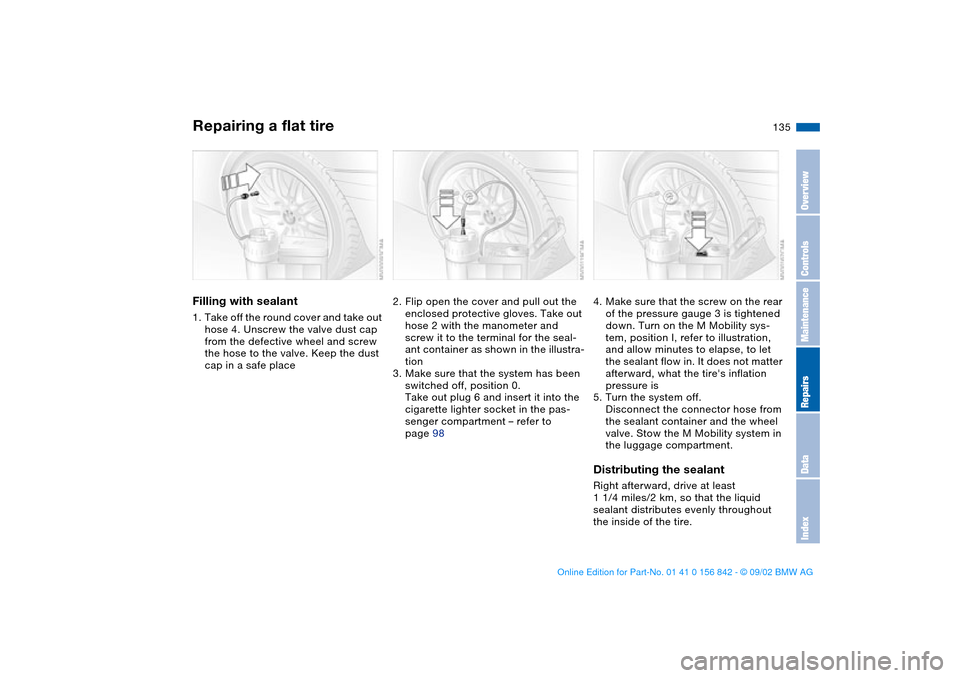
Filling with sealant1. Take off the round cover and take out
hose 4. Unscrew the valve dust cap
from the defective wheel and screw
the hose to the valve. Keep the dust
cap in a safe place
2. Flip open the cover and pull out the
enclosed protective gloves. Take out
hose 2 with the manometer and
screw it to the terminal for the seal-
ant container as shown in the illustra-
tion
3. Make sure that the system has been
switched off, position 0.
Take out plug 6 and insert it into the
cigarette lighter socket in the pas-
senger compartment – refer to
page 98
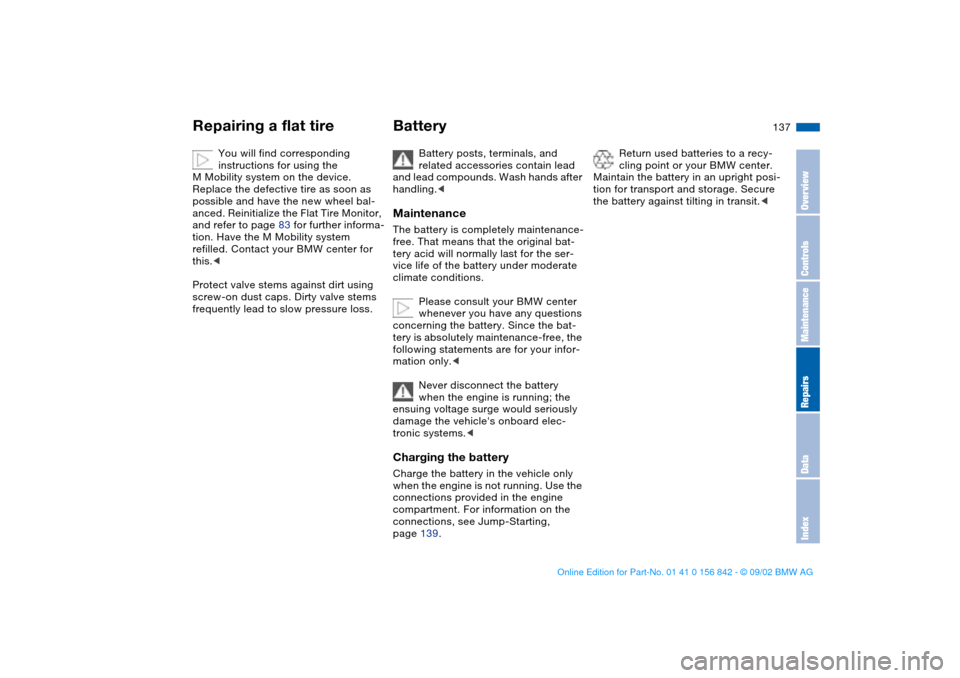
4. Make sure that the screw on the rear
of the pressure gauge 3 is tightened
down. Turn on the M Mobility sys-
tem, position I, refer to illustration,
and allow minutes to elapse, to let
the sealant flow in. It does not matter
afterward, what the tire's inflation
pressure is
5. Turn the system off.
Disconnect the connector hose from
the sealant container and the wheel
valve. Stow the M Mobility system in
the luggage compartment.Distributing the sealantRight afterward, drive at least
1 1/4 miles/2 km, so that the liquid
sealant distributes evenly throughout
the inside of the tire.
Repairing a flat tire
OverviewControlsMaintenanceRepairsDataIndex
handbook.book Page 135 Saturday, July 27, 2002 1:12 PM
Page 136 of 158
136
Do not exceed a maximum speed
of 40 mph / 60 km/h.
If possible, keep the vehicle speed
above 10 mph / 20 km/h. Stop in a suit-
able spot.<
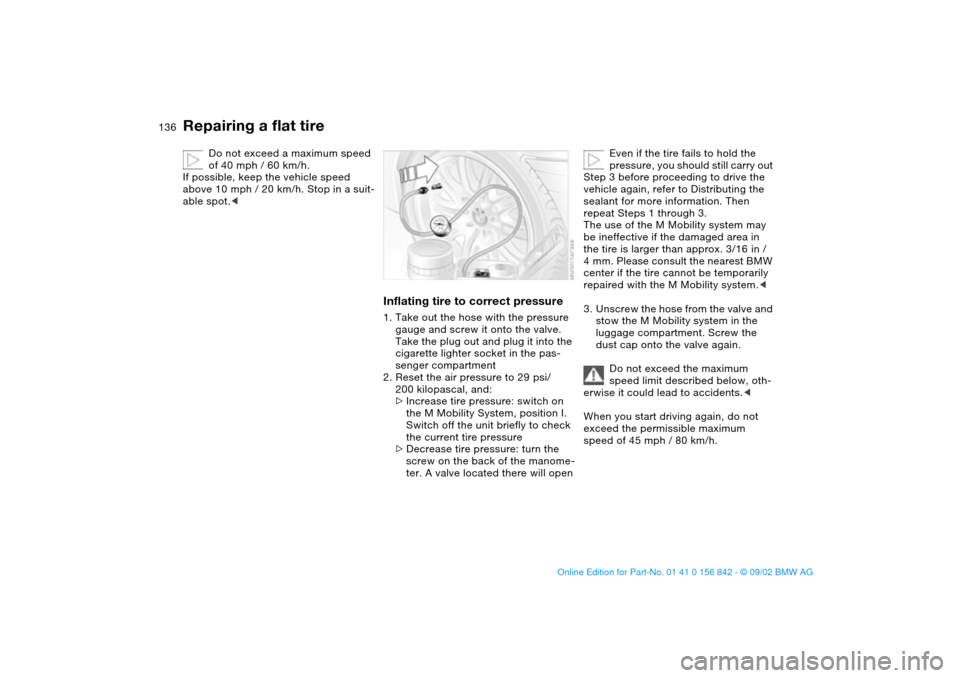
Inflating tire to correct pressure1. Take out the hose with the pressure
gauge and screw it onto the valve.
Take the plug out and plug it into the
cigarette lighter socket in the pas-
senger compartment
2. Reset the air pressure to 29 psi/
200 kilopascal, and:
>Increase tire pressure: switch on
the M Mobility System, position I.
Switch off the unit briefly to check
the current tire pressure
>Decrease tire pressure: turn the
screw on the back of the manome-
ter. A valve located there will open
Even if the tire fails to hold the
pressure, you should still carry out
Step 3 before proceeding to drive the
vehicle again, refer to Distributing the
sealant for more information. Then
repeat Steps 1 through 3.
The use of the M Mobility system may
be ineffective if the damaged area in
the tire is larger than approx. 3/16 in /
4 mm. Please consult the nearest BMW
center if the tire cannot be temporarily
repaired with the M Mobility system.<
3. Unscrew the hose from the valve and
stow the M Mobility system in the
luggage compartment. Screw the
dust cap onto the valve again.
Do not exceed the maximum
speed limit described below, oth-
erwise it could lead to accidents.<
When you start driving again, do not
exceed the permissible maximum
speed of 45 mph / 80 km/h.
Repairing a flat tire
handbook.book Page 136 Saturday, July 27, 2002 1:12 PM
Page 137 of 158
137
You will find corresponding
instructions for using the
M Mobility system on the device.
Replace the defective tire as soon as
possible and have the new wheel bal-
anced. Reinitialize the Flat Tire Monitor,
and refer to page 83 for further informa-
tion. Have the M Mobility system
refilled. Contact your BMW center for
this.<
Protect valve stems against dirt using
screw-on dust caps. Dirty valve stems
frequently lead to slow pressure loss.
Battery
Battery posts, terminals, and
related accessories contain lead
and lead compounds. Wash hands after
handling.<
MaintenanceThe battery is completely maintenance-
free. That means that the original bat-
tery acid will normally last for the ser-
vice life of the battery under moderate
climate conditions.
Please consult your BMW center
whenever you have any questions
concerning the battery. Since the bat-
tery is absolutely maintenance-free, the
following statements are for your infor-
mation only.<
Never disconnect the battery
when the engine is running; the
ensuing voltage surge would seriously
damage the vehicle's onboard elec-
tronic systems.
connections provided in the engine
compartment. For information on the
connections, see Jump-Starting,
page 139.
Return used batteries to a recy-
cling point or your BMW center.
Maintain the battery in an upright posi-
tion for transport and storage. Secure
the battery against tilting in transit.<
Repairing a flat tire
OverviewControlsMaintenanceRepairsDataIndex
handbook.book Page 137 Saturday, July 27, 2002 1:12 PM
Page 151 of 158
Everything from A to Z
151
CHECK FILLER CAP
indicator lamp 19
Checking coolant level 120
Checking oil level 116, 118
Child seat 55
Child-restraint systems 55
Cigarette lighter 98
Cleaning windshield 72
Clock 77
refer also to the radio or
onboard computer
Owner's Manual
Clothes hooks 99
Cockpit 14
Code, tires 112
Coin box 96
Compression ratio 144
Computer 78
Condensation, removing
from windows 92
Configure personal settings
Vehicle Memory, Key
Memory 59
Consumption
display 75
fuel 79
Coolant 116, 120, 147
indicator lamp 19
Cooling system 147
Copyright 4Cornering Brake Control
(CBC) 107
indicator lamp 19
Cruise control 72
indicator lamp 20
Cup holder, see Beverage
holder 96
Curb weight 146
Cushion height 145
D
Data
dimensions 145
engine 144
weights 146
Daytime driving lamps 86
DBC Dynamic Brake
Control 82
warning lamp 19
Defrost position 92
Defrosting
rear window 93
windows 92
Digital clock 77
Dimensions 145
Dipstick, engine oil 118
Disc brakes 108
Displacement 144
Display lighting 87
Displays 16
Distance warning 80
Divided rear backrest 100Door key 30
Door lock buttons 34
Doors
emergency operation 33
manual operation 33
remote control 31
unlocking and locking
31, 33
Drivelogic 68
Driving notes
braking 107
disc brakes 108
general 107
hydroplaning 107
DSC Dynamic Stability Con-
trol 81
indicator lamp 19
Dynamic Brake Control
(DBC) 82
warning lamps 19
Dynamic Stability Control
(DSC) 81
indicator lamp 19
E
Electric power windows 40
Electrical accessories, fail-
ure 138
Electrical malfunction
doors 33
fuel filler door 24
sliding/tilt sunroof 42Emergency operation
doors 33
fuel filler door 24
sliding/tilt sunroof 42
Emergency release
luggage compartment
lid 37
Engine
displacement 144
output 144
starting 61
switching off 63
torque 144
Engine compartment 116
Engine coolant 147
refilling 120
temperature gauge 75
Engine data 144
Engine electronics
warning lamp 19
Engine oil
adding 116, 118
capacity 147
consumption 118
quality 119
types 119
viscosity 119
Engine oil level
indicator lamp 19
warning lamp 18
Engine oil pressure
warning lamp 18
OverviewControlsMaintenanceRepairsDataIndex
handbook.book Page 151 Saturday, July 27, 2002 1:12 PM
Page 152 of 158
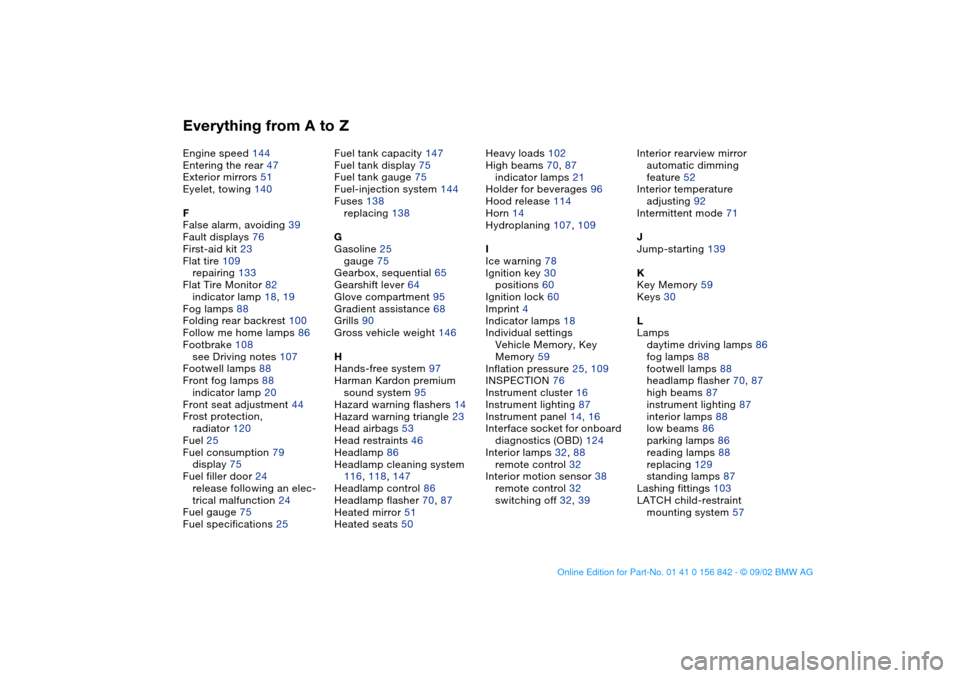
Everything from A to ZEngine speed 144
Entering the rear 47
Exterior mirrors 51
Eyelet, towing 140
F
False alarm, avoiding 39
Fault displays 76
First-aid kit 23
Flat tire 109
repairing 133
Flat Tire Monitor 82
indicator lamp 18, 19
Fog lamps 88
Folding rear backrest 100
Follow me home lamps 86
Footbrake 108
see Driving notes 107
Footwell lamps 88
Front fog lamps 88
indicator lamp 20
Front seat adjustment 44
Frost protection,
radiator 120
Fuel 25
Fuel consumption 79
display 75
Fuel filler door 24
release following an elec-
trical malfunction 24
Fuel gauge 75
Fuel specifications 25Fuel tank capacity 147
Fuel tank display 75
Fuel tank gauge 75
Fuel-injection system 144
Fuses 138
replacing 138
G
Gasoline 25
gauge 75
Gearbox, sequential 65
Gearshift lever 64
Glove compartment 95
Gradient assistance 68
Grills 90
Gross vehicle weight 146
H
Hands-free system 97
Harman Kardon premium
sound system 95
Hazard warning flashers 14
Hazard warning triangle 23
Head airbags 53
Head restraints 46
Headlamp 86
Headlamp cleaning system
116, 118, 147
Headlamp control 86
Headlamp flasher 70, 87
Heated mirror 51
Heated seats 50Heavy loads 102
High beams 70, 87
indicator lamps 21
Holder for beverages 96
Hood release 114
Horn 14
Hydroplaning 107, 109
I
Ice warning 78
Ignition key 30
positions 60
Ignition lock 60
Imprint 4
Indicator lamps 18
Individual settings
Vehicle Memory, Key
Memory 59
Inflation pressure 25, 109
INSPECTION 76
Instrument cluster 16
Instrument lighting 87
Instrument panel 14, 16
Interface socket for onboard
diagnostics (OBD) 124
Interior lamps 32, 88
remote control 32
Interior motion sensor 38
remote control 32
switching off 32, 39Interior rearview mirror
automatic dimming
feature 52
Interior temperature
adjusting 92
Intermittent mode 71
J
Jump-starting 139
K
Key Memory 59
Keys 30
L
Lamps
daytime driving lamps 86
fog lamps 88
footwell lamps 88
headlamp flasher 70, 87
high beams 87
instrument lighting 87
interior lamps 88
low beams 86
parking lamps 86
reading lamps 88
replacing 129
standing lamps 87
Lashing fittings 103
LATCH child-restraint
mounting system 57
handbook.book Page 152 Saturday, July 27, 2002 1:12 PM
Page 153 of 158
Everything from A to Z
153
Leather care, refer to the
Caring for your vehicle
brochure
Length 145
License plate lamp
replacing bulb 133
Light switch 86
Lighter 98
Lighting, see Lamps
LIGHTS ON warning 86
Load-securing devices 102
Lock, steering wheel 60
Low beams 86
bulb replacement 129
Luggage compartment 35
capacity 146
floor mat 38
floor panel 37
manual operation 35
Luggage compartment lid 35
emergency release 37
manual operation 35
opening from the inside 36
remote control 32
securing separately 35
Luggage compartment light-
ing 35
Luggage rack 103
Lumbar support 45M
M Engine dynamics
control 85
M Mobility system 133
M+S tires 112
Maintenance 76, 122
Malfunction displays 76
Manual transmission 64
Master keys 30
with remote control 30
Memory 49, 59
Microfilter 94
Microphone 97
Mirror defrosting 51
Mirror memory 49
Mirrors 51
automatic curb monitor 50
inside rearview 52
outside 51
Mobility system 133
Modifications, technical 5
Multifunction switch 70
N
Navigation system, refer to
the separate Owner's
Manual
Neckrest 46
O
OBD interface socket 124Obstruction protection
power windows 40
sliding/tilt sunroof 41
Odometer 74
Oil
capacity 147
dipstick 118
quality 119
viscosity 119
Oil additives 119
Oil change interval, refer to
Service and Warranty
Information Booklet for US
models / Warranty and
Service Guide Booklet for
Canadian models
Oil filter change 147
Oil level
checking 118
indicator lamp 19
warning lamp 18
Oil pressure
warning lamp 18
OIL SERVICE 76
Oil types 119
Onboard computer, refer to
Owner's Manual for
Onboard Computer
Onboard tool kit 128Opening and closing
from inside 34
via remote control 31
via the door lock 33
Operating elements 14
Outlets, ventilation 90
Outside temperature dis-
play 78
P
Paintwork care, refer to the
Caring for your vehicle
brochure
Panic mode, trigger
alarm 32
Park Distance Control
(PDC) 80
Parking aid 80
Parking brake 63
Parking lamps 86
PDC Park Distance
Control 80
Pollen 94
Power output 144
Power seat 45
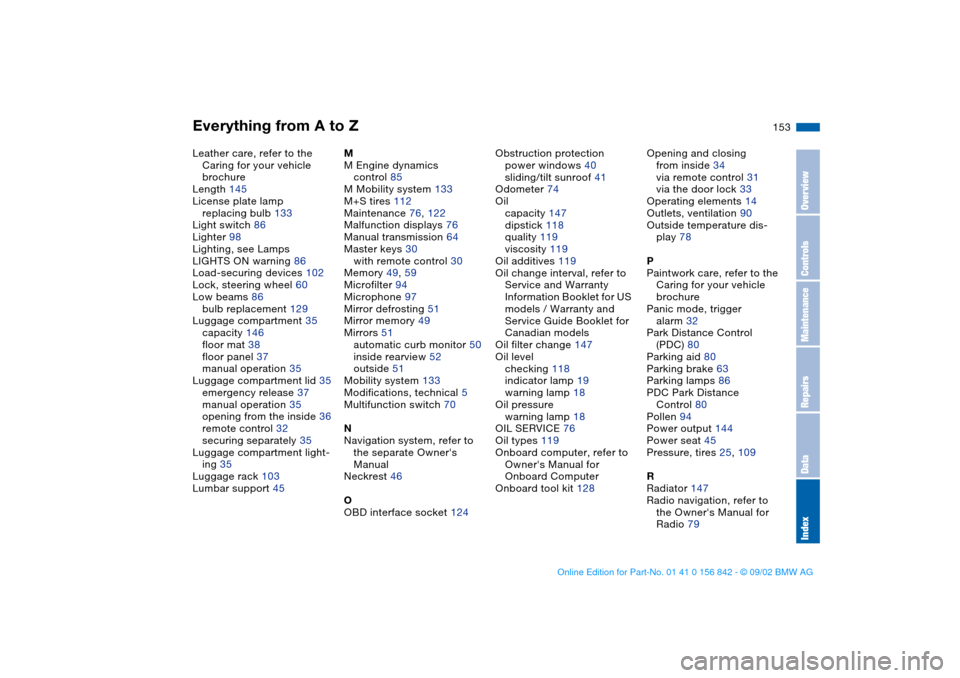
Pressure, tires 25, 109
R
Radiator 147
Radio navigation, refer to
the Owner's Manual for
Radio 79
OverviewControlsMaintenanceRepairsDataIndex
handbook.book Page 153 Saturday, July 27, 2002 1:12 PM