alarm BMW M5 SEDAN 2002 Owners Manual
[x] Cancel search | Manufacturer: BMW, Model Year: 2002, Model line: M5 SEDAN, Model: BMW M5 SEDAN 2002Pages: 154, PDF Size: 2.17 MB
Page 4 of 154

Contents
© 2001 BMW M GmbH
Munich, Germany
Reprinting, including excerpts, only with the
written consent of BMW AG, Munich.
Order no. 01 41 0 156 225
US English VIII/01
Printed in Germany
Printed on environmentally friendly paper
(bleached without chlorine, suitable for recycling).
Overview
Controls and features
Cockpit14
Instrument cluster15
Indicator and warning lamps16
Steering wheel with multifunction
buttons19
Warning triangle20
First-aid kit20
Refueling20
Fuel specifications22
Tire inflation pressure22
Opening and closing:
Keys26
Central locking system26
Opening and closing Ð via the
door lock27
Opening and closing Ð via the
remote control28
Opening and closing Ð
from the inside31
Luggage compartment lid32
Luggage compartment34
Alarm system35
Electric power windows36
Sliding/tilt sunroof38
Adjustments:
Correct sitting posture40
Seats40
BMW M sport seat41
BMW comfort seat42
Head restraints43
BMW active seat43
Safety belts44
Seat, mirror and
steering wheel memory45
Seat heating46
Steering wheel47
Mirrors48
Passenger safety systems:
Airbags49
Transporting children safely52
Vehicle Memory, Key
Memory55
Driving:
Steering/Ignition lock56
Starting the engine56
Switching off the engine57
Parking brake58
Manual transmission58
Turn signal/Headlamp flasher59
Washer/Wiper system/Rain
sensor60
Cruise control61
Everything under control:
Odometer, outside temperature
display63
Tachometer64
Engine oil temperature64
Fuel gauge64
Temperature gauge65
Service Interval Display65
Check Control66
Multi-Information Display
(MID)69
Digital clock70
Computer73
Contents
Page 10 of 154
10n
For your own safety
Use unleaded gasoline only. Fuels
containing up to and including
10 % ethanol or other oxygenates with
up to 2.8 % oxygen by weight (that is,
15 % MTBE or 3 % methanol plus an
equivalent amount of co-solvent) will
not void the applicable warranties
covering defects in materials or work-
manship. Field experience has indi-
cated significant differences in fuel
quality (volatility, composition, addi-
tives, others) among gasolines offered
for sale in the United States and
Canada. The use of poor-quality fuels
may result in driveability, starting and
stalling problems, especially under
certain environmental conditions, such
as high ambient temperature and high
altitude.
Should you encounter driveability prob-
lems which you suspect could be
related to the fuel you are using, we
recommend that you respond by
switching to a recognized high-quality
brand.
Failure to comply with these recom-
mendations may result in unscheduled
maintenance.
Always observe all applicable safety
rules when you are handling gasoline.
<
Important safety information!
For your own safety, use genuine parts
and accessories approved by BMW.
When you purchase accessories tested
and approved by BMW and Original
BMW Parts, you simultaneously acquire
the assurance that they have been
thoroughly tested by BMW to ensure
optimum performance when installed
on your vehicle.
BMW warrants these parts to be free
from defects in material and workman-
ship.
BMW will not accept any liability for
damages resulting from installation of
parts and accessories not approved by
BMW.
BMW cannot test every product made
by other manufacturers to confirm that
it can be used on a BMW safely and
without risk to either the vehicle, its
operation, or its occupants.
Original BMW Parts, BMW Accessories
and other products approved by BMW,
together with professional advice on
using these items, are available from all
BMW centers.
Installation and operation of non-BMW
approved accessories such as alarms,
radios, amplifiers, radar detectors,
wheels, suspension components, brake
dust shields, telephones (including
operation of any portable cellular phone
from within the vehicle without using an
externally mounted antenna) or trans-
ceiver equipment (such as CB, walkie-
talkie, ham radio or similar) may cause
extensive damage to the vehicle,
compromise its safety, interfere with
the vehicle's electrical system or affect
the validity of the BMW Limited
Warranty. See your BMW center for
additional information.
<
Maintenance, replacement, or
repair of the emission control
devices and systems may be performed
by any automotive repair establishment
or individual using any certified auto-
motive part.
<
Symbol on vehicle parts
Indicates that you should consult
the relevant section of this
Owner's Manual for information on a
particular part or assembly.
For your own safety
Page 26 of 154
26n
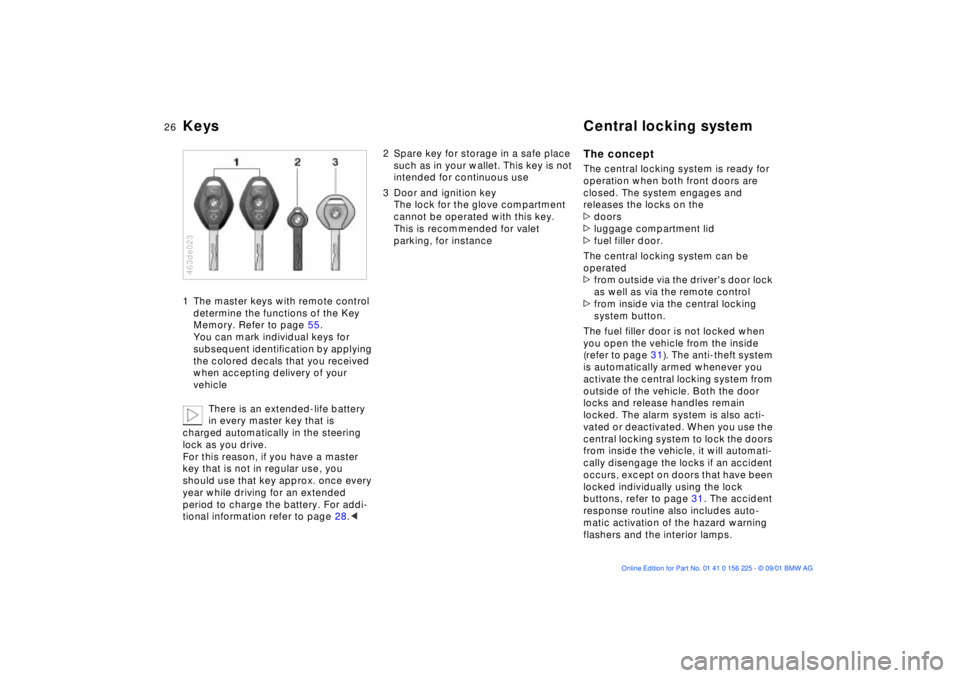
Keys Central locking system1 The master keys with remote control
determine the functions of the Key
Memory. Refer to page 55.
You can mark individual keys for
subsequent identification by applying
the colored decals that you received
when accepting delivery of your
vehicle
There is an extended-life battery
in every master key that is
charged automatically in the steering
lock as you drive.
For this reason, if you have a master
key that is not in regular use, you
should use that key approx. once every
year while driving for an extended
period to charge the battery. For addi-
tional information refer to page 28.< 463de023
2 Spare key for storage in a safe place
such as in your wallet. This key is not
intended for continuous use
3 Door and ignition key
The lock for the glove compartment
cannot be operated with this key.
This is recommended for valet
parking, for instance
The conceptThe central locking system is ready for
operation when both front doors are
closed. The system engages and
releases the locks on the
>doors
>luggage compartment lid
>fuel filler door.
The central locking system can be
operated
>from outside via the driver's door lock
as well as via the remote control
>from inside via the central locking
system button.
The fuel filler door is not locked when
you open the vehicle from the inside
(refer to page 31). The anti-theft system
is automatically armed whenever you
activate the central locking system from
outside of the vehicle. Both the door
locks and release handles remain
locked. The alarm system is also acti-
vated or deactivated. When you use the
central locking system to lock the doors
from inside the vehicle, it will automati-
cally disengage the locks if an accident
occurs, except on doors that have been
locked individually using the lock
buttons, refer to page 31. The accident
response routine also includes auto-
matic activation of the hazard warning
flashers and the interior lamps.
Page 28 of 154
28n
Opening and closing Ð via the remote control
The concept
The remote control gives you an excep-
tionally convenient method for
unlocking and locking your vehicle.
Furthermore, it provides two additional
functions that can only be executed by
means of the remote control:
>
To switch on interior lamps, refer to
page 29
With this function, you can also
"search for" your vehicle Ð when
parked in an underground garage, for
instance
>
To open the luggage compartment
lid, refer to page 29
The luggage compartment lid will
open slightly, regardless of whether it
was previously locked or unlocked
>
Panic mode, refer to page 29
In case of danger, you can trigger an
alarm.
When you unlock (lock) your vehicle the
system automatically deactivates (acti-
vates) the anti-theft system and disarms
(arms)
the alarm system while also
switching on (off) the interior lamps.
You can have a signal set as an
acknowledgment message that
the vehicle is closed correctly.
<
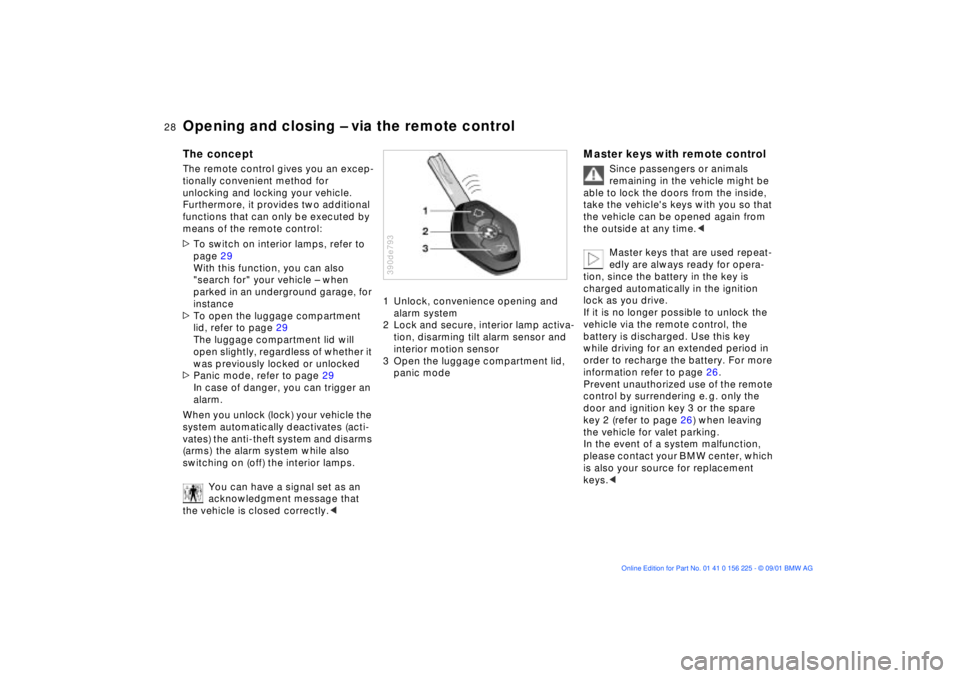
1 Unlock, convenience opening and
alarm system
2 Lock and secure, interior lamp activa-
tion, disarming tilt alarm sensor and
interior motion sensor
3 Open the luggage compartment lid,
panic mode390de793
Master keys with remote control
Since passengers or animals
remaining in the vehicle might be
able to lock the doors from the inside,
take the vehicle's keys with you so that
the vehicle can be opened again from
the outside at any time.
<
Master keys that are used repeat-
edly are always ready for opera-
tion, since the battery in the key is
charged automatically in the ignition
lock as you drive.
If it is no longer possible to unlock the
vehicle via the remote control, the
battery is discharged. Use this key
while driving for an extended period in
order to recharge the battery. For more
information refer to page 26.
Prevent unauthorized use of the remote
control by surrendering e. g. only the
door and ignition key 3 or the spare
key 2 (refer to page 26) when leaving
the vehicle for valet parking.
In the event of a system malfunction,
please contact your BMW center, which
is also your source for replacement
keys.
<
Page 29 of 154
29n
OverviewControlsMaintenanceRepairsDataIndex
Opening and closing Ð via the remote control To unlockPress button.
Press the button once to unlock the
driver's door only; press a second time
to unlock all remaining doors as well as
the luggage compartment lid and fuel
filler door.Convenience opening modePress and hold button to open the elec-
tric power windows and sliding/tilt
sunroof.
To lock and secure Press button.
Vehicles without armored glass:
Do not lock the vehicle if anyone
will be remaining inside, as it would
then be impossible for the occupant(s)
to disengage the locks from the
inside.< To deactivate the tilt alarm sensor
and the interior motion sensorPress button a second time immedi-
ately after locking.
For additional information, refer to
page 36.To switch on the interior lampsWith the vehicle locked, press button.
To open the luggage
compartment lidPress button.
The luggage compartment lid will open
slightly, regardless of whether the lid
was previously locked or unlocked.
Before and after a trip, be sure
that the luggage compartment lid
has not been opened unintentionally.
danger by holding down the button for
between two and five seconds.
To cancel alarm
Press button.
Page 31 of 154
31n
OverviewControlsMaintenanceRepairsDataIndex
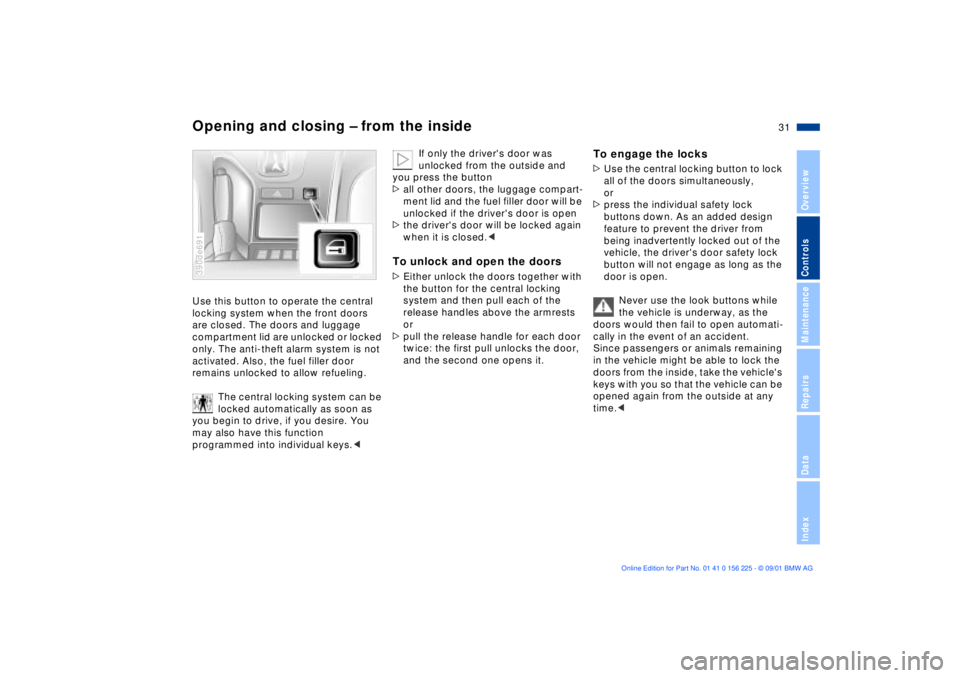
Opening and closing Ð from the insideUse this button to operate the central
locking system when the front doors
are closed. The doors and luggage
compartment lid are unlocked or locked
only. The anti-theft alarm system is not
activated. Also, the fuel filler door
remains unlocked to allow refueling.
The central locking system can be
locked automatically as soon as
you begin to drive, if you desire. You
may also have this function
programmed into individual keys.<390de691
If only the driver's door was
unlocked from the outside and
you press the button
>all other doors, the luggage compart-
ment lid and the fuel filler door will be
unlocked if the driver's door is open
>the driver's door will be locked again
when it is closed.<
To unlock and open the doors>Either unlock the doors together with
the button for the central locking
system and then pull each of the
release handles above the armrests
or
>pull the release handle for each door
twice: the first pull unlocks the door,
and the second one opens it.
To engage the locks>Use the central locking button to lock
all of the doors simultaneously,
or
>press the individual safety lock
buttons down. As an added design
feature to prevent the driver from
being inadvertently locked out of the
vehicle, the driver's door safety lock
button will not engage as long as the
door is open.
Never use the look buttons while
the vehicle is underway, as the
doors would then fail to open automati-
cally in the event of an accident.
Since passengers or animals remaining
in the vehicle might be able to lock the
doors from the inside, take the vehicle's
keys with you so that the vehicle can be
opened again from the outside at any
time.<
Page 35 of 154
35n
OverviewControlsMaintenanceRepairsDataIndex
Alarm systemThe conceptThe vehicle alarm system responds:
>When a door, the hood or the
luggage compartment lid are opened
>To movement inside the vehicle (inte-
rior motion sensor)
>Variations in the vehicle's tilt angle of
the kind that occur during attempts to
steal the wheels or tow the vehicle
>To interruption of battery voltage.
The system responds to unauthorized
vehicle entry and attempted theft by
simultaneously activating the following:
>Sounding an acoustical alarm for
30 seconds
>The hazard warning flashers are acti-
vated for approx. five minutes
>The high beams flash on and off in
the same rhythm as the hazard
warning flashers.
To arm and disarm the
alarm systemWhen the vehicle is locked or unlocked
with the key or the remote control, the
alarm system is also simultaneously
armed or disarmed.
You can have different acknowl-
edgment messages set to confirm
arming and disarming.<
You can also open the luggage
compartment lid when the system is
armed by pressing the button on the
remote control (refer to page 29). When
you close the luggage compartment lid,
the luggage compartment is secured
again.
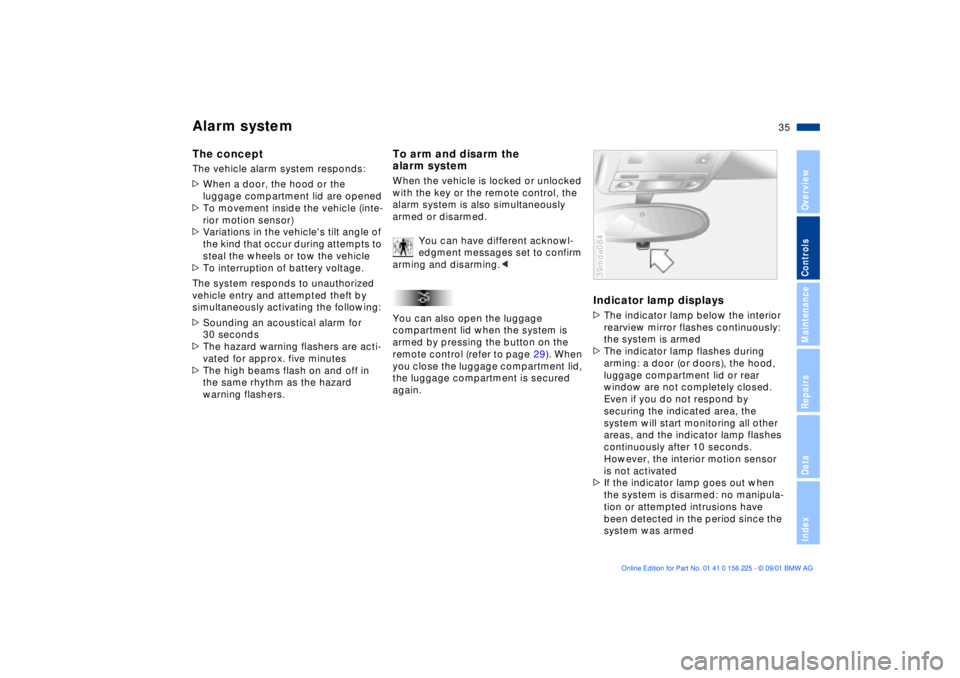
Indicator lamp displays>The indicator lamp below the interior
rearview mirror flashes continuously:
the system is armed
>The indicator lamp flashes during
arming: a door (or doors), the hood,
luggage compartment lid or rear
window are not completely closed.
Even if you do not respond by
securing the indicated area, the
system will start monitoring all other
areas, and the indicator lamp flashes
continuously after 10 seconds.
However, the interior motion sensor
is not activated
>If the indicator lamp goes out when
the system is disarmed: no manipula-
tion or attempted intrusions have
been detected in the period since the
system was armed39mde084
Page 36 of 154
36n
Alarm system Electric power windows>If the indicator lamp flashes for
10 seconds when the system is
disarmed: an attempted entry has
been detected in the period since the
system was armed.
Following triggering of an alarm, the
indicator lamp will flash continuously.Avoiding unintentional alarms The tilt alarm sensor and interior motion
sensor may be switched off at the same
time. You can do this to prevent a false
alarm from being triggered (in garages
with elevator ramps, for instance), or
when the vehicle is transported by
trailer or train:
Actuate the lock (= arm the system)
twice; in other words, press button 2 of
the remote control twice in succession
(refer to page 29). You may also actuate
the locks twice with the key (refer to
page 27).
The indicator lamp lights up briefly and
then flashes continuously. The tilt alarm
sensor and the interior motion sensor
are deactivated as long as the system is
armed.
Interior motion sensorIn order for the interior motion sensor to
function properly, the windows and
sliding/tilt sunroof must be completely
closed.
Nevertheless, you should deactivate
the interior motion sensor (refer to
"Avoiding unintentional alarms") if
>children or animals are left in the
vehicle
>the windows or the sliding/tilt sunroof
are being left open.
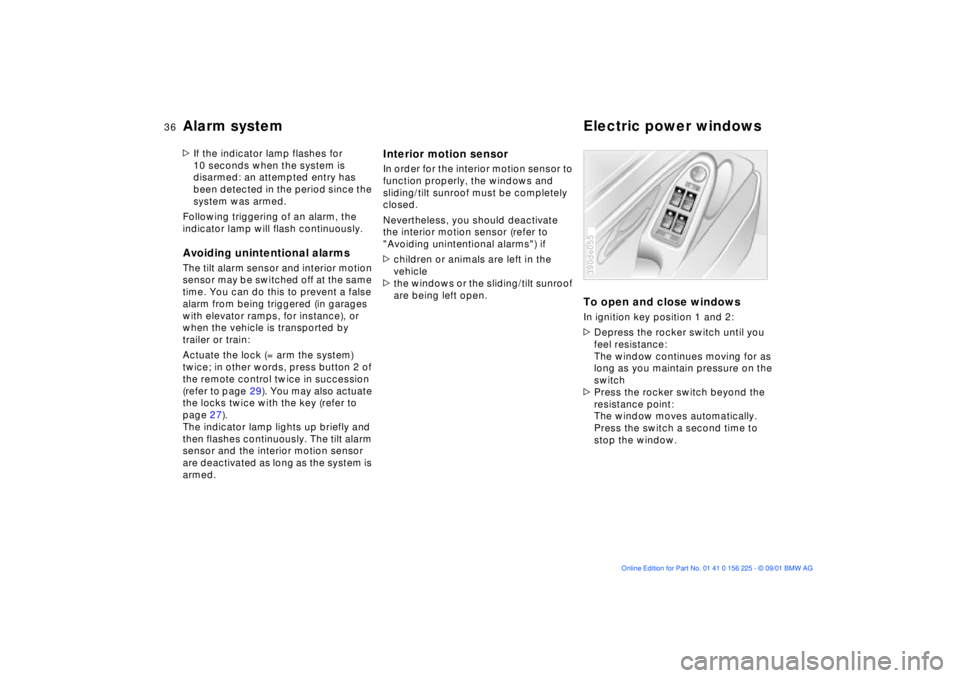
To open and close windowsIn ignition key position 1 and 2:
>Depress the rocker switch until you
feel resistance:
The window continues moving for as
long as you maintain pressure on the
switch
>Press the rocker switch beyond the
resistance point:
The window moves automatically.
Press the switch a second time to
stop the window.390de055
Page 77 of 154
77n
OverviewControlsMaintenanceRepairsDataIndex
ComputerAfter three incorrect code entries, or
three attempts to start the engine
without a code entry, the alarm will
sound for 30 seconds on vehicles
equipped with an alarm.
Setting the alarm in an emergency:
If you have forgotten the code, proceed
as follows:
1. Disconnect the battery, wait about
2 minutes, then reconnect it. Note
that on vehicles with an alarm, this
will sound
2. Place the ignition key in position 1:
The time display will count down for
the next ten minutes
3. After ten minutes, start the engine.
If the code becomes available
again in the meantime, it can be
entered during the waiting period after
pressing the CODE button.<
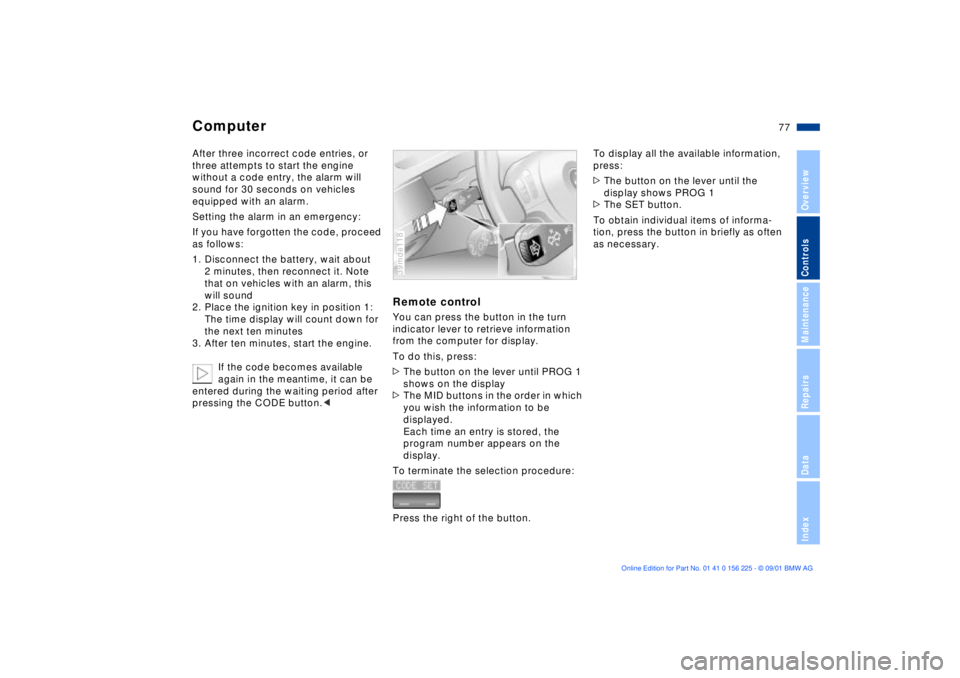
Remote controlYou can press the button in the turn
indicator lever to retrieve information
from the computer for display.
To do this, press:
>The button on the lever until PROG 1
shows on the display
>The MID buttons in the order in which
you wish the information to be
displayed.
Each time an entry is stored, the
program number appears on the
display.
To terminate the selection procedure:
Press the right of the button.39mde118
To display all the available information,
press:
>The button on the lever until the
display shows PROG 1
>The SET button.
To obtain individual items of informa-
tion, press the button in briefly as often
as necessary.
Page 93 of 154
93n
OverviewControlsMaintenanceRepairsDataIndex
The conceptThe BMW Universal Transmitter
replaces up to 3 hand-held transmitters,
e.g. for garage-door openers, alarm
systems or a door-locking system. The
BMW Universal Transmitter recognizes
and "learns" the signal transmitted from
each of the original hand-held transmit-
ters.
The signal of an original hand-held
transmitter can be programmed to one
of three channel keys. Following that,
each of the devices can be actuated
with the appropriately-programmed
channel key. The indicator lamp flashes
to confirm transmission of the signal.
Before you sell your vehicle, the
program data in the channel keys
should be deleted. Refer to page 95 for
the description of this process.
To prevent potential injuries or
damage: during the programming
operation and before every remote trig-
gering of a programmed device using
the BMW Universal Transmitter, be sure
that there are no persons, animals or
objects within the range of movement of
the respective device. Read and comply
with the safety instructions for the orig-
inal hand-held transmitter also.<
To Canadian residents
During programming, your hand-
held transmitter may automatically stop
transmitting after two seconds. This
may not be long enough to program the
BMW Universal Transmitter. If you are
programming from one of these hand-
held transmitters, the BMW Universal
Transmitter's light may begin to flash in
a series of double-blinks. If this occurs,
continue to hold the key on the BMW
Universal Transmitter while you reacti-
vate your hand-held transmitter. You
may have to repeat this function several
times while programming.<
Before programming, read the
"User's information" section on
page 95.<
The original hand-held transmitter
If this symbol is depicted on the
packaging or in the user's
instructions for the original
hand-held transmitter, it may be
assumed that this original hand-held
transmitter is compatible with the BMW
Universal Transmitter.
Checking for the change codeIn order to determine whether the orig-
inal hand-held transmitter is equipped
with a change code system, you may
either refer to the instructions for the
original hand-held transmitter or
program a channel key as described in
the left-hand column on page 94 under
"Programming."
Following that, press and hold the
programmed channel key on the BMW
Universal Transmitter. If the indicator
lamp on the BMW Universal Transmitter
flashes rapidly for two seconds and
then stays on continuously, the original
hand-held transmitter is equipped with
a change code system. If the change
code system is available, program the
channel keys as described on page 94
in the right-hand column under
"Programming a hand-held transmitter
with change code."
If you have additional questions,
please consult your BMW center
or call 1-800-355-3515.<
BMW Universal Transmitter
*