maintenance BMW M5 SEDAN 2003 Repair Manual
[x] Cancel search | Manufacturer: BMW, Model Year: 2003, Model line: M5 SEDAN, Model: BMW M5 SEDAN 2003Pages: 155, PDF Size: 1.87 MB
Page 117 of 155

117n
OverviewControlsMaintenanceRepairsDataIndex
Engine oil CoolantSpecified engine oils The quality of the engine oil is
extremely important for the function
and service life of an engine. Based on
extensive testing, BMW approves only
certain grades of engine oil.
Use only approved "BMW High Perfor-
mance Synthetic Oil."
If you are unable to obtain "BMW High
Performance Synthetic Oil," you can
add small amounts of synthetic oil in
between oil changes. Only use oils with
the API SH specification or higher.
Ask your BMW center for details
concerning the specific "BMW
High Performance Synthetic Oil" or
"special oils" which have been
approved.<
You can also call BMW of North
America at 1-800-831-1117 or visit this
website: www.bmwusa.com to obtain
this information.
Viscosity ratings Viscosity is the oil flow rating as estab-
lished in SAE classes.
The selection of the correct SAE class
depends on the climatic conditions in
the area where you typically drive your
BMW.
Approved oils are in SAE classes
5W-40 and 5W-30.<
These oils may be used for driving in all
ambient temperatures.
Do not add coolant to the cooling
system when the engine is hot.
If you attempt to do so, escaping
coolant can cause scalds. To avoid the
possibility of secondary damage, never
use anything other than factory-
approved, nitrite and amino-free
extended-duty antifreeze with corrosion
inhibitor. Your BMW center is familiar
with these specifications.
Antifreeze and anti-corrosion agents
are hazardous to health. You should
always store them in their original con-
tainers and in a location which is out of
reach of children. For this reason, do
not spill antifreeze with corrosion inhib-
itor on hot engine parts. It could ignite
and cause burns.<
Page 119 of 155
119n
OverviewControlsMaintenanceRepairsDataIndex
The BMW Maintenance System has
been designed as a reliable means of
providing maximum driving and oper-
ating safety Ð and as cost-effectively as
possible for you.
Please keep in mind that regular main-
tenance is not only necessary for the
safety of your vehicle, but also plays a
significant role in maintaining its resale
value. 380us008
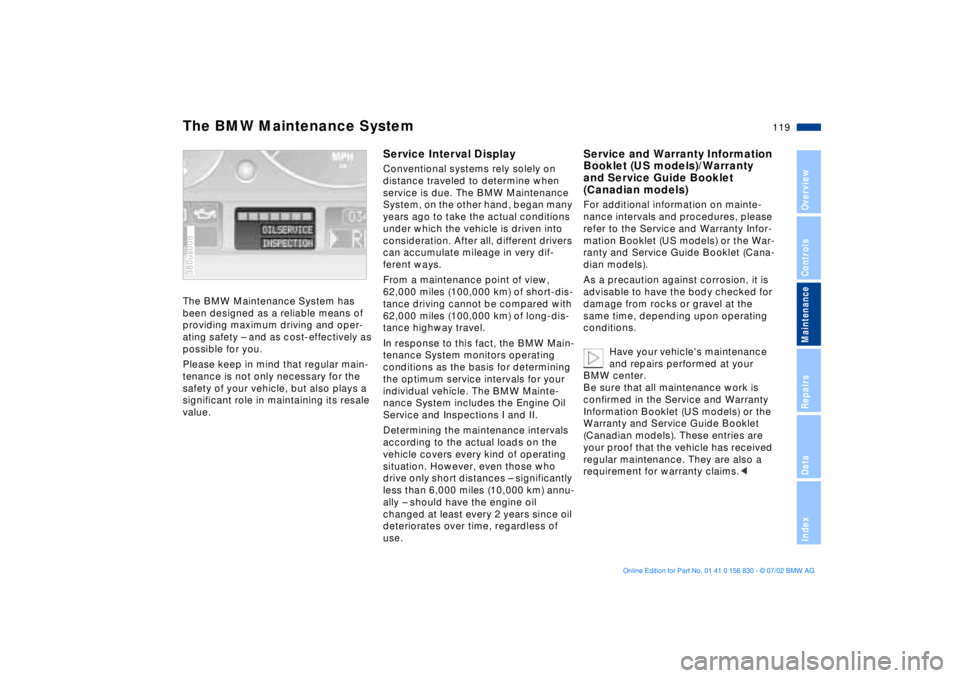
Service Interval DisplayConventional systems rely solely on
distance traveled to determine when
service is due. The BMW Maintenance
System, on the other hand, began many
years ago to take the actual conditions
under which the vehicle is driven into
consideration. After all, different drivers
can accumulate mileage in very dif-
ferent ways.
From a maintenance point of view,
62,000 miles (100,000 km) of short-dis-
tance driving cannot be compared with
62,000 miles (100,000 km) of long-dis-
tance highway travel.
In response to this fact, the BMW Main-
tenance System monitors operating
conditions as the basis for determining
the optimum service intervals for your
individual vehicle. The BMW Mainte-
nance System includes the Engine Oil
Service and Inspections I and II.
Determining the maintenance intervals
according to the actual loads on the
vehicle covers every kind of operating
situation. However, even those who
drive only short distances Ð significantly
less than 6,000 miles (10,000 km) annu-
ally Ð should have the engine oil
changed at least every 2 years since oil
deteriorates over time, regardless of
use.
Service and Warranty Information
Booklet (US models)/Warranty
and Service Guide Booklet
(Canadian models)For additional information on mainte-
nance intervals and procedures, please
refer to the Service and Warranty Infor-
mation Booklet (US models) or the War-
ranty and Service Guide Booklet (Cana-
dian models).
As a precaution against corrosion, it is
advisable to have the body checked for
damage from rocks or gravel at the
same time, depending upon operating
conditions.
Have your vehicle's maintenance
and repairs performed at your
BMW center.
Be sure that all maintenance work is
confirmed in the Service and Warranty
Information Booklet (US models) or the
Warranty and Service Guide Booklet
(Canadian models). These entries are
your proof that the vehicle has received
regular maintenance. They are also a
requirement for warranty claims.<
The BMW Maintenance System
Page 121 of 155
121n
OverviewControlsMaintenanceRepairsDataIndex
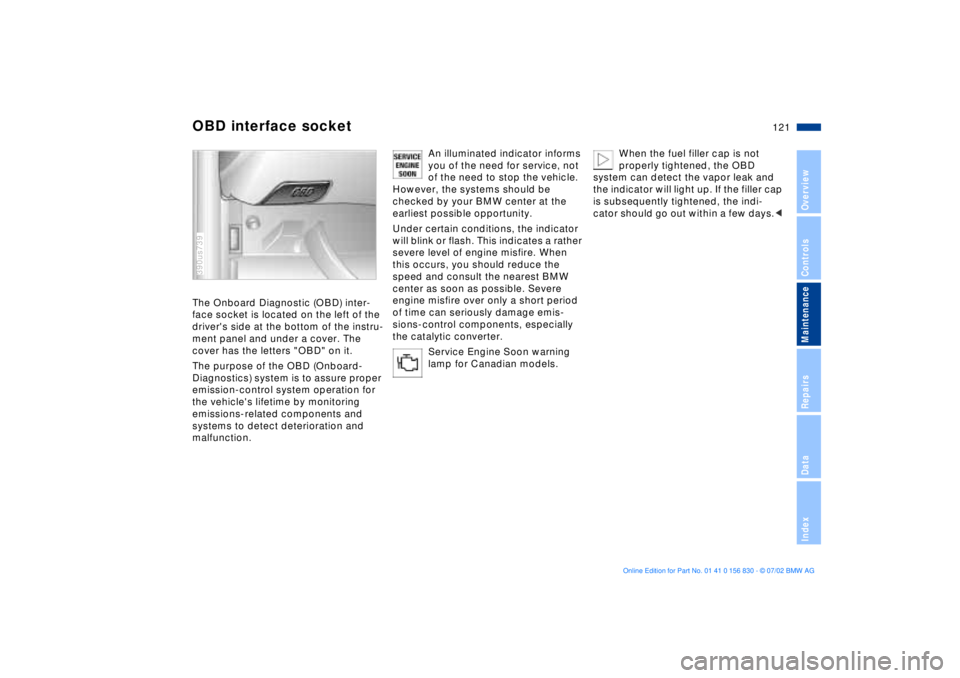
OBD interface socketThe Onboard Diagnostic (OBD) inter-
face socket is located on the left of the
driver's side at the bottom of the instru-
ment panel and under a cover. The
cover has the letters "OBD" on it.
The purpose of the OBD (Onboard-
Diagnostics) system is to assure proper
emission-control system operation for
the vehicle's lifetime by monitoring
emissions-related components and
systems to detect deterioration and
malfunction.390us739
An illuminated indicator informs
you of the need for service, not
of the need to stop the vehicle.
However, the systems should be
checked by your BMW center at the
earliest possible opportunity.
Under certain conditions, the indicator
will blink or flash. This indicates a rather
severe level of engine misfire. When
this occurs, you should reduce the
speed and consult the nearest BMW
center as soon as possible. Severe
engine misfire over only a short period
of time can seriously damage emis-
sions-control components, especially
the catalytic converter.
Service Engine Soon warning
lamp for Canadian models.
When the fuel filler cap is not
properly tightened, the OBD
system can detect the vapor leak and
the indicator will light up. If the filler cap
is subsequently tightened, the indi-
cator should go out within a few days.<
Page 123 of 155
123n
OverviewControlsMaintenanceRepairsDataIndex
Overview
Controls and features
Operation, maintenance
Owner service procedures
Index Technical data
Repairs
Page 125 of 155
125n
OverviewControlsMaintenanceRepairsDataIndex
Lamps and bulbs Xenon lamps
The service life of these bulbs is very
long and the probability of a failure is
very low, provided that they are not
switched on and off an unusual number
of times. If one of these bulbs should
nevertheless fail, it is possible to con-
tinue driving with great caution using
the fog lamps, provided traffic laws in
your area do not prohibit this.
Never attempt to perform bulb
changes or any other service oper-
ations on the xenon lamps. Always have
them serviced by professional techni-
cians. The extremely high voltages at
which these lamps operate constitute a
potentially lethal safety hazard.<
When cleaning the headlamps,
please observe the following:
>Do not clean by wiping with a dry
cloth (this causes scratches). Never
use abrasives or strong solvents to
clean the covers
>Remove dirt and contamination (such
as insects) by soaking with BMW Car
Shampoo and then rinsing with
ample water
>Always use a deicer spray to remove
accumulated ice and snow Ð never
use a scraper.<
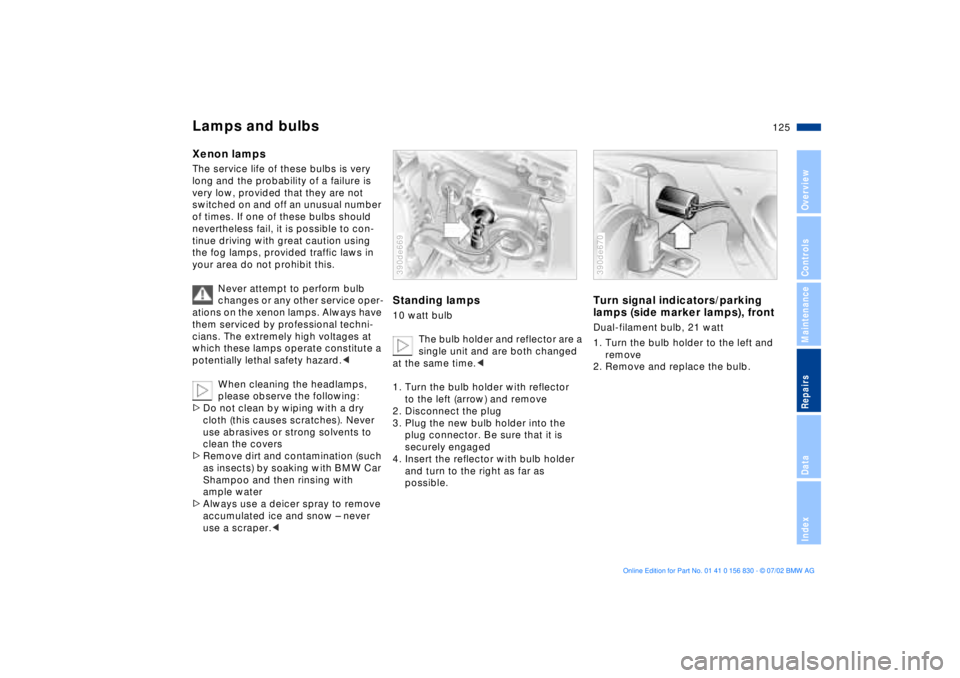
Standing lamps10 watt bulb
The bulb holder and reflector are a
single unit and are both changed
at the same time.<
1. Turn the bulb holder with reflector
to the left (arrow) and remove
2. Disconnect the plug
3. Plug the new bulb holder into the
plug connector. Be sure that it is
securely engaged
4. Insert the reflector with bulb holder
and turn to the right as far as
possible.390de669
Turn signal indicators/parking
lamps (side marker lamps), front Dual-filament bulb, 21 watt
1. Turn the bulb holder to the left and
remove
2. Remove and replace the bulb.390de670
Page 127 of 155
127n
OverviewControlsMaintenanceRepairsDataIndex
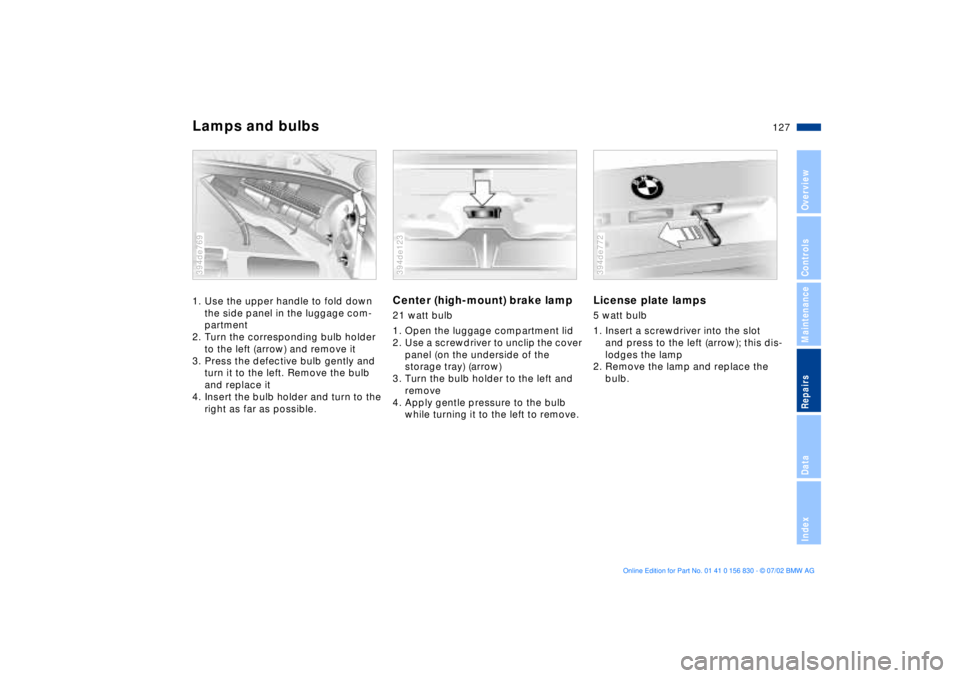
Lamps and bulbs1. Use the upper handle to fold down
the side panel in the luggage com-
partment
2. Turn the corresponding bulb holder
to the left (arrow) and remove it
3. Press the defective bulb gently and
turn it to the left. Remove the bulb
and replace it
4. Insert the bulb holder and turn to the
right as far as possible.394de769
Center (high-mount) brake lamp
21 watt bulb
1. Open the luggage compartment lid
2. Use a screwdriver to unclip the cover
panel (on the underside of the
storage tray) (arrow)
3. Turn the bulb holder to the left and
remove
4. Apply gentle pressure to the bulb
while turning it to the left to remove.394de123
License plate lamps 5 watt bulb
1. Insert a screwdriver into the slot
and press to the left (arrow); this dis-
lodges the lamp
2. Remove the lamp and replace the
bulb.394de772
Page 129 of 155
129n
OverviewControlsMaintenanceRepairsDataIndex
Repairing a flat tireUse the M Mobility system
If possible, leave the foreign
object in the tire.<
Do not exceed the maximum
speeds indicated below, as an
accident could result.
Before you use the M Mobility system,
read the warnings and danger notices
on the device carefully.<
1. Remove the warning sticker 5 for
maximum speed that is located on
top of the device and affix it to the
steering wheel
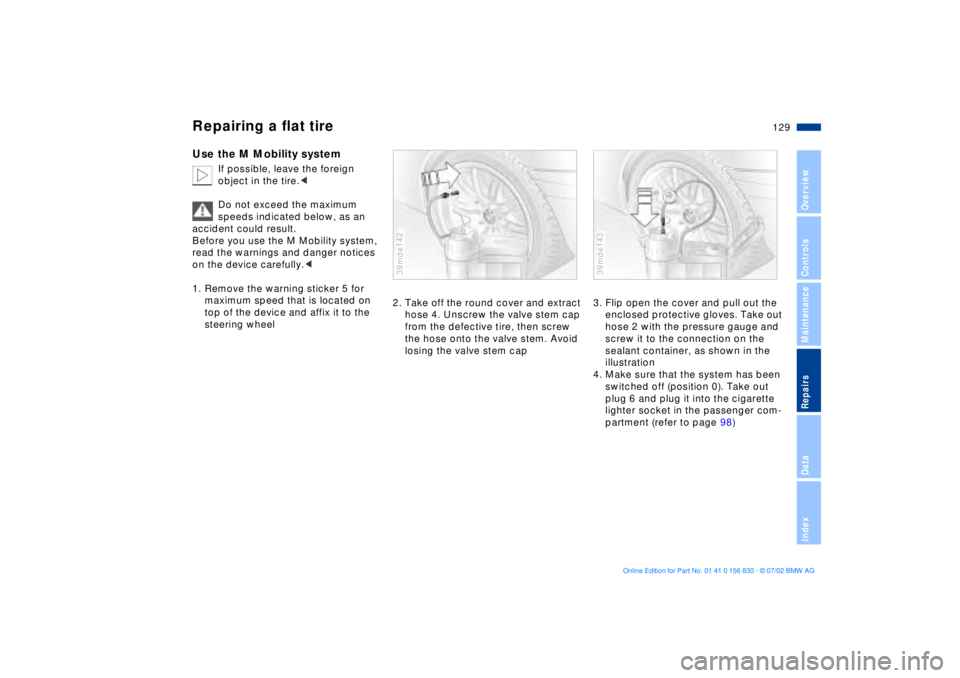
2. Take off the round cover and extract
hose 4. Unscrew the valve stem cap
from the defective tire, then screw
the hose onto the valve stem. Avoid
losing the valve stem cap39mde142
3. Flip open the cover and pull out the
enclosed protective gloves. Take out
hose 2 with the pressure gauge and
screw it to the connection on the
sealant container, as shown in the
illustration
4. Make sure that the system has been
switched off (position 0). Take out
plug 6 and plug it into the cigarette
lighter socket in the passenger com-
partment (refer to page 98)39mde143
Page 131 of 155

131n
OverviewControlsMaintenanceRepairsDataIndex
Repairing a flat tire Battery
If the inflation pressure does not
hold, complete step 10 and then
repeat steps 7 through 10.
The use of the M Mobility system may
be ineffective if the damaged area in
the tire is larger than approx. 0.15 in
(4 mm). If it should prove impossible to
restore the tire to operational status
using the M Mobility system, please
contact the nearest BMW center or
BMW Roadside Assistance at
1-800-332-4269.<
10. Unscrew the hose from the valve
and stow the M Mobility system in
the luggage compartment. Screw
the cap back onto the valve stem.
When you start driving again, do not
exceed the permissible maximum
speed of 50 mph (80 km/h).
You will find corresponding instructions
for using the M Mobility system on the
device.
Replace the defective tire as soon as
possible and have the wheel and tire
balanced. Reactivate the Flat Tire Mon-
itor, for additional information refer to
page 82. Have the M Mobility system
recharged. Contact your BMW center
for this.
Protect valve stems and valves from dirt
using screw-on valve stem caps. Dirty
valve stems frequently lead to slow
pressure loss.Battery posts, terminals and
related accessories contain lead
and lead compounds. Wash hands after
handling.<
Battery careThe battery is completely maintenance-
free. That means that the original elec-
trolyte will normally last for the service
life of the battery under moderate cli-
matic conditions.
Please consult the staff at your
BMW center whenever you have
any questions concerning the battery.
The battery is completely maintenance-
free; the following section is provided
for your information only.<
Never disconnect the battery
when the engine is running; the
ensuing voltage surge would seriously
damage the vehicle's onboard elec-
tronic systems.<
Page 133 of 155
133n
OverviewControlsMaintenanceRepairsDataIndex
Do not use spray starter fluids to start
the engine.
When your battery is discharged you
can used two jumper cables to start
your vehicle with power from the bat-
tery in a second vehicle. You can also
use the same method to help start
another vehicle. Use only jumper cables
with fully insulated handles on the ter-
minal clamps.
Do not touch high-voltage wiring
and cables on a running engine.
There is a risk of fatal injury if you do
this. Carefully observe the following
instructions to avoid personal injury
and/or damage to one or both vehi-
cles.<
1. Ensure that the battery in the sup-
port vehicle is also rated at
12 volts. This information is pro-
vided on the top of the battery
casing
2. Do not disconnect your battery from
your vehicle's electrical system.
Switch off all electrical accessories
in both vehicles
3. Make absolutely certain that there
is no contact between the body-
work of the two vehicles Ð short cir-
cuit hazard
4. Start the engine on the support
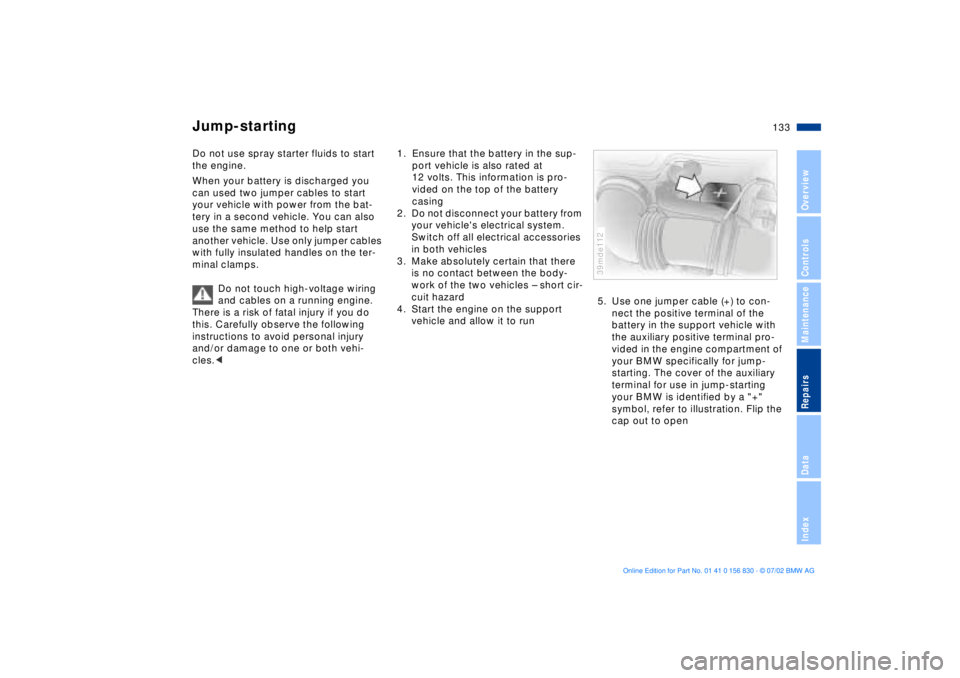
vehicle and allow it to run5. Use one jumper cable (+) to con-
nect the positive terminal of the
battery in the support vehicle with
the auxiliary positive terminal pro-
vided in the engine compartment of
your BMW specifically for jump-
starting. The cover of the auxiliary
terminal for use in jump-starting
your BMW is identified by a "+"
symbol, refer to illustration. Flip the
cap out to open
39mde112
Jump-starting
Page 135 of 155
135n
OverviewControlsMaintenanceRepairsDataIndex
Towing the vehicleTow fittingThe screw-in tow fitting is stored in the
onboard tool kit; be sure that it remains
in the vehicle at all times. This fitting
is designed for installation in the tow
sockets located at the front and rear of
the vehicle, and is intended for towing
on proper road surfaces only.
It should not be used to pull a vehicle
out of deep snow, mud, sand, etc.
Always observe all applicable towing
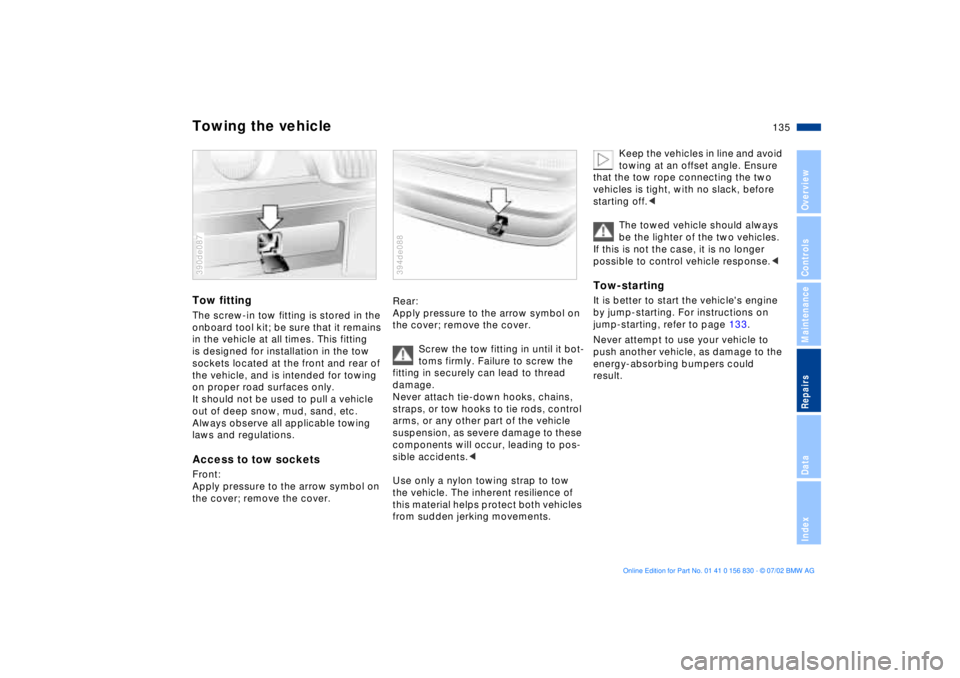
laws and regulations.Access to tow sockets Front:
Apply pressure to the arrow symbol on
the cover; remove the cover.390de087
Rear:
Apply pressure to the arrow symbol on
the cover; remove the cover.
Screw the tow fitting in until it bot-
toms firmly. Failure to screw the
fitting in securely can lead to thread
damage.
Never attach tie-down hooks, chains,
straps, or tow hooks to tie rods, control
arms, or any other part of the vehicle
suspension, as severe damage to these
components will occur, leading to pos-
sible accidents.<
Use only a nylon towing strap to tow
the vehicle. The inherent resilience of
this material helps protect both vehicles
from sudden jerking movements.394de088
Keep the vehicles in line and avoid
towing at an offset angle. Ensure
that the tow rope connecting the two
vehicles is tight, with no slack, before
starting off.<
The towed vehicle should always
be the lighter of the two vehicles.
If this is not the case, it is no longer
possible to control vehicle response.<
Tow-startingIt is better to start the vehicle's engine
by jump-starting. For instructions on
jump-starting, refer to page 133.
Never attempt to use your vehicle to
push another vehicle, as damage to the
energy-absorbing bumpers could
result.