clutch BMW M6 COUPE 2013 F13 User Guide
[x] Cancel search | Manufacturer: BMW, Model Year: 2013, Model line: M6 COUPE, Model: BMW M6 COUPE 2013 F13Pages: 214, PDF Size: 7.08 MB
Page 154 of 214
Hydroplaning
When driving on wet or slushy roads, re‐
duce your speed to prevent hydroplaning.◀
Driving through water Drive though calm water only and only if it is
not deeper than. 9.8 inches/25 cm and at this
height, no faster than walking speed, up to
6 mph/10 km/h.
Adhere to water depth and speed limita‐
tions
Do not exceed this water depth and walking
speed; otherwise, the vehicle's engine, the
electrical systems and the transmission may
be damaged.◀
Braking safely
Your vehicle is equipped with ABS as a stand‐
ard feature.
Applying the brakes fully is the most effective
way of braking in situations when this is neces‐
sary.
The vehicle maintains steering responsive‐
ness. You can still avoid any obstacles with a
minimum of steering effort.
The pulsing of the brake pedal indicates that
ABS is in its active mode.
In certain braking situations, the perforated
brake discs can cause functional problems.
However, this has no effect on the perform‐
ance and operational reliability of the brake.
Objects in the area around the pedals No objects in the area around the pedals
Keep floor mats, carpets, and any other
objects out of the area of motion of the pedals;
otherwise, the function of the pedals could be
impeded while driving
Do not place additional floor mats over existing
mats or other objects.Only use floor mats that have been approved
for the vehicle and can be properly fixed in
place.
Ensure that the floor mats are securely fas‐
tened again after they were removed for clean‐
ing, for example.◀
Driving in wet conditions When roads are wet coated with road salt or
there is heavy rain, briefly exert gentle pres‐
sure on the brake pedal every few miles.
Ensure that this action does not endanger
other road users.
The heat generated in this process helps dry
the brake discs and pads.
In this way braking efficiency will be available
when you need it.
Hills
Drive long or steep downhill gradients in the
gear in which the least braking is required.
Otherwise, the brake system may overheat, re‐
sulting in a reduction in the brake system effi‐
ciency.
Double-clutch transmission:
You can increase the engine's braking effect
by shifting down in sequential mode, refer to
page 66.
Avoid load on the brakes
Avoid placing excessive load on the
brake system. Light but consistent brake pres‐
sure can lead to high temperatures, brake wear
and possibly even brake failure.◀
Do not drive in neutral
Do not drive in neutral or with the engine
stopped, as doing so disables engine braking.
In addition, steering and brake assist is un‐
available with the engine stopped.◀
Brake disc corrosion
The corrosion on the brake discs and the con‐
tamination on the brake pads are furthered by:Seite 150Driving tipsThings to remember when driving150
Online Edition for Part no. 01 40 2 910 796 - VI/13
Page 193 of 214
▷Avoid lateral loading of the tow fitting, e.g.,
do not lift the vehicle by the tow fitting.
Otherwise, damage to the tow fitting and the
vehicle can occur.◀
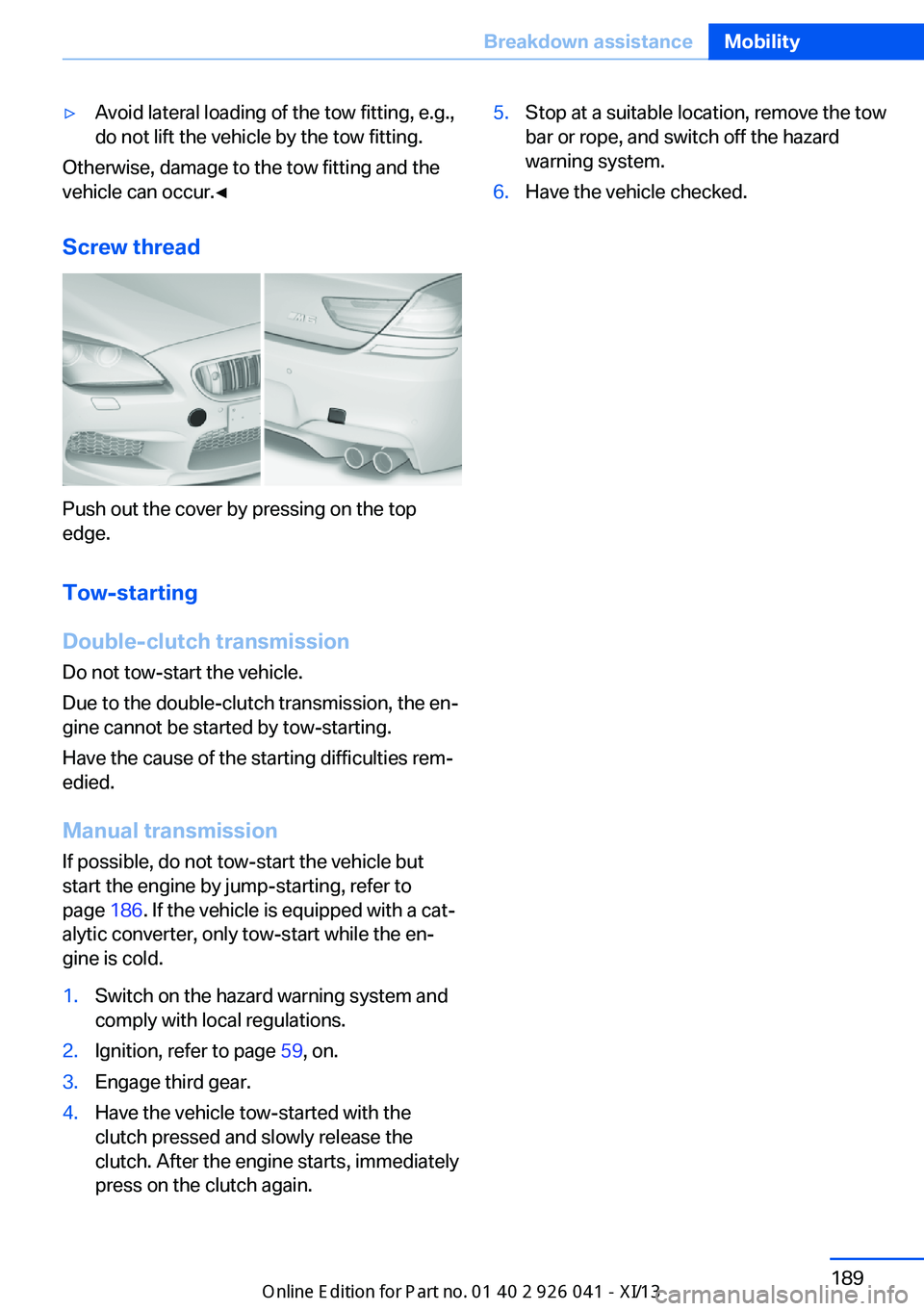
Screw thread
Push out the cover by pressing on the top
edge.
Tow-starting
Double-clutch transmission Do not tow-start the vehicle.
Due to the double-clutch transmission, the en‐
gine cannot be started by tow-starting.
Have the cause of the starting difficulties rem‐
edied.
Manual transmission
If possible, do not tow-start the vehicle but
start the engine by jump-starting, refer to
page 186. If the vehicle is equipped with a cat‐
alytic converter, only tow-start while the en‐
gine is cold.
1.Switch on the hazard warning system and
comply with local regulations.2.Ignition, refer to page 59, on.3.Engage third gear.4.Have the vehicle tow-started with the
clutch pressed and slowly release the
clutch. After the engine starts, immediately
press on the clutch again.5.Stop at a suitable location, remove the tow
bar or rope, and switch off the hazard
warning system.6.Have the vehicle checked.Seite 189Breakdown assistanceMobility189
Online Edition for Part no. 01 40 2 910 796 - VI/13
Page 195 of 214
Double-clutch transmission:1.Drive into the car wash.2.Engage transmission position N.3.Switch the engine off.
In this way, the ignition remains switched
on, and a Check-Control message is dis‐
played.
Do not turn off the ignition in the car
wash
Do not turn off the ignition in the car wash;
otherwise, the transmission position P is
engaged and damages can result.◀
To start the engine:
1.Depress the brake pedal.2.Press the Start/Stop button.
Pressing the Start/Stop button without step‐
ping on the brake turns the ignition off.
The vehicle cannot be locked from the outside
when in transmission position N. A signal is
sounded when an attempt is made to lock the
vehicle.
Transmission position
Transmission position P is engaged automati‐
cally:
▷When the ignition is switched off.▷After approx. 15 minutes.
Headlamps
▷Do not rub dry and do not use abrasive or
caustic cleansers.▷Soak areas that have been soiled e.g. due
to insects, with shampoo and wash off with
water.▷Thaw ice with deicing spray; do not use an
ice scraper.
After washing the vehicle
After washing the vehicle, apply the brakes
briefly to dry them; otherwise, braking action
can be reduced and corrosion of the brake
discs can occur.
Completely remove all residues on the win‐
dows, to minimize loss of visibility due to
smearing and to reduce wiper noises and
wiper blade wear.
Vehicle care
Car care products BMW recommends using cleaning and care
products from BMW, since these have been
tested and approved.
Car care and cleaning products
Follow the instructions on the container.
When cleaning the interior, open the doors or
windows.
Only use products intended for cleaning vehi‐
cles.
Cleansers can contain substances that are
dangerous and harmful to your health.◀
Vehicle paint
Regular care contributes to driving safety and
value retention. Environmental influences in
areas with elevated air pollution or natural con‐
taminants, such as tree resin or pollen can af‐
fect the vehicle's paintwork. Tailor the fre‐
quency and extent of your car care to these
influences.
Aggressive substances, such as spilled fuel,
oil, grease or bird droppings, must be removed
immediately to prevent the finish from being
altered or discolored.
Leather care
Remove dust from the leather often, using a
cloth or vacuum cleaner.
Otherwise, particles of dust and road grime
chafe in pores and folds, and lead to increased
wear and premature degradation of the leather
surface.Seite 191CareMobility191
Online Edition for Part no. 01 40 2 910 796 - VI/13
Page 201 of 214
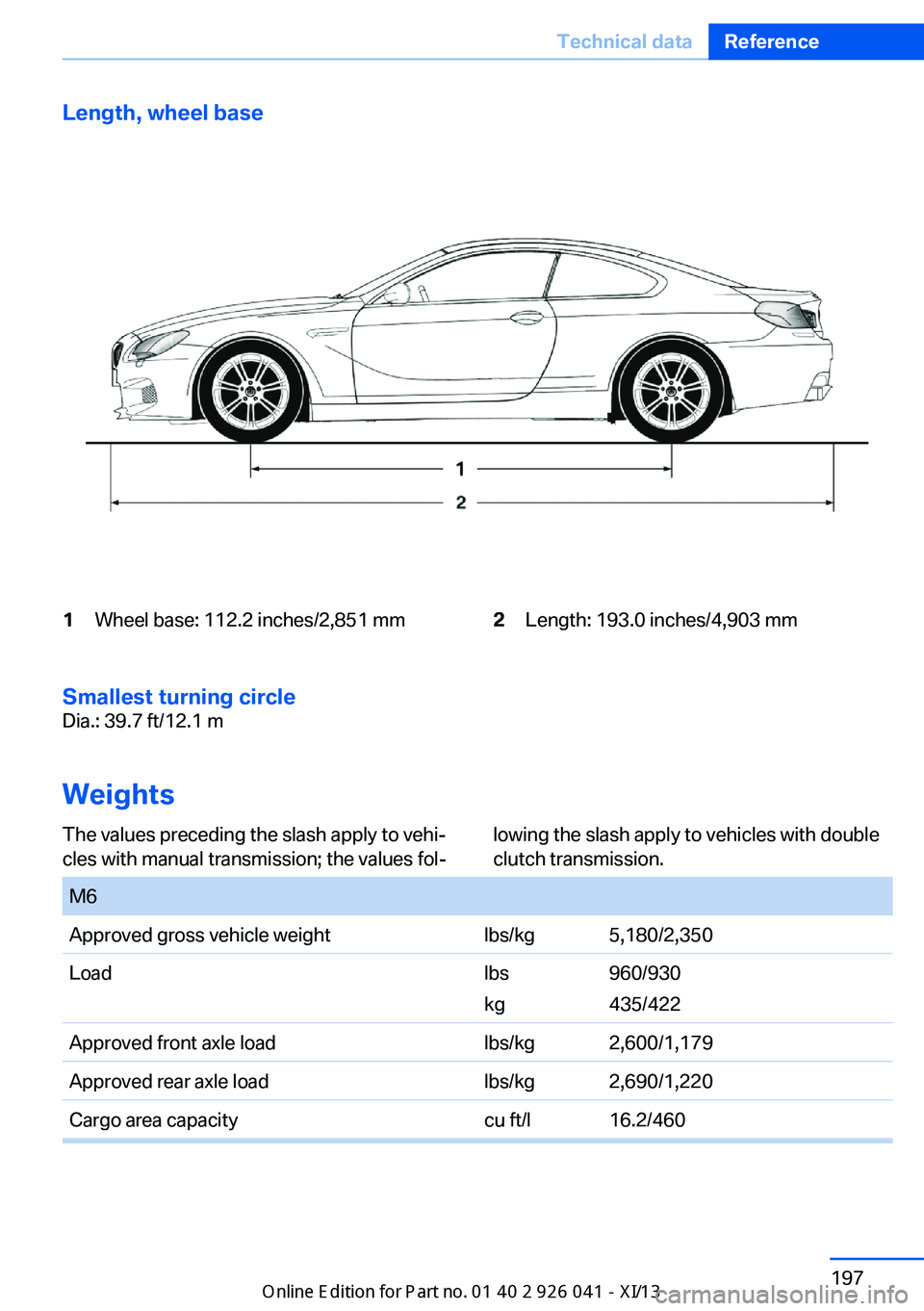
Length, wheel base1Wheel base: 112.2 inches/2,851 mm2Length: 193.0 inches/4,903 mm
Smallest turning circle
Dia.: 39.7 ft/12.1 m
Weights
The values preceding the slash apply to vehi‐
cles with manual transmission; the values fol‐lowing the slash apply to vehicles with double
clutch transmission. M6Approved gross vehicle weightlbs/kg5,180/2,350Loadlbs
kg960/930
435/422Approved front axle loadlbs/kg2,600/1,179Approved rear axle loadlbs/kg2,690/1,220Cargo area capacitycu ft/l16.2/460Seite 197Technical dataReference197
Online Edition for Part no. 01 40 2 910 796 - VI/13
Page 206 of 214
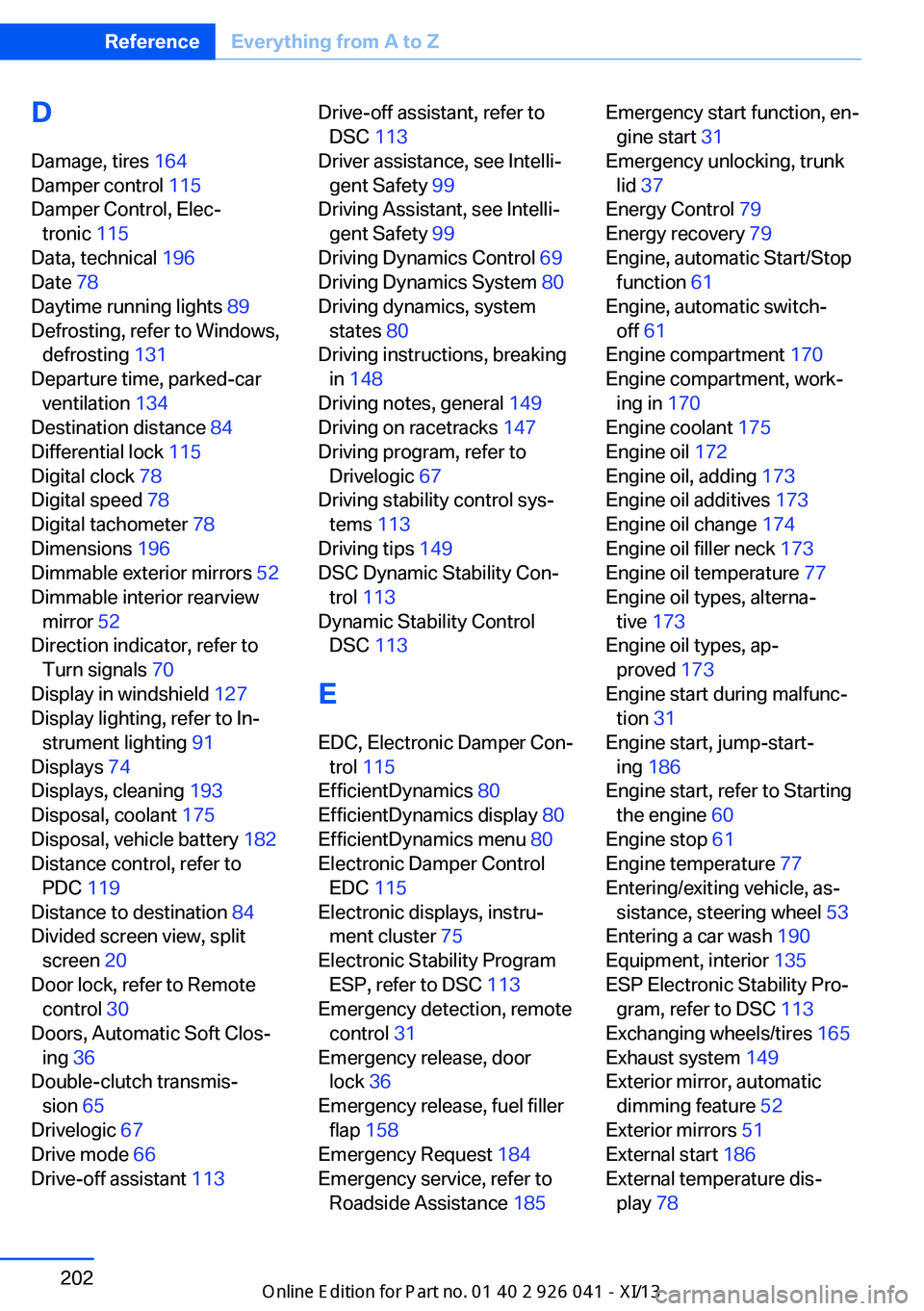
D
Damage, tires 164
Damper control 115
Damper Control, Elec‐ tronic 115
Data, technical 196
Date 78
Daytime running lights 89
Defrosting, refer to Windows, defrosting 131
Departure time, parked-car ventilation 134
Destination distance 84
Differential lock 115
Digital clock 78
Digital speed 78
Digital tachometer 78
Dimensions 196
Dimmable exterior mirrors 52
Dimmable interior rearview mirror 52
Direction indicator, refer to Turn signals 70
Display in windshield 127
Display lighting, refer to In‐ strument lighting 91
Displays 74
Displays, cleaning 193
Disposal, coolant 175
Disposal, vehicle battery 182
Distance control, refer to PDC 119
Distance to destination 84
Divided screen view, split screen 20
Door lock, refer to Remote control 30
Doors, Automatic Soft Clos‐ ing 36
Double-clutch transmis‐ sion 65
Drivelogic 67
Drive mode 66
Drive-off assistant 113 Drive-off assistant, refer to
DSC 113
Driver assistance, see Intelli‐ gent Safety 99
Driving Assistant, see Intelli‐ gent Safety 99
Driving Dynamics Control 69
Driving Dynamics System 80
Driving dynamics, system states 80
Driving instructions, breaking in 148
Driving notes, general 149
Driving on racetracks 147
Driving program, refer to Drivelogic 67
Driving stability control sys‐ tems 113
Driving tips 149
DSC Dynamic Stability Con‐ trol 113
Dynamic Stability Control DSC 113
E
EDC, Electronic Damper Con‐ trol 115
EfficientDynamics 80
EfficientDynamics display 80
EfficientDynamics menu 80
Electronic Damper Control EDC 115
Electronic displays, instru‐ ment cluster 75
Electronic Stability Program ESP, refer to DSC 113
Emergency detection, remote control 31
Emergency release, door lock 36
Emergency release, fuel filler flap 158
Emergency Request 184
Emergency service, refer to Roadside Assistance 185 Emergency start function, en‐
gine start 31
Emergency unlocking, trunk lid 37
Energy Control 79
Energy recovery 79
Engine, automatic Start/Stop function 61
Engine, automatic switch- off 61
Engine compartment 170
Engine compartment, work‐ ing in 170
Engine coolant 175
Engine oil 172
Engine oil, adding 173
Engine oil additives 173
Engine oil change 174
Engine oil filler neck 173
Engine oil temperature 77
Engine oil types, alterna‐ tive 173
Engine oil types, ap‐ proved 173
Engine start during malfunc‐ tion 31
Engine start, jump-start‐ ing 186
Engine start, refer to Starting the engine 60
Engine stop 61
Engine temperature 77
Entering/exiting vehicle, as‐ sistance, steering wheel 53
Entering a car wash 190
Equipment, interior 135
ESP Electronic Stability Pro‐ gram, refer to DSC 113
Exchanging wheels/tires 165
Exhaust system 149
Exterior mirror, automatic dimming feature 52
Exterior mirrors 51
External start 186
External temperature dis‐ play 78 Seite 202ReferenceEverything from A to Z202
Online Edition for Part no. 01 40 2 910 796 - VI/13
Page 209 of 214
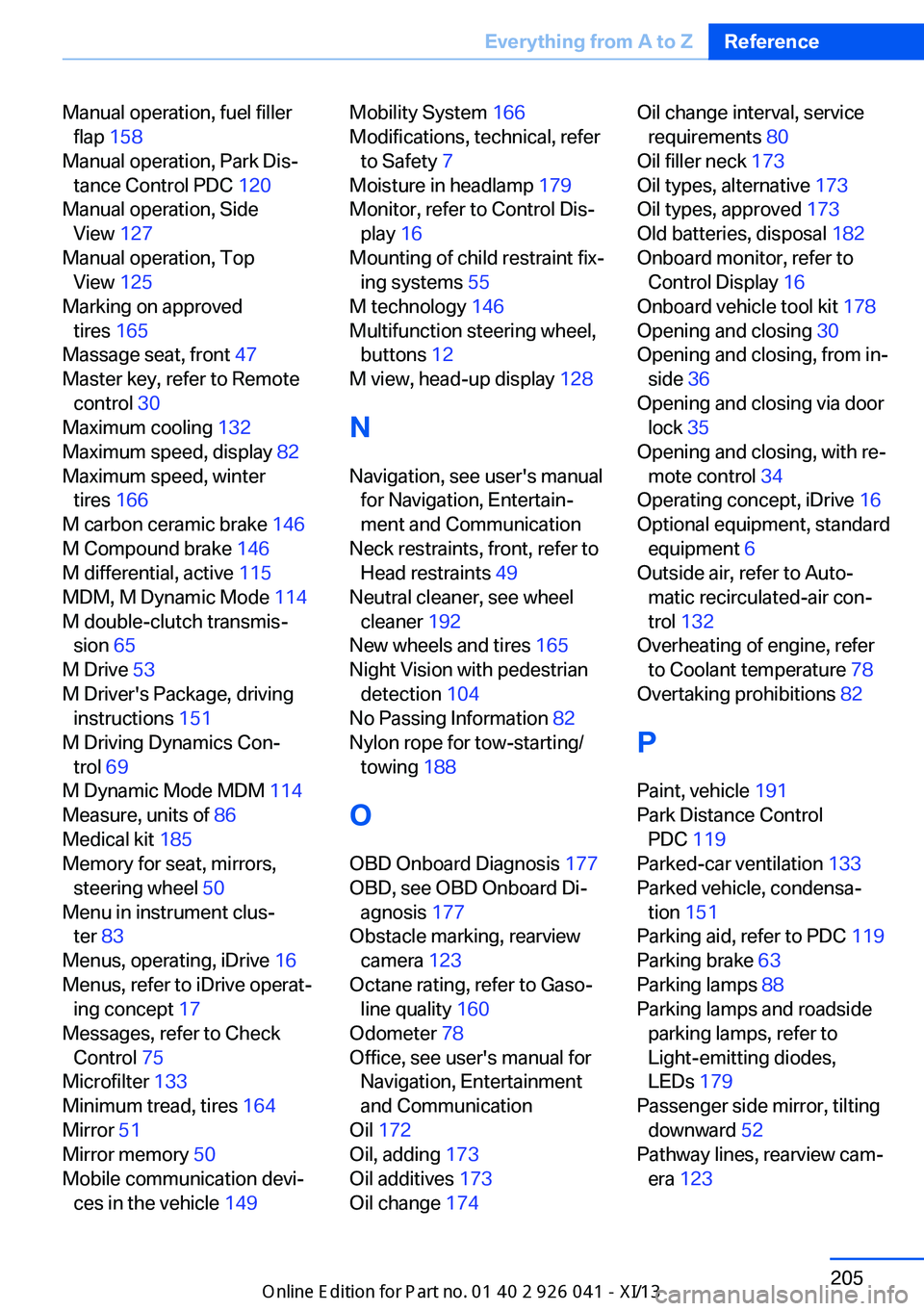
Manual operation, fuel fillerflap 158
Manual operation, Park Dis‐ tance Control PDC 120
Manual operation, Side View 127
Manual operation, Top View 125
Marking on approved tires 165
Massage seat, front 47
Master key, refer to Remote control 30
Maximum cooling 132
Maximum speed, display 82
Maximum speed, winter tires 166
M carbon ceramic brake 146
M Compound brake 146
M differential, active 115
MDM, M Dynamic Mode 114
M double-clutch transmis‐ sion 65
M Drive 53
M Driver's Package, driving instructions 151
M Driving Dynamics Con‐ trol 69
M Dynamic Mode MDM 114
Measure, units of 86
Medical kit 185
Memory for seat, mirrors, steering wheel 50
Menu in instrument clus‐ ter 83
Menus, operating, iDrive 16
Menus, refer to iDrive operat‐ ing concept 17
Messages, refer to Check Control 75
Microfilter 133
Minimum tread, tires 164
Mirror 51
Mirror memory 50
Mobile communication devi‐ ces in the vehicle 149 Mobility System 166
Modifications, technical, refer to Safety 7
Moisture in headlamp 179
Monitor, refer to Control Dis‐ play 16
Mounting of child restraint fix‐ ing systems 55
M technology 146
Multifunction steering wheel, buttons 12
M view, head-up display 128
N
Navigation, see user's manual for Navigation, Entertain‐
ment and Communication
Neck restraints, front, refer to Head restraints 49
Neutral cleaner, see wheel cleaner 192
New wheels and tires 165
Night Vision with pedestrian detection 104
No Passing Information 82
Nylon rope for tow-starting/ towing 188
O OBD Onboard Diagnosis 177
OBD, see OBD Onboard Di‐ agnosis 177
Obstacle marking, rearview camera 123
Octane rating, refer to Gaso‐ line quality 160
Odometer 78
Office, see user's manual for Navigation, Entertainment
and Communication
Oil 172
Oil, adding 173
Oil additives 173
Oil change 174 Oil change interval, service
requirements 80
Oil filler neck 173
Oil types, alternative 173
Oil types, approved 173
Old batteries, disposal 182
Onboard monitor, refer to Control Display 16
Onboard vehicle tool kit 178
Opening and closing 30
Opening and closing, from in‐ side 36
Opening and closing via door lock 35
Opening and closing, with re‐ mote control 34
Operating concept, iDrive 16
Optional equipment, standard equipment 6
Outside air, refer to Auto‐ matic recirculated-air con‐
trol 132
Overheating of engine, refer to Coolant temperature 78
Overtaking prohibitions 82
P Paint, vehicle 191
Park Distance Control PDC 119
Parked-car ventilation 133
Parked vehicle, condensa‐ tion 151
Parking aid, refer to PDC 119
Parking brake 63
Parking lamps 88
Parking lamps and roadside parking lamps, refer to
Light-emitting diodes,
LEDs 179
Passenger side mirror, tilting downward 52
Pathway lines, rearview cam‐ era 123 Seite 205Everything from A to ZReference205
Online Edition for Part no. 01 40 2 910 796 - VI/13