lock BMW MOTORRAD K 1200 R 2007 Rider's Manual (in English)
[x] Cancel search | Manufacturer: BMW MOTORRAD, Model Year: 2007, Model line: K 1200 R, Model: BMW MOTORRAD K 1200 R 2007Pages: 168, PDF Size: 2.85 MB
Page 81 of 168
Refuelling
Fuel is highly flammable. A
naked flame close to the
fuel tank can cause a fire or ex-
plosion.
Do not smoke. Never bring a
naked flame near the fuel tank.
Fuel expands when hot.
Fuel escaping from an
overfilled tank could make its way
onto the rear tyre. This could
cause a fall.
Do not fill the tank past the bot-
tom edge of the filler neck.
Fuel attacks plastics, which
become dull or unsightly.
Wipe off plastic parts immediately
if they come into contact with
fuel.
Fuel can attack the material
of the windscreen, which
becomes dull or unsightly.
Wipe off the windscreen immedi- ately if it comes into contact with
fuel.
Leaded fuel will destroy the
catalytic converter.
Use only unleaded fuel.
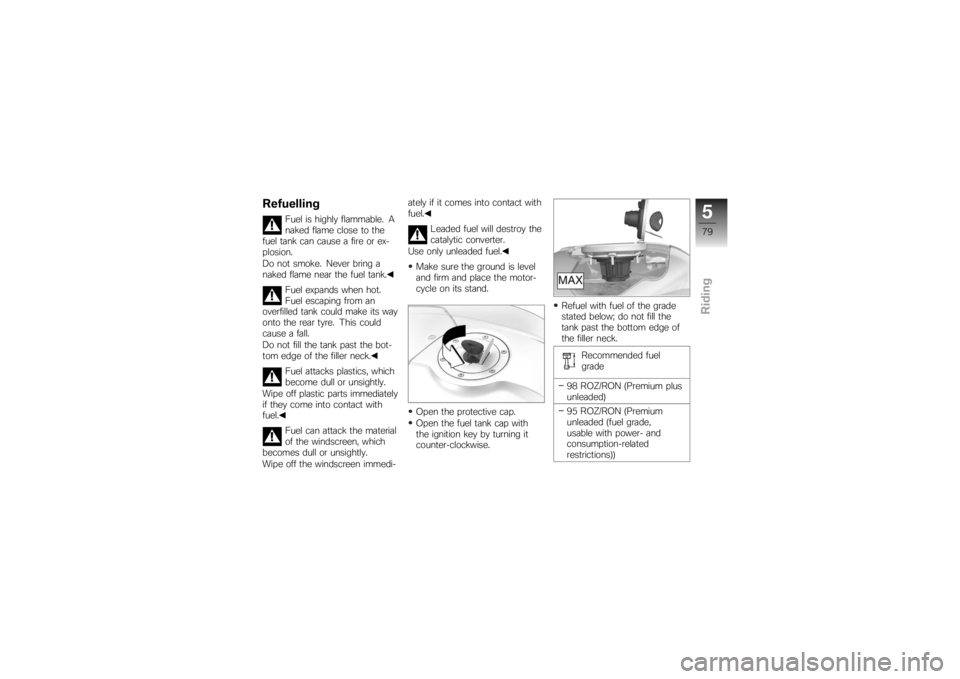
Make sure the ground is level
and firm and place the motor-
cycle on its stand.
Open the protective cap.
Open the fuel tank cap with
the ignition key by turning it
counter-clockwise. Refuel with fuel of the grade
stated below; do not fill the
tank past the bottom edge of
the filler neck.
Recommended fuel
grade
98 ROZ/RON (Premium plus
unleaded)
95 ROZ/RON (Premium
unleaded (fuel grade,
usable with power- and
consumption-related
restrictions))
579zRiding
Page 84 of 168

Brake system with
BMW Motorrad Integral
ABS
OE
Partially integral brakesYour motorcycle is equipped with
partially integral brakes. Both
front and rear brakes are applied
when you pull the handbrake
lever. The footbrake lever acts
only on the rear brake.
While the brakes are slowing the
motorcycle, the BMW Motorrad
Integral ABS adapts braking-force
distribution between front and
rear brakes to suit the load on
the motorcycle.The integral braking func-
tion makes it very difficult
to spin the rear wheel by opening
the throttle with the front brake
applied to keep the motorcycle
stationary (burn-out). Attempted
burn-outs can result in damage
to the rear brake and the clutch.
Do not attempt burn-outs.
How does ABS work?The amount of braking force that
can be transferred to the road
depends on factors hat include
the coefficient of friction of the
road surface. Loose stones, ice
and snow or a wet road all have
much lower coefficients of fric-
tion than a clean, dry asphalt sur-
face. The lower the coefficient
of friction, the longer the braking
distance.
If the rider increases braking
pressure to the extent that brak-
ing force exceeds the maxim-
um transferrable limit, the wheels
start to lock and the motorcycle
loses its directional stability; a fall
is imminent. Before this situation
can occur, ABS intervenes and
adapts braking pressure to the
maximum transferrable braking
force, so the wheels continue
to turn and directional stability
is maintained irrespective of the
condition of the road surface.
What are the effects of
surface irregularities?Humps and surface irregular-
ities can cause the wheels to
lose contact temporarily with the
road surface; if this happens the
braking force that can be trans-
mitted to the road can drop to
zero. If the brakes are applied
under these circumstances the
ABS has to reduce braking force
to ensure that directional sta-
bility is maintained when the
wheels regain contact with the
road surface. At this instant the
BMW Motorrad Integral ABS
must assume an extremely low
coefficient of friction, so that the
wheels will continue to rotate un-
der all imaginable circumstances,
because this is the precondition
for ensuring directional stability.
As soon as is registers the ac-
tual circumstances, the system
reacts instantly and adjusts brak-
682zEngineering details
Page 85 of 168

ing force accordingly to achieve
optimum braking.What feedback does the
rider receive from the
BMW Motorrad Integral
ABS?If the ABS system has to reduce
braking force on account of the
circumstances described above,
vibration is perceptible through
the handbrake lever.
When the handbrake lever is
pulled, brake pressure is also
built up at the rear wheel by
the integral function. If the
brake pedal is depressed after
the handbrake lever is pulled,
the brake pressure built up
beforehand is perceptible as
counter-pressure sooner than is
the case when the brake pedal is
depressed either before or at the
same time as the brake lever is
pulled.
Rear wheel liftEven under severe braking, a
high level of tyre grip can mean
that the front wheel does not
lock up until very late, if at all.
Consequently, ABS does not in-
tervene until very late, if at all.
Under these circumstances the
rear wheel can lift off the ground,
and the outcome can be a high-
siding situation in which the mo-
torcycle can flip over.Severe braking can cause
the rear wheel to lift off the
ground.
When you brake, bear in mind
that ABS control cannot be relied
on in all circumstances to prevent
the rear wheel from lifting clear of
the ground.
What is the design
baseline for BMW
Motorrad Integral ABS?Within the limits imposed by
physics, the BMW Motorrad In-
tegral ABS ensures directional
stability on any surface. The sys-
tem is not optimised for special
requirements that apply under
extreme competitive situations
off-road or on the track.Special situationsThe speeds of the front and rear
wheels are compared as one
means of detecting a wheel's
incipient tendency to lock. If the
system registers implausible val-
ues for a lengthy period the ABS
function is deactivated for safety
reasons and an ABS fault mes-
sage is issued. Self-diagnos-
is has to complete before fault
messages can be issued.
In addition to problems with the
BMW Motorrad Integral ABS,
683zEngineering details
Page 86 of 168

exceptional riding conditions can
lead to a fault message being
issued.
Exceptional riding
conditions:Heating up with the motorcycle
on the centre stand or an auxil-
iary stand, engine idling or with
a gear engaged.
Rear wheel locked by the en-
gine brake for a lengthy period,
for example while descending
off-road.
If a fault message is issued on
account of exceptional riding
conditions as outlined above, you
can reactivate the ABS function
by switching the ignition off and
on again.
What significance
devolves on regular
maintenance?
Invariably, a technical sys-
tem cannot perform beyond
the abilities dictated by its level
of maintenance.
In order to ensure that the BMW
Motorrad ABS is always main-
tained in optimum condition, it
is essential for you to comply
strictly with the specified inspec-
tion intervals.
Reserves for safetyThe potentially shorter braking
distances which BMW Motorrad
Integral ABS permits must not be
used as an excuse for careless
riding. ABS is primarily a means
of ensuring a safety margin in
genuine emergencies.
Take care when cornering. When
you apply the brakes on a corner,
the motorcycle's weight and momentum take over and even
BMW Motorrad Integral ABS is
unable to counteract their effects.
Electronic engine
management with BMW
Motorrad ASC
OE
How does ASC work?The BMW Motorrad ASC com-
pares the speed of rotation of the
front wheel and the rear wheel.
The differential is used to com-
pute slip as a measure of the
reserves of stability available at
the rear wheel. If slip exceeds a
certain limit the electronic engine
management system intervenes,
adapting engine torque accord-
ingly.
684zEngineering details
Page 88 of 168

If the front wheel lifts clear of the
ground under severe accelera-
tion, the ASC reduces engine
torque until the front wheel re-
gains contact with the ground.
Under these circumstances,
BMW Motorrad recommends
rolling the throttle slightly closed
so as to restore stability with the
least possible delay.
When riding on a slippery sur-
face, never snap the throttle
twistgrip fully closed without
pulling the clutch at the same
time. Engine braking torque can
cause the rear wheel to lock, with
a corresponding loss of stability.
The BWM Motorrad ASC is un-
able to control a situation of this
nature.
Tyre pressure
monitoring RDC
OE
FunctionA sensor integrated into each
tyre measures the air temperat-
ure and the air pressure inside
the tyre and transmits this in-
formation to the control unit.
Each sensor has a centrifugal-
force tripswitch that does not
enable transmission of the meas-
ured values until the motorcycle
has accelerated to about 30 km/
h. The display shows
--
for
each tyre until the tyre-pressure
signal is received for the first
time. The sensors continue to
transmit the measured-value sig-
nals for approximately 15 minutes
after the motorcycle comes to a
stop.
The control unit can adminis-
trate four sensors, so two dif-
ferent sets of wheels with RDC
sensors can be alternated on the motorcycle. An error mes-
sage is issued if wheels without
sensors are fitted to a motorcycle
equipped with an RDC control
unit.
Temperature
compensationThe tyre-pressure readings
shown by the multifunction
display are temperature-
compensated; the reference tyre
temperature for these readings
is always 20 °C. The air lines
available to the public in petrol
stations and motorway service
areas almost invariably show
temperature-dependent tyre
pressures, so in most instances
these gauge readings will not
tally with the readings shown by
the multifunction display.
686zEngineering details
Page 94 of 168
Payload of tankbag
max 5 kg
Note the maximum permissible
payload of the luggage carrier.
Payload of luggage carri-
er
max 5 kg
Case
OA
Release leversEach case has two levers, one on
each side of the lock.
The grey lever marked OPEN is
for opening and closing the case.
The black lever marked
RELEASE is for removing and
attaching the case.
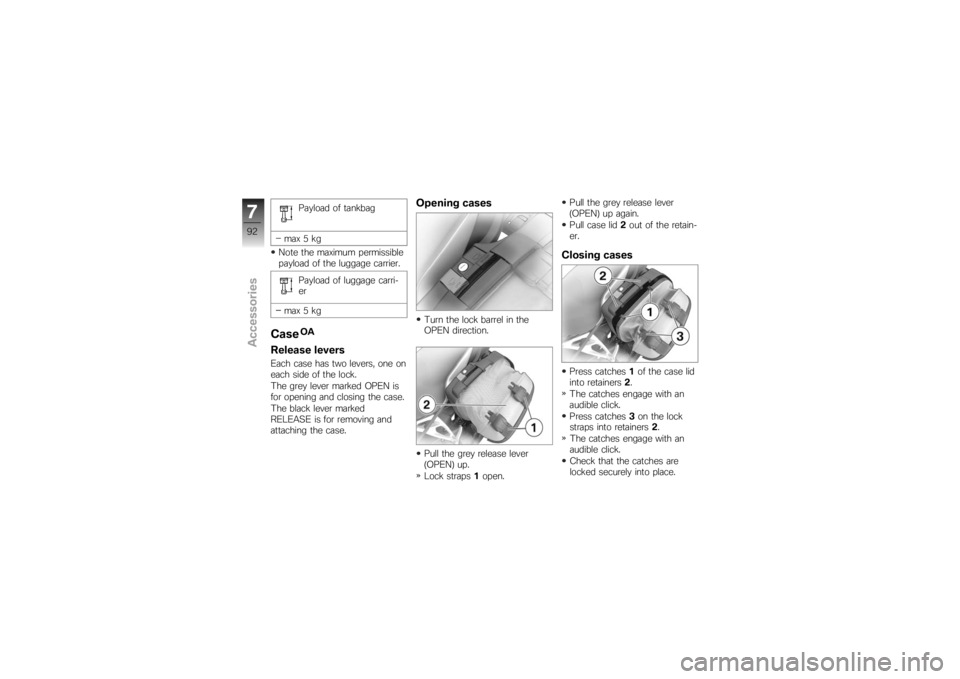
Opening casesTurn the lock barrel in the
OPEN direction.
Pull the grey release lever
(OPEN) up.
Lock straps 1open. Pull the grey release lever
(OPEN) up again.
Pull case lid
2out of the retain-
er.
Closing casesPress catches 1of the case lid
into retainers 2.
The catches engage with an
audible click.
Press catches 3on the lock
straps into retainers 2.
The catches engage with an
audible click.
Check that the catches are
locked securely into place.
792zAccessories
Page 95 of 168
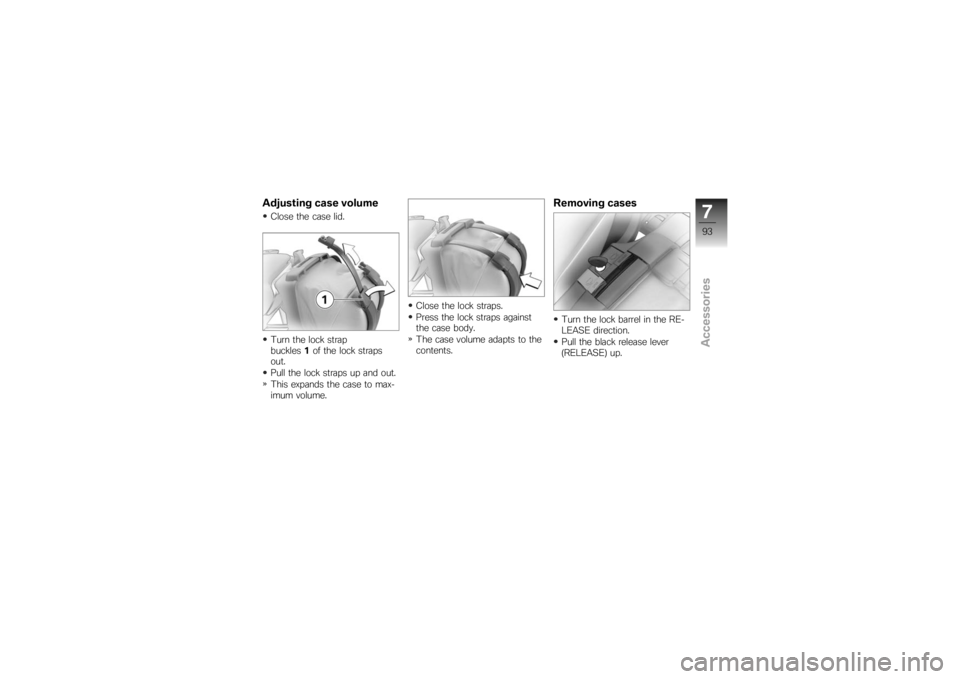
Adjusting case volumeClose the case lid.
Turn the lock strap
buckles1of the lock straps
out.
Pull the lock straps up and out.
This expands the case to max-
imum volume. Close the lock straps.
Press the lock straps against
the case body.
The case volume adapts to the
contents.
Removing casesTurn the lock barrel in the RE-
LEASE direction.
Pull the black release lever
(RELEASE) up.
793zAccessories
Page 96 of 168
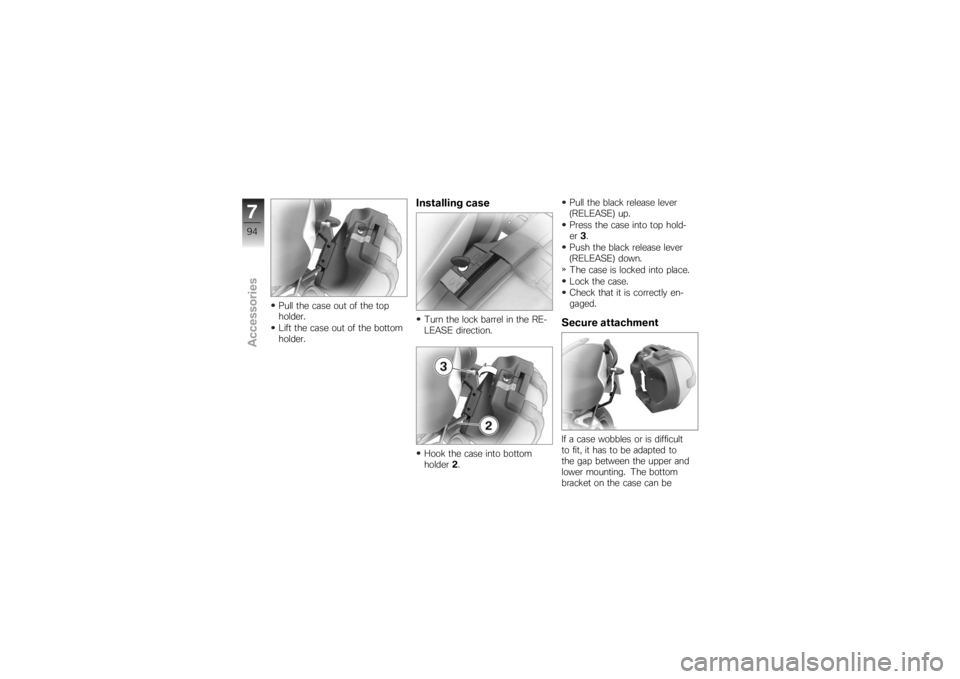
Pull the case out of the top
holder.
Lift the case out of the bottom
holder.
Installing caseTurn the lock barrel in the RE-
LEASE direction.
Hook the case into bottom
holder2. Pull the black release lever
(RELEASE) up.
Press the case into top hold-
er
3.
Push the black release lever
(RELEASE) down.
The case is locked into place.
Lock the case.
Check that it is correctly en-
gaged.
Secure attachmentIf a case wobbles or is difficult
to fit, it has to be adapted to
the gap between the upper and
lower mounting. The bottom
bracket on the case can be
794zAccessories
Page 102 of 168
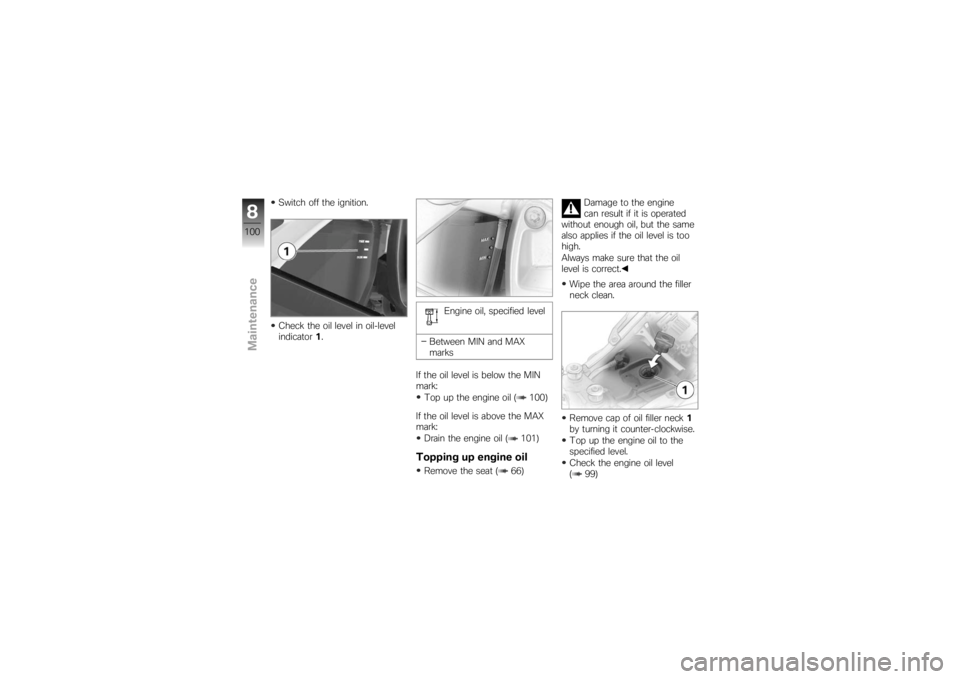
Switch off the ignition.
Check the oil level in oil-level
indicator1. Engine oil, specified level
Between MIN and MAX
marks
If the oil level is below the MIN
mark: Top up the engine oil ( 100)
If the oil level is above the MAX
mark: Drain the engine oil ( 101)
Topping up engine oilRemove the seat ( 66) Damage to the engine
can result if it is operated
without enough oil, but the same
also applies if the oil level is too
high.
Always make sure that the oil
level is correct.
Wipe the area around the filler
neck clean.
Remove cap of oil filler neck 1
by turning it counter-clockwise.
Top up the engine oil to the
specified level.
Check the engine oil level
( 99)
8100zMaintenance
Page 103 of 168
Install cap of oil filler neck1
and turn it clockwise to close.
Install the seat ( 67)Draining engine oilRemove the seat ( 66)
Damage to the engine
can result if it is operated
without enough oil, but the same
also applies if the oil level is too
high.
Always make sure that the oil
level is correct.
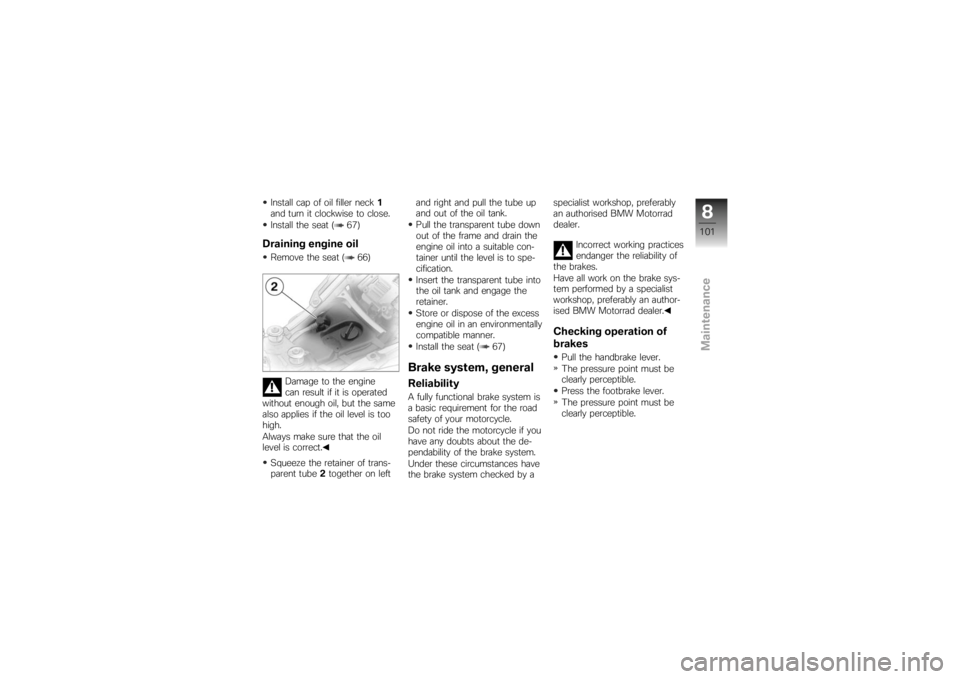
Squeeze the retainer of trans-
parent tube 2together on left and right and pull the tube up
and out of the oil tank.
Pull the transparent tube down
out of the frame and drain the
engine oil into a suitable con-
tainer until the level is to spe-
cification.
Insert the transparent tube into
the oil tank and engage the
retainer.
Store or dispose of the excess
engine oil in an environmentally
compatible manner.
Install the seat ( 67)
Brake system, generalReliabilityA fully functional brake system is
a basic requirement for the road
safety of your motorcycle.
Do not ride the motorcycle if you
have any doubts about the de-
pendability of the brake system.
Under these circumstances have
the brake system checked by a specialist workshop, preferably
an authorised BMW Motorrad
dealer.
Incorrect working practices
endanger the reliability of
the brakes.
Have all work on the brake sys-
tem performed by a specialist
workshop, preferably an author-
ised BMW Motorrad dealer.
Checking operation of
brakesPull the handbrake lever.
The pressure point must be
clearly perceptible.
Press the footbrake lever.
The pressure point must be
clearly perceptible.
8101zMaintenance