weight BMW MOTORRAD K 1200 S 2007 Rider's Manual (in English)
[x] Cancel search | Manufacturer: BMW MOTORRAD, Model Year: 2007, Model line: K 1200 S, Model: BMW MOTORRAD K 1200 S 2007Pages: 166, PDF Size: 2.8 MB
Page 5 of 166

5 Riding . . . . . . . . . . . . . . . . . . . . 67
Safety instructions . . . . . . . . . . . 68
Checklist . . . . . . . . . . . . . . . . . . . . . 70
Starting . . . . . . . . . . . . . . . . . . . . . . . 70
Running in . . . . . . . . . . . . . . . . . . . 73
Brakes . . . . . . . . . . . . . . . . . . . . . . . 74
Parking your motorcycle . . . . . 75
Refuelling . . . . . . . . . . . . . . . . . . . . 77
6 Engineering details . . . . . 79
Brake system with BMW Mo-
torrad Integral ABS . . . . . . . . . . . 80
Electronic engine manage-
ment with BMW Motorrad
ASC
OE
....................... 82
Tyre pressure monitoring
RDC
OE
....................... 84
7 Accessories . . . . . . . . . . . . . 87
General instructions . . . . . . . . . . 88
Power socket . . . . . . . . . . . . . . . . 88
Luggage . . . . . . . . . . . . . . . . . . . . . 89
CaseOA
...................... 90
Breakdown assistance
kit
OA
......................... 93 8 Maintenance . . . . . . . . . . . . 95
General instructions . . . . . . . . . . 96
Toolkit . . . . . . . . . . . . . . . . . . . . . . . . 96
Engine oil . . . . . . . . . . . . . . . . . . . . 97
Brake system, general . . . . . . . . 99
Brake pads . . . . . . . . . . . . . . . . . 100
Brake fluid . . . . . . . . . . . . . . . . . . 101
Clutch . . . . . . . . . . . . . . . . . . . . . . 103
Tyres . . . . . . . . . . . . . . . . . . . . . . . 104
Rims . . . . . . . . . . . . . . . . . . . . . . . 105
Wheels . . . . . . . . . . . . . . . . . . . . . 105
Front-wheel stand . . . . . . . . . . 113
Rear-wheel stand . . . . . . . . . . 114
Bulbs . . . . . . . . . . . . . . . . . . . . . . . 115
Jump starting . . . . . . . . . . . . . . 125
Battery . . . . . . . . . . . . . . . . . . . . . 126
9 Care . . . . . . . . . . . . . . . . . . . . . 131
Care products . . . . . . . . . . . . . . 132
Washing motorcycle . . . . . . . . 132
Cleaning easily damaged
components . . . . . . . . . . . . . . . . 132
Paint care . . . . . . . . . . . . . . . . . . 133
Protective wax coating . . . . . 134
Laying up motorcycle . . . . . . 134 Restoring motorcycle to
use......................... 134
10 Technical data . . . . . . . 135
Troubleshooting chart . . . . . . 136
Threaded fasteners . . . . . . . . 137
Engine . . . . . . . . . . . . . . . . . . . . . 138
Fuel . . . . . . . . . . . . . . . . . . . . . . . . 139
Engine oil . . . . . . . . . . . . . . . . . . 139
Clutch . . . . . . . . . . . . . . . . . . . . . . 140
Transmission . . . . . . . . . . . . . . . 140
Rear-wheel drive . . . . . . . . . . . 141
Running gear . . . . . . . . . . . . . . . 141
Brakes . . . . . . . . . . . . . . . . . . . . . 142
Wheels and tyres . . . . . . . . . . . 142
Electrics . . . . . . . . . . . . . . . . . . . . 144
Frame . . . . . . . . . . . . . . . . . . . . . . 145
Dimensions . . . . . . . . . . . . . . . . 146
Weights . . . . . . . . . . . . . . . . . . . . 146
Riding specifications . . . . . . . 147
Page 9 of 166

ESA Electronic SuspensionAdjustment
Electronic Suspension
Adjustment.
RDC Tyre pressure control
(ReifenDruck-Control)EquipmentWhen you ordered your BMW
motorcycle, you chose various
items of custom equipment. This
Rider's Manual describes option-
al extras (OE) offered by BMW
and selected optional accessor-
ies (OA). This explains why the
manual may also contain de-
scriptions of equipment which
you have not ordered. Please
note, too, that your motorcycle
might not be exactly as illus-
trated in this manual on account
of country-specific differences.
If your BMW was supplied with
equipment not described in
this Rider's Manual, you will find these features described in
separate manuals.
Technical dataAll dimensions, weights and
power ratings stated in the
Rider's Manual are quoted to the
standards and comply with the
tolerance requirements of the
Deutsche Institut für Normung
e.V. Versions for individual
countries may differ.CurrencyThe high safety and quality
standards of BMW motorcycles
are maintained by constant
development work on designs,
equipment and accessories.
Because of this, your motorcycle
may differ from the information
supplied in the Rider's Manual.
Nor can BMW Motorrad entirely
rule out errors and omissions.
We hope you will appreciate that
no claims can be entertained onthe basis of the data, illustrations
or descriptions in this manual.
17zGeneral instructions
Page 62 of 166
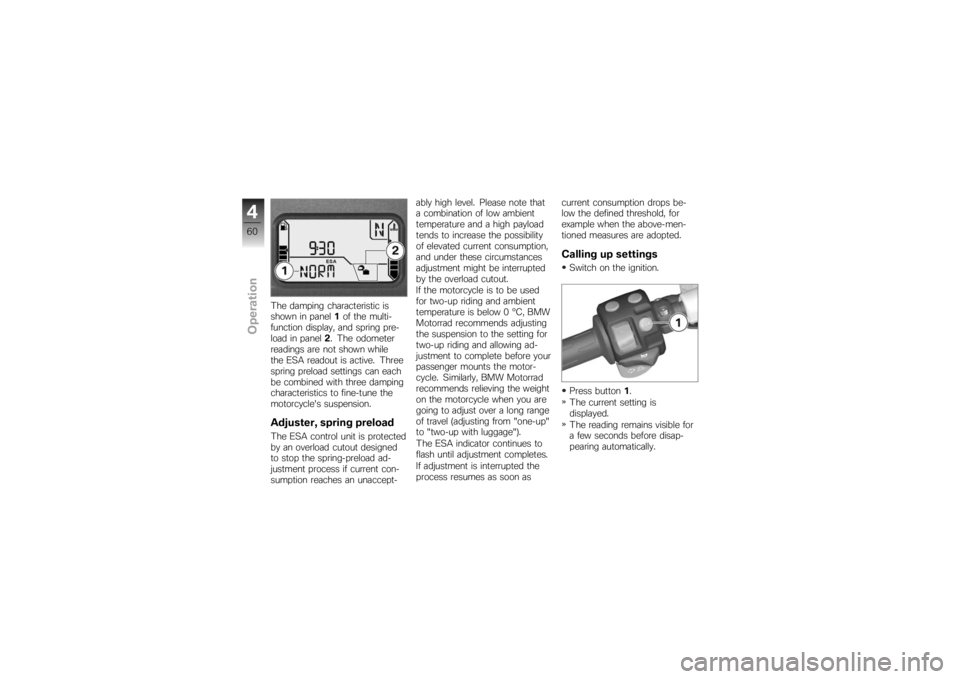
The damping characteristic is
shown in panel1of the multi-
function display, and spring pre-
load in panel 2. The odometer
readings are not shown while
the ESA readout is active. Three
spring preload settings can each
be combined with three damping
characteristics to fine-tune the
motorcycle's suspension.Adjuster, spring preloadThe ESA control unit is protected
by an overload cutout designed
to stop the spring-preload ad-
justment process if current con-
sumption reaches an unaccept- ably high level. Please note that
a combination of low ambient
temperature and a high payload
tends to increase the possibility
of elevated current consumption,
and under these circumstances
adjustment might be interrupted
by the overload cutout.
If the motorcycle is to be used
for two-up riding and ambient
temperature is below 0 °C, BMW
Motorrad recommends adjusting
the suspension to the setting for
two-up riding and allowing ad-
justment to complete before your
passenger mounts the motor-
cycle. Similarly, BMW Motorrad
recommends relieving the weight
on the motorcycle when you are
going to adjust over a long range
of travel (adjusting from "one-up"
to "two-up with luggage").
The ESA indicator continues to
flash until adjustment completes.
If adjustment is interrupted the
process resumes as soon as
current consumption drops be-
low the defined threshold, for
example when the above-men-
tioned measures are adopted.
Calling up settingsSwitch on the ignition.
Press button
1.
The current setting is
displayed.
The reading remains visible for
a few seconds before disap-
pearing automatically.
460zOperation
Page 65 of 166
Headlight beam throw and
spring preloadHeadlight beam throw is gener-
ally kept constant when spring
preload is adjusted to suit load.
Spring preload adjustment might
not suffice only if the motorcycle
is very heavily loaded. Under
these circumstances, headlight
beam throw has to be adjusted
to suit the weight carried by the
motorcycle.Consult a specialist work-
shop, preferably an au-
thorised BMW Motorrad deal-
er, if you are unsure whether
the headlight basic setting is
correct.
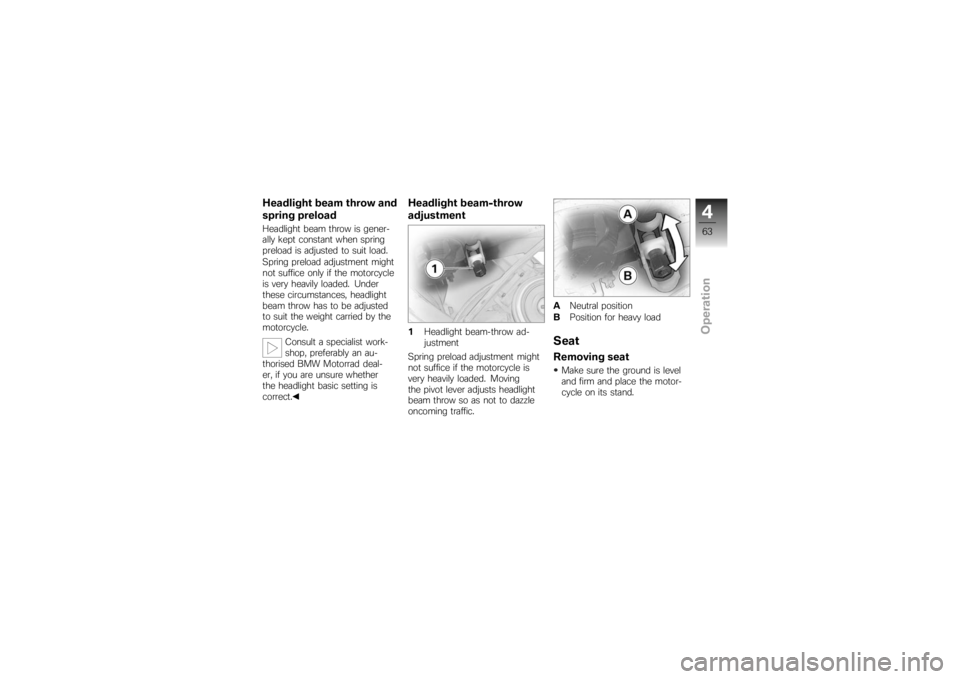
Headlight beam-throw
adjustment1 Headlight beam-throw ad-
justment
Spring preload adjustment might
not suffice if the motorcycle is
very heavily loaded. Moving
the pivot lever adjusts headlight
beam throw so as not to dazzle
oncoming traffic. A
Neutral position
B Position for heavy load
SeatRemoving seatMake sure the ground is level
and firm and place the motor-
cycle on its stand.
463zOperation
Page 70 of 166
Safety instructionsRider's equipmentDo not ride without the correct
clothing. Always wear:Helmet
Motorcycling jacket and
trousers
Gloves
Boots
This applies even to short jour-
neys, and to every season of the
year. Your authorised BMW Mo-
torrad dealer will be glad to ad-
vise you on the correct clothing
for every purpose.SpeedIf you ride at high speed, always
bear in mind that various bound-
ary conditions can adversely af-
fect the handling of your motor-
cycle: Settings of the spring-strut and
shock-absorber system
Imbalanced load
Loose clothing
Insufficient tyre pressure
Poor tyre tread
Etc.
Correct loading
Overloading and imbal-
anced loads can adversely
affect the motorcycle's handling.
Do not exceed the permissible
gross weight and be sure to
comply with the instructions on
loading.
Alcohol and drugs
Even small amounts of
alcohol or drugs will ad-
versely affect your perception
and your ability to assess situ-
ations and make decisions, and
slow down your reflexes. Med-
ication can exacerbate these ef-
fects. Do not ride your motorcycle after
consuming alcohol, drugs and/or
medication.
Risk of poisoningExhaust fumes contain carbon
monoxide, which is colourless
and odourless but highly toxic.
Inhaling the exhaust fumes
therefore represents a
health hazard and can even
cause loss of consciousness with
fatal consequences.
Do not inhale exhaust fumes.
Do not run the engine in an en-
closed space.High voltage
Touching live parts of the
ignition system with the
engine running can cause electric
shock.
Do not touch parts of the igni-
tion system when the engine is
running.
568zRiding
Page 77 of 166
Oil or grease on brakes
Oil and grease on the brake
discs and pads considerably
diminish braking efficiency.
Especially after repair and main-
tenance work, make sure that the
brake discs and brake pads are
free of oil and grease.
Dirt or mud on brakes
When riding on loose sur-
faces or muddy roads, the
brakes may fail to take effect
immediately because of dirt or
moisture on the discs or brake
pads.
Apply the brakes in good time
until the brakes have been
cleaned.
Parking your
motorcyclePlacing motorcycle on
side stand
If the ground is soft or un-
even, there is no guaran-
tee that the motorcycle will rest
firmly on the stand.
Always check that the ground
under the stand is level and
firm.
Switch off the engine.
Pull the handbrake lever.
Hold the motorcycle upright
and balanced.
Use your left foot to extend the
side stand fully. The side stand is designed
to support only the weight
of the motorcycle.
Do not lean or sit on the
motorcycle with the side stand
extended. Slowly lean the motorcycle to
the side until its weight is taken
by the stand and dismount to
the left.
If the motorcycle is on the
side stand, the surface of
the ground will determine wheth-
er it is better to turn the handle-
bars to the left or right. However,
the motorcycle is more stable on
a level surface with the handle-
bars turned to the left than with
the handlebars turned to the
right.
On level ground, always turn the
handlebars to the left to set the
steering lock.
Turn the handlebars to full left
or right lock.
Check that the motorcycle is
standing firmly. On a gradient, the motor-
cycle should always face
uphill; select 1st gear.
Lock the steering lock.
575zRiding
Page 78 of 166
Removing motorcycle
from side standUnlock the steering lock.
From the left, grip the handle-
bars with both hands.
Pull the handbrake lever.
Swing your right leg over the
seat and lift the motorcycle to
the upright position.
Hold the motorcycle upright
and balanced.An extended side stand can
catch on the ground when
the motorcycle is moving and
lead to a fall.
Retract the side stand before
moving the motorcycle.
Sit on the motorcycle and use
your left foot to retract the side
stand.
Placing motorcycle on
centre stand
OA
If the ground is soft or un-
even, there is no guaran-
tee that the motorcycle will rest
firmly on the stand.
Always check that the ground
under the stand is level and
firm.
Switch off the engine.
Dismount and keep your left
hand on the left handlebar grip.
With your right hand, grip the
rear grab handle or the rear
frame.
Use your right foot on the pin
of the centre stand to press
the stand down until its curved
feet touch the ground.
Place your full body weight on
the centre stand and at the
same time pull the motorcycle
to the rear. Excessive movements
could cause the centre
stand to retract, and the
motorcycle would topple in
consequence.
Do not lean or sit on the mo-
torcycle with the centre stand
extended.
Check that the motorcycle is
standing firmly.
Lock the steering lock.
Removing motorcycle
from centre stand
OA
Unlock the steering lock.
Place your left hand on the left
handlebar grip.
With your right hand, grip the
rear grab handle or the rear
frame.
Push the motorcycle forward
off the centre stand.
Check that the centre stand
has fully retracted.
576zRiding
Page 84 of 166

exceptional riding conditions can
lead to a fault message being
issued.
Exceptional riding
conditions:Heating up with the motorcycle
on the centre stand or an auxil-
iary stand, engine idling or with
a gear engaged.
Rear wheel locked by the en-
gine brake for a lengthy period,
for example while descending
off-road.
If a fault message is issued on
account of exceptional riding
conditions as outlined above, you
can reactivate the ABS function
by switching the ignition off and
on again.
What significance
devolves on regular
maintenance?
Invariably, a technical sys-
tem cannot perform beyond
the abilities dictated by its level
of maintenance.
In order to ensure that the BMW
Motorrad ABS is always main-
tained in optimum condition, it
is essential for you to comply
strictly with the specified inspec-
tion intervals.
Reserves for safetyThe potentially shorter braking
distances which BMW Motorrad
Integral ABS permits must not be
used as an excuse for careless
riding. ABS is primarily a means
of ensuring a safety margin in
genuine emergencies.
Take care when cornering. When
you apply the brakes on a corner,
the motorcycle's weight and momentum take over and even
BMW Motorrad Integral ABS is
unable to counteract their effects.
Electronic engine
management with BMW
Motorrad ASC
OE
How does ASC work?The BMW Motorrad ASC com-
pares the speed of rotation of the
front wheel and the rear wheel.
The differential is used to com-
pute slip as a measure of the
reserves of stability available at
the rear wheel. If slip exceeds a
certain limit the electronic engine
management system intervenes,
adapting engine torque accord-
ingly.
682zEngineering details
Page 85 of 166

What is the design
baseline for BMW
Motorrad ASC?BMW Motorrad ASC is designed
as an assistant system for the
rider and for use on public roads.
The extent to which the rider af-
fects ASC control can be consid-
erable (weight shifts when cor-
nering, items of luggage loose
on the motorcycle), especially
when style of riding takes rider
and machine close to the limits
imposed by physics. The system
is not optimised for special re-
quirements that apply under ex-
treme competitive situations off-
road or on the track. You have
the option of deactivating the
BMW Motorrad ASC system for
these circumstances.Even ASC is constrained by
the laws of physics. Invari-
ably, the rider bears responsibil-
ity for assessing road and traffic conditions and adopting his or
her style of riding accordingly.
Do not take risks that would neg-
ate the additional safety offered
by this system.
Special situationsIn accordance with the laws of
physics, the ability to accelerate
is restricted more and more as
the angle of heel increases. Con-
sequently, there can be a per-
ceptible lag in acceleration out of
very tight bends.
The speeds of the front and
rear wheels are compared as
one means of detecting the rear
wheel's incipient tendency to
spin or slip sideways. If the sys-
tem registers implausible values
for a lengthy period the ASC
function is deactivated for safety
reasons and an ASC fault mes-
sage is issued. Self-diagnos-
is has to complete before fault
messages can be issued.
The BMW Motorrad ASC can
shut down automatically under
the exceptional riding conditions
outlined below.
Exceptional riding
conditions:
Riding for a lengthy period with
the front wheel lifted off the
ground (wheelie) and ASC de-
activated.
Rear wheel rotating with the
motorcycle held stationary by
applying the front brake (burn-
out).
Heating up with the motorcycle
on the centre stand or an auxil-
iary stand, engine idling or with
a gear engaged.
Accelerating the motorcycle to
a speed in excess of 10 km/h
after switching the ignition off
and then on again reactivates the
ASC.
683zEngineering details
Page 91 of 166
the on-board power supply sys-
tem is minimised, the supply to
the power socket is cut off ap-
proximately 15 minutes after the
ignition is switched off, and it is
also temporarily interrupted dur-
ing the start procedure.Cable routingThe cables from the power sock-
et to the auxiliary device must be
routed in such a way that they:Do not impede the rider
Do not restrict or obstruct the
steering angle and handling
characteristics
Cannot be trapped
Incorrectly routed cables
can impede the rider.
Route the cables as described
above.
LuggageCorrect loading
Overloading and imbal-
anced loads can adversely
affect the motorcycle's handling.
Do not exceed the permissible
gross weight and be sure to
comply with the instructions on
loading.
Set spring preload, damping
characteristic and tyre pres-
sures to suit total weight.
Adjust the spring preload for
rear wheel ( 58)
Check the tyre pressure
( 62)
Adjust the damping for rear
wheel ( 59)
Ensure that the case volumes
on the left and right are equal.
Make sure that the weight is
uniformly distributed between
right and left. Pack heavy items at the bot-
tom and toward the inboard
side.
Note the maximum permissible
payload of the cases and the
speed limit for riding with cases
on the motorcycle.
Payload of cases
with OA Case: ≤8kg
Maximum permissible
speed for riding with
cases fitted to the motorcycle
with OA Case:
≤180 km/h
Note the maximum permissible
payload of the tank rucksack
and the speed limit for riding
with a tank rucksack on the
motorcycle.
789zAccessories