wheel BMW SPORT WAGON 2001 Owner's Guide
[x] Cancel search | Manufacturer: BMW, Model Year: 2001, Model line: SPORT WAGON, Model: BMW SPORT WAGON 2001Pages: 238, PDF Size: 2.44 MB
Page 151 of 238

Index
Data
Technology
Repairs
Car care
Controls
Overview
151nTire replacement
To maintain good handling and vehicle
response, use only tires of a single
tread configuration from a single manu-
facturer. BMW tests and approves
wheel/tire combinations. Refer to
page 153.
DOT Quality Grades
Treadwear
Traction AA A B C
Temperature A B C
All passenger car tires must con-
form to Federal Safety Require-
ments in addition to these grades. <
Treadwear
The treadwear grade is a comparative
rating based on the wear rate of the tire
when tested under controlled condi-
tions on a specified government test
course.
For example, a tire graded 150 would
wear one and one-half (1g) times as
well on the government course as a tire
graded 100. The relative performance
of tires depends upon the actual condi-
tions of their use, however, and may
depart significantly from the norm due
to variations in driving habits, service
practices and differences in road char-
acteristics and climate.
Traction
The traction grades, from highest to
lowest, are AA, A, B and C.
Those grades represent the tire's ability
to stop on wet pavement as measured
under controlled conditions on speci-
fied government test surfaces of as-
phalt and concrete. A tire marked C
may have poor traction performance.
The traction grade assigned to
this tire is based on straight-
ahead braking traction tests, and does
not include acceleration, cornering, hy-
droplaning, or peak traction character-
istics. <
Temperature
The temperature grades are A (the
highest), B and C, representing the
tire's resistance to the generation of
heat and its ability to dissipate heat
when tested under controlled condi-
tions on a specified indoor laboratory
test wheel.
Sustained high temperature can cause
the material of the tire to degenerate
and reduce tire life, and excessive tem-
perature can lead to sudden tire failure.
The grade C corresponds to a level of
performance which all passenger car
tires must meet under the Federal Mo-
tor Vehicle Safety Standard No. 109.
Grades B and A represent higher levels
of performance on the laboratory test
wheel than the minimum required by
law.
The temperature grade for this tire
is established for a tire that is
properly inflated and not overloaded.
Excessive speed, underinflation, or ex-
cessive loading, either separately or in
combination, can cause heat buildup
and possible tire failure. <
Page 153 of 238

Index
Data
Technology
Repairs
Car care
Controls
Overview
153nTire rotation Wheel and tire combinations
Should you decide to rotate the tires, it
is essential to comply with the follow-
ing: rotate tires on the same side only,
since braking characteristics and road
grip could otherwise be adversely
affected.
Following tire rotation, correct the tire
inflation pressure.
If different tire sizes are mounted
on the front and rear axles (refer to
page 156), the wheels may not be
rotated from one axle to the other.
Refer to the information beginning on
page 156.
Because of the high speeds this vehicle
can reach, the use of specific tire
brands, specifications and dimensions
is mandatory. Consult any BMW center
for details.
Comply with national, state, or province
regulations.
The correct wheel-tire combina-
tion affects different systems such
as ABS, ATC, ASC+T/DSC. The func-
tion of these systems is impaired if im-
proper wheel-tire combinations are
used.
For this reason, use only tires of the
same brand and tread pattern. In the
event of a flat tire if you have mounted
winter tires, for example, remount the
approved wheel-tire combination as
soon as possible. <
Codes on tires and wheels
The tire codes will aid you in selecting
the correct tire.
Codes on radial tires:
The speed rating indicates the ap-
proved maximum speed for the tire.
Summer tires:
S = up to 112 mph (180 km/h)
T = up to 118 mph (190 km/h)
H = up to 130 mph (210 km/h)
V = up to 150 mph (240 km/h)
W = up to 167 mph (270 km/h)
Y = up to 186 mph (300 km/h)
ZR= over 150 mph (240 km/h)Example:
Nominal width
in mm
Aspect ratio in %
Radial tire code
Rim diameter in inches
Load rating
(not on ZR tires)
Speed rating
(before R on ZR tires)
235/60 R 16 100 W
Page 154 of 238

154nWheel and tire combinations Winter tires
With all-season and winter tires:
Q M+S = up to 100 mph (160 km/h)
T M+S = up to 118 mph (190 km/h)
H M+S = up to 130 mph (210 km/h)
Codes stamped on light-alloy wheels:
Protect valve inserts against dirt using
screw-on valve stem caps. Dirt in the
valves frequently leads to slow leaks.
Example:
Rim width
in inches
Code letter for
flange type
Symbol for full-drop
center rim
Rim diameter in inches
Hump on the 2 rim shoulders
8x16H2J
Choosing the right tire
BMW recommends winter tires (M+S
radial tires) for driving in adverse winter
road conditions. While tires known as
all-season tires (M+S designation) pro-
vide better winter traction than summer
tires with load ratings H, V, W, Y and
ZR, they generally do not achieve the
performance of winter tires.
In the interests of safe tracking and
steering response, install radial tires
made by the same manufacturer and
with the same tread configuration on all
four wheels if you elect to mount winter
tires.
Mount only winter tires which have
been approved by BMW. Any BMW
center will be glad to provide you with
information for selecting the best winter
tires for your particular driving condi-
tions.
Page 155 of 238

Index
Data
Technology
Repairs
Car care
Controls
Overview
155nWinter tires Snow chains*
Do not exceed specified
maximum speeds
Never exceed the maximum
speed for which the tires are
rated.
Unprofessional attempts by laymen to
service tires can lead to damage and
accidents.
Have this work performed by skilled
professionals only. Any BMW center
has the required technical knowledge
and the proper equipment and will be
happy to assist you. <
Tire condition, tire pressure
Winter tires display a perceptible loss in
their ability to cope with winter driving
conditions once the tread wears to be-
low 0.16 in (4 mm), and should thus be
replaced.
Comply with the specified tire inflation
pressures – and be sure to have the
wheel and tire assemblies balanced
every time you change the tires.
Storage
Store tires in a cool, dry place, away
from light whenever possible. Protect
the tires against contact with oil, grease
and fuel. Use narrow-link BMW snow chains
on
summer or winter tires only in pairs and
only on the rear wheels. Comply with all
manufacturer's safety precautions
when mounting the chains.
It is not possible to mount snow
chains on tires with 17-inch
wheels. <
Page 156 of 238

156nApproved wheel and tire specifications – sedan
Pay attention to the specifications for
tires and wheels in the vehicle's docu-
ments. If sizes not approved by the
manufacturer are mounted, an entry in
the vehicle's documents may be neces-
sary. Comply with local legislation.
Tire specifications Steel rim
(wheel rim)Light-alloy wheel
BMW 525i
All season tires
225/60 R 15 96 H M+S – 7Jx15
225/55 R 16 95 H M+S – 7Jx16
Summer tires
225/60 R 15 96 W – 7Jx15
225/55 R 16 95 W – 7Jx16
235/45 R 17 94 W/Y – 8Jx17
Front: 235/45 R 17 94 W/Y
Rear: 255/40 R 17 94 W/Y –
–8Jx17
9Jx17
Winter tires (M+S)
205/65 R 15 94 Q 6.5Jx15 7Jx156.5Jx15
7Jx15
225/60 R 15 96 Q 7Jx15 7Jx15
225/55 R 16 95 Q – 7Jx16
235/45 R 17 94 Q – 8Jx16
The use of rims and wheel bolts
that do not meet the specifica-
tions of the original factory-installed
equipment will affect the safe operation
of your vehicle and may cause an acci-
dent and personal injury.
Never mix tires of different design, such
as steel-belted radials with radial bias-
belted or bias-ply tires, etc. Mixing tire
types will adversely affect roadholding
and can lead to loss of vehicle con-
trol. <
Page 157 of 238

Index
Data
Technology
Repairs
Car care
Controls
Overview
157nApproved wheel and tire specifications – sedan
Pay attention to the specifications for
tires and wheels in the vehicle's docu-
ments. If sizes not approved by the
manufacturer are mounted, an entry in
the vehicle's documents may be neces-
sary. Comply with local legislation.
Snow chains*
For tires on 17-inch wheels, it is not
possible to mount snow chains.
Tire specifications Steel rim
(wheel rim)Light-alloy wheel
BMW 530i, 540i:
All season tires (BMW 530i, 540iA only)
225/55 R 16 95 H M+S – 7Jx16
Summer tires
225/55 R 16 95 W – 7Jx16
235/45 R 17 94 W/Y – 8Jx17
Front: 235/45 R 17 94 W/Y
Rear: 255/40 R 17 94 W/Y –
–8Jx17
9Jx17
Winter tires (M+S)
225/55 R 16 95 Q/T/H – 7Jx16
235/45 R 17 94 Q/T/H – 8Jx17
The use of rims and wheel bolts
that do not meet the specifica-
tions of the original factory-installed
equipment will affect the safe operation
of your vehicle and may cause an acci-
dent and personal injury.
Never mix tires of different design, such
as steel-belted radials with radial bias-
belted or bias-ply tires, etc. Mixing tire
types will adversely affect roadholding
and can lead to loss of vehicle con-
trol. <
Page 158 of 238

158nApproved wheel and tire specifications – sport wagon
Tire specifications Steel rim
(wheel rim)Light-alloy wheel
BMW 525i
All season tires
225/60 R 15 96 H M+S – 7Jx15
225/55 R 16 95 H M+S – 7Jx16
Summer tires
225/60 R 15 96 W – 7Jx15
225/55 R 16 95 W – 7Jx16
235/45 R 17 94 W/Y – 8Jx17
Winter tires (M+S)
225/60 R 15 96 Q 7Jx15 7Jx15
225/55 R 16 95 Q – 7Jx16
235/45 R 17 94 Q – 8Jx17
BMW 540i
All season tires
225/55 R 16 95 H M+S – 7Jx16
Summer tires
225/55 R 16 95 W – 7Jx16
235/45 R 17 94 W/Y – 8Jx17
Winter tires (M+S)
225/55 R 16 95 Q – 7Jx16
235/45 R 17 94 Q – 8Jx17Pay attention to the specifications for
tires and wheels in the vehicle's docu-
ments. If sizes not approved by the
manufacturer are mounted, an entry in
the vehicle's documents may be neces-
sary. Comply with local legislation.
Snow chains*
For tires on 17-inch wheels, it is not
possible to mount snow chains. The use of rims and wheel bolts
that do not meet the specifica-
tions of the original factory-installed
equipment will affect the safe operation
of your vehicle and may cause an acci-
dent and personal injury.
Never mix tires of different design, such
as steel-belted radials with radial bias-
belted or bias-ply tires, etc. Mixing tire
types will adversely affect roadholding
and can lead to loss of vehicle con-
trol. <
Page 171 of 238

Index
Data
Technology
Repairs
Car care
Controls
Overview
171nCaring for your car
Washing your car
You can have your new BMW washed
in an automatic car wash. Car wash
systems that do not employ brushes
are preferable.
Wipe away tough dirt and loosen and
remove dead insects before washing
the vehicle.
To prevent spots, avoid washing when
the hood is still warm, or immediately
after and during exposure to strong
sunlight.
When using an automatic car wash, be
sure that:
>The car wash system is suited for the
dimensions of your vehicle.
> No damage will occur on vehicles
with attached body accessories (such
as spoilers or antennas). If you are
uncertain, consult the manager of the
car wash.
> The wheels and tires of your vehicle
cannot be damaged by the convey-
ance devices of the car wash system.
> The vehicle is cleaned with minimum
brush pressure, and that ample water
is available for washing and rinsing. Vehicles with rain sensor
*:
Clean the windshield regularly. Wax
from automatic car washes or insects,
for example, can cause malfunctions in
the function of the rain sensor.
Turn the rain sensor off in auto-
matic car washes. If you do not,
damage may occur if the wipers switch
on unintentionally. <
Parts of the vehicle which are inacces-
sible to the automatic washer – such as
door sills, door and hood edges, etc. –
should be cleaned by hand.
In the winter months, it is especially im-
portant to ensure that the vehicle is
washed on a regular basis. Large quan-
tities of dirt and road salt are difficult to
remove, and they also cause damage to
the vehicle. If spray wands or high-pressure
washers are used, be sure to
maintain an adequate distance between
the spray source and the vehicle's sur-
face. Inadequate distance and exces-
sive pressure can damage or weaken
the finish, making it more susceptible to
subsequent attack. In addition, mois-
ture could penetrate to vehicle compo-
nents, leading to long-term damage. < When cleaning the headlamps,
please observe the following:
> Do not wipe dry (scratches). Never
use abrasives or strong
solvents to clean the covers
> Remove dirt and contamination (such
as insects) by soaking with BMW Car
Shampoo and then rinsing with plenty
of water
> Always use a deicer spray to remove
accumulated ice and snow – never
use an ice scraper. <
After washing the car, apply the
brakes briefly to dry them. Braking
efficiency might otherwise be reduced
by the moisture, and the brake rotors
could also be corroded. <
Page 174 of 238

174nCaring for your car
Window care
You can use window and glass cleaner
to clean inside window surfaces and
mirrors without smearing and streaking.
Never use polishing pastes or abrasive
(quartz) cleansers on mirror lenses.
When caring for break-resistant
security glass
*, observe the fol-
lowing instructions:
The inner surface of the side windows
is coated with a plastic film. For this
reason, do not affix any decals or adhe-
sive stickers on the inside of these win-
dows unless they are to be placed there
permanently.
Wash the glass with clean water. If nec-
essary, you may add a commercially-
available mild household cleaner. Do
not use abrasive cleaners.
If the windows are fogged or iced over,
treat them with an anti-misting cloth or
a deicer spray – do not use an ice
scraper. <
Clean the wiper blades with soapy wa-
ter. The wiper blades should be re-
placed twice a year, before and after
the cold season.
Use only wiper blades which have
been approved by BMW. <
Caring for other vehicle
components and materials
Light-alloy wheels should be treated
with alloy wheel cleaner, especially
during the winter months. However, do
not use aggressive products contain-
ing acids, strong alkalis or abrasives.
Do not use steam cleaners operating at
temperatures above 140 7 (60 6).
(Follow the manufacturer's instruc-
tions.)
If your vehicle has chrome parts
* such
as window moldings, door handles or
other items, clean these parts carefully
with ample clean water, especially if
they have an accumulation of road salt.
Use a chrome polish for an additional
treatment.
Plastic components, vinyl upholstery,
headliners, lamp lenses, the clear cover
of the instrument cluster and compo-
nents with a sprayed dull black surface
can be cleaned with water (add plastic
cleaner as required). Do not allow mois-
ture to soak through the seats or head-
liner. Never use solvents such as lac-
quer thinner, heavy-duty grease
remover, fuels, etc. Rubber components should be cleaned
with water only; a rubber treatment or
silicone spray may also be applied.
The safety belts should be cleaned with
a mild soap and water solution without
being removed from the vehicle. Never
attempt chemical or dry cleaning, as
damage to the belt fabric could result.
After cleaning, never allow the inertia
reel to retract the belts until they are
completely dry. Dirty safety belts pre-
vent the inertia reel mechanism from
retracting the strap properly, and thus
constitute a safety hazard.
Heavily soiled floor carpets and mats
*
can be cleaned with an interior cleaner.
The floor mats can be removed from
the vehicle for cleaning.
Please use only a damp cloth to clean
wooden fascia panels and components.
Follow up by drying with a soft cloth.
Use cleaning and car-care
products that you can obtain
at your BMW center. <
Page 176 of 238
176nAirbags Vehicle storage
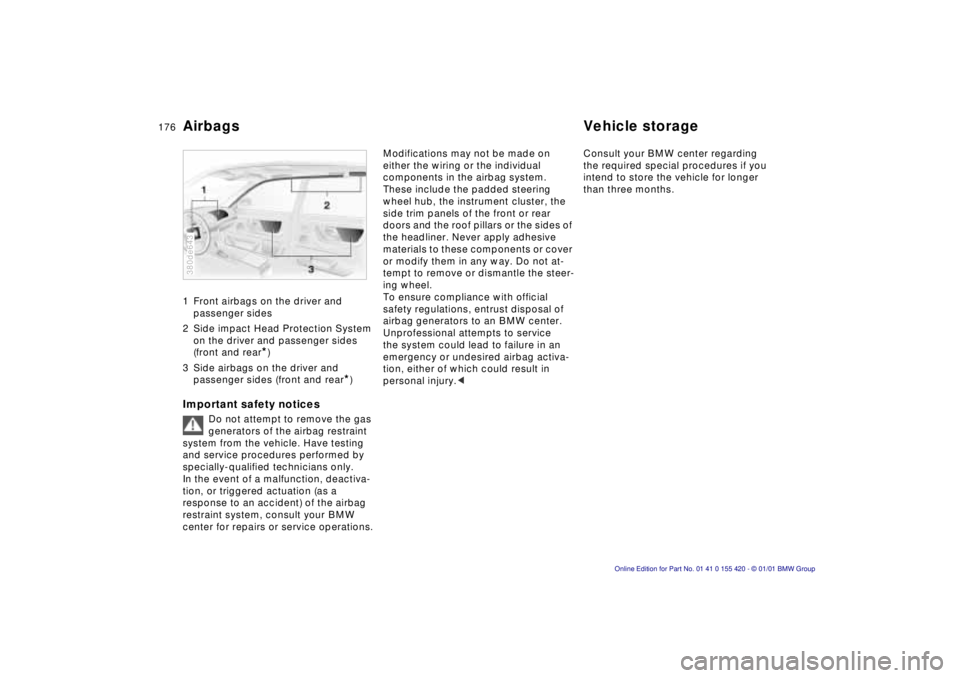
1 Front airbags on the driver and
passenger sides
2 Side impact Head Protection System on the driver and passenger sides
(front and rear
*)
3 Side airbags on the driver and passenger sides (front and rear
*)
Important safety notices
Do not attempt to remove the gas
generators of the airbag restraint
system from the vehicle. Have testing
and service procedures performed by
specially-qualified technicians only.
In the event of a malfunction, deactiva-
tion, or triggered actuation (as a
response to an accident) of the airbag
restraint system, consult your BMW
center for repairs or service operations.
380de643
Modifications may not be made on
either the wiring or the individual
components in the airbag system.
These include the padded steering
wheel hub, the instrument cluster, the
side trim panels of the front or rear
doors and the roof pillars or the sides of
the headliner. Never apply adhesive
materials to these components or cover
or modify them in any way. Do not at-
tempt to remove or dismantle the steer-
ing wheel.
To ensure compliance with official
safety regulations, entrust disposal of
airbag generators to an BMW center.
Unprofessional attempts to service
the system could lead to failure in an
emergency or undesired airbag activa-
tion, either of which could result in
personal injury. < Consult your BMW center regarding
the required special procedures if you
intend to store the vehicle for longer
than three months.