wheel BMW SPORT WAGON 2001 Service Manual
[x] Cancel search | Manufacturer: BMW, Model Year: 2001, Model line: SPORT WAGON, Model: BMW SPORT WAGON 2001Pages: 238, PDF Size: 2.44 MB
Page 181 of 238
Index
Data
Technology
Repairs
Car care
Controls
Overview
Overview
Controls and features Operation, care
and maintenance
Owner service procedures
Technical dataIndex
Advanced technology
181
n
Replacement procedures:
Onboard tool kit 182
Wiper blades 182
Lamps and bulbs 183
Changing a wheel 190
Battery 193
Fuses 196
In case of electrical
malfunction:
Fuel filler door 198
Sliding/Tilt sunroof 198
Tailgate 199
Assistance, giving and
receiving:
Jump-starting 200
Towing the vehicle 201
Page 190 of 238
190nChanging a wheel
Safety measures in the event of a
flat tire or wheel change:
Stop the vehicle as far as possible from
passing traffic. Park on a firm, flat,
surface. Switch on the hazard warning
flashers.
Turn the steering wheel to the straight-
ahead position, remove the key and
engage the steering lock. Shift into 1st
or reverse (selector lever in Park with
automatic transmission) and engage
the parking brake.
All passengers should be outside the
vehicle and well away from your imme-
diate working area (behind a guardrail,
for instance).
If necessary, set up your warning trian-
gle or portable hazard warning lamp on
the roadside at an appropriate distance
from the rear of the vehicle. Comply
with all safety guidelines and regula-
tions.
Change the wheel only on a level, firm
surface which is not slippery. Avoid
jacking the vehicle on a soft or slippery
support surface (snow, ice, loose
gravel, etc.), since it could slide side-
ways.Position the jack on a firm support
surface.
Do not place wooden blocks or similar
objects under the jack. If this is done,
the jack might not be able to reach its
full support capacity because of the
limited height.
Do not lie under the vehicle or start the
engine when the vehicle is supported
by the jack – risk of fatal injury. <
What you will need
In order to avoid rattling noises later,
note the position of the tools when you
remove them and return them to their
original position when you are through
using them.
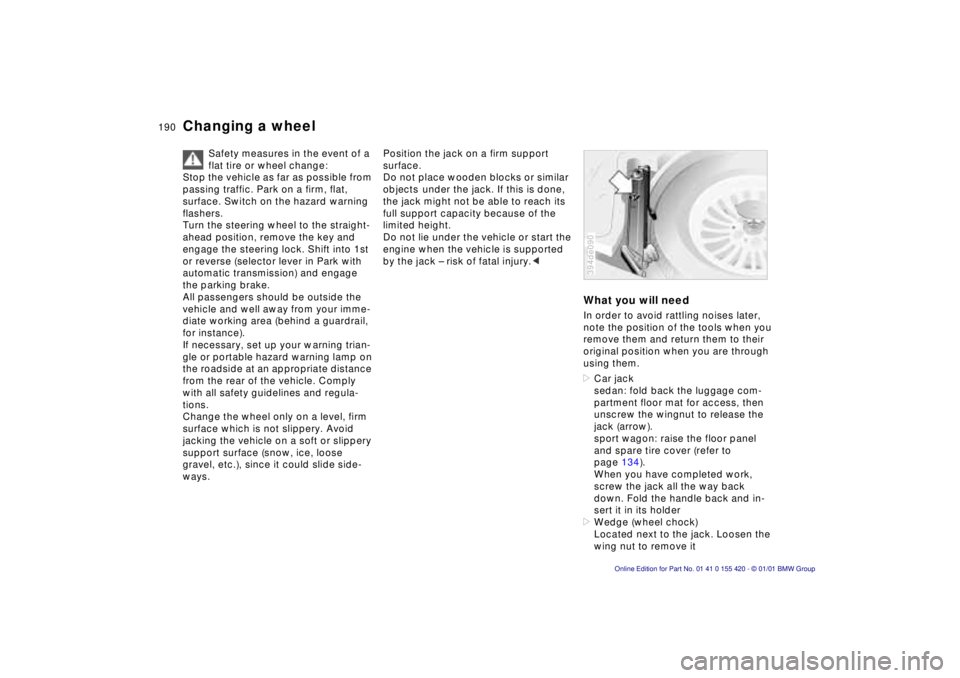
> Car jack
sedan: fold back the luggage com-
partment floor mat for access, then
unscrew the wingnut to release the
jack (arrow).
sport wagon: raise the floor panel
and spare tire cover (refer to
page 134).
When you have completed work,
screw the jack all the way back
down. Fold the handle back and in-
sert it in its holder
> Wedge (wheel chock)
Located next to the jack. Loosen the
wing nut to remove it
394de090
Page 191 of 238
Index
Data
Technology
Repairs
Car care
Controls
Overview
191nChanging a wheel
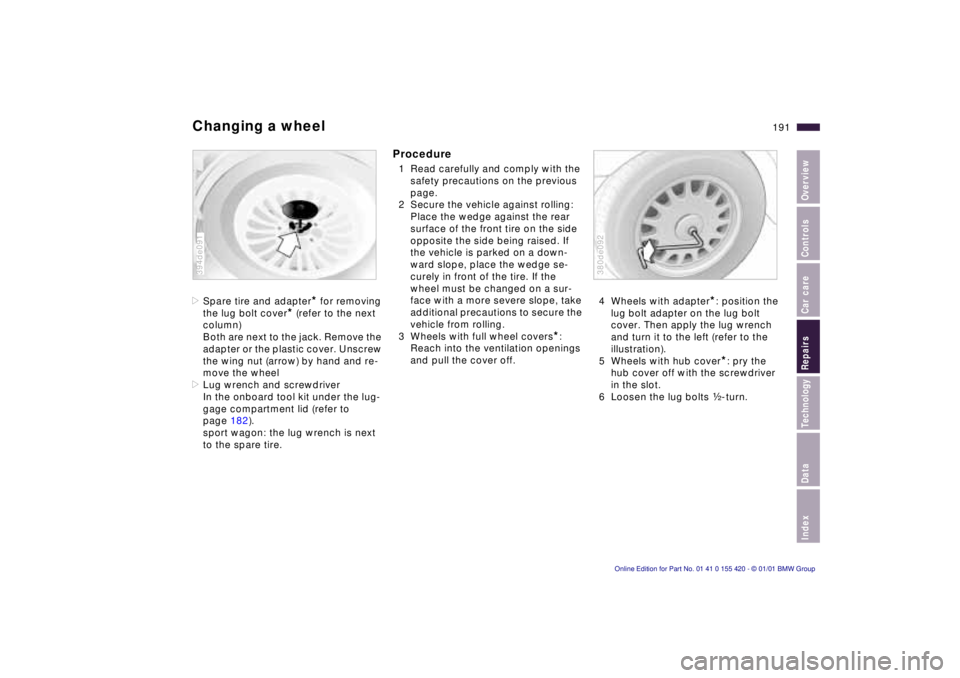
>Spare tire and adapter* for removing
the lug bolt cover
* (refer to the next
column)
Both are next to the jack. Remove the
adapter or the plastic cover. Unscrew
the wing nut (arrow) by hand and re-
move the wheel
> Lug wrench and screwdriver
In the onboard tool kit under the lug-
gage compartment lid (refer to
page 182).
sport wagon: the lug wrench is next
to the spare tire.
394de091
Procedure
1 Read carefully and comply with the safety precautions on the previous
page.
2 Secure the vehicle against rolling: Place the wedge against the rear
surface of the front tire on the side
opposite the side being raised. If
the vehicle is parked on a down-
ward slope, place the wedge se-
curely in front of the tire. If the
wheel must be changed on a sur-
face with a more severe slope, take
additional precautions to secure the
vehicle from rolling.
3 Wheels with full wheel covers
*:
Reach into the ventilation openings
and pull the cover off. 4 Wheels with adapter
*: position the
lug bolt adapter on the lug bolt
cover. Then apply the lug wrench
and turn it to the left (refer to the
illustration).
5 Wheels with hub cover
*: pry the
hub cover off with the screwdriver
in the slot.
6 Loosen the lug bolts g-turn.
380de092
Page 192 of 238
192nChanging a wheel
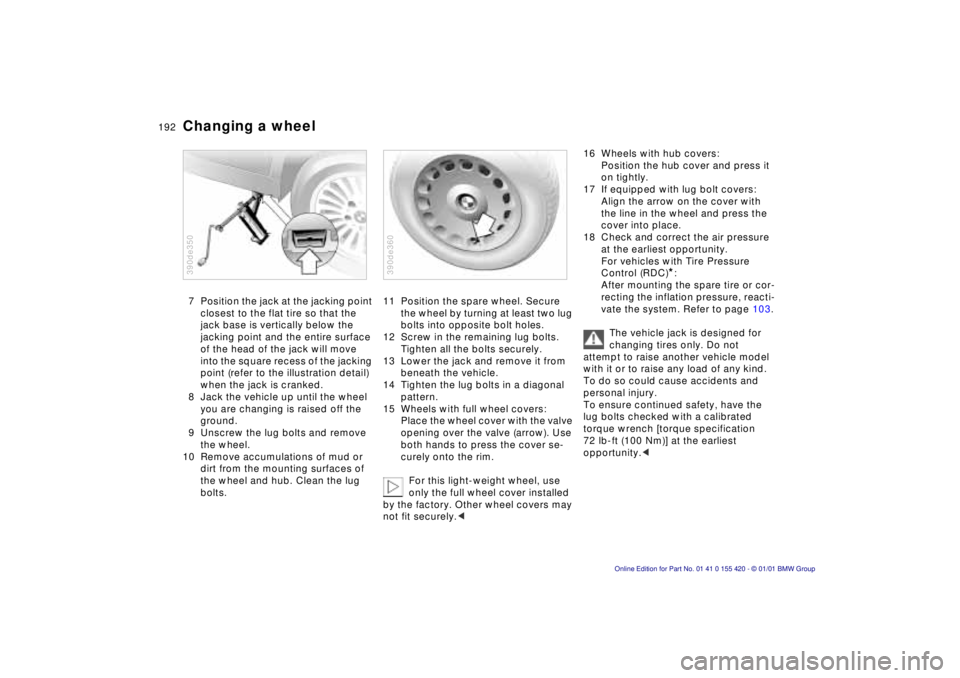
7 Position the jack at the jacking point
closest to the flat tire so that the
jack base is vertically below the
jacking point and the entire surface
of the head of the jack will move
into the square recess of the jacking
point (refer to the illustration detail)
when the jack is cranked.
8 Jack the vehicle up until the wheel you are changing is raised off the
ground.
9 Unscrew the lug bolts and remove the wheel.
10 Remove accumulations of mud or
dirt from the mounting surfaces of
the wheel and hub. Clean the lug
bolts.
390de350
11 Position the spare wheel. Secure the wheel by turning at least two lug
bolts into opposite bolt holes.
12 Screw in the remaining lug bolts. Tighten all the bolts securely.
13 Lower the jack and remove it from beneath the vehicle.
14 Tighten the lug bolts in a diagonal pattern.
15 Wheels with full wheel covers: Place the wheel cover with the valve
opening over the valve (arrow). Use
both hands to press the cover se-
curely onto the rim.
For this light-weight wheel, use
only the full wheel cover installed
by the factory. Other wheel covers may
not fit securely. <
390de360
16 Wheels with hub covers:
Position the hub cover and press it
on tightly.
17 If equipped with lug bolt covers: Align the arrow on the cover with
the line in the wheel and press the
cover into place.
18 Check and correct the air pressure at the earliest opportunity.
For vehicles with Tire Pressure
Control (RDC)
*:
After mounting the spare tire or cor-
recting the inflation pressure, reacti-
vate the system. Refer to page 103.
The vehicle jack is designed for
changing tires only. Do not
attempt to raise another vehicle model
with it or to raise any load of any kind.
To do so could cause accidents and
personal injury.
To ensure continued safety, have the
lug bolts checked with a calibrated
torque wrench [torque specification
72 lb-ft (100 Nm)] at the earliest
opportunity. <
Page 193 of 238
Index
Data
Technology
Repairs
Car care
Controls
Overview
193nChanging a wheel Battery
When storing the wheel, take care to
ensure that you do not damage the
retaining pin in the spare tire recess.
If light-alloy wheels other than original
BMW light-alloy wheels have been
mounted, it may be necessary to use
different lug bolts for those wheels.
Replace the defective tire as soon as
possible and have the new wheel/tire
balanced.
Size 255/40 R17 94 W
* tires on
the rear axle:
In the event of a puncture or other tire
failure, it may be necessary to mount
the spare tire of different size at the
rear. This tire is of full capacity in all
load and speed ranges. Nevertheless,
mount a tire of the correct size as soon
as possible. <
Battery posts, terminals, and re-
lated accessories contain lead
and lead compounds. Wash hands after
handling. <
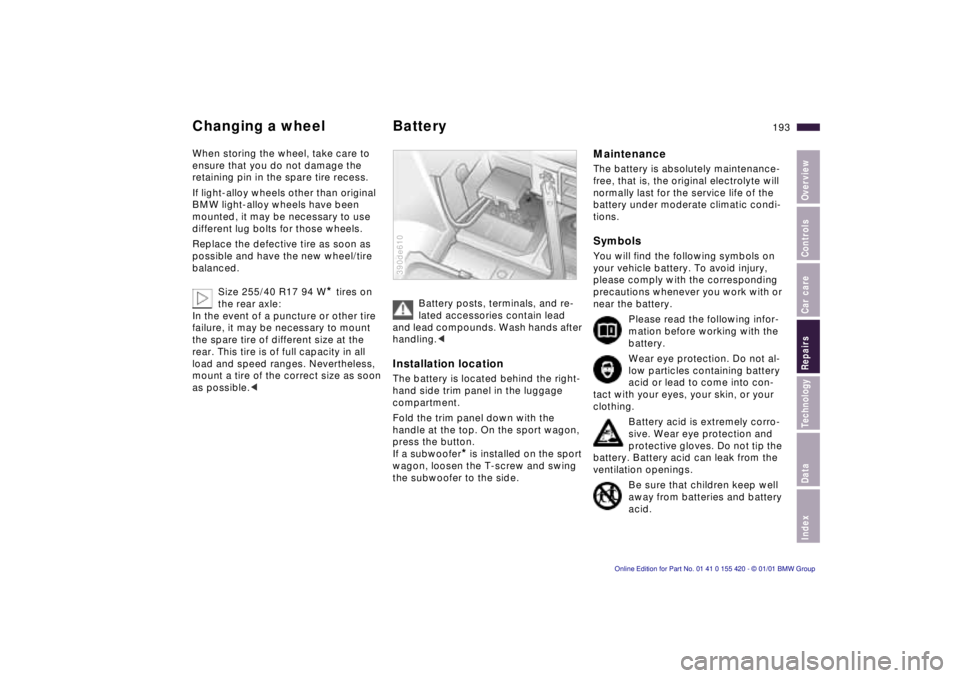
Installation location
The battery is located behind the right-
hand side trim panel in the luggage
compartment.
Fold the trim panel down with the
handle at the top. On the sport wagon,
press the button.
If a subwoofer
* is installed on the sport
wagon, loosen the T-screw and swing
the subwoofer to the side.
390de610
Maintenance
The battery is absolutely maintenance-
free, that is, the original electrolyte will
normally last for the service life of the
battery under moderate climatic condi-
tions.
Symbols
You will find the following symbols on
your vehicle battery. To avoid injury,
please comply with the corresponding
precautions whenever you work with or
near the battery.
Please read the following infor-
mation before working with the
battery.
Wear eye protection. Do not al-
low particles containing battery
acid or lead to come into con-
tact with your eyes, your skin, or your
clothing.
Battery acid is extremely corro-
sive. Wear eye protection and
protective gloves. Do not tip the
battery. Battery acid can leak from the
ventilation openings.
Be sure that children keep well
away from batteries and battery
acid.
Page 202 of 238
202nTowing the vehicle
The towed vehicle should always
be the lighter of the two vehicles.
If this is not the case, it is no longer
possible to control vehicle response. <
Tow-starting
It is not possible to start the engine of
vehicles equipped with an automatic
transmission by towing or pushing.
For instructions on jump starting, refer
to page 200.
Never attempt to use your vehicle to
push another vehicle, since damage to
the energy-absorbing bumpers could
result.
Towing a vehicle with automatic
transmission
1 Place the selector lever in position N.
2 Towing speed: Max. 45 mph (70 km/h).
3 Towing distance: Max. 95 miles (150 km).
4 Leave the ignition key in position 1 to ensure that the brake lamps, turn sig-
nals, horn and windshield wipers re-
main operative, and to prevent the
steering lock detent from engaging.
5 Switch on the hazard warning flash- ers (observe country-specific regula-
tions).
Find some means of identifying the ve-
hicle in tow, for instance, place a sign
or warning triangle in the rear window.
Make sure that the ignition key
remains in position 1 even when
the electrical system has failed to pre-
vent the steering lock from engaging.
The steering and brakes are without
power assist when the engine is off.
This means that increased effort is
required for steering and braking. <
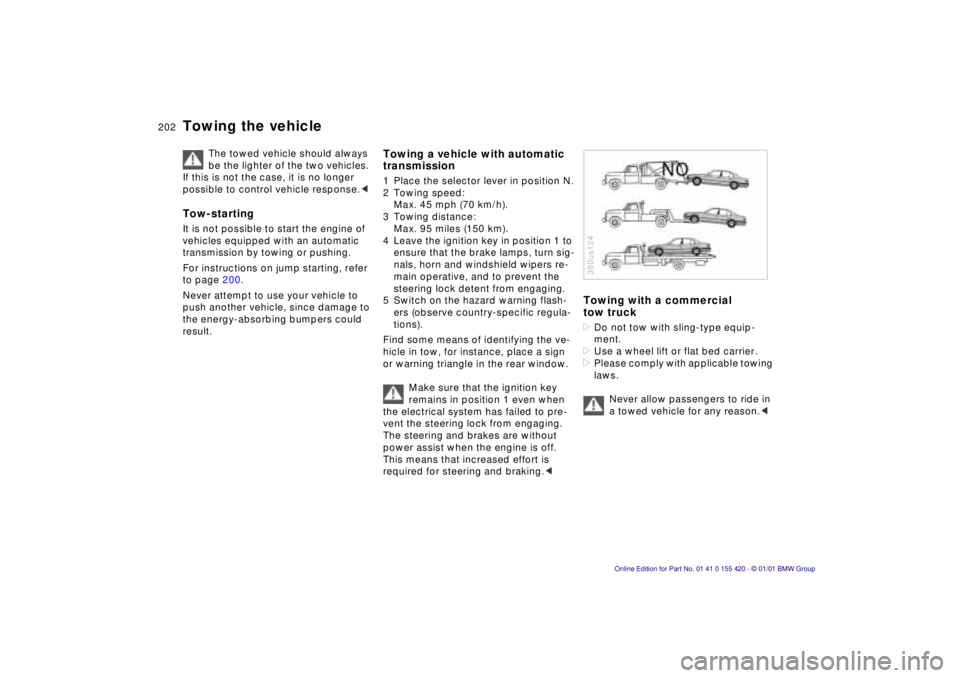
Towing with a commercial
tow truck
> Do not tow with sling-type equip-
ment.
> Use a wheel lift or flat bed carrier.
> Please comply with applicable towing
laws.
Never allow passengers to ride in
a towed vehicle for any reason. <
380us124
Page 208 of 238

208nASC+T/DSC*
Precision sensors monitor the number
of revolutions of the wheels. When
equipped with DSC, they also monitor
steering angle, lateral acceleration,
brake pressure and the movement of
the vehicle around its vertical axis.
If differences in the wheel speeds
occur, the system counteracts the dan-
ger of wheelspin by reducing torque. If
necessary, the system also responds
with additional brake applications at the
rear wheels, and at all 4 wheels with
DSC.
In addition, DSC permanently monitors
the vehicle's current operating condi-
tion and compares it with an ideal con-
dition that is calculated from the sen-
sor's signals. If deviations from this
occur (understeering or oversteering,
for instance), DSC can stabilize the
vehicle in the fraction of a second by
reducing engine output and with the
assistance of braking intervention at in-
dividual wheels. As a result, dangerous
skids can be prevented even as they
are just beginning. You may need some time to become
accustomed to this system intervention.
However, it guarantees optimum drive
force and driving stability.
The braking intervention may be
accompanied by a certain degree of
noise.
Page 213 of 238
Index
Data
Technology
Repairs
Car care
Controls
Overview
213nTire Pressure Control (RDC)*
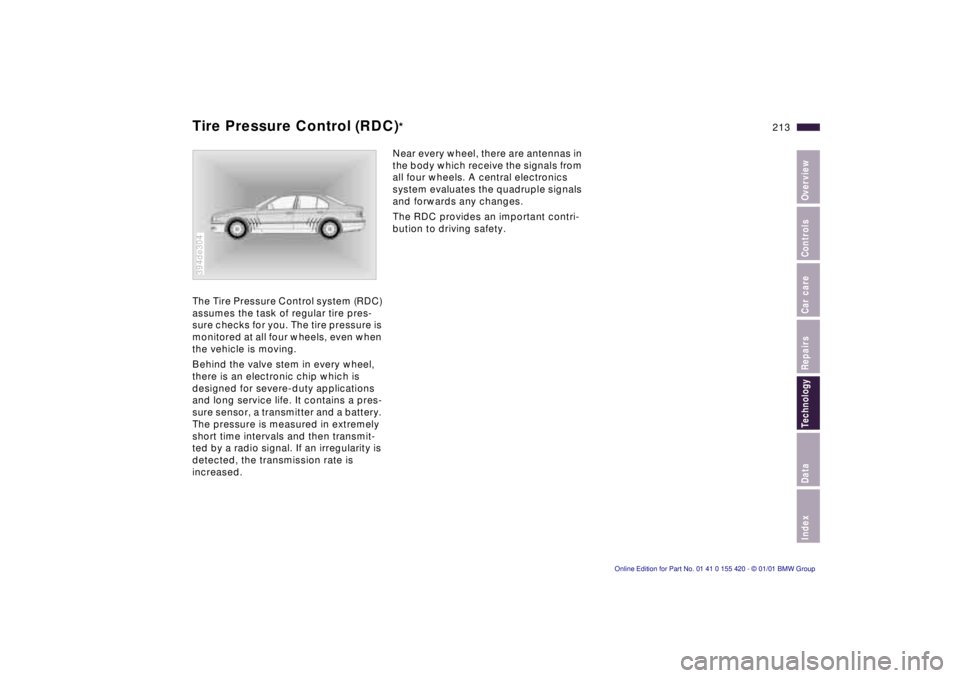
The Tire Pressure Control system (RDC)
assumes the task of regular tire pres-
sure checks for you. The tire pressure is
monitored at all four wheels, even when
the vehicle is moving.
Behind the valve stem in every wheel,
there is an electronic chip which is
designed for severe-duty applications
and long service life. It contains a pres-
sure sensor, a transmitter and a battery.
The pressure is measured in extremely
short time intervals and then transmit-
ted by a radio signal. If an irregularity is
detected, the transmission rate is
increased.
394de304
Near every wheel, there are antennas in
the body which receive the signals from
all four wheels. A central electronics
system evaluates the quadruple signals
and forwards any changes.
The RDC provides an important contri-
bution to driving safety.
Page 214 of 238
214nIntegrated rear suspension Level control system*
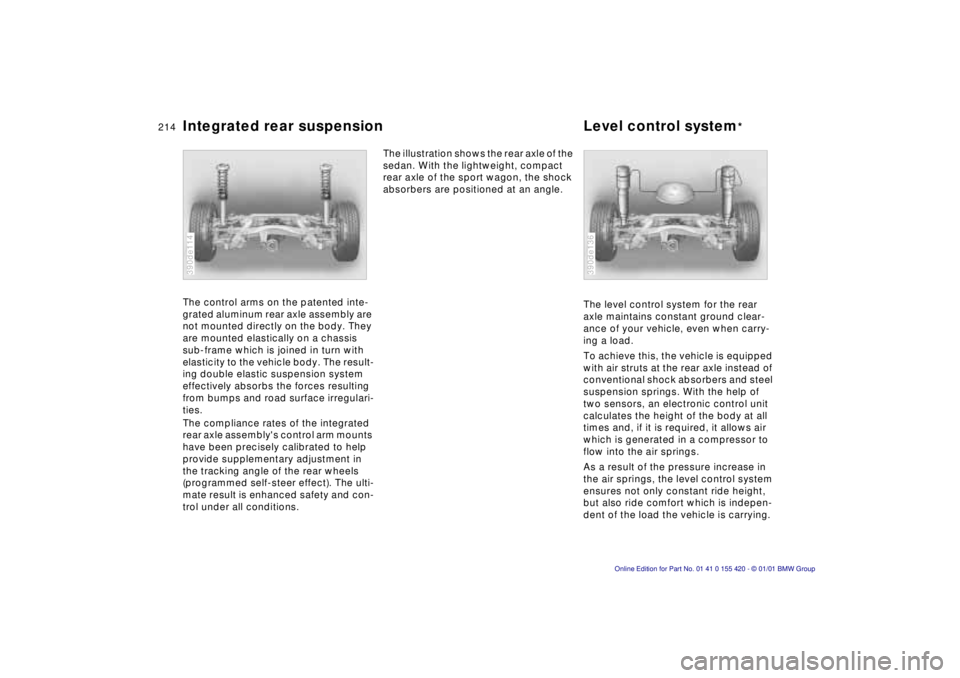
The control arms on the patented inte-
grated aluminum rear axle assembly are
not mounted directly on the body. They
are mounted elastically on a chassis
sub-frame which is joined in turn with
elasticity to the vehicle body. The result-
ing double elastic suspension system
effectively absorbs the forces resulting
from bumps and road surface irregulari-
ties.
The compliance rates of the integrated
rear axle assembly's control arm mounts
have been precisely calibrated to help
provide supplementary adjustment in
the tracking angle of the rear wheels
(programmed self-steer effect). The ulti-
mate result is enhanced safety and con-
trol under all conditions.
390de114
The illustration shows the rear axle of the
sedan. With the lightweight, compact
rear axle of the sport wagon, the shock
absorbers are positioned at an angle.
The level control system for the rear
axle maintains constant ground clear-
ance of your vehicle, even when carry-
ing a load.
To achieve this, the vehicle is equipped
with air struts at the rear axle instead of
conventional shock absorbers and steel
suspension springs. With the help of
two sensors, an electronic control unit
calculates the height of the body at all
times and, if it is required, it allows air
which is generated in a compressor to
flow into the air springs.
As a result of the pressure increase in
the air springs, the level control system
ensures not only constant ride height,
but also ride comfort which is indepen-
dent of the load the vehicle is carrying.
390de136
Page 228 of 238

Everything from A to Z
A
ABS (Antilock Brake
System)23, 143
Accessories6
Activated-charcoal
filter119
Active seat55, 210
Adaptive Transmission
Control (ATC)72, 207
Add
antifreeze168
t
brake fluid168
t
engine coolant168
t
engine oil165
t
washer fluids164
t
Adjust washer
nozzles164
t
Adjusting
backrest angle53
backrest, forward/
backward52
seats52
steering wheel56
temperature110, 116
thigh support55
Air conditioner108
Air distribution110, 116
Air outlets108, 114
Air pressure29
t
, 150
t
Air supply110, 117
Air vent108, 114Airbags23, 62, 176, 206
Alarm system47
Antennas149
Antifreeze167
t
radiator146
Antilock Brake System
(ABS)23, 143
Anti-theft alarm system47
Anti-theft protection39
Approved axle weight221
Approved gross vehicle
weight221
Approved roof load
capacity221
Aquaplaning141, 150
Arrival time97
ASC+T/DSC (Automatic
Stability Control plus
Traction/Dynamic Stability
Control)24, 102, 208
Ashtray126
ATC (Adaptive Transmission
Control)72, 207
Attach vacuum cleaner127
AUC (Automatic
recirculated-air
control)117
Automatic car washes171
Automatic climate
control114
remove condensation from
windows117Automatic cruise control81
Automatic curb monitor59
Automatic dimming
interior rearview mirror57
Automatic rear window
cleaning80
Automatic recirculated-air
control (AUC)117
Automatic Stability Control
plus Traction/Dynamic
Stability Control (ASC+T/
DSC)24, 102, 208
Automatic transmission72
Automatic transmission with
Steptronic75
Average fuel
consumption89
Average speed89, 98
Avoid false alarms48
t
Axle loads221
B
Backrest, adjusting52, 55
Backup lamps71
bulb replacement186
t
Battery193
t
, 224
capacity224
charge condition194
t
charging194
discharged200
t
removing and
installing195
t
Belts61
Beverage holder125
Blower110, 117
BMW active seat55, 210
BMW comfort seat54
BMW sports seat55
BMW Universal
Transmitter121
Body-cavity protectant172
Brake faults146
t
Brake hydraulic
system22, 146
Brake lamps, bulb
replacement186
t
Brake system140
brake faults146
brake fluid168
brake lamps, bulb
replacement186
brake pads23
disc brakes144
parking brake23, 70
Brake-in procedure140
Break-resistant security
glass174
care174
t
Bulb replacement183
t
C
California Proposition
65 Warning177
Capacity223