tec BMW X3 3.0I 2004 E83 Owner's Guide
[x] Cancel search | Manufacturer: BMW, Model Year: 2004, Model line: X3 3.0I, Model: BMW X3 3.0I 2004 E83Pages: 132, PDF Size: 3.62 MB
Page 97 of 132
Reference
At a glance
Controls
Driving tips
Mobility
95
Do not fill beyond the upper mark on the
dipstick. Excess oil can damage the
engine.
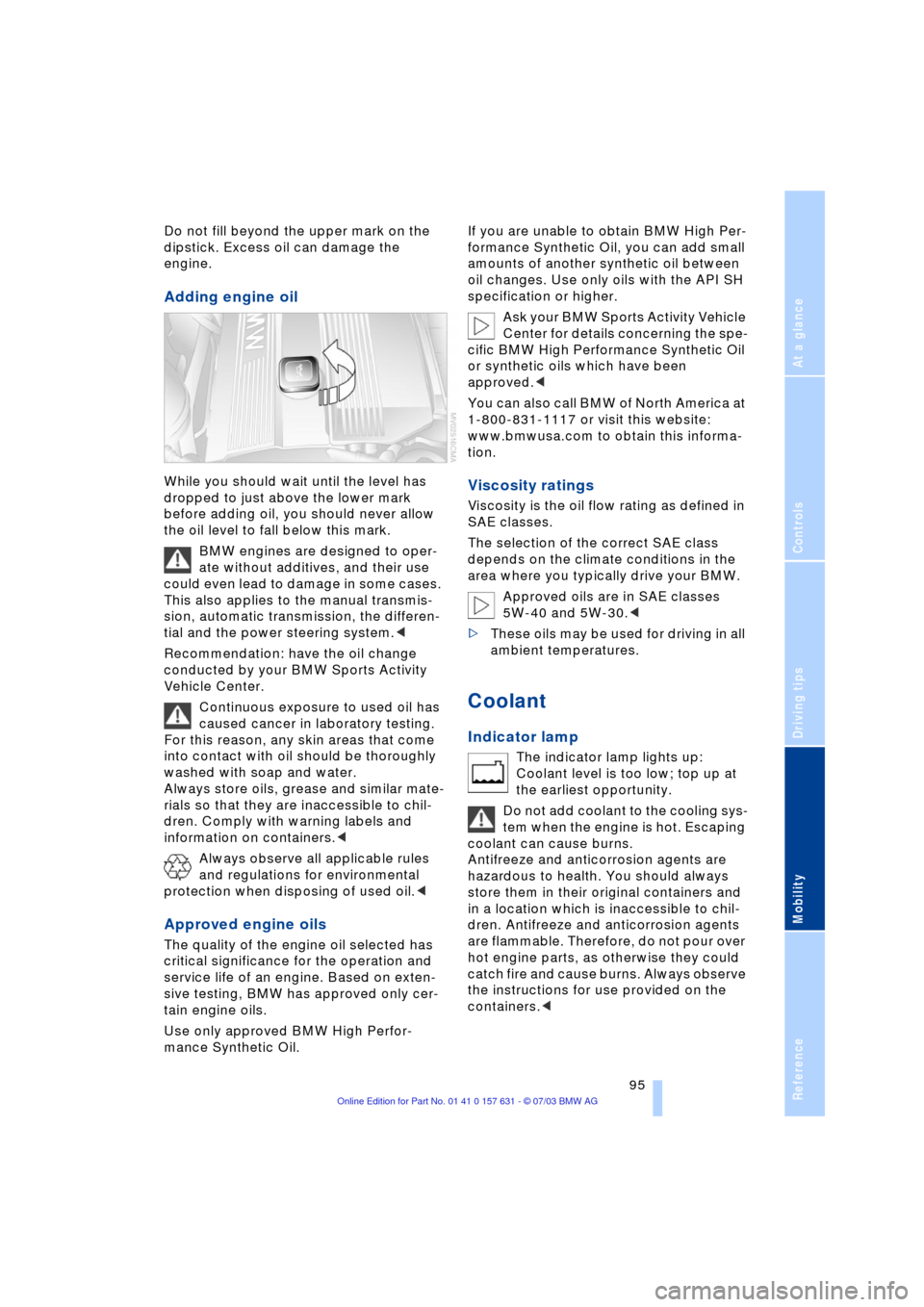
Adding engine oil
While you should wait until the level has
dropped to just above the lower mark
before adding oil, you should never allow
the oil level to fall below this mark.
BMW engines are designed to oper-
ate without additives, and their use
could even lead to damage in some cases.
This also applies to the manual transmis-
sion, automatic transmission, the differen-
tial and the power steering system.<
Recommendation: have the oil change
conducted by your BMW Sports Activity
Vehicle Center.
Continuous exposure to used oil has
caused cancer in laboratory testing.
For this reason, any skin areas that come
into contact with oil should be thoroughly
washed with soap and water.
Always store oils, grease and similar mate-
rials so that they are inaccessible to chil-
dren. Comply with warning labels and
information on containers.<
Always observe all applicable rules
and regulations for environmental
protection when disposing of used oil.<
Approved engine oils
The quality of the engine oil selected has
critical significance for the operation and
service life of an engine. Based on exten-
sive testing, BMW has approved only cer-
tain engine oils.
Use only approved BMW High Perfor-
mance Synthetic Oil.If you are unable to obtain BMW High Per-
formance Synthetic Oil, you can add small
amounts of another synthetic oil between
oil changes. Use only oils with the API SH
specification or higher.
Ask your BMW Sports Activity Vehicle
Center for details concerning the spe-
cific BMW High Performance Synthetic Oil
or synthetic oils which have been
approved.<
You can also call BMW of North America at
1-800-831-1117 or visit this website:
www.bmwusa.com to obtain this informa-
tion.
Viscosity ratings
Viscosity is the oil flow rating as defined in
SAE classes.
The selection of the correct SAE class
depends on the climate conditions in the
area where you typically drive your BMW.
Approved oils are in SAE classes
5W-40 and 5W-30.<
>These oils may be used for driving in all
ambient temperatures.
Coolant
Indicator lamp
The indicator lamp lights up:
Coolant level is too low; top up at
the earliest opportunity.
Do not add coolant to the cooling sys-
tem when the engine is hot. Escaping
coolant can cause burns.
Antifreeze and anticorrosion agents are
hazardous to health. You should always
store them in their original containers and
in a location which is inaccessible to chil-
dren. Antifreeze and anticorrosion agents
are flammable. Therefore, do not pour over
hot engine parts, as otherwise they could
catch fire and cause burns. Always observe
the instructions for use provided on the
containers.<
Page 98 of 132
Under the engine hood
96
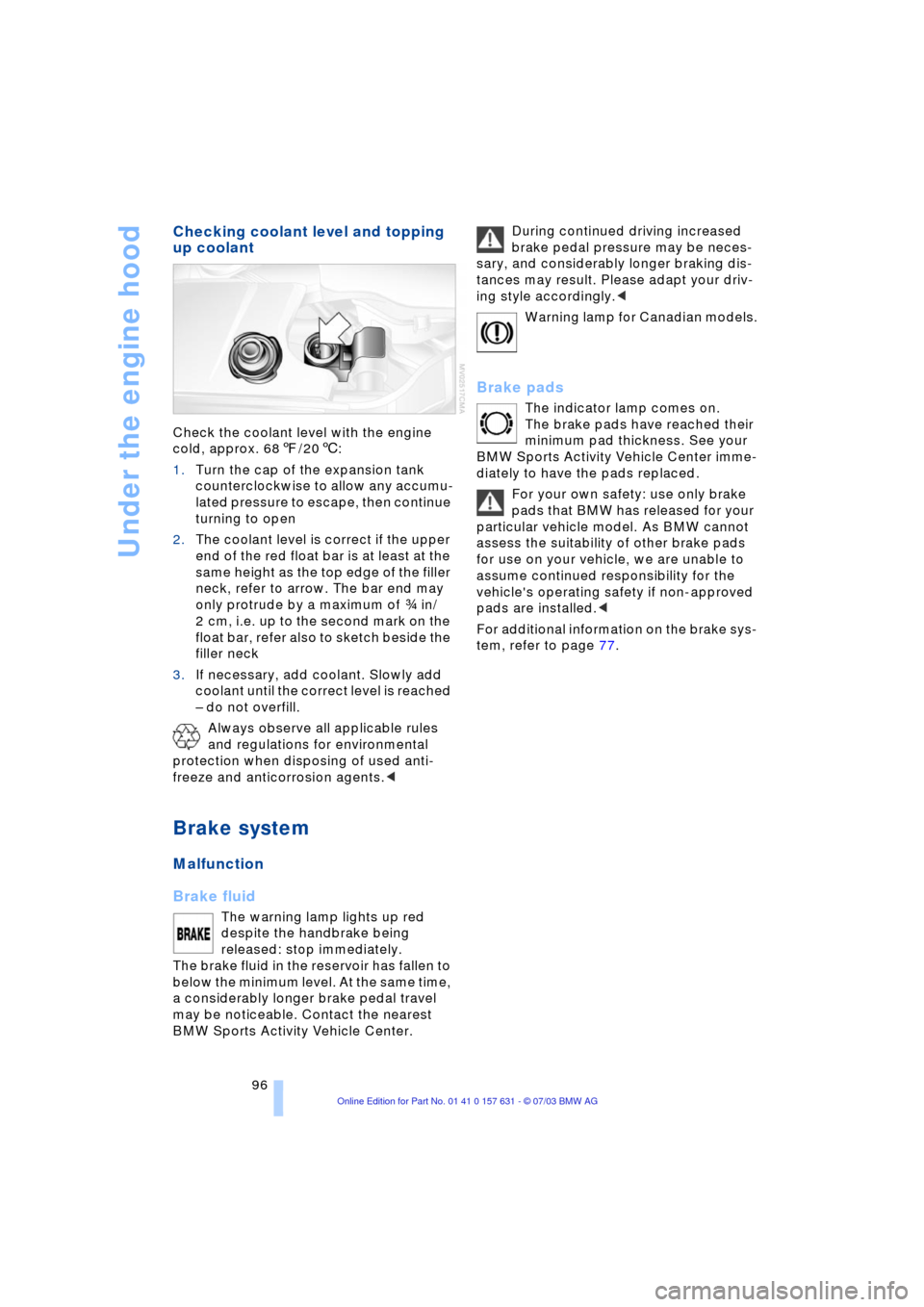
Checking coolant level and topping
up coolant
Check the coolant level with the engine
cold, approx. 687/206:
1.Turn the cap of the expansion tank
counterclockwise to allow any accumu-
lated pressure to escape, then continue
turning to open
2.The coolant level is correct if the upper
end of the red float bar is at least at the
same height as the top edge of the filler
neck, refer to arrow. The bar end may
only protrude by a maximum of i in/
2 cm, i.e. up to the second mark on the
float bar, refer also to sketch beside the
filler neck
3.If necessary, add coolant. Slowly add
coolant until the correct level is reached
Ð do not overfill.
Always observe all applicable rules
and regulations for environmental
protection when disposing of used anti-
freeze and anticorrosion agents.<
Brake system
Malfunction
Brake fluid
The warning lamp lights up red
despite the handbrake being
released: stop immediately.
The brake fluid in the reservoir has fallen to
below the minimum level. At the same time,
a considerably longer brake pedal travel
may be noticeable. Contact the nearest
BMW Sports Activity Vehicle Center.During continued driving increased
brake pedal pressure may be neces-
sary, and considerably longer braking dis-
tances may result. Please adapt your driv-
ing style accordingly.<
Warning lamp for Canadian models.
Brake pads
The indicator lamp comes on.
The brake pads have reached their
minimum pad thickness. See your
BMW Sports Activity Vehicle Center imme-
diately to have the pads replaced.
For your own safety: use only brake
pads that BMW has released for your
particular vehicle model. As BMW cannot
assess the suitability of other brake pads
for use on your vehicle, we are unable to
assume continued responsibility for the
vehicle's operating safety if non-approved
pads are installed.<
For additional information on the brake sys-
tem, refer to page 77.
Page 100 of 132
Laws and regulations
98
Laws and regulations
California Proposition 65
Warning
California laws require us to state the fol-
lowing warning:
Engine exhaust and a wide variety of
automobile components and parts,
including components found in the interior
furnishings in a vehicle, contain or emit
chemicals known to the State of California
to cause cancer and birth defects and
reproductive harm. In addition, certain flu-
ids contained in vehicles and certain prod-
ucts of component wear contain or emit
chemicals known to the State of California
to cause cancer and birth defects or other
reproductive harm. Battery posts, terminals
and related accessories contain lead and
lead compounds. Wash your hands after
handling. Used engine oil contains chemi-
cals that have caused cancer in laboratory
animals. Always protect your skin by wash-
ing thoroughly with soap and water.<
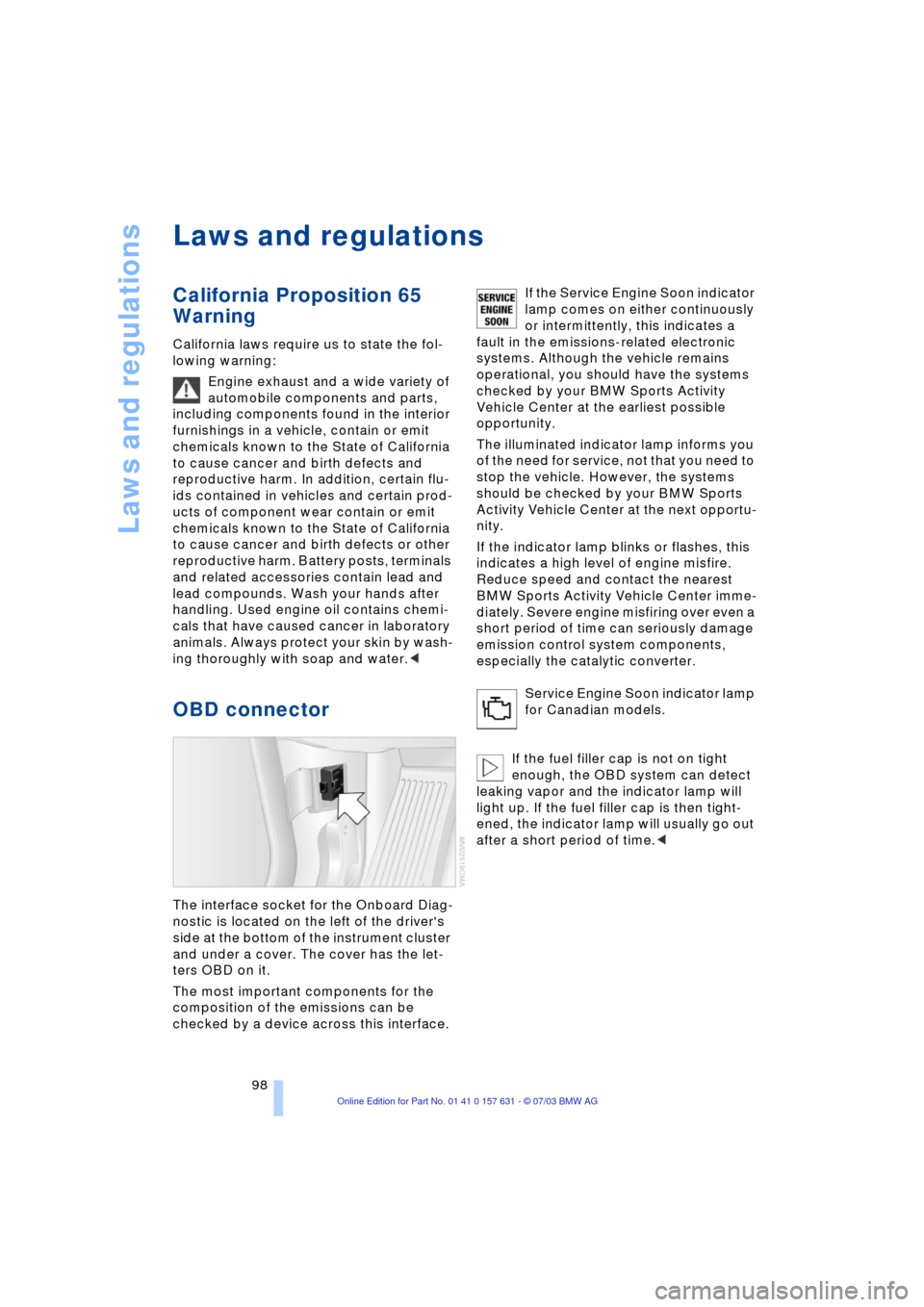
OBD connector
The interface socket for the Onboard Diag-
nostic is located on the left of the driver's
side at the bottom of the instrument cluster
and under a cover. The cover has the let-
ters OBD on it.
The most important components for the
composition of the emissions can be
checked by a device across this interface. If the Service Engine Soon indicator
lamp comes on either continuously
or intermittently, this indicates a
fault in the emissions-related electronic
systems. Although the vehicle remains
operational, you should have the systems
checked by your BMW Sports Activity
Vehicle Center at the earliest possible
opportunity.
The illuminated indicator lamp informs you
of the need for service, not that you need to
stop the vehicle. However, the systems
should be checked by your BMW Sports
Activity Vehicle Center at the next opportu-
nity.
If the indicator lamp blinks or flashes, this
indicates a high level of engine misfire.
Reduce speed and contact the nearest
BMW Sports Activity Vehicle Center imme-
diately. Severe engine misfiring over even a
short period of time can seriously damage
emission control system components,
especially the catalytic converter.
Service Engine Soon indicator lamp
for Canadian models.
If the fuel filler cap is not on tight
enough, the OBD system can detect
leaking vapor and the indicator lamp will
light up. If the fuel filler cap is then tight-
ened, the indicator lamp will usually go out
after a short period of time.<
Page 102 of 132
Replacing components
100 When maintaining the headlamps,
please comply with the instructions in
the separate Caring for your vehicle bro-
chure.<
Halogen low beams
H7 bulb, 55 Watts
Always wear gloves and eye protec-
tion Ð the atmosphere within the bulb
is pressurized. Failure to observe this pre-
caution can lead to personal injury should
the bulb be damaged.<
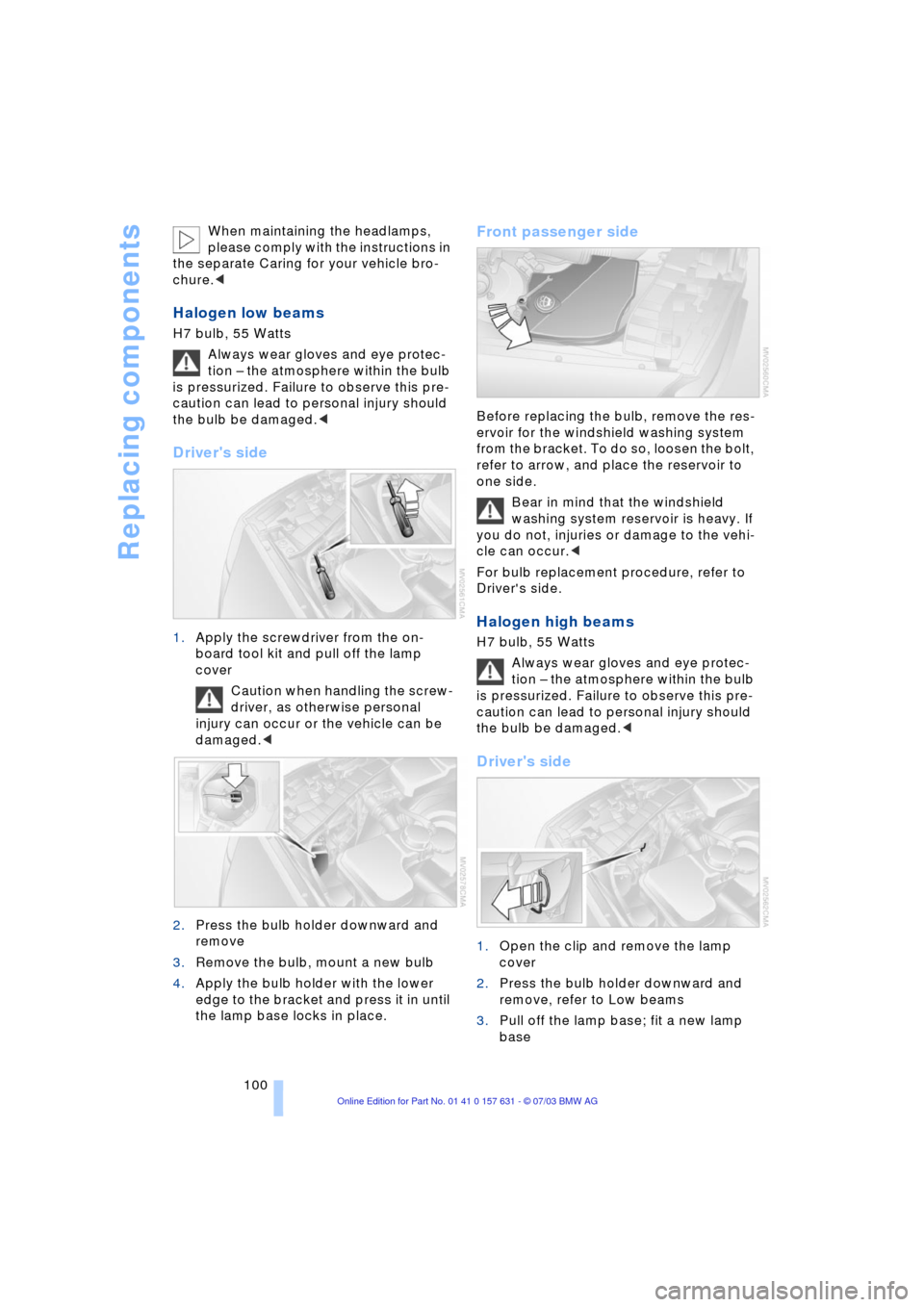
Driver's side
1.Apply the screwdriver from the on-
board tool kit and pull off the lamp
cover
Caution when handling the screw-
driver, as otherwise personal
injury can occur or the vehicle can be
damaged.<
2.Press the bulb holder downward and
remove
3.Remove the bulb, mount a new bulb
4.Apply the bulb holder with the lower
edge to the bracket and press it in until
the lamp base locks in place.
Front passenger side
Before replacing the bulb, remove the res-
ervoir for the windshield washing system
from the bracket. To do so, loosen the bolt,
refer to arrow, and place the reservoir to
one side.
Bear in mind that the windshield
washing system reservoir is heavy. If
you do not, injuries or damage to the vehi-
cle can occur.<
For bulb replacement procedure, refer to
Driver's side.
Halogen high beams
H7 bulb, 55 Watts
Always wear gloves and eye protec-
tion Ð the atmosphere within the bulb
is pressurized. Failure to observe this pre-
caution can lead to personal injury should
the bulb be damaged.<
Driver's side
1.Open the clip and remove the lamp
cover
2.Press the bulb holder downward and
remove, refer to Low beams
3.Pull off the lamp base; fit a new lamp
base
Page 104 of 132
Replacing components
102
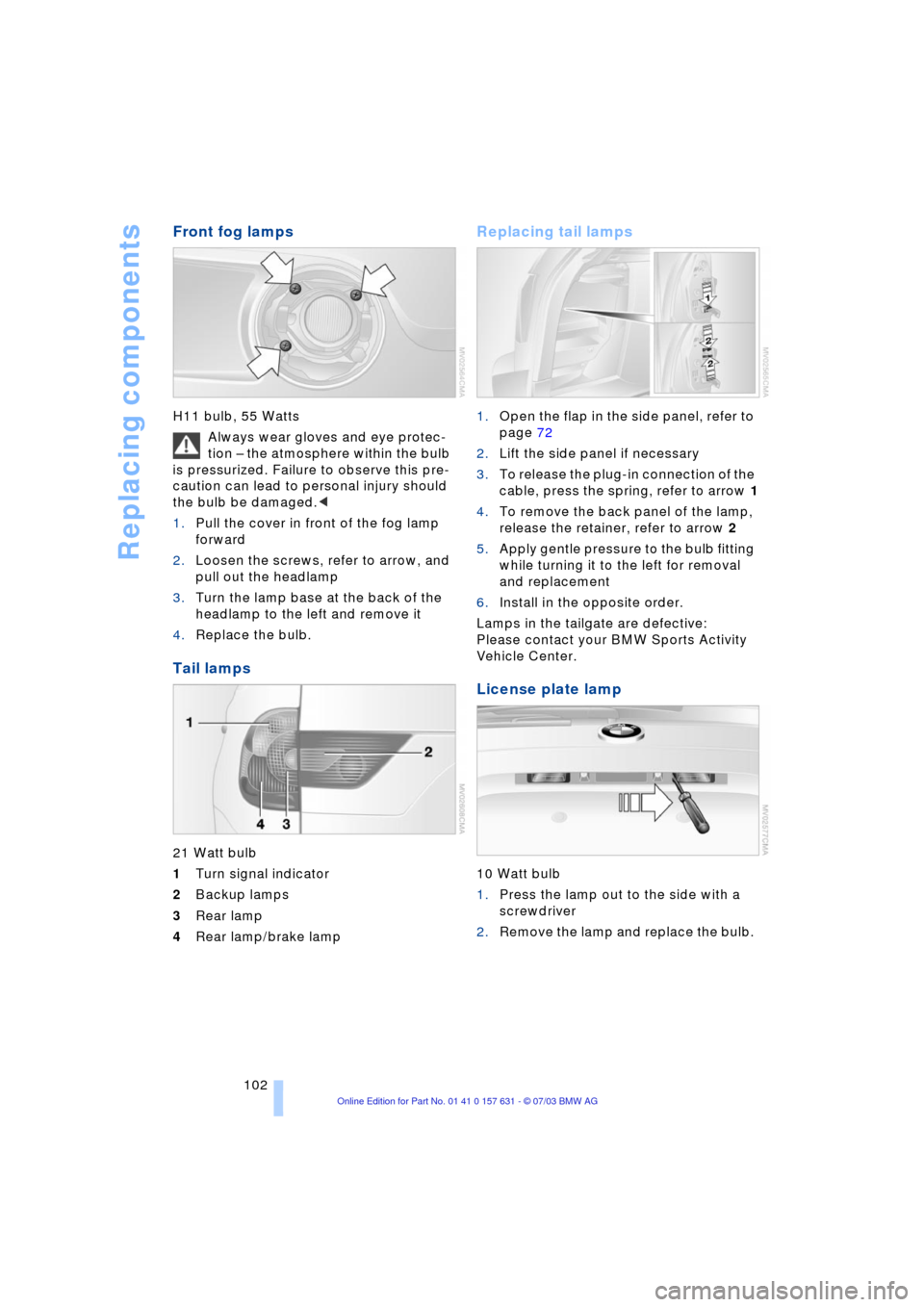
Front fog lamps
H11 bulb, 55 Watts
Always wear gloves and eye protec-
tion Ð the atmosphere within the bulb
is pressurized. Failure to observe this pre-
caution can lead to personal injury should
the bulb be damaged.<
1.Pull the cover in front of the fog lamp
forward
2.Loosen the screws, refer to arrow, and
pull out the headlamp
3.Turn the lamp base at the back of the
headlamp to the left and remove it
4.Replace the bulb.
Tail lamps
21 Watt bulb
1Turn signal indicator
2Backup lamps
3Rear lamp
4Rear lamp/brake lamp
Replacing tail lamps
1.Open the flap in the side panel, refer to
page 72
2.Lift the side panel if necessary
3.To release the plug-in connection of the
cable, press the spring, refer to arrow 1
4.To remove the back panel of the lamp,
release the retainer, refer to arrow 2
5.Apply gentle pressure to the bulb fitting
while turning it to the left for removal
and replacement
6.Install in the opposite order.
Lamps in the tailgate are defective:
Please contact your BMW Sports Activity
Vehicle Center.
License plate lamp
10 Watt bulb
1.Press the lamp out to the side with a
screwdriver
2.Remove the lamp and replace the bulb.
Page 107 of 132
Reference
At a glance
Controls
Driving tips
Mobility
105
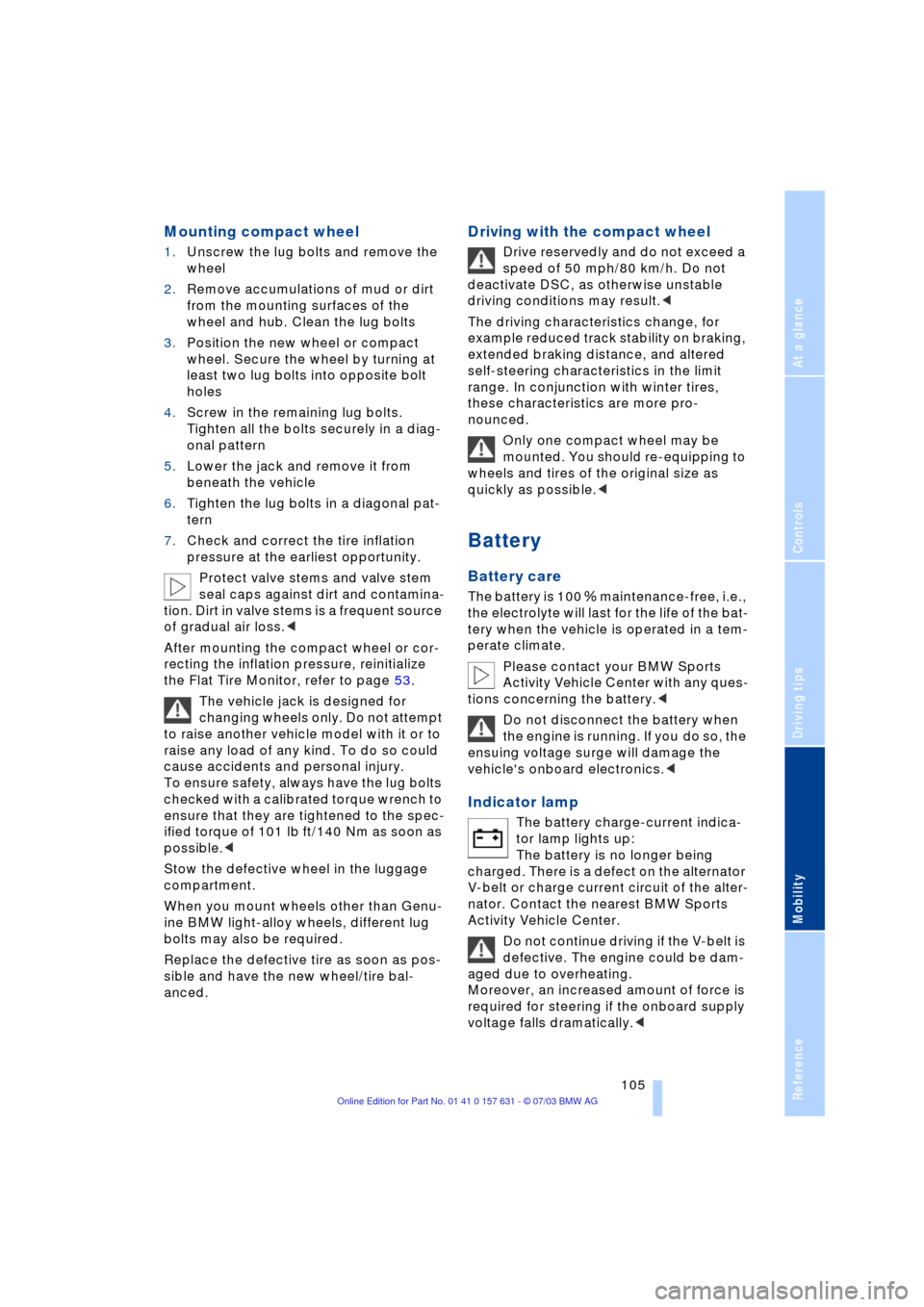
Mounting compact wheel
1.Unscrew the lug bolts and remove the
wheel
2.Remove accumulations of mud or dirt
from the mounting surfaces of the
wheel and hub. Clean the lug bolts
3.Position the new wheel or compact
wheel. Secure the wheel by turning at
least two lug bolts into opposite bolt
holes
4.Screw in the remaining lug bolts.
Tighten all the bolts securely in a diag-
onal pattern
5.Lower the jack and remove it from
beneath the vehicle
6.Tighten the lug bolts in a diagonal pat-
tern
7.Check and correct the tire inflation
pressure at the earliest opportunity.
Protect valve stems and valve stem
seal caps against dirt and contamina-
tion. Dirt in valve stems is a frequent source
of gradual air loss.<
After mounting the compact wheel or cor-
recting the inflation pressure, reinitialize
the Flat Tire Monitor, refer to page 53.
The vehicle jack is designed for
changing wheels only. Do not attempt
to raise another vehicle model with it or to
raise any load of any kind. To do so could
cause accidents and personal injury.
To ensure safety, always have the lug bolts
checked with a calibrated torque wrench to
ensure that they are tightened to the spec-
ified torque of 101 lb ft/140 Nm as soon as
possible.<
Stow the defective wheel in the luggage
compartment.
When you mount wheels other than Genu-
ine BMW light-alloy wheels, different lug
bolts may also be required.
Replace the defective tire as soon as pos-
sible and have the new wheel/tire bal-
anced.
Driving with the compact wheel
Drive reservedly and do not exceed a
speed of 50 mph/80 km/h. Do not
deactivate DSC, as otherwise unstable
driving conditions may result.<
The driving characteristics change, for
example reduced track stability on braking,
extended braking distance, and altered
self-steering characteristics in the limit
range. In conjunction with winter tires,
these characteristics are more pro-
nounced.
Only one compact wheel may be
mounted. You should re-equipping to
wheels and tires of the original size as
quickly as possible.<
Battery
Battery care
The battery is 100% maintenance-free, i.e.,
the electrolyte will last for the life of the bat-
tery when the vehicle is operated in a tem-
perate climate.
Please contact your BMW Sports
Activity Vehicle Center with any ques-
tions concerning the battery.<
Do not disconnect the battery when
the engine is running. If you do so, the
ensuing voltage surge will damage the
vehicle's onboard electronics.<
Indicator lamp
The battery charge-current indica-
tor lamp lights up:
The battery is no longer being
charged. There is a defect on the alternator
V-belt or charge current circuit of the alter-
nator. Contact the nearest BMW Sports
Activity Vehicle Center.
Do not continue driving if the V-belt is
defective. The engine could be dam-
aged due to overheating.
Moreover, an increased amount of force is
required for steering if the onboard supply
voltage falls dramatically.<
Page 109 of 132
Reference
At a glance
Controls
Driving tips
Mobility
107
Giving and receiving assistance
Receiving assistance
The Roadside Assistance of the BMW
Group offers you assistance in the event of
a breakdown around the clock, also at
weekends and on public holidays.
The phone numbers of the Roadside Assis-
tance control center in your home country
can be found in the BMW Dealer Directory.
In the case of vehicles with the corre-
sponding equipment, you can use buttons
in the headlining to contact Roadside
Assistance or start an emergency call.
When an emergency call is started, a tele-
phone connection is set up to the general
emergency call center.
In vehicles where BMW Assist is enabled,
the phone system will also automatically
establish contact with the BMW Assist
emergency call center. If the current loca-
tion of your vehicle can be determined, this
is transferred to the BMW Assist emer-
gency call center.
The condition for starting an emergency
call or contacting Roadside Assistance:
>The car phone is logged on to a mobile
telephone network
>The emergency call system is operable.
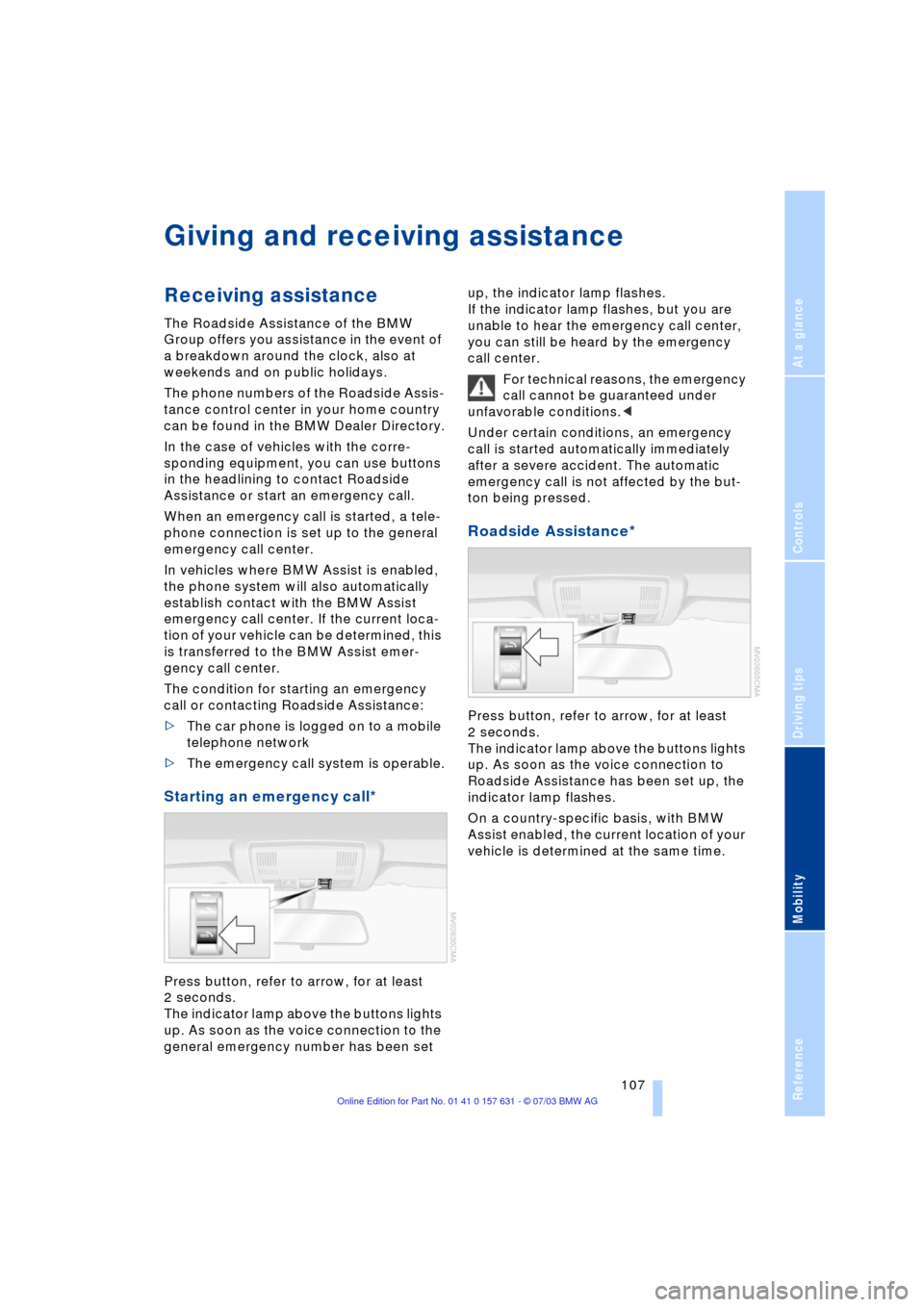
Starting an emergency call*
Press button, refer to arrow, for at least
2 seconds.
The indicator lamp above the buttons lights
up. As soon as the voice connection to the
general emergency number has been set up, the indicator lamp flashes.
If the indicator lamp flashes, but you are
unable to hear the emergency call center,
you can still be heard by the emergency
call center.
For technical reasons, the emergency
call cannot be guaranteed under
unfavorable conditions.<
Under certain conditions, an emergency
call is started automatically immediately
after a severe accident. The automatic
emergency call is not affected by the but-
ton being pressed.
Roadside Assistance*
Press button, refer to arrow, for at least
2 seconds.
The indicator lamp above the buttons lights
up. As soon as the voice connection to
Roadside Assistance has been set up, the
indicator lamp flashes.
On a country-specific basis, with BMW
Assist enabled, the current location of your
vehicle is determined at the same time.
Page 115 of 132
Reference
This is where to look to find
information on any desired topic as
quickly as possible.
This chapter includes the section
with technical information as well
as the manual's index.
Page 116 of 132
Technical data
114
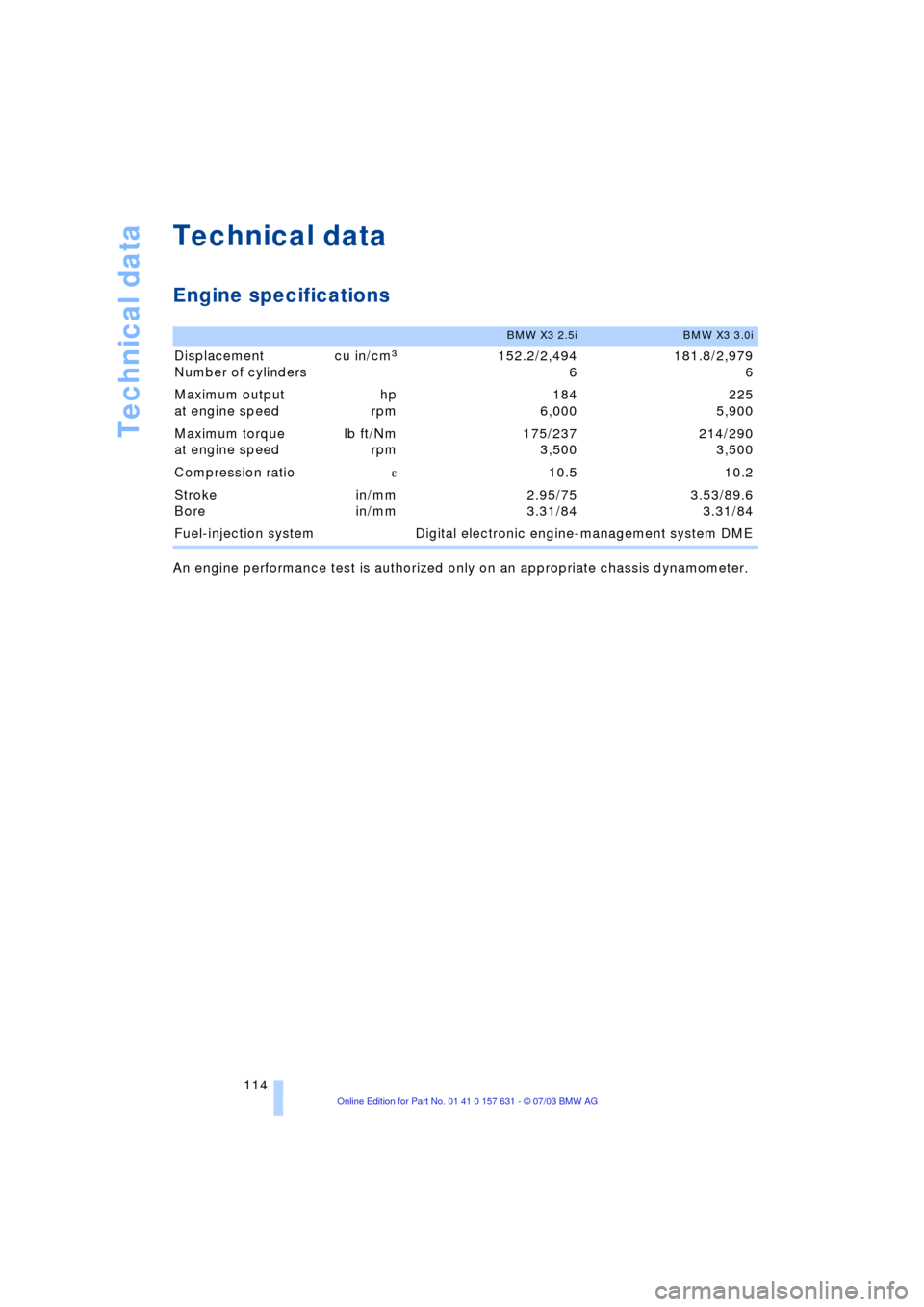
Technical data
Engine specifications
An engine performance test is authorized only on an appropriate chassis dynamometer.
BMW X3 2.5iBMW X3 3.0i
Displacement
Number of cylinderscu in/cmm152.2/2,494
6181.8/2,979
6
Maximum output
at engine speedhp
rpm184
6,000225
5,900
Maximum torque
at engine speedlb ft/Nm
rpm175/237
3,500214/290
3,500
Compression ratioe10.5 10.2
Stroke
Borein/mm
in/mm2.95/75
3.31/843.53/89.6
3.31/84
Fuel-injection system Digital electronic engine-management system DME
Page 118 of 132
Technical data
116
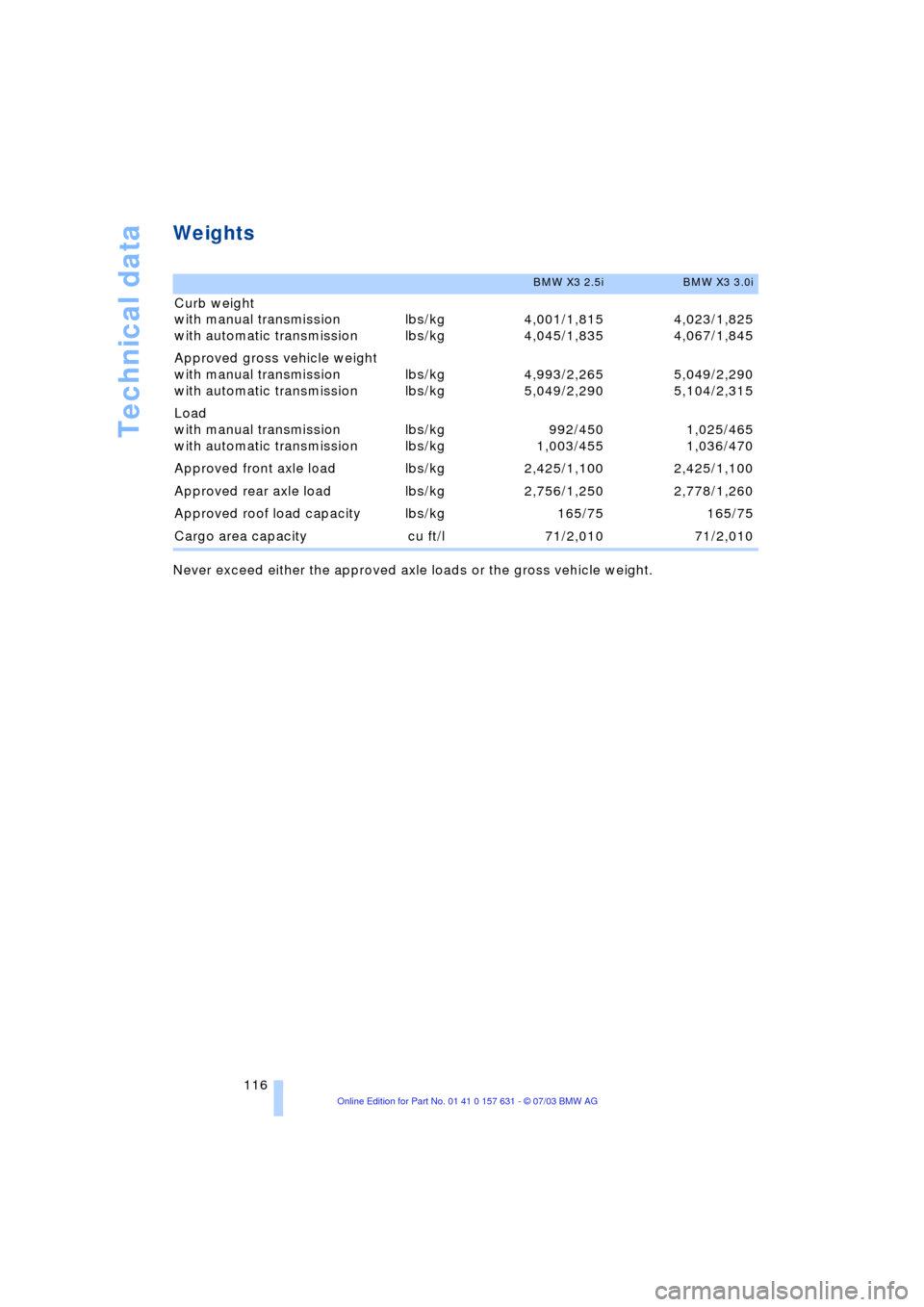
Weights
Never exceed either the approved axle loads or the gross vehicle weight.
BMW X3 2.5iBMW X3 3.0i
Curb weight
with manual transmission
with automatic transmissionlbs/kg
lbs/kg4,001/1,815
4,045/1,8354,023/1,825
4,067/1,845
Approved gross vehicle weight
with manual transmission
with automatic transmissionlbs/kg
lbs/kg4,993/2,265
5,049/2,2905,049/2,290
5,104/2,315
Load
with manual transmission
with automatic transmissionlbs/kg
lbs/kg992/450
1,003/4551,025/465
1,036/470
Approved front axle load lbs/kg 2,425/1,100 2,425/1,100
Approved rear axle load lbs/kg 2,756/1,250 2,778/1,260
Approved roof load capacity lbs/kg 165/75 165/75
Cargo area capacity cu ft/l 71/2,010 71/2,010