tec BMW X3 3.0I 2004 E83 Owner's Guide
[x] Cancel search | Manufacturer: BMW, Model Year: 2004, Model line: X3 3.0I, Model: BMW X3 3.0I 2004 E83Pages: 132, PDF Size: 3.62 MB
Page 55 of 132
Reference
At a glance
Controls
Driving tips
Mobility
53
available. See your BMW Sports Activity
Vehicle Center to have the system
repaired.
Flat Tire Monitor
The concept
The Flat Tire Monitor keeps track of the
inflation pressures in the four fitted tires as
you drive. The system provides an alert
whenever the inflation pressure drops sig-
nificantly in relation to the pressure another
tire.
The check of the tire inflation pressure is
based on monitoring the relative speeds of
the wheels. A flat tire is detected and
reported on the basis of a deviation in cer-
tain speed ratios.
Functional requirement
So that the Flat Tire Monitor can learn the
correct inflation pressure, please perform
the following:
1.Check the inflation pressures in all tires
2.Compare with the inflation pressure
table on page 87 and correct if neces-
sary
3.Initialize the system.
Limits of the system
The Flat Tire Monitor cannot indicate
sudden severe tire damage caused
by outside factors and does not detect a
natural, even pressure drop in all four
tires.<
In the following situations, on the other
hand, there can be delays in detecting tire
pressure losses, and even system failure:
>When driving on snow-covered or slip-
pery road surfaces
>In the case of performance-oriented
driving: slip on the drive wheels, high
lateral acceleration
>False alarms and undetected loss of
pressure may occur when you are driv-
ing with snow chains fitted>When driving with a compact wheel, the
Flat Tire Monitor cannot operate.
Initializing the system
Perform the initialization immediately
every time you correct the inflation
pressure, change a tire or change a wheel
or all wheels. A drive is required for this
purpose.<
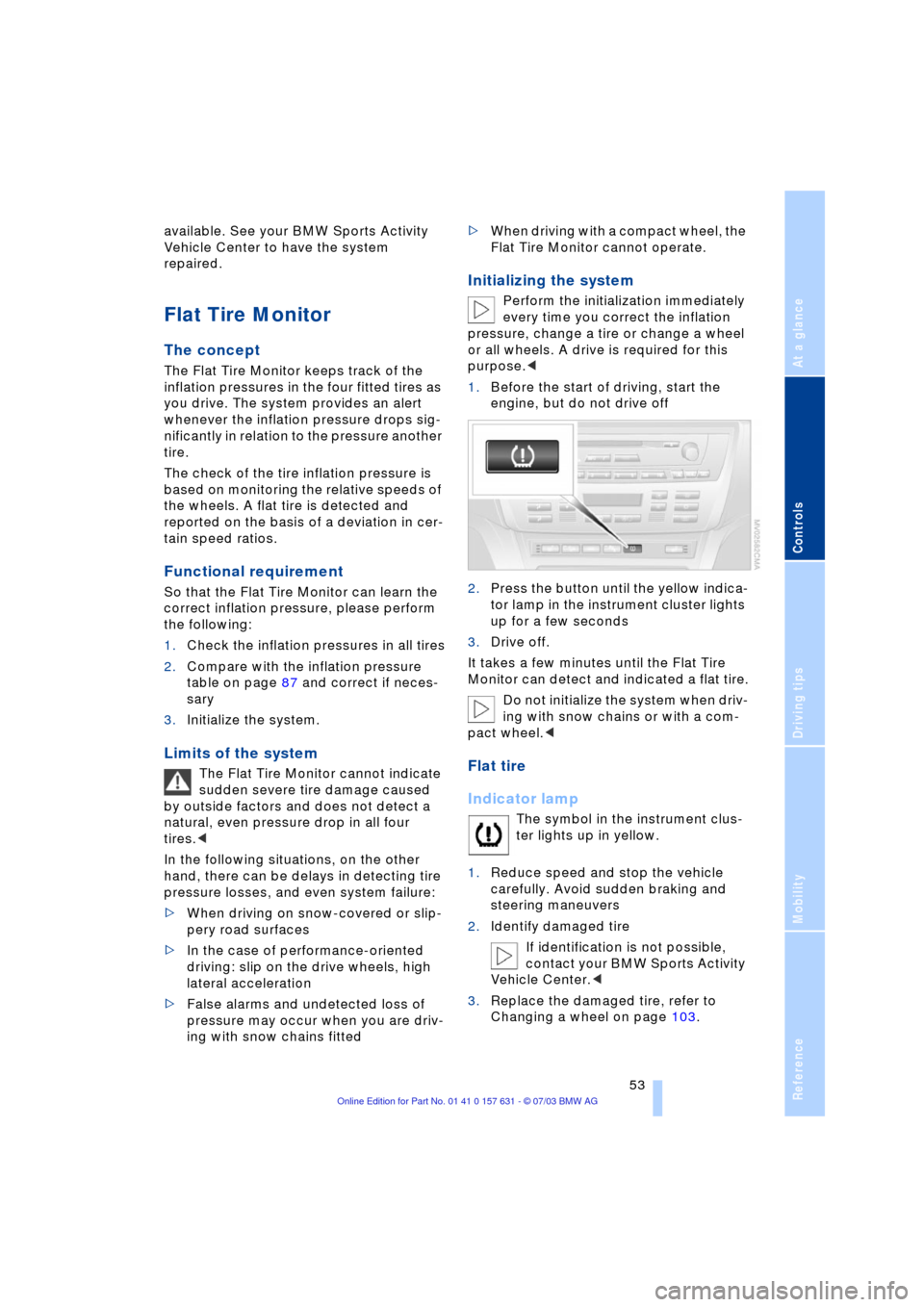
1.Before the start of driving, start the
engine, but do not drive off
2.Press the button until the yellow indica-
tor lamp in the instrument cluster lights
up for a few seconds
3.Drive off.
It takes a few minutes until the Flat Tire
Monitor can detect and indicated a flat tire.
Do not initialize the system when driv-
ing with snow chains or with a com-
pact wheel.<
Flat tire
Indicator lamp
The symbol in the instrument clus-
ter lights up in yellow.
1.Reduce speed and stop the vehicle
carefully. Avoid sudden braking and
steering maneuvers
2.Identify damaged tire
If identification is not possible,
contact your BMW Sports Activity
Vehicle Center.<
3.Replace the damaged tire, refer to
Changing a wheel on page 103.
Page 56 of 132
Technology for comfort, convenience and safety
54
Brake force display
The brake force display indicates the inten-
sity with which you are applying your
brakes to drivers of following vehicles.
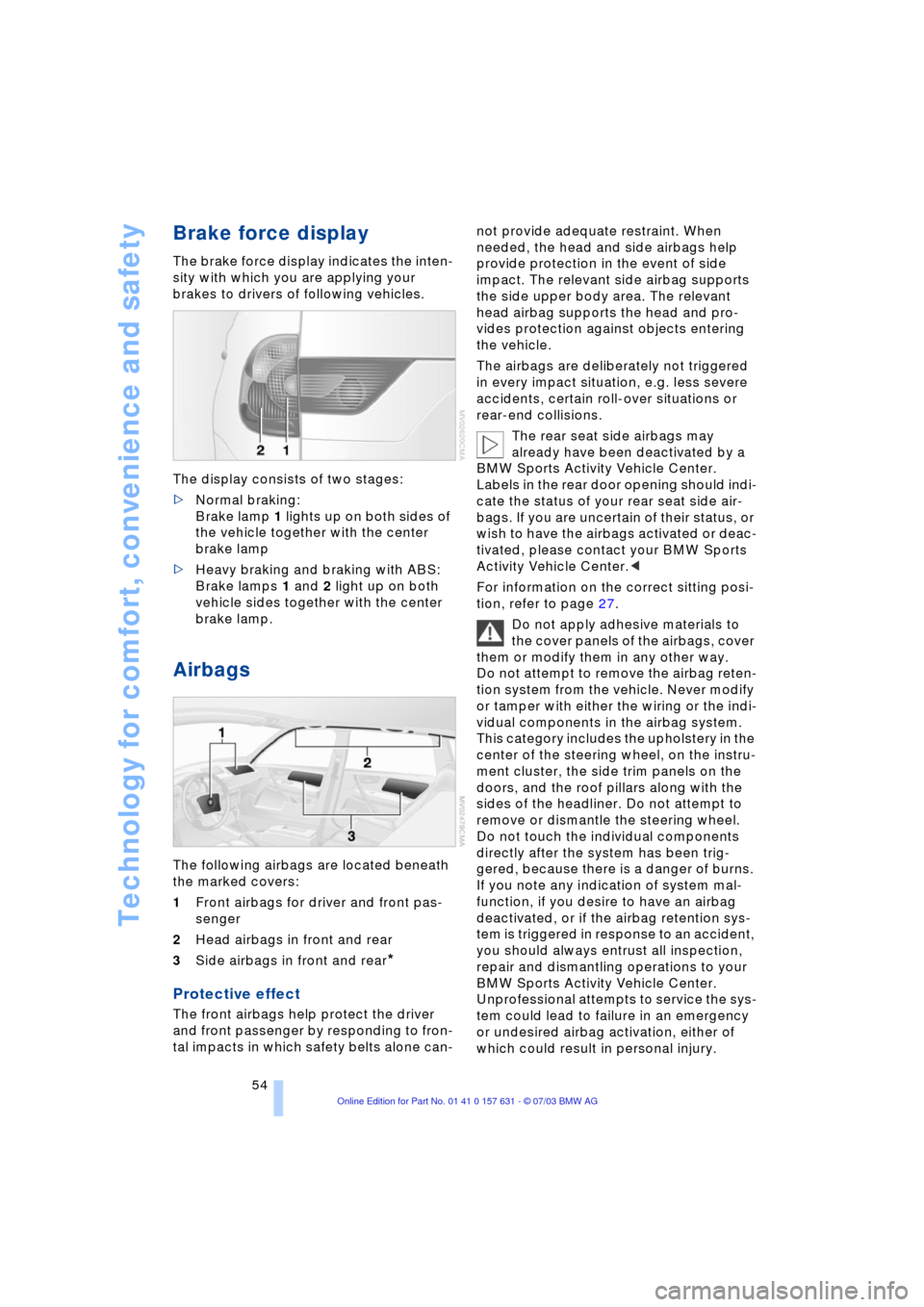
The display consists of two stages:
>Normal braking:
Brake lamp 1 lights up on both sides of
the vehicle together with the center
brake lamp
>Heavy braking and braking with ABS:
Brake lamps 1 and 2 light up on both
vehicle sides together with the center
brake lamp.
Airbags
The following airbags are located beneath
the marked covers:
1Front airbags for driver and front pas-
senger
2Head airbags in front and rear
3Side airbags in front and rear
*
Protective effect
The front airbags help protect the driver
and front passenger by responding to fron-
tal impacts in which safety belts alone can-not provide adequate restraint. When
needed, the head and side airbags help
provide protection in the event of side
impact. The relevant side airbag supports
the side upper body area. The relevant
head airbag supports the head and pro-
vides protection against objects entering
the vehicle.
The airbags are deliberately not triggered
in every impact situation, e.g. less severe
accidents, certain roll-over situations or
rear-end collisions.
The rear seat side airbags may
already have been deactivated by a
BMW Sports Activity Vehicle Center.
Labels in the rear door opening should indi-
cate the status of your rear seat side air-
bags. If you are uncertain of their status, or
wish to have the airbags activated or deac-
tivated, please contact your BMW Sports
Activity Vehicle Center.<
For information on the correct sitting posi-
tion, refer to page 27.
Do not apply adhesive materials to
the cover panels of the airbags, cover
them or modify them in any other way.
Do not attempt to remove the airbag reten-
tion system from the vehicle. Never modify
or tamper with either the wiring or the indi-
vidual components in the airbag system.
This category includes the upholstery in the
center of the steering wheel, on the instru-
ment cluster, the side trim panels on the
doors, and the roof pillars along with the
sides of the headliner. Do not attempt to
remove or dismantle the steering wheel.
Do not touch the individual components
directly after the system has been trig-
gered, because there is a danger of burns.
If you note any indication of system mal-
function, if you desire to have an airbag
deactivated, or if the airbag retention sys-
tem is triggered in response to an accident,
you should always entrust all inspection,
repair and dismantling operations to your
BMW Sports Activity Vehicle Center.
Unprofessional attempts to service the sys-
tem could lead to failure in an emergency
or undesired airbag activation, either of
which could result in personal injury.
Page 57 of 132
Reference
At a glance
Controls
Driving tips
Mobility
55
To ensure compliance with official safety
regulations, please also entrust disposal of
airbag generators to a BMW Sports Activity
Vehicle Center.<
Airbag warning information is also provided
on the sun visors.
Automatic deactivation of the front
passenger airbags
Your BMW has a seat occupation detection
system. By evaluating the weight on the
front passenger's seat, the system detects
whether or not the seat is occupied by a
child in the child-restraint system or an
adult.
>When a child is seated in the child-
restraint system or with an empty seat,
the front and side airbags are deacti-
vated on the passenger's side
>When an adult is traveling in the front
seat, the front and side airbags remain
active on the passenger side.
With heavier children, the front pas-
senger airbags can remain active, or
with very light adults or teenagers the front
passenger airbags can be deactivated
unintentionally.
The condition of the front passenger air-
bags is indicated via the telltale lamp, refer
to Indicator lamps in the following. In this
case transport the corresponding persons
on the rear seat.
Except when persons to be transported, do
not increase the load on the front passen-
ger seat with additional items. Do not fit
seat covers, seat cushion padding, ball
mats or other items to the front passenger
seat unless they are specifically recom-
mended by BMW. Do not place any items
under the seat. Otherwise, the function of
the seat occupation detection could be
impaired.<
Indicator/warning lamp
Airbag system operational
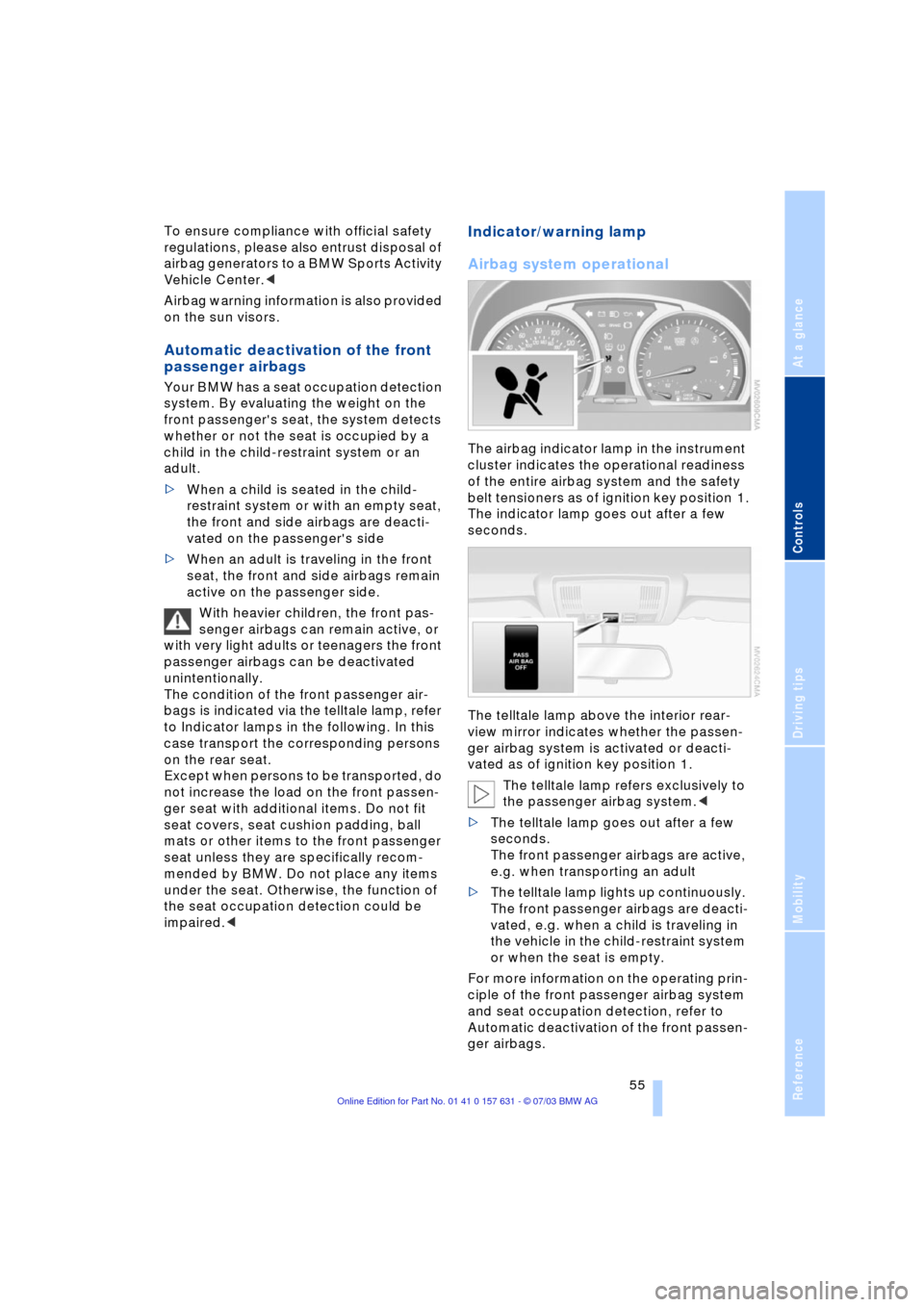
The airbag indicator lamp in the instrument
cluster indicates the operational readiness
of the entire airbag system and the safety
belt tensioners as of ignition key position 1.
The indicator lamp goes out after a few
seconds.
The telltale lamp above the interior rear-
view mirror indicates whether the passen-
ger airbag system is activated or deacti-
vated as of ignition key position 1.
The telltale lamp refers exclusively to
the passenger airbag system.<
>The telltale lamp goes out after a few
seconds.
The front passenger airbags are active,
e.g. when transporting an adult
>The telltale lamp lights up continuously.
The front passenger airbags are deacti-
vated, e.g. when a child is traveling in
the vehicle in the child-restraint system
or when the seat is empty.
For more information on the operating prin-
ciple of the front passenger airbag system
and seat occupation detection, refer to
Automatic deactivation of the front passen-
ger airbags.
Page 58 of 132

Technology for comfort, convenience and safety
56
Airbag system malfunction
A system malfunction could prevent
the system from responding in the
expected manner to an impact occurring
within its normal response range.
Please have the airbag system checked
immediately by a BMW Sports Activity
Vehicle Center.<
There is a fault in the airbag system
if the airbag indicator lamp in the
instrument cluster behaves as fol-
lows:
>Indicator lamp does not light up as of
ignition key position 1
>Indicator lamp remains lit continuously
>Indicator lamp lights up while the vehi-
cle is being driven.
Page 59 of 132
Reference
At a glance
Controls
Driving tips
Mobility
57
Lamps
Parking lamps/low beams
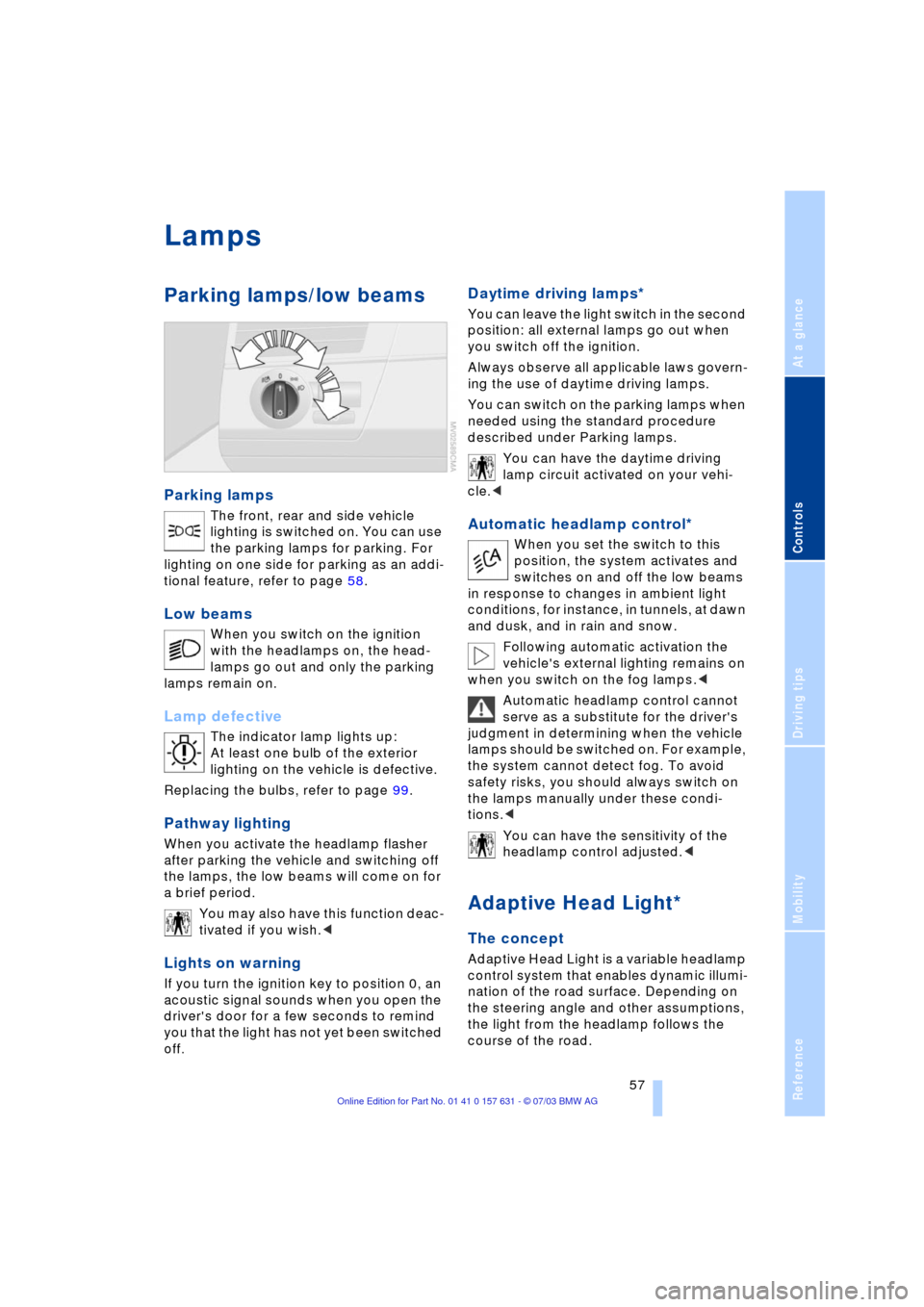
Parking lamps
The front, rear and side vehicle
lighting is switched on. You can use
the parking lamps for parking. For
lighting on one side for parking as an addi-
tional feature, refer to page 58.
Low beams
When you switch on the ignition
with the headlamps on, the head-
lamps go out and only the parking
lamps remain on.
Lamp defective
The indicator lamp lights up:
At least one bulb of the exterior
lighting on the vehicle is defective.
Replacing the bulbs, refer to page 99.
Pathway lighting
When you activate the headlamp flasher
after parking the vehicle and switching off
the lamps, the low beams will come on for
a brief period.
You may also have this function deac-
tivated if you wish.<
Lights on warning
If you turn the ignition key to position 0, an
acoustic signal sounds when you open the
driver's door for a few seconds to remind
you that the light has not yet been switched
off
.
Daytime driving lamps*
You can leave the light switch in the second
position: all external lamps go out when
you switch off the ignition.
Always observe all applicable laws govern-
ing the use of daytime driving lamps.
You can switch on the parking lamps when
needed using the standard procedure
described under Parking lamps.
You can have the daytime driving
lamp circuit activated on your vehi-
cle.<
Automatic headlamp control*
When you set the switch to this
position, the system activates and
switches on and off the low beams
in response to changes in ambient light
conditions, for instance, in tunnels, at dawn
and dusk, and in rain and snow.
Following automatic activation the
vehicle's external lighting remains on
when you switch on the fog lamps.<
Automatic headlamp control cannot
serve as a substitute for the driver's
judgment in determining when the vehicle
lamps should be switched on. For example,
the system cannot detect fog. To avoid
safety risks, you should always switch on
the lamps manually under these condi-
tions.<
You can have the sensitivity of the
headlamp control adjusted.<
Adaptive Head Light*
The concept
Adaptive Head Light is a variable headlamp
control system that enables dynamic illumi-
nation of the road surface. Depending on
the steering angle and other assumptions,
the light from the headlamp follows the
course of the road.
Page 67 of 132
Reference
At a glance
Controls
Driving tips
Mobility
65
repeatedly to run through the following
control sequence:
>Indicator lamps off: outside air flows
into the vehicle
>Left-hand indicator lamp on Ð AUC
mode: the system recognizes pollutants
in the outside air and blocks the flow of
air when necessary. The system then
recirculates the air currently within the
vehicle.
Depending on the air quality, the auto-
matic system then switches back and
forth between outside air supply and
recirculation of the air within the vehicle
>Right-hand indicator lamp on: the out-
side air supply into the vehicle is com-
pletely blocked. The system then recir-
culates the air currently within the
vehicle.
If condensation starts to form on the
inside window surfaces during opera-
tion in the recirculated-air mode, you
should switch it off while also increasing air
supply as required. The recirculated-air
mode should not be used over a sustained
longer period of time, as the air quality
inside the vehicle deteriorates.<
Rear window defroster
When the rear window
defroster is activated,
the indicator lamp comes on.
The rear window defroster switches off
automatically.
You can have your vehicle adjusted in
such a way that the rear window
defroster switches on automatically. It is
then switched on at outside temperatures
of less than approx. +46/397within
5 minutes of the engine start.<
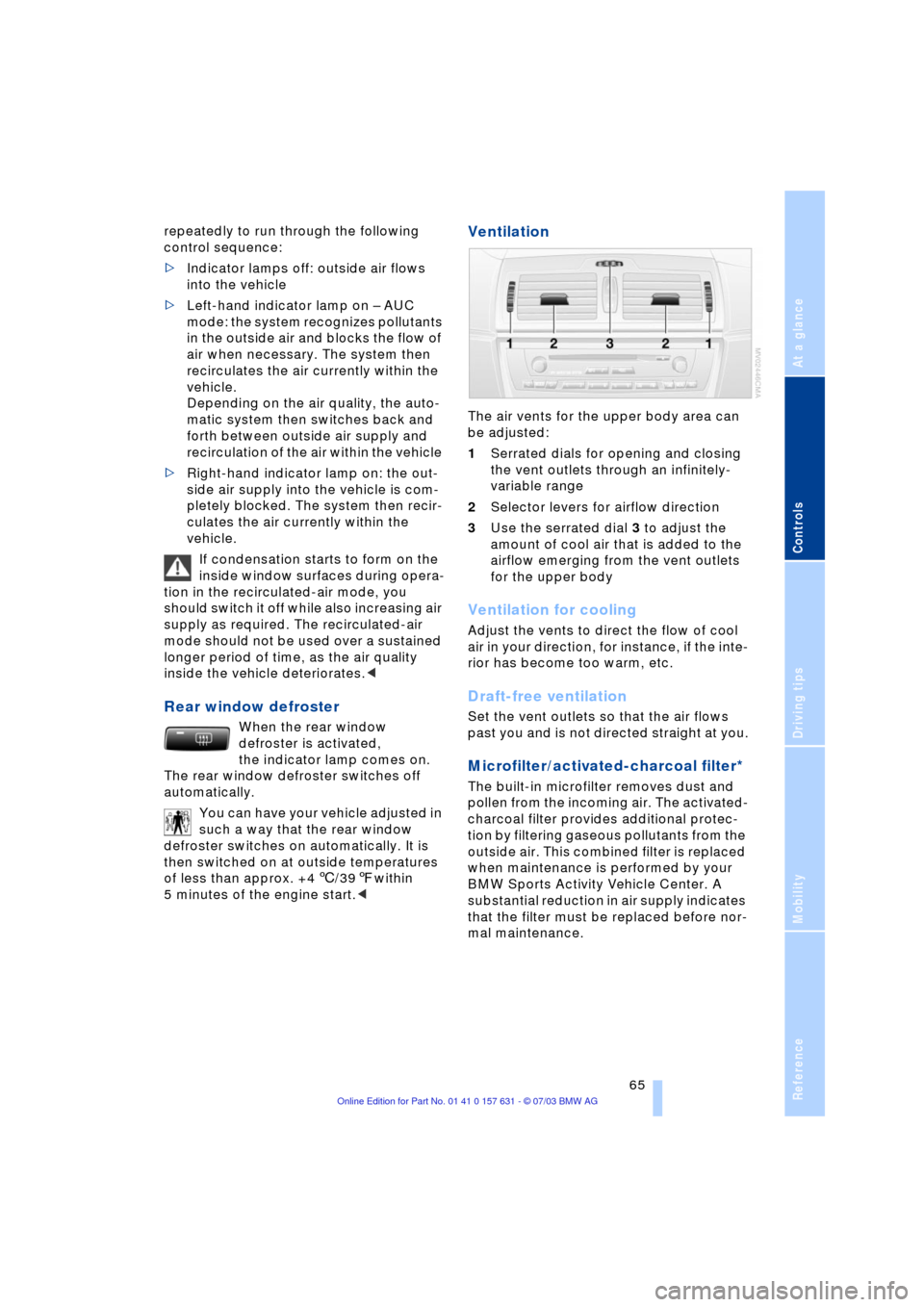
Ventilation
The air vents for the upper body area can
be adjusted:
1Serrated dials for opening and closing
the vent outlets through an infinitely-
variable range
2Selector levers for airflow direction
3Use the serrated dial 3 to adjust the
amount of cool air that is added to the
airflow emerging from the vent outlets
for the upper body
Ventilation for cooling
Adjust the vents to direct the flow of cool
air in your direction, for instance, if the inte-
rior has become too warm, etc.
Draft-free ventilation
Set the vent outlets so that the air flows
past you and is not directed straight at you.
Microfilter/activated-charcoal filter*
The built-in microfilter removes dust and
pollen from the incoming air. The activated-
charcoal filter provides additional protec-
tion by filtering gaseous pollutants from the
outside air. This combined filter is replaced
when maintenance is performed by your
BMW Sports Activity Vehicle Center. A
substantial reduction in air supply indicates
that the filter must be replaced before nor-
mal maintenance.
Page 78 of 132
Things to remember when driving
76
Things to remember when driving
Break-in procedures
To ensure that your vehicle provides maxi-
mum economy throughout a long service
life, we request that you observe the fol-
lowing instructions:
Engine and differential
Up to 1,200 miles/2,000 km:
During this initial period you should attempt
to avoid constant, steady-state operation
and vary both vehicle and engine speeds
as often as possible. Until the break-in
period has been completed you should
also refrain from exceeding the following:
>4,500 rpm or 100 mph/160 km/h.
Always obey all official speed limits.
Refrain from using full throttle and avoid
pressing the accelerator beyond the kick-
down point.
Once you have driven 1,200 miles/
2,000 km, the engine and vehicle speeds
can be gradually increased.
You should also comply with these break-in
procedures should the engine or one of the
differentials be replaced later in the course
of the vehicle's service life.
Tires
Due to technical factors associated with
their manufacture, tires do not achieve their
full traction potential until after an initial
break-in period. For this reason, drive with
extra care during the initial 200 miles/
300 km.
Obey your local and state maximum speed
limits.
When the vehicle is operated on wet
or slushy roads, a wedge of water
may form between the tire and the road
surface. This phenomenon is referred to as
hydroplaning and can lead to partial or
complete loss of traction, vehicle control
and braking effectiveness. Reduce your
speed on wet roads.<
Brake system
Approx. 300 miles/500 km must elapse
before the brake pads and rotors achieve
the optimal pad-surface and wear patterns
required for trouble-free operation and
long service life later on.
To break in the separate handbrake drums,
apply the handbrake lightly when coasting
to a standstill Ð at a traffic signal, for
instance; use caution to avoid posing a
danger to other road users.
To avoid corrosion, repeat this procedure
from time to time.
The brake lamps do not come on when the
handbrake is set.
Vacuum for the brake system servo
unit on your BMW is available only
when the engine is running. When you
move the vehicle with the engine off Ð e.g.
by towing Ð substantially higher levels of
pedal force will be required to brake the
vehicle.<
Clutch
The function of the clutch is also only at its
optimized level after a distance driven of
approx. 300 miles/500 km. During this
break-in period, engage the clutch gently.
General driving notes
High temperatures
Extreme temperatures occur at the
catalytic converter on this and every
catalyst-equipped vehicle. Do not remove
the heat shields installed adjacent to vari-
ous sections of the exhaust system, and
never apply undercoating to them. When
driving, standing at idle and while parking
take care to avoid possible contact
between the hot exhaust system and any
highly flammable materials such as hay,
leaves, grass, etc. Such contact could lead
Page 81 of 132
Reference
At a glance
Controls
Driving tips
Mobility
79
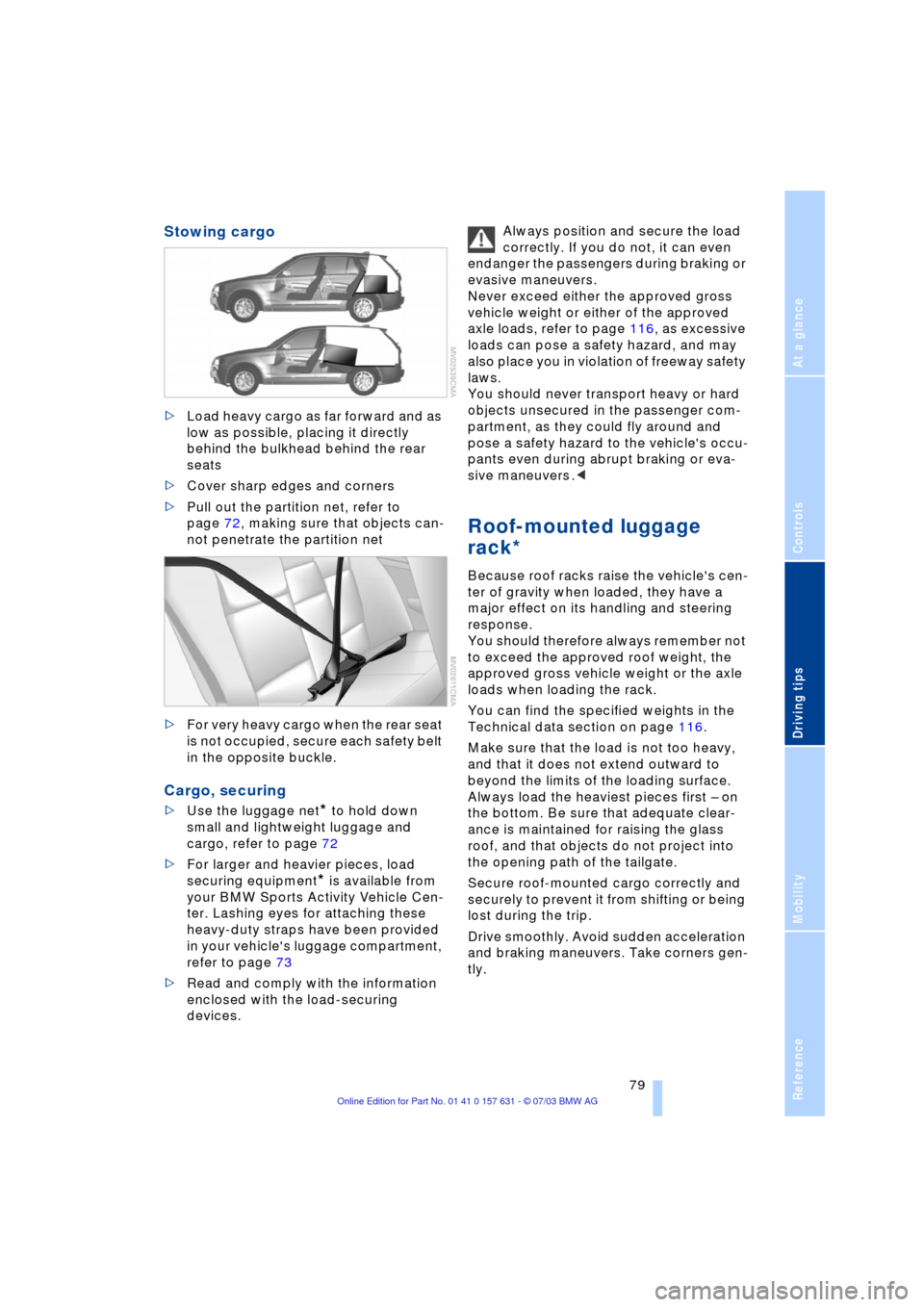
Stowing cargo
>Load heavy cargo as far forward and as
low as possible, placing it directly
behind the bulkhead behind the rear
seats
>Cover sharp edges and corners
>Pull out the partition net, refer to
page 72, making sure that objects can-
not penetrate the partition net
>For very heavy cargo when the rear seat
is not occupied, secure each safety belt
in the opposite buckle.
Cargo, securing
>Use the luggage net* to hold down
small and lightweight luggage and
cargo, refer to page 72
>For larger and heavier pieces, load
securing equipment
* is available from
your BMW Sports Activity Vehicle Cen-
ter. Lashing eyes for attaching these
heavy-duty straps have been provided
in your vehicle's luggage compartment,
refer to page 73
>Read and comply with the information
enclosed with the load-securing
devices.Always position and secure the load
correctly. If you do not, it can even
endanger the passengers during braking or
evasive maneuvers.
Never exceed either the approved gross
vehicle weight or either of the approved
axle loads, refer to page 116, as excessive
loads can pose a safety hazard, and may
also place you in violation of freeway safety
laws.
You should never transport heavy or hard
objects unsecured in the passenger com-
partment, as they could fly around and
pose a safety hazard to the vehicle's occu-
pants even during abrupt braking or eva-
sive maneuvers .<
Roof-mounted luggage
rack*
Because roof racks raise the vehicle's cen-
ter of gravity when loaded, they have a
major effect on its handling and steering
response.
You should therefore always remember not
to exceed the approved roof weight, the
approved gross vehicle weight or the axle
loads when loading the rack.
You can find the specified weights in the
Technical data section on page 116.
Make sure that the load is not too heavy,
and that it does not extend outward to
beyond the limits of the loading surface.
Always load the heaviest pieces first Ð on
the bottom. Be sure that adequate clear-
ance is maintained for raising the glass
roof, and that objects do not project into
the opening path of the tailgate.
Secure roof-mounted cargo correctly and
securely to prevent it from shifting or being
lost during the trip.
Drive smoothly. Avoid sudden acceleration
and braking maneuvers. Take corners gen-
tly.
Page 92 of 132

Wheels and tires
90 with specialized knowledge and corre-
sponding equipment.<
The correct wheel and tire combination
affects various systems whose function
would otherwise be impaired, e.g. ABS,
DSC or xDrive.
Have the wheel and tire assemblies bal-
anced every time either a wheel or a tire is
replaced.
BMW does not recommend the use of
retreaded tires, as otherwise driving
safety may be reduced. Possible variations
in the design and the age Ð which could be
substantial Ð of the carcasses can lead to
unusually rapid wear.<
The right wheels and tires
BMW recommends that you use only
wheel and tire combinations that
BMW has tested and approved for your
particular vehicle. Variations in factors such
as manufacturing tolerances mean that
even wheels and tires with identical official
size ratings could actually have different
dimensions than the approved units Ð these
differences could lead to body contact, and
with it the risk of severe accidents. If non-
approved wheels and tires are used, BMW
cannot evaluate their suitability, and there-
fore cannot be held liable for driving
safety.<
To maintain good handling and vehicle
response, use only tires of a single tread
configuration from a single manufacturer.
After a flat tire, always remember to have
the specified wheel and tire combination
remounted on the vehicle as soon as pos-
sible.
Recommended tire brands
BMW tests certain tire brands for each tire
size, classifies them as road-safe and
approves them. You can obtain a list of
these from your BMW Sports Activity Vehi-
cle Center. Observe any country-specific
regulations, e.g. on making a correspond-
ing entry in the vehicle documents.
The factory-mounted tires have been spe-
cially selected to provide optimized perfor-mance when installed on your vehicle; if
properly cared for, they will provide a com-
bination of safety and excellent ride com-
fort.
Special characteristics of winter
tires
BMW recommends winter tires for use in
cold winter driving conditions. Although all-
season M+S tires provide better winter
traction than summer tires, they generally
fail to provide the same levels of cold-
weather performance as winter tires.
When switching to winter tires, observe the
descriptions at Tire condition and Replac-
ing wheels/tires, refer to page 89.
Observing speed ratings
Never exceed the maximum speed for
which the winter tires are rated.
Unprofessional attempts by laymen to ser-
vice tires can lead to damage and acci-
dents. Have this work performed by skilled
professionals only. The technicians at your
BMW Sports Activity Vehicle Center will be
glad to assist you with the required profes-
sional knowledge and specialized equip-
ment.<
Storage
Store wheels or tires in a cool, dry place,
protecting them against light whenever
possible. Protect the tires against contact
with oil, grease and fuel.
Do not exceed the maximum tire inflation
pressure specified on the side of the tire.
Snow chains*
Do not exceed a vehicle speed of
30 mph/50 km/h with snow chains
mounted.<
Only certain snow chains have been tested
by BMW and classified and approved as
safe. You can obtain a list of these from
your BMW Sports Activity Vehicle Center.
BMW recommends the use of approved
narrow-link snow chains only. These snow
chains are approved exclusively for use on
Page 94 of 132
Under the engine hood
92
Under the engine hood
Never attempt to perform any service
or repair operations on your vehicle
without the required professional technical
training. If you are unaware of the regula-
tions that need to be observed, BMW rec-
ommends that you have this work per-
formed at a BMW Sports Activity Vehicle
Center, as otherwise unqualified handling
of parts and materials can lead to safety
risk for vehicle occupants and other road
users.<
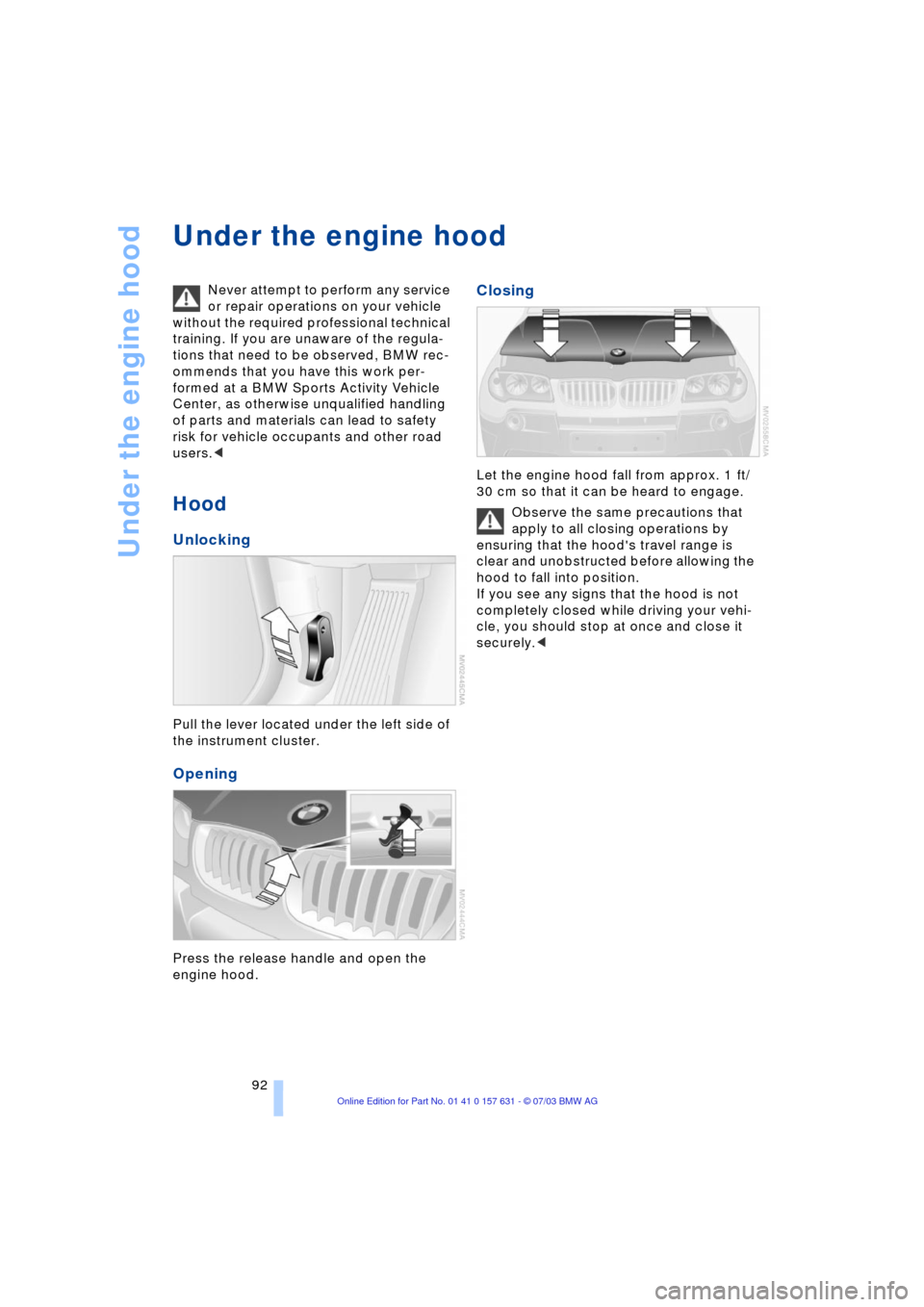
Hood
Unlocking
Pull the lever located under the left side of
the instrument cluster.
Opening
Press the release handle and open the
engine hood.
Closing
Let the engine hood fall from approx. 1 ft/
30 cm so that it can be heard to engage.
Observe the same precautions that
apply to all closing operations by
ensuring that the hood's travel range is
clear and unobstructed before allowing the
hood to fall into position.
If you see any signs that the hood is not
completely closed while driving your vehi-
cle, you should stop at once and close it
securely.<