fuel BMW X5 3.0I 2003 User Guide
[x] Cancel search | Manufacturer: BMW, Model Year: 2003, Model line: X5 3.0I, Model: BMW X5 3.0I 2003Pages: 183, PDF Size: 2.31 MB
Page 25 of 183
25n
OverviewControlsMaintenanceRepairsDataIndex
Refueling
When handling fuels, comply with
all of the applicable safety precau-
tions and regulations pertaining to
fuels. Never carry spare fuel containers
in your vehicle. Whether empty or full,
these containers can leak, cause an
explosion, or lead to fire in the event of
a collision.<
Simple and environmentally
friendly
Open the filler cap carefully to
prevent fuel from spraying out.
Fuel spray may cause injury.
Do not top off. Topping off may cause
fuel spillage.<
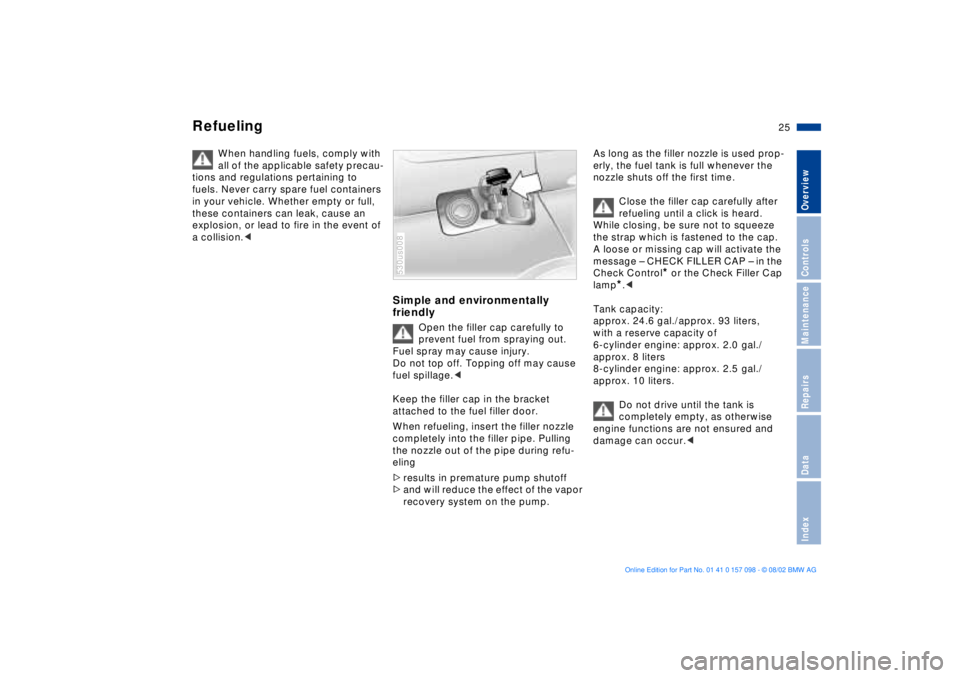
Keep the filler cap in the bracket
attached to the fuel filler door.
When refueling, insert the filler nozzle
completely into the filler pipe. Pulling
the nozzle out of the pipe during refu-
eling
>results in premature pump shutoff
>and will reduce the effect of the vapor
recovery system on the pump.
530us008
As long as the filler nozzle is used prop-
erly, the fuel tank is full whenever the
nozzle shuts off the first time.
Close the filler cap carefully after
refueling until a click is heard.
While closing, be sure not to squeeze
the strap which is fastened to the cap.
A loose or missing cap will activate the
message Ð CHECK FILLER CAP Ð in the
Check Control
* or the Check Filler Cap
lamp
*.<
Tank capacity:
approx. 24.6 gal./approx. 93 liters,
with a reserve capacity of
6-cylinder engine: approx. 2.0 gal./
approx. 8 liters
8-cylinder engine: approx. 2.5 gal./
approx. 10 liters.
Do not drive until the tank is
completely empty, as otherwise
engine functions are not ensured and
damage can occur.<
Page 26 of 183
26n
Fuel specifications Tire inflation pressures The engine uses lead-free gasoline
only.
Required fuel:
>Premium Unleaded Gasoline,
min. 91 AKI.
AKI = Anti Knock Index
Do not use leaded fuels. The use
of leaded fuels will cause perma-
nent damage to the system's oxygen
sensor and the catalytic converter.<
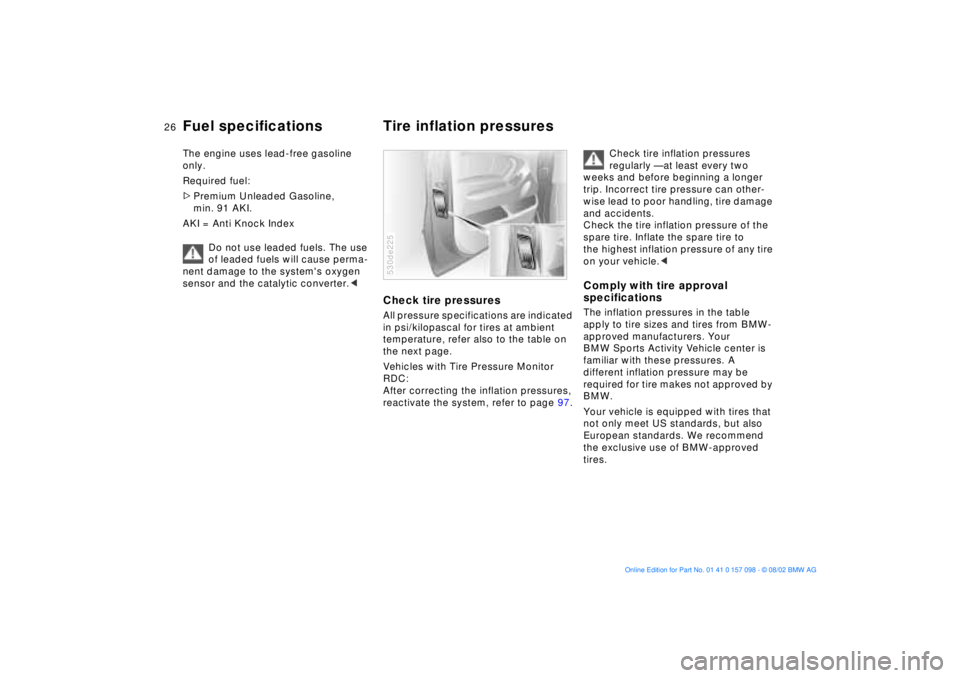
Check tire pressures All pressure specifications are indicated
in psi/kilopascal for tires at ambient
temperature, refer also to the table on
the next page.
Vehicles with Tire Pressure Monitor
RDC:
After correcting the inflation pressures,
reactivate the system, refer to page 97.530de225
Check tire inflation pressures
regularly Ñ at least every two
weeks and before beginning a longer
trip. Incorrect tire pressure can other-
wise lead to poor handling, tire damage
and accidents.
Check the tire inflation pressure of the
spare tire. Inflate the spare tire to
the highest inflation pressure of any tire
on your vehicle.<
Comply with tire approval
specificationsThe inflation pressures in the table
apply to tire sizes and tires from BMW-
approved manufacturers. Your
BMW Sports Activity Vehicle center is
familiar with these pressures. A
different inflation pressure may be
required for tire makes not approved by
BMW.
Your vehicle is equipped with tires that
not only meet US standards, but also
European standards. We recommend
the exclusive use of BMW-approved
tires.
Page 30 of 183
30n
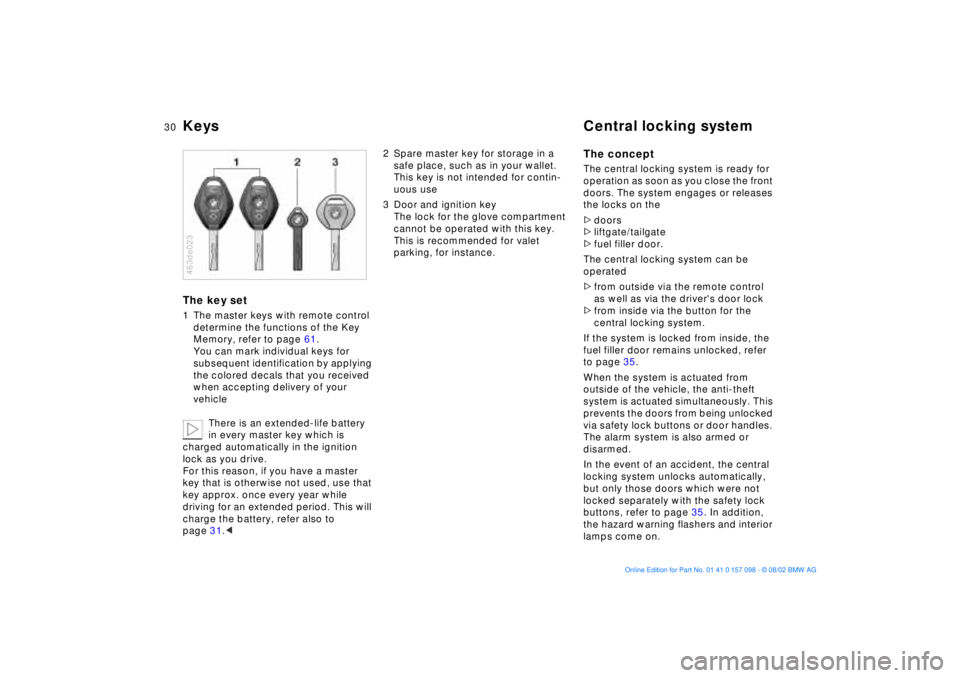
Keys Central locking system The key set1 The master keys with remote control
determine the functions of the Key
Memory, refer to page 61.
You can mark individual keys for
subsequent identification by applying
the colored decals that you received
when accepting delivery of your
vehicle
There is an extended-life battery
in every master key which is
charged automatically in the ignition
lock as you drive.
For this reason, if you have a master
key that is otherwise not used, use that
key approx. once every year while
driving for an extended period. This will
charge the battery, refer also to
page 31.< 463de023
2 Spare master key for storage in a
safe place, such as in your wallet.
This key is not intended for contin-
uous use
3 Door and ignition key
The lock for the glove compartment
cannot be operated with this key.
This is recommended for valet
parking, for instance.
The concept The central locking system is ready for
operation as soon as you close the front
doors. The system engages or releases
the locks on the
>doors
>liftgate/tailgate
>fuel filler door.
The central locking system can be
operated
>from outside via the remote control
as well as via the driver's door lock
>from inside via the button for the
central locking system.
If the system is locked from inside, the
fuel filler door remains unlocked, refer
to page 35.
When the system is actuated from
outside of the vehicle, the anti-theft
system is actuated simultaneously. This
prevents the doors from being unlocked
via safety lock buttons or door handles.
The alarm system is also armed or
disarmed.
In the event of an accident, the central
locking system unlocks automatically,
but only those doors which were not
locked separately with the safety lock
buttons, refer to page 35. In addition,
the hazard warning flashers and interior
lamps come on.
Page 32 of 183
32n
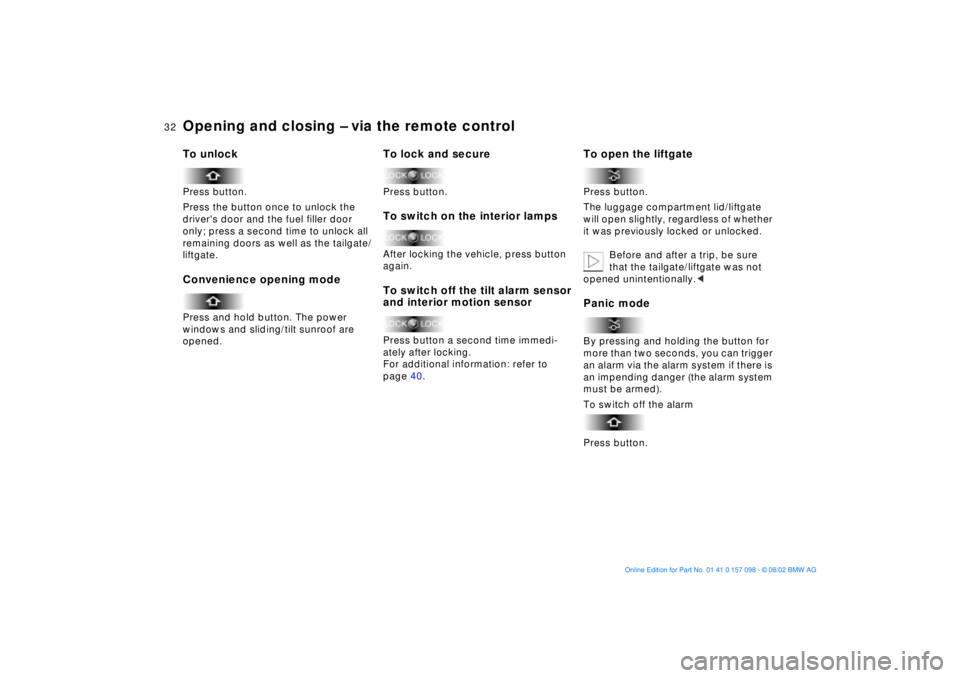
Opening and closing Ð via the remote controlTo unlock Press button.
Press the button once to unlock the
driver's door and the fuel filler door
only; press a second time to unlock all
remaining doors as well as the tailgate/
liftgate. Convenience opening mode Press and hold button. The power
windows and sliding/tilt sunroof are
opened.
To lock and secure Press button. To switch on the interior lamps After locking the vehicle, press button
again. To switch off the tilt alarm sensor
and interior motion sensorPress button a second time immedi-
ately after locking.
For additional information: refer to
page 40.
To open the liftgate Press button.
The luggage compartment lid/liftgate
will open slightly, regardless of whether
it was previously locked or unlocked.
Before and after a trip, be sure
that the tailgate/liftgate was not
opened unintentionally.< Panic modeBy pressing and holding the button for
more than two seconds, you can trigger
an alarm via the alarm system if there is
an impending danger (the alarm system
must be armed).
To switch off the alarm
Press button.
Page 34 of 183
34n
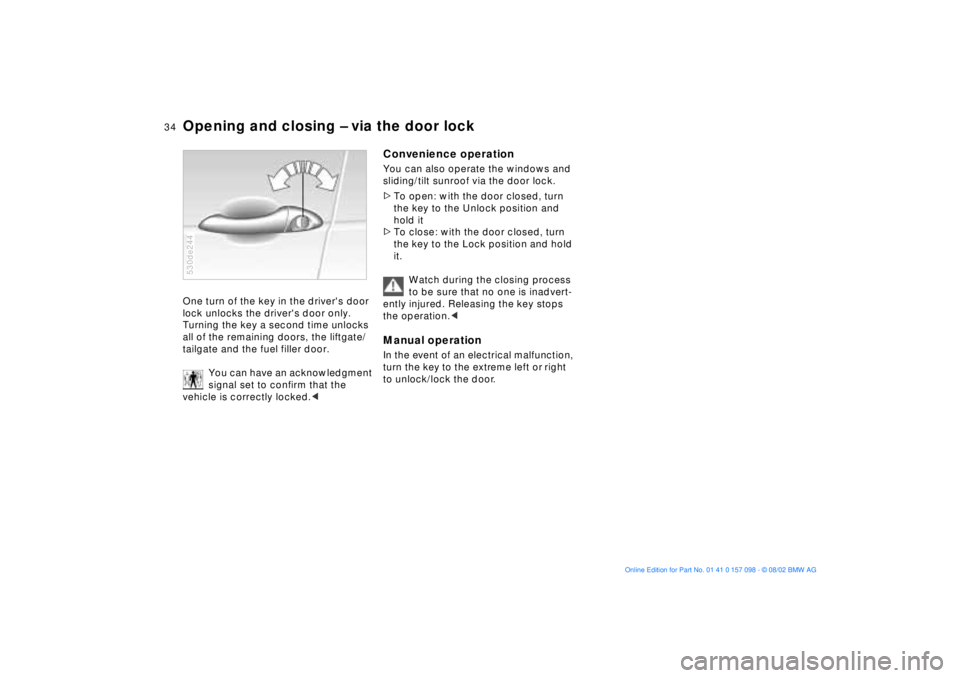
Opening and closing Ð via the door lockOne turn of the key in the driver's door
lock unlocks the driver's door only.
Turning the key a second time unlocks
all of the remaining doors, the liftgate/
tailgate and the fuel filler door.
You can have an acknowledgment
signal set to confirm that the
vehicle is correctly locked.< 530de244
Convenience operationYou can also operate the windows and
sliding/tilt sunroof via the door lock.
>To open: with the door closed, turn
the key to the Unlock position and
hold it
>To close: with the door closed, turn
the key to the Lock position and hold
it.
Watch during the closing process
to be sure that no one is inadvert-
ently injured. Releasing the key stops
the operation.< Manual operation In the event of an electrical malfunction,
turn the key to the extreme left or right
to unlock/lock the door.
Page 35 of 183
35n
OverviewControlsMaintenanceRepairsDataIndex
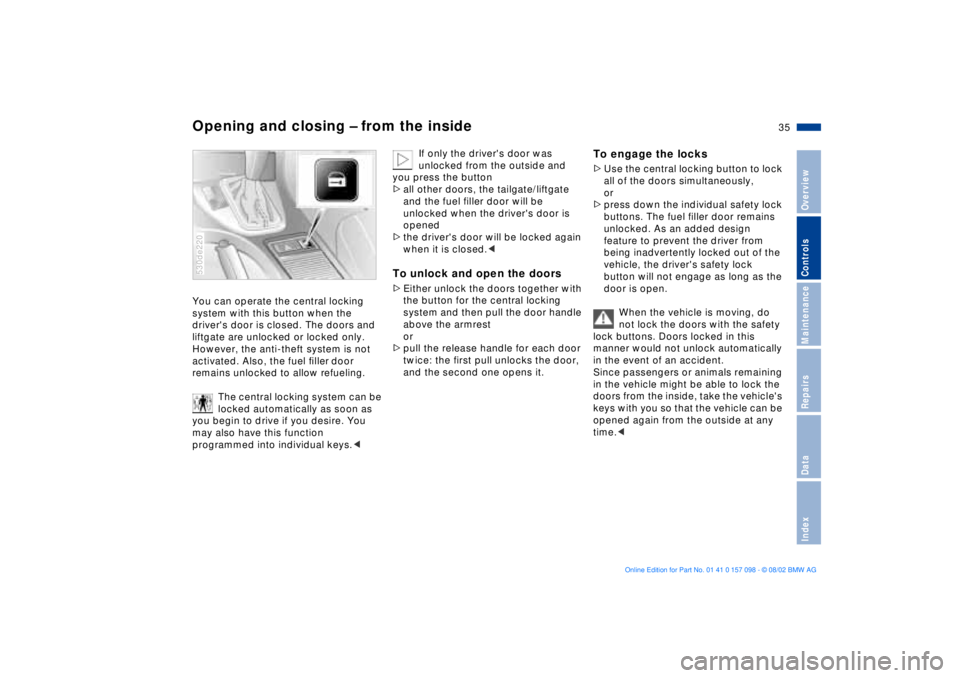
Opening and closing Ð from the insideYou can operate the central locking
system with this button when the
driver's door is closed. The doors and
liftgate are unlocked or locked only.
However, the anti-theft system is not
activated. Also, the fuel Þller door
remains unlocked to allow refueling.
The central locking system can be
locked automatically as soon as
you begin to drive if you desire. You
may also have this function
programmed into individual keys.<530de220
If only the driver's door was
unlocked from the outside and
you press the button
>all other doors, the tailgate/liftgate
and the fuel filler door will be
unlocked when the driver's door is
opened
>the driver's door will be locked again
when it is closed.<
To unlock and open the doors >Either unlock the doors together with
the button for the central locking
system and then pull the door handle
above the armrest
or
>pull the release handle for each door
twice: the first pull unlocks the door,
and the second one opens it.
To engage the locks >Use the central locking button to lock
all of the doors simultaneously,
or
>press down the individual safety lock
buttons. The fuel filler door remains
unlocked. As an added design
feature to prevent the driver from
being inadvertently locked out of the
vehicle, the driver's safety lock
button will not engage as long as the
door is open.
When the vehicle is moving, do
not lock the doors with the safety
lock buttons. Doors locked in this
manner would not unlock automatically
in the event of an accident.
Since passengers or animals remaining
in the vehicle might be able to lock the
doors from the inside, take the vehicle's
keys with you so that the vehicle can be
opened again from the outside at any
time.<
Page 65 of 183
65n
OverviewControlsMaintenanceRepairsDataIndex
Manual transmission Automatic transmission with Steptronic
*
Reverse Select Reverse only when the vehicle is
completely stopped. Press the gearshift
lever to the left to overcome the resis-
tance.
As you do this, the backup lamps will
turn on automatically when the ignition
key is in position 2.
Do not hold the vehicle in place on
slopes by slipping or riding the
clutch. Use the parking brake instead,
since a slipping clutch increases clutch
wear.<
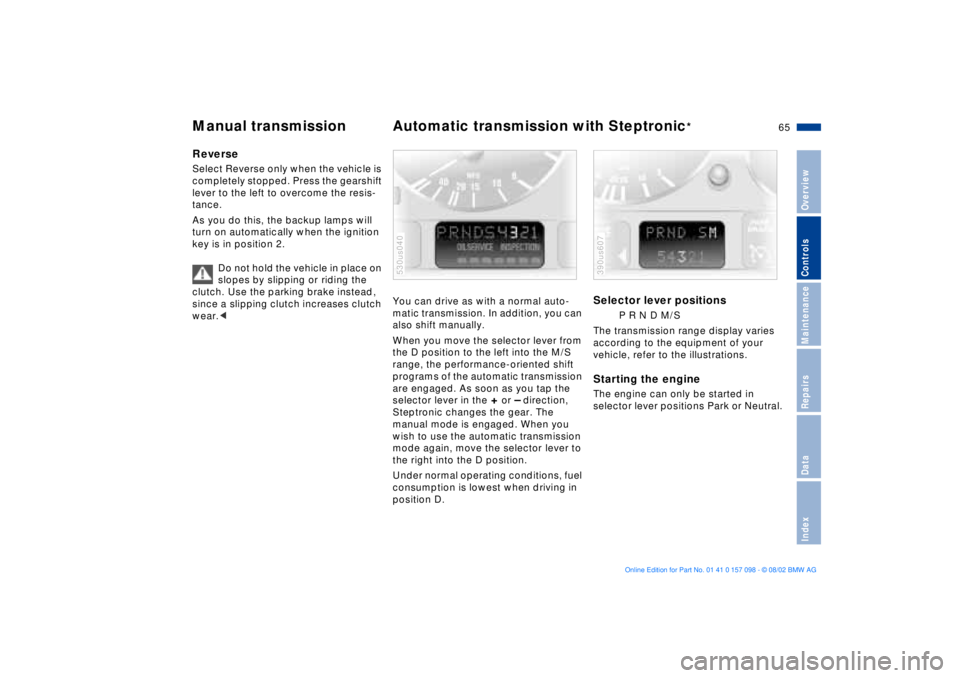
You can drive as with a normal auto-
matic transmission. In addition, you can
also shift manually.
When you move the selector lever from
the D position to the left into the M/S
range, the performance-oriented shift
programs of the automatic transmission
are engaged. As soon as you tap the
selector lever in the
+ or
Ð direction,
Steptronic changes the gear. The
manual mode is engaged. When you
wish to use the automatic transmission
mode again, move the selector lever to
the right into the D position.
Under normal operating conditions, fuel
consumption is lowest when driving in
position D.
530us040
Selector lever positions
P R N D M/S
The transmission range display varies
according to the equipment of your
vehicle, refer to the illustrations.
Starting the engine The engine can only be started in
selector lever positions Park or Neutral. 390us607
Page 74 of 183
74n
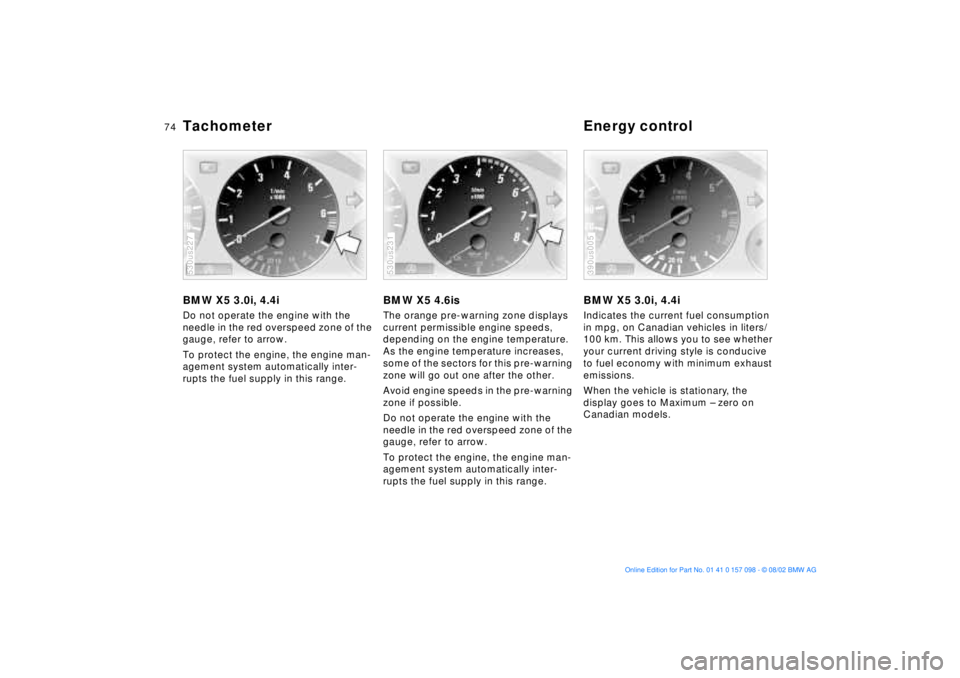
Tachometer Energy controlBMW X5 3.0i, 4.4iDo not operate the engine with the
needle in the red overspeed zone of the
gauge, refer to arrow.
To protect the engine, the engine man-
agement system automatically inter-
rupts the fuel supply in this range.530us227
BMW X5 4.6isThe orange pre-warning zone displays
current permissible engine speeds,
depending on the engine temperature.
As the engine temperature increases,
some of the sectors for this pre-warning
zone will go out one after the other.
Avoid engine speeds in the pre-warning
zone if possible.
Do not operate the engine with the
needle in the red overspeed zone of the
gauge, refer to arrow.
To protect the engine, the engine man-
agement system automatically inter-
rupts the fuel supply in this range.530us231
BMW X5 3.0i, 4.4iIndicates the current fuel consumption
in mpg, on Canadian vehicles in liters/
100 km. This allows you to see whether
your current driving style is conducive
to fuel economy with minimum exhaust
emissions.
When the vehicle is stationary, the
display goes to Maximum Ð zero on
Canadian models.390us005
Page 75 of 183
75n
OverviewControlsMaintenanceRepairsDataIndex
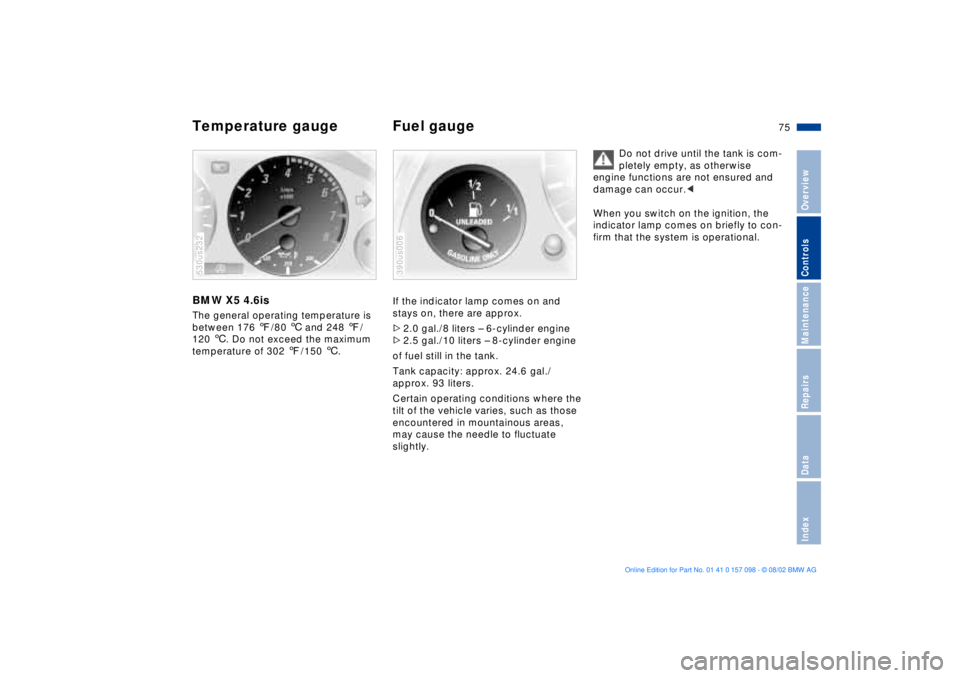
Temperature gauge Fuel gauge BMW X5 4.6isThe general operating temperature is
between 176 7/80 6 and 248 7/
120 6. Do not exceed the maximum
temperature of 302 7/150 6.530us232
If the indicator lamp comes on and
stays on, there are approx.
>2.0 gal./8 liters Ð 6-cylinder engine
>2.5 gal./10 liters Ð 8-cylinder engine
of fuel still in the tank.
Tank capacity: approx. 24.6 gal./
approx. 93 liters.
Certain operating conditions where the
tilt of the vehicle varies, such as those
encountered in mountainous areas,
may cause the needle to fluctuate
slightly.390us006
Do not drive until the tank is com-
pletely empty, as otherwise
engine functions are not ensured and
damage can occur.<
When you switch on the ignition, the
indicator lamp comes on briefly to con-
firm that the system is operational.
Page 78 of 183

78n
Check Control>CHECK BRAKE FLUID
Indicates that brake fluid is down to
approximately the minimum level.
Top off the brake fluid at the next
opportunity, refer to page 144. Have
the cause of the brake fluid loss diag-
nosed and corrected by your BMW
Sports Activity Vehicle center
>TIRE LOW/FLAT
*
Reduce vehicle speed immediately
and stop the vehicle. Avoid hard
brake applications. Do not oversteer,
refer to page 98
>SELFLEVEL SUSP.INACT
*
Please consult the nearest
BMW Sports Activity Vehicle center
>SELFLEVEL SUSP.INACT
*
max. 35 mph/max. 60 km/h
*
These displays appear consecutively.
Do not exceed a maximum speed of
35 mph/60 km/h.
Please consult the nearest BMW
Sports Activity Vehicle center
>LIMIT
*
You will see this message if the pro-
grammed speed limit has been
exceeded, refer to page 85.Priority 2
These displays appear for 20 seconds
when the ignition key is turned to posi-
tion 2. The warning symbols remain
after the message disappears. You can
call up the messages again for display
by pressing the CHECK button.
>TRUNKLID OPEN
This message appears only at the
start of a trip
>DOOR OPEN
This message appears after a min-
imal defined road speed has been
exceeded
>FASTEN SEAT BELTS
*
In addition to this message, an indi-
cator lamp with the safety belt icon
appears and an acoustical signal is
sounded
>WASHER FLUID LOW
The fluid level is too low; top off at
the next opportunity, refer to
page 141
>CHECK ENGINE OIL LEV
The oil level is at the absolute min-
imum; refill as soon as possible, refer
to page 141. Do not drive more than
approx. 30 miles/50 km until you add
oil >CHECK FILLER CAP
Check to see whether the fuel filler
cap has been closed properly, refer
to page 25
>OUTSIDE TEMP. +23 7/Ð5 6
This display is only an example. The
current temperature is displayed at
outside temperatures of +37.5 7/
+3 6 and below, refer also to
page 73
>TIRE PRESSURE SET
*
The RDC has imported the current
inflation pressure in the tires as the
target values which the system will
monitor, refer to page 97
>CHECK TIRE PRESSURE
*
Check and correct the tire inflation
pressure to specifications at the ear-
liest opportunity, e.g. next stop to
refuel, refer to page 97
>TIRECONTROL INACTIVE
*
A temporary interference of the RDC
or a system fault, refer to page 98
>CHECK BRAKE LIGHTS
A lamp has failed or the electrical
circuit has a fault, refer to page 153
or consult a BMW Sports Activity
Vehicle center