operation BMW X5 3.0I 2004 E53 User Guide
[x] Cancel search | Manufacturer: BMW, Model Year: 2004, Model line: X5 3.0I, Model: BMW X5 3.0I 2004 E53Pages: 200, PDF Size: 3.91 MB
Page 43 of 200
41n
OverviewControlsMaintenanceRepairsDataIndex
Panorama glass roof
*
When leaving the vehicle, always
remove the ignition key and close
the doors, as otherwise children could
operate the roof and injure themselves
etc.<
The panorama glass roof is operational
from ignition key position 1.
After the ignition has been switched off:
You can operate the panorama glass
roof for up to 1 minute as long as nei-
ther of the doors has been opened.
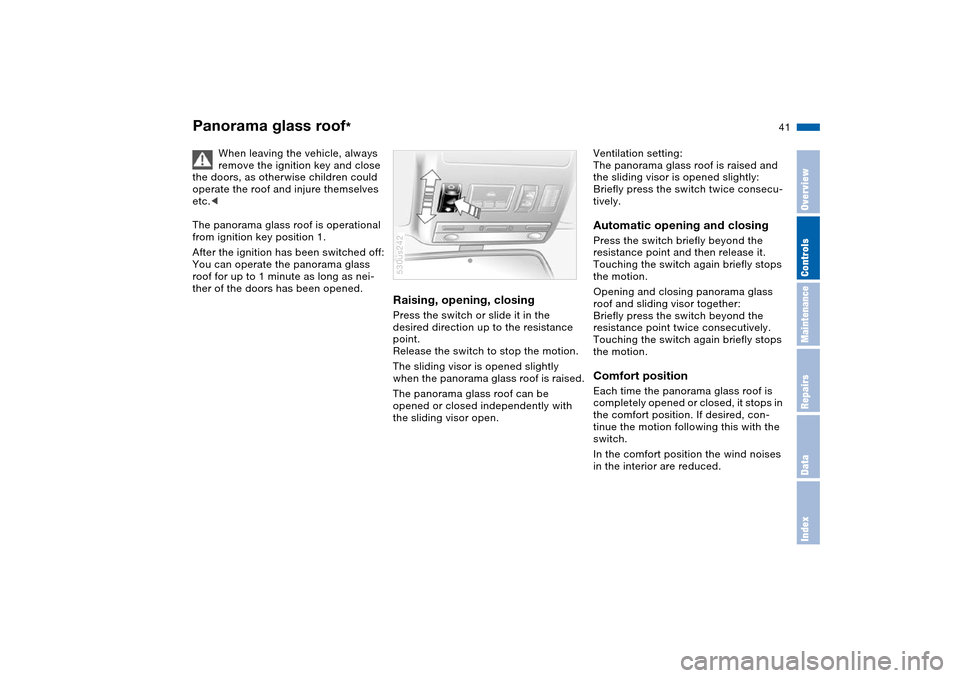
Raising, opening, closingPress the switch or slide it in the
desired direction up to the resistance
point.
Release the switch to stop the motion.
The sliding visor is opened slightly
when the panorama glass roof is raised.
The panorama glass roof can be
opened or closed independently with
the sliding visor open.530us242
Ventilation setting:
The panorama glass roof is raised and
the sliding visor is opened slightly:
Briefly press the switch twice consecu-
tively.Automatic opening and closing Press the switch briefly beyond the
resistance point and then release it.
Touching the switch again briefly stops
the motion.
Opening and closing panorama glass
roof and sliding visor together:
Briefly press the switch beyond the
resistance point twice consecutively.
Touching the switch again briefly stops
the motion.Comfort position Each time the panorama glass roof is
completely opened or closed, it stops in
the comfort position. If desired, con-
tinue the motion following this with the
switch.
In the comfort position the wind noises
in the interior are reduced.
Page 44 of 200
42n
Panorama glass roof
*
Anti-trapping mechanism If the panorama glass roof or sliding
visor encounter resistance when clos-
ing from roughly one third of the roof
opening or when closing from the
raised position, the closing action is
interrupted and the panorama glass
roof and sliding visor reopen a little.
Despite the anti-trapping mecha-
nism inspect the roof's travel path
prior to closing it, as the safety system
might fail to detect certain kinds of
obstructions, such as very thin objects,
and the roof would continue closing.
The anti-trapping mechanism for clos-
ing the panorama glass roof is deacti-
vated if the switch is pressed beyond
the resistance point and held there. The
closing action is interrupted when you
release the switch.<
Following a power failure Following interruptions in electrical
power, for instance, when the battery is
disconnected, it is possible that the
panorama glass roof will extend to its
tilt-up position, but fail to respond to
other commands. The system must be
initialized. BMW recommends having
this work carried out by your BMW
Sport Activity Vehicle center.
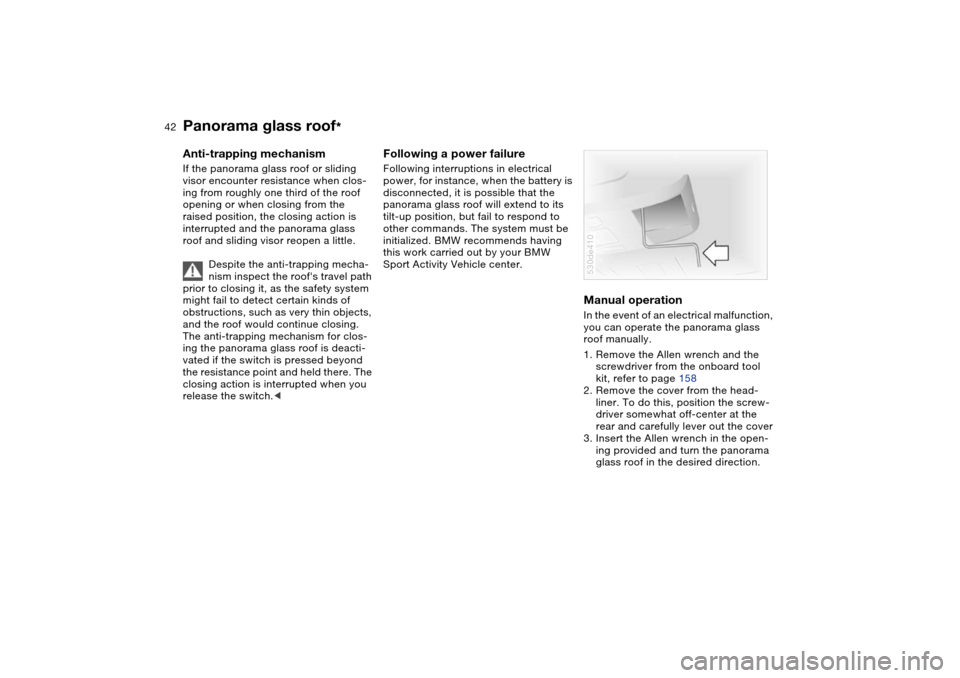
Manual operation In the event of an electrical malfunction,
you can operate the panorama glass
roof manually.
1. Remove the Allen wrench and the
screwdriver from the onboard tool
kit, refer to page 158
2. Remove the cover from the head-
liner. To do this, position the screw-
driver somewhat off-center at the
rear and carefully lever out the cover
3. Insert the Allen wrench in the open-
ing provided and turn the panorama
glass roof in the desired direction.530de410
Page 55 of 200
53n
OverviewControlsMaintenanceRepairsDataIndex
Steering wheel Steering wheel heater
*
Automatic steering wheel
adjustmentonly in conjunction with seat, mirror and
steering wheel memory
In order to make it easier to get into and
out of the vehicle, the steering wheel
automatically moves into the top posi-
tion and returns to the driving or mem-
ory position.
This automatic feature is controlled by
the position of the ignition key and by
the driver's door.
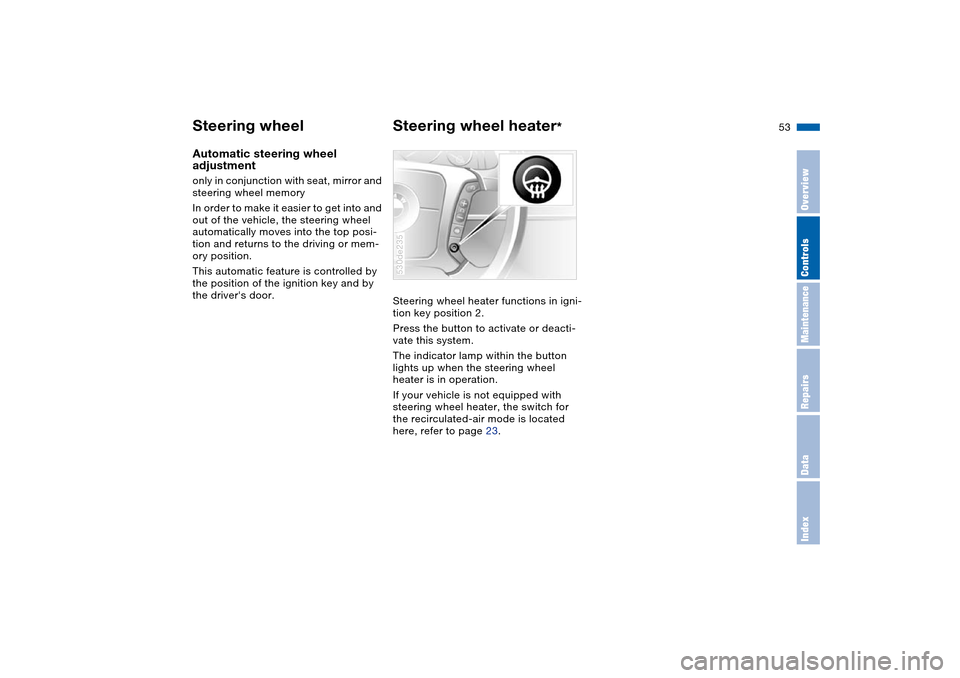
Steering wheel heater functions in igni-
tion key position 2.
Press the button to activate or deacti-
vate this system.
The indicator lamp within the button
lights up when the steering wheel
heater is in operation.
If your vehicle is not equipped with
steering wheel heater, the switch for
the recirculated-air mode is located
here, refer to page 23.
530de235
Page 57 of 200
55n
OverviewControlsMaintenanceRepairsDataIndex
MirrorsInterior and exterior mirrors,
automatic dimming feature
*
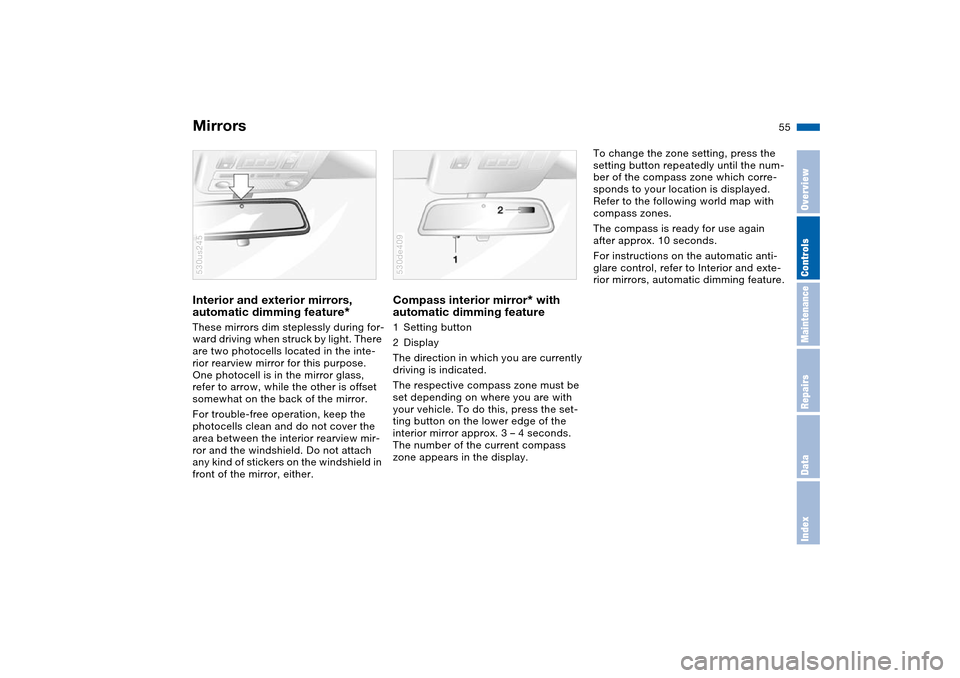
These mirrors dim steplessly during for-
ward driving when struck by light. There
are two photocells located in the inte-
rior rearview mirror for this purpose.
One photocell is in the mirror glass,
refer to arrow, while the other is offset
somewhat on the back of the mirror.
For trouble-free operation, keep the
photocells clean and do not cover the
area between the interior rearview mir-
ror and the windshield. Do not attach
any kind of stickers on the windshield in
front of the mirror, either. 530us245
Compass interior mirror
* with
automatic dimming feature
1Setting button
2Display
The direction in which you are currently
driving is indicated.
The respective compass zone must be
set depending on where you are with
your vehicle. To do this, press the set-
ting button on the lower edge of the
interior mirror approx. 3 – 4 seconds.
The number of the current compass
zone appears in the display.530de409
To change the zone setting, press the
setting button repeatedly until the num-
ber of the compass zone which corre-
sponds to your location is displayed.
Refer to the following world map with
compass zones.
The compass is ready for use again
after approx. 10 seconds.
For instructions on the automatic anti-
glare control, refer to Interior and exte-
rior mirrors, automatic dimming feature.
Page 61 of 200
59n
OverviewControlsMaintenanceRepairsDataIndex
Airbags Transporting children safely Airbag system operational
The warning lamp in the instru-
ment cluster indicates the oper-
ational readiness of the entire
airbag system and the safety belt ten-
sioners as of ignition key position 1.
The warning lamp goes out after a few
seconds.
Airbag system malfunction
Have the airbag system checked
immediately if a malfunction
occurs, as otherwise there is a danger
of the system failing to respond in the
expected manner to an impact occur-
ring within its normal response range.<
A fault has occurred in the air-
bag system:
>Warning lamp does not light up as of
ignition key position 1
>Warning lamp lights up continuously
>Warning lamp lights up while the
vehicle is being driven.
The right place for children Children always in the rear:
Accident research shows that the saf-
est place for children in a vehicle is in
the rear seat.
Older children should be tightly secured
with a safety belt, after they have out-
grown a booster seat that is appropri-
ate for their age, height and weight.
A child sitting in the rear seat and
not properly restrained may place
his or her head on or near the airbag, if
so equipped. For example, a child –
even though belted – may fall asleep
with his or her head against the side air-
bag. It may be difficult for a driver to
ensure that children in the rear seat will
remain properly positioned at all times
and do not place their heads on or near
the side airbag. Therefore, we recom-
mend that the rear side airbags, if pro-
vided, be deactivated if you plan to
transport children in the rear seat.<
Child-restraint systems in the rearChild-restraint systems appropriate for
every age group and weight are avail-
able at your BMW Sports Activity Vehi-
cle center.
Children under 13 years of age
and children less than 5 ft/150 cm
tall should always ride in the rear and
the restraint systems should be secured
with the vehicle's safety belts.<
No universal child-restraint sys-
tems facing the rear of the vehicle
may be mounted on the rear seats.
If you want to use a rearward-facing
child-restraint system in the rear, then
the BMW Baby Seat with or without the
LATCH child-restraint fixing is suitable
for this purpose.<
Younger children should be secured in
an appropriate forward-facing child-
restraint system that has first been
properly secured with a safety belt.
All rear sitting positions in your
vehicle meet the recommendations of
SAE J1819, an industry-recommended
practice for securing child-restraint sys-
tems in motor vehicles.
Page 66 of 200
64n
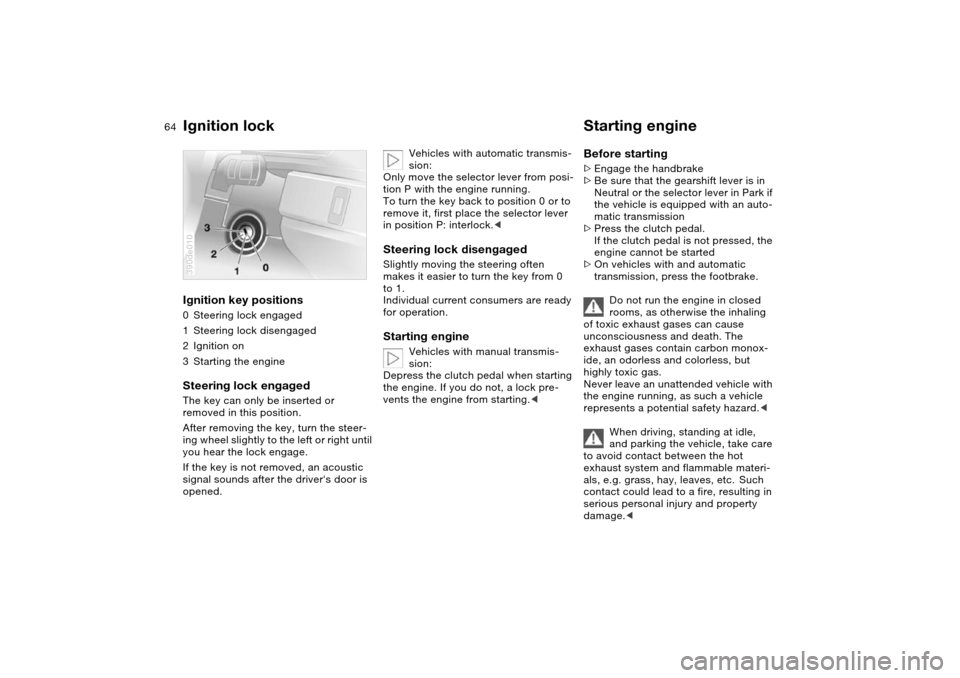
Ignition lock Starting engine Ignition key positions 0Steering lock engaged
1Steering lock disengaged
2Ignition on
3Starting the engineSteering lock engaged The key can only be inserted or
removed in this position.
After removing the key, turn the steer-
ing wheel slightly to the left or right until
you hear the lock engage.
If the key is not removed, an acoustic
signal sounds after the driver's door is
opened.390de010
Vehicles with automatic transmis-
sion:
Only move the selector lever from posi-
tion P with the engine running.
To turn the key back to position 0 or to
remove it, first place the selector lever
in position P: interlock.<
Steering lock disengaged Slightly moving the steering often
makes it easier to turn the key from 0
to 1.
Individual current consumers are ready
for operation. Starting engine
Vehicles with manual transmis-
sion:
Depress the clutch pedal when starting
the engine. If you do not, a lock pre-
vents the engine from starting.<
Before starting >Engage the handbrake
>Be sure that the gearshift lever is in
Neutral or the selector lever in Park if
the vehicle is equipped with an auto-
matic transmission
>Press the clutch pedal.
If the clutch pedal is not pressed, the
engine cannot be started
>On vehicles with and automatic
transmission, press the footbrake.
Do not run the engine in closed
rooms, as otherwise the inhaling
of toxic exhaust gases can cause
unconsciousness and death. The
exhaust gases contain carbon monox-
ide, an odorless and colorless, but
highly toxic gas.
Never leave an unattended vehicle with
the engine running, as such a vehicle
represents a potential safety hazard.<
When driving, standing at idle,
and parking the vehicle, take care
to avoid contact between the hot
exhaust system and flammable materi-
als, e.g. grass, hay, leaves, etc. Such
contact could lead to a fire, resulting in
serious personal injury and property
damage.<
Page 69 of 200
67n
OverviewControlsMaintenanceRepairsDataIndex
Manual transmission Automatic transmission with SteptronicReverse Select only when the vehicle is station-
ary. Press the gearshift lever to the left
to overcome the resistance.
As you do this, the backup lamps will
turn on automatically when the ignition
key is in position 2.
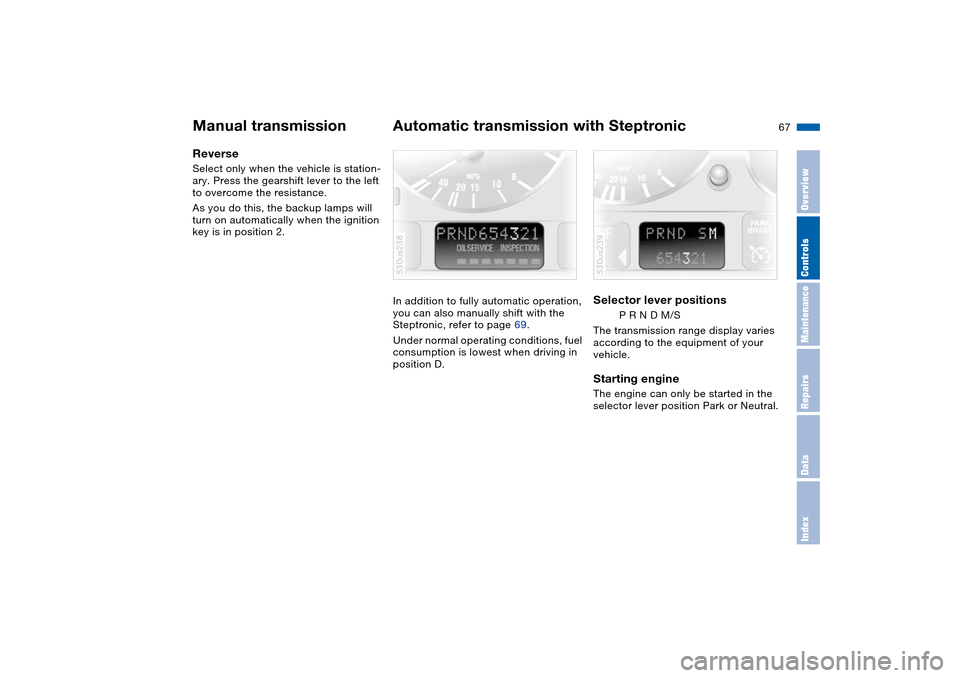
In addition to fully automatic operation,
you can also manually shift with the
Steptronic, refer to page 69.
Under normal operating conditions, fuel
consumption is lowest when driving in
position D.
530us238
Selector lever positions
P R N D M/S
The transmission range display varies
according to the equipment of your
vehicle.
Starting engine The engine can only be started in the
selector lever position Park or Neutral. 530us239
Page 71 of 200
69n
OverviewControlsMaintenanceRepairsDataIndex
Automatic transmission with SteptronicSport program and M/S manual
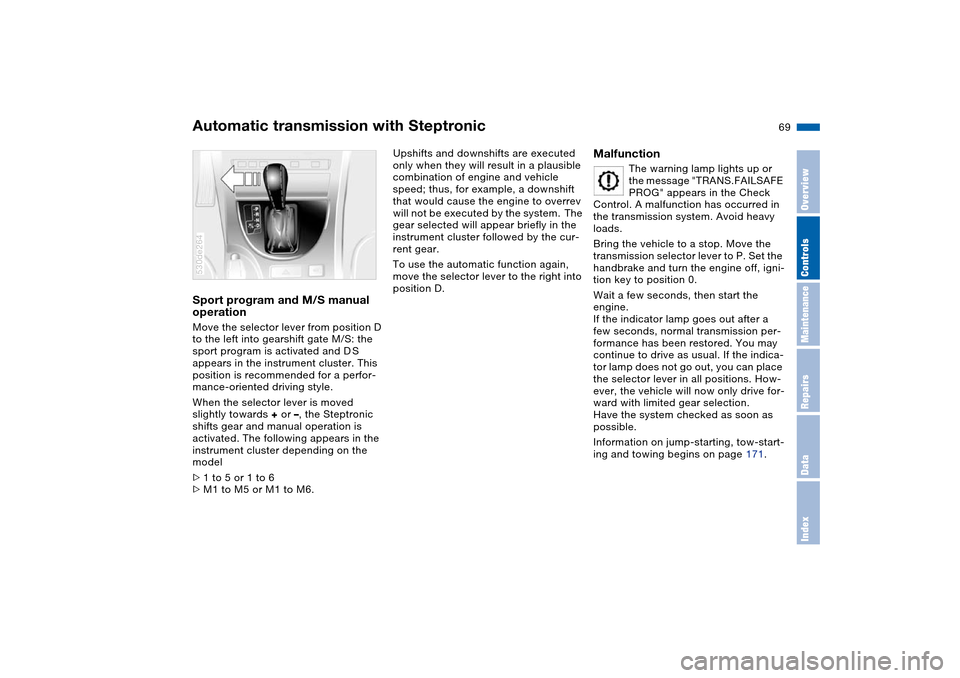
operation Move the selector lever from position D
to the left into gearshift gate M/S: the
sport program is activated and D S
appears in the instrument cluster. This
position is recommended for a perfor-
mance-oriented driving style.
When the selector lever is moved
slightly towards + or –, the Steptronic
shifts gear and manual operation is
activated. The following appears in the
instrument cluster depending on the
model
>1 to 5 or 1 to 6
>M1 to M5 or M1 to M6. 530de264
Upshifts and downshifts are executed
only when they will result in a plausible
combination of engine and vehicle
speed; thus, for example, a downshift
that would cause the engine to overrev
will not be executed by the system. The
gear selected will appear briefly in the
instrument cluster followed by the cur-
rent gear.
To use the automatic function again,
move the selector lever to the right into
position D.
Malfunction
The warning lamp lights up or
the message "TRANS.FAILSAFE
PROG" appears in the Check
Control. A malfunction has occurred in
the transmission system. Avoid heavy
loads.
Bring the vehicle to a stop. Move the
transmission selector lever to P. Set the
handbrake and turn the engine off, igni-
tion key to position 0.
Wait a few seconds, then start the
engine.
If the indicator lamp goes out after a
few seconds, normal transmission per-
formance has been restored. You may
continue to drive as usual. If the indica-
tor lamp does not go out, you can place
the selector lever in all positions. How-
ever, the vehicle will now only drive for-
ward with limited gear selection.
Have the system checked as soon as
possible.
Information on jump-starting, tow-start-
ing and towing begins on page 171.
Page 75 of 200
73n
OverviewControlsMaintenanceRepairsDataIndex
Washer/wiper system/rain sensor
*
Cruise control
*
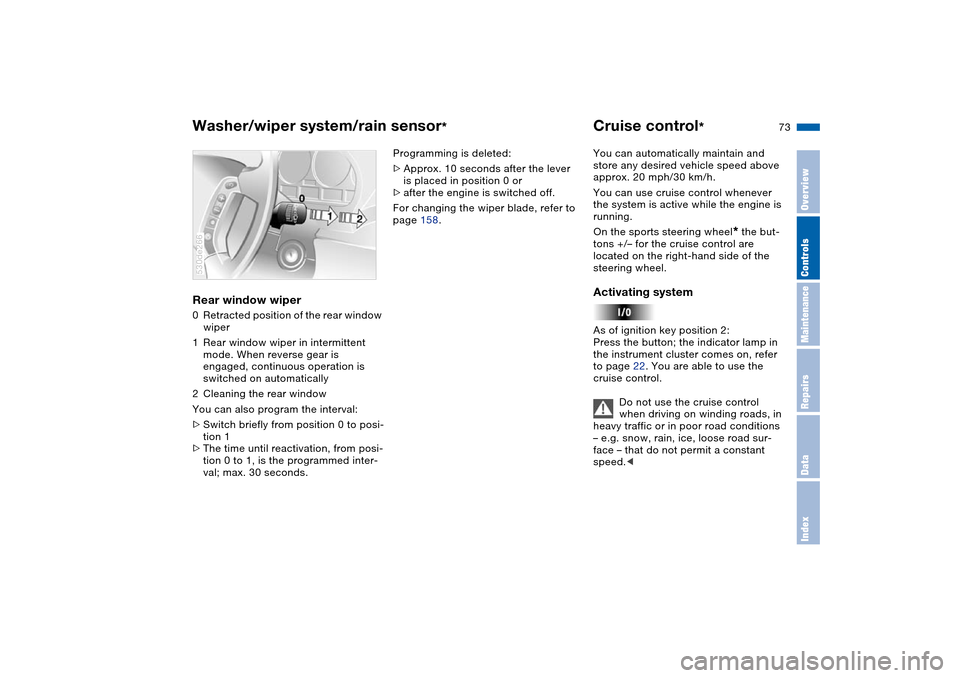
Rear window wiper 0Retracted position of the rear window
wiper
1Rear window wiper in intermittent
mode. When reverse gear is
engaged, continuous operation is
switched on automatically
2Cleaning the rear window
You can also program the interval:
>Switch briefly from position 0 to posi-
tion 1
>The time until reactivation, from posi-
tion 0 to 1, is the programmed inter-
val; max. 30 seconds. 530de266
Programming is deleted:
>Approx. 10 seconds after the lever
is placed in position 0 or
>after the engine is switched off.
For changing the wiper blade, refer to
page 158.You can automatically maintain and
store any desired vehicle speed above
approx. 20 mph/30 km/h.
You can use cruise control whenever
the system is active while the engine is
running.
On the sports steering wheel
* the but-
tons +/– for the cruise control are
located on the right-hand side of the
steering wheel.
Activating system As of ignition key position 2:
Press the button; the indicator lamp in
the instrument cluster comes on, refer
to page 22. You are able to use the
cruise control.
Do not use the cruise control
when driving on winding roads, in
heavy traffic or in poor road conditions
– e.g. snow, rain, ice, loose road sur-
face – that do not permit a constant
speed.<
Page 79 of 200
Maintenance
77n
OverviewControlsRepairsDataIndex
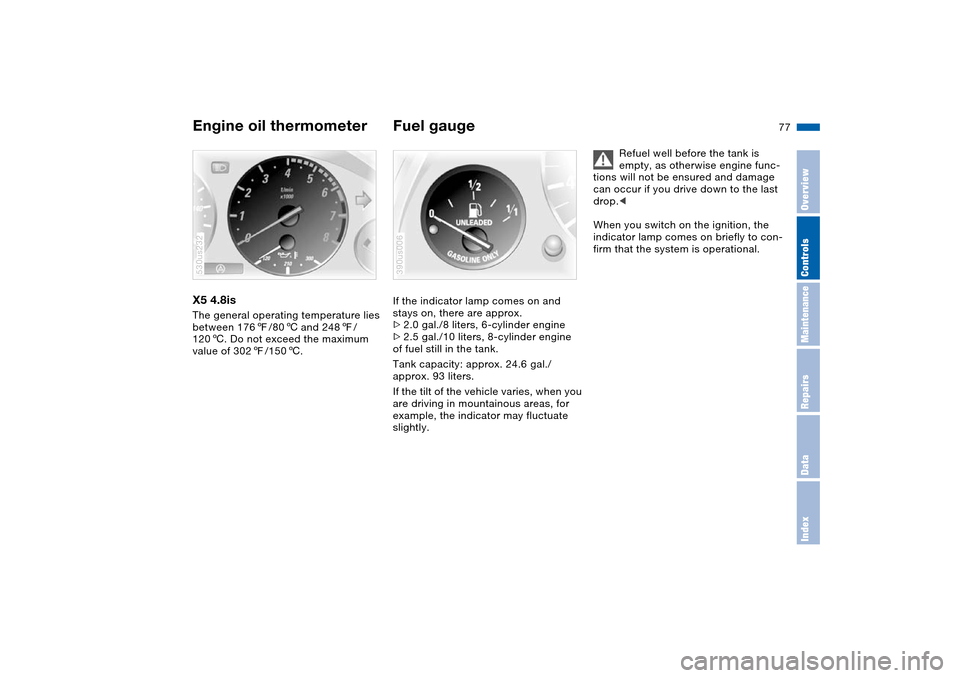
Engine oil thermometer Fuel gauge X5 4.8is The general operating temperature lies
between 1767/806 and 2487/
1206. Do not exceed the maximum
value of 3027/1506.530us232
If the indicator lamp comes on and
stays on, there are approx.
>2.0 gal./8 liters, 6-cylinder engine
>2.5 gal./10 liters, 8-cylinder engine
of fuel still in the tank.
Tank capacity: approx. 24.6 gal./
approx. 93 liters.
If the tilt of the vehicle varies, when you
are driving in mountainous areas, for
example, the indicator may fluctuate
slightly.390us006
Refuel well before the tank is
empty, as otherwise engine func-
tions will not be ensured and damage
can occur if you drive down to the last
drop.<
When you switch on the ignition, the
indicator lamp comes on briefly to con-
firm that the system is operational.