operation BMW X5 3.0I 2004 E53 Owner's Manual
[x] Cancel search | Manufacturer: BMW, Model Year: 2004, Model line: X5 3.0I, Model: BMW X5 3.0I 2004 E53Pages: 200, PDF Size: 3.91 MB
Page 8 of 200
Contents
Operation, maintenance
Owner service procedures
Special operating instructions:
Break-in procedures136
Driving your X5137
General driving notes138
Safe braking139
Wheels and tires:
Tire inflation pressure140
Tire identification marks142
Wheel/tire condition143
Replacing wheels/tires144
Snow chains145
Under the hood:
Hood146
Engine compartment
essentials147
Washer fluid148
Engine oil148
Coolant150
Brake fluid151
Care and maintenance:
The BMW Maintenance
System152
Laws and regulations:
California laws153
OBD interface socket153
Replacement procedures:
Onboard tool kit158
Windshield wiper blades158
Lamps and bulbs159
Changing a tire163
Battery168
Fuses169
Assistance, giving and
receiving:
Receiving assistance170
Jump-starting171
Towing and tow-starting
vehicle173
Page 11 of 200
9n
OverviewControlsMaintenanceRepairsDataIndex
Status at time of printing
BMW pursues a policy of continuous,
ongoing development that is conceived
to ensure that our vehicles continue to
embody the highest quality and safety
standards combined with advanced,
state-of-the-art technology. In isolated
cases, the features described in this
Owner's Manual could differ from those
on your vehicle for this reason.
For your own safety
Maintenance and repair:
Advanced technology, e. g. the
use of modern materials and high-
performance electronics, requires spe-
cially adapted maintenance and repair
methods. Therefore, only have corre-
sponding work on your BMW carried
out by a BMW Sports Activity Vehicle
center or a workshop that works
according to BMW repair procedures
with correspondingly trained personnel.
If work is carried out improperly there is
a danger of consequential damage and
the related safety risks.<
Parts and accessories:
For your own safety, use genuine
parts and accessories approved
by BMW.
When you purchase accessories tested
and approved by BMW and Genuine
BMW Parts, you simultaneously acquire
the assurance that they have been thor-
oughly tested by BMW to ensure opti-
mum performance when installed on
your vehicle.
BMW warrants these parts to be free
from defects in material and workman-
ship.
BMW will not accept any liability for
damages resulting from installation of
parts and accessories not approved by
BMW.
BMW cannot test every product on the
market to determine whether it can be
used on a BMW safely and without risk
to either the vehicle, its operation, or its
occupants.
Genuine BMW Parts, BMW Accessories
and other products approved by BMW,
together with professional advice on
using these items, are available from all
BMW Sports Activity Vehicle centers.
Installation and operation of non-BMW
approved accessories such as alarms,
radios, amplifiers, radar detectors,
wheels, suspension components, brake
dust shields, telephones – including
operation of any portable phone from
within the vehicle without using an
externally mounted antenna – or trans-
ceiver equipment such as CB, walkie-
talkie, ham radio or similar accessories,
may cause extensive damage to the
vehicle, compromise its safety, interfere
with the vehicle's electrical system or
affect the validity of the BMW Limited
Warranty. Refer to your BMW Sports
Activity Vehicle center for additional
information.<
Status at time of printing
Notes
Page 15 of 200
13n
OverviewControlsMaintenanceRepairsDataIndex
Overview
Controls and features
Operation, maintenance
Owner service procedures
Index Technical data
Overview
Page 18 of 200
16n
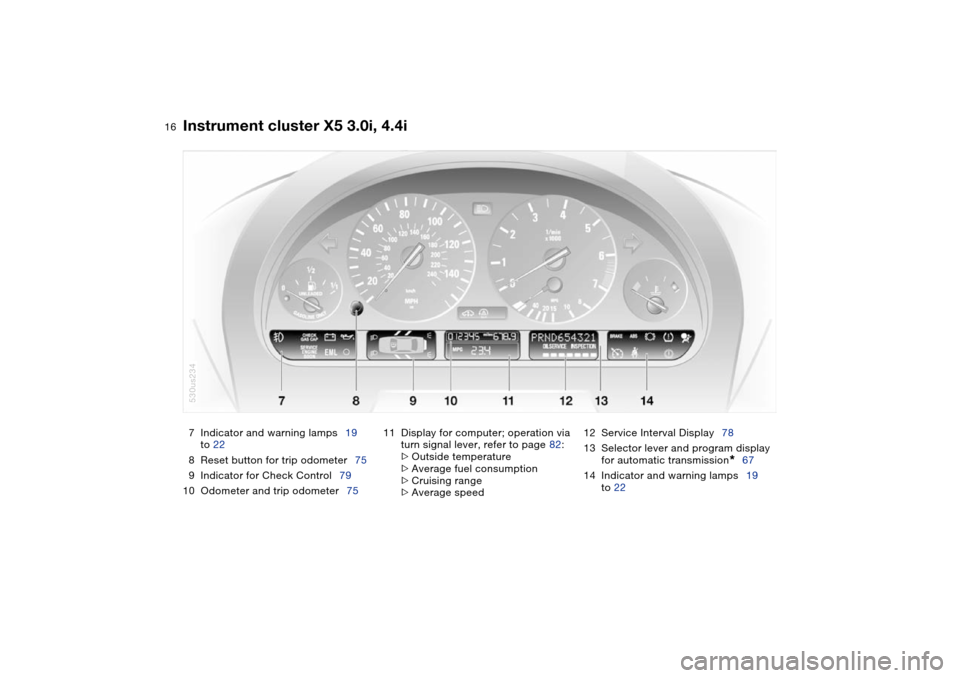
Instrument cluster X5 3.0i, 4.4i
7Indicator and warning lamps19
to 22
8Reset button for trip odometer75
9Indicator for Check Control79
10 Odometer and trip odometer7511 Display for computer; operation via
turn signal lever, refer to page 82:
>
Outside temperature
>
Average fuel consumption
>
Cruising range
>
Average speed12 Service Interval Display78
13 Selector lever and program display
for automatic transmission
*
67
14 Indicator and warning lamps19
to 22
530us234
Page 24 of 200
22n
Indicator and warning lamps
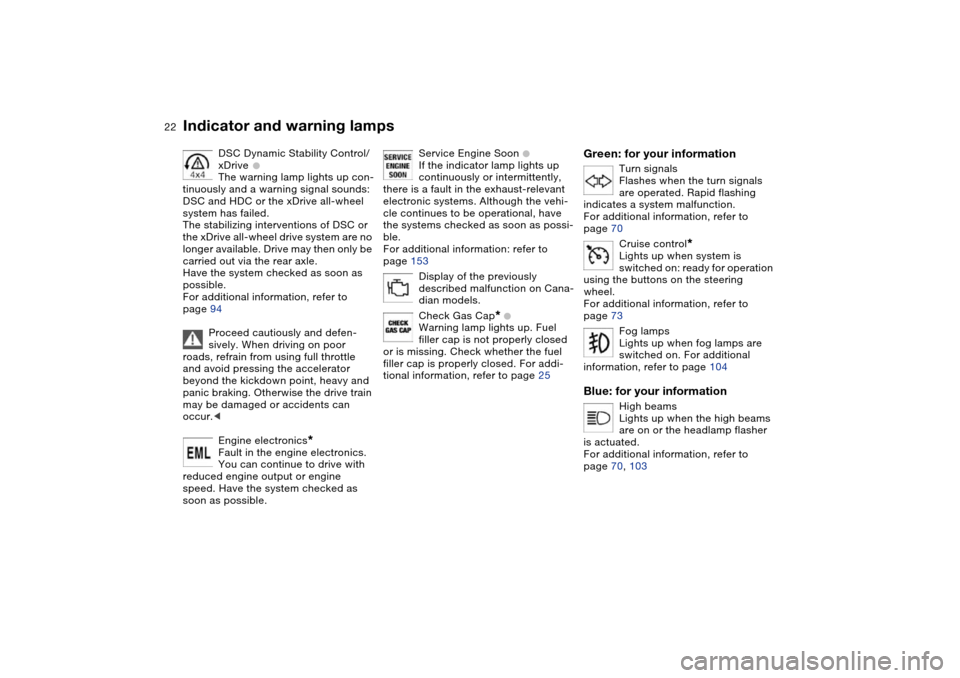
DSC Dynamic Stability Control/
xDrive
+
The warning lamp lights up con-
tinuously and a warning signal sounds:
DSC and HDC or the xDrive all-wheel
system has failed.
The stabilizing interventions of DSC or
the xDrive all-wheel drive system are no
longer available. Drive may then only be
carried out via the rear axle.
Have the system checked as soon as
possible.
For additional information, refer to
page 94
Proceed cautiously and defen-
sively. When driving on poor
roads, refrain from using full throttle
and avoid pressing the accelerator
beyond the kickdown point, heavy and
panic braking. Otherwise the drive train
may be damaged or accidents can
occur.<
Engine electronics
*
Fault in the engine electronics.
You can continue to drive with
reduced engine output or engine
speed. Have the system checked as
soon as possible.
Service Engine Soon
+
If the indicator lamp lights up
continuously or intermittently,
there is a fault in the exhaust-relevant
electronic systems. Although the vehi-
cle continues to be operational, have
the systems checked as soon as possi-
ble.
For additional information: refer to
page 153
Display of the previously
described malfunction on Cana-
dian models.
Check Gas Cap
* +
Warning lamp lights up. Fuel
filler cap is not properly closed
or is missing. Check whether the fuel
filler cap is properly closed. For addi-
tional information, refer to page 25
Green: for your information
Turn signals
Flashes when the turn signals
are operated. Rapid flashing
indicates a system malfunction.
For additional information, refer to
page 70
Cruise control
*
Lights up when system is
switched on: ready for operation
using the buttons on the steering
wheel.
For additional information, refer to
page 73
Fog lamps
Lights up when fog lamps are
switched on. For additional
information, refer to page 104
Blue: for your information
High beams
Lights up when the high beams
are on or the headlamp flasher
is actuated.
For additional information, refer to
page 70, 103
Page 31 of 200
MaintenanceOverviewControlsRepairsDataIndex
29n
Overview
Controls and features
Operation, maintenance
Index Technical data
Owner service procedures
Page 32 of 200
30n
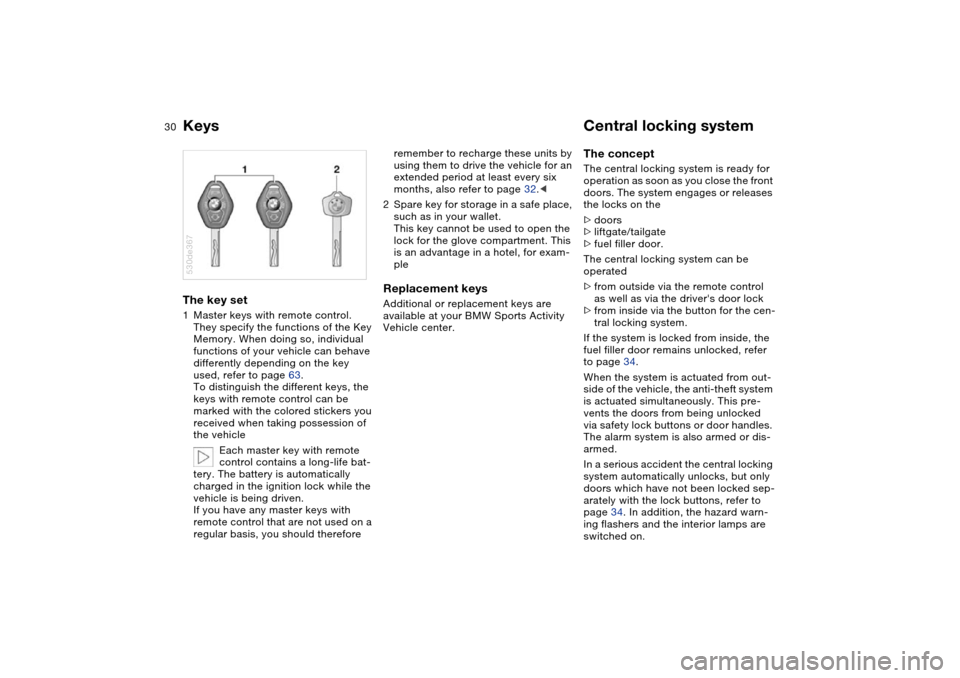
Keys Central locking system The key set 1Master keys with remote control.
They specify the functions of the Key
Memory. When doing so, individual
functions of your vehicle can behave
differently depending on the key
used, refer to page 63.
To distinguish the different keys, the
keys with remote control can be
marked with the colored stickers you
received when taking possession of
the vehicle
Each master key with remote
control contains a long-life bat-
tery. The battery is automatically
charged in the ignition lock while the
vehicle is being driven.
If you have any master keys with
remote control that are not used on a
regular basis, you should therefore 530de367
remember to recharge these units by
using them to drive the vehicle for an
extended period at least every six
months, also refer to page 32.<
2Spare key for storage in a safe place,
such as in your wallet.
This key cannot be used to open the
lock for the glove compartment. This
is an advantage in a hotel, for exam-
ple Replacement keys Additional or replacement keys are
available at your BMW Sports Activity
Vehicle center.
The concept The central locking system is ready for
operation as soon as you close the front
doors. The system engages or releases
the locks on the
>doors
>liftgate/tailgate
>fuel filler door.
The central locking system can be
operated
>from outside via the remote control
as well as via the driver's door lock
>from inside via the button for the cen-
tral locking system.
If the system is locked from inside, the
fuel filler door remains unlocked, refer
to page 34.
When the system is actuated from out-
side of the vehicle, the anti-theft system
is actuated simultaneously. This pre-
vents the doors from being unlocked
via safety lock buttons or door handles.
The alarm system is also armed or dis-
armed.
In a serious accident the central locking
system automatically unlocks, but only
doors which have not been locked sep-
arately with the lock buttons, refer to
page 34. In addition, the hazard warn-
ing flashers and the interior lamps are
switched on.
Page 34 of 200
32n
Opening and closing: from outside
If the vehicle is locked, the liftgate
is also locked again when closed.
Before and after a trip, be sure that the
liftgate was not opened unintention-
ally.<
Panic modeBy pressing and holding the button for
more than two seconds, you can start
the alarm system if there is an impend-
ing danger if its is armed.
To switch off the alarm
Press the button.
Malfunction The remote control can be subjected to
malfunctions by local radio waves.
Should the remote control fail to oper-
ate owing to interference of this kind,
unlock and lock the vehicle via the door
lock using the master key.
If it is no longer possible to lock the
vehicle via the remote control, the bat-
tery is discharged. Use this remote
control during an extended drive; this
will recharge the battery, refer to
page 30.
For US owners onlyThe transmitter and receiver units com-
ply with part 15 of the FCC/Federal
Communication Commission regula-
tions. Operation is governed by the fol-
lowing:
FCC ID: LX8EWS
LX8FZVS
LX8FZVE
Compliance statement:
This device complies with part 15 of the
FCC Rules. Operation is subject to the
following two conditions:
>This device may not cause harmful
interference, and
>this device must accept any interfer-
ence received, including interference
that may cause undesired operation.
Any unauthorized modifications to
these devices could void the
user's authority to operate this equip-
ment.<
Page 35 of 200
33n
OverviewControlsMaintenanceRepairsDataIndex
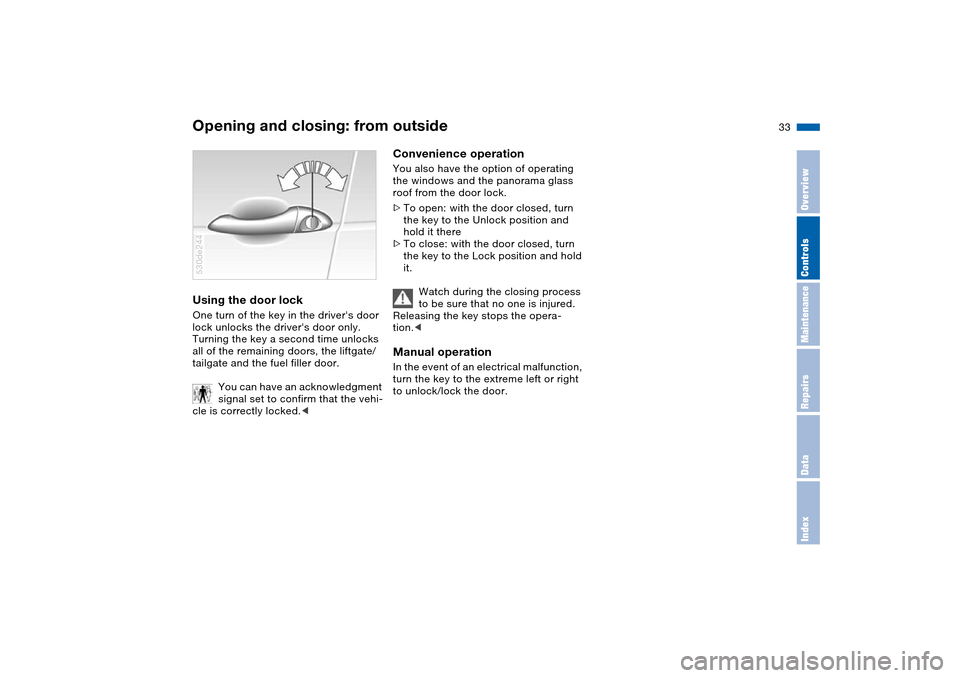
Opening and closing: from outsideUsing the door lock One turn of the key in the driver's door
lock unlocks the driver's door only.
Turning the key a second time unlocks
all of the remaining doors, the liftgate/
tailgate and the fuel filler door.
You can have an acknowledgment
signal set to confirm that the vehi-
cle is correctly locked.< 530de244
Convenience operation You also have the option of operating
the windows and the panorama glass
roof from the door lock.
>To open: with the door closed, turn
the key to the Unlock position and
hold it there
>To close: with the door closed, turn
the key to the Lock position and hold
it.
Watch during the closing process
to be sure that no one is injured.
Releasing the key stops the opera-
tion.< Manual operation In the event of an electrical malfunction,
turn the key to the extreme left or right
to unlock/lock the door.
Page 42 of 200
40n
Windows After the ignition has been switched off:
>You can still operate the windows as
long as neither of the front doors has
been opened. To open the windows,
press the switch beyond the resis-
tance point.
When leaving the vehicle, always
remove the ignition key and close
the doors, as otherwise children could
operate the windows and injure them-
selves etc.<
For the convenience operation via the
remote control or the door lock, refer to
pages 31, 33. Anti-trapping mechanism A contact strip is integrated into the
inner side of each of the upper window
frame sections. If pressure is exerted
against this contact strip while a win-
dow is being raised, the system will
respond by stopping the window and
then retracting it a small distance.
Despite the anti-trapping mecha-
nism, be extremely careful that the
closing path of the window is not
obstructed whenever it is closed.
Otherwise, an object might not touch
the contact strip in some situations,
with very thin objects, for instance.
You can disable the anti-trapping
mechanism by pulling the switch
beyond the resistance point and hold-
ing it.
Because the power windows are sealed
at high pressure to prevent wind noise
when closed, a powerful motor is
required for efficient closing. When
closing the windows, always ensure
that they are not obstructed in any way.
Unsupervised use of these systems can
result in serious personal injury.
Remove the ignition key to deactivate
the power windows whenever you
leave the vehicle. Never leave the keys
in the vehicle with unsupervised chil-
dren. Never place anything that could
obstruct the driver's vision on or next to
the windows.<
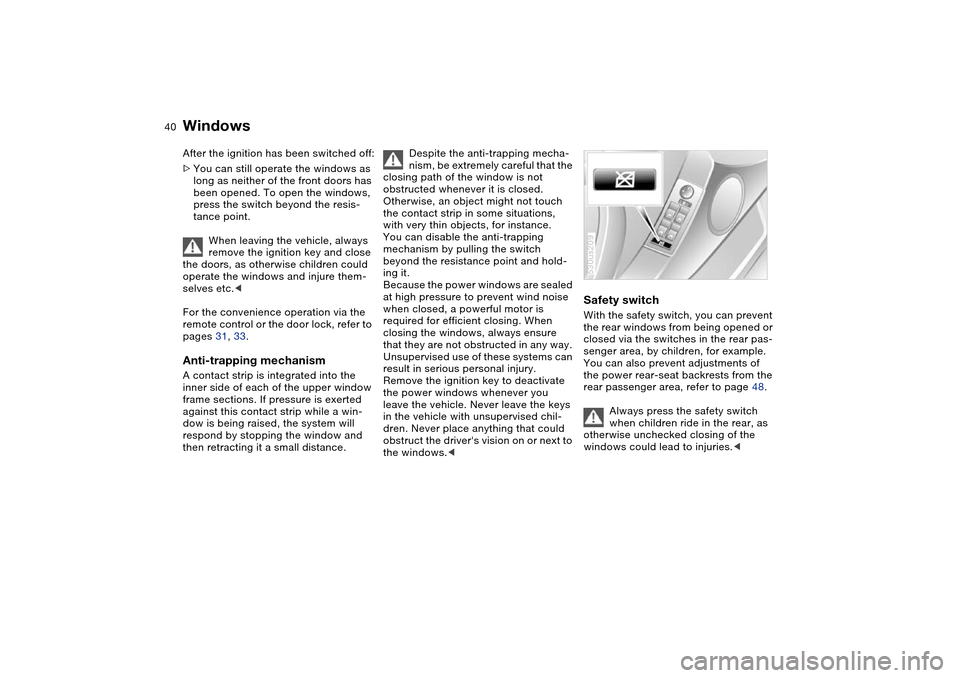
Safety switch With the safety switch, you can prevent
the rear windows from being opened or
closed via the switches in the rear pas-
senger area, by children, for example.
You can also prevent adjustments of
the power rear-seat backrests from the
rear passenger area, refer to page 48.
Always press the safety switch
when children ride in the rear, as
otherwise unchecked closing of the
windows could lead to injuries.<530us209