maintenance BMW X5 3.0I 2006 E53 Manual PDF
[x] Cancel search | Manufacturer: BMW, Model Year: 2006, Model line: X5 3.0I, Model: BMW X5 3.0I 2006 E53Pages: 202, PDF Size: 4.13 MB
Page 131 of 202
131n
OverviewControlsMaintenanceRepairsDataIndex
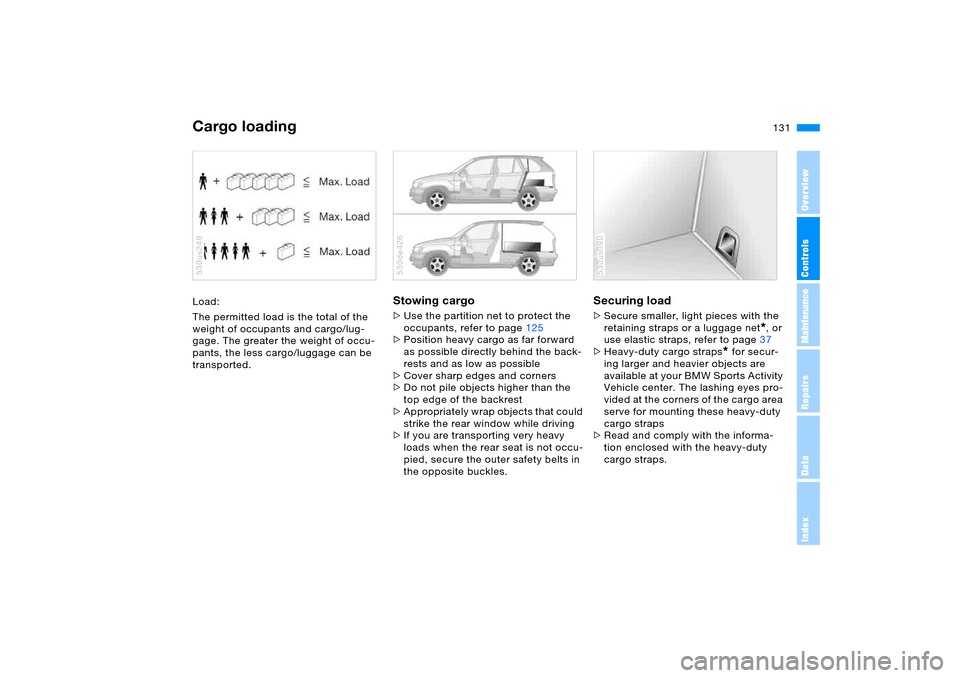
Cargo loadingLoad:
The permitted load is the total of the
weight of occupants and cargo/lug-
gage. The greater the weight of occu-
pants, the less cargo/luggage can be
transported.530us249
Stowing cargo >Use the partition net to protect the
occupants, refer to page125
>Position heavy cargo as far forward
as possible directly behind the back-
rests and as low as possible
>Cover sharp edges and corners
>Do not pile objects higher than the
top edge of the backrest
>Appropriately wrap objects that could
strike the rear window while driving
>If you are transporting very heavy
loads when the rear seat is not occu-
pied, secure the outer safety belts in
the opposite buckles. 530de426
Securing load >Secure smaller, light pieces with the
retaining straps or a luggage net
*, or
use elastic straps, refer to page37
>Heavy-duty cargo straps
* for secur-
ing larger and heavier objects are
available at your BMW Sports Activity
Vehicle center. The lashing eyes pro-
vided at the corners of the cargo area
serve for mounting these heavy-duty
cargo straps
>Read and comply with the informa-
tion enclosed with the heavy-duty
cargo straps.
530us090
Page 133 of 202

133n
OverviewControlsMaintenanceRepairsDataIndex
Page 135 of 202
135n
OverviewControlsMaintenanceRepairsDataIndex
Overview
Controls and features
Operation, maintenance
Owner service procedures
Index Technical data
Maintena
Page 137 of 202
137n
OverviewControlsMaintenanceRepairsDataIndex
General driving notesClosing liftgate/tailgate
Operate the vehicle only when the
tailgate and liftgate are completely
closed. Otherwise, exhaust fumes
could enter into the passenger com-
partment.<
However, if special circumstances
should make it absolutely necessary to
operate the vehicle with the liftgate/tail-
gate open:
1. Close all windows and the panorama
glass roof
2. Increase the air supply for the air
conditioner or automatic climate
control to a high level, refer to
page105 or109.
Hot exhaust system
Extreme temperatures occur on
the exhaust system on any vehi-
cle. Do not remove the heat shields
installed adjacent to it, and never apply
undercoating to them. When driving,
standing at idle and while parking, take
care to avoid possible contact between
a hot exhaust system and any highly
flammable materials such as hay,
leaves, grass etc. Otherwise, there is a
danger of ignition and fire, with the risk
of serious injuries and damage.<
Mobile communications devices
in vehicle
BMW advises against using
mobile communications devices
such as mobile phones inside the vehi-
cle unless they are directly connected
to the external antenna. Otherwise, it is
impossible to prevent a mutual interfer-
ence of the vehicle electronics with the
mobile phone device. Also, there is no
guarantee that the radiation generated
by the transmission will be conveyed
out from the interior of the vehicle.<
When vehicle is parked Condensation forms in the air condi-
tioner system during operation and then
exits under the vehicle. Traces of water
on the ground are therefore normal.Brakes
Do not drive with your foot resting
on the brake pedal. Even light but
consistent pedal pressure can lead to
excessively high temperatures, brake
wear and possibly even brake failure.<
Road hazards
If road hazards, obstacles or curbs
are unavoidable, only drive over
them very slowly and carefully, other-
wise the wheels and suspension parts,
especially on vehicles fitted with low
profile tires, can be damaged.<
For more information on wheels and
tires, refer to page146.
Before driving into a car washFold in the exterior mirrors, refer to
page53, otherwise they could be dam-
aged due to the width of the vehicle.Hydroplaning
When driving on wet or slushy
roads, reduce road speed. If you
do not, a wedge of water can form
between tires and road surface. This
state can cause a partial or total loss
of contact with the road surface, of
braking control and of control over the
vehicle.<
Page 139 of 202
139n
OverviewControlsMaintenanceRepairsDataIndex
Driving your X5>Please note that it is possible for the
undercarriage to touch the ground,
for example on crests and bumpy
roads. The ground clearance of the
vehicle is:
– without self-leveling suspension
X5 3.0i, 4.4i: 8 in/20 cm
X5 3.0d: 7 in/17.5 cm
– with 2-axle self-leveling suspen-
sion
*
6.5-9 in/16.5-22 cm, depending on
the level selected.
>Only drive through water up to a max-
imum depth of 20 in/50 cm and only
at walking speed, making sure not to
stop in the process. When equipped
with 2-axle self leveling suspension
*,
switch the vehicle to the Off-Road
setting before driving through, refer
to page97.
After leaving the water, apply the
footbrake lightly several times while
driving at low speeds so as to dry the
brakes by braking and to prevent
decreased braking action due to wet-
ness.
Back onto paved road Our recommendation that you observe
the following points after driving on
adverse road surfaces is not intended
as a beauty treatment for your BMW.
Instead, it is intended to maintain driv-
ing safety:
>Clean the worst of the dirt from the
body and inspect the undercarriage
for damage.
>Clean mud, snow, ice etc. from the
wheels and tires and check the
wheels for damage.
>Check to determine whether rocks,
gravel or accumulations of dirt on the
brake rotors and calipers could influ-
ence braking performance. Remove
all such foreign objects.
>In order to clean the brake rotors,
apply the footbrake gently several
times while driving at a low speed.
Be sure that following traffic is not
endangered by this.
>For cleaning the handbrake, apply the
lever slightly at approx. 25 mph/
40 km/h and continue to drive for
approx. 200 yards/200 meters, pro-
vided that traffic conditions allow you
to do so.
Page 141 of 202
141n
OverviewControlsMaintenanceRepairsDataIndex
Information for your safety The condition of the tires and the main-
tenance of the specified tire pressure
are crucial not only to the tire's service
life, but also to driving comfort and
most importantly, driving safety. Checking pressureOnly check tire inflation pressure when
the tires are cold. This means after a
maximum of 1.25 miles/2 km driving or
when the vehicle has been parked for at
least 2 hours. When tires are warm, the
tire inflation pressure increases.
Check the tire inflation pressure
regularly and correct it as needed,
even on the spare wheel: at least twice
a month and before starting long trips. If
you fail to observe this precaution, you
may be driving on tires with incorrect
tire pressures, a condition that can not
only compromise your vehicle's driving
stability, but also lead to tire damage
and the risk of an accident. Do not drive
with deflated, i.e. flat, tires. A flat tire
will seriously impairs your vehicle's
handling and braking response.
Attempts to drive on a flat tire can lead
to loss of control over the vehicle.<
After correcting the inflation pres-
sure(s), always reinitialize the Flat
Tire Monitor, refer to page99.<
Inflation pressures for factory-
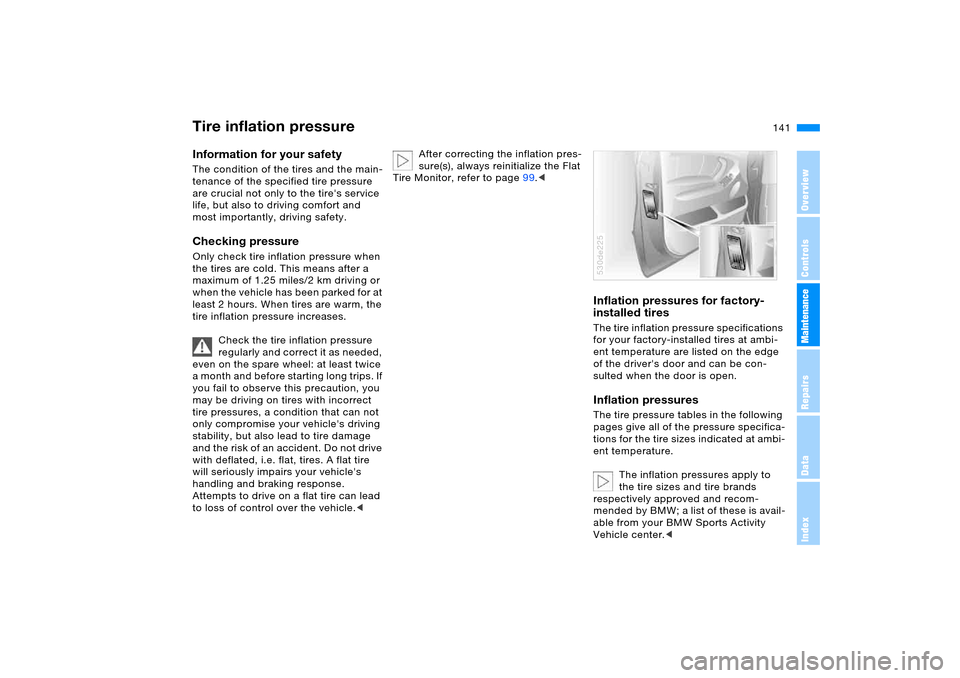
installed tiresThe tire inflation pressure specifications
for your factory-installed tires at ambi-
ent temperature are listed on the edge
of the driver's door and can be con-
sulted when the door is open.Inflation pressuresThe tire pressure tables in the following
pages give all of the pressure specifica-
tions for the tire sizes indicated at ambi-
ent temperature.
The inflation pressures apply to
the tire sizes and tire brands
respectively approved and recom-
mended by BMW; a list of these is avail-
able from your BMW Sports Activity
Vehicle center.<530de225
Tire inflation pressure
Page 143 of 202
143n
OverviewControlsMaintenanceRepairsDataIndex
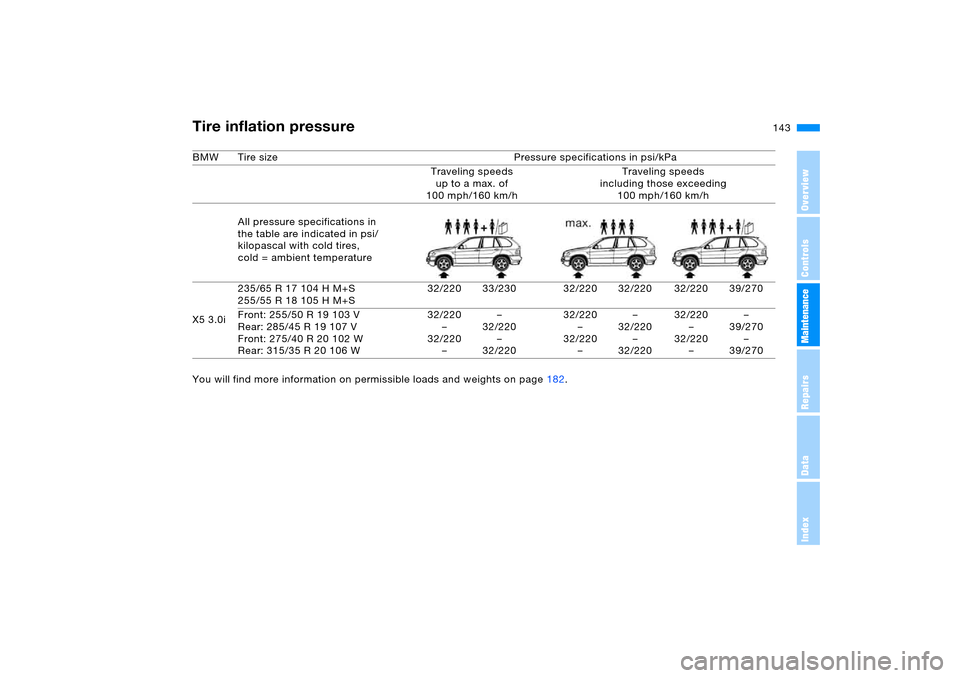
Tire inflation pressureBMW Tire size Pressure specifications in psi/kPa
Traveling speeds
up to a max. of
100 mph/160 km/hTraveling speeds
including those exceeding
100 mph/160 km/h
All pressure specifications in
the table are indicated in psi/
kilopascal with cold tires,
cold = ambient temperature
X5 3.0i235/65 R 17 104 H M+S
255/55 R 18 105 H M+S32/220 33/230 32/220 32/220 32/220 39/270
Front: 255/50 R 19 103 V
Rear: 285/45 R 19 107 V
Front: 275/40 R 20 102 W
Rear: 315/35 R 20 106 W32/220
–
32/220
––
32/220
–
32/22032/220
–
32/220
––
32/220
–
32/22032/220
–
32/220
––
39/270
–
39/270
You will find more information on permissible loads and weights on page182.
Page 145 of 202
145n
OverviewControlsMaintenanceRepairsDataIndex
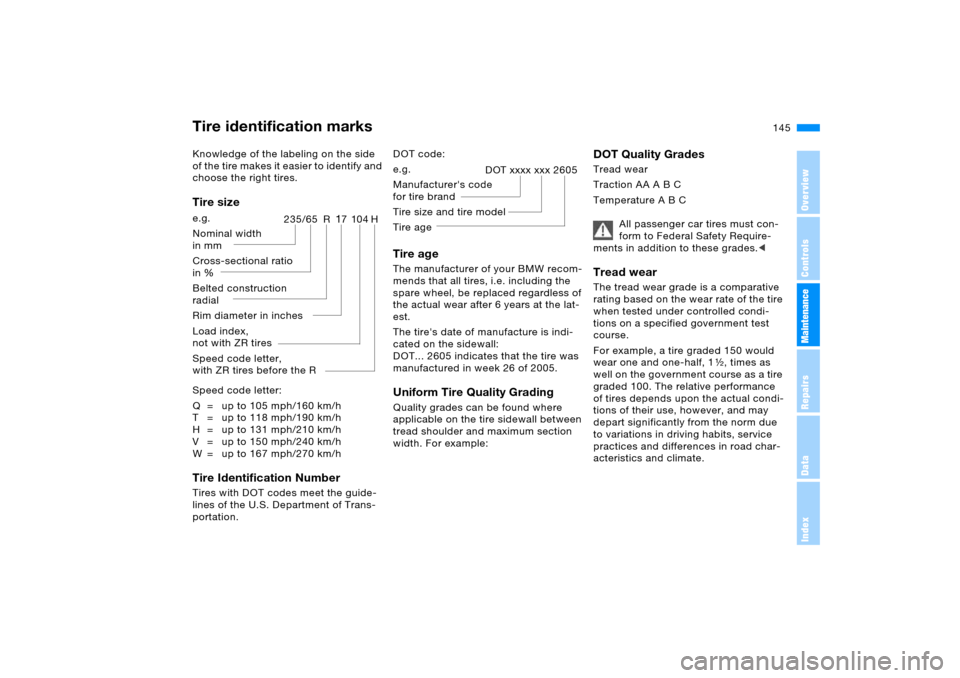
Tire identification marksKnowledge of the labeling on the side
of the tire makes it easier to identify and
choose the right tires.Tire sizeSpeed code letter:
Q = up to 105 mph/160 km/h
T = up to 118 mph/190 km/h
H = up to 131 mph/210 km/h
V = up to 150 mph/240 km/h
W = up to 167 mph/270 km/hTire Identification Number Tires with DOT codes meet the guide-
lines of the U.S. Department of Trans-
portation. e.g.
Nominal width
in mm
Cross-sectional ratio
in Ξ
Belted construction
radial
Rim diameter in inches
Load index,
not with ZR tires
Speed code letter,
with ZR tires before the R
235/65 R
17104H
DOT code: Tire age The manufacturer of your BMW recom-
mends that all tires, i.e. including the
spare wheel, be replaced regardless of
the actual wear after 6 years at the lat-
est.
The tire's date of manufacture is indi-
cated on the sidewall:
DOT... 2605 indicates that the tire was
manufactured in week 26 of 2005. Uniform Tire Quality Grading Quality grades can be found where
applicable on the tire sidewall between
tread shoulder and maximum section
width. For example: e.g.
Manufacturer's code
for tire brand
Tire size and tire model
Tire age
DOT xxxx xxx 2605
DOT Quality Grades Tread wear
Traction AA A B C
Temperature A B C
All passenger car tires must con-
form to Federal Safety Require-
ments in addition to these grades.< Tread wear The tread wear grade is a comparative
rating based on the wear rate of the tire
when tested under controlled condi-
tions on a specified government test
course.
For example, a tire graded 150 would
wear one and one-half, 1γ, times as
well on the government course as a tire
graded 100. The relative performance
of tires depends upon the actual condi-
tions of their use, however, and may
depart significantly from the norm due
to variations in driving habits, service
practices and differences in road char-
acteristics and climate.
Page 147 of 202
147n
OverviewControlsMaintenanceRepairsDataIndex
Wheel/tire conditionTire tread The tread depth should not fall below
0.12 in/3 mm although, for example,
European regulations only require a
minimum tread depth of 0.063 in/
1.6 mm.
At tread depths below 0.12 in/3 mm,
there is an increased risk of high-speed
hydroplaning, even when only small
amounts of water are present on the
road surface.
As winter tires display a noticeable
loss in their ability to cope with cold-
weather driving conditions once the
tread wears to below 0.16 in/4 mm, you
should always have such tires replaced
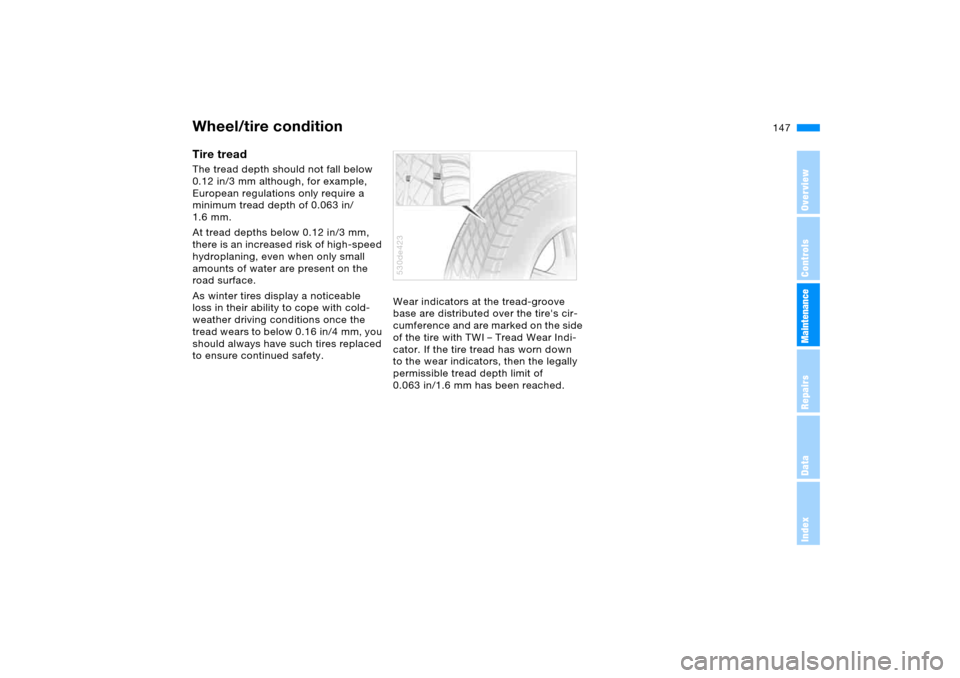
to ensure continued safety.Wear indicators at the tread-groove
base are distributed over the tire's cir-
cumference and are marked on the side
of the tire with TWI – Tread Wear Indi-
cator. If the tire tread has worn down
to the wear indicators, then the legally
permissible tread depth limit of
0.063 in/1.6 mm has been reached.
530de423
Page 149 of 202
149n
OverviewControlsMaintenanceRepairsDataIndex
Replacing wheels/tires Snow chains
*
Special features of winter tires BMW recommends winter tires for use
in cold winter driving conditions.
Although all-season M+S tires provide
better winter traction than summer
tires, they generally fail to provide the
same levels of cold-weather perfor-
mance as winter tires.
When switching to winter tires, observe
the description under Tire condition,
page146, and Replacing wheels/tires.
Observing speed ratings:
Never exceed the maximum
speed for which the winter tires
are rated. Unprofessional attempts by
laymen to service tires can lead to dam-
age and accidents. Have this work per-
formed by skilled professionals only.
The technicians at your BMW Sports
Activity Vehicle center will be glad to
assist you with the required profes-
sional knowledge and specialized
equipment.<
Storage Store wheels or tires in a cool, dry
place, protecting them against light
whenever possible. Always protect tires
against all contact with oil, grease and
fuels.
Do not exceed the maximum tire infla-
tion pressure indicated on the side wall
of the tire.Only certain fine-link snow chains are
tested, classified as road-safe, and rec-
ommended by BMW. Consult your
BMW Sports Activity Vehicle center for
details. Use is only permitted in pairs on
the rear wheels with the following tire
sizes:
X5 4.8is: 255/55 R 18
All other models: 235/65 R 17
Follow the manufacturer's instructions
when installing snow chains. Do not
exceed a maximum speed of 30 mph/
50 km/h.
Do not initialize the Flat Tire Moni-
tor after mounting snow chains, as
the monitor may then incorrectly indi-
cate flat tires.
When you are driving with snow chains,
it can be beneficial to switch off DSC
briefly, refer to page93.<