maintenance BMW X5 3.0I 2006 E53 Manual Online
[x] Cancel search | Manufacturer: BMW, Model Year: 2006, Model line: X5 3.0I, Model: BMW X5 3.0I 2006 E53Pages: 202, PDF Size: 4.13 MB
Page 151 of 202
151n
OverviewControlsMaintenanceRepairsDataIndex
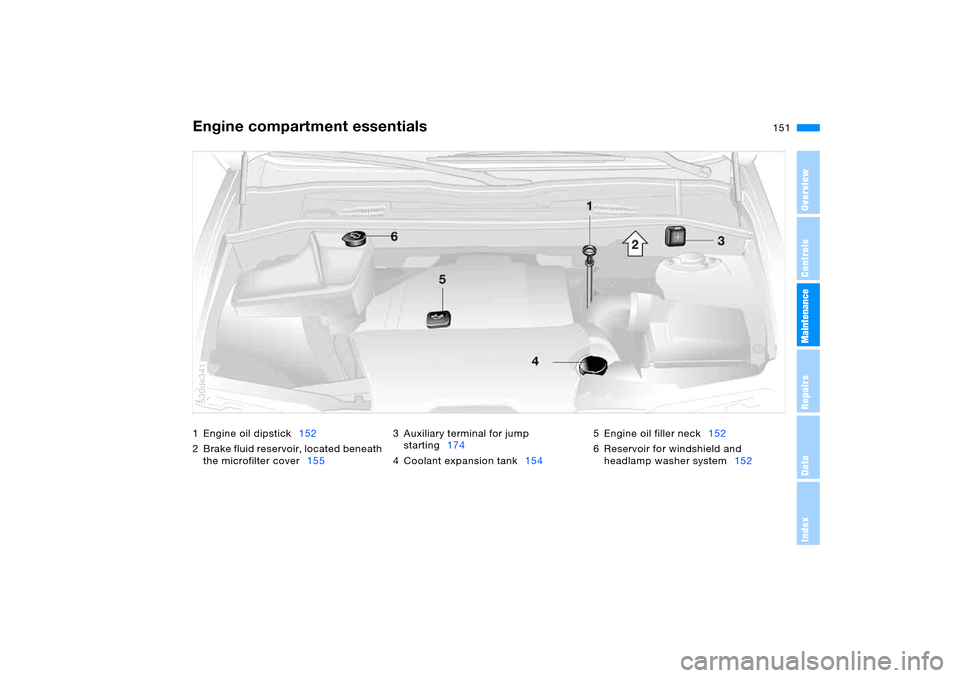
1Engine oil dipstick152
2 Brake fluid reservoir, located beneath
the microfilter cover1553 Auxiliary terminal for jump
starting174
4 Coolant expansion tank1545 Engine oil filler neck152
6 Reservoir for windshield and
headlamp washer system152Engine compartment essentials
530de341
Page 153 of 202
153n
OverviewControlsMaintenanceRepairsDataIndex
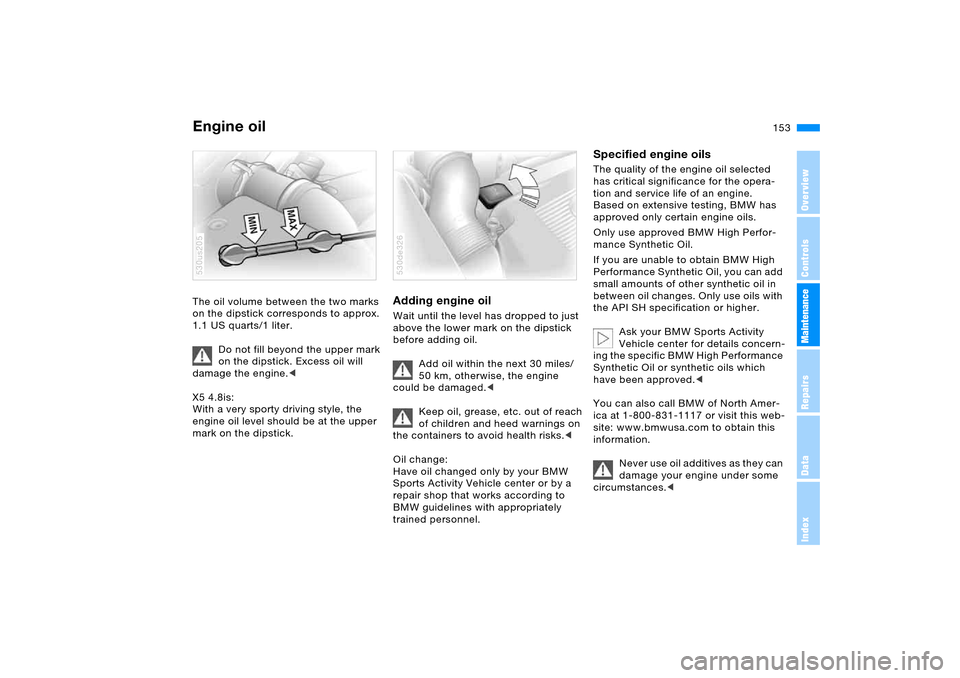
Engine oil The oil volume between the two marks
on the dipstick corresponds to approx.
1.1 US quarts/1 liter.
Do not fill beyond the upper mark
on the dipstick. Excess oil will
damage the engine.<
X5 4.8is:
With a very sporty driving style, the
engine oil level should be at the upper
mark on the dipstick.530us205
Adding engine oil Wait until the level has dropped to just
above the lower mark on the dipstick
before adding oil.
Add oil within the next 30 miles/
50 km, otherwise, the engine
could be damaged.<
Keep oil, grease, etc. out of reach
of children and heed warnings on
the containers to avoid health risks.<
Oil change:
Have oil changed only by your BMW
Sports Activity Vehicle center or by a
repair shop that works according to
BMW guidelines with appropriately
trained personnel.530de326
Specified engine oils The quality of the engine oil selected
has critical significance for the opera-
tion and service life of an engine.
Based on extensive testing, BMW has
approved only certain engine oils.
Only use approved BMW High Perfor-
mance Synthetic Oil.
If you are unable to obtain BMW High
Performance Synthetic Oil, you can add
small amounts of other synthetic oil in
between oil changes. Only use oils with
the API SH specification or higher.
Ask your BMW Sports Activity
Vehicle center for details concern-
ing the specific BMW High Performance
Synthetic Oil or synthetic oils which
have been approved.<
You can also call BMW of North Amer-
ica at 1-800-831-1117 or visit this web-
site: www.bmwusa.com to obtain this
information.
Never use oil additives as they can
damage your engine under some
circumstances.<
Page 155 of 202
155n
OverviewControlsMaintenanceRepairsDataIndex
Coolant Brake fluid4. When necessary, slowly add coolant
until the correct level is reached; do
not overfill.
5. Close the cap and tighten snugly.
6. Have the cause of the coolant loss
corrected as soon as possible.
Brake fluid level
If the warning lamp lights up
or
the message CHECK BRAKE
FLUID appears in the Check
Control: stop immediately. The
brake fluid in the reservoir has
fallen to below the minimum
level.
Add brake fluid The brake fluid reservoir is located
under the microfilter housing trim panel
on the driver's side of the vehicle. For
adding brake fluid or for determining
and correcting the cause of brake fluid
loss, consult your BMW Sports Activity
Vehicle center. Your BMW Sports Activ-
ity Vehicle center is familiar with the
specifications for factory-approved
DOT 4 brake fluids.
Brake fluid loss may result in extended
brake pedal travel. For this situation,
refer to the notes on page140.
Brake fluid is hygroscopic, that is,
it absorbs moisture from the air
over time.
In order to ensure the safety and reli-
ability of the brake system, have the
brake fluid changed every two years by
a BMW Sports Activity Vehicle center.
Refer also to the Service and Warranty
Information Booklet for US models or
the Warranty and Service Guide Book-
let for Canadian models.
Brake fluid is toxic and also damages
vehicle paintwork. Always store these
agents in tightly-closed original con-
tainers kept well away from the reach of
children.
Do not spill the fluid and do not refill the
brake fluid reservoir to beyond the MAX
mark. The brake fluid could ignite upon
contact with hot engine parts and cause
serious burns.<
Always observe all applicable
environmental rules and regula-
tions when disposing of used brake
fluid.<
Page 156 of 202
156n
The BMW Maintenance System helps
maintain the road and driving safety of
your BMW.
Please keep in mind that regular main-
tenance is not only necessary for the
safety of your vehicle, but also plays a
significant role in maintaining the resale
value of the vehicle.
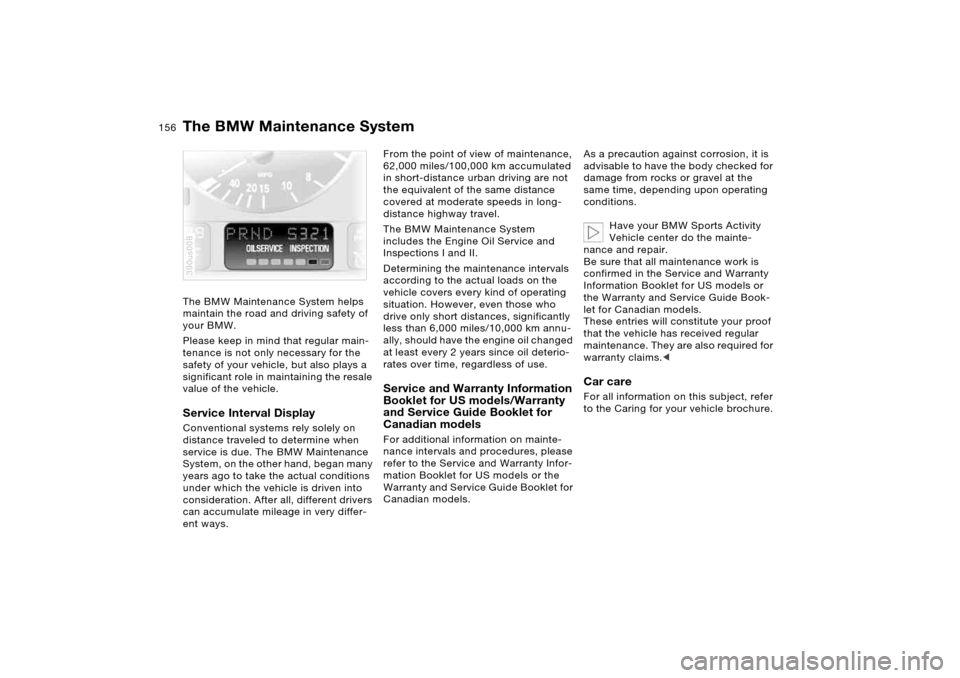
Service Interval Display Conventional systems rely solely on
distance traveled to determine when
service is due. The BMW Maintenance
System, on the other hand, began many
years ago to take the actual conditions
under which the vehicle is driven into
consideration. After all, different drivers
can accumulate mileage in very differ-
ent ways.390us008
From the point of view of maintenance,
62,000 miles/100,000 km accumulated
in short-distance urban driving are not
the equivalent of the same distance
covered at moderate speeds in long-
distance highway travel.
The BMW Maintenance System
includes the Engine Oil Service and
Inspections I and II.
Determining the maintenance intervals
according to the actual loads on the
vehicle covers every kind of operating
situation. However, even those who
drive only short distances, significantly
less than 6,000 miles/10,000 km annu-
ally, should have the engine oil changed
at least every 2 years since oil deterio-
rates over time, regardless of use. Service and Warranty Information
Booklet for US models/Warranty
and Service Guide Booklet for
Canadian models For additional information on mainte-
nance intervals and procedures, please
refer to the Service and Warranty Infor-
mation Booklet for US models or the
Warranty and Service Guide Booklet for
Canadian models. As a precaution against corrosion, it is
advisable to have the body checked for
damage from rocks or gravel at the
same time, depending upon operating
conditions.
Have your BMW Sports Activity
Vehicle center do the mainte-
nance and repair.
Be sure that all maintenance work is
confirmed in the Service and Warranty
Information Booklet for US models or
the Warranty and Service Guide Book-
let for Canadian models.
These entries will constitute your proof
that the vehicle has received regular
maintenance. They are also required for
warranty claims.<
Car careFor all information on this subject, refer
to the Caring for your vehicle brochure.
The BMW Maintenance System
Page 157 of 202
157n
OverviewControlsMaintenanceRepairsDataIndex
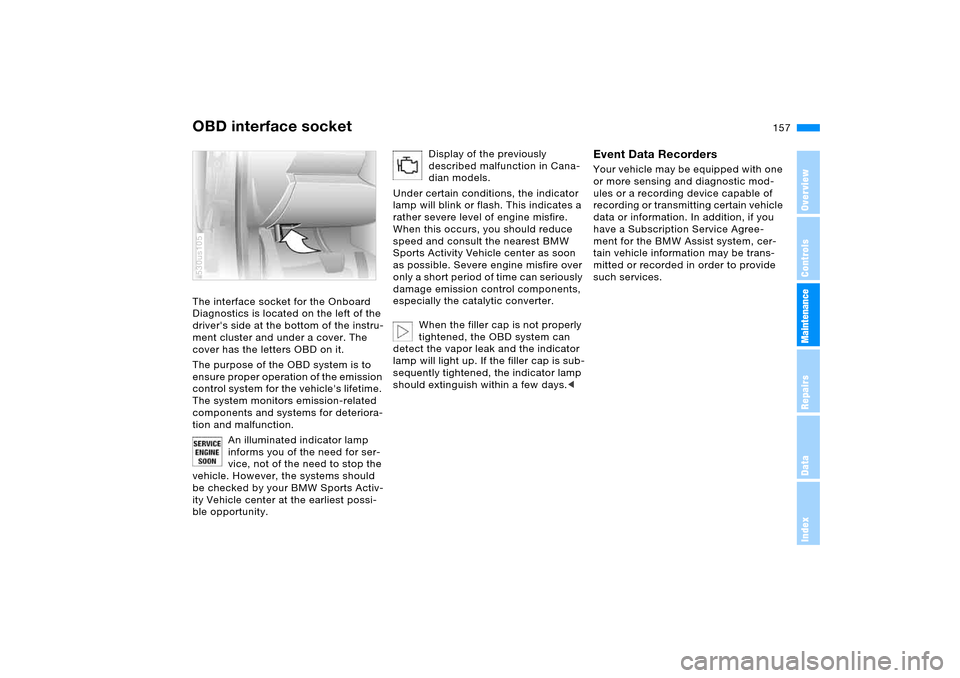
OBD interface socketThe interface socket for the Onboard
Diagnostics is located on the left of the
driver's side at the bottom of the instru-
ment cluster and under a cover. The
cover has the letters OBD on it.
The purpose of the OBD system is to
ensure proper operation of the emission
control system for the vehicle's lifetime.
The system monitors emission-related
components and systems for deteriora-
tion and malfunction.
An illuminated indicator lamp
informs you of the need for ser-
vice, not of the need to stop the
vehicle. However, the systems should
be checked by your BMW Sports Activ-
ity Vehicle center at the earliest possi-
ble opportunity. 530us105
Display of the previously
described malfunction in Cana-
dian models.
Under certain conditions, the indicator
lamp will blink or flash. This indicates a
rather severe level of engine misfire.
When this occurs, you should reduce
speed and consult the nearest BMW
Sports Activity Vehicle center as soon
as possible. Severe engine misfire over
only a short period of time can seriously
damage emission control components,
especially the catalytic converter.
When the filler cap is not properly
tightened, the OBD system can
detect the vapor leak and the indicator
lamp will light up. If the filler cap is sub-
sequently tightened, the indicator lamp
should extinguish within a few days.<
Event Data Recorders Your vehicle may be equipped with one
or more sensing and diagnostic mod-
ules or a recording device capable of
recording or transmitting certain vehicle
data or information. In addition, if you
have a Subscription Service Agree-
ment for the BMW Assist system, cer-
tain vehicle information may be trans-
mitted or recorded in order to provide
such services.
Page 159 of 202
159n
OverviewControlsMaintenanceRepairsDataIndex
Overview
Controls and features
Operation, maintenance
Owner service procedures
Index Technical data
Repairs
Page 161 of 202
161n
OverviewControlsMaintenanceRepairsDataIndex
Lamps and bulbs The lamps and bulbs make essential
contributions to the safety of your vehi-
cle. For this reason, follow the instruc-
tions below carefully when replacing a
bulb. If you are not familiar with any of
the procedures, consult your BMW
Sports Activity Vehicle center.
Never touch the glass on new
bulbs with your bare fingers, as
even minute amounts of contamination
will burn into the bulb's surface and
reduce its service life. Use a clean
cloth, paper napkin, or a similar mate-
rial, or hold the bulb by its metallic
base.<
A replacement bulb set is available from
your BMW Sports Activity Vehicle cen-
ter.
To prevent short circuits, before
working on any electrical system,
equipment or accessory you should
always switch it off and disconnect the
cable from the battery's negative termi-
nal before starting.
To avoid possible injury or equipment
damage when replacing bulbs, follow
any instructions provided by the bulb
manufacturer.<
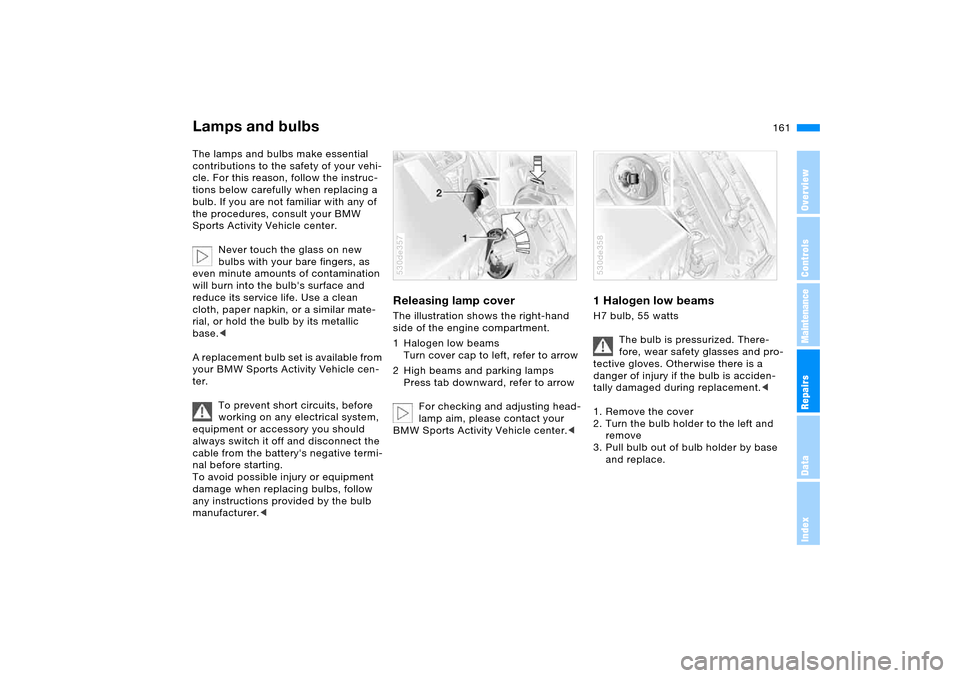
Releasing lamp cover The illustration shows the right-hand
side of the engine compartment.
1 Halogen low beams
Turn cover cap to left, refer to arrow
2 High beams and parking lamps
Press tab downward, refer to arrow
For checking and adjusting head-
lamp aim, please contact your
BMW Sports Activity Vehicle center.< 530de357
1 Halogen low beams H7 bulb, 55 watts
The bulb is pressurized. There-
fore, wear safety glasses and pro-
tective gloves. Otherwise there is a
danger of injury if the bulb is acciden-
tally damaged during replacement.<
1. Remove the cover
2. Turn the bulb holder to the left and
remove
3. Pull bulb out of bulb holder by base
and replace.530de358
Page 163 of 202
163n
OverviewControlsMaintenanceRepairsDataIndex
Lamps and bulbs Front fog lamps H11 bulb, 55 watts
The bulb is pressurized. There-
fore, wear safety glasses and pro-
tective gloves. Otherwise there is a
danger of injury if the bulb is acciden-
tally damaged during replacement.<
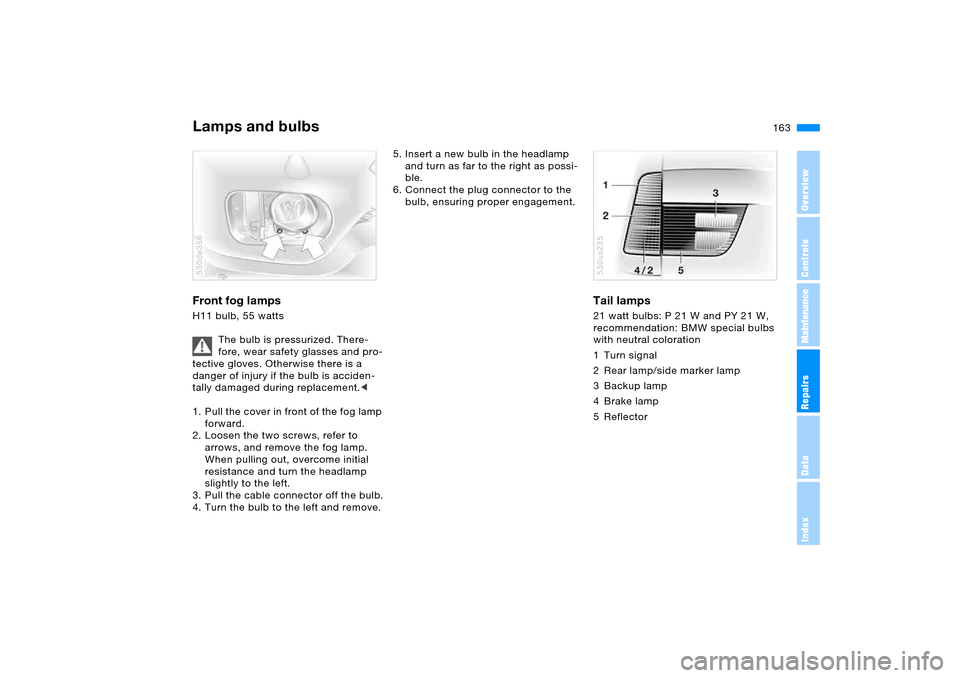
1. Pull the cover in front of the fog lamp
forward.
2. Loosen the two screws, refer to
arrows, and remove the fog lamp.
When pulling out, overcome initial
resistance and turn the headlamp
slightly to the left.
3. Pull the cable connector off the bulb.
4. Turn the bulb to the left and remove.530de356
5. Insert a new bulb in the headlamp
and turn as far to the right as possi-
ble.
6. Connect the plug connector to the
bulb, ensuring proper engagement.
Tail lamps 21 watt bulbs: P 21 W and PY 21 W,
recommendation: BMW special bulbs
with neutral coloration
1 Turn signal
2 Rear lamp/side marker lamp
3 Backup lamp
4Brake lamp
5Reflector 530us235
Page 165 of 202
165n
OverviewControlsMaintenanceRepairsDataIndex
Lamps and bulbs Changing a wheel Light-emitting diodes LEDs Light-emitting diodes installed behind
translucent lenses serve as the light
source for many of the controls and dis-
plays in your vehicle. The concept
behind their operation is related to that
employed for lasers.
Do not remove the covers, and
never stare into the unfiltered light
several hours, as irritation of the retina
could result.<
Safety precautions to observe in
the event of a flat and during all
tire changes:
Park the vehicle as far as possible from
passing traffic. Park on a firm, flat, sur-
face. Switch on the hazard warning
flashers.
Turn the steering wheel to the straight-
ahead position, remove the key and
engage the steering lock. Shift into 1st
or reverse, selector lever in Park with
automatic transmission, and engage the
handbrake.
All passengers should be outside the
vehicle and well away from your imme-
diate working area, behind a guardrail,
for instance.
If a warning triangle or portable hazard
warning lamp is required, set it up on
the roadside at an appropriate distance
from the rear of the vehicle. Comply
with all safety guidelines and regula-
tions.
Change the wheel only on a level, firm
surface that is not slippery. The vehicle
or the jack could slip to the side if you
attempt to raise the vehicle on a soft
or slippery surface such as snow, ice,
tiles, etc.
Position the jack on a firm support sur-
face.
Do not place wooden blocks or similar
objects under the jack. If this is done,
the jack might not be able to reach its
full support capacity because of the
limited height. To avoid serious or fatal
injury: never lie under the vehicle, and
never start the engine while it is sup-
ported by the jack.<
Your BMW has either a compact wheel
for temporary use to ensure your mobil-
ity, or a spare wheel of the size 235/
65 R 17. Please observe the differences
in handling when removing the wheel
from the cargo area.
Page 167 of 202
167n
OverviewControlsMaintenanceRepairsDataIndex
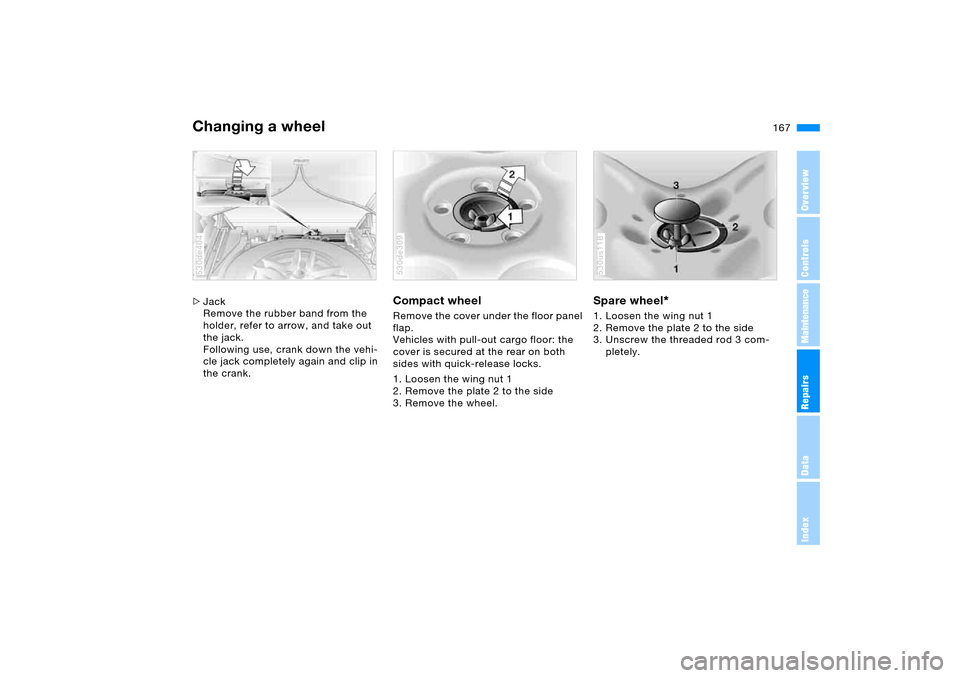
Changing a wheel >Jack
Remove the rubber band from the
holder, refer to arrow, and take out
the jack.
Following use, crank down the vehi-
cle jack completely again and clip in
the crank.530de404
Compact wheel Remove the cover under the floor panel
flap.
Vehicles with pull-out cargo floor: the
cover is secured at the rear on both
sides with quick-release locks.
1. Loosen the wing nut 1
2. Remove the plate 2 to the side
3. Remove the wheel.530de309
Spare wheel
*
1. Loosen the wing nut 1
2. Remove the plate 2 to the side
3. Unscrew the threaded rod 3 com-
pletely. 530us118