brake light BMW X5 4.4I 2000 User Guide
[x] Cancel search | Manufacturer: BMW, Model Year: 2000, Model line: X5 4.4I, Model: BMW X5 4.4I 2000Pages: 201, PDF Size: 1.93 MB
Page 118 of 201

118n
General driving notes Catalytic converter
Brakes:
Do not drive with your foot resting
on the brake pedal. Even light but con-
sistent pedal pressure can lead to high
temperatures, brake wear and possibly
even brake failure.
Aquaplaning:
When driving on wet or slushy roads,
reduce vehicle speed. If you do not, a
wedge of water may form between the
tires and the road surface. This phe-
nomenon is referred to as aquaplaning
or hydroplaning. It is characterized by a
partial or complete loss of contact be-
tween the tires and the road surface.
The ultimate results are loss of steering
and braking control.
Cargo area cover:
Do not place heavy or hard objects on
the cargo area cover. These objects
could endanger vehicle occupants dur-
ing heavy brake applications or evasive
maneuvers.
Clothes hooks:
When suspending articles of clothing
from the hooks, be sure that they will
not obstruct the driver's vision. Do not
hang heavy objects on the hooks. If you
do so, they could cause personal injury
during braking or evasive maneuvers.< The catalytic converter reduces harmful
exhaust emissions.
It is designed for use with unleaded fuel
only. Even minute quantities of lead
would be enough to permanently dam-
age both the catalytic converter and the
system oxygen sensor.
To ensure efficient, trouble-free engine
operation and avoid potential damage:
>Be sure to comply with the scheduled
maintenance requirements.
>Fill the fuel tank well before it is
empty.
>When the battery is discharged, start
the engine with an outside starting
aid.
>Avoid other situations in which the
fuel is not burned, or burns incom-
pletely, such as engaging the starter
frequently or for extended periods, or
repeated start attempts in which the
engine does not start (stopping and
restarting an engine which is running
properly does not present a problem).
Never allow the engine to run with
any of the spark plug cables discon-
nected.
Page 122 of 201

122n
Disc brakes Disc brakes furnish optimum decelera-
tion and braking control and greater
fade resistance under heavy use.
When the vehicle is driven only occa-
sionally, during extended periods when
the vehicle is not used at all, and in op-
erating conditions where brake applica-
tions are less frequent, there is an in-
creased tendency for corrosion of the
rotors and accumulation of contamina-
tion on the brake pads. This occurs be-
cause the minimal pressure which must
be exerted by the pads to clean the ro-
tors by brake applications is not
reached.
If the brake rotors are corroded, they
will tend to respond to braking with a
pulsating effect which even extended
application will fail to cure.
For your own safety: use only
brake pads that BMW has re-
leased for your particular vehicle
model. BMW cannot evaluate non-ap-
proved brake pads to determine if they
are suited for use, and therefore cannot
ensure the operating safety of the vehi-
cle if they are installed.<
Driving notes When driving in wet conditions and in
heavy rain, it is advisable to apply light
pressure to the brake pedal every few
miles (kilometers). Watch traffic condi-
tions to ensure that this maneuver does
not endanger other road users. The
heat which is generated by the brake
applications helps to dry the brake
pads and rotors.
Maximum braking force is obtained
while the wheels continue to rotate,
peaking when the wheels remain on the
verge of locking without actually doing
so. ABS maintains this state automati-
cally. If the ABS fails, you should revert
to the staggered braking technique
(refer to page 124).
Extended or steep mountain descents
do not necessarily have to lead to re-
duced braking efficiency. Move the se-
lector lever to the appropriate lower
range in which only minimal periodic
brake applications are required.
You can increase the engine's braking
effect by selecting progressively lower
gears, downshifting as far as 1st gear,
on steep descents. If engine braking should prove to be in-
adequate, you should still avoid ex-
tended, continuous braking. Instead of
maintaining low to moderate pressure
over an extended period of time, you
should decelerate by applying more
substantial pressure to the brake pedal
(watch for following traffic), then releas-
ing the pedal, then repeating the appli-
cation. This staggered braking tech-
nique allows the brakes to cool in the
intervals between active braking
phases, preventing overheating and en-
suring that full braking capacity remains
available at all times.
Do not coast with the selector le-
ver in ÒNeutralÒ. Do not drive with
the engine shut off. The engine pro-
vides no braking effect when the trans-
mission is in ÒNeutralÒ, and there is no
power-assist for braking or steering
when the engine is not running.
Have brake inspections performed at
an authorized BMW center only. If you
do not, parts of the four-wheel drive
system could be damaged.
Never allow floor mats, carpets or any
other objects to protrude into the area
around the accelerator and brake ped-
als and obstruct their movement.<
Page 125 of 201

IndexDataTechnologyRepairsCar careControlsOverview
125n
Winter operation Power steering Level control system
Skid control Release the accelerator pedal. Coun-
tersteer carefully and attempt to regain
control of the vehicle.Parking Place the selector lever in "Park." and
apply the parking brake when parking
on inclined surfaces. In order to prevent
the parking brake linings from locking
due to frost or corrosion, dry them by
gently applying the parking brake as the
vehicle is coming to a stop. Make sure
that following traffic is not endangered.
The brake lamps do not light up
when the parking brake is ap-
plied.<
If there is a change in steering response
(difficult steering, for example) or, espe-
cially on vehicles with Servotronic
*, if
the steering "drifts" or "floats" at in-
creasing speeds:
Have your authorized BMW center in-
spect this system as soon as possible.
If the power steering fails, in-
creased effort will be required to
steer the vehicle.<
The warning lamp for the level
control system comes on, or the
message LEVEL CONTROL IN-
ACTIVE appears in the Check Control
*:
There is a malfunction in the level con-
trol system.
Stop and inspect the vehicle. If it is
riding significantly lower in the rear than
in the front, or if it is sitting at an incline
(left rear compared to right rear), con-
sult the nearest authorized BMW cen-
ter. Drive with appropriate caution in
the meantime, especially if you are driv-
ing under poor road-surface conditions.
The vehicle has reduced ground clear-
ance or driving comfort is noticeably re-
duced.
Even if the attitude of the vehicle is nor-
mal, you should consult the nearest au-
thorized BMW center if the warning
lamp indicates a system fault.
Page 143 of 201

IndexDataTechnologyRepairsCar careControlsOverview
143n
Caring for your vehicle Washing your vehicle You can have your new BMW washed
in an automatic car wash. Car wash
systems that do not employ brushes
are preferable.
Wipe away tough dirt and loosen and
remove dead insects before washing
the vehicle.
To prevent spots, avoid washing when
the hood is still warm, or immediately
after and during exposure to strong
sunlight.
When using an automatic car wash, be
sure that:
>The car wash system is suited for the
dimensions of your vehicle.
Before washing the vehicle in a
car wash, fold in the exterior mir-
rors manually, otherwise they may be
damaged on account of the width of the
vehicle.<
>No damage will occur on vehicles
with attached body accessories (such
as spoilers or antennas). If you are
uncertain, consult the manager of the
car wash.
>The wheels and tires of your vehicle
cannot be damaged by the convey-
ance devices of the car wash system.
>The vehicle is cleaned with minimum
brush pressure, and that ample water
is available for washing and rinsing.
Vehicles with rain sensor
*:
Clean the windshield regularly. Wax
from automatic car washes or insects,
for example, can cause malfunctions in
the function of the rain sensor.
Turn the rain sensor off in auto-
matic car washes. If you do not,
damage may occur if the wipers switch
on unintentionally.<
Parts of the vehicle that are inaccessi-
ble to the automatic washer Ñ such as
door sills, door and hood edges, etc. Ñ
should be cleaned by hand.
In the winter months, it is especially
important to ensure that the vehicle is
washed on a regular basis. Large quan-
tities of dirt and road salt are difficult to
remove, and they also cause damage to
the vehicle.
If spray wands or high-pressure
washers are used, be sure to
maintain an adequate distance between
the spray source and the vehicle's sur-
face. Inadequate distance and exces-
sive pressure can damage or weaken
the finish, making it more susceptible to
subsequent attack. In addition, mois-
ture could penetrate to vehicle compo-
nents, leading to long-term damage.<
When cleaning the headlamps,
please observe the following:
>Do not clean by wiping with a dry
cloth. Never use abrasives or strong
solvents to clean the covers.
>Remove dirt and contamination (such
as insects) by soaking with BMW Car
Shampoo and then rinsing with plenty
of water.
>Always use a deicer spray to remove
accumulated ice and snow Ð never
use a scraper.<
After washing the vehicle, apply
the brakes briefly to dry them.
Braking efficiency might otherwise be
reduced by the moisture and the brake
rotors could also be corroded.<
Page 172 of 201
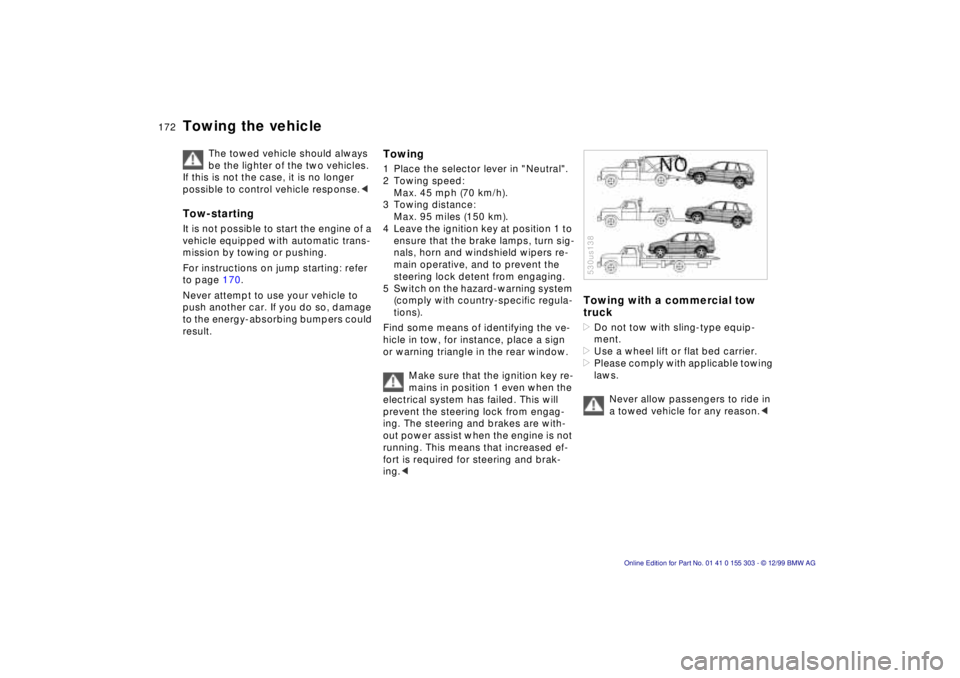
172n
Towing the vehicle
The towed vehicle should always
be the lighter of the two vehicles.
If this is not the case, it is no longer
possible to control vehicle response.<
Tow-starting It is not possible to start the engine of a
vehicle equipped with automatic trans-
mission by towing or pushing.
For instructions on jump starting: refer
to page 170.
Never attempt to use your vehicle to
push another car. If you do so, damage
to the energy-absorbing bumpers could
result.
Towing 1 Place the selector lever in "Neutral".
2 Towing speed:
Max. 45 mph (70 km/h).
3 Towing distance:
Max. 95 miles (150 km).
4 Leave the ignition key at position 1 to
ensure that the brake lamps, turn sig-
nals, horn and windshield wipers re-
main operative, and to prevent the
steering lock detent from engaging.
5 Switch on the hazard-warning system
(comply with country-specific regula-
tions).
Find some means of identifying the ve-
hicle in tow, for instance, place a sign
or warning triangle in the rear window.
Make sure that the ignition key re-
mains in position 1 even when the
electrical system has failed. This will
prevent the steering lock from engag-
ing. The steering and brakes are with-
out power assist when the engine is not
running. This means that increased ef-
fort is required for steering and brak-
ing.<
Towing with a commercial tow
truck >Do not tow with sling-type equip-
ment.
>Use a wheel lift or flat bed carrier.
>Please comply with applicable towing
laws.
Never allow passengers to ride in
a towed vehicle for any reason.< 530us138
Page 192 of 201

Everything from A to ZAABS (Antilock Brake
System)119
Accessories6
Activated-charcoal filter95
Adaptive Transmission
Control (ATC)176
Adding engine oil137
Adding washer fluid136
Adjusting seats48
Adjusting the steering
wheel51
Adjusting the
temperature92
Air conditioner93
Air distribution92
Air nozzles90
Air outlets90
Air pressure30, 127
Air supply93
Airbags23, 57, 148, 176
Alarm system43
Antennas126
Antifreeze140
Antifreeze, radiator123
Antilock Brake System
(ABS)119
Anti-theft alarm system43
Anti-theft protection37
Approved gross vehicle
weight186
Aquaplaning118, 127
Ashtray103AUC (Automatic recirculated
air control)93
Automatic car washes143
Automatic climate
control90
Removing condensation
from the windows93
Automatic cruise control72
Automatic curb monitor54
Automatic dimming, interior
rearview mirror53
Automatic recirculated air
control (AUC)93
Automatic steering wheel
adjustment52
Automatic transmission with
Steptronic66
Average fuel
consumption80
Average speed80
Axle loads186
BBackup lamps67
Bulb replacement157
Battery165, 188
Capacity188
Charge166
Discharged170
Belts56
Beverage holder102
Blower93
BMW comfort seat50BMW High Performance
Synthetic Oil138
BMW sports seat50
BMW Universal
Transmitter98
Body-cavity protectant144
Brake fluid141
Brake hydraulic system22
Brake lamps, bulb
replacement157
Brake pads24
Brakes122
Malfunctions123
Break-in procedures116
Bulb replacement155
CCapacities187
Car Memory55
Car radio
reception126, 178
Car wash143
Care, exterior144
Care, interior146
Cargo area42, 107
Capacity186
Opening from the
inside41
Cargo area cover107
Cargo area lamps87
Cargo floor, pull-out111
Cargo loading112Caring for the vehicle
finish145
Catalytic converter118
CBC (Cornering Brake
Control)120
Cellular phones102, 126
refer to the separate
Owner's Manual
Center (high-mount) brake
lamp157
Central locking system36
Button40
Changing a tire160
Changing a wheel160
Charge indicator lamp22
Check air pressure30
CHECK button77
Check Control77
Check engine oil level137
Checking tire pressure30
Child restraint systems57
Child's seat57
Child-safety locks62
Cigarette lighter103
Clean the windshield70
Climate control in the rear
passenger area94
Clock, refer to the Radio or
Onboard Computer
Owner's Manual
Cockpit16
Code, refer to the Radio
Owner's Manual126
Page 193 of 201

Everything from A to Z
193n
IndexDataTechnologyRepairsCar careControlsOverview
Cold start64
Comfort seat50
Compartments101
Computer80
Configuring the settings55
Contamination on
paintwork144
Convenience operation of
windows and sliding/tilt
sunroof36
Convenience starting
feature64
Coolant123, 140
Coolant, antifreeze123
Cornering Brake Control
(CBC)120
Cruise control72
Cup holder102
Curb weight186DDashboard16
Data link connector for On-
Board Diagnostics150
Date, refer to the Radio or
Onboard Computer
Owner's Manual
Daytime-driving lamp86
DBC (Dynamic Brake
Control)24, 120Deep water117
Defrosting the windows93
Digital clock, refer to the
Radio or Onboard
Computer Owner's Manual
Digital sound processor179
Dimensions185
Dipstick, engine oil137
Disc brakes122
Displacement184
Display lighting86
Displays18, 20
Distance warning82
Diversity Antenna
system178
Divided rear backrest107
Door keys34
Door locks, care123
Doors
Manual operation36
Remote control38
Unlocking and locking36
Drive belts188
Driving through water117
Driving your BMW X5117
DSC (Dynamic Stability
Control)24, 83, 177
DSP amplifier, refer to the
Radio Owner's ManualDynamic Brake Control
(DBC)24, 120
Dynamic Stability Control
(DSC)24, 83, 177
EEBV (Electronic Brake Force
Distribution)120
Electric power windows45
Electrical malfunction
Fuel filler door168
Liftgate168
Sliding/Tilt sunroof168
Tailgate169
Electrical system188
Electronic Brake Force
Distribution (EBV)120
Electronic immobilizer35
Elements of operation16
Emergency operation
Doors36
Fuel filler door168
Sliding/Tilt sunroof168
Tailgate168
Energy Control75
Engine compartment134
Engine coolant140
Engine knock control30
Engine oil consumption137
Engine oil grades138
Engine oil level24Engine oil pressure22
Engine output184
Engine specifications184
Error indicators77
Exterior finish144
Exterior mirrors52
FFailure of an electrical
accessory167
Failure warnings77
Filler cap cover29
First-aid kit28
Fittings, tow-starting and
towing171
Flashlight101
Flat tire127, 160
Fog lamps87
Bulb replacement156
Folding rear backrest107
Footbrake122
Footwell lamps88
Bulb replacement158
Front area lighting88
Front fog lamps87
Front seat adjustment48
Frost protection,
radiator140
Fuel30
Fuel capacity187
Fuel display75
Page 194 of 201

Everything from A to ZFuel filler door release after
electrical fault168
Fuel gauge75
Fuel quality30
Fuel tank capacity187
Fuses167GGarage-door opener98
Gasoline30
General driving notes118
Glasses compartment102
Glove compartment101
Glove compartment lamp,
bulb replacement159
Gross vehicle weight186
Ground clearance117HHandbrake65
Handsfree system102
Hazard warning flashers28
Hazard warning triangle28
HDC (Hill Descent
Control)84
Head restraints49
Headlamp covers,
care143, 155
Headlamp flasher69
Headlamp washer
system136Headlamp washers70
Heated steering wheel96
Heating and ventilation90
Heating while stopped94
Heavy cargo112
Height185
Height adjustment, seats48
Height adjustment, steering
wheel51
HiFi system179
High beams25, 87
Bulb replacement155
Hill Descent Control
(HDC)84
Hood release133
Horn26, 27
Hydraulic Brake Assistant
refer to DBC24, 120
IIce warning74
Identification number141
Identification, tires130
Ignition key34
Ignition lock63
Independent ventilation97
Indicator lamps22
Inflation pressure31, 127
INSPECTION76
Instrument cluster18, 20
Instrument lighting86Instrument panel20
Instruments18
Integrated rear axle180
Interference indicators77
Interference, cellular
phone126
Interior and exterior rearview
mirrors, automatic
dimming feature53
Interior lamps87
Bulb replacement158
Remote control38
Interior mirror53
Interior motion sensor44
Interior rearview mirror,
automatic dimming
feature179
Interlock63
Intermittent switch69
JJump-starting170KKey Memory55
Keys34
Keys with radio remote
control34
Kickdown67
LLashing eyes42, 112
Leather care147
Length185
Level control
system24, 125, 181
License plate lamp, bulb
replacement158
Liftgate42, 168
Light switch86
Light-alloy wheel132
Lighter103
Lights-on warning86
Load-securing devices112
Louvers90
Low beams86
Bulb replacement155
Low-fuel warning lamp75
Lug bolts163
Lug wrench160
Luggage net42
Luggage space42
Luggage straps42
Lumbar support49MM+S tires131
Maintenance76, 142
Manual operation
Doors36
Liftgate168
Sliding/Tilt sunroof168
Tailgate169
Page 195 of 201

Everything from A to Z
195n
IndexDataTechnologyRepairsCar careControlsOverview
Master key34
Memory54
Microfilter95
MID (Multi-Information
Display), refer to the Radio
Owner's Manual
Mirror52
Mirror defrosting52
Mirror memory54
Mobile phones126
Modifications,
technical6, 149
Multifunction steering
wheel26
Multi-Information Display
(MID), refer to the Radio
Owner's ManualNNavigation system, refer to
the separate Owner's
ManualOOBD interface socket150
Odometer74
Oil additives137
Oil change interval, see the
Service and Warranty
Information Booklet (US
models) or the Warranty
and Service Guide Booklet
(Canadian models)Oil consumption137
Oil dipstick137
Oil grades138
Oil level, indicator
lamp23, 24
Oil pressure, indicator
lamp22
OILSERVICE76
Onboard computer80
refer also to the Onboard
computer Owner's Manual
Onboard monitor
refer to the separate
Owner's Manual
Onboard tool kit154
Opening and closing
From the inside40
From the outside36
Operating range80
Outlets, ventilation90
Output184
Outside temperature
display74
Outside temperature in the
onboard computer80
PPaintwork, minor
repairs145
Paintwork, waxing145
Park Distance Control
(PDC)82
Parking aid82Parking brake23, 65
Parking in the winter125
Parking lamps87
Passenger side mirror tilt
function54
PDC (Park Distance
Control)82
Playing cassettes, refer to
the Radio Owner's
Manual126
Playing CDs, refer to the
Radio Owner's
Manual126
"Please wear your safety
belt" warning lamp23
Pocket flashlight101
Pollen95
Poor driving conditions117
Power rear-seat
backrests51
Power seat48
Power steering125
Power windows45
Safety switch46
Pressure, tires127
Pre-warmed seats96
Pull-out cargo floor111
RRadio reception126, 178
Radio, refer to the Radio
Owner's Manual126
Reading lamps88
Rear backrests, folding
down107
Rear lamps157
Rear passenger area climate
control94
Rear seats, power51
Rear view mirror52
Rear window
defroster71, 94
Rear window wiper71
Rear window wiper, wiper
blade replacement154
Rear-seat backrest, folding
down107
Rear-seat backrests,
power51
Recirculated air mode93
Reclining seat48
Refueling29
Remote control37
Removing condensation
from the windows93
Replacement key34
Replacement of tires128
Reservoir, washer
system136
Residual heat94