ESP BMW X5 4.4I 2000 Owners Manual
[x] Cancel search | Manufacturer: BMW, Model Year: 2000, Model line: X5 4.4I, Model: BMW X5 4.4I 2000Pages: 201, PDF Size: 1.93 MB
Page 6 of 201

6n
For your own safety
Use unleaded gasoline only. Fuels
containing up to and including
10 % Ethanol or other oxygenates with
up to 2.8 % oxygen by weight (that is,
15 % MTBE or 3 % methanol plus an
equivalent amount of co-solvent) will
not void the applicable warranties re-
specting defects in materials or work-
manship. Field experience has indi-
cated significant differences in fuel
quality (volatility, composition, addi-
tives, etc.) among gasolines offered for
sale in the United States and Canada.
The use of poor quality fuels may result
in driveability, starting and stalling
problems especially under certain envi-
ronmental conditions such as high am-
bient temperature and high altitude.
Should you encounter driveability prob-
lems which you suspect could be re-
lated to the fuel you are using, we rec-
ommend that you respond by switching
to a recognized high-quality brand.
Failure to comply with these recom-
mendations may result in unscheduled
maintenance.
Follow the relevant safety rules when
you are handling gasoline.
<
Important safety information.
For your own safety, use genuine parts
and accessories approved by BMW.
When you purchase accessories tested
and approved by BMW and Original
BMW Parts, you simultaneously acquire
the assurance that they have been thor-
oughly tested by BMW to ensure opti-
mum performance when installed on
your vehicle.
BMW warrants these parts to be free
from defects in material and workman-
ship.
BMW will not accept any liability for
damage resulting from installation of
parts and accessories not approved by
BMW.
BMW cannot test every product from
other manufacturers to verify if it can be
used on a BMW safely and without risk
to either the vehicle, its operation, or its
occupants.
Original BMW Parts, BMW Accessories
and other products approved by BMW,
together with professional advice on
using these items, are available from all
BMW centers.
Installation and operation of non-BMW
approved accessories such as alarms,
radios, amplifiers, radar detectors,
wheels, suspension components, brake
dust shields, telephones (including op-
eration of any portable cellular phone
from within the vehicle without using an
externally mounted antenna) or trans-
ceiver equipment (for instance, CBs,
walkie-talkie, ham radio or similar ac-
cessories) may cause extensive dam-
age to the vehicle, compromise its
safety, interfere with the vehicle's elec-
trical system or affect the validity of the
BMW Limited Warranty. See your au-
thorized BMW center for additional in-
formation.
<
Maintenance, replacement, or
repair of the emission control de-
vices and systems may be performed
by any automotive repair establishment
or individual using any certified auto-
motive part.
<
Symbol on vehicle parts
Indicates that you should consult
the relevant section of this
Owner's Manual for information on a
particular part or assembly.
For your own safety
Page 22 of 201
22n
Indicator and warning lamps
Technology that monitors itself
Many of the systems of your BMW
monitor themselves automatically, both
during engine starts and while you are
driving. Indicator and warning lamps
that are identified by "
l
" are tested for
proper functioning whenever the igni-
tion key is turned. They each light up
once for different periods of time.
If a fault should occur in one of these
systems, the corresponding lamp does
not go out after the engine is started or
it lights up while the vehicle is moving.
You will see how to react to this below.
Red: stop immediately
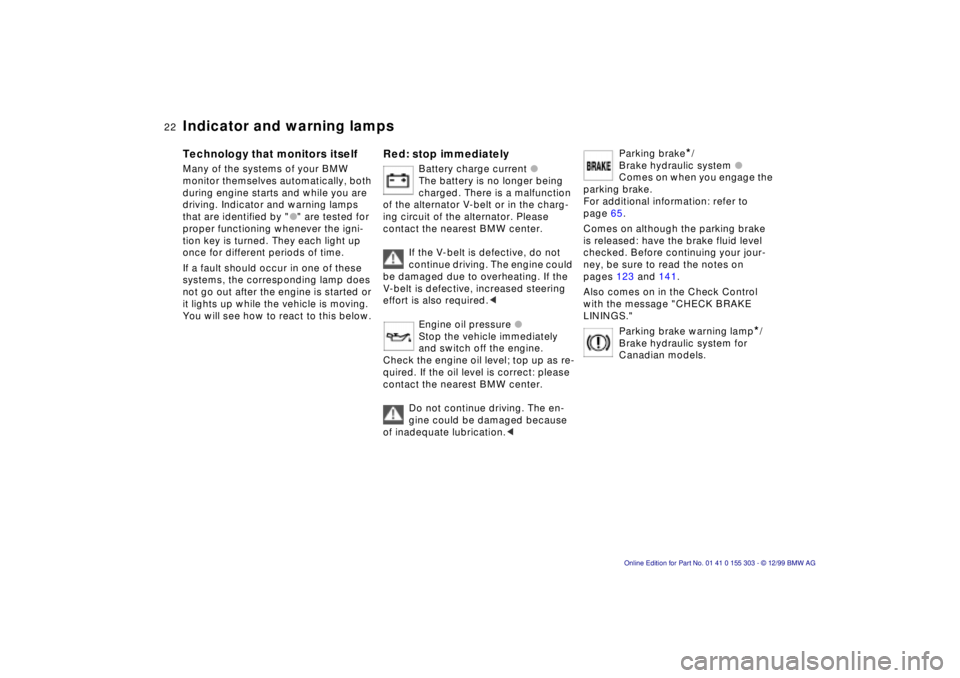
Battery charge current
l
The battery is no longer being
charged. There is a malfunction
of the alternator V-belt or in the charg-
ing circuit of the alternator. Please
contact the nearest BMW center.
If the V-belt is defective, do not
continue driving. The engine could
be damaged due to overheating. If the
V-belt is defective, increased steering
effort is also required.
<
Engine oil pressure
l
Stop the vehicle immediately
and switch off the engine.
Check the engine oil level; top up as re-
quired. If the oil level is correct: please
contact the nearest BMW center.
Do not continue driving. The en-
gine could be damaged because
of inadequate lubrication.
<
Parking brake
*/
Brake hydraulic system l
Comes on when you engage the
parking brake.
For additional information: refer to
page 65.
Comes on although the parking brake
is released: have the brake fluid level
checked. Before continuing your jour-
ney, be sure to read the notes on
pages 123 and 141.
Also comes on in the Check Control
with the message "CHECK BRAKE
LININGS."
Parking brake warning lamp
*/
Brake hydraulic system for
Canadian models.
Page 26 of 201
26n
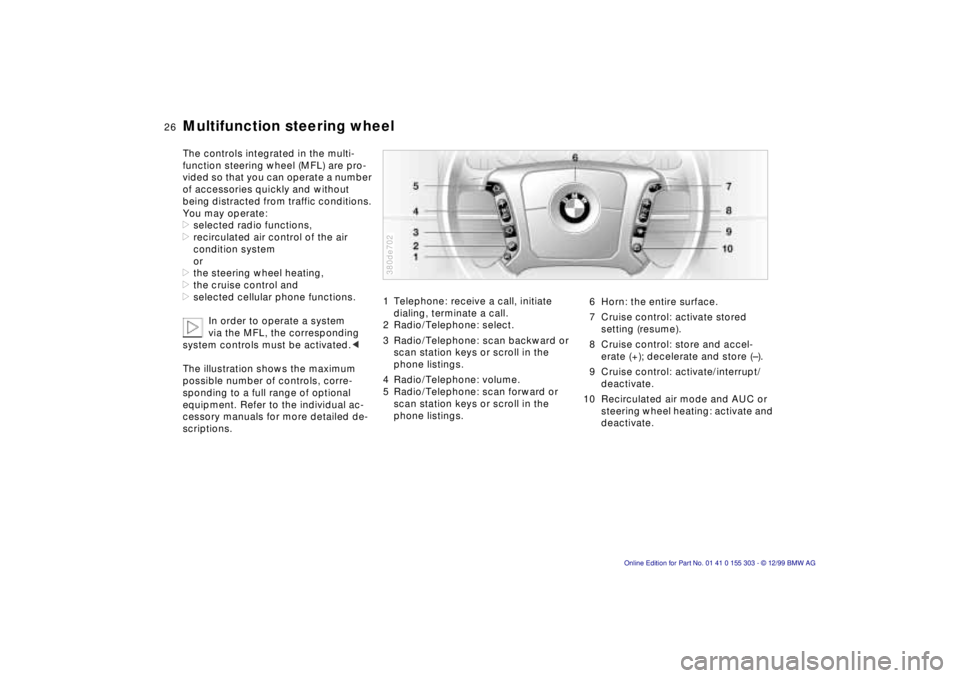
Multifunction steering wheel The controls integrated in the multi-
function steering wheel (MFL) are pro-
vided so that you can operate a number
of accessories quickly and without
being distracted from traffic conditions.
You may operate:
>selected radio functions,
>recirculated air control of the air
condition system
or
>the steering wheel heating,
>the cruise control and
>selected cellular phone functions.
In order to operate a system
via the MFL, the corresponding
system controls must be activated.<
The illustration shows the maximum
possible number of controls, corre-
sponding to a full range of optional
equipment. Refer to the individual ac-
cessory manuals for more detailed de-
scriptions.
1 Telephone: receive a call, initiate
dialing, terminate a call.
2 Radio/Telephone: select.
3 Radio/Telephone: scan backward or
scan station keys or scroll in the
phone listings.
4 Radio/Telephone: volume.
5 Radio/Telephone: scan forward or
scan station keys or scroll in the
phone listings. 380de702
6 Horn: the entire surface.
7 Cruise control: activate stored
setting (resume).
8 Cruise control: store and accel-
erate (+); decelerate and store (Ð).
9 Cruise control: activate/interrupt/
deactivate.
10 Recirculated air mode and AUC or
steering wheel heating: activate and
deactivate.
Page 27 of 201
IndexDataTechnologyRepairsCar careControlsOverview
27n
Sports steering wheel
*
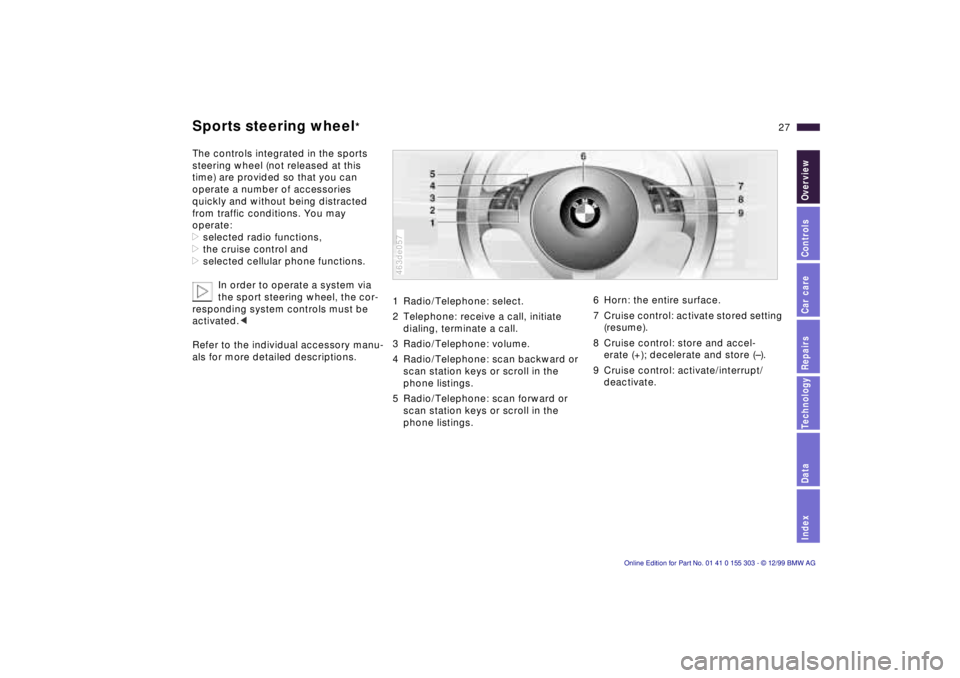
The controls integrated in the sports
steering wheel (not released at this
time) are provided so that you can
operate a number of accessories
quickly and without being distracted
from traffic conditions. You may
operate:
>selected radio functions,
>the cruise control and
>selected cellular phone functions.
In order to operate a system via
the sport steering wheel, the cor-
responding system controls must be
activated.<
Refer to the individual accessory manu-
als for more detailed descriptions.
1 Radio/Telephone: select.
2 Telephone: receive a call, initiate
dialing, terminate a call.
3 Radio/Telephone: volume.
4 Radio/Telephone: scan backward or
scan station keys or scroll in the
phone listings.
5 Radio/Telephone: scan forward or
scan station keys or scroll in the
phone listings. 463de057
6 Horn: the entire surface.
7 Cruise control: activate stored setting
(resume).
8 Cruise control: store and accel-
erate (+); decelerate and store (Ð).
9 Cruise control: activate/interrupt/
deactivate.
Page 43 of 201
IndexDataTechnologyRepairsCar careControlsOverview
43n
Alarm system The concept The vehicle alarm system responds:
>When a door, the hood, or the liftgate
is opened.
>To movement inside the vehicle (inte-
rior motion sensor).
>To variations in the vehicle tilt sensor
such as occur during attempts to
steal the wheels or tow the vehicle.
>To interruption of battery voltage.
The system responds to unauthorized
vehicle entry and attempted theft by
simultaneously activating the following:
>Sounding an acoustical alarm for
30 seconds.
>The hazard warning flashers are acti-
vated for approx. five minutes.
>The high beams flash on and off in
the same rhythm.
To activate and deactivate the
alarm system When the vehicle is locked or unlocked
with the key or the remote control, the
alarm system is also simultaneously
armed or disarmed.
The interior motion sensor is activated
approx. 30 seconds after you have fin-
ished locking the vehicle.
The system indicates that it has been
correctly armed by switching on the
hazard flashers for a single cycle and
by emitting an acoustical signal.
You can have different acknowl-
edgment signals set to confirm
system arming and disarming.<
You can still open the liftgate after the
system has been armed by pressing
button 3 of the remote control. Refer to
page 39. When you close the liftgate,
the system is secured again.
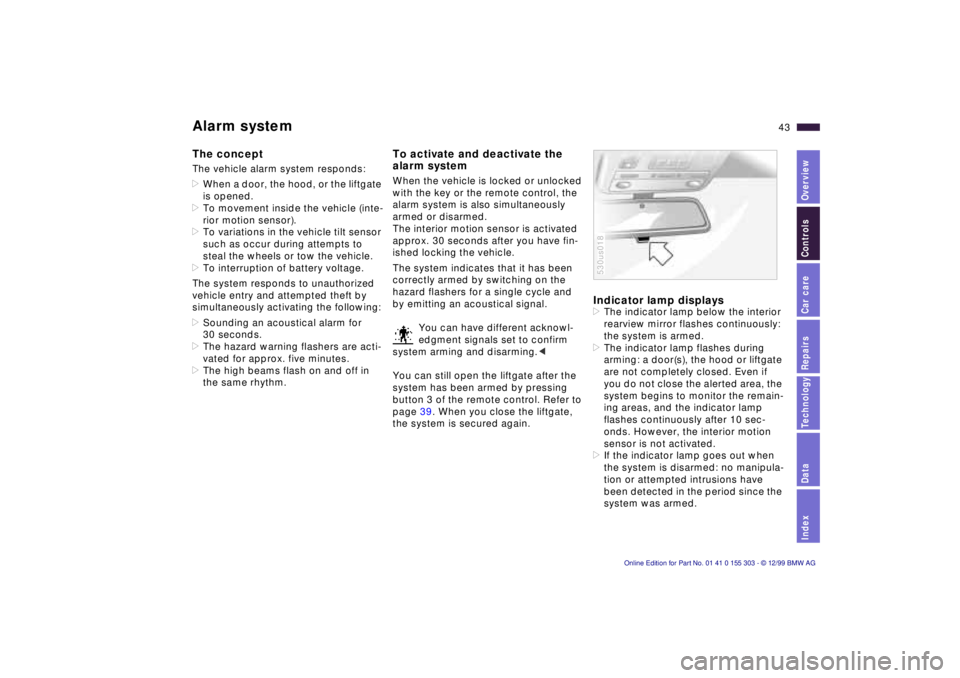
Indicator lamp displays >The indicator lamp below the interior
rearview mirror flashes continuously:
the system is armed.
>The indicator lamp flashes during
arming: a door(s), the hood or liftgate
are not completely closed. Even if
you do not close the alerted area, the
system begins to monitor the remain-
ing areas, and the indicator lamp
flashes continuously after 10 sec-
onds. However, the interior motion
sensor is not activated.
>If the indicator lamp goes out when
the system is disarmed: no manipula-
tion or attempted intrusions have
been detected in the period since the
system was armed. 530us018
Page 45 of 201
IndexDataTechnologyRepairsCar careControlsOverview
45n
Electric power windows Open and close windows From ignition key position 1:
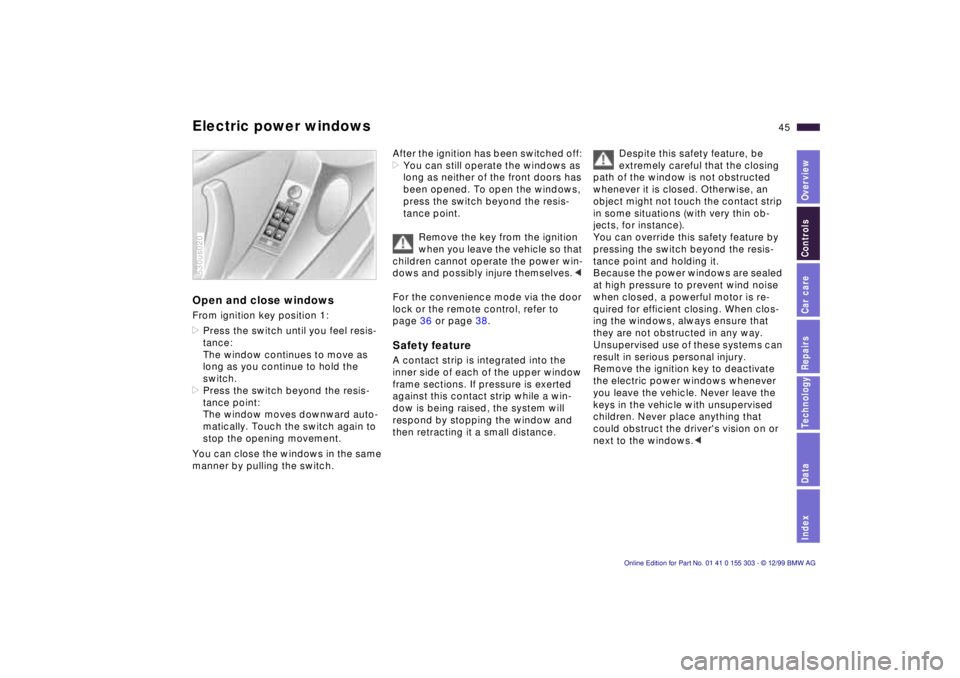
>Press the switch until you feel resis-
tance:
The window continues to move as
long as you continue to hold the
switch.
>Press the switch beyond the resis-
tance point:
The window moves downward auto-
matically. Touch the switch again to
stop the opening movement.
You can close the windows in the same
manner by pulling the switch. 530us020
After the ignition has been switched off:
>You can still operate the windows as
long as neither of the front doors has
been opened. To open the windows,
press the switch beyond the resis-
tance point.
Remove the key from the ignition
when you leave the vehicle so that
children cannot operate the power win-
dows and possibly injure themselves.<
For the convenience mode via the door
lock or the remote control, refer to
page 36 or page 38. Safety feature A contact strip is integrated into the
inner side of each of the upper window
frame sections. If pressure is exerted
against this contact strip while a win-
dow is being raised, the system will
respond by stopping the window and
then retracting it a small distance.
Despite this safety feature, be
extremely careful that the closing
path of the window is not obstructed
whenever it is closed. Otherwise, an
object might not touch the contact strip
in some situations (with very thin ob-
jects, for instance).
You can override this safety feature by
pressing the switch beyond the resis-
tance point and holding it.
Because the power windows are sealed
at high pressure to prevent wind noise
when closed, a powerful motor is re-
quired for efficient closing. When clos-
ing the windows, always ensure that
they are not obstructed in any way.
Unsupervised use of these systems can
result in serious personal injury.
Remove the ignition key to deactivate
the electric power windows whenever
you leave the vehicle. Never leave the
keys in the vehicle with unsupervised
children. Never place anything that
could obstruct the driver's vision on or
next to the windows.<
Page 47 of 201
IndexDataTechnologyRepairsCar careControlsOverview
47n
Sliding/Tilt sunroof with glass moonroof
*
Automatic
* opening and closing
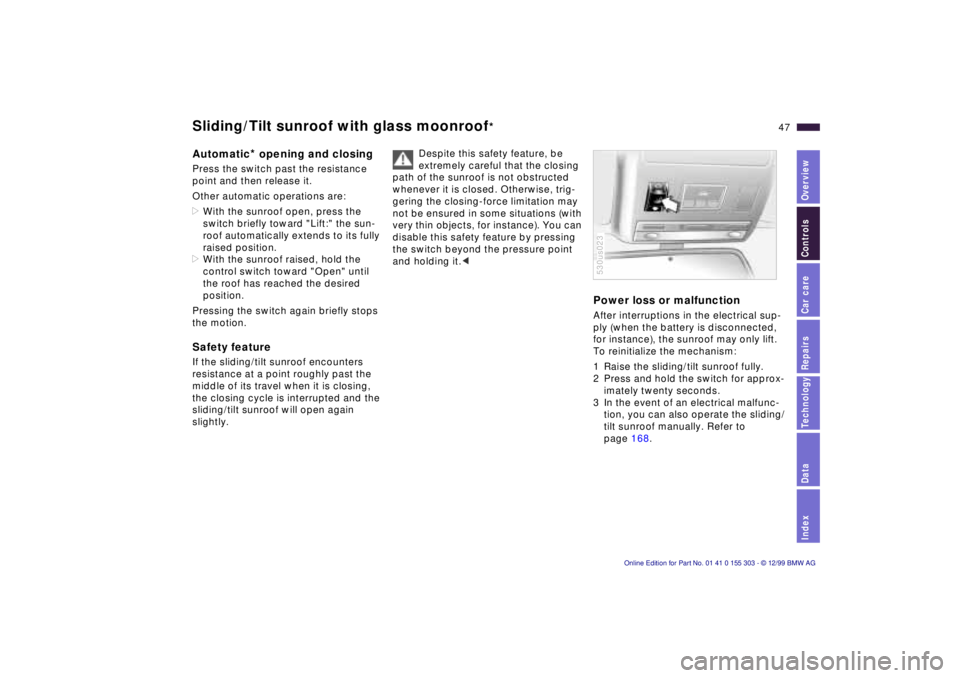
Press the switch past the resistance
point and then release it.
Other automatic operations are:
>With the sunroof open, press the
switch briefly toward "Lift:" the sun-
roof automatically extends to its fully
raised position.
>With the sunroof raised, hold the
control switch toward "Open" until
the roof has reached the desired
position.
Pressing the switch again briefly stops
the motion. Safety feature If the sliding/tilt sunroof encounters
resistance at a point roughly past the
middle of its travel when it is closing,
the closing cycle is interrupted and the
sliding/tilt sunroof will open again
slightly. Despite this safety feature, be
extremely careful that the closing
path of the sunroof is not obstructed
whenever it is closed. Otherwise, trig-
gering the closing-force limitation may
not be ensured in some situations (with
very thin objects, for instance). You can
disable this safety feature by pressing
the switch beyond the pressure point
and holding it.<
Power loss or malfunction After interruptions in the electrical sup-
ply (when the battery is disconnected,
for instance), the sunroof may only lift.
To reinitialize the mechanism:
1 Raise the sliding/tilt sunroof fully.
2 Press and hold the switch for approx-
imately twenty seconds.
3 In the event of an electrical malfunc-
tion, you can also operate the sliding/
tilt sunroof manually. Refer to
page 168. 530us023
Page 48 of 201
48n
For maximum safety when adjusting the
seat position, please observe the fol-
lowing:
Never try to adjust your seat while
driving the vehicle. The seat could
respond with unexpected movement,
and the ensuing loss of vehicle control
could lead to an accident.
Be sure that the safety belt remains
firmly against your body at all times. In
the event of a frontal impact, a loose lap
belt could slide over your hips, leading
to abdominal injury. In addition, the
safety belt's restraint effectiveness is
reduced if the belt is worn loosely.
Never ride with the backrest reclined to
an extreme angle (especially important
for the front passenger to remember).
If you do so, there is a risk that you will
slide under the safety belt in an acci-
dent, thus reducing the protection
provided by the safety belt.<
Correct sitting posture
To reduce strain on the spinal column,
sit all the way back in the seat and rest
your back fully against the backrest.
The ideal sitting posture is achieved
with your head extending from your
spine in a straight line.
For long-distance driving, you may wish
to angle the backrest slightly to reduce
muscular tension. You should be able
to reach the highest point on the steer-
ing wheel without straightening your
arms.
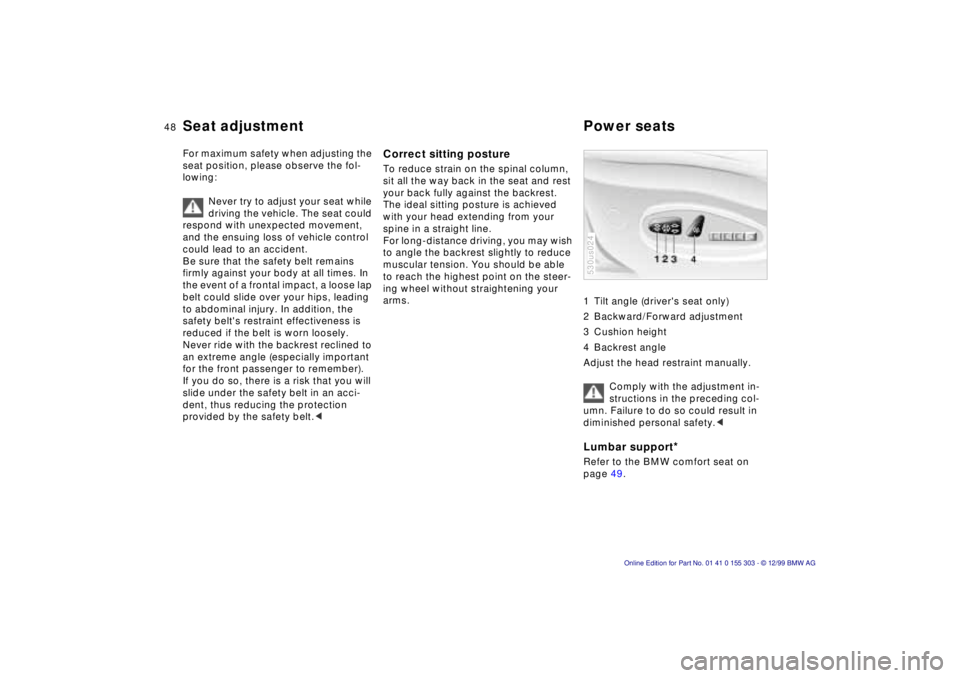
1 Tilt angle (driver's seat only)
2 Backward/Forward adjustment
3 Cushion height
4 Backrest angle
Adjust the head restraint manually.
Comply with the adjustment in-
structions in the preceding col-
umn. Failure to do so could result in
diminished personal safety.<
Lumbar support
*
Refer to the BMW comfort seat on
page 49. 530us024
Seat adjustment Power seats
Page 53 of 201
IndexDataTechnologyRepairsCar careControlsOverview
53n
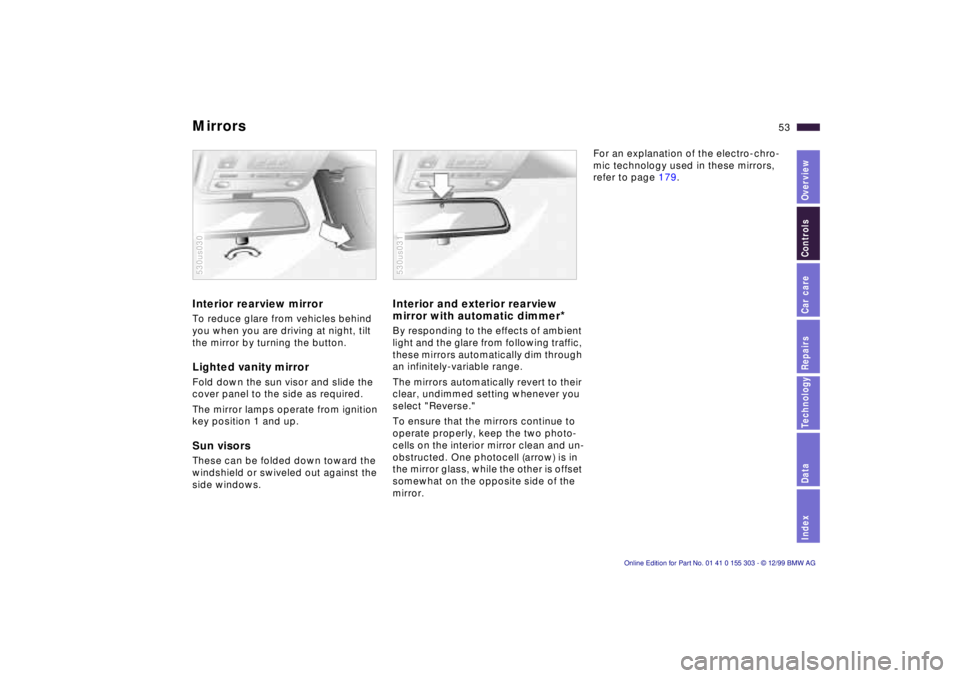
Mirrors Interior rearview mirror To reduce glare from vehicles behind
you when you are driving at night, tilt
the mirror by turning the button. Lighted vanity mirror Fold down the sun visor and slide the
cover panel to the side as required.
The mirror lamps operate from ignition
key position 1 and up. Sun visors These can be folded down toward the
windshield or swiveled out against the
side windows. 530us030
Interior and exterior rearview
mirror with automatic dimmer
*
By responding to the effects of ambient
light and the glare from following traffic,
these mirrors automatically dim through
an infinitely-variable range.
The mirrors automatically revert to their
clear, undimmed setting whenever you
select "Reverse."
To ensure that the mirrors continue to
operate properly, keep the two photo-
cells on the interior mirror clean and un-
obstructed. One photocell (arrow) is in
the mirror glass, while the other is offset
somewhat on the opposite side of the
mirror. 530us031
For an explanation of the electro-chro-
mic technology used in these mirrors,
refer to page 179.
Page 58 of 201

58n
Airbags Indicator lamp
The indicator lamp displays the
operational status of the airbag
system from ignition key posi-
tion 1 and up.
System operational:
>The indicator lamp comes on briefly
then goes out.
System malfunction:
>The indicator lamp fails to come on.
>The indicator lamp comes on briefly
before going out and then lighting up
again.
A system malfunction could prevent the
system from responding to an impact
occurring within its normal response
range.
Please have your authorized BMW cen-
ter inspect and repair the system as
soon as possible.
Sitting correctly with airbags
For your safety, comply with the
following instructions for the air-
bags. If you do not, the airbags may not
be able to provide their maximum pro-
tection. All passengers in the vehicle
should be aware of and comply with
this information:
The airbags are supplemental restraint
devices designed to provide extra pro-
tection; they are not a substitute for
safety belts. Wear your safety belt at all
times. The airbags will not be triggered
in the event of a minor accident, a vehi-
cle roll-over, or collisions from the rear.
In these instances, the safety belt pro-
vides optimal protection.
Airbags are located under cover panels
in the steering wheel, in the dashboard,
in the side trim panels in the front and
rear*, and in the windshield pillars and
the sides of the headliner.
Adjust your seat to a position that pro-
vides maximum distance between you
and the steering wheel, the instrument
panel and the door while still allowing
comfortable and safe access to all
vehicle controls.
To avoid sustaining hand and arm inju-
ries, always grasp the steering wheel
on
the rim with the hands at the 9 and
3 o'clock positions. Do not place your
hands on the center pad.
Never allow any objects to obstruct the
area between the airbag and an occu-
pant.
Do not use the cover panel above the
passenger-side airbag as a storage
area.
Do not apply adhesive materials to the
cover panels of the airbags, cover them
or modify them in any other way.
Do not install a rear-facing child re-
straint system in the front passenger
seat of this vehicle.
Children under 13 years of age and
children less than 5 feet (150 cm) tall
should ride only in the rear seat.
Infants or small children should never
be held on the lap of a passenger.
If your vehicle is equipped with side air-
bags in the rear passenger area, be
sure that child restraints are mounted
correctly and provided with the great-
est-possible distance between the air-
bags in the side trim panels. Do not al-
low children to lean out of the child's
seat in the direction of the side trim
panels. If they do so, serious injuries
can occur if the airbag is triggered.<