maintenance BMW X5 4.4I 2000 User Guide
[x] Cancel search | Manufacturer: BMW, Model Year: 2000, Model line: X5 4.4I, Model: BMW X5 4.4I 2000Pages: 201, PDF Size: 1.93 MB
Page 118 of 201

118n
General driving notes Catalytic converter
Brakes:
Do not drive with your foot resting
on the brake pedal. Even light but con-
sistent pedal pressure can lead to high
temperatures, brake wear and possibly
even brake failure.
Aquaplaning:
When driving on wet or slushy roads,
reduce vehicle speed. If you do not, a
wedge of water may form between the
tires and the road surface. This phe-
nomenon is referred to as aquaplaning
or hydroplaning. It is characterized by a
partial or complete loss of contact be-
tween the tires and the road surface.
The ultimate results are loss of steering
and braking control.
Cargo area cover:
Do not place heavy or hard objects on
the cargo area cover. These objects
could endanger vehicle occupants dur-
ing heavy brake applications or evasive
maneuvers.
Clothes hooks:
When suspending articles of clothing
from the hooks, be sure that they will
not obstruct the driver's vision. Do not
hang heavy objects on the hooks. If you
do so, they could cause personal injury
during braking or evasive maneuvers.< The catalytic converter reduces harmful
exhaust emissions.
It is designed for use with unleaded fuel
only. Even minute quantities of lead
would be enough to permanently dam-
age both the catalytic converter and the
system oxygen sensor.
To ensure efficient, trouble-free engine
operation and avoid potential damage:
>Be sure to comply with the scheduled
maintenance requirements.
>Fill the fuel tank well before it is
empty.
>When the battery is discharged, start
the engine with an outside starting
aid.
>Avoid other situations in which the
fuel is not burned, or burns incom-
pletely, such as engaging the starter
frequently or for extended periods, or
repeated start attempts in which the
engine does not start (stopping and
restarting an engine which is running
properly does not present a problem).
Never allow the engine to run with
any of the spark plug cables discon-
nected.
Page 142 of 201
142n
The BMW Maintenance System has
been designed as a reliable means of
providing maximum driving and operat-
ing safety Ð and as cost-effectively as
possible for you.
Please keep in mind that regular main-
tenance is not only necessary for the
safety of your vehicle, but also plays a
significant role in maintaining the resale
value of the vehicle.
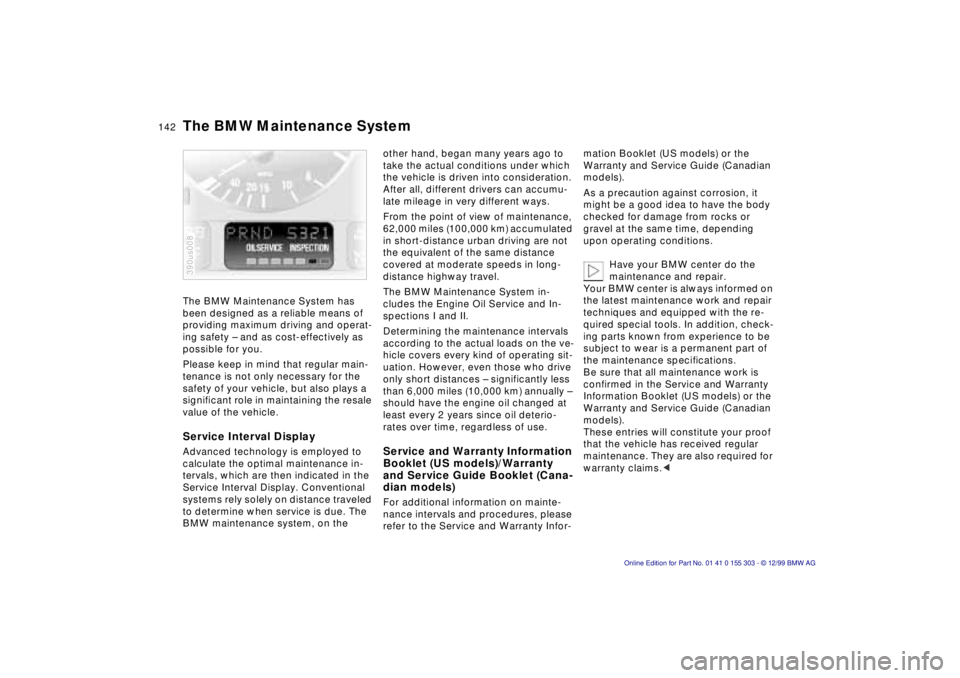
Service Interval Display Advanced technology is employed to
calculate the optimal maintenance in-
tervals, which are then indicated in the
Service Interval Display. Conventional
systems rely solely on distance traveled
to determine when service is due. The
BMW maintenance system, on the 390us008
other hand, began many years ago to
take the actual conditions under which
the vehicle is driven into consideration.
After all, different drivers can accumu-
late mileage in very different ways.
From the point of view of maintenance,
62,000 miles (100,000 km) accumulated
in short-distance urban driving are not
the equivalent of the same distance
covered at moderate speeds in long-
distance highway travel.
The BMW Maintenance System in-
cludes the Engine Oil Service and In-
spections I and II.
Determining the maintenance intervals
according to the actual loads on the ve-
hicle covers every kind of operating sit-
uation. However, even those who drive
only short distances Ð significantly less
than 6,000 miles (10,000 km) annually Ð
should have the engine oil changed at
least every 2 years since oil deterio-
rates over time, regardless of use. Service and Warranty Information
Booklet (US models)/Warranty
and Service Guide Booklet (Cana-
dian models) For additional information on mainte-
nance intervals and procedures, please
refer to the Service and Warranty Infor-mation Booklet (US models) or the
Warranty and Service Guide (Canadian
models).
As a precaution against corrosion, it
might be a good idea to have the body
checked for damage from rocks or
gravel at the same time, depending
upon operating conditions.
Have your BMW center do the
maintenance and repair.
Your BMW center is always informed on
the latest maintenance work and repair
techniques and equipped with the re-
quired special tools. In addition, check-
ing parts known from experience to be
subject to wear is a permanent part of
the maintenance specifications.
Be sure that all maintenance work is
confirmed in the Service and Warranty
Information Booklet (US models) or the
Warranty and Service Guide (Canadian
models).
These entries will constitute your proof
that the vehicle has received regular
maintenance. They are also required for
warranty claims.<
The BMW Maintenance System
Page 144 of 201

144n
Caring for your vehicle Exterior finish To provide effective corrosion protec-
tion, multilayer paintwork is applied at
the factory. Cataphoretic immersion
priming techniques are supplemented
using special body-cavity protectants,
with the application of specially-devel-
oped and extensively tested materials.
A layer of flexible PVC is first applied to
the undercarriage. Following this, a
comprehensive undercoating treat-
ment with a wax-based protectant is
applied.
Regular maintenance makes an impor-
tant contribution to maintaining the
safety and value of your vehicle.
Increasing awareness of the effects of
harmful environmental factors on vehi-
cle finishes have led paint and vehicle
manufacturers to initiate ongoing pro-
grams designed to further improve the
durability of their finishes. Despite this,
environmental factors that occur locally
or regionally can have negative effects
on the finish of your vehicle. These
should guide you in determining the fre-
quency and extent of your efforts to
maintain the vehicle finish. Depending upon material and type
of impact (perforation of paint layer),
physical stresses from sand, road salt,
gravel, etc., can cause corrosion to
start extending beneath the finish, start-
ing at the point of impact.
Road dirt, tar spots, dead insects, ani-
mal droppings (strong alkali effect) and
tree excretions (resins and pollen) all
contain substances capable of causing
damage when allowed to remain on the
finish of your vehicle for any period of
time (spots, etching, flaking, separation
in the top coat).
In industrial areas, deposits from fly
ash, lime, oil deposits, sulfur-dioxide in
precipitation (acid rain) and other envi-
ronmental pollutants will all damage the
surface of the vehicle unless adequate
protection is provided. In coastal regions, high levels of atmo-
spheric salt and humidity promote cor-
rosion.
In tropical zones, temperatures of over
105 7 (40 6) in the shade prevail, in
addition to heavy ultraviolet radiation
and high humidity. Under those condi-
tions, light paints can reach tempera-
tures up to 175 7 (80 6) and dark
paints up to 250 7 (120 6).
Page 153 of 201
IndexDataTechnologyRepairsCar careControlsOverview
Overview
Controls and features
Operation, care
and maintenance
Owner service procedures
Technical data
Index Advanced technology
153n
Replacement procedures:
Onboard tool kit154
Wiper blades154
Lamps and bulbs155
Changing a wheel161
Battery165
Fuses167
In case of electrical
malfunction:
Fuel filler door168
Sliding/Tilt sunroof168
Liftgate168
Tailgate169
Assistance, giving and
receiving:
Jump-starting170
Towing the vehicle171
Repairs
Page 165 of 201
IndexDataTechnologyRepairsCar careControlsOverview
165n
Battery Battery location The battery is located in the floor of the
vehicle below the spare wheel. Battery care The battery is maintenance-free, that is,
the original electrolyte will normally last
for the service life of the battery under
moderate climatic conditions.
For all questions that regard the
battery, please consult your BMW
center. Since the battery is mainte-
nance-free, the following is for your in-
formation only.<
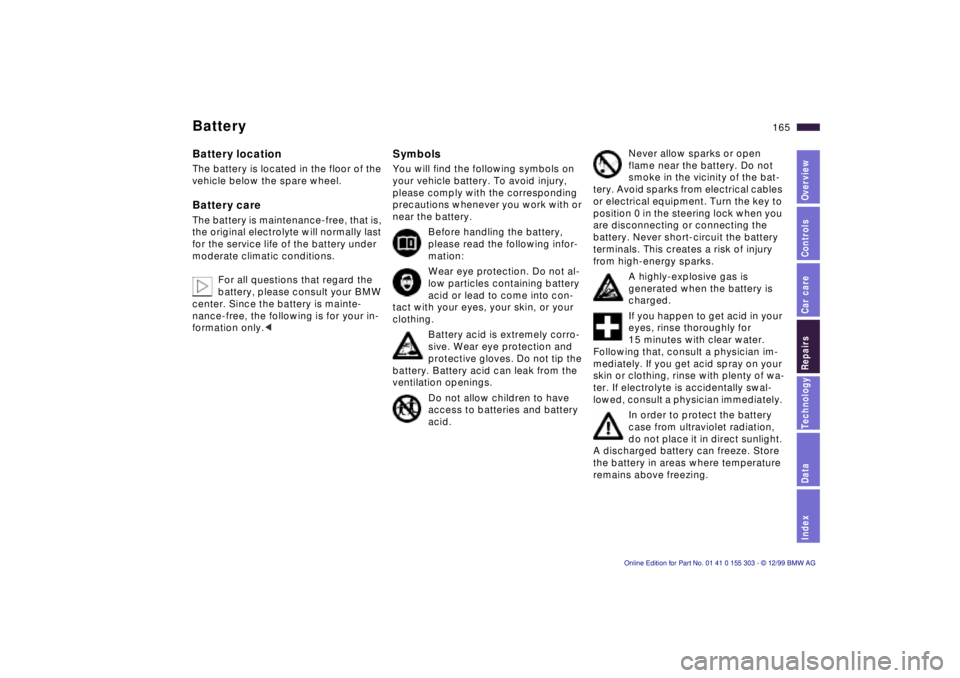
Symbols You will find the following symbols on
your vehicle battery. To avoid injury,
please comply with the corresponding
precautions whenever you work with or
near the battery.
Before handling the battery,
please read the following infor-
mation:
Wear eye protection. Do not al-
low particles containing battery
acid or lead to come into con-
tact with your eyes, your skin, or your
clothing.
Battery acid is extremely corro-
sive. Wear eye protection and
protective gloves. Do not tip the
battery. Battery acid can leak from the
ventilation openings.
Do not allow children to have
access to batteries and battery
acid.
Never allow sparks or open
flame near the battery. Do not
smoke in the vicinity of the bat-
tery. Avoid sparks from electrical cables
or electrical equipment. Turn the key to
position 0 in the steering lock when you
are disconnecting or connecting the
battery. Never short-circuit the battery
terminals. This creates a risk of injury
from high-energy sparks.
A highly-explosive gas is
generated when the battery is
charged.
If you happen to get acid in your
eyes, rinse thoroughly for
15 minutes with clear water.
Following that, consult a physician im-
mediately. If you get acid spray on your
skin or clothing, rinse with plenty of wa-
ter. If electrolyte is accidentally swal-
lowed, consult a physician immediately.
In order to protect the battery
case from ultraviolet radiation,
do not place it in direct sunlight.
A discharged battery can freeze. Store
the battery in areas where temperature
remains above freezing.
Page 175 of 201
IndexDataTechnologyRepairsCar careControlsOverview
Overview
Controls and features
Operation, care
and maintenance
Owner service procedures
Technical data
Index Advanced technology
175n
Airbags176
Adaptive Transmission Control
(ATC)176
Four-wheel drive177
Dynamic Stability Control
(DSC)177
Radio reception178
Safety belt tensioner178
DSP sound system179
Rearview mirrors with automatic
dimmer179
Rain sensor180
Integrated rear suspension180
Level control system181
Xenon lamps181
Technol-
Page 183 of 201
IndexDataTechnologyRepairsCar careControlsOverview
Overview
Controls and features
Operation, care
and maintenance
Owner service procedures
Technical data
Index Advanced technology
183n
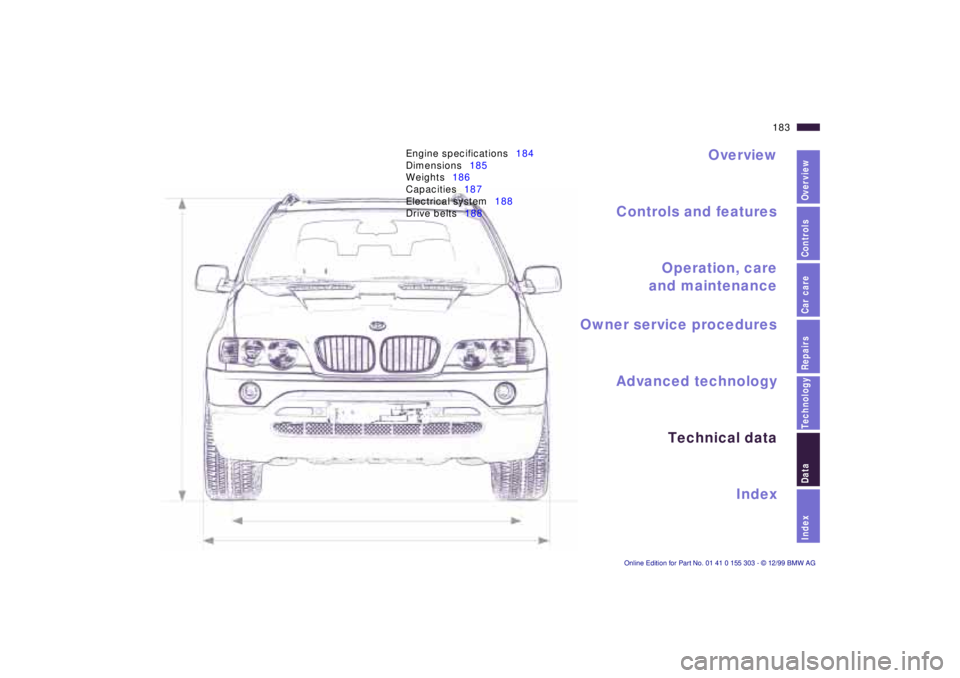
Engine specifications184
Dimensions185
Weights186
Capacities187
Electrical system188
Drive belts188
Data
Page 191 of 201
IndexDataTechnologyRepairsCar careControlsOverview
Overview
Controls and features
Operation, care
and maintenance
Owner service procedures
Technical data
Index Advanced technology
191n
Everything from A to Z192
Owner service procedures198
Index
Page 194 of 201

Everything from A to ZFuel filler door release after
electrical fault168
Fuel gauge75
Fuel quality30
Fuel tank capacity187
Fuses167GGarage-door opener98
Gasoline30
General driving notes118
Glasses compartment102
Glove compartment101
Glove compartment lamp,
bulb replacement159
Gross vehicle weight186
Ground clearance117HHandbrake65
Handsfree system102
Hazard warning flashers28
Hazard warning triangle28
HDC (Hill Descent
Control)84
Head restraints49
Headlamp covers,
care143, 155
Headlamp flasher69
Headlamp washer
system136Headlamp washers70
Heated steering wheel96
Heating and ventilation90
Heating while stopped94
Heavy cargo112
Height185
Height adjustment, seats48
Height adjustment, steering
wheel51
HiFi system179
High beams25, 87
Bulb replacement155
Hill Descent Control
(HDC)84
Hood release133
Horn26, 27
Hydraulic Brake Assistant
refer to DBC24, 120
IIce warning74
Identification number141
Identification, tires130
Ignition key34
Ignition lock63
Independent ventilation97
Indicator lamps22
Inflation pressure31, 127
INSPECTION76
Instrument cluster18, 20
Instrument lighting86Instrument panel20
Instruments18
Integrated rear axle180
Interference indicators77
Interference, cellular
phone126
Interior and exterior rearview
mirrors, automatic
dimming feature53
Interior lamps87
Bulb replacement158
Remote control38
Interior mirror53
Interior motion sensor44
Interior rearview mirror,
automatic dimming
feature179
Interlock63
Intermittent switch69
JJump-starting170KKey Memory55
Keys34
Keys with radio remote
control34
Kickdown67
LLashing eyes42, 112
Leather care147
Length185
Level control
system24, 125, 181
License plate lamp, bulb
replacement158
Liftgate42, 168
Light switch86
Light-alloy wheel132
Lighter103
Lights-on warning86
Load-securing devices112
Louvers90
Low beams86
Bulb replacement155
Low-fuel warning lamp75
Lug bolts163
Lug wrench160
Luggage net42
Luggage space42
Luggage straps42
Lumbar support49MM+S tires131
Maintenance76, 142
Manual operation
Doors36
Liftgate168
Sliding/Tilt sunroof168
Tailgate169
Page 198 of 201
Owner service proceduresAAdding brake fluid141
Adding coolant140
Adding engine oil137
Adding washer fluid136
Adjusting washer
nozzles136
Air pressure30, 127
Avoiding unintentional
alarms44BBattery, discharged170
Brakes, brake faults123CChanging a wheel160
Charging the battery166
Check Control77
Check oil level137
Checking tire pressure30DDeactivating the interior
motion sensor38, 44
Deactivating the tilt sensor
alarm system38, 44
Defrosting the windows93
Difficult steering125
Doors, manual operation36
EElectrical malfunction
Fuel filler door168
Liftgate168
Sliding/Tilt sunroof168
Tailgate169
Emergency operation
Doors36
Fuel filler door168
Liftgate168
Sliding/Tilt sunroof168
Tailgate169
Engine oil grades138FFailure messages77
Failure of an electrical
accessory167
Fault displays77
Filling the windshield washer
reservoir136
First-aid kit28
Fittings, tow-starting and
towing171
Flat tire160
Fog lamp, bulb
replacement156
Footwell lamps, bulb
replacement158
GGlove compartment lamp,
bulb replacement158HHazard warning flashers28
Hazard warning triangle28
Headlamp covers,
care143, 155
High beams, bulb
replacement155
Hood release133IIndicator lamps22
Interior lamps, bulb
replacement158JJump-starting170LLevel control system,
inactive125
License plate lamps, bulb
replacement158
Liftgate
Release following an
electrical malfunction168Low beams, bulb
replacement155
Lug wrench160
MMaintenance76, 142
Malfunction displays77
Manual operation
Doors36
Liftgate168
Sliding/Tilt sunroof168
Tailgate169OOil grades138
Onboard tool kit154PPressure, tires30, 127RRear window wiper, wiper
blade replacement154
Releasing the fuel filler door
following an electrical
malfunction168
Releasing the hood133
Releasing the tailgate
following an electrical
malfunction169