traction control BMW X5 4.4I 2000 User Guide
[x] Cancel search | Manufacturer: BMW, Model Year: 2000, Model line: X5 4.4I, Model: BMW X5 4.4I 2000Pages: 201, PDF Size: 1.93 MB
Page 131 of 201

IndexDataTechnologyRepairsCar careControlsOverview
131n
Winter tires Snow chains
*
Choosing the right tire BMW recommends special winter tires
(M+S radial tires) for driving in adverse
winter road conditions. While the All-
Season tires with M+S designation that
are mounted as standard equipment
provide better winter traction than sum-
mer tires, they generally do not achieve
the performance of winter tires.
For safe tracking and steering re-
sponse, install winter tires made by the
same manufacturer having the same
tread configuration on all four wheels.
Mount only winter tires approved by
BMW. Any BMW center will be glad to
provide you with information for select-
ing the best winter tires for your partic-
ular driving conditions.
Do not exceed specified
maximum speeds
Never exceed the maximum
speed for which winter tires are
rated.
Unprofessional attempts by laymen to
service tires can lead to damage and
accidents.
Have this work performed by skilled
professionals only. Any BMW center
has the required technical knowledge
and the proper equipment and will be
happy to assist you.<
Tire condition, tire pressure Once winter tires wear to a tread depth
below 0.16 in (4 mm), their performance
under winter driving conditions deterio-
rates noticeably. Worn tires should
therefore be replaced for safety consid-
erations.
Comply with the specified tire inflation
pressures Ñ and be sure to have the
wheel and tire assemblies balanced
every time you change the tires. Storage Store tires in a cool, dry place, away
from light whenever possible. Protect
the tires against contact with oil, grease
and fuel.
The use of narrow-link BMW snow
chains is approved only in pairs on the
rear wheels and only with tire size
235/65 R 17. Comply with all manufac-
turer's safety precautions when mount-
ing the chains.
Page 177 of 201
IndexDataTechnologyRepairsCar careControlsOverview
177n
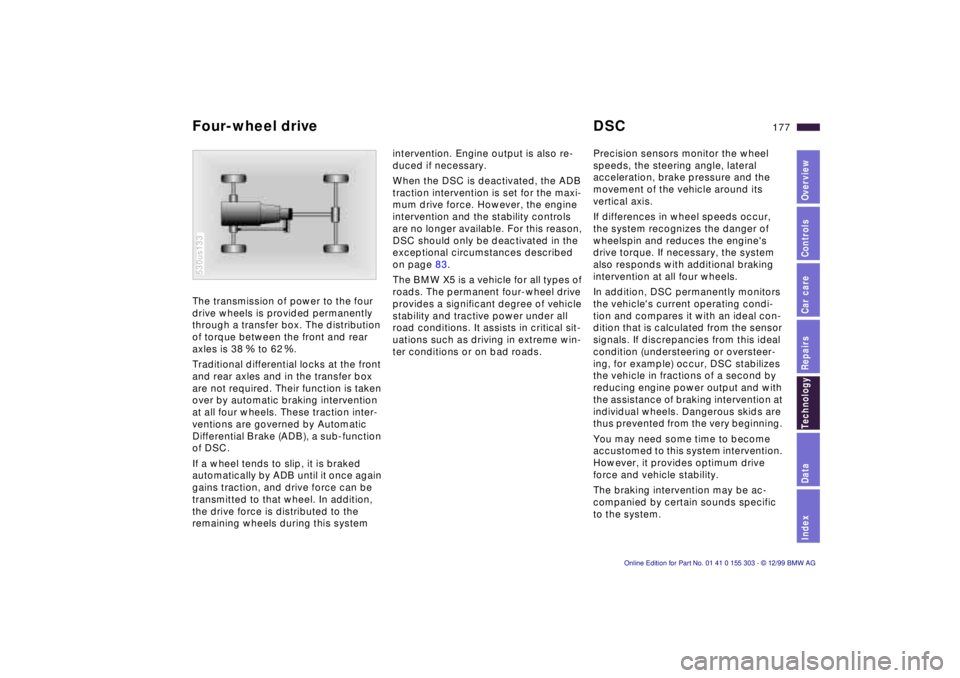
The transmission of power to the four
drive wheels is provided permanently
through a transfer box. The distribution
of torque between the front and rear
axles is 38% to 62%.
Traditional differential locks at the front
and rear axles and in the transfer box
are not required. Their function is taken
over by automatic braking intervention
at all four wheels. These traction inter-
ventions are governed by Automatic
Differential Brake (ADB), a sub-function
of DSC.
If a wheel tends to slip, it is braked
automatically by ADB until it once again
gains traction, and drive force can be
transmitted to that wheel. In addition,
the drive force is distributed to the
remaining wheels during this system
530us133
intervention. Engine output is also re-
duced if necessary.
When the DSC is deactivated, the ADB
traction intervention is set for the maxi-
mum drive force. However, the engine
intervention and the stability controls
are no longer available. For this reason,
DSC should only be deactivated in the
exceptional circumstances described
on page 83.
The BMW X5 is a vehicle for all types of
roads. The permanent four-wheel drive
provides a significant degree of vehicle
stability and tractive power under all
road conditions. It assists in critical sit-
uations such as driving in extreme win-
ter conditions or on bad roads. Precision sensors monitor the wheel
speeds, the steering angle, lateral
acceleration, brake pressure and the
movement of the vehicle around its
vertical axis.
If differences in wheel speeds occur,
the system recognizes the danger of
wheelspin and reduces the engine's
drive torque. If necessary, the system
also responds with additional braking
intervention at all four wheels.
In addition, DSC permanently monitors
the vehicle's current operating condi-
tion and compares it with an ideal con-
dition that is calculated from the sensor
signals. If discrepancies from this ideal
condition (understeering or oversteer-
ing, for example) occur, DSC stabilizes
the vehicle in fractions of a second by
reducing engine power output and with
the assistance of braking intervention at
individual wheels. Dangerous skids are
thus prevented from the very beginning.
You may need some time to become
accustomed to this system intervention.
However, it provides optimum drive
force and vehicle stability.
The braking intervention may be ac-
companied by certain sounds specific
to the system.
Four-wheel drive DSC
Page 196 of 201

Everything from A to ZRestraint system57
Reverse67
Rims130
Roof load capacity186
Roof-mounted luggage
rack113
Rubber parts124SSafety belt height
adjustment56
Safety belt tensioner178
Safety belts56
Safety lock buttons40
Seat heating96
Seat memory54
Seat, power48
Securing cargo42, 112
Securing the load112
Selector lever, automatic
transmission66
Service and Warranty
Information Booklet (US
models)142
Service Interval
Display76, 142
Servotronic125
Shiftlock66
Shoulder support50
Shutting off the engine65
Side airbags57
Side Impact Head Protection
System57Side lamps86
Bulb replacement156
Ski bag105
Skidcontrol125
Sliding/Tilt sunroof46
Closing following an
electrical malfunction168
Convenience
operation36
Power loss47
Remote control38
Slippery roads124
Snow chains124, 131
Socket104
Spare key34
Spare tire161
Spare wheel161
Spark plugs188
Speaker102
Special wash program70
Speed control72
Speedometer18, 20
Sports seat50
Starting64
Starting problems
64, 118, 170, 171
Steering125
Steering wheel
adjustment51
Automatic52
Steering wheel heating96
Steering wheel lock63
Steering wheel memory54Steptronic66
Storage compartments101
Storage compartments in the
cargo area109
Storing the vehicle148
Summer tires130
Sun visors53
Switching off the vehicle65
Symbols4
Synthetic oils138
TTachometer75
Tail lamps157
Bulb replacement157
Tailgate42
Opening from the
inside41
Opening from the
outside41
Radio control
operation39
Release following an
electrical malfunction168
Technical
modifications6, 149
Telephone hookup102
Telephone, refer to the
separate Owner's Manual
Temperature display,
outside
temperature74, 80
Temperature gauge76Temperature layering94
Thigh support
adjustment50
Third brake lamp157
Tilt alarm38, 44
Tilt function, passenger side
mirror54
Timer, refer to the Radio
Owner's Manual
Tire code130
Tire damage127
Tire inflation
pressure31, 127
Tire renewal128
Tire rotation between front
and rear129
Tire specifications132
Tire tread127
Tools154
Torque184
Tow fittings171
Towing171
Tow-starting172
Track width185
Traction Control System
refer to DSC83
Transmission66
Tread depth, tires127
Trip odometer74
Turn signal indicator69
Bulb
replacement156, 157
Turning circle185