brake BMW X5 4.4I 2000 Owner's Manual
[x] Cancel search | Manufacturer: BMW, Model Year: 2000, Model line: X5 4.4I, Model: BMW X5 4.4I 2000Pages: 201, PDF Size: 1.93 MB
Page 85 of 201

IndexDataTechnologyRepairsCar careControlsOverview
85n
HDC To use HDC You can use HDC in every drive
position. In the event of a fault The indicator lamp goes out in the HDC
mode or does not come on when HDC
is activated:
HDC is temporarily not available if
brake temperature is too high.
If the DSC indicator lamp also
lights up:
There is a fault in the HDC and
DSC systems. Have your BMW center
inspect this system as soon as possi-
ble.
Page 115 of 201
IndexDataTechnologyRepairsCar careControlsOverview
Overview
Controls and features
Operation, care
and maintenance
Owner service procedures
Technical data
Index Advanced technology
115n
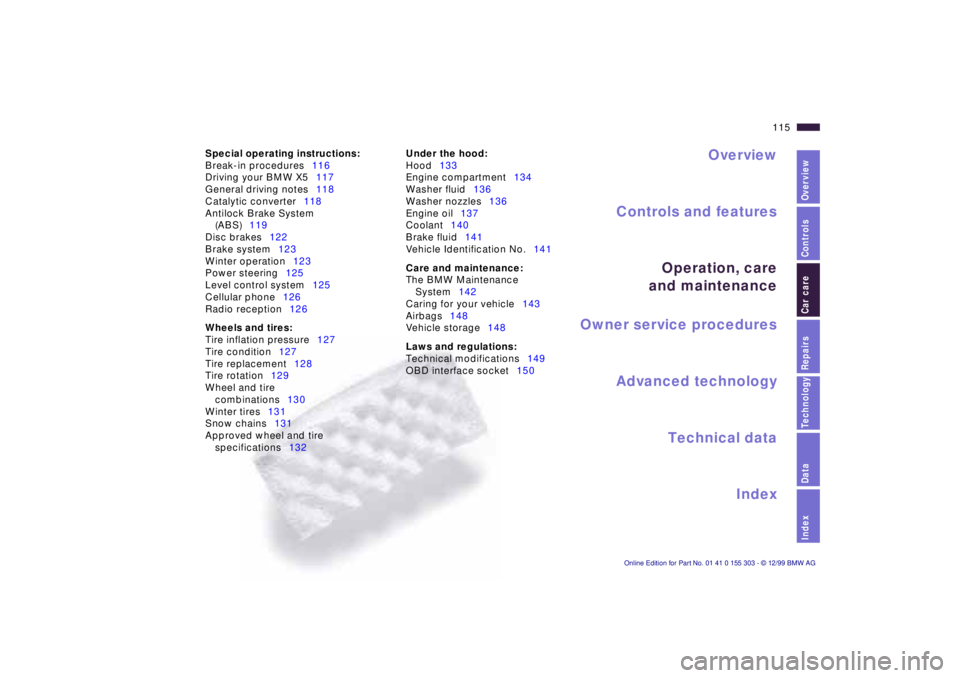
Car care Special operating instructions:
Break-in procedures116
Driving your BMW X5117
General driving notes118
Catalytic converter118
Antilock Brake System
(ABS)119
Disc brakes122
Brake system123
Winter operation123
Power steering125
Level control system125
Cellular phone126
Radio reception126
Wheels and tires:
Tire inflation pressure127
Tire condition127
Tire replacement128
Tire rotation129
Wheel and tire
combinations130
Winter tires131
Snow chains131
Approved wheel and tire
specifications132Under the hood:
Hood133
Engine compartment134
Washer fluid136
Washer nozzles136
Engine oil137
Coolant140
Brake fluid141
Vehicle Identification No.141
Care and maintenance:
The BMW Maintenance
System142
Caring for your vehicle143
Airbags148
Vehicle storage148
Laws and regulations:
Technical modifications149
OBD interface socket150
Page 116 of 201

116n
Break-in procedures To ensure that your vehicle provides
maximum economy throughout a long
service life, we request that you ob-
serve the following suggestions: Engine and axle drive Up to 1,200 miles (2,000 km):
Drive at varying engine speeds and
road speeds, but do not exceed
4,500 rpm and a road speed of
106 mph (170 km/h) during this initial
period:
Obey your local and state maximum
speed limits.
Refrain from using full throttle and avoid
pressing the accelerator beyond the
kickdown point.
Once you have driven 1,200 miles
(2,000 km), engine and vehicle speeds
can gradually be increased.
You should also comply with these
break-in procedures if the engine or
one of the axle drives is replaced later
in the course of the vehicle service life.
Tires Due to technical factors associated
with their manufacture, tires do not
achieve their full traction potential until
an initial break-in period has elapsed.
For this reason, drive with extra care
during the initial 200 miles (300 km).
Obey your local and state maximum
speed limits.
When the vehicle is operated on
wet or slushy roads, a wedge of
water may form between the tire and
the road surface. This phenomenon is
referred to as aquaplaning, or hydro-
planing, and can lead to partial or com-
plete loss of traction, vehicle control
and braking effectiveness. Reduce your
speed on wet roads.<
Brake system Approximately 300 miles (500 km) must
elapse before the brake pads and ro-
tors achieve the optimal pad-surface
and wear patterns required for trouble-
free operation and long service life later
on.
To break in the separate parking brake
drums, apply the parking brake lightly
when coasting to a standstill (at a traffic
signal, for instance), provided that traf-
fic conditions allow you to do so.
To avoid corrosion, repeat this proce-
dure from time to time.
The brake lamps do not light up
when the parking brake is applied.
Vacuum for the brake system servo unit
on your BMW is available only when the
engine is running. When you move the
vehicle with the engine shut off Ð when
towing, for instance Ð substantially
higher levels of pedal force will be re-
quired to brake the vehicle.<
Page 117 of 201

IndexDataTechnologyRepairsCar careControlsOverview
117n
Driving your BMW X5 Your BMW is right at home on all roads
and byways Ð even where the pavement
ends. It combines permanent four-
wheel drive with the agility of a typical
passenger car. On bad roads When you are driving on bad roads,
there are a few points which you should
strictly heed Ñ for your own safety, for
that of your passengers, and for the
safekeeping of the vehicle:
>Familiarize yourself with the vehicle
before you begin driving. Do not take
risks with the vehicle under any cir-
cumstances.
>Always adapt vehicle speed to road
conditions Ð the steeper and more
uneven the road surface is, the
slower the vehicle's speed should be.
>You can operate your vehicle on up-
hill and downhill gradients with a
maximum slope of 50 %. If you intend
to drive on either an uphill or downhill
gradient of this steepness, check to
be sure in advance that the engine oil
and coolant levels are both near the
"max" mark. Refer to page 137
and 140.
When driving down steep slopes, use
the Hill Descent Control (HDC). Refer
to page 84. Starting from a full stop is possible on
uphill gradients of up to 32 %.
The permitted side tilt is also 50 %.
>While driving, watch carefully for ob-
stacles such as rocks or holes. Try to
avoid these obstacles whenever pos-
sible.
>On hill crests and bumpy roads, for
example, be careful to prevent the
body from "bottoming" (contact be-
tween the body and the ground).
The ground clearance of the vehicle
is:
Ð 8 inches (200 mm) with up to four
passengers
Ð 7 inches (180 mm) fully loaded.
>Do not drive in water that is deeper
than 20 inches (50 cm). If you must
drive through water up to that depth,
drive at a walking speed and do not
stop.
After leaving the water, press on the
footbrake gently several times while
driving at a low speed. The brake ap-
plications will help to dry the brakes,
thus preventing a reduction in brak-
ing performance caused by the mois-
ture.
Back onto the paved road In recommending that you observe the
following points after driving on adverse
road surfaces, it is not as a "beauty
treatment" for your BMW. Instead, it is
intended for the maintenance of driving
safety:
>Clean accumulations of dirt from the
body and check the undercarriage for
damage.
>Clean mud, snow, ice and other ma-
terials from the wheels and tires.
Check the tires for damage.
>Check to determine whether rocks,
gravel or accumulations of dirt on the
brake rotors and calipers could influ-
ence braking performance. Remove
all such foreign objects.
>In order to clean the brake rotors,
apply the footbrake gently several
times while driving at a low speed. Be
sure that following traffic is not en-
dangered by this.
>For cleaning the parking brake, apply
the lever slightly at approx. 25 mph
(40 km/h) and continue to drive for
approx. 200 yards (200 meters), pro-
vided that traffic conditions allow you
to do so.
Page 118 of 201

118n
General driving notes Catalytic converter
Brakes:
Do not drive with your foot resting
on the brake pedal. Even light but con-
sistent pedal pressure can lead to high
temperatures, brake wear and possibly
even brake failure.
Aquaplaning:
When driving on wet or slushy roads,
reduce vehicle speed. If you do not, a
wedge of water may form between the
tires and the road surface. This phe-
nomenon is referred to as aquaplaning
or hydroplaning. It is characterized by a
partial or complete loss of contact be-
tween the tires and the road surface.
The ultimate results are loss of steering
and braking control.
Cargo area cover:
Do not place heavy or hard objects on
the cargo area cover. These objects
could endanger vehicle occupants dur-
ing heavy brake applications or evasive
maneuvers.
Clothes hooks:
When suspending articles of clothing
from the hooks, be sure that they will
not obstruct the driver's vision. Do not
hang heavy objects on the hooks. If you
do so, they could cause personal injury
during braking or evasive maneuvers.< The catalytic converter reduces harmful
exhaust emissions.
It is designed for use with unleaded fuel
only. Even minute quantities of lead
would be enough to permanently dam-
age both the catalytic converter and the
system oxygen sensor.
To ensure efficient, trouble-free engine
operation and avoid potential damage:
>Be sure to comply with the scheduled
maintenance requirements.
>Fill the fuel tank well before it is
empty.
>When the battery is discharged, start
the engine with an outside starting
aid.
>Avoid other situations in which the
fuel is not burned, or burns incom-
pletely, such as engaging the starter
frequently or for extended periods, or
repeated start attempts in which the
engine does not start (stopping and
restarting an engine which is running
properly does not present a problem).
Never allow the engine to run with
any of the spark plug cables discon-
nected.
Page 119 of 201

IndexDataTechnologyRepairsCar careControlsOverview
119n
Catalytic converter Antilock Brake System (ABS)
Be sure to comply with the in-
structions above to prevent un-
burned fuel from reaching the catalytic
converter. Otherwise, the catalytic con-
verter could respond by overheating,
leading to serious damage.
Extreme temperatures occur at the cat-
alytic converter on this and every cata-
lyst-equipped vehicle. Heat shields are
installed adjacent to some sections of
the exhaust system. Never remove
these shields; do not apply undercoat-
ing to their surfaces. When driving,
standing at idle, and parking the vehi-
cle, take care to avoid contact between
the exhaust system and flammable ma-
terials (grass, hay, leaves, etc.). Such
contact could lead to a fire, resulting in
serious personal injury and property
damage.<
The concept ABS enhances active safety by helping
to prevent the wheels from locking un-
der braking. This is because: locked
wheels are dangerous. When the front
wheels slide, the driver loses steering
control over the vehicle. Traction loss at
the rear wheels can cause the rear end
to break into an uncontrolled skid.
With ABS, you will achieve the shortest-
possible braking distances under all
given conditions (braking while driving
straight ahead or in curves, different
road surfaces).
ABS is designed to meet two essential
requirements during every brake appli-
cation:
>To help provide vehicle stability.
>To help retain steering and maneu-
vering capability on all types of road
surfaces (asphalt, cement, dirt, wet
surfaces, snow and ice).
Braking with ABS The system becomes operative once
the vehicle exceeds a speed of approx.
6 mph (10 km/h). The ABS is deactivated
whenever the vehicle's speed drops
back below approx. 4 mph
(6 km/h).
To shorten the braking distance Ñ espe-
cially on steep, poor road surfaces when
driving slowly straight ahead Ñ the sys-
tem allows one or both front wheels to
lock for a short time. Nevertheless, the
vehicle still retains steering response
since this "poor road logic" is deacti-
vated again automatically as you steer.
If you are in a situation that requires full
braking, you will exploit the full beneÞts
of the ABS system if you apply maxi-
mum brake pressure ("panic stop").
Since the vehicle maintains steering
responsiveness, you can avoid possible
obstacles with a minimum of steering
effort, despite the full brake application.
The ABS system's closed-loop control
circuit cycles in fractions of a second.
A pulsation at the brake pedal, together
with the sounds associated with the
hydraulic controls, tells you that the
brake system is within its maximum
limit range and reminds you that you
Page 120 of 201

120n
Antilock Brake System (ABS) should adapt road speed to the road
conditions.
On road surfaces that have a loose sur-
face layer on a firm base with good
traction (on gravel, deep sand or snow,
for example), braking distances may be
longer than with locked wheels.This is
also true if snow chains are mounted.
However, ABS continues to provide en-
hanced vehicle stability and steering re-
sponse under these conditions. Information for your safety Not even ABS can suspend the laws of
physics. ABS alone cannot prevent
accidents when the brakes are applied
without an adequate safety distance
between vehicles, if the vehicle is
driven with excessive speed, or if aqua-
planing occurs. Responsibility for these
types of situations remains in the hands
(and at the feet) of the driver. You
should never allow the added safety of
ABS to lull you into a false sense of
security, or mislead you into taking
increased risks that could affect your
own safety and that of others.
Do not make any modifications to
the ABS system.
Service procedures on ABS are to be
performed by authorized technicians
only.<
Cornering Brake Control (CBC) CBC is an advanced engineering de-
sign of the ABS. When braking during
cornering with high lateral accelera-
tion, or when braking during a lane
change, vehicle stability is further im-
proved and the steering response is
enhanced. Electronic Brake Force Distribu-
tion (EBV) EBV governs brake application pres-
sure at the rear wheels to achieve sta-
ble brake response.
If the EBV fails (refer to the next
page), avoid full or "panic" brake
applications. Full or panic brake appli-
cations can result in overbraking at the
rear axle, and braking stability is no
longer ensured.<
Dynamic Brake Control (DBC)
If you apply the brakes rapidly, this sys-
tem automatically produces the maxi-
mum braking force boost and thus
helps to achieve the shortest possible
braking distance during "panic stops."
All of the benefits of the ABS system
are exploited under these circum-
stances.
Do not reduce the pressure on the
brake pedal for the duration of the
brake application. When the brake
pedal is released, the DBC is deacti-
vated.
In the event of a malfunction,
the yellow warning lamp comes
on. Have the system checked
and repaired at your BMW cen-
ter as soon as possible.
Refer to the "Information for your
safety" covering the ABS system.
This information also applies in general
for DBC.<
Page 121 of 201

IndexDataTechnologyRepairsCar careControlsOverview
121n
Antilock Brake System (ABS) In the event of a fault
If the brake warning lamp
comes on red together with the
yellow indicator lamps for ABS
and DSC (refer to pages 22
and 24), ABS, CBC, DSC, DBC,
EBV and HDC have failed. You
may continue driving, but drive
defensively and with extra cau-
tion. Avoid full brake applications be-
cause the vehicle could become unsta-
ble and go out of control.
Have the system checked by the near-
est BMW center.
If all all three warning lamps come on
yellow:
ABS, CBC, DSC, DBC and HDC have
failed. The effect of the EBV Brake
Force Distribution at the rear wheels,
which achieves stable brake response,
is largely preserved. Optimum brake
force and braking stability are no longer
assured. Continue to drive; drive cau-
tiously and defensively and avoid full
brake applications.
Have the system checked by your
authorized BMW center as soon as
possible.
Following an interruption in bat-
tery power, the ABS, CBC, DSC,
DBC and HDC systems are no longer
available. After you drive for only a few
yards or meters or if you turn the steer-
ing wheel from stop to stop while the
vehicle is stationary and the engine is
running, the functions are activated
again and the three warning lamps will
go out.<
Warning lamps for Canadian
models.
Page 122 of 201

122n
Disc brakes Disc brakes furnish optimum decelera-
tion and braking control and greater
fade resistance under heavy use.
When the vehicle is driven only occa-
sionally, during extended periods when
the vehicle is not used at all, and in op-
erating conditions where brake applica-
tions are less frequent, there is an in-
creased tendency for corrosion of the
rotors and accumulation of contamina-
tion on the brake pads. This occurs be-
cause the minimal pressure which must
be exerted by the pads to clean the ro-
tors by brake applications is not
reached.
If the brake rotors are corroded, they
will tend to respond to braking with a
pulsating effect which even extended
application will fail to cure.
For your own safety: use only
brake pads that BMW has re-
leased for your particular vehicle
model. BMW cannot evaluate non-ap-
proved brake pads to determine if they
are suited for use, and therefore cannot
ensure the operating safety of the vehi-
cle if they are installed.<
Driving notes When driving in wet conditions and in
heavy rain, it is advisable to apply light
pressure to the brake pedal every few
miles (kilometers). Watch traffic condi-
tions to ensure that this maneuver does
not endanger other road users. The
heat which is generated by the brake
applications helps to dry the brake
pads and rotors.
Maximum braking force is obtained
while the wheels continue to rotate,
peaking when the wheels remain on the
verge of locking without actually doing
so. ABS maintains this state automati-
cally. If the ABS fails, you should revert
to the staggered braking technique
(refer to page 124).
Extended or steep mountain descents
do not necessarily have to lead to re-
duced braking efficiency. Move the se-
lector lever to the appropriate lower
range in which only minimal periodic
brake applications are required.
You can increase the engine's braking
effect by selecting progressively lower
gears, downshifting as far as 1st gear,
on steep descents. If engine braking should prove to be in-
adequate, you should still avoid ex-
tended, continuous braking. Instead of
maintaining low to moderate pressure
over an extended period of time, you
should decelerate by applying more
substantial pressure to the brake pedal
(watch for following traffic), then releas-
ing the pedal, then repeating the appli-
cation. This staggered braking tech-
nique allows the brakes to cool in the
intervals between active braking
phases, preventing overheating and en-
suring that full braking capacity remains
available at all times.
Do not coast with the selector le-
ver in ÒNeutralÒ. Do not drive with
the engine shut off. The engine pro-
vides no braking effect when the trans-
mission is in ÒNeutralÒ, and there is no
power-assist for braking or steering
when the engine is not running.
Have brake inspections performed at
an authorized BMW center only. If you
do not, parts of the four-wheel drive
system could be damaged.
Never allow floor mats, carpets or any
other objects to protrude into the area
around the accelerator and brake ped-
als and obstruct their movement.<
Page 123 of 201

IndexDataTechnologyRepairsCar careControlsOverview
123n
Brake system Winter operation Brake fluid level
The warning lamp for the brake
hydraulic system comes on, or
the CHECK BRAKE FLUID mes-
sage appears in the Check Con-
trol
*.
The brake fluid level is too low in the
reservoir (refer to page 141).
If the brake fluid level is too low and
brake pedal travel has become notice-
ably longer, there may be a defect in
one of the brake system's hydraulic
circuits.
Proceed to the nearest autho-
rized BMW center. Higher brake
application pressure may be necessary
under these conditions, and brake
pedal travel may be significantly longer.
Please remember to adapt your driving
style accordingly.<
The warning lamp also comes on when
the CHECK BRAKE LININGS message
appears in the Check Control.
Brake pads
The warning lamp for the brake
pads comes on, or the CHECK
BRAKE LININGS message ap-
pears in the Check Control
*:
The brake pads have reached their min-
imum pad thickness. Proceed to the
nearest authorized BMW center as
soon as possible to have the pads re-
placed.
For your own safety: use only
brake pads that BMW has re-
leased for your particular vehicle
model. BMW cannot evaluate non-ap-
proved brake pads to determine if they
are suited for use, and therefore cannot
ensure the operating safety of the vehi-
cle if they are installed.<
The onset of winter is often accompa-
nied by rapid changes in weather. Ad-
aptations in driving style should be
accompanied by preparations on the
vehicle itself to ensure that your
progress through the winter remains
safe and trouble-free. Coolant Be sure that the coolant mixture
contains the year-round ratio of 50:50
water and antifreeze/corrosion protec-
tion. This mixture provides protection
against freezing down to approx. -347
(-376). Replace the coolant every four
years. Locks BMW door lock deicer can be used to
free locks if they are frozen. This deicer
also contains lubricant.
After using the deicer, treatment with
BMW lock barrel grease is recom-
mended.