fuel BMW X5 4.4I 2001 Owner's Manual
[x] Cancel search | Manufacturer: BMW, Model Year: 2001, Model line: X5 4.4I, Model: BMW X5 4.4I 2001Pages: 223, PDF Size: 2.66 MB
Page 136 of 223

136n
General driving notes Catalytic converter
Brakes:
Do not drive with your foot resting
on the brake pedal. Even light but
consistent pedal pressure can lead to
high temperatures, brake wear and
possibly even brake failure.
Aquaplaning:
When driving on wet or slushy roads,
reduce vehicle speed. If you do not, a
wedge of water may form between the
tires and the road surface. This
phenomenon is referred to as aqua-
planing or hydroplaning. It is character-
ized by a partial or complete loss of
contact between the tires and the road
surface. The ultimate results are loss of
steering and braking control.
Cargo area cover:
Do not place heavy or hard objects on
the cargo area cover. These objects
could endanger vehicle occupants
during heavy brake applications or
evasive maneuvers.
Clothes hooks:
When suspending articles of clothing
from the hooks, be sure that they will
not obstruct the driver's vision. Do not
hang heavy objects on the hooks. If you
do so, they could cause personal injury
during braking or evasive maneuvers.< The catalytic converter reduces harmful
exhaust emissions.
It is designed for use with unleaded fuel
only. Even minute quantities of lead
would be enough to permanently
damage both the catalytic converter
and the system oxygen sensor.
To ensure efficient, trouble-free engine
operation and avoid potential damage:
>Be sure to comply with the scheduled
maintenance requirements.
>Fill the fuel tank well before it is
empty.
>Tow-start the vehicle only when the
engine is cold, since unburned fuel
may otherwise reach the catalytic
converter. It is better to start the
vehicle with an outside starting aid.
>Avoid other situations in which the
fuel is not burned, or burns incom-
pletely, such as engaging the starter
frequently or for extended periods, or
repeated start attempts in which the
engine does not start (stopping and
restarting an engine which is running
properly does not present a problem).
Never allow the engine to run with
any of the spark plug cables discon-
nected.
Page 137 of 223

IndexDataTechnologyRepairsCar careControlsOverview
137n
Catalytic converter Antilock Brake System (ABS)
Be sure to comply with the
instructions above to prevent
unburned fuel from reaching the cata-
lytic converter. Otherwise, the catalytic
converter could respond by over-
heating, leading to serious damage.
Extreme temperatures occur at the
catalytic converter on this and every
catalyst-equipped vehicle. Heat shields
are installed adjacent to some sections
of the exhaust system. Never remove
these shields; do not apply under-
coating to their surfaces. When driving,
standing at idle, and parking the
vehicle, take care to avoid contact
between the exhaust system and flam-
mable materials (grass, hay, leaves,
etc.). Such contact could lead to a fire,
resulting in serious personal injury and
property damage.<
The concept ABS enhances active safety by helping
to prevent the wheels from locking
under braking. This is because: locked
wheels are dangerous. When the front
wheels slide, the driver loses steering
control over the vehicle. Traction loss at
the rear wheels can cause the rear end
to break into an uncontrolled skid.
With ABS, you will achieve the shortest-
possible braking distances under all
given conditions (braking while driving
straight ahead or in curves, different
road surfaces).
ABS is designed to meet two essential
requirements during every brake appli-
cation:
>To help provide vehicle stability.
>To help retain steering and maneu-
vering capability on all types of road
surfaces (asphalt, cement, dirt, wet
surfaces, snow and ice).
Braking with ABS The system becomes operative once
the vehicle exceeds a speed of approx.
6 mph (10 km/h). The ABS is inactive
again whenever the vehicle's speed
drops back below approx. 4 mph
(6 km/h).
To shorten the braking distance — espe-
cially on steep, poor road surfaces when
driving slowly straight ahead — the
system allows one or both front wheels
to lock for a short time. Nevertheless,
the vehicle still retains steering
response since this "poor road logic" is
deactivated again automatically as you
steer.
If you are in a situation that requires full
braking, you will exploit the full benefits
of the ABS system if you apply maxi-
mum brake pressure ("panic stop").
Since the vehicle maintains steering
responsiveness, you can avoid possible
obstacles with a minimum of steering
effort, despite the full brake application.
The ABS system's closed-loop control
circuit cycles in fractions of a second.
A pulsation at the brake pedal, together
with the sounds associated with the
hydraulic controls, tells you that the
brake system is within its maximum
limit range and reminds you that you
Page 148 of 223

148n
Wheel and tire combinationsThe right choice
Use only wheels and tires
approved by BMW for the corre-
sponding vehicle model, as otherwise
the tires may make contact with the
body as the result of tolerances despite
the same nominal size being used,
resulting in serious accidents. If non-
approved wheels and tires are used,
BMW cannot evaluate their suitability,
and therefore cannot be held liable for
driving safety.<
For wheel and tire specifications
approved by BMW, refer to page 150.
The correct wheel-tire combina-
tion affects different systems such
as ABS, ATC and DSC. The function of
these systems is impaired if improper
wheel-tire combinations are used.
For this reason, use only tires of the
same brand and tread pattern on the
vehicle and, for example, restore the
approved wheel-tire combination
following a flat tire as soon as
possible.<
Codes on the tires and wheels The code on tires has the following
meaning.
Codes on radial tires:
The speed rating indicates the
approved maximum speed for the tire.
Summer tires:
S = up to 112 mph (180 km/h)
T = up to 118 mph (190 km/h)
H = up to 130 mph (210 km/h)
V = up to 150 mph (240 km/h)
W = up to 167 mph (270 km/h)
Y = up to 186 mph (300 km/h)
ZR= over 150 mph (240 km/h) Example:
Nominal width
in mm
Aspect ratio in X
Belt rating code for
radial tires
Rim diameter in inches
Load rating
(not on ZR tires)
Speed rating
(before R on ZR tires)
235/65 R 17 104 H
All-season, all-terrain and winter tires:
Q M+S = up to 100 mph (160 km/h)
T M+S = up to 118 mph (190 km/h)
H M+S = up to 130 mph (210 km/h)
Codes on light-alloy wheels:
Protect valve stems and valves from dirt
using screw-on valve stem caps. Dirt in
the valves frequently leads to slow
leaks. Storage Store tires in a cool, dry place,
protecting them against light when-
ever possible. Protect the tires against
contact with oil, grease and fuel. Example:
Rim width
in inches
Code letter for
flange type
Symbol for full-drop
center rim
Rim diameter in inches
Special extended hump
on the 2 rim shoulders
7.5 x 17 SEH 2
J
Page 157 of 223
IndexDataTechnologyRepairsCar careControlsOverview
157n
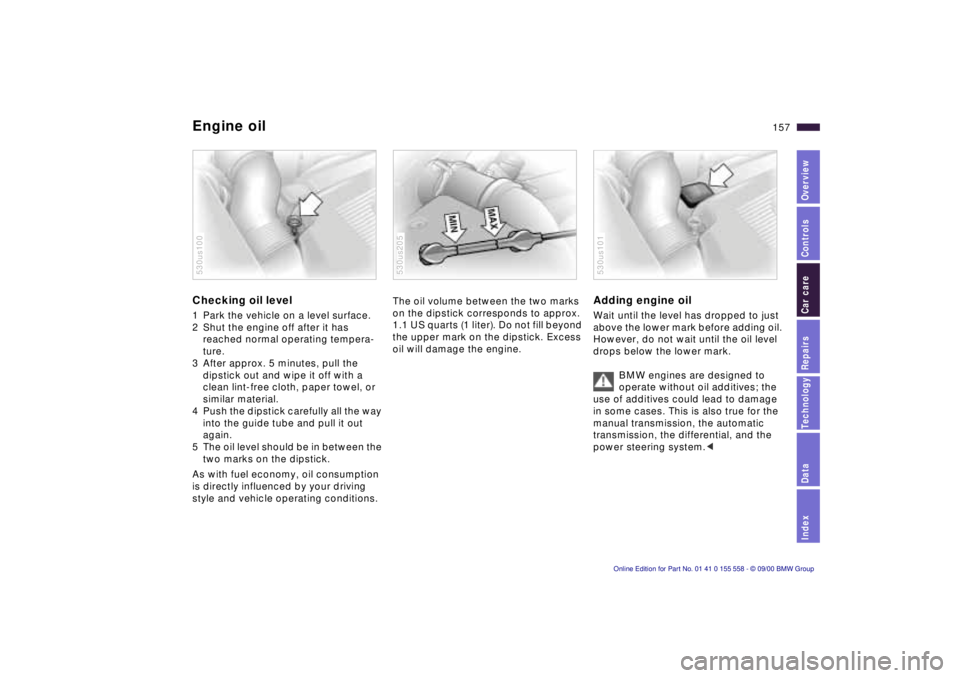
Engine oilChecking oil level1 Park the vehicle on a level surface.
2 Shut the engine off after it has
reached normal operating tempera-
ture.
3 After approx. 5 minutes, pull the
dipstick out and wipe it off with a
clean lint-free cloth, paper towel, or
similar material.
4 Push the dipstick carefully all the way
into the guide tube and pull it out
again.
5 The oil level should be in between the
two marks on the dipstick.
As with fuel economy, oil consumption
is directly influenced by your driving
style and vehicle operating conditions. 530us100
The oil volume between the two marks
on the dipstick corresponds to approx.
1.1 US quarts (1 liter). Do not fill beyond
the upper mark on the dipstick. Excess
oil will damage the engine.530us205
Adding engine oilWait until the level has dropped to just
above the lower mark before adding oil.
However, do not wait until the oil level
drops below the lower mark.
BMW engines are designed to
operate without oil additives; the
use of additives could lead to damage
in some cases. This is also true for the
manual transmission, the automatic
transmission, the differential, and the
power steering system.< 530us101
Page 165 of 223

IndexDataTechnologyRepairsCar careControlsOverview
165n
Caring for your vehicleCaring for the vehicle finish Regular washing is a preventive
measure against long-term effects from
substances that are harmful to the
vehicle's finish, especially if you drive
your vehicle in areas with high levels of
air pollution or aggressive natural
substances (tree resins, pollen).
Nevertheless, you should immediately
remove especially aggressive
substances. Failure to do so can lead to
changes in the paint's chemical struc-
ture or to discoloration. Fuel spilled
during refueling, oil, grease and brake
fluid should always be cleaned away
immediately, as should bird droppings
(finish damage).
Any contamination remaining on the
surface of the vehicle will be especially
conspicuous after washing. Use
cleaning fluid or alcohol with a clean
cloth or cotton pad to remove these
stains. Remove tar spots with tar
remover. After cleaning, the affected
areas should be waxed to ensure
continued protection.
Waxing your vehicle Protect the finish using carnauba or
synthetic-based waxes only.
The best way to determine when the
finish needs to be waxed is by noting
when water stops beading on the
surface.
You can use a glass cleaner to remove
any wax or silicone that may have been
left on the windows during waxing.
Paint damageYou can touch up small areas of
damage with BMW spray paint or a
BMW touchup stick.
The color code of your vehicle is
provided on a tag on the right-hand
panel under the hood and on the first
page of the Service and Warranty Infor-
mation Booklet (US models) or the
Warranty and Service Guide Booklet
(Canadian models).
Damage caused by flying stones,
scratches, etc., must be touched up
without delay to prevent rust from
forming.
If corrosion has started to form in an
area with paint damage, remove all rust
and clean the area. Then prime the area
with a BMW Primer Stick. Finally, apply
the finish coat. After a few days, polish
and protect the touched-in areas.
More extensive paint damage should
be professionally repaired in accor-
dance with the manufacturer's instruc-
tions. Your BMW center uses original
BMW finish materials in accordance
with factory repair procedures.
A full range of car-care products is
available from your BMW center.<
Page 166 of 223

166n
Caring for your vehicleWindow care You can use window and glass cleaner
to clean inside window surfaces and
mirrors without smearing and streaking.
Never use polishing pastes or abrasive
(quartz) cleansers on mirror lenses.
Clean the wiper blades with soapy
water. The wiper blades should be
replaced twice a year, before and after
the cold season.
Use only wiper blades that have
been approved by BMW.<
Caring for other vehicle
components and materialsLight-alloy wheels should be treated
with alloy wheel cleaner, especially
during the winter months. However, do
not use aggressive products containing
acids, strong alkalis or abrasives. Do
not use steam cleaners operating at
temperatures above +140 7 (+60 6).
Follow the manufacturer's instructions.
If your vehicle has chrome parts
* such
as window moldings, door handles or
other items, clean these parts carefully
with ample clean water, especially if
they have an accumulation of road salt.
Use chrome polish as an additional
treatment.
Plastic components, vinyl upholstery,
headliners, lamp lenses, the clear cover
of the instrument cluster and compo-
nents with a sprayed dull black surface
can be cleaned with water (add plastic
cleaner as required). Do not allow mois-
ture to soak through the seats or head-
liner. Never use solvents such as
lacquer thinner, heavy-duty grease
remover, fuels, etc. Rubber components should be cleaned
with water only; a rubber treatment or
silicone spray may also be applied.
The safety belts should be cleaned with
a mild soap and water solution without
being removed from the vehicle. Never
attempt chemical or dry cleaning, as
damage to the belt fabric could result.
After cleaning, never allow the inertia
reel to retract the belts until they are
completely dry. Dirty safety belts
prevent the inertia reel mechanism from
retracting the strap properly, and thus
constitute a safety hazard.
Heavily soiled floor carpets and mats
*
can be cleaned with an interior cleaner.
The floor mats can be removed from
the vehicle for cleaning.
Please use only a damp cloth to clean
wooden fascia panels and components.
Follow up by drying with a soft cloth.
A full range of car-care products is
available from your BMW center.<
Page 173 of 223
IndexDataTechnologyRepairsCar careControlsOverview
Overview
Controls and features
Operation, care
and maintenance
Owner service procedures
Technical data
Index Advanced technology
173n
Replacement procedures:
Onboard tool kit174
Windshield wiper blades174
Lamps and bulbs175
Changing a wheel181
Battery185
Fuses187
In case of electrical
malfunction:
Fuel filler door188
Sliding/Tilt sunroof188
Liftgate188
Tailgate189
Assistance, giving and
receiving:
Jump-starting190
Towing the vehicle191
Repairs
Page 188 of 223
188n
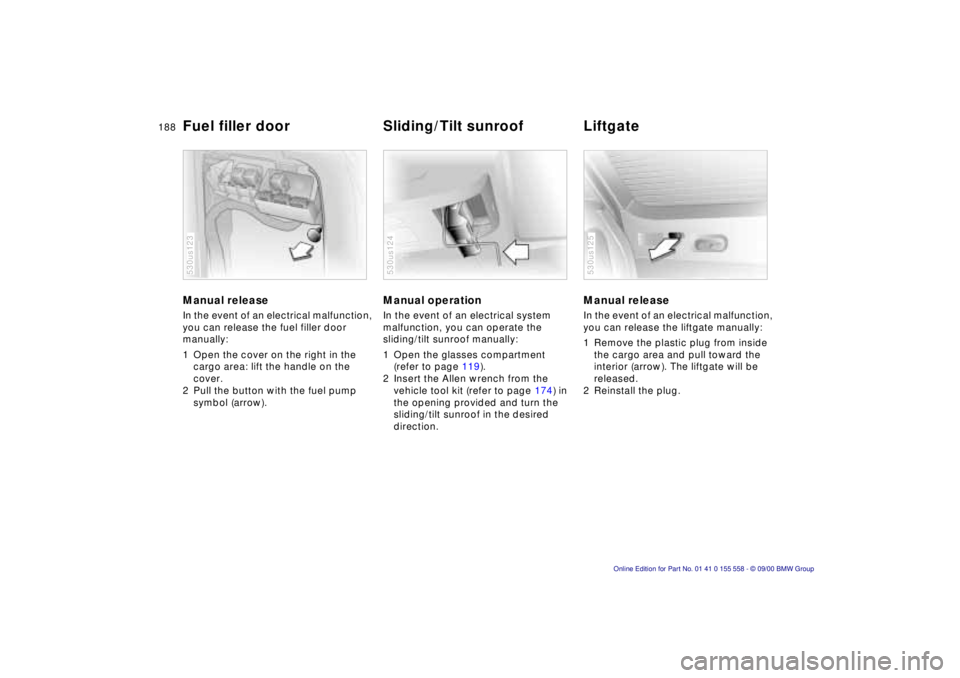
Manual release In the event of an electrical malfunction,
you can release the fuel filler door
manually:
1 Open the cover on the right in the
cargo area: lift the handle on the
cover.
2 Pull the button with the fuel pump
symbol (arrow). 530us123
Manual operationIn the event of an electrical system
malfunction, you can operate the
sliding/tilt sunroof manually:
1 Open the glasses compartment
(refer to page 119).
2 Insert the Allen wrench from the
vehicle tool kit (refer to page 174) in
the opening provided and turn the
sliding/tilt sunroof in the desired
direction.530us124
Manual release In the event of an electrical malfunction,
you can release the liftgate manually:
1 Remove the plastic plug from inside
the cargo area and pull toward the
interior (arrow). The liftgate will be
released.
2 Reinstall the plug. 530us125
Fuel filler door Sliding/Tilt sunroof Liftgate
Page 206 of 223
 181.8 (2,979)
6 268.4 (4,398)
8
Maxim")
206n
An engine performance test is authorized only on an appropriate chassis \
dynamometer. BMW X5 3.0i BMW X5 4.4i
Displacement
Number of cylinders cu in (cm
3) 181.8 (2,979)
6 268.4 (4,398)
8
Maximum output
at engine speed hp
rpm 225
5,900282
5,400
Maximum torque
at engine speed Ib ft (Nm)
rpm 214 (290)
3,500324 (440)
3,600
Compression ratio 10.2 10.0
Stroke
Bore in (mm)
in (mm) 3.53 (89.6)
3.31 (84)3.26 (82.7)
3.62 (92)
Fuel-injection system Digital-electronic engine-management system
Engine specifications
Page 208 of 223

with manual transmission
with automatic transmission lbs. (kg)
lbs.")
208nWeights
BMW X5 3.0i BMW X5 4.4i
Curb weight (with one person, ready for operation, full tank of fuel, o\
ptions not included)
with manual transmission
with automatic transmission lbs. (kg)
lbs. (kg)4,519 (2050)
4,563 (2070) –
4,795 (2,175)
Approved gross vehicle weight
with manual transmission
with automatic transmission lbs. (kg)
lbs. (kg)6,005 (2,724)
6,005 (2,724) –
6,005 (2,724)
Approved front axle weight lbs. (kg) 2,787 (1,264) 2,787 (1,264)
Approved rear axle weight lbs. (kg) 3,307 (1,500) 3,307 (1,500)
Approved roof load capacity lbs. (kg) 220 (100)
Never exceed either the approved axle weights or the gross vehicle weigh\
t.
Cargo area capacity cu ft (l) 16.1 - 54.4 (455 - 1,540)