brake BMW X5 4.4I 2003 Owner's Manual
[x] Cancel search | Manufacturer: BMW, Model Year: 2003, Model line: X5 4.4I, Model: BMW X5 4.4I 2003Pages: 183, PDF Size: 2.31 MB
Page 130 of 183

130n
Break-in proceduresTo ensure that your vehicle provides
maximum economy throughout a long
service life, we request that you
observe the following instructions: Engine and differential Up to 1,200 miles/2,000 km:
Drive at varying engine speeds and
road speeds, but do not exceed
4,500 rpm and the following road
speeds during this initial period:
6-cylinder engines: 100 mph/160 km/h
8-cylinder engines: 106 mph/170 km/h
Obey your local and state maximum
speed limits.
Refrain from using full throttle and avoid
pressing the accelerator beyond the
kickdown point.
Once you have driven 1,200 miles/
2,000 km, engine and vehicle speeds
can gradually be increased.
You should also comply with these
break-in procedures should the engine
or one of the differentials be replaced
later in the course of the vehicle's ser-
vice life.
TiresDue to technical factors associated
with their manufacture, tires do not
achieve their full traction potential until
an initial break-in period has elapsed.
For this reason, drive with extra care
during the initial 200 miles/300 km.
Obey your local and state maximum
speed limits.
When the vehicle is operated on
wet or slushy roads, a wedge of
water may form between the tire and
the road surface. This phenomenon is
referred to as aquaplaning, or hydro-
planing, and can lead to partial or com-
plete loss of traction, vehicle control
and braking effectiveness. Reduce your
speed on wet roads.<
Brake systemApprox. 300 miles/500 km must elapse
before the brake pads and rotors
achieve the optimal pad-surface and
wear patterns required for trouble-free
operation and long service life later on.
To break in the separate parking brake
drums, apply the parking brake lightly
when coasting to a standstill at a traffic
signal, for instance, provided that traffic
conditions allow you to do so.
To avoid corrosion, repeat this proce-
dure from time to time.
The brake lamps do not light up
when the parking brake is applied.
Vacuum for the brake system servo unit
on your BMW is available only when the
engine is running. When you move the
vehicle with the engine switched off Ð
when towing, for instance Ð substan-
tially higher levels of pedal force will be
required to brake the vehicle.<
Page 131 of 183

131n
OverviewControlsMaintenanceRepairsDataIndex
Driving your BMW X5 Your BMW is right at home on all roads
and byways Ð even where the pavement
ends. It combines permanent four-
wheel drive with the agility of a typical
passenger vehicle. On bad roadsWhen you are driving on bad roads,
there are a few points which you should
strictly observe Ñ for your own safety,
for that of your passengers, and for the
safety of the vehicle:
>Familiarize yourself with the vehicle
before you begin driving. Do not take
risks with the vehicle under any cir-
cumstances
>Always adapt vehicle speed to road
conditions Ð the steeper and more
uneven the road surface is, the
slower the vehicle's speed should be
>You can operate your vehicle on
uphill and downhill gradients with a
maximum slope of 50 %. If you intend
to drive on either an uphill or downhill
gradient of this steepness, check to
be sure in advance that the engine oil
and coolant levels are both near the
MAX mark, refer to pages 141
and 143.
When driving down steep slopes, use
the Hill Descent Control HDC, refer to
page 93. Starting from a full stop is possible on
uphill gradients of up to 32 %.
The permitted side tilt is also 50 %
>While driving, watch carefully for
obstacles such as rocks or holes. Try
to avoid these obstacles whenever
possible
>On hill crests and bumpy roads, for
example, be careful to prevent the
body from bottoming Ð contact
between the body and the ground.
The ground clearance of the vehicle
is:
8 in/200 mm with up to four
passengers
7 in/180 mm fully loaded Ð without
self-leveling suspension
>Do not drive in water that is deeper
than 20 inches/50 cm. If you must
drive through water up to that depth,
drive at a walking speed and do not
stop.
After leaving the water, press on the
footbrake gently several times while
driving at a low speed. The brake
applications will help to dry the
brakes, thus preventing a reduction in
braking performance caused by the
moisture.
Back onto the paved road In recommending that you observe the
following points after driving on adverse
road surfaces, it is not as a beauty
treatment for your BMW. Instead, it is
intended for the maintenance of driving
safety:
>Clean accumulations of dirt from the
body and check the undercarriage for
damage
>Clean mud, snow, ice and other
materials from the wheels and tires.
Check the tires for damage
>Check to determine whether rocks,
gravel or accumulations of dirt on the
brake rotors and calipers could influ-
ence braking performance. Remove
all such foreign objects
>In order to clean the brake rotors,
apply the footbrake gently several
times while driving at a low speed. Be
sure that following traffic is not
endangered by this
>For cleaning the parking brake, apply
the lever slightly at approx. 25 mph/
40 km/h and continue to drive for
approx. 200 yards/200 meters, pro-
vided that traffic conditions allow you
to do so.
Page 132 of 183

132n
General driving notes
Antilock Brake System
Brake system
Brakes:
Do not drive with your foot resting
on the brake pedal. Even light but con-
sistent pedal pressure can lead to high
temperatures, brake wear and possibly
even brake failure.
Hydroplaning:
When driving on wet or slushy roads,
reduce vehicle speed. If you do not, a
wedge of water may form between the
tires and the road surface. This phe-
nomenon is referred to as hydroplaning
or aquaplaning. It is characterized by a
partial or complete loss of contact
between the tires and the road surface.
The ultimate results are loss of steering
and braking control.<
The conceptThe Antilock Brake System ABS keeps
the wheels from locking during braking,
thereby enhancing active driving safety.Braking with ABSIf you are in a situation that requires full
braking, you will exploit the full benefits
of the ABS system if you apply max-
imum pedal pressure Ð panic stop.
Pulsation at the brake pedal combined
with sounds from the hydraulic circuits
indicates to the driver that ABS is in its
active mode.
Brake fluid levelIf the brake fluid level is too low and
brake pedal travel has become longer,
there may be a defect in one of the two
brake system's hydraulic circuits.
Proceed to the nearest
BMW Sports Activity Vehicle
center. Here increased pressure on the
brake pedal may be required, and slight
pulling to the side and longer braking
distances may result. Please remember
to adapt your driving style accord-
ingly.<
Page 133 of 183
133n
OverviewControlsMaintenanceRepairsDataIndex
Brake systemDisc brakesWhen the vehicle is driven only occa-
sionally, during extended periods when
the vehicle is not used at all, and in
operating conditions where brake appli-
cations are less frequent, there is an
increased tendency for corrosion of the
rotors and accumulation of contamina-
tion on the brake pads. This occurs
because the minimal pressure which
must be exerted by the pads to clean
the discs by brake applications is not
reached.
If the brake rotors are corroded, they
will tend to respond to braking with a
pulsating effect which even extended
application will fail to cure.
When driving in wet conditions and in
heavy rain, it is advisable to apply light
pressure to the brake pedal from time
to time. Watch traffic conditions to
ensure that this maneuver does not
endanger other road users. The heat
which is generated by the brake appli-
cations helps to dry the brake pads and
rotors. The braking force is then imme-
diately available when required.Extended or steep mountain descents
should be driven in the gear in which
only minimal periodic brake application
is required. This avoids excessive strain
on the brakes and possible impairment
of the braking effect.
Do not coast with the clutch
depressed or with the transmis-
sion or selector lever in neutral. Do not
drive with the engine switched off. The
engine provides no braking effect when
the clutch is depressed or the transmis-
sion is in neutral, and there is no
power-assist for braking or steering
when the engine is not running.
BMW recommends having brake
inspections performed at a BMW
Sports Activity Vehicle center only. If
you do not, parts of the four-wheel
drive system could be damaged.
Never allow floor mats, carpets or any
other objects to protrude into the area
around the accelerator, clutch and
brake pedals and obstruct their move-
ment.<
Brake pads
For your own safety: use only
brake pads that BMW has
released for your particular vehicle
model. BMW cannot evaluate non-
approved brake pads to determine if
they are suited for use, and therefore
cannot ensure the operating safety of
the vehicle if they are installed.<
Page 140 of 183
140n
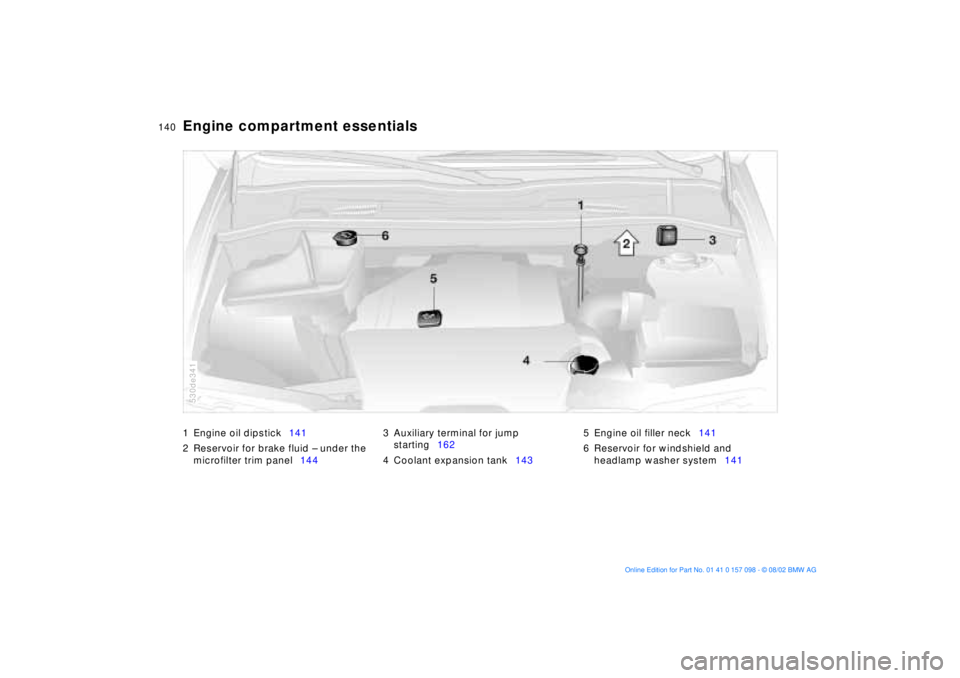
1 Engine oil dipstick141
2 Reservoir for brake fluid Ð under the
microfilter trim panel144 3 Auxiliary terminal for jump
starting162
4 Coolant expansion tank1435 Engine oil filler neck141
6 Reservoir for windshield and
headlamp washer system141
Engine compartment essentials
530de341
Page 144 of 183

144n
Brake fluidBrake fluid level
If the indicator lamp for the
brake hydraulic system appears
or if the CHECK BRAKE FLUID
warning appears in the Check
Control: the brake fluid level is
too low.
Add brake fluidThe brake fluid reservoir is located
under the microfilter housing trim panel
on the driver's side of the vehicle. For
adding brake fluid or for determining
and correcting the cause of brake fluid
loss, consult your BMW Sports Activity
Vehicle center. Your BMW Sports
Activity Vehicle center is familiar with
the specifications for factory-approved
brake fluids Ð DOT 4.
Brake fluid loss may result in extended
brake pedal travel. For this situation,
refer to the notes on page 132.
Brake fluid is hygroscopic, that is,
it absorbs moisture from the air
over time.
In order to ensure the safety and reli-
ability of the brake system, have the
brake fluid changed every two years by
a BMW Sports Activity Vehicle center.
Refer also to the Service and Warranty
Information Booklet for US models or
the Warranty and Service Guide
Booklet for Canadian models.
Brake fluid is toxic and damages the
vehicle's paint. You should always store
it in its original container and in a loca-
tion which is out of reach of children.
Do not spill the fluid and do not fill the
brake fluid reservoir beyond the
MAX mark. The brake fluid could ignite
upon contact with hot engine parts and
cause serious burns.<
Comply with the applicable envi-
ronmental laws regulating the
disposal of brake fluid.<
Page 153 of 183
153n
OverviewControlsMaintenanceRepairsDataIndex
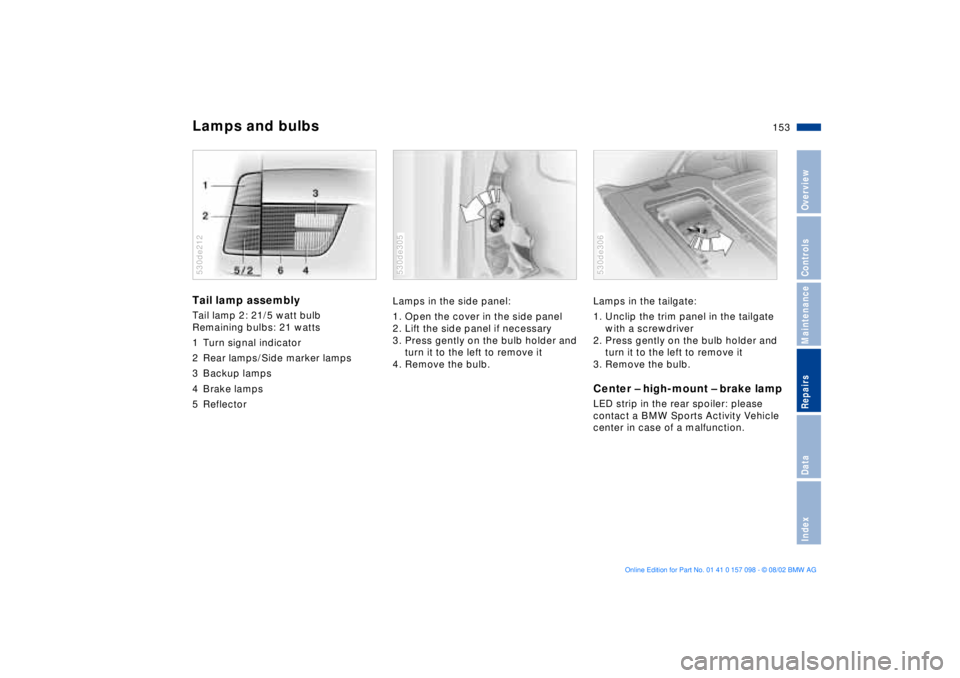
Lamps and bulbs Tail lamp assembly Tail lamp 2: 21/5 watt bulb
Remaining bulbs: 21 watts
1 Turn signal indicator
2 Rear lamps/Side marker lamps
3 Backup lamps
4 Brake lamps
5 Reflector 530de212
Lamps in the side panel:
1. Open the cover in the side panel
2. Lift the side panel if necessary
3. Press gently on the bulb holder and
turn it to the left to remove it
4. Remove the bulb. 530de305
Lamps in the tailgate:
1. Unclip the trim panel in the tailgate
with a screwdriver
2. Press gently on the bulb holder and
turn it to the left to remove it
3. Remove the bulb. Center Ð high-mount Ð brake lamp LED strip in the rear spoiler: please
contact a BMW Sports Activity Vehicle
center in case of a malfunction. 530de306
Page 154 of 183
154n
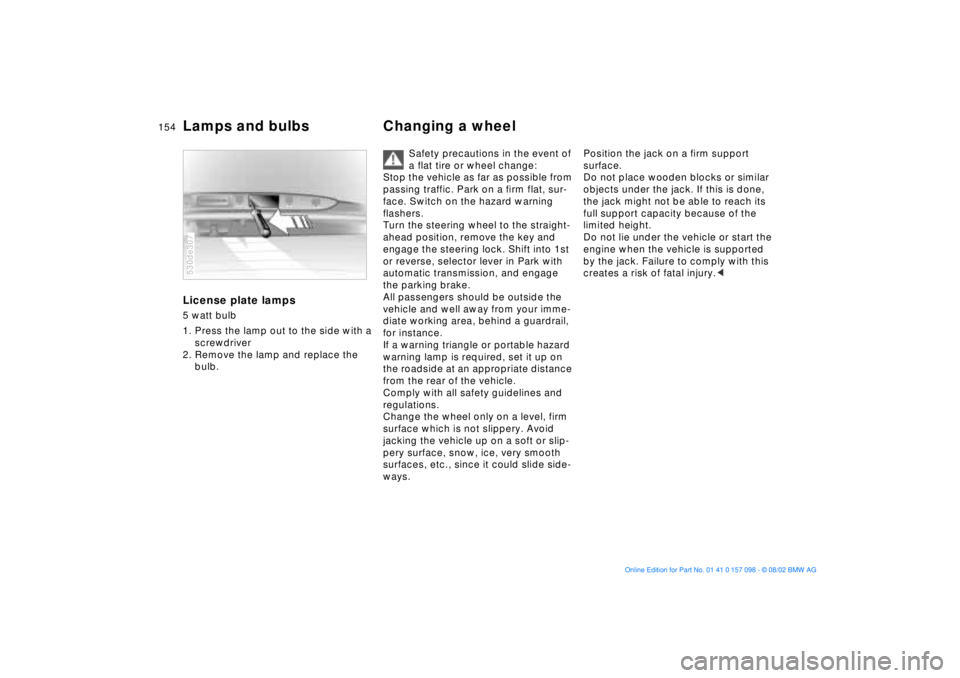
Lamps and bulbs Changing a wheel License plate lamps 5 watt bulb
1. Press the lamp out to the side with a
screwdriver
2. Remove the lamp and replace the
bulb. 530de307
Safety precautions in the event of
a flat tire or wheel change:
Stop the vehicle as far as possible from
passing traffic. Park on a firm flat, sur-
face. Switch on the hazard warning
flashers.
Turn the steering wheel to the straight-
ahead position, remove the key and
engage the steering lock. Shift into 1st
or reverse, selector lever in Park with
automatic transmission, and engage
the parking brake.
All passengers should be outside the
vehicle and well away from your imme-
diate working area, behind a guardrail,
for instance.
If a warning triangle or portable hazard
warning lamp is required, set it up on
the roadside at an appropriate distance
from the rear of the vehicle.
Comply with all safety guidelines and
regulations.
Change the wheel only on a level, firm
surface which is not slippery. Avoid
jacking the vehicle up on a soft or slip-
pery surface, snow, ice, very smooth
surfaces, etc., since it could slide side-
ways.
Position the jack on a firm support
surface.
Do not place wooden blocks or similar
objects under the jack. If this is done,
the jack might not be able to reach its
full support capacity because of the
limited height.
Do not lie under the vehicle or start the
engine when the vehicle is supported
by the jack. Failure to comply with this
creates a risk of fatal injury.<
Page 165 of 183
165n
OverviewControlsMaintenanceRepairsDataIndex
Towing the vehicle Towing a vehicle with automatic
transmission1. Place the selector lever in position N
2. Towing speed:
Maximum 45 mph/70 km/h
3. Towing distance:
Maximum 95 miles/150 km
4. Turn the ignition key to position 1 to
ensure that the brake lamps, turn
signal indicators, horn and wind-
shield wipers remain operative, and
to prevent the steering lock from
engaging
5. Switch on the hazard warning
flashers, comply with country-spe-
cific regulations.
In the event of electrical malfunction,
find some means of identifying the
vehicle in tow, for instance, place a sign
or warning triangle in the rear window.
Make sure that the ignition key
remains in position 1 even when
the electrical system has failed. This will
prevent the steering lock from
engaging. The steering and brakes are
without power assist when the engine is
not running. This means that increased
effort is required for steering and
braking.<
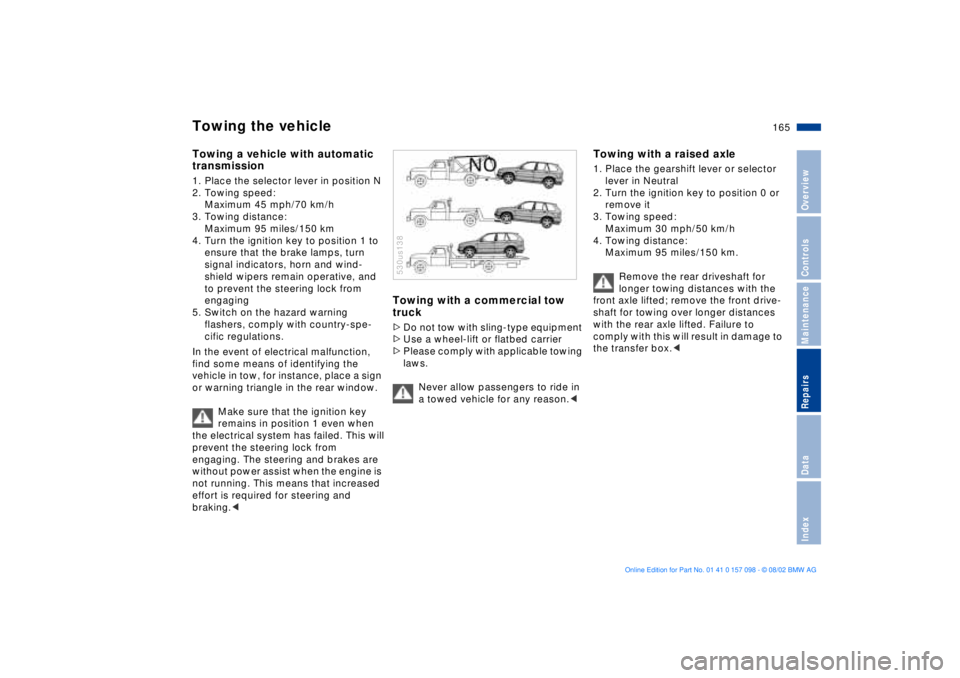
Towing with a commercial tow
truck >Do not tow with sling-type equipment
>Use a wheel-lift or flatbed carrier
>Please comply with applicable towing
laws.
Never allow passengers to ride in
a towed vehicle for any reason.< 530us138
Towing with a raised axle 1. Place the gearshift lever or selector
lever in Neutral
2. Turn the ignition key to position 0 or
remove it
3. Towing speed:
Maximum 30 mph/50 km/h
4. Towing distance:
Maximum 95 miles/150 km.
Remove the rear driveshaft for
longer towing distances with the
front axle lifted; remove the front drive-
shaft for towing over longer distances
with the rear axle lifted. Failure to
comply with this will result in damage to
the transfer box.<
Page 174 of 183

Everything from A to ZAABS Antilock Brake
System20, 132
Accessories9
Activated-charcoal
filter110
Adaptive brake light98
Adding
brake fluid144
coolant143
engine oil141
washer fluid141
Adjusting
head restraints47
mirrors53
seats44
steering wheel52
thigh support45
Air conditioner102
Air distribution103, 107
Air outlets102, 105
Air supply103, 107
Airbags20, 55
Alarm system39
Antifreeze143
Antilock Brake System
ABS20, 132
Anti-theft system31
Approved gross vehicle
weight170
Aquaplaning132, 134Arrival time87
Ashtray
front117
rear118
AUC Automatic recirculated-
air control108
Automatic climate
control105
removing condensation
from the windows107
Automatic cruise control71
Automatic curb monitor51
Automatic dimming
exterior rearview
mirrors54
interior rearview mirror54
Automatic headlamp
control99
Automatic recirculated-air
control AUC108
Automatic steering wheel
adjustment52
Automatic transmission with
Steptronic65
Average fuel
consumption80
Average speed80, 88
Avoiding unintentional
alarms40
Axle loads170
BBackup lamps65
bulb replacement153
Battery160
charge160
discharged163
Battery charge indicator
lamp19
Battery, disposal160
Belts49
Beverage holder116
Blower103, 107
BMW comfort seat46
BMW High Performance
Synthetic Oil142
BMW Maintenance
System145
BMW sports seat45
BMW Universal
Transmitter112
Brake fluid144
Brake fluid level144
Brake lamps
bulb replacement153
Brake light, adaptive98Brake system132
brake fluid144
brake fluid level133
brake pads indicator21
disc brakes133
hydraulic system
indicator19
malfunctions132
Break-in procedures130
Bulbs and lamps151
CCalifornia Proposition
65 Warning146
Can holder, refer to
beverage holder116
Capacities171
Cargo area38, 120
capacity170
cover120
lamps101
partition net122
Cargo floor, pull-out124
Cargo loading126
Cellular phone116
hands-free system116
Center Ð high-mount Ð brake
lamp153
Center (high-mount) brake
lamp153