light BMW X5 4.4I 2004 E53 User Guide
[x] Cancel search | Manufacturer: BMW, Model Year: 2004, Model line: X5 4.4I, Model: BMW X5 4.4I 2004 E53Pages: 200, PDF Size: 3.91 MB
Page 49 of 200
47n
OverviewControlsMaintenanceRepairsDataIndex
Power seat adjustment
*
Head restraints
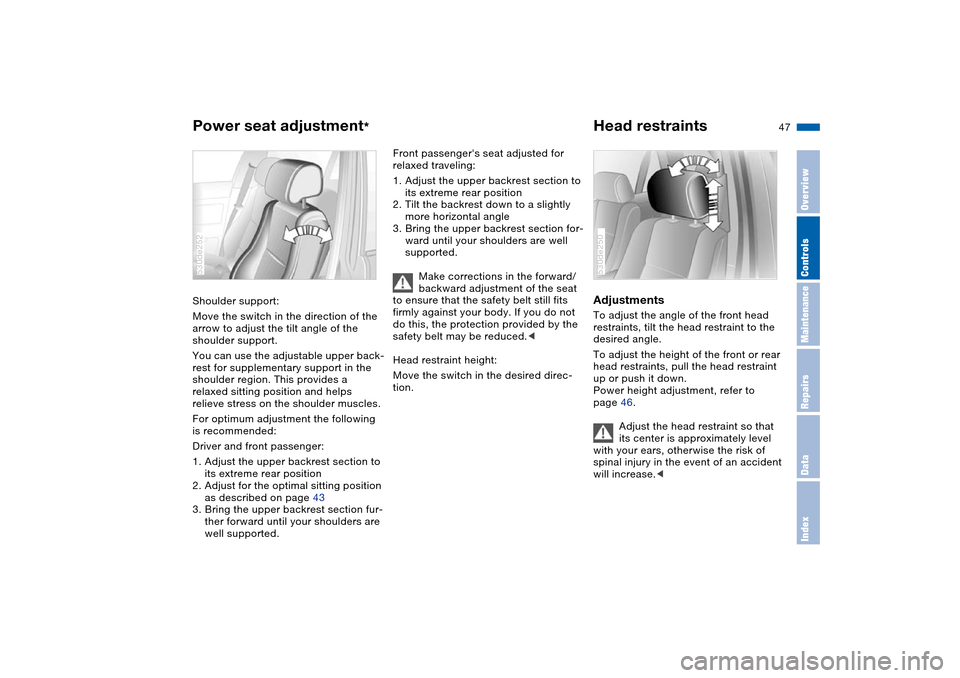
Shoulder support:
Move the switch in the direction of the
arrow to adjust the tilt angle of the
shoulder support.
You can use the adjustable upper back-
rest for supplementary support in the
shoulder region. This provides a
relaxed sitting position and helps
relieve stress on the shoulder muscles.
For optimum adjustment the following
is recommended:
Driver and front passenger:
1. Adjust the upper backrest section to
its extreme rear position
2. Adjust for the optimal sitting position
as described on page 43
3. Bring the upper backrest section fur-
ther forward until your shoulders are
well supported.530de252
Front passenger's seat adjusted for
relaxed traveling:
1. Adjust the upper backrest section to
its extreme rear position
2. Tilt the backrest down to a slightly
more horizontal angle
3. Bring the upper backrest section for-
ward until your shoulders are well
supported.
Make corrections in the forward/
backward adjustment of the seat
to ensure that the safety belt still fits
firmly against your body. If you do not
do this, the protection provided by the
safety belt may be reduced.<
Head restraint height:
Move the switch in the desired direc-
tion.
Adjustments To adjust the angle of the front head
restraints, tilt the head restraint to the
desired angle.
To adjust the height of the front or rear
head restraints, pull the head restraint
up or push it down.
Power height adjustment, refer to
page 46.
Adjust the head restraint so that
its center is approximately level
with your ears, otherwise the risk of
spinal injury in the event of an accident
will increase.<530de250
Page 51 of 200
49n
OverviewControlsMaintenanceRepairsDataIndex
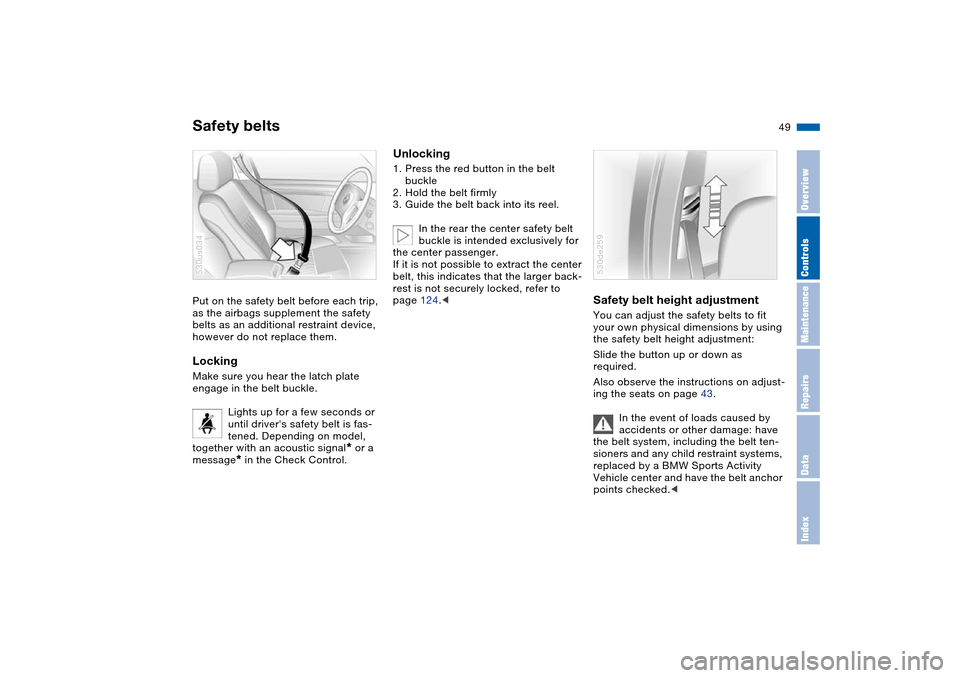
Safety beltsPut on the safety belt before each trip,
as the airbags supplement the safety
belts as an additional restraint device,
however do not replace them.Locking Make sure you hear the latch plate
engage in the belt buckle.
Lights up for a few seconds or
until driver's safety belt is fas-
tened. Depending on model,
together with an acoustic signal
* or a
message
* in the Check Control.
530us034
Unlocking1. Press the red button in the belt
buckle
2. Hold the belt firmly
3. Guide the belt back into its reel.
In the rear the center safety belt
buckle is intended exclusively for
the center passenger.
If it is not possible to extract the center
belt, this indicates that the larger back-
rest is not securely locked, refer to
page 124.<
Safety belt height adjustment You can adjust the safety belts to fit
your own physical dimensions by using
the safety belt height adjustment:
Slide the button up or down as
required.
Also observe the instructions on adjust-
ing the seats on page 43.
In the event of loads caused by
accidents or other damage: have
the belt system, including the belt ten-
sioners and any child restraint systems,
replaced by a BMW Sports Activity
Vehicle center and have the belt anchor
points checked.c530de259
Page 53 of 200
51n
OverviewControlsMaintenanceRepairsDataIndex
Seat, mirror and steering wheel memory
*
You can have your vehicle pro-
grammed to automatically dial in
your own individual adjustment settings
for the seat, mirrors and steering wheel
whenever you use your personal
remote control to unlock the vehicle.<
If you make use of this adjust-
ment, be sure that the footwell
behind the driver's seat is unobstructed
before unlocking the vehicle. If you fail
to do so, any persons or objects behind
the seat could be injured or damaged
by a rearward movement of the seat.<
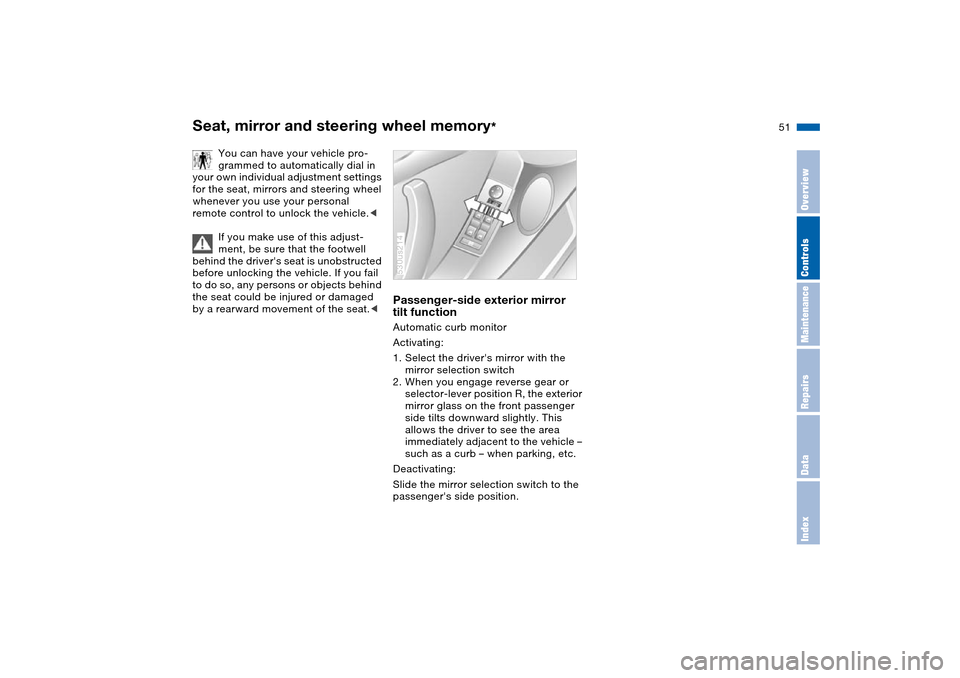
Passenger-side exterior mirror
tilt function Automatic curb monitor
Activating:
1. Select the driver's mirror with the
mirror selection switch
2. When you engage reverse gear or
selector-lever position R, the exterior
mirror glass on the front passenger
side tilts downward slightly. This
allows the driver to see the area
immediately adjacent to the vehicle –
such as a curb – when parking, etc.
Deactivating:
Slide the mirror selection switch to the
passenger's side position.530us214
Page 54 of 200
52n
Heated seats
*
Steering wheel
Front The seat cushion and backrest can be
heated when the ignition key is in posi-
tion 2.
You can call up different heating modes
by repeatedly pressing the button.
You can also switch the higher heating
modes off directly:
Press the button and hold it slightly
longer.530de233
Rear The operating concept is the same as
for the front heated seats. You can
select between two heating modes.530de234
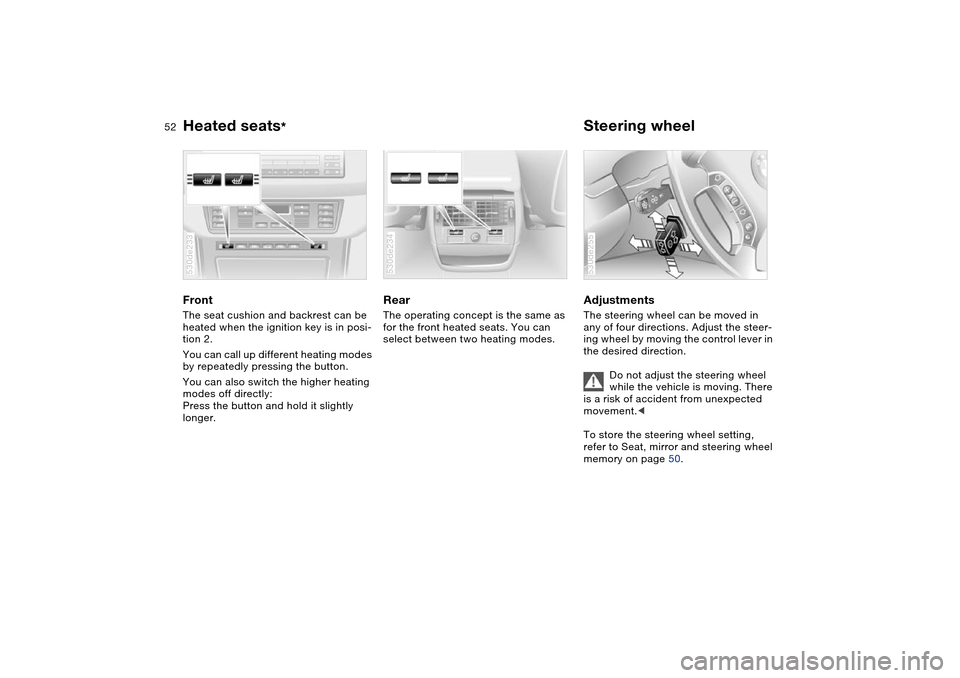
Adjustments The steering wheel can be moved in
any of four directions. Adjust the steer-
ing wheel by moving the control lever in
the desired direction.
Do not adjust the steering wheel
while the vehicle is moving. There
is a risk of accident from unexpected
movement.<
To store the steering wheel setting,
refer to Seat, mirror and steering wheel
memory on page 50. 530de255
Page 55 of 200
53n
OverviewControlsMaintenanceRepairsDataIndex
Steering wheel Steering wheel heater
*
Automatic steering wheel
adjustmentonly in conjunction with seat, mirror and
steering wheel memory
In order to make it easier to get into and
out of the vehicle, the steering wheel
automatically moves into the top posi-
tion and returns to the driving or mem-
ory position.
This automatic feature is controlled by
the position of the ignition key and by
the driver's door.
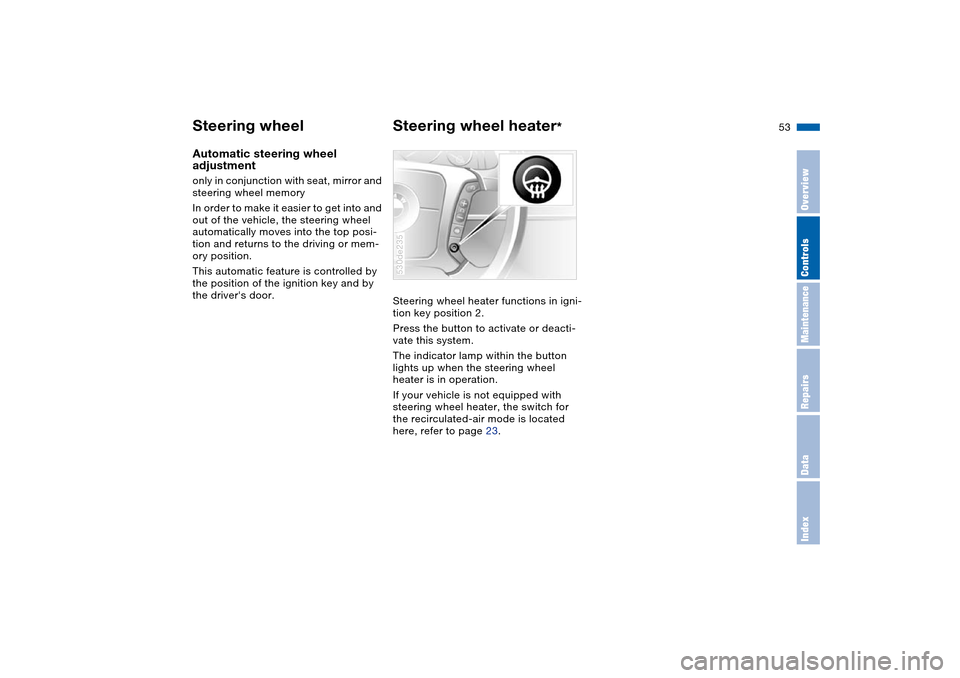
Steering wheel heater functions in igni-
tion key position 2.
Press the button to activate or deacti-
vate this system.
The indicator lamp within the button
lights up when the steering wheel
heater is in operation.
If your vehicle is not equipped with
steering wheel heater, the switch for
the recirculated-air mode is located
here, refer to page 23.
530de235
Page 57 of 200
55n
OverviewControlsMaintenanceRepairsDataIndex
MirrorsInterior and exterior mirrors,
automatic dimming feature
*
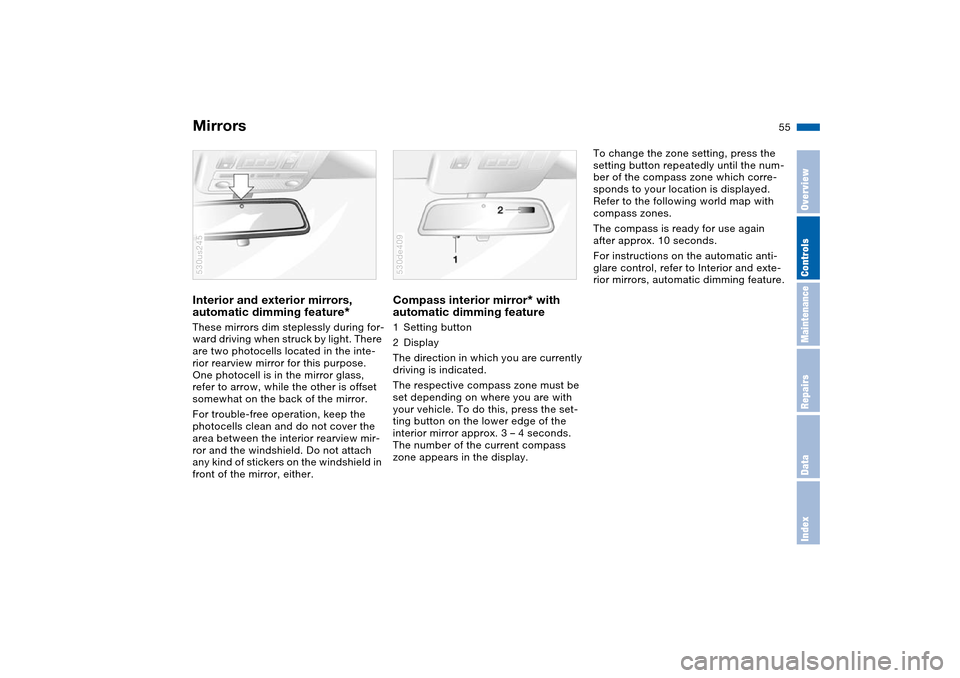
These mirrors dim steplessly during for-
ward driving when struck by light. There
are two photocells located in the inte-
rior rearview mirror for this purpose.
One photocell is in the mirror glass,
refer to arrow, while the other is offset
somewhat on the back of the mirror.
For trouble-free operation, keep the
photocells clean and do not cover the
area between the interior rearview mir-
ror and the windshield. Do not attach
any kind of stickers on the windshield in
front of the mirror, either. 530us245
Compass interior mirror
* with
automatic dimming feature
1Setting button
2Display
The direction in which you are currently
driving is indicated.
The respective compass zone must be
set depending on where you are with
your vehicle. To do this, press the set-
ting button on the lower edge of the
interior mirror approx. 3 – 4 seconds.
The number of the current compass
zone appears in the display.530de409
To change the zone setting, press the
setting button repeatedly until the num-
ber of the compass zone which corre-
sponds to your location is displayed.
Refer to the following world map with
compass zones.
The compass is ready for use again
after approx. 10 seconds.
For instructions on the automatic anti-
glare control, refer to Interior and exte-
rior mirrors, automatic dimming feature.
Page 61 of 200
59n
OverviewControlsMaintenanceRepairsDataIndex
Airbags Transporting children safely Airbag system operational
The warning lamp in the instru-
ment cluster indicates the oper-
ational readiness of the entire
airbag system and the safety belt ten-
sioners as of ignition key position 1.
The warning lamp goes out after a few
seconds.
Airbag system malfunction
Have the airbag system checked
immediately if a malfunction
occurs, as otherwise there is a danger
of the system failing to respond in the
expected manner to an impact occur-
ring within its normal response range.<
A fault has occurred in the air-
bag system:
>Warning lamp does not light up as of
ignition key position 1
>Warning lamp lights up continuously
>Warning lamp lights up while the
vehicle is being driven.
The right place for children Children always in the rear:
Accident research shows that the saf-
est place for children in a vehicle is in
the rear seat.
Older children should be tightly secured
with a safety belt, after they have out-
grown a booster seat that is appropri-
ate for their age, height and weight.
A child sitting in the rear seat and
not properly restrained may place
his or her head on or near the airbag, if
so equipped. For example, a child –
even though belted – may fall asleep
with his or her head against the side air-
bag. It may be difficult for a driver to
ensure that children in the rear seat will
remain properly positioned at all times
and do not place their heads on or near
the side airbag. Therefore, we recom-
mend that the rear side airbags, if pro-
vided, be deactivated if you plan to
transport children in the rear seat.<
Child-restraint systems in the rearChild-restraint systems appropriate for
every age group and weight are avail-
able at your BMW Sports Activity Vehi-
cle center.
Children under 13 years of age
and children less than 5 ft/150 cm
tall should always ride in the rear and
the restraint systems should be secured
with the vehicle's safety belts.<
No universal child-restraint sys-
tems facing the rear of the vehicle
may be mounted on the rear seats.
If you want to use a rearward-facing
child-restraint system in the rear, then
the BMW Baby Seat with or without the
LATCH child-restraint fixing is suitable
for this purpose.<
Younger children should be secured in
an appropriate forward-facing child-
restraint system that has first been
properly secured with a safety belt.
All rear sitting positions in your
vehicle meet the recommendations of
SAE J1819, an industry-recommended
practice for securing child-restraint sys-
tems in motor vehicles.
Page 65 of 200
63n
OverviewControlsMaintenanceRepairsDataIndex
Vehicle Memory, Key Memory How the system functions You have probably frequently wished
that you could configure individual
functions of your vehicle to reflect your
own personal requirements. In engi-
neering your vehicle, BMW has
included several user-defined func-
tions in the vehicle's design. Your
BMW Sports Activity Vehicle center can
make these settings for you.
There are vehicle and person-related
adjustments: Vehicle Memory and Key
Memory. You can configure up to four
different basic positions for four differ-
ent persons. The only requirement is
that each person uses his or her own
remote control key.
When your vehicle is unlocked with the
remote control, the vehicle recognizes
the individual user by means of a data
exchange with the key, and makes
adjustments accordingly.
In order for you to distinguish between
the master keys with remote control,
color-coded decals are supplied
together with the keys.
What the system can doYour BMW Sports Activity Vehicle cen-
ter can provide you with details on the
capabilities of the Vehicle Memory and
Key Memory systems.
You will see this symbol through-
out the Owner's Manual. It is to
remind you at appropriate places of the
settings that are available to you.<
Following configuration of the
memory functions, vehicle opera-
tion may differ from the description in
the Owner's Manual. Should you want
to sell your BMW some day, please
remember to have the memory func-
tions reset to the default state.<
Examples for Vehicle Memory:
>Various signals that can serve as
acknowledgment for locking and
unlocking the vehicle, refer to
pages 31, 33
>Deactivating/activating the pathway
lighting function, refer to page 102.
Examples for Key Memory:
>Automatic adjustment of the driver's
seat, exterior mirror and steering
wheel with settings stored in the
memory for the individual driver when
the vehicle is unlocked, refer to
page 51
>Calling up customized settings for
the automatic climate control when
unlocking the vehicle, refer to
page 111.
Page 66 of 200
64n
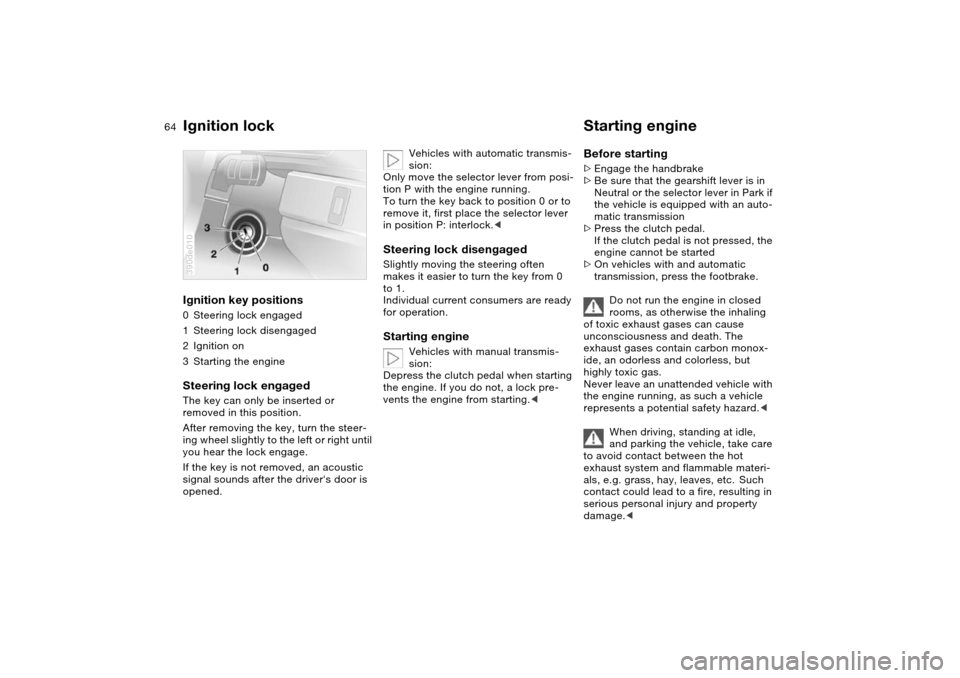
Ignition lock Starting engine Ignition key positions 0Steering lock engaged
1Steering lock disengaged
2Ignition on
3Starting the engineSteering lock engaged The key can only be inserted or
removed in this position.
After removing the key, turn the steer-
ing wheel slightly to the left or right until
you hear the lock engage.
If the key is not removed, an acoustic
signal sounds after the driver's door is
opened.390de010
Vehicles with automatic transmis-
sion:
Only move the selector lever from posi-
tion P with the engine running.
To turn the key back to position 0 or to
remove it, first place the selector lever
in position P: interlock.<
Steering lock disengaged Slightly moving the steering often
makes it easier to turn the key from 0
to 1.
Individual current consumers are ready
for operation. Starting engine
Vehicles with manual transmis-
sion:
Depress the clutch pedal when starting
the engine. If you do not, a lock pre-
vents the engine from starting.<
Before starting >Engage the handbrake
>Be sure that the gearshift lever is in
Neutral or the selector lever in Park if
the vehicle is equipped with an auto-
matic transmission
>Press the clutch pedal.
If the clutch pedal is not pressed, the
engine cannot be started
>On vehicles with and automatic
transmission, press the footbrake.
Do not run the engine in closed
rooms, as otherwise the inhaling
of toxic exhaust gases can cause
unconsciousness and death. The
exhaust gases contain carbon monox-
ide, an odorless and colorless, but
highly toxic gas.
Never leave an unattended vehicle with
the engine running, as such a vehicle
represents a potential safety hazard.<
When driving, standing at idle,
and parking the vehicle, take care
to avoid contact between the hot
exhaust system and flammable materi-
als, e.g. grass, hay, leaves, etc. Such
contact could lead to a fire, resulting in
serious personal injury and property
damage.<
Page 68 of 200
66n
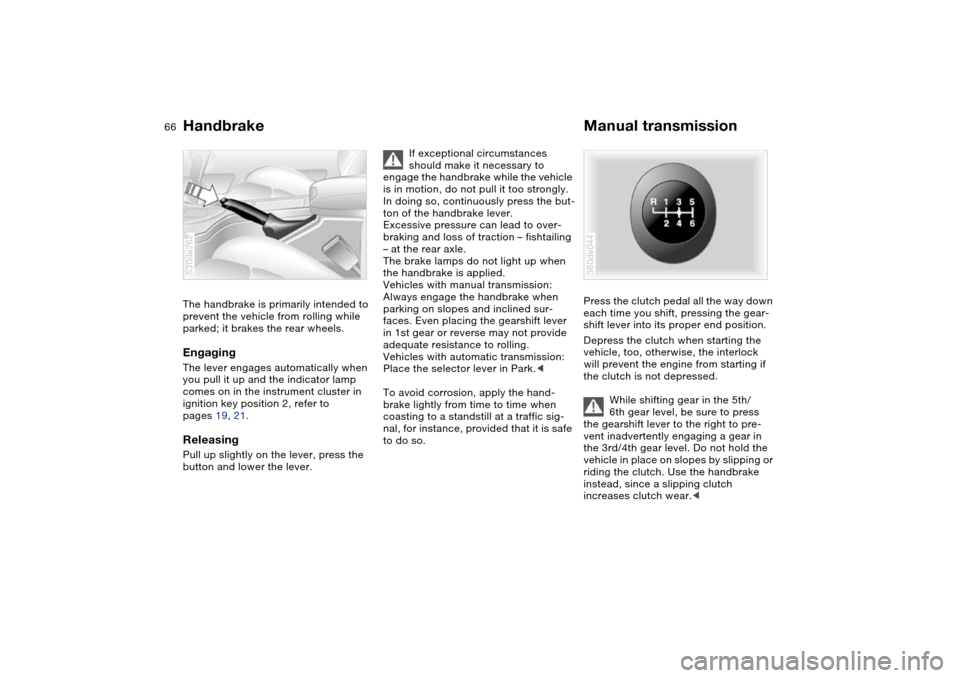
Handbrake Manual transmissionThe handbrake is primarily intended to
prevent the vehicle from rolling while
parked; it brakes the rear wheels.EngagingThe lever engages automatically when
you pull it up and the indicator lamp
comes on in the instrument cluster in
ignition key position 2, refer to
pages 19, 21.Releasing Pull up slightly on the lever, press the
button and lower the lever. 530de262
If exceptional circumstances
should make it necessary to
engage the handbrake while the vehicle
is in motion, do not pull it too strongly.
In doing so, continuously press the but-
ton of the handbrake lever.
Excessive pressure can lead to over-
braking and loss of traction – fishtailing
– at the rear axle.
The brake lamps do not light up when
the handbrake is applied.
Vehicles with manual transmission:
Always engage the handbrake when
parking on slopes and inclined sur-
faces. Even placing the gearshift lever
in 1st gear or reverse may not provide
adequate resistance to rolling.
Vehicles with automatic transmission:
Place the selector lever in Park.<
To avoid corrosion, apply the hand-
brake lightly from time to time when
coasting to a standstill at a traffic sig-
nal, for instance, provided that it is safe
to do so.
Press the clutch pedal all the way down
each time you shift, pressing the gear-
shift lever into its proper end position.
Depress the clutch when starting the
vehicle, too, otherwise, the interlock
will prevent the engine from starting if
the clutch is not depressed.
While shifting gear in the 5th/
6th gear level, be sure to press
the gearshift lever to the right to pre-
vent inadvertently engaging a gear in
the 3rd/4th gear level. Do not hold the
vehicle in place on slopes by slipping or
riding the clutch. Use the handbrake
instead, since a slipping clutch
increases clutch wear.< 380de044