warning BMW Z3 2002 User Guide
[x] Cancel search | Manufacturer: BMW, Model Year: 2002, Model line: Z3, Model: BMW Z3 2002Pages: 187, PDF Size: 2.73 MB
Page 25 of 187
25n
IndexDataTechnologyRepairsMaintenanceControlsOverview
Refueling
Before filling the tank, switch off
the engine, as otherwise fuel
cannot flow into the tank and the
"Service Engine Soon" warning lamp
may come on, refer to page 22.<
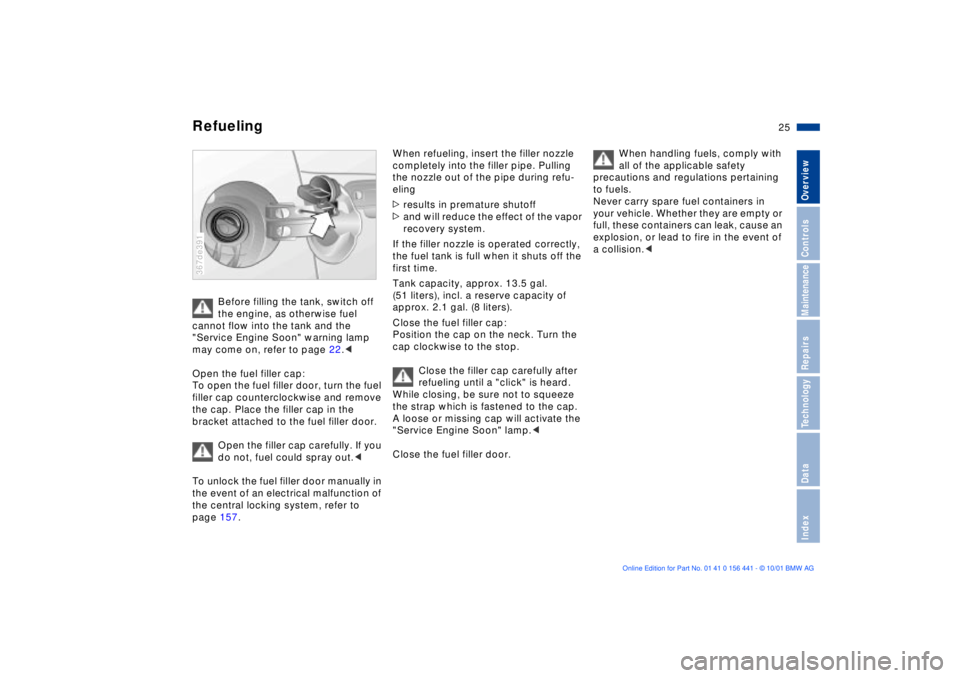
Open the fuel filler cap:
To open the fuel filler door, turn the fuel
filler cap counterclockwise and remove
the cap. Place the filler cap in the
bracket attached to the fuel filler door.
Open the filler cap carefully. If you
do not, fuel could spray out.<
To unlock the fuel filler door manually in
the event of an electrical malfunction of
the central locking system, refer to
page 157.
367de391
When refueling, insert the filler nozzle
completely into the filler pipe. Pulling
the nozzle out of the pipe during refu-
eling
>results in premature shutoff
>and will reduce the effect of the vapor
recovery system.
If the filler nozzle is operated correctly,
the fuel tank is full when it shuts off the
first time.
Tank capacity, approx. 13.5 gal.
(51 liters), incl. a reserve capacity of
approx. 2.1 gal. (8 liters).
Close the fuel filler cap:
Position the cap on the neck. Turn the
cap clockwise to the stop.
Close the filler cap carefully after
refueling until a "click" is heard.
While closing, be sure not to squeeze
the strap which is fastened to the cap.
A loose or missing cap will activate the
"Service Engine Soon" lamp.<
Close the fuel filler door.
When handling fuels, comply with
all of the applicable safety
precautions and regulations pertaining
to fuels.
Never carry spare fuel containers in
your vehicle. Whether they are empty or
full, these containers can leak, cause an
explosion, or lead to fire in the event of
a collision.<
Page 32 of 187
32n
Central locking system Opening and closing Ð from the outsideThe conceptThe central locking system becomes
operational when the doors are closed.
The system simultaneously engages
and releases the locks on the
>doors
>luggage compartment
>fuel filler door.
The central locking system can be
operated
>from outside via the door locks, the
luggage compartment lock as well as
via the remote control
*
>from inside via the safety lock
buttons (locks doors only).
The anti-theft system is automatically
activated whenever you activate the
central locking system from outside the
vehicle. It prevents the doors from
being unlocked with the lock buttons or
release handles.
The central locking system unlocks
automatically in the event of an acci-
dent. In addition, the hazard warning
flashers and interior lamps come on.
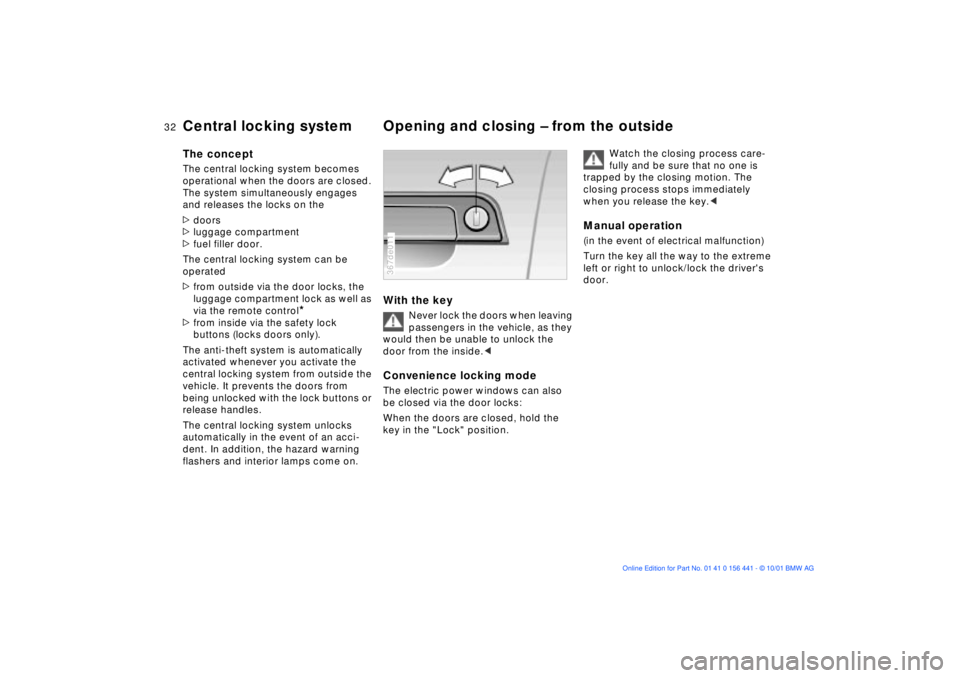
With the key
Never lock the doors when leaving
passengers in the vehicle, as they
would then be unable to unlock the
door from the inside.<
Convenience locking modeThe electric power windows can also
be closed via the door locks:
When the doors are closed, hold the
key in the "Lock" position.367de011
Watch the closing process care-
fully and be sure that no one is
trapped by the closing motion. The
closing process stops immediately
when you release the key.<
Manual operation(in the event of electrical malfunction)
Turn the key all the way to the extreme
left or right to unlock/lock the driver's
door.
Page 58 of 187
58n
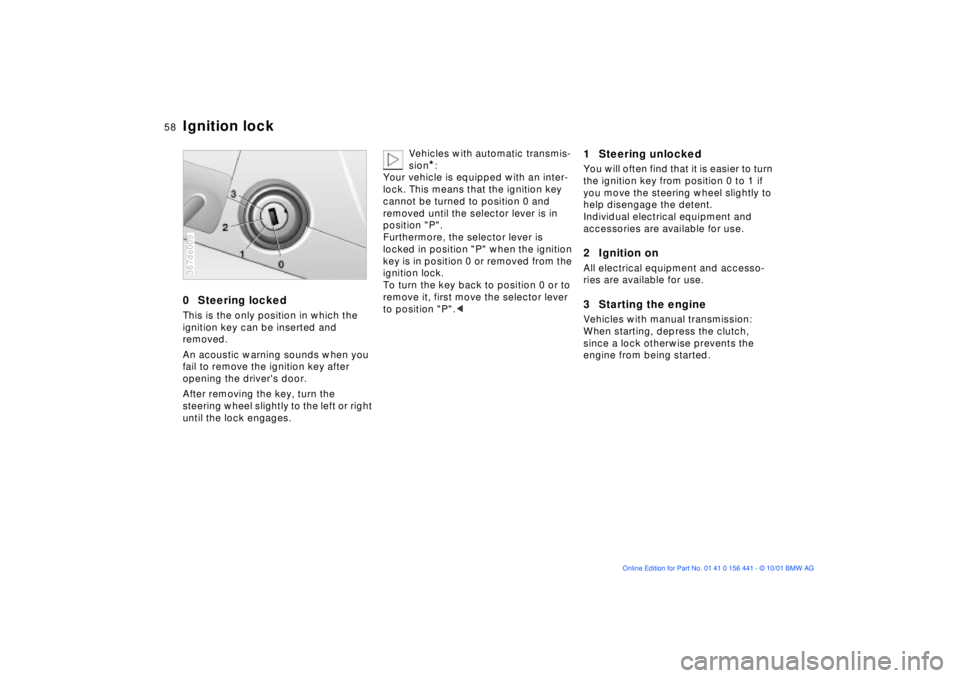
0 Steering lockedThis is the only position in which the
ignition key can be inserted and
removed.
An acoustic warning sounds when you
fail to remove the ignition key after
opening the driver's door.
After removing the key, turn the
steering wheel slightly to the left or right
until the lock engages.367de009
Vehicles with automatic transmis-
sion
*:
Your vehicle is equipped with an inter-
lock. This means that the ignition key
cannot be turned to position 0 and
removed until the selector lever is in
position "P".
Furthermore, the selector lever is
locked in position "P" when the ignition
key is in position 0 or removed from the
ignition lock.
To turn the key back to position 0 or to
remove it, first move the selector lever
to position "P".<
1 Steering unlockedYou will often find that it is easier to turn
the ignition key from position 0 to 1 if
you move the steering wheel slightly to
help disengage the detent.
Individual electrical equipment and
accessories are available for use.2 Ignition onAll electrical equipment and accesso-
ries are available for use.3 Starting the engineVehicles with manual transmission:
When starting, depress the clutch,
since a lock otherwise prevents the
engine from being started.
Ignition lock
Page 69 of 187
69n
IndexDataTechnologyRepairsMaintenanceControlsOverview
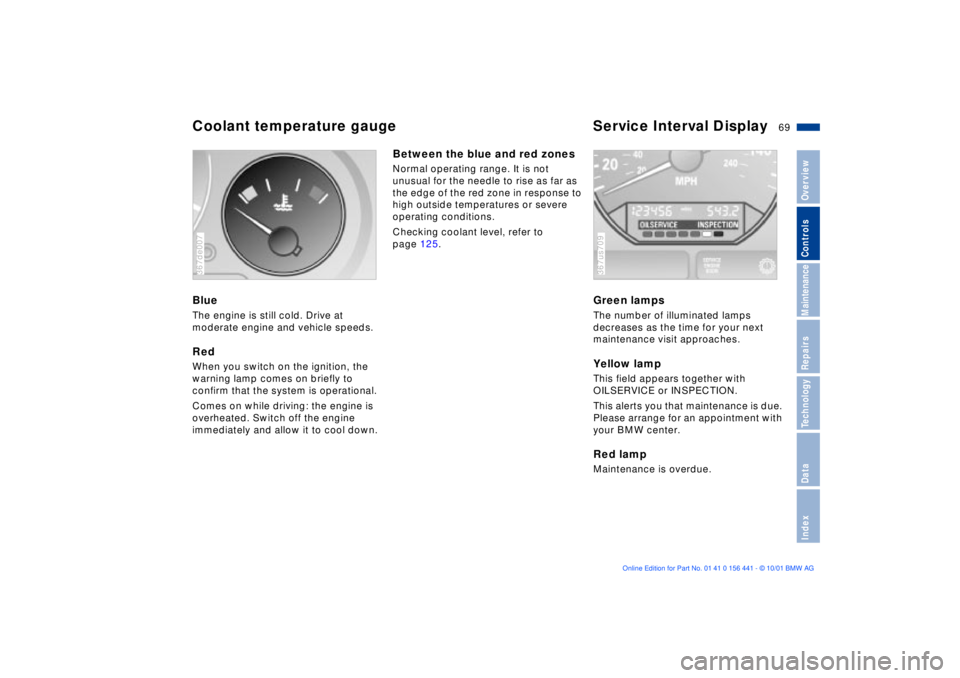
Coolant temperature gauge Service Interval DisplayBlueThe engine is still cold. Drive at
moderate engine and vehicle speeds.RedWhen you switch on the ignition, the
warning lamp comes on briefly to
confirm that the system is operational.
Comes on while driving: the engine is
overheated. Switch off the engine
immediately and allow it to cool down.367de007
Between the blue and red zonesNormal operating range. It is not
unusual for the needle to rise as far as
the edge of the red zone in response to
high outside temperatures or severe
operating conditions.
Checking coolant level, refer to
page 125.
Green lamps The number of illuminated lamps
decreases as the time for your next
maintenance visit approaches.Yellow lamp This field appears together with
OILSERVICE or INSPECTION.
This alerts you that maintenance is due.
Please arrange for an appointment with
your BMW center.Red lamp Maintenance is overdue.367us709
Page 71 of 187
71n
IndexDataTechnologyRepairsMaintenanceControlsOverview
Computer
*
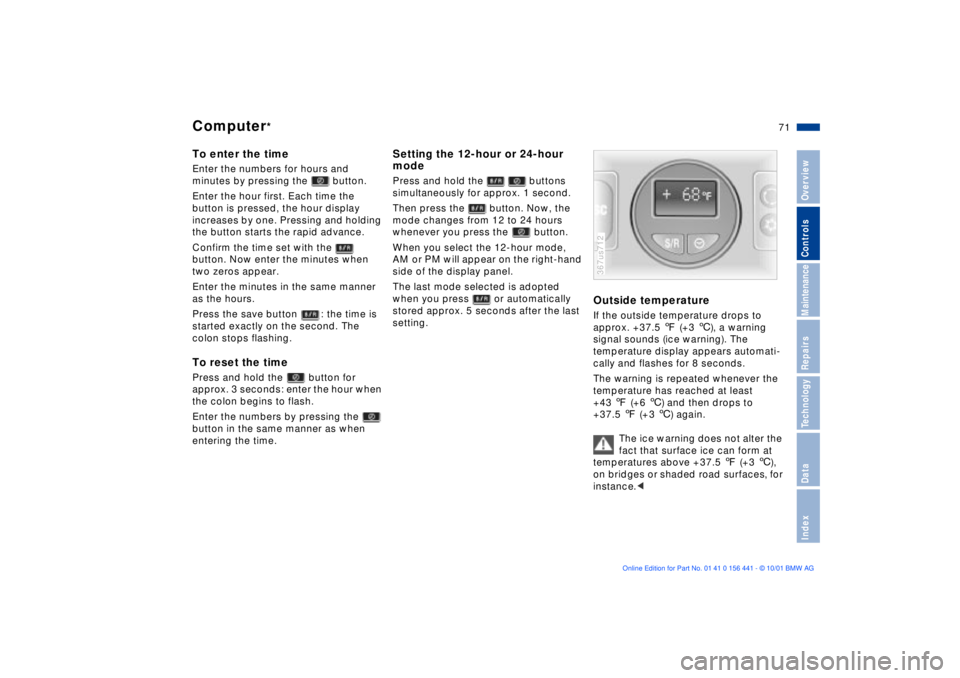
To enter the timeEnter the numbers for hours and
minutes by pressing the button.
Enter the hour first. Each time the
button is pressed, the hour display
increases by one. Pressing and holding
the button starts the rapid advance.
Confirm the time set with the
button. Now enter the minutes when
two zeros appear.
Enter the minutes in the same manner
as the hours.
Press the save button : the time is
started exactly on the second. The
colon stops flashing.To reset the timePress and hold the button for
approx. 3 seconds: enter the hour when
the colon begins to flash.
Enter the numbers by pressing the
button in the same manner as when
entering the time.
Setting the 12-hour or 24-hour
modePress and hold the buttons
simultaneously for approx. 1 second.
Then press the button. Now, the
mode changes from 12 to 24 hours
whenever you press the button.
When you select the 12-hour mode,
AM or PM will appear on the right-hand
side of the display panel.
The last mode selected is adopted
when you press or automatically
stored approx. 5 seconds after the last
setting.
Outside temperatureIf the outside temperature drops to
approx. +37.5 7 (+3 6), a warning
signal sounds (ice warning). The
temperature display appears automati-
cally and flashes for 8 seconds.
The warning is repeated whenever the
temperature has reached at least
+43 7 (+6 6) and then drops to
+37.5 7 (+3 6) again.
The ice warning does not alter the
fact that surface ice can form at
temperatures above +37.5 7 (+3 6),
on bridges or shaded road surfaces, for
instance.< 367us712
Page 74 of 187
74n
ASC+T Dynamic Stability Control (DSC)*Reactivate the ASC+TPress the button again; the indicator
lamp goes out.
The laws of physics cannot be
repealed, even with ASC+T. It will
always be the driver's responsibility to
drive in a manner that matches road
conditions. We therefore urge you to
avoid using the additional safety margin
of the system as an excuse for taking
risks.<
For additional details concerning
ASC+T, please refer to the chapter,
"Advanced technology," page 165.
The conceptDSC maintains vehicle stability, even in
critical driving situations.
The system optimizes vehicle stability
during acceleration and when starting
from a full stop, as well as optimizing
traction. In addition, it recognizes
unstable vehicle conditions, such as
understeering or oversteering, and, as
far as is possible within the laws of
physics, helps keep the vehicle on a
steady course by reducing the engine
speed and brake applications to the
individual wheels.
The DSC is operational every time you
start the engine. DSC includes the
functions of ADB and CBC, refer to
page 102.
The ADB (Automatic Differential
Braking) copies the function of conven-
tional differential and transverse locks
through brake intervention, and
increases traction whenever conditions
merit, e. g. when driving on snow-
covered roads.
If the DSC is deactivated the ADB is in
ready mode.
Indicator lamp
The indicator lamp in the instru-
ment cluster goes out shortly
after you switch on the ignition,
refer to page 22.
The indicator lamp flashes:
DSC controls the drive and braking
forces.
The indicator lamp stays lit:
DSC has been switched off via the
button; ADB is in ready mode.
ADB control intervention is not indi-
cated.
The indicator lamp and the
brake warning lamp remain on:
The DSC, ADB and DBC have
been switched off via the button
or are defective.
The vehicle will remain completely
operational, however without DSC. In
the event of a fault, please see your
BMW center.
Indicator and warning lamps for
Canadian models.
Page 75 of 187
75n
IndexDataTechnologyRepairsMaintenanceControlsOverview
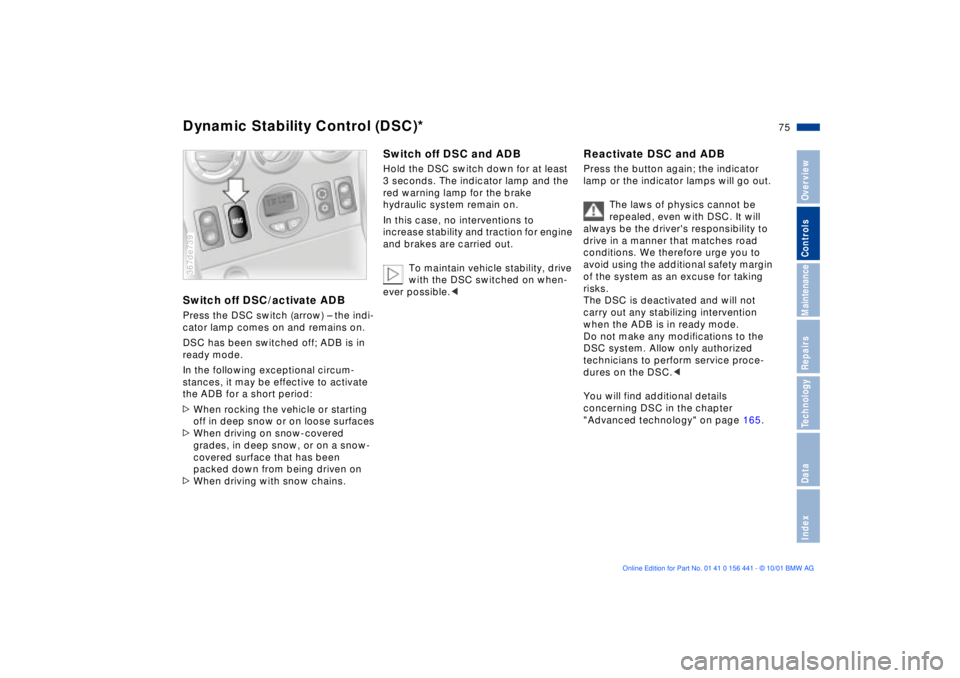
Dynamic Stability Control (DSC)*Switch off DSC/activate ADBPress the DSC switch (arrow) Ð the indi-
cator lamp comes on and remains on.
DSC has been switched off; ADB is in
ready mode.
In the following exceptional circum-
stances, it may be effective to activate
the ADB for a short period:
>When rocking the vehicle or starting
off in deep snow or on loose surfaces
>When driving on snow-covered
grades, in deep snow, or on a snow-
covered surface that has been
packed down from being driven on
>When driving with snow chains.367de739
Switch off DSC and ADBHold the DSC switch down for at least
3 seconds. The indicator lamp and the
red warning lamp for the brake
hydraulic system remain on.
In this case, no interventions to
increase stability and traction for engine
and brakes are carried out.
To maintain vehicle stability, drive
with the DSC switched on when-
ever possible.<
Reactivate DSC and ADBPress the button again; the indicator
lamp or the indicator lamps will go out.
The laws of physics cannot be
repealed, even with DSC. It will
always be the driver's responsibility to
drive in a manner that matches road
conditions. We therefore urge you to
avoid using the additional safety margin
of the system as an excuse for taking
risks.
The DSC is deactivated and will not
carry out any stabilizing intervention
when the ADB is in ready mode.
Do not make any modifications to the
DSC system. Allow only authorized
technicians to perform service proce-
dures on the DSC.<
You will find additional details
concerning DSC in the chapter
"Advanced technology" on page 165.
Page 76 of 187
76n
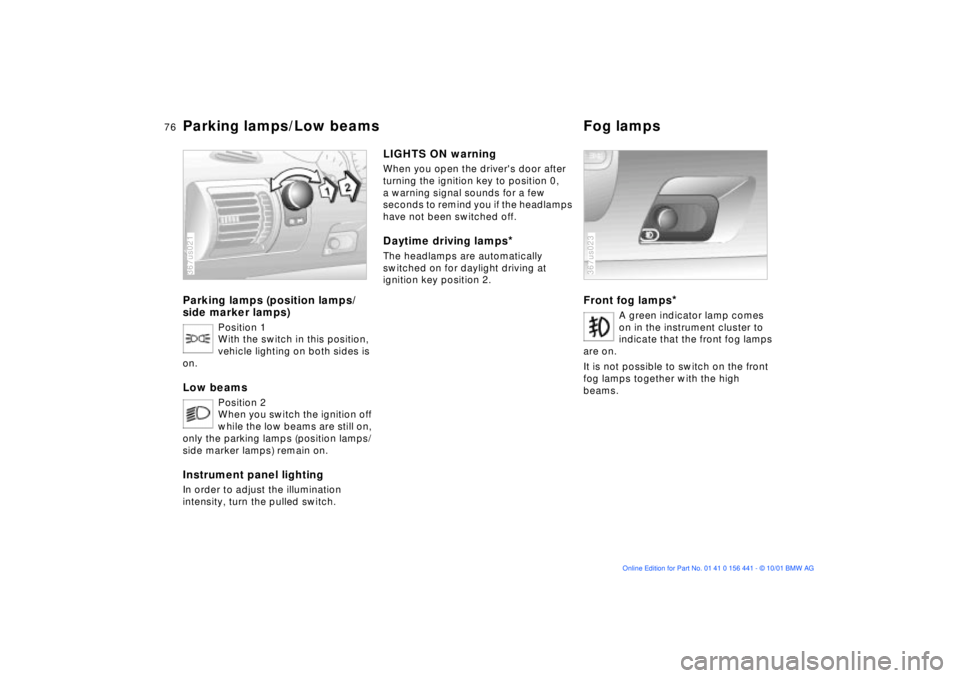
Parking lamps/Low beams Fog lampsParking lamps (position lamps/
side marker lamps)
Position 1
With the switch in this position,
vehicle lighting on both sides is
on.
Low beams
Position 2
When you switch the ignition off
while the low beams are still on,
only the parking lamps (position lamps/
side marker lamps) remain on.
Instrument panel lightingIn order to adjust the illumination
intensity, turn the pulled switch. 367us021
LIGHTS ON warningWhen you open the driver's door after
turning the ignition key to position 0,
a warning signal sounds for a few
seconds to remind you if the headlamps
have not been switched off.Daytime driving lamps
*
The headlamps are automatically
switched on for daylight driving at
ignition key position 2.
Front fog lamps
*
A green indicator lamp comes
on in the instrument cluster to
indicate that the front fog lamps
are on.
It is not possible to switch on the front
fog lamps together with the high
beams.
367us023
Page 97 of 187
Overview
Controls and features
Operation, maintenance
Owner service procedures
Technical data
Index Advanced technology
97n
IndexDataTechnologyRepairsMaintenanceControlsOverview
Special operating instructions:
Break-in procedure98
Driving notes99
Catalytic converter100
Antilock Brake System
(ABS)101
Disc brakes103
Brake system104
Winter operation105
Power steering106
Cellular phone107
Car radio reception107
Hardtop Ð roadster108
Wheels and tires:
Notes on inflation pressures110
Tire condition110
Tire replacement111
Tire rotation113
Wheel and tire
combinations114
Special features of winter
tires115
Snow chains115
Approved wheel and tire
specifications116In the engine compartment:
Hood118
Engine compartment120
Fluids for the washer
systems122
Washer nozzles122
Engine oil123
Coolant125
Brake fluid126
Vehicle Identification127
Care and maintenance:
The BMW Maintenance
System128
Airbags130
Storing your vehicle130
Laws and regulations:
Technical modifications132
California Proposition
65 Warning132
OBD interface socket133
Maintenance
Page 102 of 187
102n
Antilock Brake System (ABS)Information for your safetyNot even ABS can suspend the laws
of physics. ABS alone cannot prevent
accidents if the brakes are applied
without an adequate, safe distance
between vehicles or if the speed limit
has been exceeded. Nor can it prevent
the hazards of aquaplaning. Responsi-
bility for these types of situations
remains in the hands (and at the feet) of
the driver. You should never allow the
added safety of ABS to lull you into a
false sense of security, or mislead you
into taking increased risks that could
affect your own safety and that of
others.
Do not make any modifications to
the ABS system.
Service procedures on ABS are to be
performed by authorized technicians
only.< Antilock Brake System (ABS)/
Cornering Brake Control (CBC)CBC is an advanced engineering
design of the ABS. When braking while
cornering at high speed or braking
during high lateral acceleration, or
when braking during a lane change,
vehicle stability is improved and
steering response is enhanced.
In the event of a fault
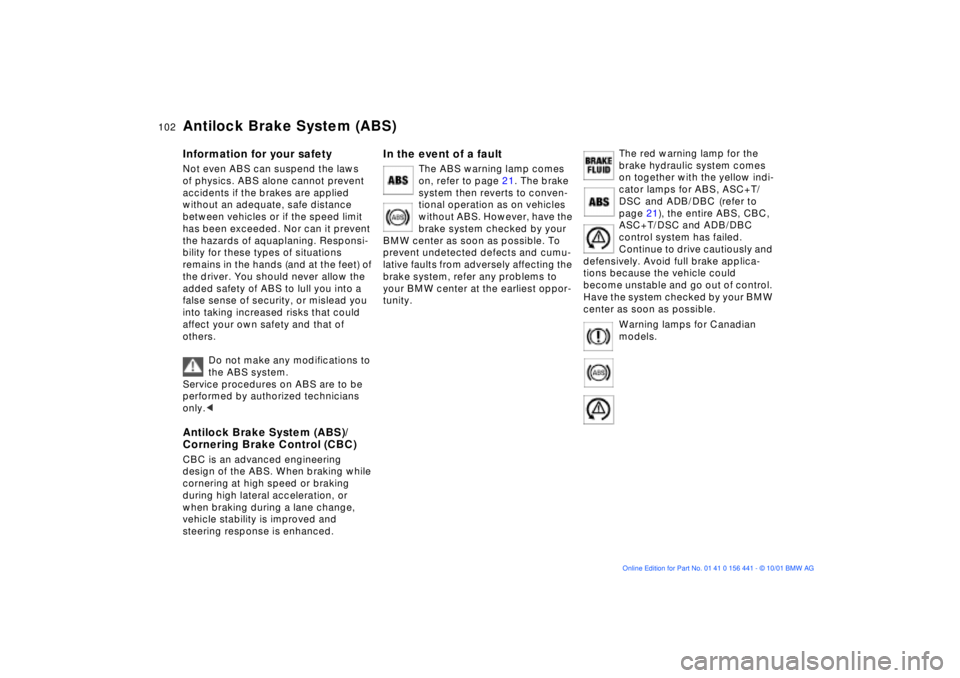
The ABS warning lamp comes
on, refer to page 21. The brake
system then reverts to conven-
tional operation as on vehicles
without ABS. However, have the
brake system checked by your
BMW center as soon as possible. To
prevent undetected defects and cumu-
lative faults from adversely affecting the
brake system, refer any problems to
your BMW center at the earliest oppor-
tunity.
The red warning lamp for the
brake hydraulic system comes
on together with the yellow indi-
cator lamps for ABS, ASC+T/
DSC
and ADB/DBC
(refer to
page 21), the entire ABS, CBC,
ASC+T/DSC and ADB/DBC
control system has failed.
Continue to drive cautiously and
defensively. Avoid full brake applica-
tions because the vehicle could
become unstable and go out of control.
Have the system checked by your BMW
center as soon as possible.
Warning lamps for Canadian
models.