warning BMW Z3 2002 Owner's Manual
[x] Cancel search | Manufacturer: BMW, Model Year: 2002, Model line: Z3, Model: BMW Z3 2002Pages: 187, PDF Size: 2.73 MB
Page 103 of 187
103n
IndexDataTechnologyRepairsMaintenanceControlsOverview
ABS Disc brakesDynamic Brake Control (DBC)*DBC is included in the DSC, refer to
information beginning on page 74.
If you step on the brake rapidly, this
system automatically produces
maximum braking force boost and thus
helps to achieve the shortest possible
braking distance during "panic stops".
All of the benefits of the ABS system
are exploited under these circum-
stances.
Do not reduce the pressure on the
brake pedal for the duration of the
brake application. When the brake
pedal is released, the DBC is deacti-
vated.
In the event of a malfunction,
the brake warning lamp lights up
yellow. Normal braking effi-
ciency is still fully available.
Have the system checked and
repaired at your BMW center as
soon as possible.
Please observe the section "Infor-
mation for your safety" concerning
the ABS system, which also applies to
the DSC system.<
Disc brakes furnish optimum decelera-
tion and braking control and greater
fade resistance under heavy use.
When the vehicle is driven only occa-
sionally, during extended periods when
the vehicle is not used at all, or in oper-
ating conditions where brake applica-
tions are less frequent, there is an
increased tendency for corrosion of the
rotors and accumulation of contamina-
tion on the brake pads. This occurs
because the minimal pressure which
must be exerted by the pads to clean
the rotors by brake applications is not
reached.
If the brake rotors are corroded, they
will tend to respond to braking with a
pulsating effect which even extended
application will fail to cure.
For your own safety: use only
brake pads that BMW has
approved for your specific vehicle
model. BMW cannot evaluate non-
approved brake pads to determine if
they are suited for use, and therefore
cannot ensure the operating safety of
the vehicle in the event of their use.<
Driving notesWhile driving in wet conditions and in
heavy rain, it is advisable to apply light
pressure to the brake pedal every few
miles Ð watch traffic conditions to
ensure that this maneuver does not
endanger other road users. The heat
generated in this process helps dry the
pads and rotors.
Maximum braking force is obtained
while the wheels continue to rotate,
peaking when the wheels remain on the
verge of locking without actually doing
so. ABS maintains this state automati-
cally. If the ABS fails, you should revert
to the staggered braking technique
described on page 106.
Extended or steep mountain descents
should be driven in the gear in which
only minimal periodic brake application
is required. This avoids excessive strain
on the brakes and possible
impairment of the braking effect.
You can increase the engine's braking
effect by selecting progressively lower
gears, downshifting into first gear, if
necessary. You can also downshift into
first gear if you are using the manual
mode in a vehicle with automatic trans-
mission, refer to page 63.
Page 104 of 187
104n
Disc brakes Brake system Should engine braking prove inade-
quate, you should still avoid extended,
continuous braking. Instead, decelerate
the vehicle with increased pressure on
the brake pedal (watch for following
traffic), release the pedal and then
repeat the brake application (staggered
braking). This staggered braking tech-
nique allows the brakes to cool in the
intervals between active braking
phases, preventing overheating and
ensuring that full braking capacity
remains available at all times.
Do not coast with the clutch
depressed or with the transmis-
sion or selector lever in Neutral. Do not
coast with the engine switched off. The
engine provides no braking effect when
the clutch is depressed and there is no
power-assist for braking or steering
when the engine is not running.
Never allow floor mats, carpets or any
other objects to protrude into the area
around the accelerator, clutch and
brake pedals and obstruct their move-
ment.<
Brake fluid level
The warning lamp for the
hydraulic brake system comes
on:
The brake fluid level is too low in
the reservoir (refer to page 126).
If the brake fluid level is too low
and brake pedal travel has become
noticeably longer, there may be a
defect in one of the two brake system's
hydraulic circuits.
Proceed to the nearest BMW
center. Higher brake application
pressure may be necessary under these
conditions, and braking distances may
be significantly longer. Please
remember to adapt your driving style
accordingly.<
Brake pads
The warning lamp for the brake
pads comes on:
The brake pads have reached
their minimum pad thickness. Proceed
to the nearest BMW center as soon as
possible to have the pads replaced.
For your own safety: use only
brake pads that BMW has
approved for your specific vehicle
model. BMW cannot evaluate non-
approved brake pads to determine if
they are suited for use, and therefore
cannot ensure the operating safety of
the vehicle in the event of their use.<
Page 118 of 187
118n
Do not work on your vehicle
without appropriate skills. Always
switch off the engine and allow it to
cool down before working in the engine
compartment. Always disconnect the
battery before working on any electrical
systems or equipment, especially when
these are located within the engine
compartment. Comply with all appli-
cable instructions and warnings. If you
are not familiar with all guidelines, have
the work performed by your BMW
center. Otherwise, safety hazards for
vehicle occupants and other road users
may occur as a result of improper
handling of components and mate-
rials.<
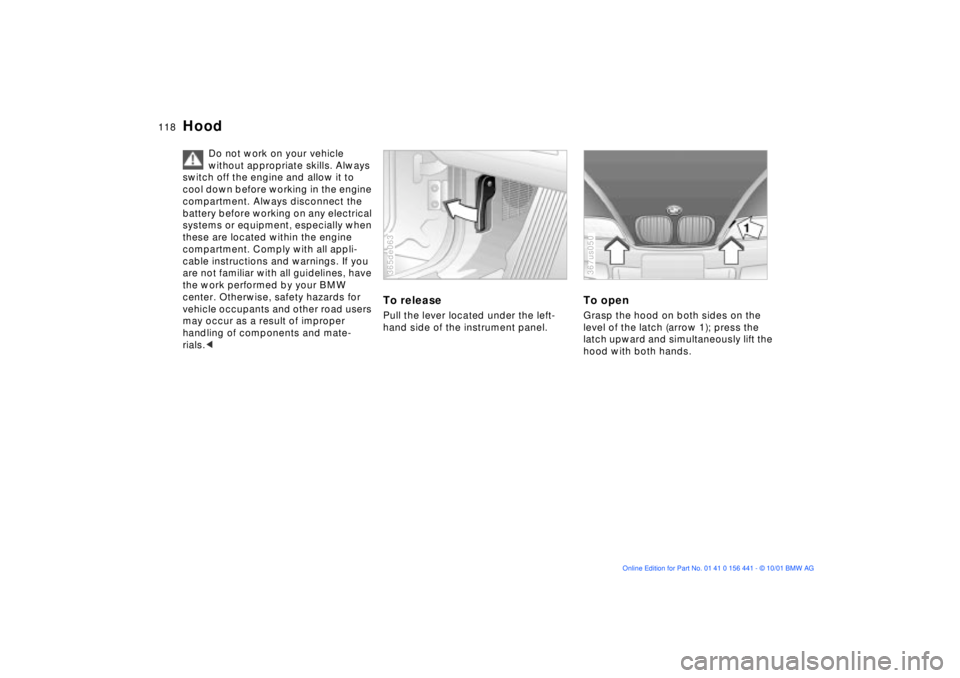
To release Pull the lever located under the left-
hand side of the instrument panel.365de063
To openGrasp the hood on both sides on the
level of the latch (arrow 1); press the
latch upward and simultaneously lift the
hood with both hands.367us050
Hood
Page 125 of 187
125n
IndexDataTechnologyRepairsMaintenanceControlsOverview
Engine oil Coolant
Comply with the applicable envi-
ronmental laws regulating the
disposal of used oil.<
Recommendation: have the oil changed
by your BMW center only.
Continuous exposure to used oil
has caused cancer in laboratory
testing. Any skin areas that come in
contact with oil should thus be thor-
oughly washed with soap and water.
Store oil, grease, etc., out of reach of
children. Comply with warning labels
and information on containers.
If you use SAE 15W-40 engine oil in low
temperatures (below +14 7/Ð10 6),
the engine may become difficult to
start.
Special engine oils individually
approved by BMW are preferred for use
in your engine. Please contact your
BMW center for details.<
Do not add coolant to the cooling
system when the engine is hot. If
you do, escaping coolant can cause
burns.
To avoid the possibility of damage later
on, do not use anything other than
factory-approved, nitrite and amino-
free extended-duty antifreeze with
corrosion inhibitor which can be used
with aluminum radiator cores. Your
BMW center is familiar with the
approved specifications.
Antifreeze and anti-corrosion agents
are hazardous to health. Store them in
their original containers. Keep the
containers tightly closed and out of
reach of children.
Extended-duty antifreeze with corro-
sion inhibitor contains the flammable
substance ethylene glycol. For this
reason, do not spill extended-duty anti-
freeze with corrosion inhibitor on hot
engine components. If you do, it could
be ignited and cause burns.<
Comply with the applicable envi-
ronmental laws regulating the
disposal of extended-duty antifreeze
with corrosion inhibitor.<
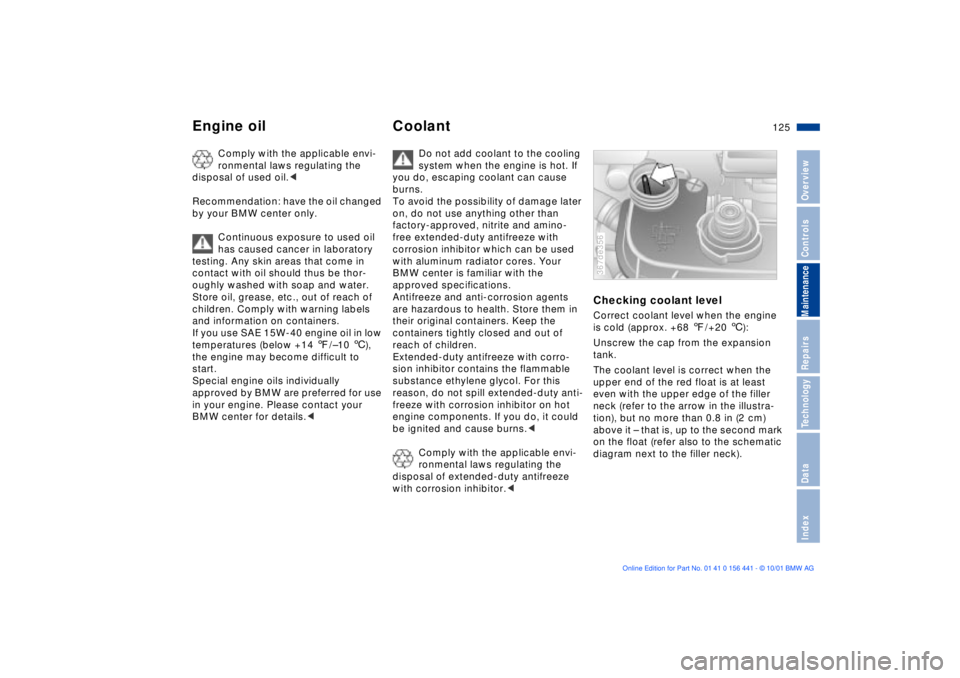
Checking coolant levelCorrect coolant level when the engine
is cold (approx. +68 7/+20 6):
Unscrew the cap from the expansion
tank.
The coolant level is correct when the
upper end of the red float is at least
even with the upper edge of the filler
neck (refer to the arrow in the illustra-
tion), but no more than 0.8 in (2 cm)
above it Ð that is, up to the second mark
on the float (refer also to the schematic
diagram next to the filler neck).367de356
Page 126 of 187
126n
Coolant Brake fluid To add coolantWait until the engine cools before
removing the cap from the expansion
tank. The needle of the coolant gauge
in the instrument cluster must be
located in the blue field; otherwise,
there is a danger of scalding.
1. Turn the cap slightly counterclock-
wise in order to allow accumulated
pressure to escape, then open
2. If the coolant is low, slowly add
coolant until the correct level is
reached Ð do not overfill.
The coolant is a mixture of water and
extended-duty antifreeze with corrosion
inhibitor. Always maintain the
prescribed all-season 50 : 50 mixture
ratio for year-round protection against
internal corrosion. No other additives
are required.
Replace the coolant regularly. Refer to
the Service and Warranty Information
Booklet (US models) or the Warranty
and Service Guide Booklet (Canadian
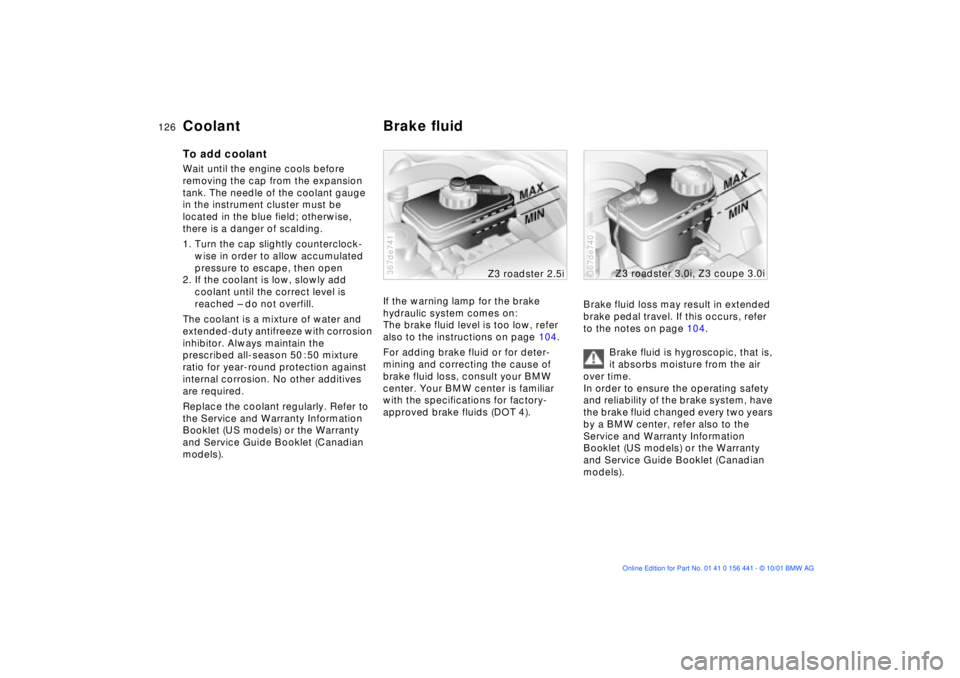
models).If the warning lamp for the brake
hydraulic system comes on:
The brake fluid level is too low, refer
also to the instructions on page 104.
For adding brake fluid or for deter-
mining and correcting the cause of
brake fluid loss, consult your BMW
center. Your BMW center is familiar
with the specifications for factory-
approved brake fluids (DOT 4).
367de741
Z3 roadster 2.5i
Brake fluid loss may result in extended
brake pedal travel. If this occurs, refer
to the notes on page 104.
Brake fluid is hygroscopic, that is,
it absorbs moisture from the air
over time.
In order to ensure the operating safety
and reliability of the brake system, have
the brake fluid changed every two years
by a BMW center, refer also to the
Service and Warranty Information
Booklet (US models) or the Warranty
and Service Guide Booklet (Canadian
models).367de740
Z3 roadster 3.0i, Z3 coupe 3.0i
Page 132 of 187

132n
Any BMW center will be happy to
advise you concerning the advisability,
legal implications and factory recom-
mendations for technical modifications
to the vehicle. For this purpose, the
BMW center will require the Vehicle
Identification Number. The engine
number is also required in some
instances.
Light-emitting diodes (LEDs)Light-emitting diodes installed behind
translucent lenses serve as the light
source for many of the controls and
displays in your vehicle. These LEDs
are similar to conventional laser tech-
nology.
Do not remove the protective lens
and avoid staring directly at the
unfiltered beam for extended periods
(several hours), since inflammation of
the iris could result.<
California laws require us to state the
following warning:
Engine exhaust, some of its
constituents, and certain vehicle
components contain or emit chemicals
known to the State of California to
cause cancer and birth defects or other
reproductive harm.<
Technical modifications California Proposition 65 Warning
Page 133 of 187
133n
IndexDataTechnologyRepairsMaintenanceControlsOverview
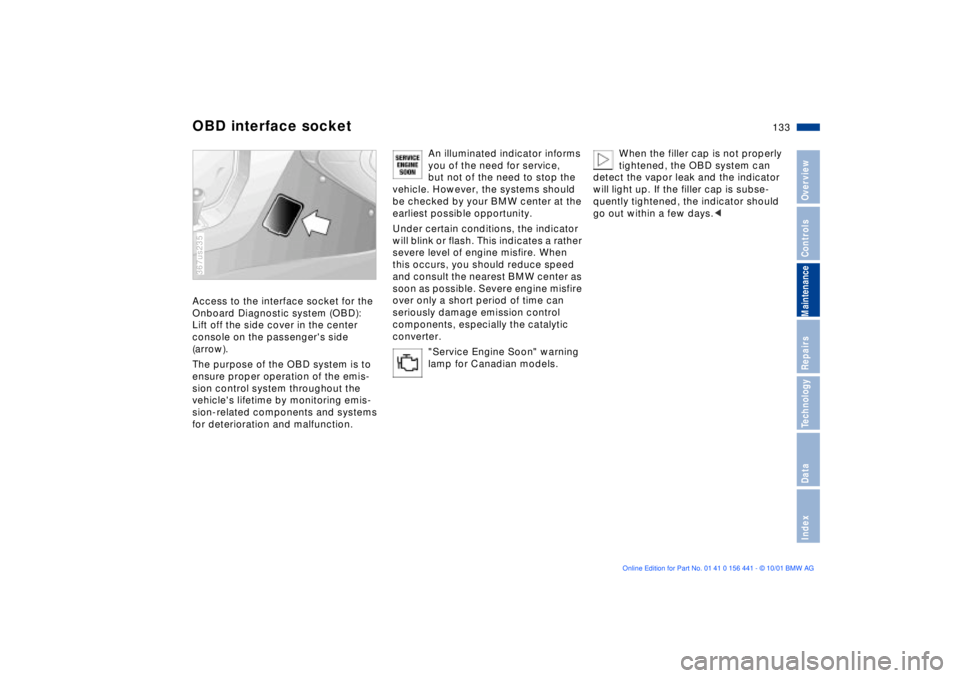
OBD interface socketAccess to the interface socket for the
Onboard Diagnostic system (OBD):
Lift off the side cover in the center
console on the passenger's side
(arrow).
The purpose of the OBD system is to
ensure proper operation of the emis-
sion control system throughout the
vehicle's lifetime by monitoring emis-
sion-related components and systems
for deterioration and malfunction.367us235
An illuminated indicator informs
you of the need for service,
but not of the need to stop the
vehicle. However, the systems should
be checked by your BMW center at the
earliest possible opportunity.
Under certain conditions, the indicator
will blink or flash. This indicates a rather
severe level of engine misfire. When
this occurs, you should reduce speed
and consult the nearest BMW center as
soon as possible. Severe engine misfire
over only a short period of time can
seriously damage emission control
components, especially the catalytic
converter.
"Service Engine Soon" warning
lamp for Canadian models.
When the filler cap is not properly
tightened, the OBD system can
detect the vapor leak and the indicator
will light up. If the filler cap is subse-
quently tightened, the indicator should
go out within a few days.<
Page 146 of 187
146n
Wheel change
Safety measures in the event of a
flat tire or a wheel change:
Stop the vehicle on a firm, level surface
as far as possible from the flow of
traffic. Turn on the hazard warning
flashers.
Turn the steering wheel to the straight-
ahead position and engage the steering
lock, engage the parking brake and
shift into 1st or reverse gear (selector
lever in "Park" with automatic transmis-
sion).
All passengers should be outside the
vehicle and well away from your imme-
diate working area (for instance, behind
the guardrail).
If a warning triangle or portable hazard
warning lamp is available, set it up on
the roadside at an appropriate distance
from the rear of the vehicle. Comply
with all safety guidelines and regula-
tions.
Change the wheel only on a level, firm
surface which is not slippery. Avoid
jacking the vehicle on a soft or slippery
support surface (snow, ice, tiles, loose
gravel, etc.), since it could slide side-
ways.
Place the jack on a firm support
surface.
Do not place wooden blocks or similar
objects under the jack. If this is done,
the jack might not be able to reach its
full support capacity because of the
limited height.
Do not lie under the vehicle or start the
engine when the vehicle is supported
by the jack. This creates the risk of fatal
injury.<
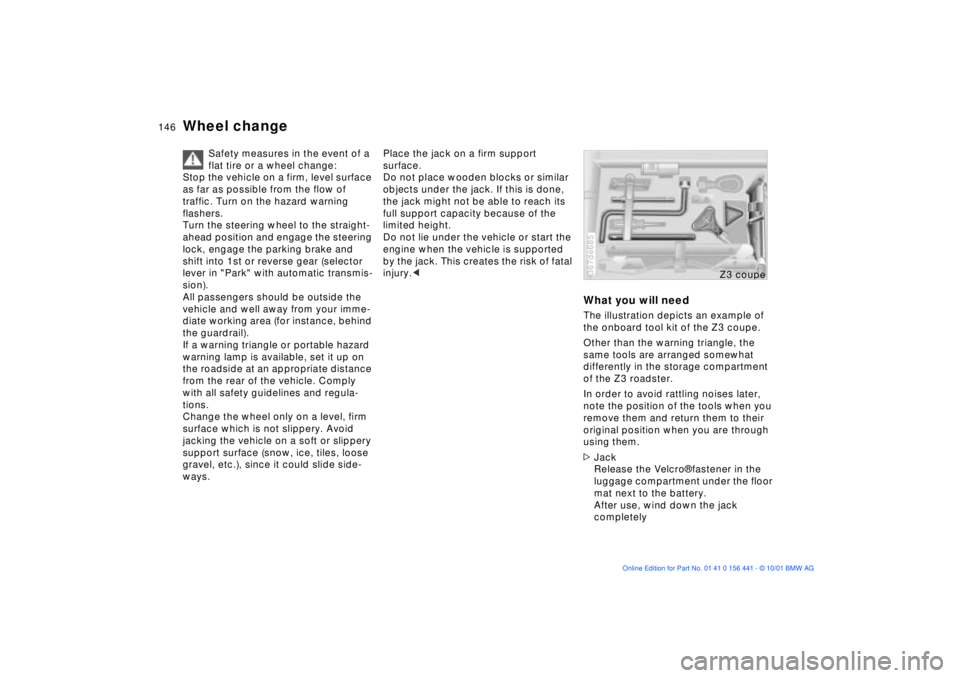
What you will needThe illustration depicts an example of
the onboard tool kit of the Z3 coupe.
Other than the warning triangle, the
same tools are arranged somewhat
differently in the storage compartment
of the Z3 roadster.
In order to avoid rattling noises later,
note the position of the tools when you
remove them and return them to their
original position when you are through
using them.
>Jack
Release the Velcro¨ fastener in the
luggage compartment under the floor
mat next to the battery.
After use, wind down the jack
completely367de685
Z3 coupe
Page 147 of 187
147n
IndexDataTechnologyRepairsMaintenanceControlsOverview
Wheel change>Wedge (wheel chock)
Next to the jack
>Lug wrench, centering pin, spark-
plug wrench and lifting handle
In the luggage compartment under
the floor mat
>Spare wheel
Stored under the luggage compart-
ment on the vehicle floor and
protected with a storage tray.
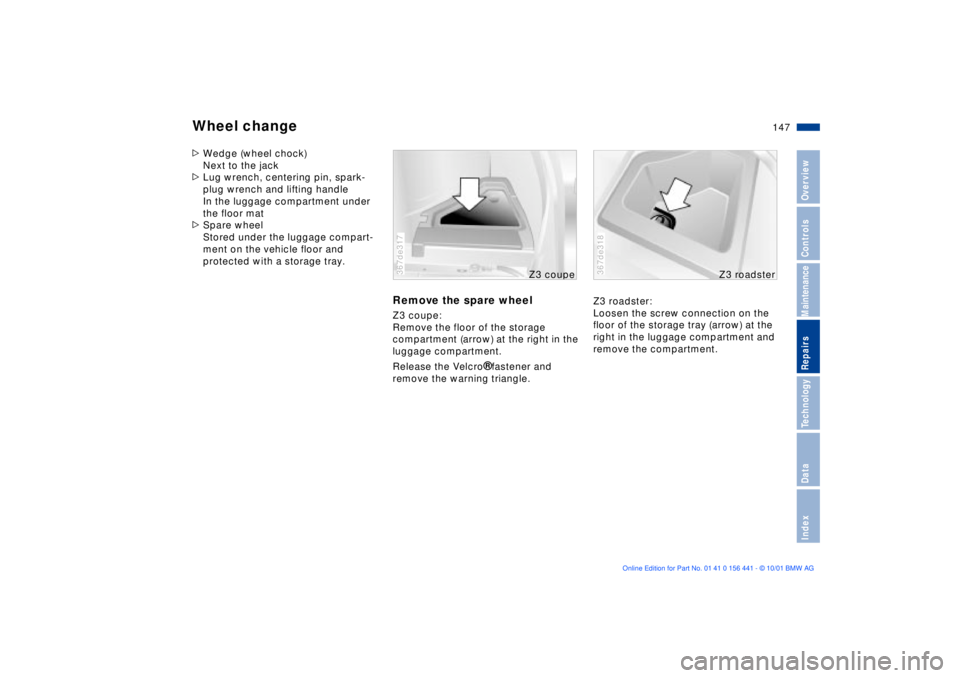
Remove the spare wheelZ3 coupe:
Remove the floor of the storage
compartment (arrow) at the right in the
luggage compartment.
Release the Velcro
¨ fastener and
remove the warning triangle.
367de317
Z3 cou
pe
Z3 roadster:
Loosen the screw connection on the
floor of the storage tray (arrow) at the
right in the luggage compartment and
remove the compartment.367de318
Z3 roadster
Page 160 of 187
160n
Towing the vehicle
The towed vehicle should always
be the lighter of the two vehicles.
If this is not the case, it will not be
possible to control vehicle handling.<
Tow-startingIt is not possible to start the engine of a
vehicle with an automatic transmission
by towing or pushing the vehicle.
For instructions on jump-starting, refer
to page 158.
Never attempt to use your vehicle to
push another vehicle. This could result
in damage to the energy-absorbing
bumpers.
Towing a vehicle with automatic
transmission1. Place the selector lever in
position "N"
2. Towing speed:
max. 45 mph (70 km/h)
3. Towing distance:
max. 95 miles (150 km)
4. Leave the ignition key in position 1 to
ensure that brake lamps, turn signal
indicators, horn and windshield
wipers remain operative, and to
prevent the steering lock from
engaging
5. Switch on the hazard-warning
flashers (observe applicable legal
regulations).
Find some means of identifying the
vehicle in tow. Place a sign or warning
triangle in the rear window, for
instance.
Even when the electrical system
has failed, make sure that the igni-
tion key remains in position 1 to prevent
the steering lock from engaging.
The steering and brakes are without
power assist when the engine is off.
This means that increased effort is
required for steering and braking.<
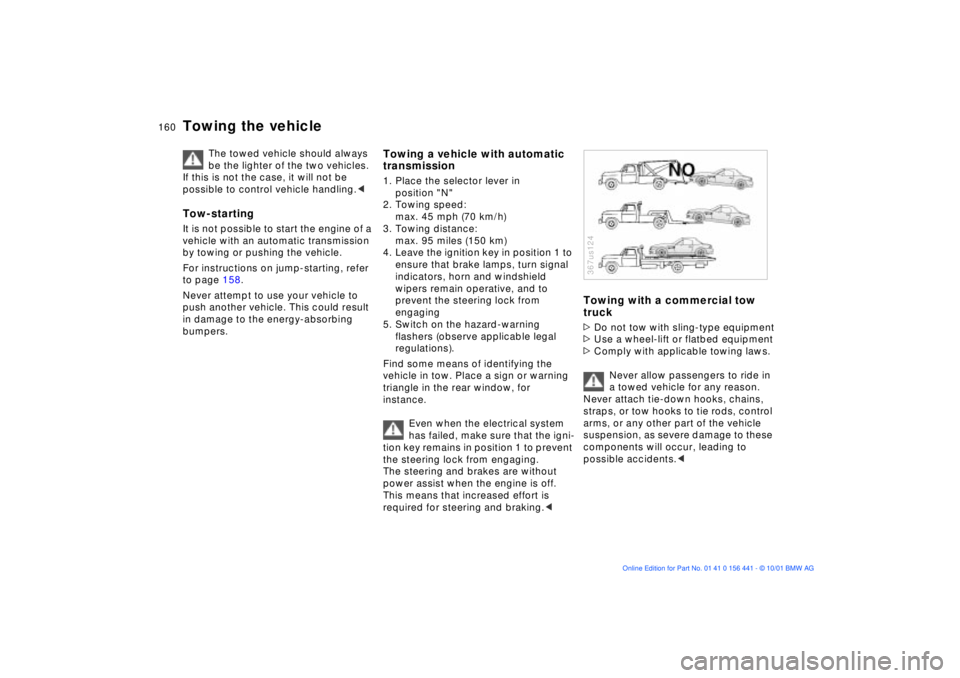
Towing with a commercial tow
truck>Do not tow with sling-type equipment
>Use a wheel-lift or flatbed equipment
>Comply with applicable towing laws.
Never allow passengers to ride in
a towed vehicle for any reason.
Never attach tie-down hooks, chains,
straps, or tow hooks to tie rods, control
arms, or any other part of the vehicle
suspension, as severe damage to these
components will occur, leading to
possible accidents.< 367us124