maintenance BMW Z3 2002 Owner's Guide
[x] Cancel search | Manufacturer: BMW, Model Year: 2002, Model line: Z3, Model: BMW Z3 2002Pages: 187, PDF Size: 2.73 MB
Page 65 of 187
65n
IndexDataTechnologyRepairsMaintenanceControlsOverview
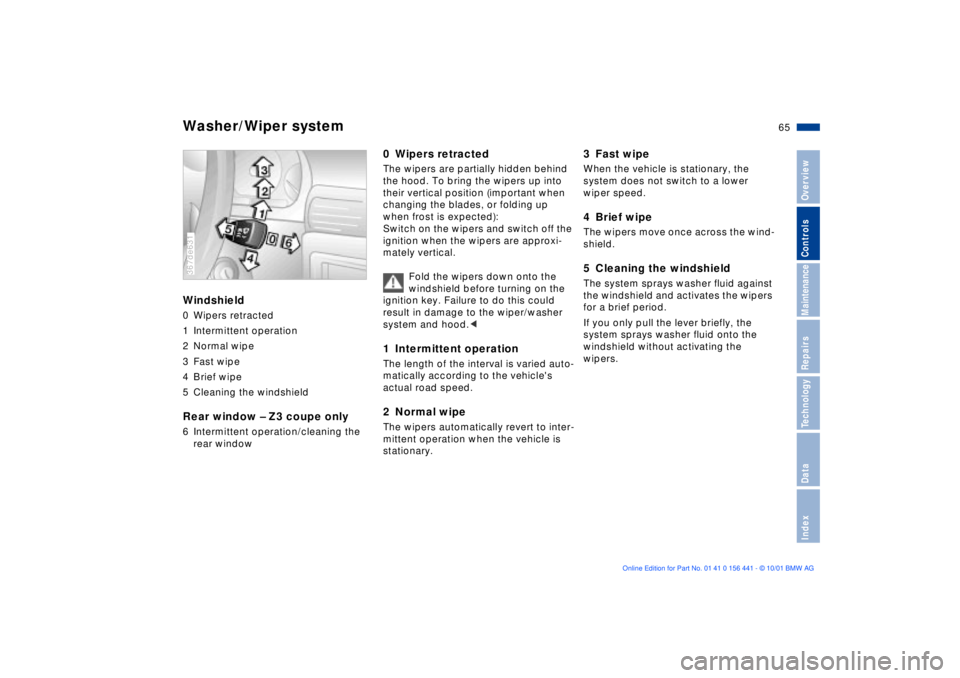
Washer/Wiper systemWindshield0 Wipers retracted
1 Intermittent operation
2 Normal wipe
3 Fast wipe
4 Brief wipe
5 Cleaning the windshieldRear window Ð Z3 coupe only6 Intermittent operation/cleaning the
rear window367de631
0 Wipers retractedThe wipers are partially hidden behind
the hood. To bring the wipers up into
their vertical position (important when
changing the blades, or folding up
when frost is expected):
Switch on the wipers and switch off the
ignition when the wipers are approxi-
mately vertical.
Fold the wipers down onto the
windshield before turning on the
ignition key. Failure to do this could
result in damage to the wiper/washer
system and hood.< 1 Intermittent operationThe length of the interval is varied auto-
matically according to the vehicle's
actual road speed.2 Normal wipeThe wipers automatically revert to inter-
mittent operation when the vehicle is
stationary.
3 Fast wipeWhen the vehicle is stationary, the
system does not switch to a lower
wiper speed.4 Brief wipeThe wipers move once across the wind-
shield.5 Cleaning the windshieldThe system sprays washer fluid against
the windshield and activates the wipers
for a brief period.
If you only pull the lever briefly, the
system sprays washer fluid onto the
windshield without activating the
wipers.
Page 67 of 187
67n
IndexDataTechnologyRepairsMaintenanceControlsOverview
Cruise control
*
You can maintain and store any desired
vehicle speed above approx. 25 mph
(40 km/h).
The system is switched off and the
stored speed deleted from its memory
when you turn the ignition key to posi-
tion 0.
Do not use the cruise control on
winding roads, when high traffic
density prevents driving at a constant
speed, when the road surface is slick
(snow, rain, ice) or when the road
surface is loose (rocks or gravel,
sand).< 365us059
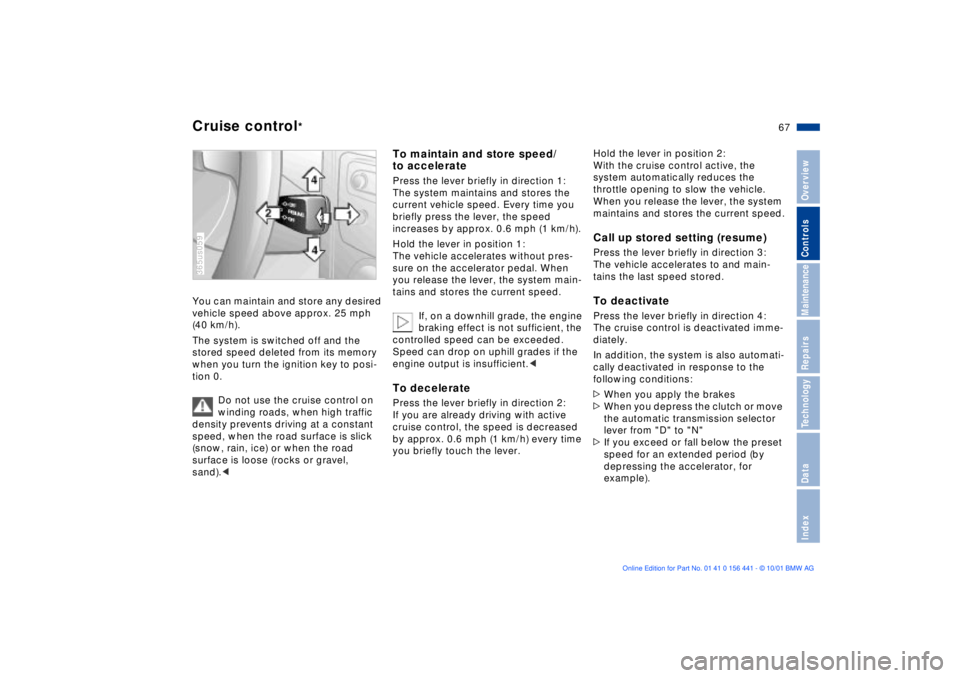
To maintain and store speed/
to acceleratePress the lever briefly in direction 1:
The system maintains and stores the
current vehicle speed. Every time you
briefly press the lever, the speed
increases by approx. 0.6 mph (1 km/h).
Hold the lever in position 1:
The vehicle accelerates without pres-
sure on the accelerator pedal. When
you release the lever, the system main-
tains and stores the current speed.
If, on a downhill grade, the engine
braking effect is not sufficient, the
controlled speed can be exceeded.
Speed can drop on uphill grades if the
engine output is insufficient.< To deceleratePress the lever briefly in direction 2:
If you are already driving with active
cruise control, the speed is decreased
by approx. 0.6 mph (1 km/h) every time
you briefly touch the lever.
Hold the lever in position 2:
With the cruise control active, the
system automatically reduces the
throttle opening to slow the vehicle.
When you release the lever, the system
maintains and stores the current speed.Call up stored setting (resume)Press the lever briefly in direction 3:
The vehicle accelerates to and main-
tains the last speed stored.To deactivatePress the lever briefly in direction 4:
The cruise control is deactivated imme-
diately.
In addition, the system is also automati-
cally deactivated in response to the
following conditions:
>When you apply the brakes
>When you depress the clutch or move
the automatic transmission selector
lever from "D" to "N"
>If you exceed or fall below the preset
speed for an extended period (by
depressing the accelerator, for
example).
Page 69 of 187
69n
IndexDataTechnologyRepairsMaintenanceControlsOverview
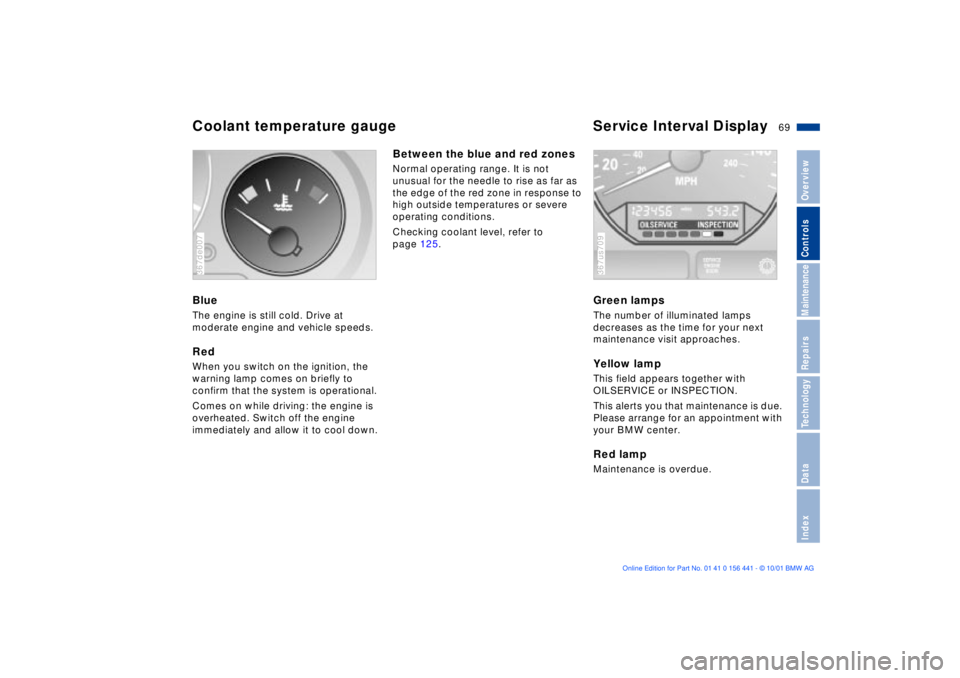
Coolant temperature gauge Service Interval DisplayBlueThe engine is still cold. Drive at
moderate engine and vehicle speeds.RedWhen you switch on the ignition, the
warning lamp comes on briefly to
confirm that the system is operational.
Comes on while driving: the engine is
overheated. Switch off the engine
immediately and allow it to cool down.367de007
Between the blue and red zonesNormal operating range. It is not
unusual for the needle to rise as far as
the edge of the red zone in response to
high outside temperatures or severe
operating conditions.
Checking coolant level, refer to
page 125.
Green lamps The number of illuminated lamps
decreases as the time for your next
maintenance visit approaches.Yellow lamp This field appears together with
OILSERVICE or INSPECTION.
This alerts you that maintenance is due.
Please arrange for an appointment with
your BMW center.Red lamp Maintenance is overdue.367us709
Page 71 of 187
71n
IndexDataTechnologyRepairsMaintenanceControlsOverview
Computer
*
To enter the timeEnter the numbers for hours and
minutes by pressing the button.
Enter the hour first. Each time the
button is pressed, the hour display
increases by one. Pressing and holding
the button starts the rapid advance.
Confirm the time set with the
button. Now enter the minutes when
two zeros appear.
Enter the minutes in the same manner
as the hours.
Press the save button : the time is
started exactly on the second. The
colon stops flashing.To reset the timePress and hold the button for
approx. 3 seconds: enter the hour when
the colon begins to flash.
Enter the numbers by pressing the
button in the same manner as when
entering the time.
Setting the 12-hour or 24-hour
modePress and hold the buttons
simultaneously for approx. 1 second.
Then press the button. Now, the
mode changes from 12 to 24 hours
whenever you press the button.
When you select the 12-hour mode,
AM or PM will appear on the right-hand
side of the display panel.
The last mode selected is adopted
when you press or automatically
stored approx. 5 seconds after the last
setting.
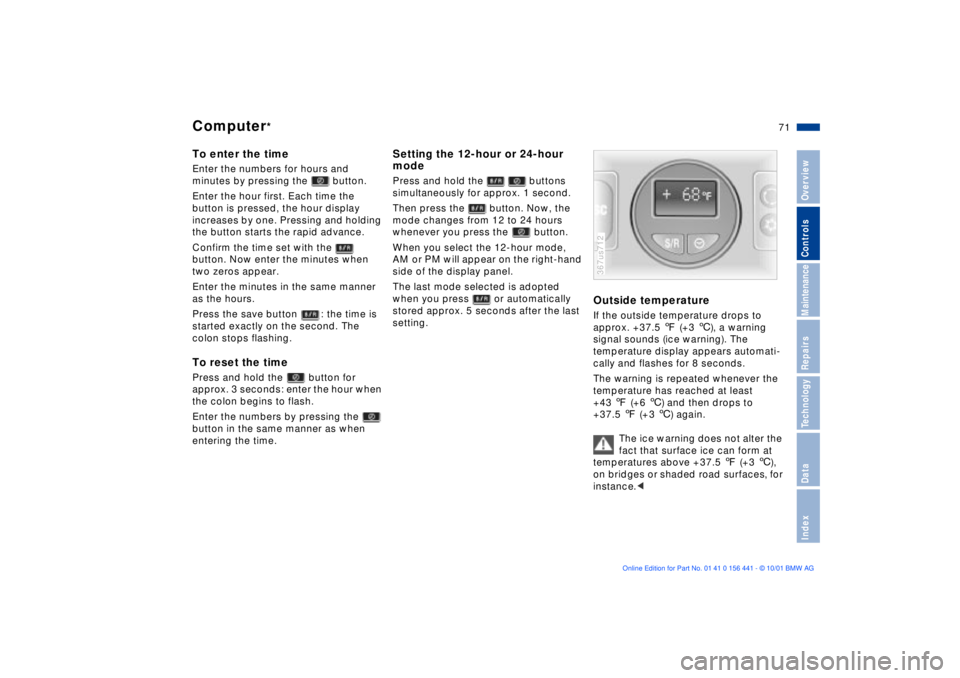
Outside temperatureIf the outside temperature drops to
approx. +37.5 7 (+3 6), a warning
signal sounds (ice warning). The
temperature display appears automati-
cally and flashes for 8 seconds.
The warning is repeated whenever the
temperature has reached at least
+43 7 (+6 6) and then drops to
+37.5 7 (+3 6) again.
The ice warning does not alter the
fact that surface ice can form at
temperatures above +37.5 7 (+3 6),
on bridges or shaded road surfaces, for
instance.< 367us712
Page 73 of 187
73n
IndexDataTechnologyRepairsMaintenanceControlsOverview
The conceptThis system helps provide additional
dynamic stability, particularly when
starting off, accelerating and cornering.
ASC+T recognizes the danger present
in traction loss and will increase driving
stability and traction by reducing the
engine's output, and if necessary, by
applying the brakes individually to the
rear wheels.
ASC+T is available as soon as the
engine starts up.
Indicator lamp
The indicator lamp in the instru-
ment cluster goes out shortly
after you switch on the ignition,
refer to page 22.
The indicator lamp flashes:
ASC+T controls the drive and braking
forces.
If the indicator lamp fails to go out after
the engine is started, or if it comes on
during normal driving and stays on:
There is a system malfunction or the
system was switched off with the
button. Consequently, interventions to
increase driving stability (as described
in the preceding column) are not avail-
able. You can still drive the vehicle
normally without ASC+T.
In the event of a malfunction, please
consult your BMW center.
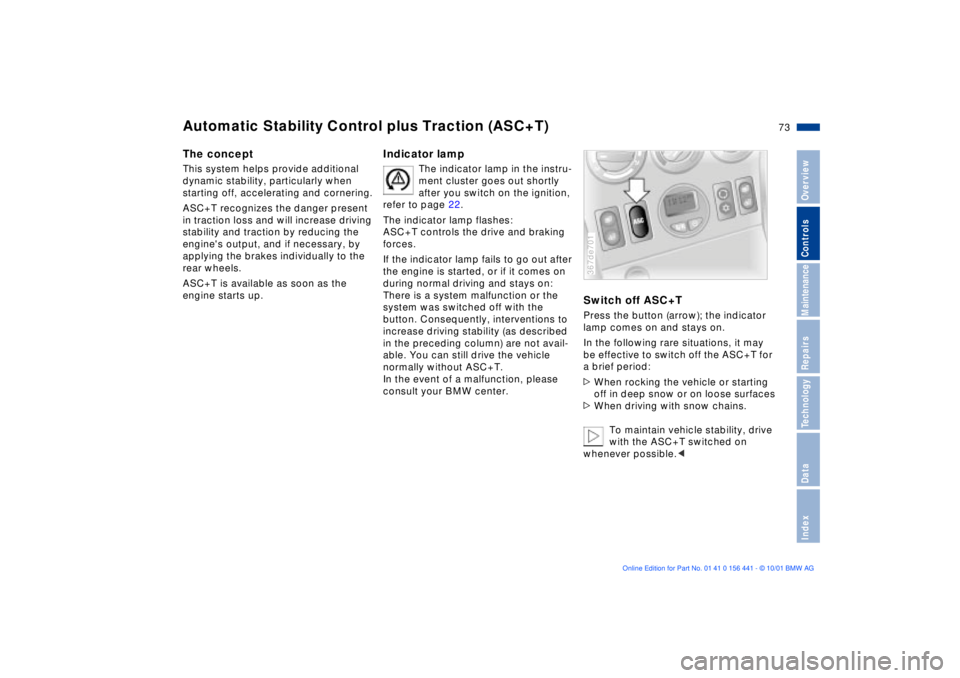
Switch off ASC+TPress the button (arrow); the indicator
lamp comes on and stays on.
In the following rare situations, it may
be effective to switch off the ASC+T for
a brief period:
>When rocking the vehicle or starting
off in deep snow or on loose surfaces
>When driving with snow chains.
To maintain vehicle stability, drive
with the ASC+T switched on
whenever possible.<367de701
Automatic Stability Control plus Traction (ASC+T)
Page 75 of 187
75n
IndexDataTechnologyRepairsMaintenanceControlsOverview
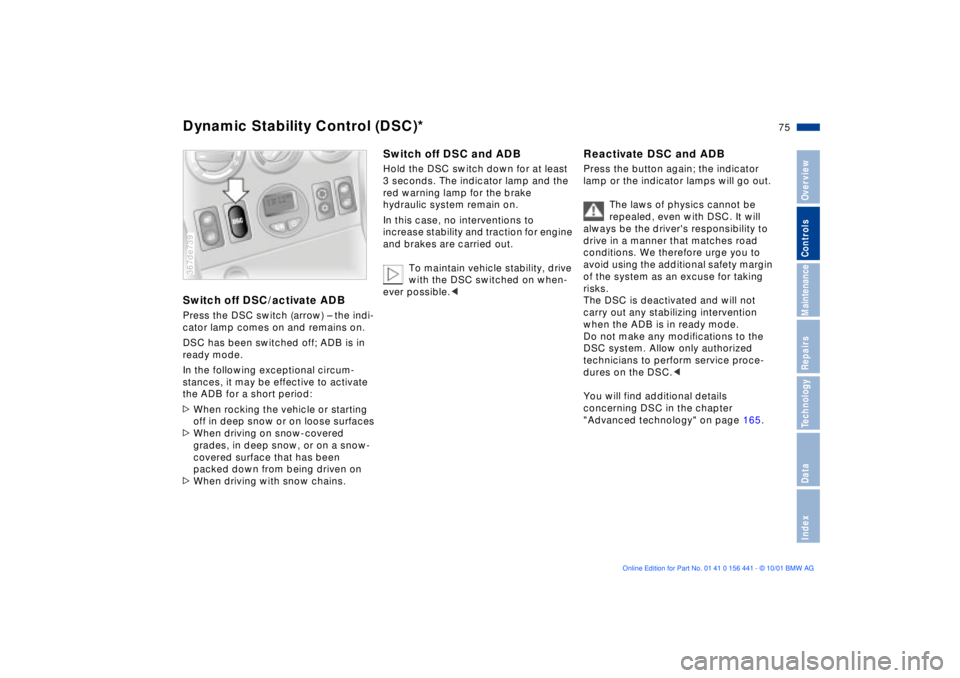
Dynamic Stability Control (DSC)*Switch off DSC/activate ADBPress the DSC switch (arrow) Ð the indi-
cator lamp comes on and remains on.
DSC has been switched off; ADB is in
ready mode.
In the following exceptional circum-
stances, it may be effective to activate
the ADB for a short period:
>When rocking the vehicle or starting
off in deep snow or on loose surfaces
>When driving on snow-covered
grades, in deep snow, or on a snow-
covered surface that has been
packed down from being driven on
>When driving with snow chains.367de739
Switch off DSC and ADBHold the DSC switch down for at least
3 seconds. The indicator lamp and the
red warning lamp for the brake
hydraulic system remain on.
In this case, no interventions to
increase stability and traction for engine
and brakes are carried out.
To maintain vehicle stability, drive
with the DSC switched on when-
ever possible.<
Reactivate DSC and ADBPress the button again; the indicator
lamp or the indicator lamps will go out.
The laws of physics cannot be
repealed, even with DSC. It will
always be the driver's responsibility to
drive in a manner that matches road
conditions. We therefore urge you to
avoid using the additional safety margin
of the system as an excuse for taking
risks.
The DSC is deactivated and will not
carry out any stabilizing intervention
when the ADB is in ready mode.
Do not make any modifications to the
DSC system. Allow only authorized
technicians to perform service proce-
dures on the DSC.<
You will find additional details
concerning DSC in the chapter
"Advanced technology" on page 165.
Page 77 of 187
77n
IndexDataTechnologyRepairsMaintenanceControlsOverview
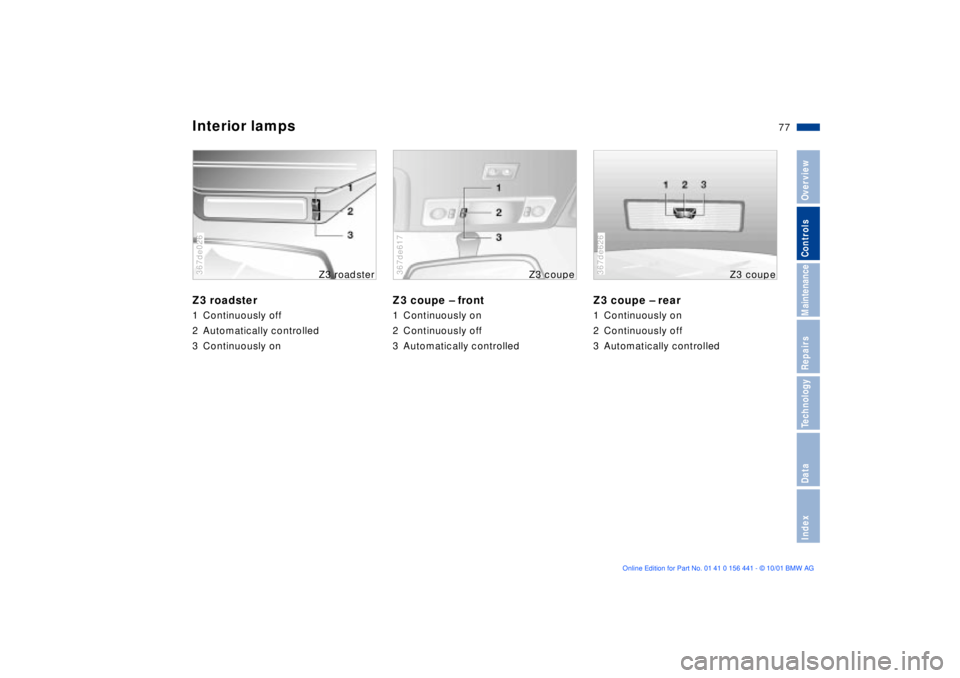
Interior lampsZ3 roadster1 Continuously off
2 Automatically controlled
3 Continuously on367de026
Z3 roadster
Z3 coupe Ð front1 Continuously on
2 Continuously off
3 Automatically controlled367de617
Z3 cou
pe
Z3 coupe Ð rear1 Continuously on
2 Continuously off
3 Automatically controlled367de626
Z3 coupe
Page 79 of 187

79n
IndexDataTechnologyRepairsMaintenanceControlsOverview
Page 81 of 187

81n
IndexDataTechnologyRepairsMaintenanceControlsOverview
Heating and ventilation 1 Airflow toward the windshield and
side windows
2 Airflow toward upper body
The rotary dials allow infinitely-vari-
able regulation of the air supply. You
can change the airflow direction with
the lever in the center of the vent or
by rotating the vent grille82
3 Front footwell ventilation
4 Air distribution onto the
>windows
>upper body
>footwell
All intermediate settings are
possible82
5 Temperature82
6 Air supply
The heating and ventilation are oper-
ational beginning with position 182
Page 83 of 187
83n
IndexDataTechnologyRepairsMaintenanceControlsOverview
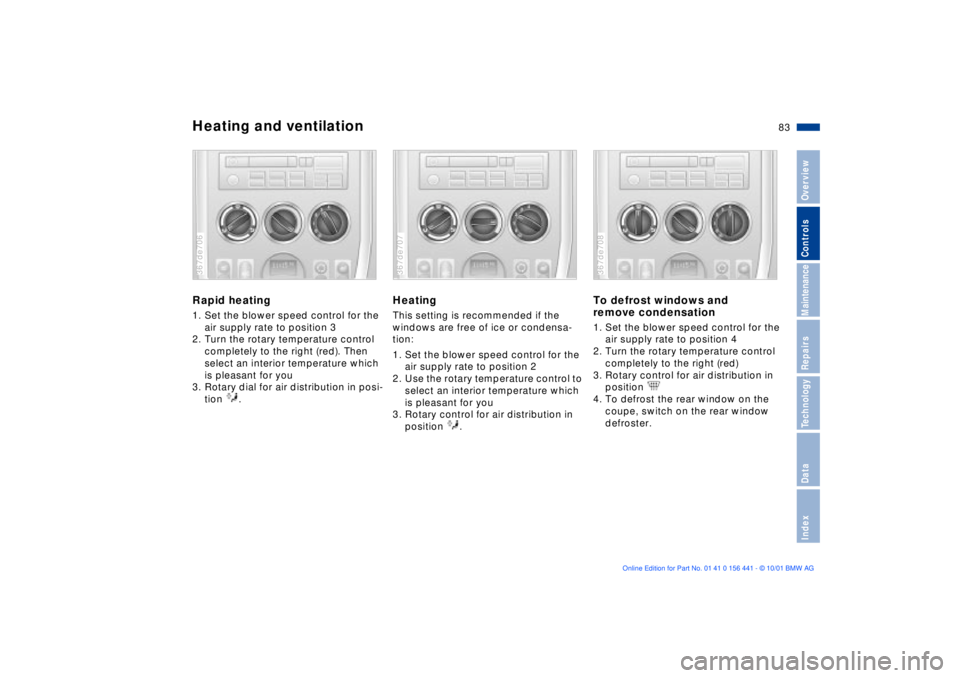
Heating and ventilationRapid heating1. Set the blower speed control for the
air supply rate to position 3
2. Turn the rotary temperature control
completely to the right (red). Then
select an interior temperature which
is pleasant for you
3. Rotary dial for air distribution in posi-
tion .367de706
HeatingThis setting is recommended if the
windows are free of ice or condensa-
tion:
1. Set the blower speed control for the
air supply rate to position 2
2. Use the rotary temperature control to
select an interior temperature which
is pleasant for you
3. Rotary control for air distribution in
position .367de707
To defrost windows and
remove condensation 1. Set the blower speed control for the
air supply rate to position 4
2. Turn the rotary temperature control
completely to the right (red)
3. Rotary control for air distribution in
position
4. To defrost the rear window on the
coupe, switch on the rear window
defroster.367de708