maintenance BMW Z3 2002 Service Manual
[x] Cancel search | Manufacturer: BMW, Model Year: 2002, Model line: Z3, Model: BMW Z3 2002Pages: 187, PDF Size: 2.73 MB
Page 85 of 187

85n
IndexDataTechnologyRepairsMaintenanceControlsOverview
Heating and ventilation/Air conditioner
*
1 Airflow toward the windshield and
side windows
2 Airflow toward upper body
The rotary dials allow infinitely-vari-
able regulation of the air supply. You
can change the airflow direction with
the lever in the center of the vent or
by rotating the vent grille87
3 Front footwell ventilation
4 Air distribution onto the
>windows
>upper body
>footwell
All intermediate settings are
possible86
5 Temperature86
6 Air supply
The heating and ventilation are oper-
ational beginning with position 186
7 Recirculated-air mode86
8 Air conditioner86
Page 87 of 187
87n
IndexDataTechnologyRepairsMaintenanceControlsOverview
Heating and ventilation/Air conditioner
*
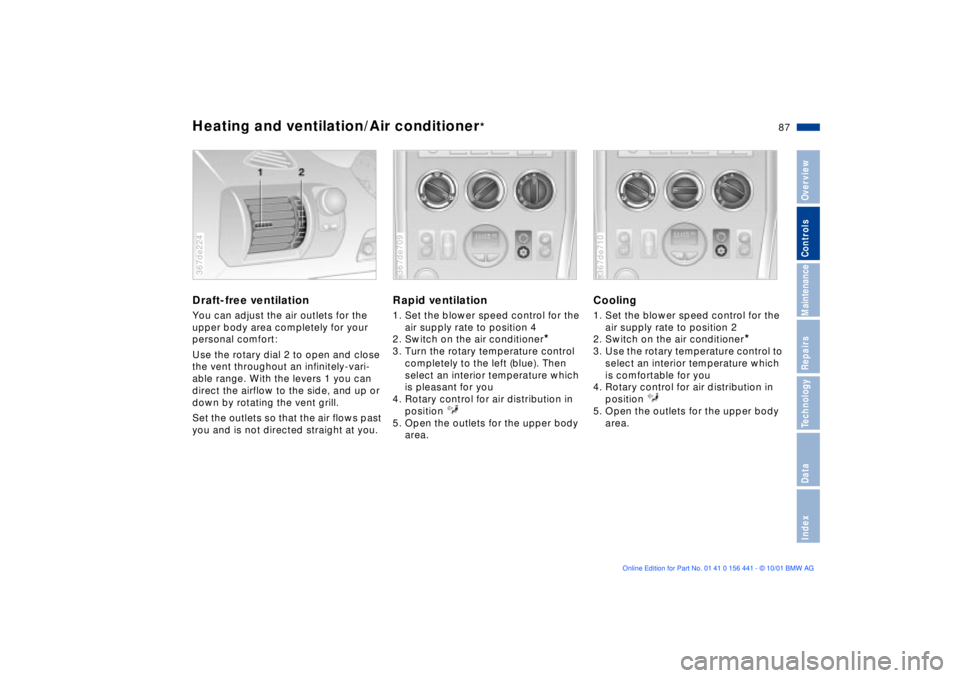
Draft-free ventilationYou can adjust the air outlets for the
upper body area completely for your
personal comfort:
Use the rotary dial 2 to open and close
the vent throughout an infinitely-vari-
able range. With the levers 1 you can
direct the airflow to the side, and up or
down by rotating the vent grill.
Set the outlets so that the air flows past
you and is not directed straight at you.367de224
Rapid ventilation1. Set the blower speed control for the
air supply rate to position 4
2. Switch on the air conditioner
*
3. Turn the rotary temperature control
completely to the left (blue). Then
select an interior temperature which
is pleasant for you
4. Rotary control for air distribution in
position
5. Open the outlets for the upper body
area.367de709
Cooling1. Set the blower speed control for the
air supply rate to position 2
2. Switch on the air conditioner
*
3. Use the rotary temperature control to
select an interior temperature which
is comfortable for you
4. Rotary control for air distribution in
position
5. Open the outlets for the upper body
area.367de710
Page 89 of 187
89n
IndexDataTechnologyRepairsMaintenanceControlsOverview
Seat heating
*
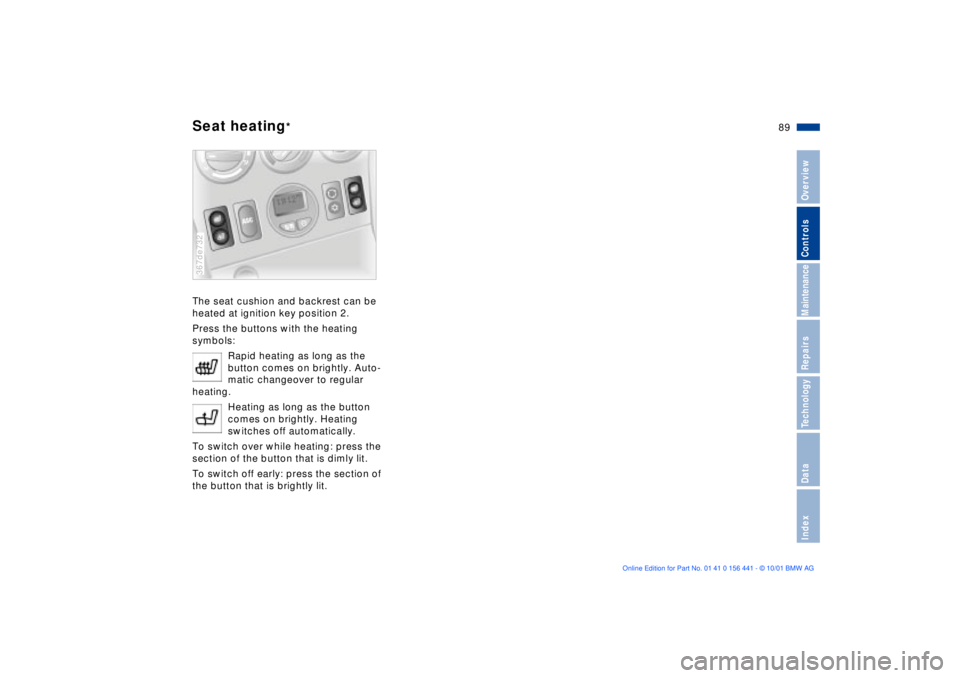
The seat cushion and backrest can be
heated at ignition key position 2.
Press the buttons with the heating
symbols:
Rapid heating as long as the
button comes on brightly. Auto-
matic changeover to regular
heating.
Heating as long as the button
comes on brightly. Heating
switches off automatically.
To switch over while heating: press the
section of the button that is dimly lit.
To switch off early: press the section of
the button that is brightly lit.367de732
Page 91 of 187
91n
IndexDataTechnologyRepairsMaintenanceControlsOverview
Beverage holder
*
Ashtray
*
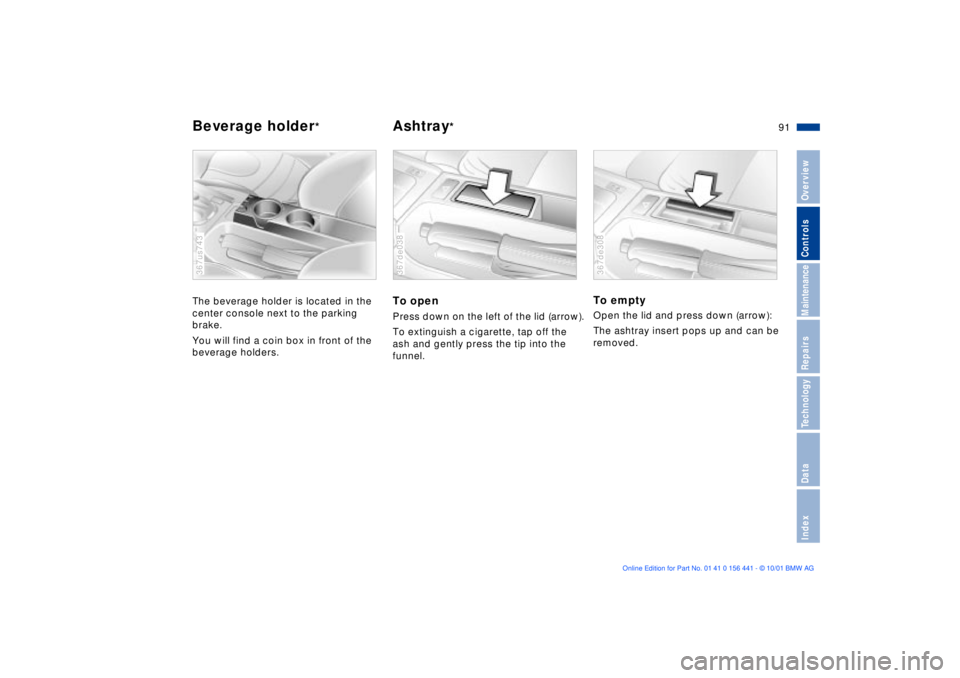
The beverage holder is located in the
center console next to the parking
brake.
You will find a coin box in front of the
beverage holders.367us743
To openPress down on the left of the lid (arrow).
To extinguish a cigarette, tap off the
ash and gently press the tip into the
funnel.367de038
To emptyOpen the lid and press down (arrow):
The ashtray insert pops up and can be
removed.367de308
Page 93 of 187
93n
IndexDataTechnologyRepairsMaintenanceControlsOverview
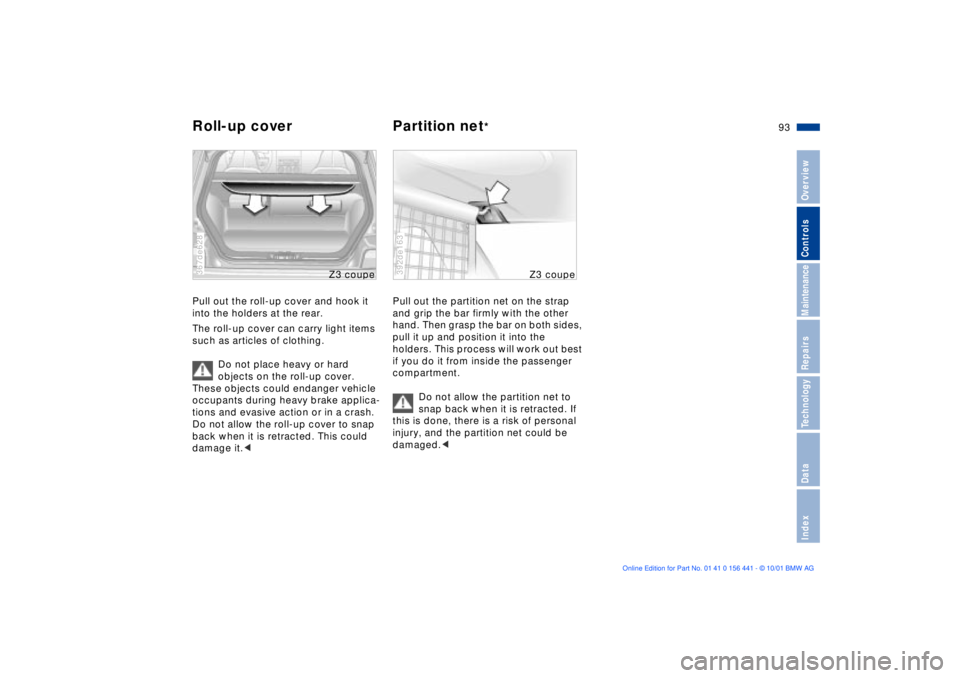
Pull out the roll-up cover and hook it
into the holders at the rear.
The roll-up cover can carry light items
such as articles of clothing.
Do not place heavy or hard
objects on the roll-up cover.
These objects could endanger vehicle
occupants during heavy brake applica-
tions and evasive action or in a crash.
Do not allow the roll-up cover to snap
back when it is retracted. This could
damage it.< 367de628
Z3 cou
pe
Pull out the partition net on the strap
and grip the bar firmly with the other
hand. Then grasp the bar on both sides,
pull it up and position it into the
holders. This process will work out best
if you do it from inside the passenger
compartment.
Do not allow the partition net to
snap back when it is retracted. If
this is done, there is a risk of personal
injury, and the partition net could be
damaged.< 392de163
Z3 cou
pe
Roll-up cover Partition net
*
Page 95 of 187

95n
IndexDataTechnologyRepairsMaintenanceControlsOverview
Roof-mounted luggage rackA special roof-rack system is available
for your coupe as an optional acces-
sory. Please comply with the precau-
tions included with the installation
instructions.
Roof-mounted luggage racks raise the
center of gravity of the vehicle when
they are loaded. For this reason, they
have a major effect on the vehicle's
handling and steering response.
You should therefore always remember
not to exceed the approved roof load
capacity, the approved gross vehicle
weight or the axle loads when loading
the rack. You will find the specifications
for this under "Technical Data" on
page 172.
Make sure that the load is not too large
in size, and distribute it evenly. Always
load the heaviest pieces first (on the
bottom). Be sure that adequate clear-
ance is maintained for raising the
sunroof, and that objects do not project
into the opening path of the luggage
compartment lid.Secure the roof luggage correctly
and securely to prevent it from
shifting or being lost during driving
(danger to following traffic).<
Drive smoothly and avoid sudden
acceleration and braking. Do not corner
at high speeds.
Page 97 of 187
Overview
Controls and features
Operation, maintenance
Owner service procedures
Technical data
Index Advanced technology
97n
IndexDataTechnologyRepairsMaintenanceControlsOverview
Special operating instructions:
Break-in procedure98
Driving notes99
Catalytic converter100
Antilock Brake System
(ABS)101
Disc brakes103
Brake system104
Winter operation105
Power steering106
Cellular phone107
Car radio reception107
Hardtop Ð roadster108
Wheels and tires:
Notes on inflation pressures110
Tire condition110
Tire replacement111
Tire rotation113
Wheel and tire
combinations114
Special features of winter
tires115
Snow chains115
Approved wheel and tire
specifications116In the engine compartment:
Hood118
Engine compartment120
Fluids for the washer
systems122
Washer nozzles122
Engine oil123
Coolant125
Brake fluid126
Vehicle Identification127
Care and maintenance:
The BMW Maintenance
System128
Airbags130
Storing your vehicle130
Laws and regulations:
Technical modifications132
California Proposition
65 Warning132
OBD interface socket133
Maintenance
Page 99 of 187

99n
IndexDataTechnologyRepairsMaintenanceControlsOverview
Driving notes
Brakes:
Do not drive with your foot resting
on the brake pedal. Even light but
consistent pedal pressure can lead to
high temperatures, brake wear and
possibly even brake failure.
Aquaplaning:
When driving on wet or slushy roads,
reduce vehicle speed. If you do not, a
wedge of water may form between the
tires and the road surface. This
phenomenon is referred to as aqua-
planing or hydroplaning. It is character-
ized by a partial or complete loss of
contact between the tires and the road
surface. The ultimate results are loss of
steering and braking control.
Driving through water:
When there is water on the roads, do
not drive in it if it is deeper than 1 ft
(30 cm). If the water is at that depth,
drive only at walking speed, otherwise
the vehicle can sustain damage to the
engine, the electrical systems and the
transmission.
Clothes hooks (coupe):
Hang items of clothing on the hooks in
such a manner that they do not obstruct
the driver's vision. Do not hang heavy
objects on the hooks. If you do so, they
could cause personal injury during
braking or evasive maneuvers.<
Page 100 of 187

100n
Catalytic converterThe catalytic converter reduces harmful
exhaust emissions.
It is designed for use with unleaded fuel
only.
Even minute quantities of lead would be
enough to permanently damage both
the catalytic converter and the system's
oxygen sensor.
To ensure efficient, trouble-free engine
operation and avoid potential damage:
>Be sure to comply with the scheduled
maintenance requirements
>Fill the fuel tank well before it is
empty
>If the engine runs roughly, shut it off
as soon as possible
>Tow-start the vehicle only when the
engine is cold. Tow-starting when the
engine is warm could cause unburned
fuel to ignite on the way to the cata-
lytic converter, resulting in significant
damage. It is better to start the vehicle
with an outside starting aid>Avoid any other situations in which
the fuel would not be (completely)
burned, for instance:
Frequent or consecutive extended
starting attempts or repeated starting
attempts when the engine fails to
start. (Shutting down and restarting
an engine which is running properly
does not present a problem.) Never
allow the engine to run with any of
the spark plug cables disconnected.Be sure to comply with the
instructions above to prevent
unburned fuel from reaching the cata-
lytic converter. Otherwise, the catalytic
converter could respond by over-
heating, leading to serious damage.
Extreme temperatures occur at the
catalytic converter on this and every
catalyst-equipped vehicle. Heat shields
are installed adjacent to some sections
of the exhaust system. Never remove
these shields; do not apply under-
coating to their surfaces.
When driving, standing while the engine
is idling, or when parking, be careful to
avoid contact between the hot exhaust
system and easily-flammable materials
(hay, dry grass, leaves, etc.). Such
contact could cause a fire, resulting in
personal injuries and property
damage.<
Page 101 of 187

101n
IndexDataTechnologyRepairsMaintenanceControlsOverview
Antilock Brake System (ABS)The conceptThe Antilock Brake System (ABS) keeps
the wheels from locking during braking,
thereby enhancing active driving safety.
The reason: locked wheels are
dangerous. When the front wheels
slide, the driver loses steering control
over the vehicle. Traction loss at the
rear wheels can cause the rear end to
break into an uncontrolled skid.
The system can achieve the shortest
braking distances possible under most
conditions (on straight-aways or in
curves, on the various road surfaces).
ABS is designed to meet two essential
requirements during every brake appli-
cation:
>To help provide vehicle stability
>Assured ability to steer and maneuver
on the various road surfaces (asphalt,
concrete, dirt, wet conditions, snow
and ice).
Braking with ABSThe system is operative once the
vehicle exceeds a speed of approx.
6 mph (10 km/h). It is inactive once
again below approx. 4 mph (6 km/h).
Therefore, the wheels could theoreti-
cally tend to lock in the final phase of a
braking action, but this is insignificant in
actual practice.
If you are in a situation which requires
full braking, you will exploit the full
benefits of the ABS system if you apply
maximum brake pressure ("panic stop").
Since the vehicle maintains steering
responsiveness, you can avoid possible
obstacles with a minimum of steering
effort, despite the full brake application.The ABS closed-loop control circuit
cycles in fractions of a second. The
pulsation at the brake pedal, together
with sounds generated by the hydraulic
control system, indicate to you that the
vehicle is approaching its maximum
braking range. It is a reminder to you
that you must adapt the vehicle's road
speed to existing road conditions.
On road surfaces that have a loose
surface layer on a firm base with good
traction (on gravel, deep sand or snow,
for example), braking distances may be
longer than with locked wheels. This
also applies for driving with snow
chains. However, ABS continues to
provide enhanced vehicle stability and
steering response under these condi-
tions.