maintenance BMW Z3 2002 Workshop Manual
[x] Cancel search | Manufacturer: BMW, Model Year: 2002, Model line: Z3, Model: BMW Z3 2002Pages: 187, PDF Size: 2.73 MB
Page 103 of 187

103n
IndexDataTechnologyRepairsMaintenanceControlsOverview
ABS Disc brakesDynamic Brake Control (DBC)*DBC is included in the DSC, refer to
information beginning on page 74.
If you step on the brake rapidly, this
system automatically produces
maximum braking force boost and thus
helps to achieve the shortest possible
braking distance during "panic stops".
All of the benefits of the ABS system
are exploited under these circum-
stances.
Do not reduce the pressure on the
brake pedal for the duration of the
brake application. When the brake
pedal is released, the DBC is deacti-
vated.
In the event of a malfunction,
the brake warning lamp lights up
yellow. Normal braking effi-
ciency is still fully available.
Have the system checked and
repaired at your BMW center as
soon as possible.
Please observe the section "Infor-
mation for your safety" concerning
the ABS system, which also applies to
the DSC system.<
Disc brakes furnish optimum decelera-
tion and braking control and greater
fade resistance under heavy use.
When the vehicle is driven only occa-
sionally, during extended periods when
the vehicle is not used at all, or in oper-
ating conditions where brake applica-
tions are less frequent, there is an
increased tendency for corrosion of the
rotors and accumulation of contamina-
tion on the brake pads. This occurs
because the minimal pressure which
must be exerted by the pads to clean
the rotors by brake applications is not
reached.
If the brake rotors are corroded, they
will tend to respond to braking with a
pulsating effect which even extended
application will fail to cure.
For your own safety: use only
brake pads that BMW has
approved for your specific vehicle
model. BMW cannot evaluate non-
approved brake pads to determine if
they are suited for use, and therefore
cannot ensure the operating safety of
the vehicle in the event of their use.<
Driving notesWhile driving in wet conditions and in
heavy rain, it is advisable to apply light
pressure to the brake pedal every few
miles Ð watch traffic conditions to
ensure that this maneuver does not
endanger other road users. The heat
generated in this process helps dry the
pads and rotors.
Maximum braking force is obtained
while the wheels continue to rotate,
peaking when the wheels remain on the
verge of locking without actually doing
so. ABS maintains this state automati-
cally. If the ABS fails, you should revert
to the staggered braking technique
described on page 106.
Extended or steep mountain descents
should be driven in the gear in which
only minimal periodic brake application
is required. This avoids excessive strain
on the brakes and possible
impairment of the braking effect.
You can increase the engine's braking
effect by selecting progressively lower
gears, downshifting into first gear, if
necessary. You can also downshift into
first gear if you are using the manual
mode in a vehicle with automatic trans-
mission, refer to page 63.
Page 105 of 187

105n
IndexDataTechnologyRepairsMaintenanceControlsOverview
Winter operationThe onset of winter is often accompa-
nied by rapid changes in weather.
Adaptations in driving style should be
accompanied by preparations on the
vehicle itself to ensure that your vehicle
operation through the winter remains
safe and trouble-free.CoolantEnsure that the coolant contains the
year-round 50 : 50 ratio of water and
antifreeze with corrosion inhibitor. This
mixture provides protection against
freezing down to approx. Ð 34 7
(Ð 37 6). Replace the coolant every
three years.LocksBMW door lock deicer can be used to
free the doors if they are frozen. This
deicer also contains lubricant.
After using deicer, treatment with BMW
lock cylinder grease is recommended.
Rubber seals and components In order to prevent freezing, apply BMW
rubber treatment to weather-stripping
on the doors, hood, luggage compart-
ment and to convertible top seals.
A full range of car-care products is
available from your BMW center.< Snow chainsBMW snow chains
* can be mounted on
both summer and winter tires. Mount
them in pairs on the rear wheels only.
Comply with the manufacturer's safety
precautions. Do not exceed a speed
limit of 30 mph (50 km/h) when driving
with chains. As an exception in this
situation, we recommend that you
switch off the ASC+T/DSC
* system
when snow chains are mounted. Refer
to pages 73, 74.
Starting offWhen starting from a full stop or
"rocking" free in deep snow, we recom-
mend that you switch off the ASC+T/
DSC
* system, refer to pages 73, 74.
Driving on low-traction road
surfacesUse smooth, gentle pressure to control
the accelerator pedal. Avoid excessive
engine speeds and shift to the next
higher gear at an early point. Shift down
into the next lowest gear when
approaching uphill or downhill grades.
Maintain an adequate distance between
yourself and the vehicle ahead.Brakes Winter road conditions substantially
reduce the traction available between
the tires and the road surface.
Remember that Ð in every situation Ð
braking distances will be significantly
longer as a result of this.
ABS is intended to prevent the wheels
from locking during brake applications,
thus helping to maintain vehicle stability
and steering response.
Page 107 of 187

107n
IndexDataTechnologyRepairsMaintenanceControlsOverview
Cellular phone
*
Car radio reception
Mobile communications systems
(cellular phones, two-way radios, etc.)
are approved only up to a power output
of 10 watts. Nonetheless, they may
cause interference in the operation of
your vehicle if they are not specifically
designed for use in your vehicle. BMW
can neither test nor assume responsi-
bility for every individual product being
offered on the market. We recommend
that you consult your BMW center
before purchasing any device of this
kind.
To ensure that your BMW continues to
provide reliable and trouble-free opera-
tion, refrain from using a cellular phone
or other radio device with an antenna
located inside the passenger compart-
ment. The antenna should always be
fitted on the outside of the vehicle.
Before loading the vehicle on
a car-carrier train or driving it
through a car wash, remove the
antenna.<
The reception and sound quality
obtained from mobile radios varies
according to a variety of factors,
including the broadcast range of the
transmitter and the directional orienta-
tion of the antenna. Interference factors
such as high-tension power lines, build-
ings and natural obstructions can all
lead to unavoidable reception interfer-
ence, regardless of how well the
vehicle's sound system is operating.
Climatic factors such as intense solar
radiation, fog, rain and snow can also
interfere with reception.
Cellular phones without official BMW
approval can also generate interference
during use. This phenomenon assumes
the form of a low-pitched hum
emanating from the speaker system.
Please refer to the Owner's Manual
provided with your sound system for
detailed information on its use.Whenever necessary (when
entering a car wash, for instance),
remove the rod antenna
*. To remove
the antenna, grasp the rod at the
bottom and unscrew it to the left from
the antenna base.<
You will find additional information
concerning car radio reception in the
chapter "Advanced technology" on
page 166.
Page 109 of 187
109n
IndexDataTechnologyRepairsMaintenanceControlsOverview
Hardtop
* Ð roadster
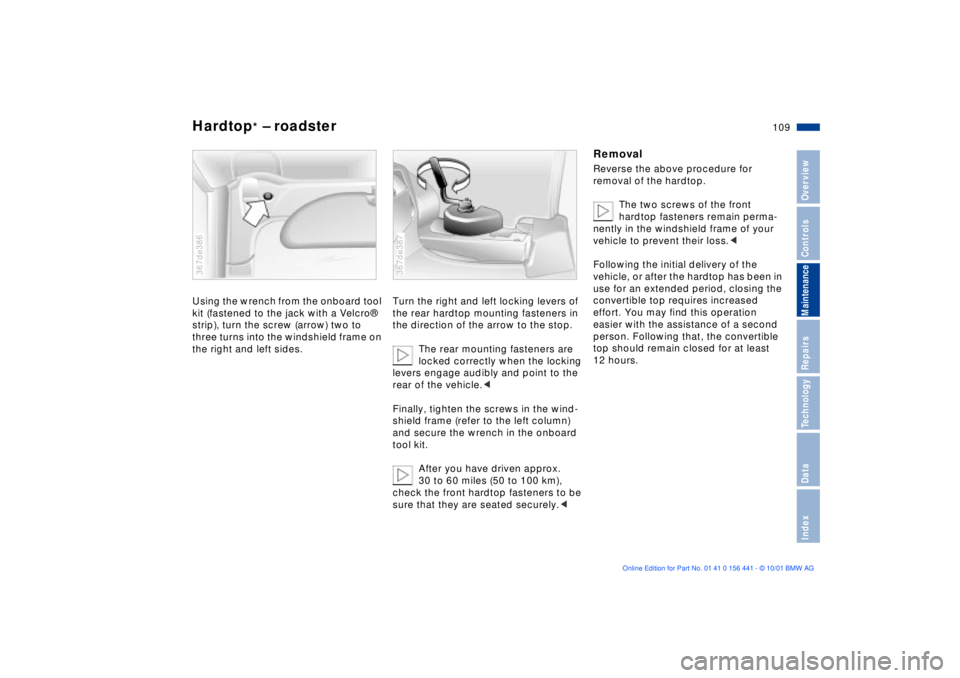
Using the wrench from the onboard tool
kit (fastened to the jack with a Velcro¨
strip), turn the screw (arrow) two to
three turns into the windshield frame on
the right and left sides.367de386
Turn the right and left locking levers of
the rear hardtop mounting fasteners in
the direction of the arrow to the stop.
The rear mounting fasteners are
locked correctly when the locking
levers engage audibly and point to the
rear of the vehicle.<
Finally, tighten the screws in the wind-
shield frame (refer to the left column)
and secure the wrench in the onboard
tool kit.
After you have driven approx.
30 to 60 miles (50 to 100 km),
check the front hardtop fasteners to be
sure that they are seated securely.< 367de387
RemovalReverse the above procedure for
removal of the hardtop.
The two screws of the front
hardtop fasteners remain perma-
nently in the windshield frame of your
vehicle to prevent their loss.<
Following the initial delivery of the
vehicle, or after the hardtop has been in
use for an extended period, closing the
convertible top requires increased
effort. You may find this operation
easier with the assistance of a second
person. Following that, the convertible
top should remain closed for at least
12 hours.
Page 111 of 187

111n
IndexDataTechnologyRepairsMaintenanceControlsOverview
Tire condition Tire replacementmoderate speeds and with only small
amounts of water on the road.
Never continue driving on a
deflated (flat) tire. A flat tire greatly
impairs steering and braking response,
and can lead to complete loss of
control over the vehicle.
Avoid overloading the vehicle so that
the permitted load on the tires is not
exceeded. Overloading causes over-
heating and damage inside the tires.
The ultimate result can assume the
form of a sudden air loss.
Unusual vibrations encountered during
normal vehicle operation can indicate a
flat tire or some other vehicle malfunc-
tion. The type of problem can be
caused by contact with curbs, etc. This
is also true for irregularities in the
vehicle's handling characteristics, such
as a pronounced tendency to pull to the
left or right. Should this occur, respond
by immediately reducing your speed.
Proceed carefully to the nearest BMW
center or professional tire center, or
have the vehicle towed in to have it, its
wheels and tires inspected.
Tire damage (up to and including
sudden and complete air loss) can pose
an extreme hazard for both vehicle
occupants and other road users.< To maintain good handling and vehicle
response, use only tires of a single tread
configuration from a single manufac-
turer. BMW tests and approves wheel
and tire combinations, refer to page 116.
DOT Quality GradesTread wear
Traction AA A B C
Temperature A B C
All passenger vehicle tires must
conform to Federal Safety
Requirements in addition to these
grades.
when tested under controlled condi-
tions on a specified government test
course.
For example, a tire graded 150 would
wear one and one-half (1g) times as
well on the government course as a tire
graded 100. The relative performance
of tires depends upon the actual condi-
tions of their use, however, and may
depart significantly from the norm due
to variations in driving habits, service
practices and differences in road char-
acteristics and climate.
Page 113 of 187

113n
IndexDataTechnologyRepairsMaintenanceControlsOverview
Tire replacement Tire rotationTire ageThe date on which the tire was manu-
factured is indicated by the code on the
sidewall:
DOT ... 2501 indicates that the tire was
manufactured in week 25 of 2001.
BMW recommends the replacement
of all tires when the tires are no more
than 6 years old, even if a tire usage of
10 years is possible.
Spare tires over 6 years old should be
used only in case of emergency. A tire
of this age should be replaced by a new
tire immediately, and should not be
fitted together with new tires.
Between the axlesTread wear at the front and rear axle is
different and will vary according to indi-
vidual driving conditions. In the interest
of safety and optimal vehicle response,
we advise against rotating tires from
front to rear and vice versa.
If rotating the tires between the axles is
under consideration for economic
reasons, the costs for remounting the
wheels must be calculated against any
savings which might result from the
anticipated extension in tire life. Rota-
tion should always be carried out at
short intervals, with a maximum of
3,000 miles (5,000 km). Consult your
BMW center for more information.Should you decide to rotate the tires,
it is essential to comply with the
following:
Rotate wheels on the same side of the
vehicle only, otherwise braking effi-
ciency and road grip could be adversely
affected.
Following rotation, correct the tire infla-
tion pressure.
If tires with different sizes are
mounted on the front and rear
axles (refer to the information beginning
on page 116), the wheels may not be
rotated from one axle to the other.<
Page 115 of 187

115n
IndexDataTechnologyRepairsMaintenanceControlsOverview
Special features of winter tires Snow chains
*
Choosing the right tireBMW recommends winter tires (M+S
radial tires) for operation under
inclement winter driving conditions.
While so-called all season tires (M+S
designation) provide better winter trac-
tion than summer tires with the load
ratings H, V, W, Y and ZR, they gener-
ally do not achieve the performance of
winter tires.
In the interests of sure tracking and safe
steering response, mount winter tires
which are made by the same manufac-
turer and which have the same tread
configuration at all four wheels.Comply with recommended speed
Never exceed the maximum
speed for which the winter tires
are rated.
Unprofessional attempts by laymen to
service tires can lead to damage and
accidents.
Have this work performed by skilled
professionals only. Any BMW center
has the required technical knowledge
and the proper equipment and will be
happy to assist you.<
Tire condition, tire pressureOnce the tire wears to below 0.16 in
(4 mm), winter tires display a percep-
tible decrease in their ability to cope
with winter driving conditions, and
should be replaced in the interest of
safety.
Comply with the specified tire inflation
pressures Ð and be sure to have the
wheel and tire assemblies balanced
every time you change the tires.BMW narrow-link snow chains are
intended for mounting in pairs at the
rear wheels only. Comply with all manu-
facturer's safety precautions when
mounting the chains. Do not exceed a
speed of 30 mph (50 km/h) while
driving with mounted snow chains.
Page 117 of 187

117n
IndexDataTechnologyRepairsMaintenanceControlsOverview
Approved wheel and tire specificationsBMW tests certain tire brands for each tire size, classifies them as road-safe and
approves them. Consult your BMW center for more information.
Observe any regulations applicable in the country of use, e.g. requiring entry in
the vehicle documents.
Z3 roadster 3.0i, Z3 coupe 3.0i
Summer
225/50 R 16 92 V
225/50 ZR 16[Ð 7Jx16
Front: 225/45 ZR 17 Ð Ð 7.5Jx17
Rear: 245/40 ZR 17 Ð Ð 8.5Jx17
Winter (M+S)
205/55 R 16 91 Q/T/H
225/50 R 16 92 Q/T/H[7Jx16 7Jx16
225/45 R 17 91 Q[Ð
Ð7.5Jx17
8Jx17
Spare tire
T 115/90 R 16 92 M Ð 3.00Bx16 Ð
Use the spare tire only for short
distances (to reach the nearest BMW
center, for instance). Due to the altered
handling characteristics, do not exceed
a maximum speed of 50 mph (80 km/h).
Mounting snow chains on the spare tire
is not possible. Be sure that all tires are
properly inflated, refer to page 27.
The use of rims and lug bolts that
do not meet the specifications of
the original factory-installed equipment
will affect the safe operation of your
vehicle and may cause an accident and
personal injury.
Never mix tires of different design, such
as steel-belted radials with bias-belted
or bias-ply tires etc. Mixing tire types
will adversely affect road-holding and
can lead to loss of vehicle control.<
Page 119 of 187
119n
IndexDataTechnologyRepairsMaintenanceControlsOverview
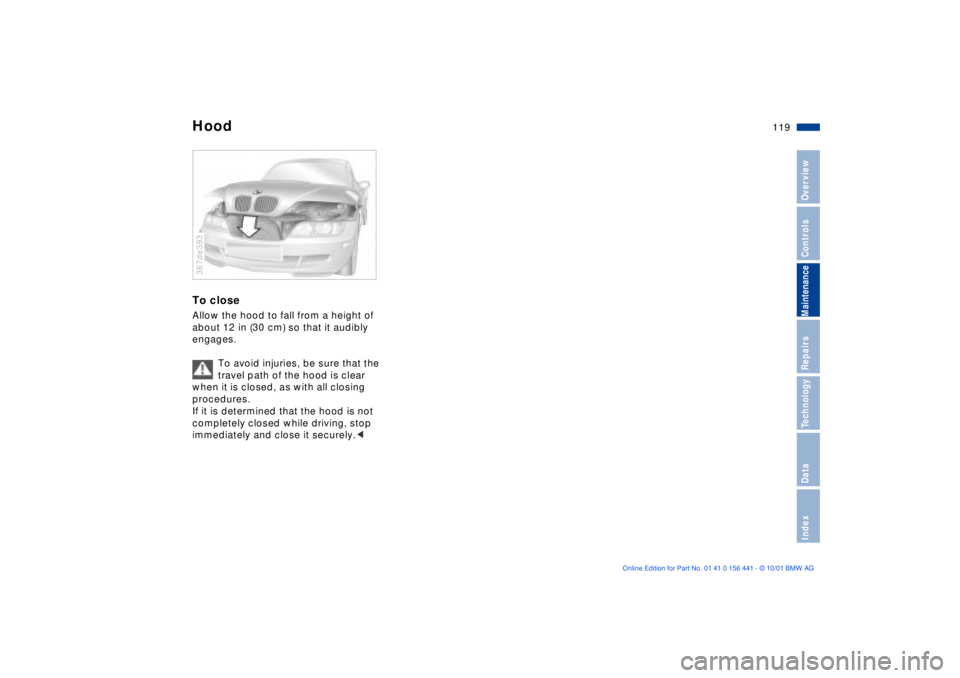
HoodTo closeAllow the hood to fall from a height of
about 12 in (30 cm) so that it audibly
engages.
To avoid injuries, be sure that the
travel path of the hood is clear
when it is closed, as with all closing
procedures.
If it is determined that the hood is not
completely closed while driving, stop
immediately and close it securely.< 367de393
Page 121 of 187

121n
IndexDataTechnologyRepairsMaintenanceControlsOverview
Engine compartment Ð Z3 roadster 2.5i, 3.0i, Z3 coupe 3.0i1 Engine oil dipstick123
2 Brake fluid reservoir,
the illustration shows the reservoir for
Z3 roadster 3.0i, Z3 coupe 3.0i126
3 Fuse box156
4 Coolant expansion tank125
5 Engine oil filler neck123
6 Reservoir for windshield and
headlamp
* washer fluid122
7 Auxiliary terminal for jump-starting Ð
negative terminal158
8 Auxiliary terminal for jump-starting Ð
positive terminal158