ABS BMW Z8 2000 User Guide
[x] Cancel search | Manufacturer: BMW, Model Year: 2000, Model line: Z8, Model: BMW Z8 2000Pages: 172, PDF Size: 1.9 MB
Page 92 of 172
91n
IndexDataTechnologyRepairsCar careControlsOverview
Winter operationDriving on low-traction road
surfacesDo not activate the Sport Mode (refer to
page 64). Use smooth, gentle pressure
to control the accelerator pedal. Avoid
excessive engine speeds and shift to
the next higher gear at an early point.
Shift down into the next lowest gear
when approaching uphill or downhill
grades. Maintain an adequate distance
between yourself and the vehicle
ahead.BrakesWinter road conditions substantially
reduce the amount of traction available
between the tires and the road surface.
The resulting increases in braking dis-
tance are considerable and should be
kept in mind at all times.
ABS is intended to prevent the wheels
from locking during brake applications,
thus helping to maintain vehicle stability
and steering response.If the ABS does not respond in a critical
braking situation and the wheels lock,
reduce the pressure on the brake pedal
until the wheels just start to roll again
while still maintaining enough force to
continue braking.
Then increase the pressure, reduce the
pressure when the wheels lock, reapply
pressure etc.
This staggered braking procedure will
reduce braking distances while helping
you maintain steering control.
You can always then attempt to steer
around hazards after you have reduced
pressure on the brake pedal.
Do not shift down on slick road
surfaces if you want to decelerate.
Doing so could cause the wheels to
lose traction and skid, thus resulting in
the loss of vehicle control.<
Depress the clutch during hard
braking on road surfaces that pro-
vide only poor or uneven traction.<
Skid control Depress the clutch and release the
accelerator pedal. Countersteer care-
fully and attempt to regain control of the
vehicle.ParkingEngage first or reverse gear. Depending
on the steepness of the incline, you can
apply the parking brake as well. In order
to prevent the parking brake pads from
locking due to frost or corrosion, dry
them by gently applying the parking
brake as the vehicle is coming to a stop.
Make sure that following traffic is not
endangered.
The brake lamps do not come
on when the parking brake is
engaged.<
Page 102 of 172

101n
IndexDataTechnologyRepairsCar careControlsOverview
Wheel and tire combinations The right choice Use only BMW-approved tires with
emergency driving characteristics.
Refer to page 103.
Due to the maximum speeds this vehi-
cle can reach, the use of specific brands
and sizes is mandatory. Consult any
BMW center for details. Comply with
local/national regulations.
The correct wheel/tire combinaton
affects different sytems, such as
ABS, ATC, DSC and RDW. The function
of these systems is impaired if improper
wheel/tire combinations are used.
For this reason, use only tires made by
the same manufacturer that have the
same tread configuration and possess
emergency driving characteristics. And
after a flat tire, for instance, restore the
approved wheel-tire combination as
soon as possible.<
Codes on tires and wheels The tire codes will aid you in selecting
the correct tire.
Codes on radial tires:
The speed rating indicates the approved
maximum speed for the tire.
Summer tires:
S = up to 112 mph (180 km/h)
T = up to 118 mph (190 km/h)
H = up to 130 mph (210 km/h)
V = up to 150 mph (240 km/h)
W = up to 167 mph (270 km/h)
Y = up to 186 mph (300 km/h)
ZR = over 150 mph (240 km/h) For example:
Nominal width
in mm
Aspect ratio in X
Radial tire code
Rim diameter in inches
Load rating
(not on ZR tires)
Speed rating
(before R on ZR tires)
245/45 R 18 96 W
Winter tires:
Q M+S = up to 100 mph (160 km/h)
T M+S = up to 118 mph (190 km/h)
H M+S = up to 130 mph (210 km/h)
Codes stamped on light-alloy wheels:
Protect tire valves from dirt by using
screw-on valve stem caps. Dirt in the
valves frequently leads to slow leaks.
Tires with emergency driving character-
istics also possess an additional identi-
fication mark that varies by manufac-
turer, e. g.:
Bridgestone RFT
Dunlop DSST
Goodyear EMT
Michelin ZP For example:
Rim width
in inches
Code letter for
flange type
Symbol for full-drop
center rim
Rim diameter in inches
Hump on the 2 rim shoulders
8 x 18 H 2
J
Page 113 of 172
112n
Coolant Brake fluidAdding coolant Wait until the engine cools before
removing the cap from the expansion
tank. The needle of the coolant gauge
in the instrument cluster must fall within
the blue zone. If it is not, there is a
danger of scalding.
1 Turn the cap slightly counterclock-
wise in order to allow accumulated
pressure to escape. Then open
2 If the coolant is low, slowly add cool-
ant until the correct level is reached Ð
do not overfill.
The coolant is a mixture of water and
extended-duty antifreeze with corrosion
inhibitor. Always maintain the pre-
scribed all-season 50:50 mixture ratio
for year-round protection against inter-
nal corrosion. No other additives are
required.
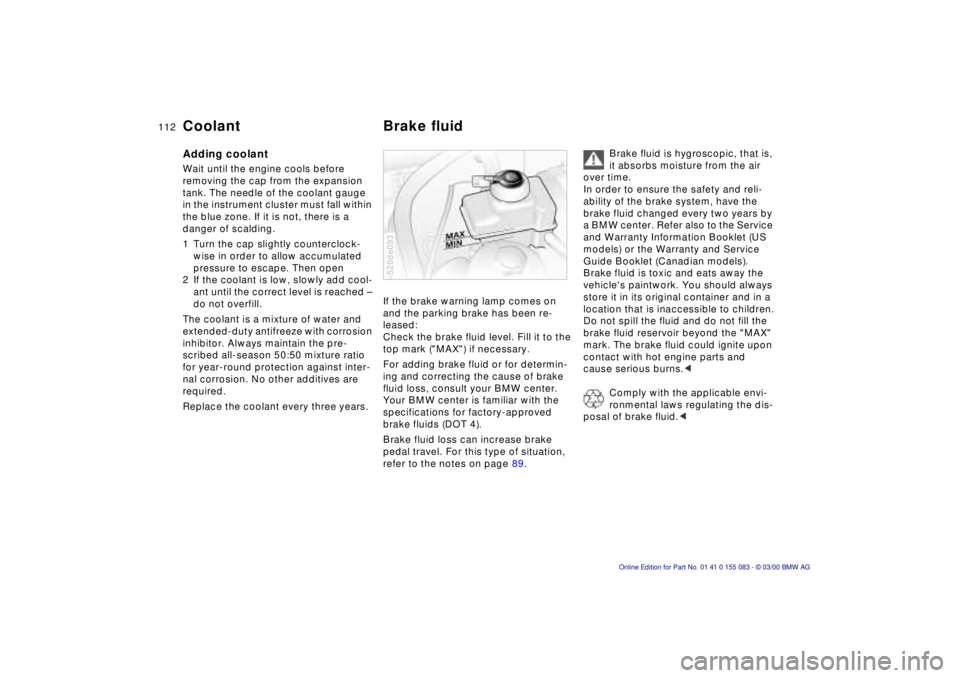
Replace the coolant every three years.If the brake warning lamp comes on
and the parking brake has been re-
leased:
Check the brake fluid level. Fill it to the
top mark ("MAX") if necessary.
For adding brake fluid or for determin-
ing and correcting the cause of brake
fluid loss, consult your BMW center.
Your BMW center is familiar with the
specifications for factory-approved
brake fluids (DOT 4).
Brake fluid loss can increase brake
pedal travel. For this type of situation,
refer to the notes on page 89.
520de093
Brake fluid is hygroscopic, that is,
it absorbs moisture from the air
over time.
In order to ensure the safety and reli-
ability of the brake system, have the
brake fluid changed every two years by
a BMW center. Refer also to the Service
and Warranty Information Booklet (US
models) or the Warranty and Service
Guide Booklet (Canadian models).
Brake fluid is toxic and eats away the
vehicle's paintwork. You should always
store it in its original container and in a
location that is inaccessible to children.
Do not spill the fluid and do not fill the
brake fluid reservoir beyond the "MAX"
mark. The brake fluid could ignite upon
contact with hot engine parts and
cause serious burns.<
Comply with the applicable envi-
ronmental laws regulating the dis-
posal of brake fluid.<
Page 137 of 172
136n
Battery
Battery posts, terminals, and re-
lated accessories contain lead
and lead compounds. Wash hands after
handling.<
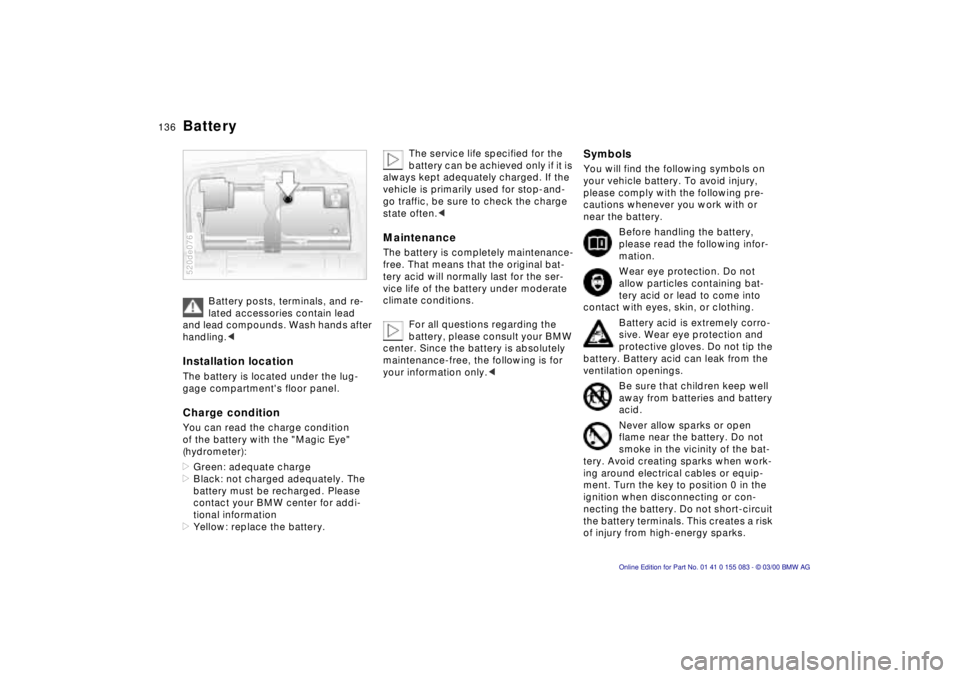
Installation location The battery is located under the lug-
gage compartment's floor panel.Charge conditionYou can read the charge condition
of the battery with the "Magic Eye"
(hydrometer):
>Green: adequate charge
>Black: not charged adequately. The
battery must be recharged. Please
contact your BMW center for addi-
tional information
>Yellow: replace the battery.520de076
The service life specified for the
battery can be achieved only if it is
always kept adequately charged. If the
vehicle is primarily used for stop-and-
go traffic, be sure to check the charge
state often.<
MaintenanceThe battery is completely maintenance-
free. That means that the original bat-
tery acid will normally last for the ser-
vice life of the battery under moderate
climate conditions.
For all questions regarding the
battery, please consult your BMW
center. Since the battery is absolutely
maintenance-free, the following is for
your information only.<
SymbolsYou will find the following symbols on
your vehicle battery. To avoid injury,
please comply with the following pre-
cautions whenever you work with or
near the battery.
Before handling the battery,
please read the following infor-
mation.
Wear eye protection. Do not
allow particles containing bat-
tery acid or lead to come into
contact with eyes, skin, or clothing.
Battery acid is extremely corro-
sive. Wear eye protection and
protective gloves. Do not tip the
battery. Battery acid can leak from the
ventilation openings.
Be sure that children keep well
away from batteries and battery
acid.
Never allow sparks or open
flame near the battery. Do not
smoke in the vicinity of the bat-
tery. Avoid creating sparks when work-
ing around electrical cables or equip-
ment. Turn the key to position 0 in the
ignition when disconnecting or con-
necting the battery. Do not short-circuit
the battery terminals. This creates a risk
of injury from high-energy sparks.
Page 146 of 172
145n
IndexDataTechnologyRepairsCar careControlsOverview
Towing
Avoid "off-center" towing. Be sure
that the tow rope is pulled tightly
when the towing vehicle begins to
move.<
The towed vehicle should always
be the lighter of the two vehicles.
If this is not the case, it is no longer
possible to control vehicle response.<
Tow-startingFor instructions on jump starting, refer
to page 143.
Never attempt to use your vehicle to
push another vehicle, since damage to
the energy-absorbing bumpers could
result.
Towing a vehicle1 Put the manual-shift gear lever in
neutral
2 Towing speed:
Max. 45 mph (70 km/h)
3 Towing distance:
Max. 95 miles (150 km)
4 Leave the ignition key at position 1 to
ensure that the brake lamps, turn sig-
nals, horn and windshield wipers
remain operative, and to prevent the
steering lock detent from engaging
5 Switch on the hazard-warning system
(comply with country-specific regula-
tions).
Find some means of identifying the
vehicle in tow, e. g. place a sign or
warning triangle in the rear window.
Make sure that the ignition key re-
mains in position 1 even when the
electrical system has failed to prevent
the steering lock from engaging. The
steering and brakes are without power
assist when the engine is not running.
This means that increased effort is
required for steering and braking.<
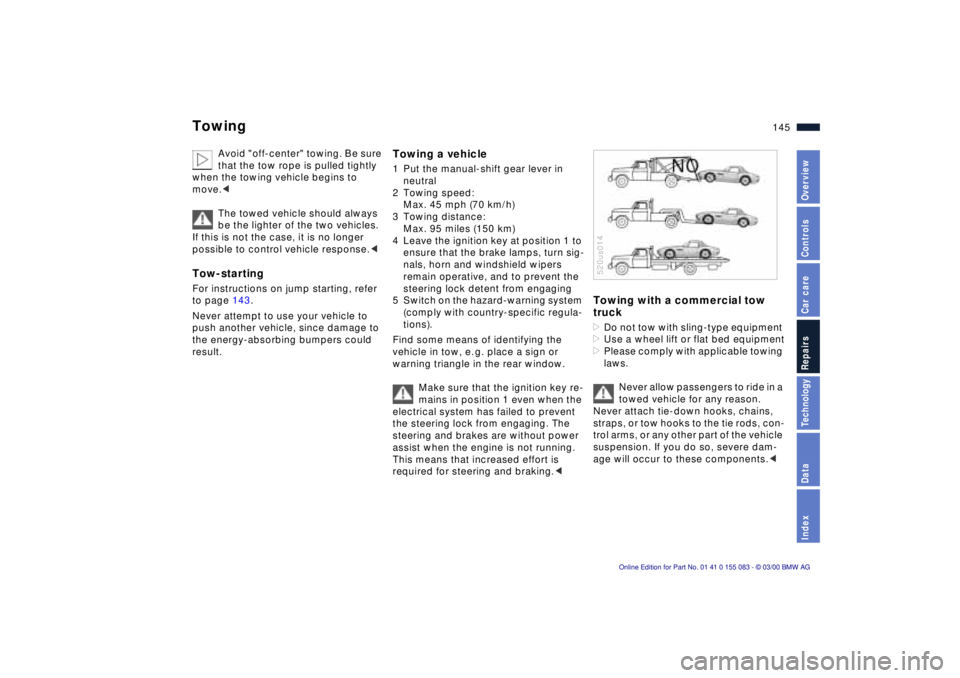
Towing with a commercial tow
truck>Do not tow with sling-type equipment
>Use a wheel lift or flat bed equipment
>Please comply with applicable towing
laws.
Never allow passengers to ride in a
towed vehicle for any reason.
Never attach tie-down hooks, chains,
straps, or tow hooks to the tie rods, con-
trol arms, or any other part of the vehicle
suspension. If you do so, severe dam-
age will occur to these components.<520us014
Page 163 of 172

Everything from A to ZA
ABS (Antilock Brake
System)19,86
Accessories4
Activated charcoal filter73
Adding engine oil109
Adding washer
fluid108,157
Adjusting the
temperature72
Adusting seats43
Air conditioner70
Air distribution72
Air nozzles70
Air outlets70
Air pressure96
Air supply72
Airbags19,49,121,148
Alarm system36
Antenna92
Antifreeze111
Antilock Brake System
(ABS)19,86
Anti-theft alarm system36
Anti-theft protection30
Aquaplaning85,97
Ashtray79
Attach vehicle vacuum
cleaner80
Automatic car washes115
Automatic speed control59 Automatic windshield
washer58
Avoiding unwanted
alarm37
Axle loads156
B
Backrest, unlock44
Backup lamps56
bulb replacement130
Battery136,158
charge137
discharged143
Battery capacity158
Battery charge current18
Belts48
Beverage can holder78
Blower72
BMW High Performance
Synthetic Oil110
Bore154
Brake fluid112
Brake hydraulic system18
Brake pads20
Brakes88
brake faults89
Breaking in the vehicle84
Bulb replacement129 C
California Proposition 65
Warning123 Can holder78
Car Memory46
Car radio62,92
refer also to the car radio
Owner's Manual
Car radio
reception92,148
Car telephone79
Car wash115
Care
exterior117
interior119
Caring for the vehicle
finish118
Catalytic converter85
CBC (Cornering Brake
Control)19
CD mode, refer to the radio
Owner's Manual
Cellular phone92
refer also to "Radio and
Information Systems
Owner's Manual"
Central locking system30
key34
Changing the oil filter157
Check air pressure24
Child restraint systems51
Child seat safety52
Child seats51
Cigarette lighter80
Clock62
Cockpit14 Code, refer to the radio
Owner's Manual
Combination switch56
Compartments76,77
Compartments for stowing
items76
Compression154
Configuring the settings46
Connector for On-Board-
Diagnostics124
Consumption display60
Controls14
Convertible top39
closing after an electrical
malfunction141
Coolant111,157
Coolant temperature
gauge61
Cornering Brake Control
(CBC)19
Cruise control59
Curb weight156
Current check indicator18
D
Dashboard14
Data
dimensions155
engine154
technical154
weights156
A-Z
Page 164 of 172

Everything from A to Z
163n
IndexDataTechnologyRepairsCar careControlsOverview
Daytime running lamps
switch67
Daytime-driving lamp
switch67
DBC (Dynamic Brake
Control)88
Defrost position73
Defroster, rear
window58,73
Defrosting the windows73
Dimensions155
Dipstick109
Disc brakes88
Displacement154
Display lighting67
Displays16
Door keys28
Door warning lamp
bulb replacement132
Doors
emergency actuation30
remote control31
unlocking and locking30
DOT Quality Grades98
Draft-free ventilation73
Drive belts158
Driving hints85
Driving lamps67
DSC (Dynamic Stability
Control)20,63,149
Dynamic Brake Control
(DBC)88 Dynamic Stability Control
(DSC)20,63,149
E
Electric power seat
adjustment43
Electric power windows38
Electrical defect
passenger-side door141
Electrical equipment
failure138
Electrical system158
Electronic vehicle
immobilizer29
Emergency actuation
doors30
Emergency operation
fuel filler door140
passenger-side door141
Engine compartment106
Engine coolant111
Engine cooling157
Engine data154
Engine oil109
consumption109
fill capacity157
quality110
specifications110
viscosity110
Engine oil level19
check109
Engine oil pressure18 Engine output154
Engine speed154
Engine, starting54
Exit lamps
bulb replacement132
Exterior mirrors45
F
Fault, ABS87
Fill capacities157
Filler cap cover23
Filling capacities157
Filling the washer
reservoir157
Filling the windshield washer
reservoir157
First aid22
First-aid kit22
Fittings, tow starting and
towing144
Flashlight77
Flat tire135
Foglamps
bulb replacement131
Follow-Me-Home lamps67
Footbrake88
Footwell lamps68
bulb replacement132
For car phones and
telephones, please refer to
the manufacturer's
Owner's Manual Front seat adjustment43
Frost protection,
radiator111
Fuel24
preparation154
Fuel filler door
release after an electrical
defect140
Fuel gauge60
Fuel indicator60
Fuel quality24
Fuel tank capacity157
Fuses138
G
Gasoline24
Glove compartment76
Glove compartment lamp
bulb replacement133
Gross vehicle weight156 H
Handbrake55
Handsfree system79
Hardtop94
Hazard warning flashers22
Hazard warning triangle22
Head restraint44
Headlamp covers,
care115,129
Headlamp flasher68