ABS BMW Z8 2000 Owners Manual
[x] Cancel search | Manufacturer: BMW, Model Year: 2000, Model line: Z8, Model: BMW Z8 2000Pages: 172, PDF Size: 1.9 MB
Page 10 of 172

9n
Controls and features
Operation, care and maintenance
Lamps:
Side lamps/Low beams67
Instrument lighting67
High beams/Parking lamps68
Rear foglamp68
Interior lamps68
Reading lamps69
Controlling the climate for
pleasant driving:
Heating and ventilation/
Air conditioning70
Seat heating75
Interior conveniences:
Glove compartment76
Storage compartments76
Beverage can holder78
Cellular phone79
Ashtray79
Cigarette lighter80
Loading and transporting:
Cargo loading81
Special operating instructions:
Break-in procedures84
Driving notes85
Catalytic converter85
Antilock Brake System (ABS)86
Dynamic Brake Control
(DBC)88
Disc brakes88
Brake system89
Winter operation90
Power steering92
Cellular phone92
Radio reception92
Wind protection93
Hardtop94
Wheels and tires:
Tire inflation pressure96
Tire condition97
Tire replacement98
Tire rotation100
Wheel and tire
combinations101
Winter tires102
Snow chains102
Approved wheel and tire
specifications103
Under the hood:
Hood104
Engine compartment106
Washer fluids108
Washer nozzles108
Engine oil109
Coolant111
Brake fluid112
Vehicle Identification
Number113
Maintenance and care:
The BMW Maintenance
System114
Caring for your vehicle115
Airbags121
Storing your vehicle122
Laws and regulations:
Technical modifications123
California Proposition 65
Warning123
OBD interface socket124
Page 18 of 172

17n
IndexDataTechnologyRepairsCar careControlsOverview
Instrument cluster
1 Fuel gauge with indicator lamp for
fuel reserve60
2 Speedometer with indicator and
warning lamps for
>
Dynamic Stability Control
(DSC)20
>
Engine electronics20
3 Instrument lighting67
4 Tachometer60
with indicator and warning lamps
for
>
Battery charge current18
>
Convertible top operation39
>
Tire Pressure Warning (RDW)18
>
Antilock Brake System (ABS)19
>
Parking brake/Brake hydraulic
system/Cornering Brake Control
(CBC)18
>
Service Engine Soon20
>
Engine oil pressure/Engine oil
level18, 19
5 Engine coolant temperature gauge
with "Coolant temperature too high"
warning lamp61
6 Indicator and warning lamps for
>
Rear foglamps20
>
Turn signal indicator right21
7 Clock628 Control knob for
>
Clock62
>
Trip odometer, reset to zero60
9 Indicator and warning lamps for
>
Please fasten safety belts19
>
High beams21
>
Airbags19
10 Indicator for
>
Odometer60
>
Trip odometer60
>
Service Interval61
11 Indicator and warning lamps for
>
Turn signal indicator left21
>
Brake pads20
Page 20 of 172
19n
IndexDataTechnologyRepairsCar careControlsOverview
Indicator and warning lamps
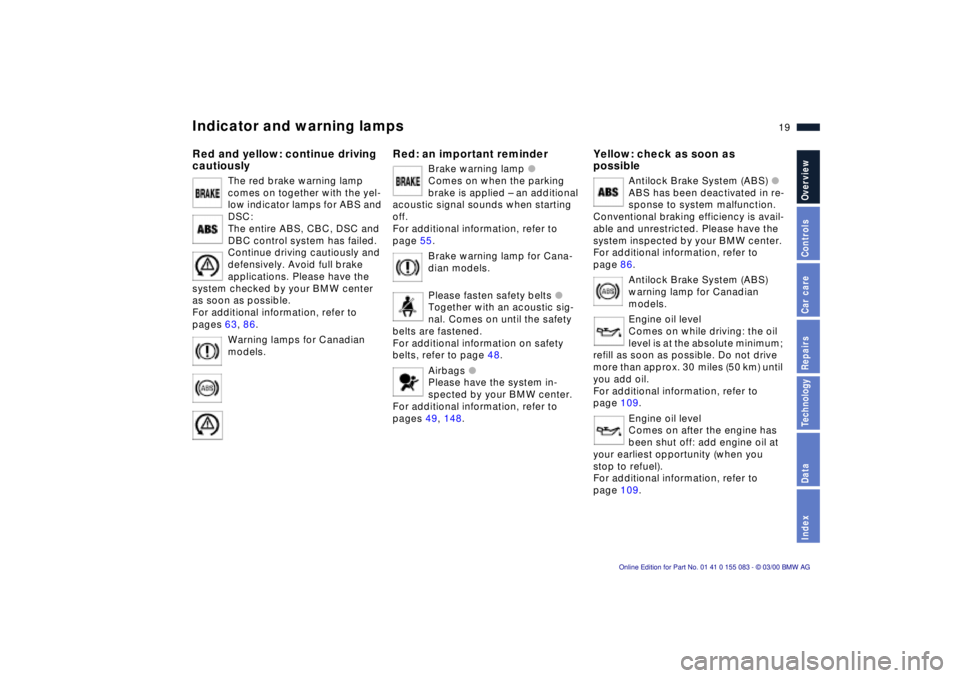
Red and yellow: continue driving
cautiously
The red brake warning lamp
comes on together with the yel-
low indicator lamps for ABS and
DSC:
The entire ABS, CBC, DSC and
DBC control system has failed.
Continue driving cautiously and
defensively. Avoid full brake
applications. Please have the
system checked by your BMW center
as soon as possible.
For additional information, refer to
pages 63, 86.
Warning lamps for Canadian
models.
Red: an important reminder
Brake warning lamp
l
Comes on when the parking
brake is applied Ð an additional
acoustic signal sounds when starting
off.
For additional information, refer to
page 55.
Brake warning lamp for Cana-
dian models.
Please fasten safety belts
l
Together with an acoustic sig-
nal. Comes on until the safety
belts are fastened.
For additional information on safety
belts, refer to page 48.
Airbags
l
Please have the system in-
spected by your BMW center.
For additional information, refer to
pages 49, 148.
Yellow: check as soon as
possible
Antilock Brake System (ABS)
l
ABS has been deactivated in re-
sponse to system malfunction.
Conventional braking efficiency is avail-
able and unrestricted. Please have the
system inspected by your BMW center.
For additional information, refer to
page 86.
Antilock Brake System (ABS)
warning lamp for Canadian
models.
Engine oil level
Comes on while driving: the oil
level is at the absolute minimum;
refill as soon as possible. Do not drive
more than approx. 30 miles (50 km) until
you add oil.
For additional information, refer to
page 109.
Engine oil level
Comes on after the engine has
been shut off: add engine oil at
your earliest opportunity (when you
stop to refuel).
For additional information, refer to
page 109.
Page 41 of 172
40n
The automatic convertible top
In order to avoid subsequent
moisture damage, do not leave
the convertible top open when it is wet
(further reference to this made begin-
ning on page 116, in the chapter "Car-
ing for your vehicle").<
To mount the cover
In order to avoid damaging or
getting dirt on the inside of the
convertible top, always drive with the
convertible cover installed.<
Take the folded up cover out of the lug-
gage compartment and pull it out of its
protective sleeve.
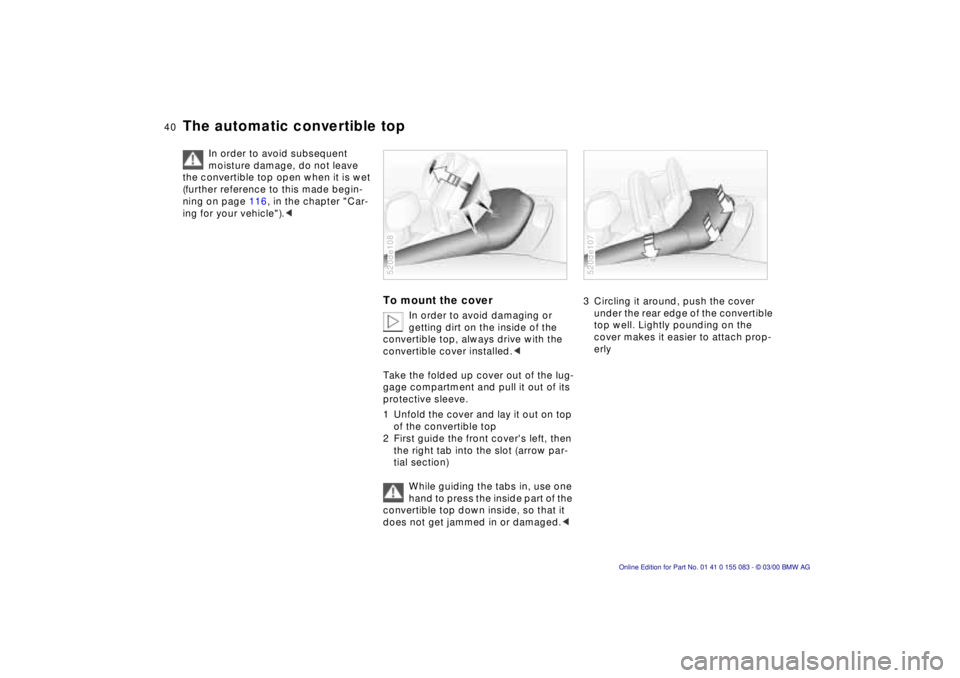
1 Unfold the cover and lay it out on top
of the convertible top
2 First guide the front cover's left, then
the right tab into the slot (arrow par-
tial section)
While guiding the tabs in, use one
hand to press the inside part of the
convertible top down inside, so that it
does not get jammed in or damaged.<
520de108
3 Circling it around, push the cover
under the rear edge of the convertible
top well. Lightly pounding on the
cover makes it easier to attach prop-
erly520de107
Page 84 of 172
Overview
Controls and features
Operation, care
and maintenance
Owner service procedures
Technical data
Index Advanced technology
83n
IndexDataTechnologyRepairsCar careControlsOverview
Car care Special operating instructions:
Break-in procedures84
Driving notes85
Catalytic converter85
Antilock Brake System (ABS)86
Dynamic Brake Control
(DBC)88
Disc brakes88
Brake system89
Winter operation90
Power steering92
Cellular phone92
Radio reception92
Wind protection93
Hardtop94
Wheels and tires:
Tire inflation pressure96
Tire condition97
Tire replacement98
Tire rotation100
Wheel and tire
combinations101
Winter tires102
Snow chains102
Approved wheel and tire
specifications103Under the hood:
Hood104
Engine compartment106
Washer fluids108
Washer nozzles108
Engine oil109
Coolant111
Brake fluid112
Vehicle Identification
Number113
Maintenance and care:
The BMW Maintenance
System114
Caring for your vehicle115
Airbags121
Storing your vehicle122
Laws and regulations:
Technical modifications123
California Proposition 65
Warning123
OBD interface socket124
Page 85 of 172

84n
To ensure that your vehicle provides
maximum economy throughout a long
service life, we request that you
observe the following instructions:
Your BMW Z8 roadster is an espe-
cially high-quality vehicle. It is in
your best interest to follow the break-in
instructions very closely. Doing this will
create the basis for a long, optimum
service life.<
Engine and differentialUp to 1,200 miles (2,000 km):
Drive at varying engine and road
speeds, but do not exceed 4,500 rpm
(4,500/min), or a road speed of 106 mph
(170 km/h).
Obey your local and state maximum
speed limits.
Absolutely refrain from the full-throttle
position with the accelerator.
Once you have driven 1,200 miles
(2,000 km), you can begin to gradually
increase both the engine speed and
road speed.
You should also comply with these
break-in procedures if the engine or
differential is replaced later in the
course of the vehicle service life.TiresDue to technical factors associated
with their manufacture, tires do not
achieve their full traction potential until
an initial break-in period has elapsed.
Thus, drive with extra care during the
initial 200 miles (300 km).
Obey your local and state maximum
speed limits.
When the vehicle is being driven
on wet or slushy roads, a wedge
of water may form between the tire and
the road surface. This phenomenon is
referred to as "aquaplaning," or "hydro-
planing," and can lead to partial or
complete loss of traction, vehicle con-
trol and braking effectiveness. Reduce
your speed on wet roads.<
Brake systemApproximately 300 miles (500 km) must
elapse before the brake pads and
rotors achieve the optimal pad-surface
and wear patterns required for trouble-
free operation and long service life.
To break in the separate parking brake
drums, apply the parking brake lightly
when coasting to a standstill (at a traffic
signal, for instance), provided that traf-
fic conditions allow you to do so.
To avoid corrosion, repeat this proce-
dure from time to time.
The brake lamps do not come
on when the parking brake is en-
gaged.
Vacuum for the brake system servo unit
on your BMW is available only when the
engine is running. When you move the
vehicle with the engine shut off Ð when
towing, for instance Ð substantially
higher levels of pedal force will be
required to brake the vehicle.
Engage the gears carefully and without
high engine speeds during this break-in
period.
Break-in procedures
Page 87 of 172

86n
Antilock Brake System (ABS) The concept ABS enhances active safety by helping
to prevent the wheels from locking un-
der braking. This is because: locked
wheels are dangerous. When the front
wheels slide, the driver loses steering
control over the vehicle. Traction loss at
the rear wheels can cause the rear end
to break into an uncontrolled skid.
With ABS, you will achieve the shortest-
possible braking distances under all
given conditions (braking while driving
straight ahead or in curves, different
road surfaces).
ABS is designed to meet two essential
requirements during every brake appli-
cation:
>To help provide vehicle stability
>To help retain steering and maneu-
vering capability on all types of road
surfaces (asphalt, concrete, dirt, wet
surfaces, snow and ice).
Braking with ABSThe system is operative once the vehi-
cle exceeds a speed of approx. 6 mph
(10 km/h). The ABS is deactivated
whenever the vehicle's speed drops
back below approx. 4 mph (6 km/h).
This means that the wheels can tend
to lock in the very final phase of a panic
stop, which in actual practice is not
critical.
The ABS system works best in situa-
tions requiring maximum pressure on
the pedal (full braking). Since the vehi-
cle maintains steering responsiveness,
you can nevertheless avoid possible
obstacles with a minimum of steering
effort.
The ABS system's closed-loop control
circuit cycles in fractions of a second.
A pulsing of the brake pedal, com-
bined with the sounds associated with
the hydraulic controls, tells you that the
brake system is within its maximum
limit range and reminds you that you
should adapt your vehicle's speed to
road conditions.On road surfaces that have a loose layer
on a firm base (on gravel or snow, for in-
stance), the braking distances with ABS
may be longer than with the wheels
locked. This also applies for driving with
snow chains. However, ABS continues
to provide enhanced vehicle stability
and steering response under these
conditions.
Page 88 of 172

87n
IndexDataTechnologyRepairsCar careControlsOverview
Antilock Brake System (ABS)Information for your safetyNot even ABS can suspend the laws
of physics. The consequences of brake
applications with inadequate clear-
ances for safety between vehicles,
excessive speed or if aquaplaning
occurs are always the responsibility of
the driver. You should never allow the
added safety of ABS to mislead you into
taking risks of any kind.
Do not make any modifications
to the ABS system.
Service procedures on ABS are to be
performed by authorized technicians
only.<
In the event of a fault
If the ABS warning lamp comes
on, refer to page 19. The brake
system will then function the
same as on vehicles without
ABS. However, have the brake
system checked by your BMW
center as soon as possible. To prevent
undetected defects and cumulative
faults from adversely affecting the brake
system, refer any problems to your
BMW center at the earliest opportunity.
Cornering Brake Control (CBC)CBC is an advanced ABS engineering
design. Vehicle stability is also en-
hanced when braking during cornering
at high lateral acceleration, or when
braking during a lane changing.
Page 89 of 172

88n
Dynamic Brake Control (DBC) Disc brakesIf you step on the brake rapidly, this
system automatically produces maxi-
mum braking force boost and thus
helps to achieve the shortest possible
braking distance during "panic stops."
All of the benefits of the ABS system
are exploited under these circum-
stances.
Do not reduce the pressure on the
brake pedal for the duration of the brake
application. When the brake pedal is
released, the DBC is deactivated.
In the event of a malfunction,
the yellow brake warning lamp
comes on. Normal braking effi-
ciency and ABS are still fully
available. Have the system
checked and repaired at your
BMW center as soon as possible.
Information for your safetyNot even DBC can suspend the laws
of physics. The consequences of brake
applications with inadequate clear-
ances for safety between vehicles,
excessive speed or if aquaplaning
occurs are always the responsibility of
the driver. You should never allow the
added safety provided by DBC to mis-
lead you into taking risks of any kind.Disc brakes furnish optimum decelera-
tion and braking control and greater
fade resistance under heavy use.
When the vehicle is driven only occa-
sionally, during extended periods when
the vehicle is not used at all, or in oper-
ating conditions where brake applica-
tions are less frequent, there is an in-
creased tendency for corrosion of the
rotors and accumulation of contamina-
tion on the brake pads. This occurs
because the minimal pressure which
must be exerted by the pads to clean
the rotors by brake applications is not
achieved.
If the brake rotors are corroded, they
will tend to respond to braking with a
pulsating effect that even extended
brake applications will fail to cure.
For your own safety: use only
brake pads BMW has approved
for your specific vehicle model. BMW
cannot evaluate non-approved brake
pads to determine if they are suited for
use, and therefore cannot ensure the
operating safety of the vehicle if they
are installed.<
Page 90 of 172
89n
IndexDataTechnologyRepairsCar careControlsOverview
Disc brakes Brake systemDriving notesWhen driving in wet conditions and in
heavy rain, it is effective to apply light
pressure to the brakes every few miles
or kilometers. Watch traffic conditions
to ensure that this maneuver does not
endanger other road users. The heat
which is generated by the brake appli-
cations helps to dry the brake pads and
rotors.
Maximum braking force is obtained
while the wheels are not locked, but
rather when they are still barely turning
immediately prior to locking. ABS main-
tains this state automatically. If the ABS
fails, you should revert to the staggered
braking technique (refer to page 91).
Long or steep mountain descents do
not necessarily lead to reduced braking
efficiency if you drive downhill with the
transmission in a gear requiring minimal
brake applications.
Braking effect on the engine can be
further increased by downshifting, into
first gear, if necessary.If engine braking should prove to be
inadequate, you should still avoid ex-
tended, continuous braking. Instead of
maintaining low to moderate pressure
over an extended period of time, you
should decelerate by applying more
substantial pressure to the brake pedal
(watch for following traffic), releasing
the pedal, and then repeating the appli-
cation (staggered braking). The cooling
phases between active braking inter-
vals prevent the brakes from overheat-
ing and retain full braking capacity.
Do not coast with the clutch de-
pressed, the gear-shift lever in
neutral, or, above all, with the engine
shutt off; otherwise, the engine will pro-
vide no braking effect if the transmis-
sion is in neutral, and there is no brak-
ing or steering power assist if the
engine is not running. Do not allow floor
mats, carpets or any other objects to
protrude into the area around the brake
pedal, the clutch or the accelerator
which could obstruct their freedom of
movement.<
Brake fluid level
The brake warning lamp comes
on with the parking brake
released:
The brake fluid level is too low in
the reservoir (refer to page 112).
If the brake fluid level is too low
and brake pedal travel has become no-
ticeably longer, there may be a defect
in one of the brake system's hydraulic
circuits.
Proceed to the nearest BMW cen-
ter. Higher brake application pres-
sure may be necessary under these con-
ditions, and brake pedal travel may be
significantly longer. Please remember to
adapt your driving style accordingly.<