warning BMW Z8 2001 User Guide
[x] Cancel search | Manufacturer: BMW, Model Year: 2001, Model line: Z8, Model: BMW Z8 2001Pages: 170, PDF Size: 1.64 MB
Page 26 of 170
26n
Fuel quality Tire inflation pressure The engine uses lead-free gasoline
only.
Required fuel:
>Premium Unleaded Gasoline,
min. 91 AKI
AKI = Anti Knock Index
Do not use leaded fuels. The use
of leaded fuels will cause perma-
nent damage to the system's oxygen
sensor and the catalytic converter.<
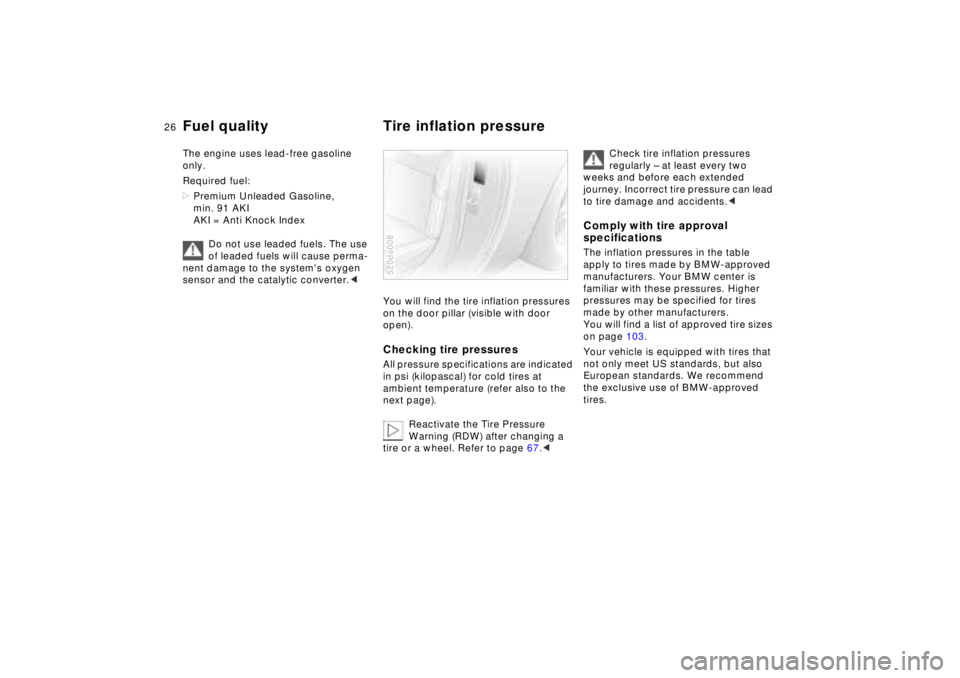
You will find the tire inflation pressures
on the door pillar (visible with door
open).Checking tire pressuresAll pressure specifications are indicated
in psi (kilopascal) for cold tires at
ambient temperature (refer also to the
next page).
Reactivate the Tire Pressure
Warning (RDW) after changing a
tire or a wheel. Refer to page 67.<520de008
Check tire inflation pressures
regularly Ð at least every two
weeks and before each extended
journey. Incorrect tire pressure can lead
to tire damage and accidents.<
Comply with tire approval
specificationsThe inflation pressures in the table
apply to tires made by BMW-approved
manufacturers. Your BMW center is
familiar with these pressures. Higher
pressures may be specified for tires
made by other manufacturers.
You will find a list of approved tire sizes
on page 103.
Your vehicle is equipped with tires that
not only meet US standards, but also
European standards. We recommend
the exclusive use of BMW-approved
tires.
Page 29 of 170
Overview
Controls and features
Operation, care
and maintenance
Owner service procedures
Technical data
Index Advanced technology
29n
IndexDataTechnologyRepairsCar careControlsOverview
Driving:
Ignition and steering lock55
Starting the engine56
Turning the engine off56
Parking brake57
Manual transmission58
Turn signal indicator/Headlamp
flasher58
Washer/Wiper system59
Rear window defroster60
Cruise control61
Everything under control:
Odometer62
Tachometer62
Fuel gauge62
Coolant temperature gauge63
Service Interval Display63
Clock64
Multi-Information Radio (MIR)64
Technology for safety and
driving convenience:
Dynamic Stability Control
(DSC)65
Dynamic Performance
Control66
Tire Pressure Warning (RDW)67Lamps:
Side lamps/Low beams69
Instrument panel lighting69
High beams/Parking lamps70
Rear fog lamp70
Interior lamps70
Reading lamps71
Controlling the climate for
pleasant driving:
Heating and ventilation/
Air conditioner72
Seat heating77
Interior conveniences:
Glove compartment78
Storage compartments78
Drink holder80
Cellular phone81
Ashtray81
Cigarette lighter82
Loading and transporting:
Cargo loading83
Page 32 of 170
32n
Central locking system Opening and closing Ð from outside The conceptThe central locking system is ready for
operation whenever the driver's door is
closed. The system engages and
releases the locks on the
>doors
>luggage compartment lid
>fuel filler door
>glove compartment
>cellular phone holder.
The central locking system can be
operated
>from the outside via the driver's door
lock or by using the remote control
>from the inside by pressing a button.
If you initiate central locking from
inside, neither the fuel filler door, the
glove compartment, nor the cellular
phone holder are locked (refer to
page 36).
If you do set it from outside, the anti-
theft alarm is automatically activated as
well. This prevents the door handles
from unlocking the doors. The alarm
system is also activated or deactivated.
The central locking system unlocks
automatically in the event of an acci-
dent. In addition, the hazard warning
flashers and interior lamps come on.
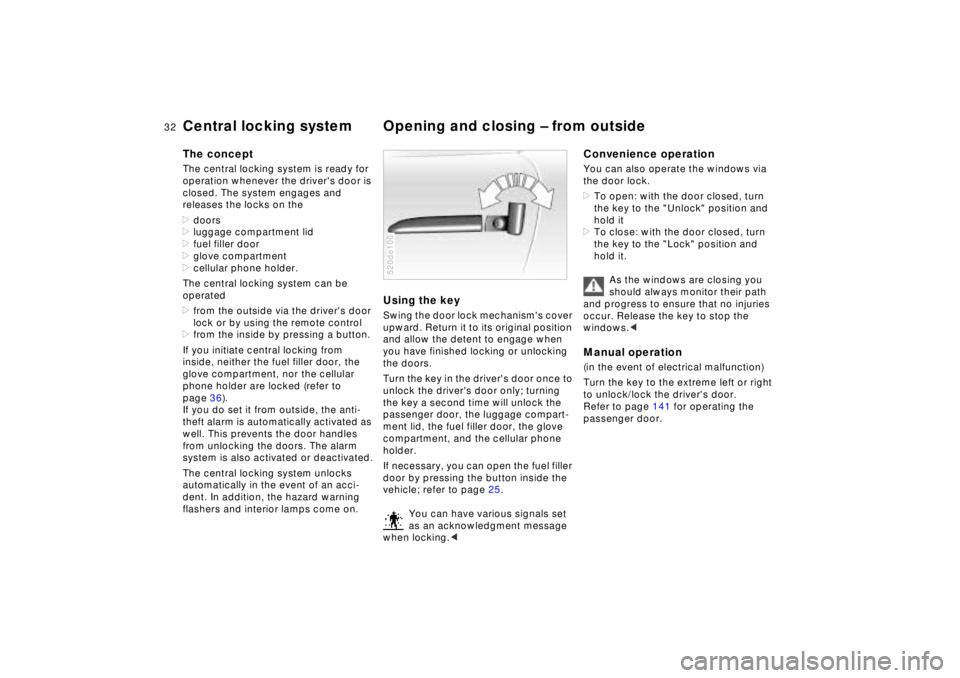
Using the keySwing the door lock mechanism's cover
upward. Return it to its original position
and allow the detent to engage when
you have finished locking or unlocking
the doors.
Turn the key in the driver's door once to
unlock the driver's door only; turning
the key a second time will unlock the
passenger door, the luggage compart-
ment lid, the fuel filler door, the glove
compartment, and the cellular phone
holder.
If necessary, you can open the fuel filler
door by pressing the button inside the
vehicle; refer to page 25.
You can have various signals set
as an acknowledgment message
when locking.<520de100
Convenience operationYou can also operate the windows via
the door lock.
>To open: with the door closed, turn
the key to the "Unlock" position and
hold it
>To close: with the door closed, turn
the key to the "Lock" position and
hold it.
As the windows are closing you
should always monitor their path
and progress to ensure that no injuries
occur. Release the key to stop the
windows.
to unlock/lock the driver's door.
Refer to page 141 for operating the
passenger door.
Page 38 of 170
38n
Alarm systemThe conceptThe vehicle alarm system responds
>when a door, the hood or the luggage
compartment lid is opened
>to movement inside the vehicle
(interior motion sensor)
>to variations in the vehicle's tilt angle
such as those occurring during
attempts to steal the wheels or tow
the vehicle
>to interruption of battery voltage.
The system responds to attempts of
unauthorized vehicle incursion and theft
by simultaneously activating the
following
>an alarm sounds for 30 seconds
>the hazard warning flashers are acti-
vated for approx. five minutes
>the high beams flash on and off in the
same rhythm.
To activate and deactivate the
alarm systemWhen the vehicle is locked or unlocked
via a door lock or with the remote
control, the alarm system is also simul-
taneously armed or disarmed.
The interior motion sensor and tilt alarm
sensor are activated approx.
30 seconds after you have finished
locking the vehicle.
The system indicates that it has been
correctly armed by switching on the
hazard warning flashers for a single
cycle and by emitting an acoustic
signal.
You can select the individual
confirmation signal used to indi-
cate that the alarm system has been
armed or disarmed.<
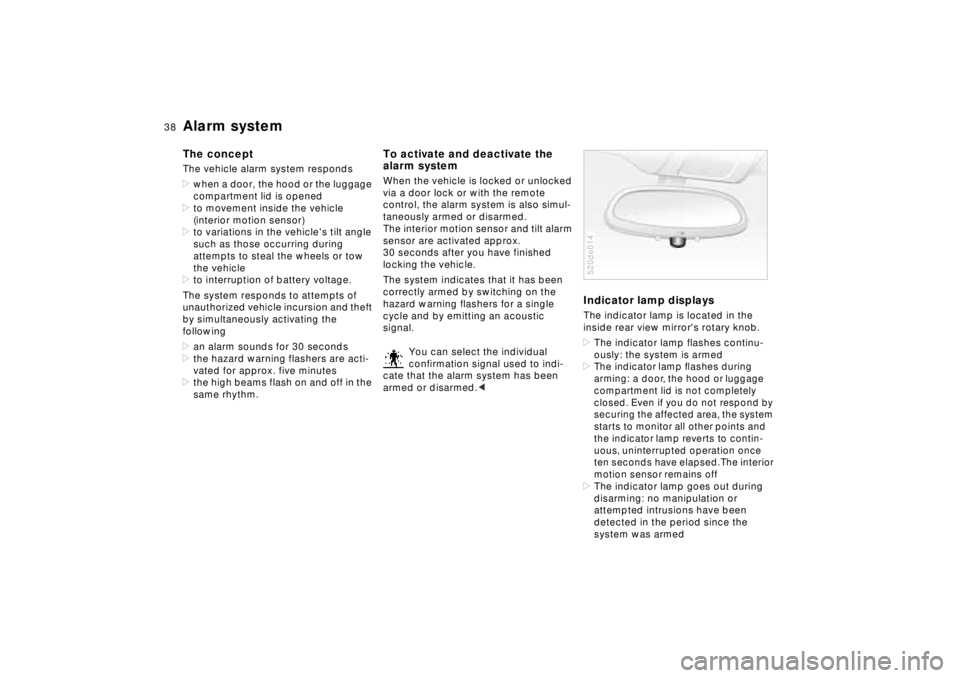
Indicator lamp displaysThe indicator lamp is located in the
inside rear view mirror's rotary knob.
>The indicator lamp flashes continu-
ously: the system is armed>The indicator lamp ßashes during
arming: a door, the hood or luggage
compartment lid is not completely
closed. Even if you do not respond by
securing the affected area, the system
starts to monitor all other points and
the indicator lamp reverts to contin-
uous, uninterrupted operation once
ten seconds have elapsed. The interior
motion sensor remains off>The indicator lamp goes out during
disarming: no manipulation or
attempted intrusions have been
detected in the period since the
system was armed520de014
Page 63 of 170
63n
IndexDataTechnologyRepairsCar careControlsOverview
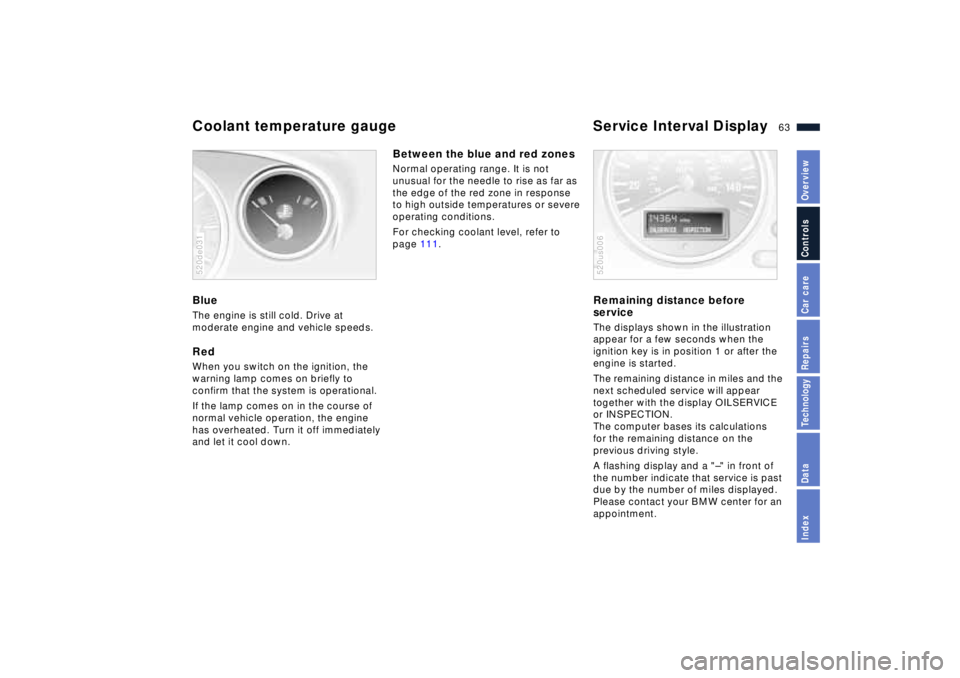
Coolant temperature gauge Service Interval Display BlueThe engine is still cold. Drive at
moderate engine and vehicle speeds.RedWhen you switch on the ignition, the
warning lamp comes on briefly to
confirm that the system is operational.
If the lamp comes on in the course of
normal vehicle operation, the engine
has overheated. Turn it off immediately
and let it cool down.520de031
Between the blue and red zonesNormal operating range. It is not
unusual for the needle to rise as far as
the edge of the red zone in response
to high outside temperatures or severe
operating conditions.
For checking coolant level, refer to
page 111.
Remaining distance before
serviceThe displays shown in the illustration
appear for a few seconds when the
ignition key is in position 1 or after the
engine is started.
The remaining distance in miles and the
next scheduled service will appear
together with the display OILSERVICE
or INSPECTION.
The computer bases its calculations
for the remaining distance on the
previous driving style.
A flashing display and a "Ð" in front of
the number indicate that service is past
due by the number of miles displayed.
Please contact your BMW center for an
appointment.520us006
Page 67 of 170
67n
IndexDataTechnologyRepairsCar careControlsOverview
Tire Pressure Warning (RDW)The conceptRDW monitors the tire pressure in all
four wheels while driving. The system
provides an alert whenever the inflation
pressure drops significantly in one of
the tires.
For RDW to "learn" the correct tire infla-
tion pressure, check the inflation pres-
sure in all tires, comparing them with
the values in the inflation pressure table
(refer to page 27), and make correc-
tions as necessary. Then activate the
system.
The indicator lamp within the in-
strument cluster flashes to alert
you to substantial pressure loss
in any of the tires.
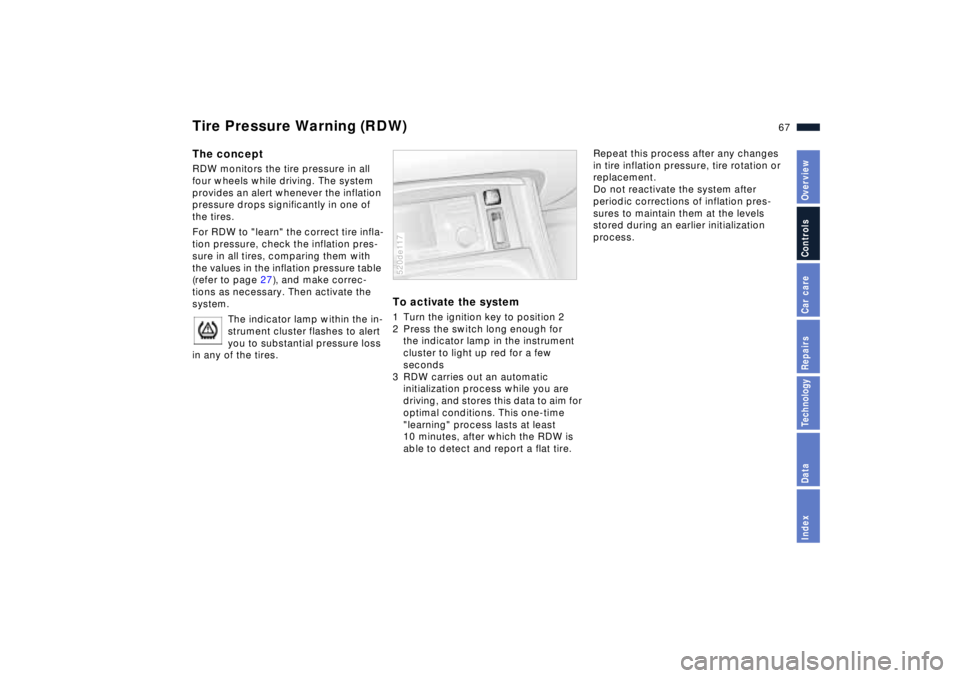
To activate the system 1 Turn the ignition key to position 2
2 Press the switch long enough for
the indicator lamp in the instrument
cluster to light up red for a few
seconds
3 RDW carries out an automatic
initialization process while you are
driving, and stores this data to aim for
optimal conditions. This one-time
"learning" process lasts at least
10 minutes, after which the RDW is
able to detect and report a flat tire.520de117
Repeat this process after any changes
in tire inflation pressure, tire rotation or
replacement.
Do not reactivate the system after
periodic corrections of inflation pres-
sures to maintain them at the levels
stored during an earlier initialization
process.
Page 68 of 170

68n
Tire Pressure Warning (RDW)Flat tire The red indicator lamp will flash in the
event of a flat tire.
A supplementary gong is also heard.
Carefully reduce speed to less than
50 mph (80 km/h), avoiding any hard
braking or steering maneuvers while
doing so.
For additional details, refer to page 135.
RDW cannot provide advance
warning of sudden and severe tire
damage caused by road hazards or
other environmental factors.
RDW is also not designed to detect the
gradual, even pressure loss that all tires
exhibit over extended periods of time.<
Check tire pressure on a regular
basis and correct it as required.
Refer to page 26.
Do not activate the system when driving
on snow chains or when operating the
vehicle on a closed racing circuit. False
alarms and undetected pressure loss
are both possible under these condi-
tions.
In certain circumstances, there could
be a delayed detection of any loss in in-
flation pressure while driving on snow-
covered or slippery road surfaces.
A performance-oriented driving style
can also cause delayed RDW alerts
(e. g. slippage in the drive wheels, high
lateral acceleration).<
System interferenceThe red indicator lamp in the instrument
cluster will stay on for as long as there
is a malfunction.
The indicator lamp will come on if the
system malfunctions.
Please contact your BMW center for
additional information.
Page 69 of 170
69n
IndexDataTechnologyRepairsCar careControlsOverview
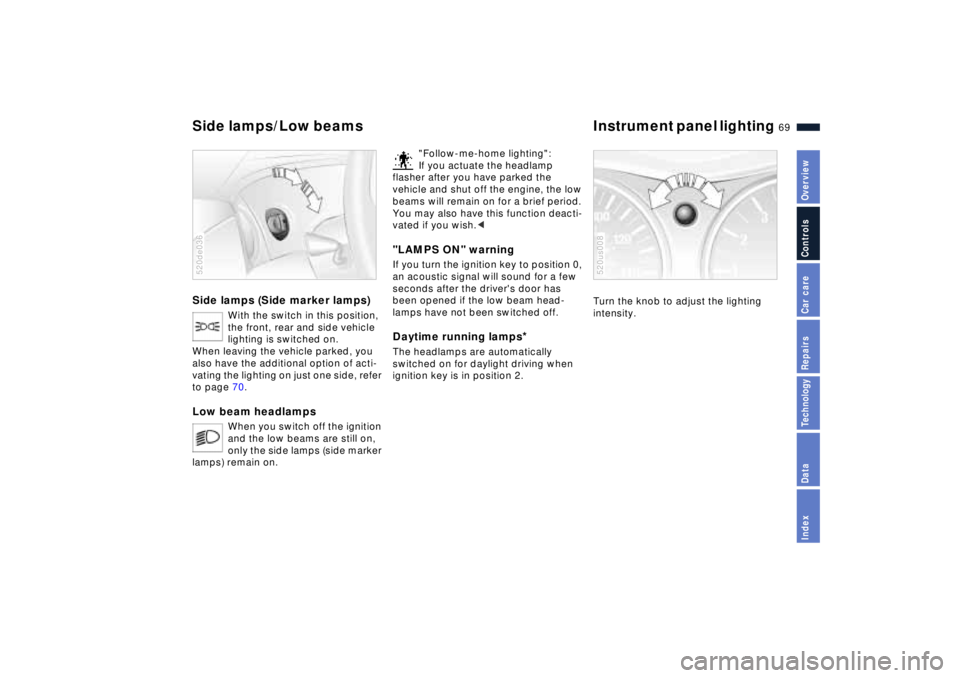
Side lamps (Side marker lamps)
With the switch in this position,
the front, rear and side vehicle
lighting is switched on.
When leaving the vehicle parked, you
also have the additional option of acti-
vating the lighting on just one side, refer
to page 70.
Low beam headlamps
When you switch off the ignition
and the low beams are still on,
only the side lamps (side marker
lamps) remain on.
520de036
"Follow-me-home lighting":
If you actuate the headlamp
flasher after you have parked the
vehicle and shut off the engine, the low
beams will remain on for a brief period.
You may also have this function deacti-
vated if you wish.<
"LAMPS ON" warningIf you turn the ignition key to position 0,
an acoustic signal will sound for a few
seconds after the driver's door has
been opened if the low beam head-
lamps have not been switched off.Daytime running lamps
*
The headlamps are automatically
switched on for daylight driving when
ignition key is in position 2.
Turn the knob to adjust the lighting
intensity.520us008
Side lamps/Low beams Instrument panel lighting
Page 85 of 170
Overview
Controls and features
Operation, care
and maintenance
Owner service procedures
Technical data
Index Advanced technology
85n
IndexDataTechnologyRepairsCar careControlsOverview
Car care Special operating instructions:
Break-in procedures86
Driving notes87
Catalytic converter87
Antilock Brake System (ABS)88
Dynamic Brake Control
(DBC)90
Disc brakes90
Brake system91
Winter operation92
Power steering94
Cellular phone94
Radio reception94
Wind deflector95
Hardtop96
Wheels and tires:
Tire inflation pressure98
Tire condition98
Tire replacement99
Tire rotation100
Wheel and tire
combinations101
Special features of winter
tires102
Snow chains102
Approved wheel and tire
specifications103Under the hood:
Hood104
Engine compartment106
Washer fluids108
Washer nozzles108
Engine oil109
Coolant111
Brake fluid112
Vehicle Identification
Number113
Maintenance and care:
The BMW Maintenance
System114
Caring for your vehicle115
Airbags121
Vehicle storage122
Laws and regulations:
Technical modifications123
California Proposition 65
Warning123
OBD interface socket124
Page 89 of 170
89n
IndexDataTechnologyRepairsCar careControlsOverview
Antilock Brake System (ABS)Information for your safetyNot even ABS can suspend the laws
of physics. The consequences of brake
applications with inadequate clear-
ances for safety between vehicles,
excessive speed or if aquaplaning
occurs are always the responsibility of
the driver. You should never allow the
added safety of ABS to mislead you into
taking risks of any kind.
Do not make any modifications
to the ABS system.
Service procedures on ABS are to be
performed by authorized technicians
only.<
In case of a system malfunction
If the ABS warning lamp comes
on, refer to page 21. The brake
system will then function the
same as on vehicles without
ABS. However, have the brake
system checked by your BMW
center as soon as possible. To prevent
undetected defects and cumulative
faults from adversely affecting the brake
system, refer any problems to your
BMW center at the earliest opportunity.
Cornering Brake Control (CBC)CBC is an advanced ABS engineering
design. Vehicle stability is also
enhanced when braking during
cornering at a higher rate of lateral
acceleration and during lane changes.