warning BMW Z8 2001 Owner's Manual
[x] Cancel search | Manufacturer: BMW, Model Year: 2001, Model line: Z8, Model: BMW Z8 2001Pages: 170, PDF Size: 1.64 MB
Page 90 of 170

90n
Dynamic Brake Control (DBC) Disc brakesIf you step on the brake rapidly, this
system automatically produces maxi-
mum braking force boost and thus
helps to achieve the shortest possible
braking distance during "panic stops."
All of the benefits of the ABS system
are exploited under these circum-
stances.
Do not reduce the pressure on the
brake pedal during the brake applica-
tion. When the brake pedal is released,
the DBC is deactivated.
In the event of a malfunction,
the yellow brake warning lamp
comes on. Normal braking effi-
ciency and ABS are still fully
available. Have the system
checked and repaired at your
BMW center as soon as possible.
For your safetyNot even DBC can suspend the laws
of physics. The consequences of brake
applications with inadequate clear-
ances for safety between vehicles,
excessive speed or if aquaplaning
occurs are always the responsibility of
the driver. You should never allow the
added safety provided by DBC to
mislead you into taking risks of any
kind.Disc brakes furnish optimum decelera-
tion and braking control and greater
fade resistance under heavy use.
When the vehicle is driven only occa-
sionally, during extended periods when
the vehicle is not used at all, or in oper-
ating conditions where brake applica-
tions are less frequent, there is an
increased tendency for corrosion of the
rotors and accumulation of contamina-
tion on the brake pads. This occurs
because the minimal pressure which
must be exerted by the pads to clean
the rotors by brake applications is not
achieved.
If the brake rotors are corroded, they
will tend to respond to braking with a
pulsating effect that even extended
brake applications will fail to cure.
For your own safety: use only
brake pads BMW has approved
for your specific vehicle model. BMW
cannot evaluate non-approved brake
pads to determine if they are suited for
use, and therefore cannot ensure the
operating safety of the vehicle if they
are installed.<
Page 91 of 170

91n
IndexDataTechnologyRepairsCar careControlsOverview
Disc brakes Brake systemDriving notesWhen driving in heavy rain and on wet
roads it is advisable to apply light pres-
sure to the brake pedal every few miles.
Monitor traffic conditions to ensure that
this maneuver does not pose a hazard
to you or to other road users. The heat
generated in this braking process helps
dry the pads and rotors.
Maximum braking force is obtained
while the wheels are not locked, but
rather when they are still barely turning
immediately prior to locking. ABS main-
tains this state automatically. If the ABS
fails, you should revert to the staggered
braking technique (refer to page 93).
When descending steep hills and
extended grades, downshift to a gear
that will allow you to continue safely
with only a minimal amount of braking.
By minimizing the loads placed on the
brake system, this strategy helps
ensure that optimal brake system
response will remain available at all
times.
You can enhance the engine's braking
effect by engaging a lower gear, down-
shifting as far as first gear when
descending extremely steep slopes. Even if engine braking fails to slow the
vehicle sufficiently, you should still
make every effort to avoid prolonged
braking with continuous application of
low to moderate pressure at the pedal.
It is better to decelerate the vehicle by
applying a higher level of force at the
pedal (watch following traffic!) and then
subsequently pausing to allow the
brakes to cool briefly before starting on
your next braking cycle. By protecting
brake system components against
overheating, the cooling phases
afforded by this staggered, or intermit-
tent braking technique help maintain
consistent availability of optimal braking
response when it is needed.
Do not coast with the clutch
depressed, the gear-shift lever in
neutral, or, above all, with the engine
off; otherwise, the engine will provide
no braking effect if the transmission is
in neutral, and there is no braking or
steering power assist if the engine is
not running. Never allow floor mats,
carpets or any other objects to obstruct
the accelerator, clutch or brake pedals
and pose a safety hazard by reducing
their available travel range.<
Brake fluid level
The brake warning lamp comes
on with the parking brake
released:
The brake fluid level in the reser-
voir is too low, refer to page 112.
If the brake fluid level is too low
and brake pedal travel has become
noticeably longer, there may be a
defect in one of the brake system's
hydraulic circuits.
Proceed to the nearest BMW
center. Higher brake application
pressure may be necessary under these
conditions, and brake pedal travel may
be significantly longer. Please
remember to adapt your driving style
accordingly.<
Page 92 of 170

92n
Brake system Winter operationBrake pads
The warning lamp for the brake
pads comes on:
The brake pads have reached
their minimum thickness. Proceed to
the nearest BMW center as soon as
possible to have the pads replaced.
For your own safety: use only
brake pads which BMW has
approved for your specific vehicle
model. BMW cannot evaluate non-
approved brake pads to determine if
they are suited for use, and therefore
cannot ensure the operating safety of
the vehicle if they are installed.<
Winter is often accompanied by rapid
changes in weather, requiring not only
a different driving style, but also certain
preparations to the vehicle itself to
ensure that your progress through the
winter months remains safe and
trouble-free. CoolantBe sure that the coolant mixture
contains the year-round ratio of 50:50
water and antifreeze/corrosion protec-
tion. This mixture provides protection
against freezing down to approx. Ð 34 7
(Ð 37 6). LocksBMW door lock deicer can be used to
free doors if frozen. This deicer also
contains lubricant.
After using the deicer, treatment with
BMW lock cylinder grease is recom-
mended.
Rubber seals and components To prevent the weather-stripping from
freezing, apply a spray-on rubber treat-
ment or silicone spray to the door, hood
and luggage compartment lid seals.
A full range of car care products is
available from your BMW center.
on the rear wheels with approved winter
tires. Always follow the manufacturer's
safety precautions. Do not exceed a
maximum speed of 30 mph (50 km/h).
Do not activate the RDW system while
using snow chains. Malfunction warn-
ings and undetected losses in pressure
are possible when driving with snow
chains.
Starting offWhen starting off in deep snow or when
"rocking" the vehicle to free it, it may be
advisable to temporarily deactivate the
DSC system. Refer to page 65.
To maintain vehicle stability,
always drive with the system
switched on whenever possible.<
Page 102 of 170

102n
Special features of winter tires Snow chains
*
Choosing the right tireFor winter road driving, BMW recom-
mends winter tires (M+S radial belt
tires). Although all-season M+S tires
provide better winter traction than stan-
dard summer tires with H, V, W and ZR
speed ratings, they generally fail to
provide the same levels of performance
as standard snow tires in winter driving.
In the interests of safe tracking and
steering response, install radial tires
made by the same manufacturer and
with the same tread configuration on all
four wheels if you elect to mount winter
tires.
Use only winter tires with emer-
gency driving characteristics as
there is no spare tire available if you get
a flat tire.
For further information, refer to
page 135.<
Do not exceed specified
maximum speeds
Never exceed the maximum speed
for which winter tires are rated.
Unprofessional attempts by laymen to
service tires can lead to damage and
accidents.
Have this work performed by skilled
professionals only. Your BMW center
will be glad to assist you with both their
expertise and the proper equipment for
your vehicle.<
Tire condition, tire pressureOnce the tread depth on winter tires is
less than 0.16 in (4 mm), they are no
longer suitable for winter road driving,
and in the interest of safety should be
replaced.
Comply with the specified tire inflation
pressures Ð and be sure to have the
wheel and tire assemblies balanced
every time you change the tires.
The use of narrow-link BMW snow
chains is permissible in pairs only on
the rear wheels with winter tires with
tire size 245/45 R 18 96 H. Comply with
all manufacturer's safety precautions
when mounting the chains.
Do not activate the RDW system
while using snow chains.
Malfunction warnings and undetected
losses in pressure are possible when
driving with snow chains.
For further information, refer to
page 67.<
Page 103 of 170

103n
IndexDataTechnologyRepairsCar careControlsOverview
Approved wheel and tire specifications Snow chains
*
It is impossible to install snow chains
when using summer tires
275/40 R 18 99 W.
Do not activate the RDW system
while using snow chains.
Malfunction warnings and undetected
losses in pressure are possible when
driving with snow chains.
For further information, refer to
page 67.< BMW tests certain tire brands for each tire size, classifies them as road-safe and
approves them. Your BMW center can provide further information.
Observe any regulations applicable in the country of use, e.g. requiring entry in
the vehicle documents.
Tire specifications Light-alloy wheel
BMW Z8
Summer tires
Front: 245/45 R 18 96 W 8Jx18EH2
Rear: 275/40 R 18 99 W 9Jx18EH2
Winter tires
245/45 R 18 96 H M+S 8Jx18EH2
The use of rims and wheel bolts
that do not meet the specifications
of the original factory-installed equip-
ment will affect the safe operation of
your vehicle and may cause an accident
and personal injury.
Never mix tires of different design, such
as steel-belted radials with radial bias
belted or bias-ply tires, etc. Mixing tire
types will adversely affect roadholding
and can lead to loss of vehicle control.<
Page 111 of 170
111n
IndexDataTechnologyRepairsCar careControlsOverview
Engine oil Coolant
Comply with the applicable envi-
ronmental laws regulating the
disposal of used oil.<
Recommendation: have the oil changed
by your BMW center only.
Continuous exposure to used oil
has caused cancer in laboratory
testing.
For this reason, thoroughly wash any
areas of skin that come into contact
with oil using soap and water.
Always store oils, grease, etc. so that
they are inaccessible to children, and
follow warning labels on containers.<
Do not add coolant to the cooling
system when the engine is hot,
since escaping coolant can cause
burns.
To avoid the possibility of damage later
on, never use anything other than
factory-approved, nitrite- and amino-
free, extended-duty antifreeze with
corrosion inhibitor. Your BMW center is
familiar with the official specifications.
Antifreeze and corrosion inhibitor is
hazardous to health. Always store in
tightly closed original containers kept
well out of the reach of children.
Extended-duty antifreeze with corro-
sion inhibitor contains the flammable
substance ethyleneÐglycol: never allow
the antifreeze to spill onto hot engine
components, as fire and serious
personal injury in the form of burns
could result.<
Comply with the applicable envi-
ronmental laws regulating the
disposal of extended-duty antifreeze
with corrosion inhibitor.<
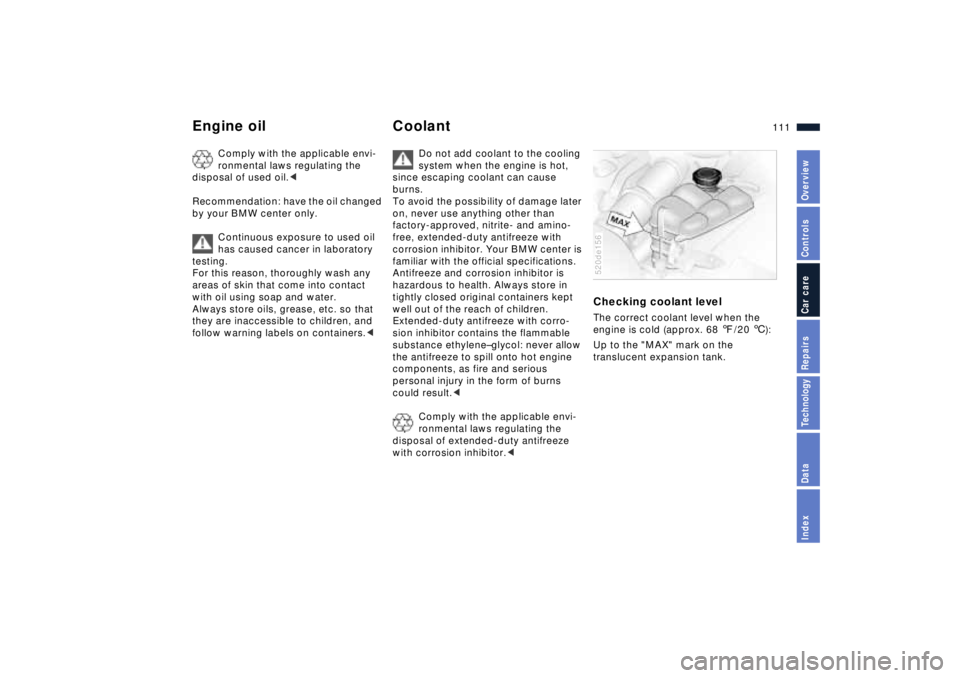
Checking coolant levelThe correct coolant level when the
engine is cold (approx. 68 7/20 6):
Up to the "MAX" mark on the
translucent expansion tank.520de156
Page 112 of 170
112n
Coolant Brake fluidAdding coolant To guard against the possibility of
scalding injuries, always wait until the
engine cools (temperature gauge
needle in blue sector) before
unscrewing the cap on the expansion
tank.
1 Turn the cap slightly counterclock-
wise in order to allow accumulated
pressure to escape, then continue
turning to remove.
2 If the coolant is low, slowly add
coolant until the correct level is
reached Ð do not overfill.
The coolant is a mixture of water and
extended-duty antifreeze with corrosion
inhibitor. Always maintain the
prescribed all-season 50:50 mixture
ratio for year-round protection against
internal corrosion. No other additives
are required.
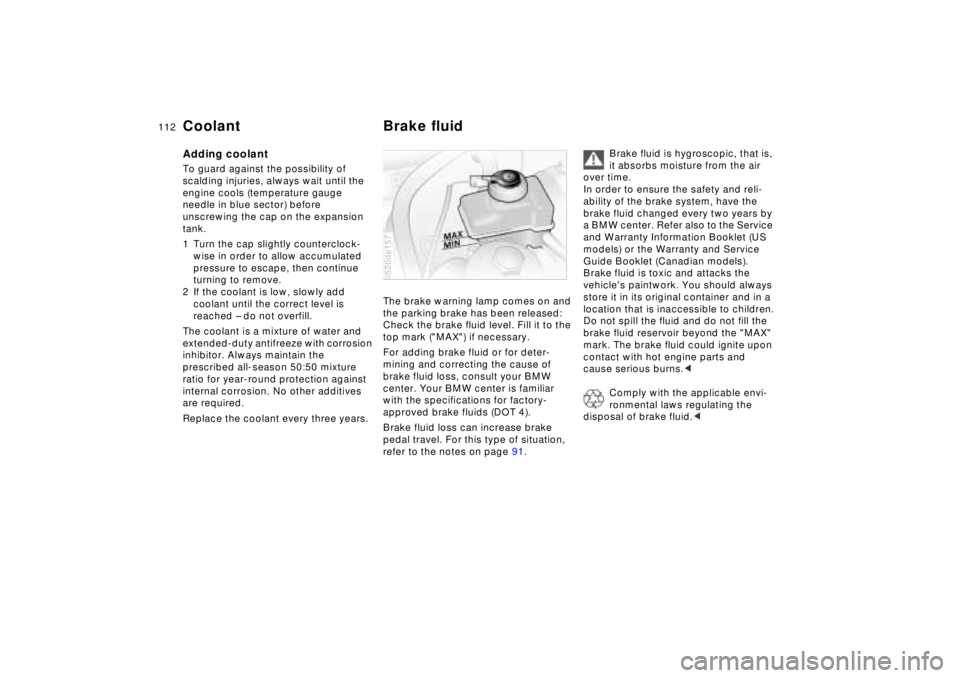
Replace the coolant every three years.The brake warning lamp comes on and
the parking brake has been released:
Check the brake fluid level. Fill it to the
top mark ("MAX") if necessary.
For adding brake fluid or for deter-
mining and correcting the cause of
brake fluid loss, consult your BMW
center. Your BMW center is familiar
with the specifications for factory-
approved brake fluids (DOT 4).
Brake fluid loss can increase brake
pedal travel. For this type of situation,
refer to the notes on page 91.
520de157
Brake fluid is hygroscopic, that is,
it absorbs moisture from the air
over time.
In order to ensure the safety and reli-
ability of the brake system, have the
brake fluid changed every two years by
a BMW center. Refer also to the Service
and Warranty Information Booklet (US
models) or the Warranty and Service
Guide Booklet (Canadian models).
Brake fluid is toxic and attacks the
vehicle's paintwork. You should always
store it in its original container and in a
location that is inaccessible to children.
Do not spill the fluid and do not fill the
brake fluid reservoir beyond the "MAX"
mark. The brake fluid could ignite upon
contact with hot engine parts and
cause serious burns.<
Comply with the applicable envi-
ronmental laws regulating the
disposal of brake fluid.<
Page 120 of 170

120n
Caring for your vehicleLeather care The leather upholstery used by BMW is
a natural product of the highest quality,
processed using state-of-the-art
methods to ensure that it will maintain
its high quality for years to come,
provided that it is properly cared for.
Because the leather upholstery is
crafted using unadulterated natural
materials, it will display individual char-
acteristics and possible surface irregu-
larities. You should also bear in mind
that this kind of material needs special
care and attention.
Regular periodic cleaning and care are
essential, as dust and road dirt act as
abrasives in the pores and creases of
the material. This leads to wear spots
and premature brittleness on the
surface of the leather. We therefore
suggest that you clean the leather with
a vacuum cleaner or cloth at frequent
intervals.
For cleaning, use BMW leather cleaning
foam.Since dirt and grease gradually attack
the protective layer of the leather, the
cleaned surfaces should be treated
with BMW leather care agent. This also
prevents static electricity.
For protection against dampness or
moisture, treat the leather with a BMW
impregnating agent.
We recommend that you perform this
procedure twice a year on leather
exposed to normal use.
Spills should be wiped up immediately.
Remove grease and oil stains without
rubbing, but rather by dabbing with
spot remover.
If the upholstery is to be exposed to
intense sunlight or if the vehicle is to be
stored for an extended period, cover all
leather surfaces (or, better yet, the
windows) to prevent fading.
Use the cleaning and car-care
products available at your BMW
center.<
Cleaning agents can contain
dangerous or health-threatening
substances. Therefore, always comply
with the warnings and danger notices
on the package.
Open the doors or windows on your
vehicle when cleaning the interior
(when the convertible top is closed).
Never clean your vehicle with solvents
or other materials not specifically
intended for this application.<
Page 123 of 170

123n
IndexDataTechnologyRepairsCar careControlsOverview
Technical modifications California Proposition 65 WarningAny BMW center will be happy to
advise you concerning the advisability,
legal requirements and factory recom-
mendations for technical modifications
to the vehicle. The BMW center will
require the Vehicle Identification
Number and, in some cases, the
engine number as well. Light-Emitting Diodes (LEDs)Light-emitting diodes installed behind
translucent lenses serve as the light
source for many of the controls and
displays in your vehicle. These light-
emitting diodes are similar to conven-
tional lasers.
Do not remove the protective lens
and avoid staring directly at the
unfiltered beam for extended periods
(several hours). To do so could result in
inflammation of the iris.<
California laws require us to state the
following warning:
Engine exhaust, some of its
constituents, and certain vehicle
components contain or emit chemicals
known to the State of California to
cause cancer and birth defects or other
reproductive harm.<
Page 124 of 170
124n
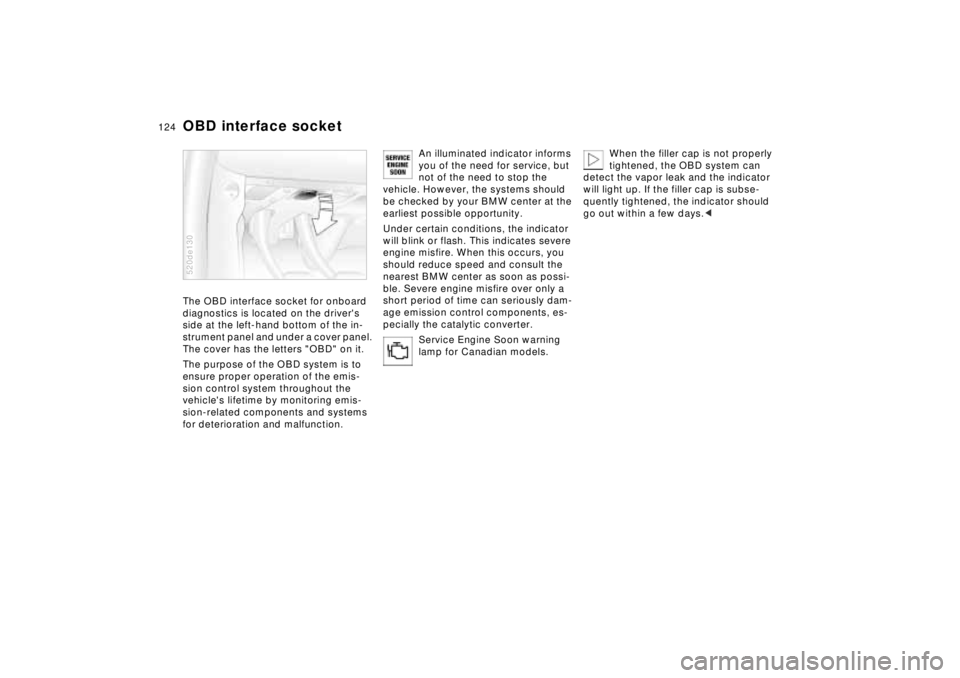
OBD interface socket The OBD interface socket for onboard
diagnostics is located on the driver's
side at the left-hand bottom of the in-
strument panel and under a cover panel.
The cover has the letters "OBD" on it.
The purpose of the OBD system is to
ensure proper operation of the emis-
sion control system throughout the
vehicle's lifetime by monitoring emis-
sion-related components and systems
for deterioration and malfunction.520de130
An illuminated indicator informs
you of the need for service, but
not of the need to stop the
vehicle. However, the systems should
be checked by your BMW center at the
earliest possible opportunity.
Under certain conditions, the indicator
will blink or flash. This indicates severe
engine misfire. When this occurs, you
should reduce speed and consult the
nearest BMW center as soon as possi-
ble. Severe engine misfire over only a
short period of time can seriously dam-
age emission control components, es-
pecially the catalytic converter.
Service Engine Soon warning
lamp for Canadian models.
When the filler cap is not properly
tightened, the OBD system can
detect the vapor leak and the indicator
will light up. If the filler cap is subse-
quently tightened, the indicator should
go out within a few days.<