lock BMW Z8 2001 Owner's Manual
[x] Cancel search | Manufacturer: BMW, Model Year: 2001, Model line: Z8, Model: BMW Z8 2001Pages: 170, PDF Size: 1.64 MB
Page 43 of 170
43n
IndexDataTechnologyRepairsCar careControlsOverview
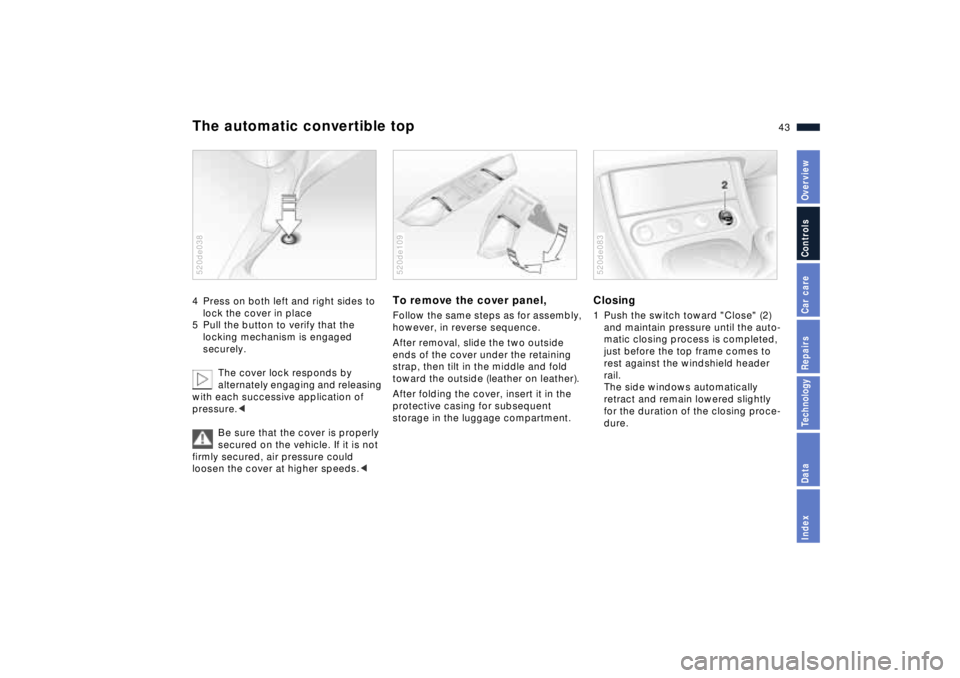
The automatic convertible top4 Press on both left and right sides to
lock the cover in place
5 Pull the button to verify that the
locking mechanism is engaged
securely.
The cover lock responds by
alternately engaging and releasing
with each successive application of
pressure.<
Be sure that the cover is properly
secured on the vehicle. If it is not
firmly secured, air pressure could
loosen the cover at higher speeds.<520de038
To remove the cover panel,Follow the same steps as for assembly,
however, in reverse sequence.
After removal, slide the two outside
ends of the cover under the retaining
strap, then tilt in the middle and fold
toward the outside (leather on leather).
After folding the cover, insert it in the
protective casing for subsequent
storage in the luggage compartment.520de109
Closing1 Push the switch toward "Close" (2)
and maintain pressure until the auto-
matic closing process is completed,
just before the top frame comes to
rest against the windshield header
rail.
The side windows automatically
retract and remain lowered slightly
for the duration of the closing proce-
dure.520de083
Page 44 of 170
44n
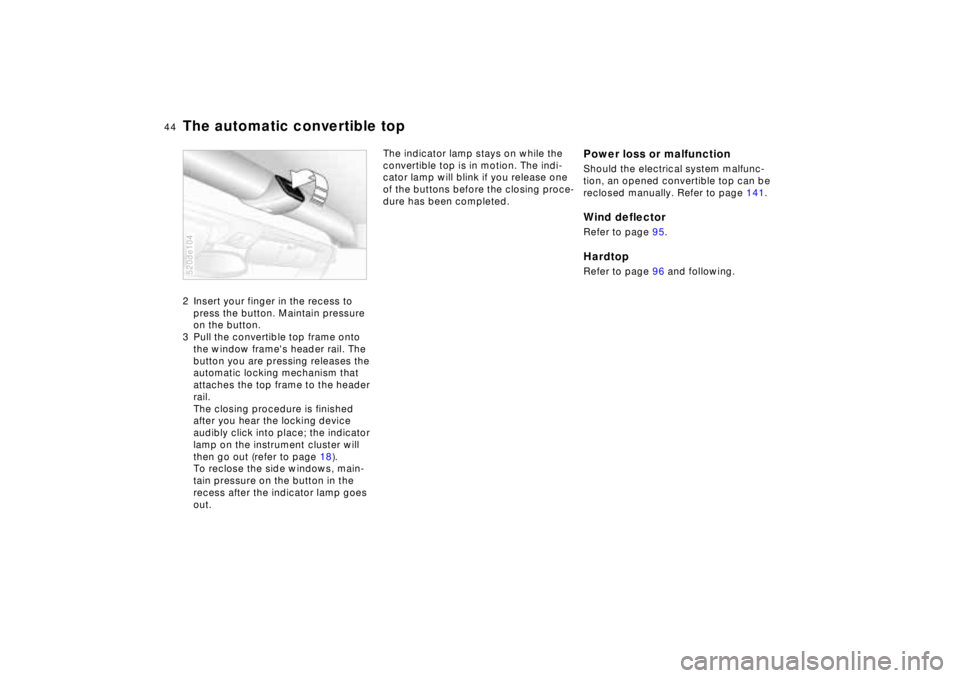
The automatic convertible top2 Insert your finger in the recess to
press the button. Maintain pressure
on the button.
3 Pull the convertible top frame onto
the window frame's header rail. The
button you are pressing releases the
automatic locking mechanism that
attaches the top frame to the header
rail.
The closing procedure is finished
after you hear the locking device
audibly click into place; the indicator
lamp on the instrument cluster will
then go out (refer to page 18).
To reclose the side windows, main-
tain pressure on the button in the
recess after the indicator lamp goes
out. 520de104
The indicator lamp stays on while the
convertible top is in motion. The indi-
cator lamp will blink if you release one
of the buttons before the closing proce-
dure has been completed.
Power loss or malfunctionShould the electrical system malfunc-
tion, an opened convertible top can be
reclosed manually. Refer to page 141.Wind deflectorRefer to page 95.HardtopRefer to page 96 and following.
Page 46 of 170
46n
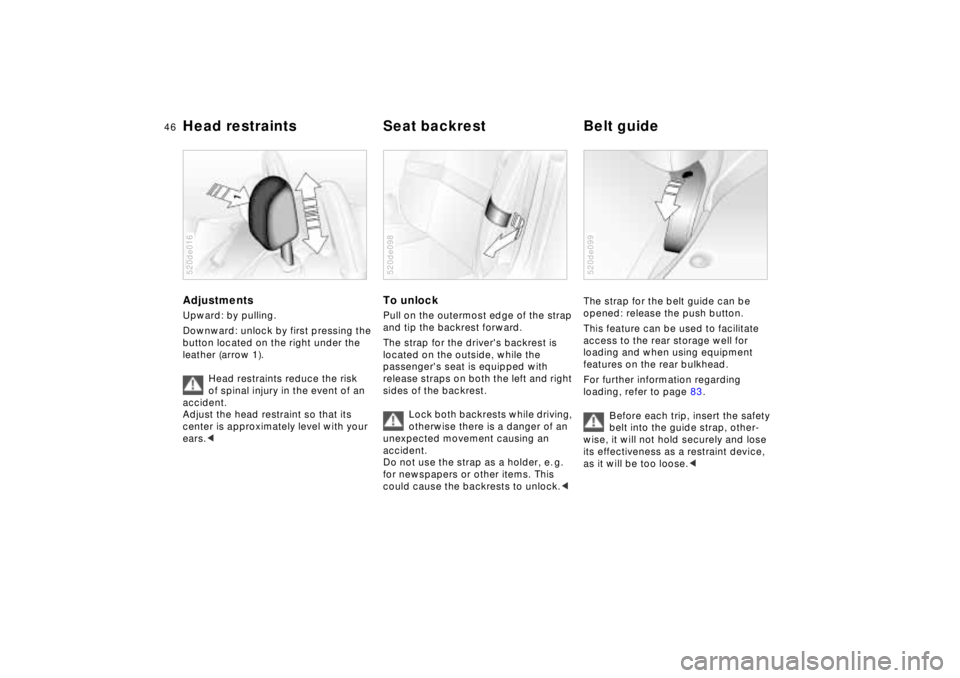
Head restraints Seat backrest Belt guideAdjustments Upward: by pulling.
Downward: unlock by first pressing the
button located on the right under the
leather (arrow 1).
Head restraints reduce the risk
of spinal injury in the event of an
accident.
Adjust the head restraint so that its
center is approximately level with your
ears.<520de016
To unlockPull on the outermost edge of the strap
and tip the backrest forward.
The strap for the driver's backrest is
located on the outside, while the
passenger's seat is equipped with
release straps on both the left and right
sides of the backrest.
Lock both backrests while driving,
otherwise there is a danger of an
unexpected movement causing an
accident.
Do not use the strap as a holder, e. g.
for newspapers or other items. This
could cause the backrests to unlock.<520de098
The strap for the belt guide can be
opened: release the push button.
This feature can be used to facilitate
access to the rear storage well for
loading and when using equipment
features on the rear bulkhead.
For further information regarding
loading, refer to page 83.
Before each trip, insert the safety
belt into the guide strap, other-
wise, it will not hold securely and lose
its effectiveness as a restraint device,
as it will be too loose.<520de099
Page 48 of 170
48n
Mirrors Car Memory, Key MemoryInterior rearview mirror with
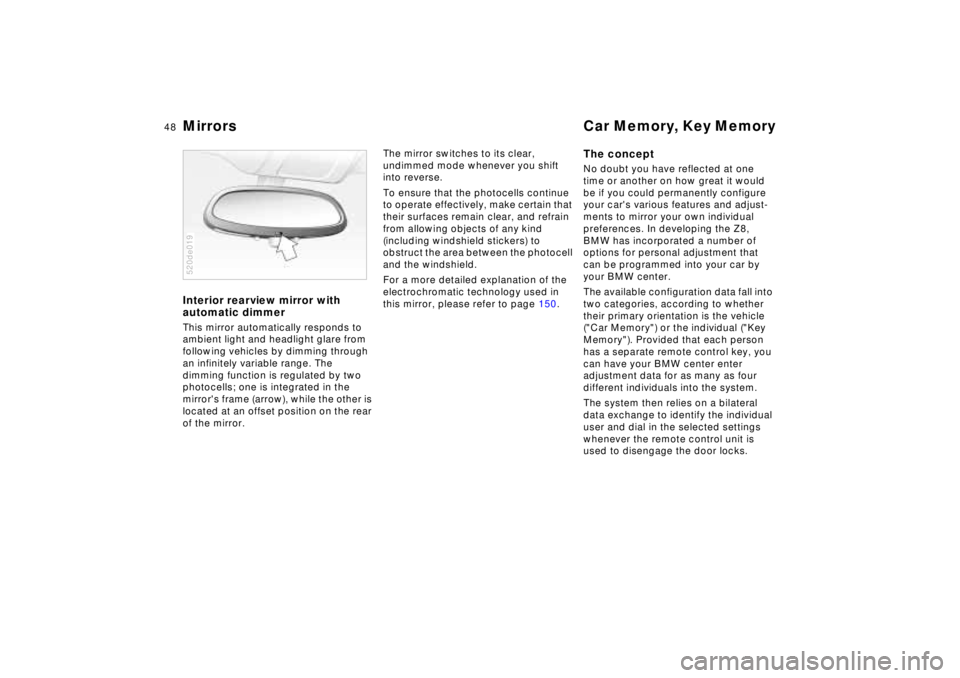
automatic dimmer This mirror automatically responds to
ambient light and headlight glare from
following vehicles by dimming through
an infinitely variable range. The
dimming function is regulated by two
photocells; one is integrated in the
mirror's frame (arrow), while the other is
located at an offset position on the rear
of the mirror. 520de019
The mirror switches to its clear,
undimmed mode whenever you shift
into reverse.
To ensure that the photocells continue
to operate effectively, make certain that
their surfaces remain clear, and refrain
from allowing objects of any kind
(including windshield stickers) to
obstruct the area between the photocell
and the windshield.
For a more detailed explanation of the
electrochromatic technology used in
this mirror, please refer to page 150.
The conceptNo doubt you have reflected at one
time or another on how great it would
be if you could permanently configure
your car's various features and adjust-
ments to mirror your own individual
preferences. In developing the Z8,
BMW has incorporated a number of
options for personal adjustment that
can be programmed into your car by
your BMW center.
The available configuration data fall into
two categories, according to whether
their primary orientation is the vehicle
("Car Memory") or the individual ("Key
Memory"). Provided that each person
has a separate remote control key, you
can have your BMW center enter
adjustment data for as many as four
different individuals into the system.
The system then relies on a bilateral
data exchange to identify the individual
user and dial in the selected settings
whenever the remote control unit is
used to disengage the door locks.
Page 49 of 170

49n
IndexDataTechnologyRepairsCar careControlsOverview
Car Memory, Key MemoryWhat the system can doYour BMW center can provide you with
details on the capabilities of the Car
Memory and Key Memory systems.
Below are a few examples:
A Car Memory sampler:
>Various signals to confirm release
and engagement of the vehicle's
locks.
>Activate/deactivate the "Follow-me-
home lighting" function.
A Key Memory sampler:
>Engage vehicle locks as soon as the
vehicle is underway.
At various points throughout this
Owner's Manual you will find this
symbol, indicating that the equipment
or system described in the adjacent
section can be preset for automatic
adjustment using the Car or Key
Memory.<
Page 50 of 170
50n
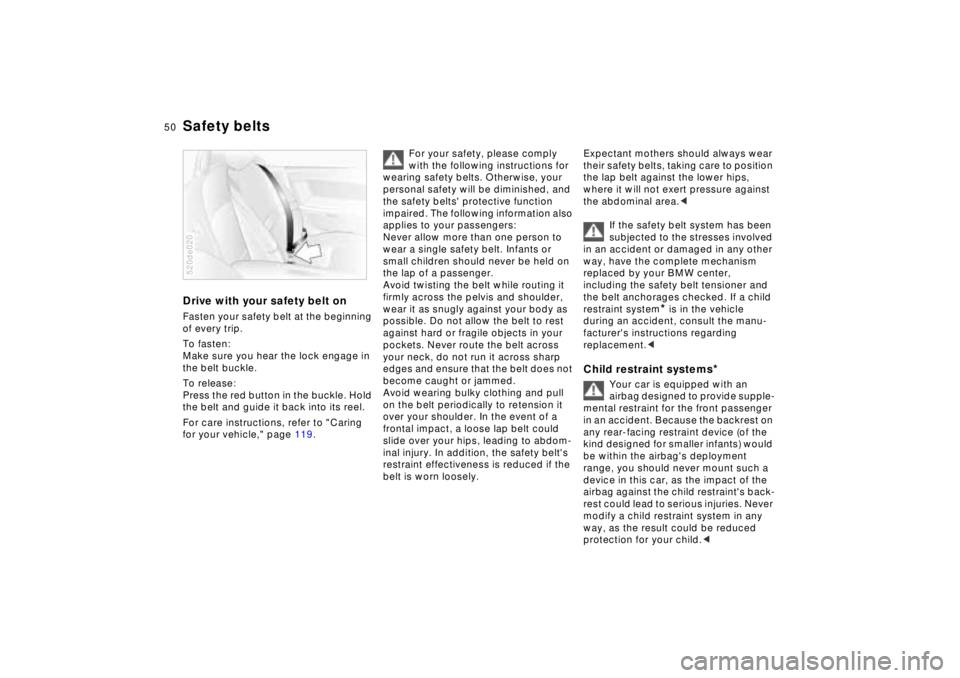
Drive with your safety belt onFasten your safety belt at the beginning
of every trip.
To fasten:
Make sure you hear the lock engage in
the belt buckle.
To release:
Press the red button in the buckle. Hold
the belt and guide it back into its reel.
For care instructions, refer to "Caring
for your vehicle," page 119.520de020
For your safety, please comply
with the following instructions for
wearing safety belts. Otherwise, your
personal safety will be diminished, and
the safety belts' protective function
impaired. The following information also
applies to your passengers:
Never allow more than one person to
wear a single safety belt. Infants or
small children should never be held on
the lap of a passenger.
Avoid twisting the belt while routing it
firmly across the pelvis and shoulder,
wear it as snugly against your body as
possible. Do not allow the belt to rest
against hard or fragile objects in your
pockets. Never route the belt across
your neck, do not run it across sharp
edges and ensure that the belt does not
become caught or jammed.
Avoid wearing bulky clothing and pull
on the belt periodically to retension it
over your shoulder. In the event of a
frontal impact, a loose lap belt could
slide over your hips, leading to abdom-
inal injury. In addition, the safety belt's
restraint effectiveness is reduced if the
belt is worn loosely.
Expectant mothers should always wear
their safety belts, taking care to position
the lap belt against the lower hips,
where it will not exert pressure against
the abdominal area.<
If the safety belt system has been
subjected to the stresses involved
in an accident or damaged in any other
way, have the complete mechanism
replaced by your BMW center,
including the safety belt tensioner and
the belt anchorages checked. If a child
restraint system
* is in the vehicle
during an accident, consult the manu-
facturer's instructions regarding
replacement.<
Child restraint systems
*
Your car is equipped with an
airbag designed to provide supple-
mental restraint for the front passenger
in an accident. Because the backrest on
any rear-facing restraint device (of the
kind designed for smaller infants) would
be within the airbag's deployment
range, you should never mount such a
device in this car, as the impact of the
airbag against the child restraint's back-
rest could lead to serious injuries. Never
modify a child restraint system in any
way, as the result could be reduced
protection for your child.<
Safety belts
Page 52 of 170
52n
AirbagsSitting correctly with airbags
Comply with the following instruc-
tions for the airbags, otherwise,
the airbags may not be able to provide
their maximum protection, with
resulting risks to personal safety. All
passengers in the vehicle should be
aware of and comply with this informa-
tion:
The airbag is a supplemental restraint
device; it is not a substitute or replace-
ment for your safety belt, which you
should continue to wear at all times.
When adjusting your seat, assume a
comfortable driving posture allowing
comfortable and secure access to all of
the vehicle's controls. Avoid sitting too
close to the steering wheel.
Always hold the steering wheel by the
rim Ð hands in the "9 o'clock" and
"3 o'clock" positions Ð otherwise, your
hands or arms could be injured if the
airbag is triggered.
Never allow any other passengers,
animals or objects to intrude into the
area between the airbag and the driver
or front passenger.
Do not use the cover panel above the
front passenger airbag as a storage
area.
Do not apply adhesive materials to the
cover panels of the airbags, or cover or
modify them in any other way.
Do not use a rear-facing child seat in the
front passenger seat. If you use a child
restraint system, carefully read and
comply with the instructions on page 53.
Be sure that child seats are installed
correctly and with the greatest possible
distance between them and the side
airbag. Do not allow children to lean out
of the child's seat in the direction of the
side trim panels. If they do so, serious
injuries can occur if the airbag is trig-
gered.<
Even when all these guidelines are
observed, there is still a small residual
risk of injury to the face, hands and
arms occurring from airbag deployment
in isolated instances.
The ignition and inflation noise may
cause a mild temporary hearing loss in
extremely sensitive individuals.
You will find the proper airbag safety
precautions on both sun visors and on
the instrument cluster (US models).
For additional information concerning
the airbag system, refer to pages 121
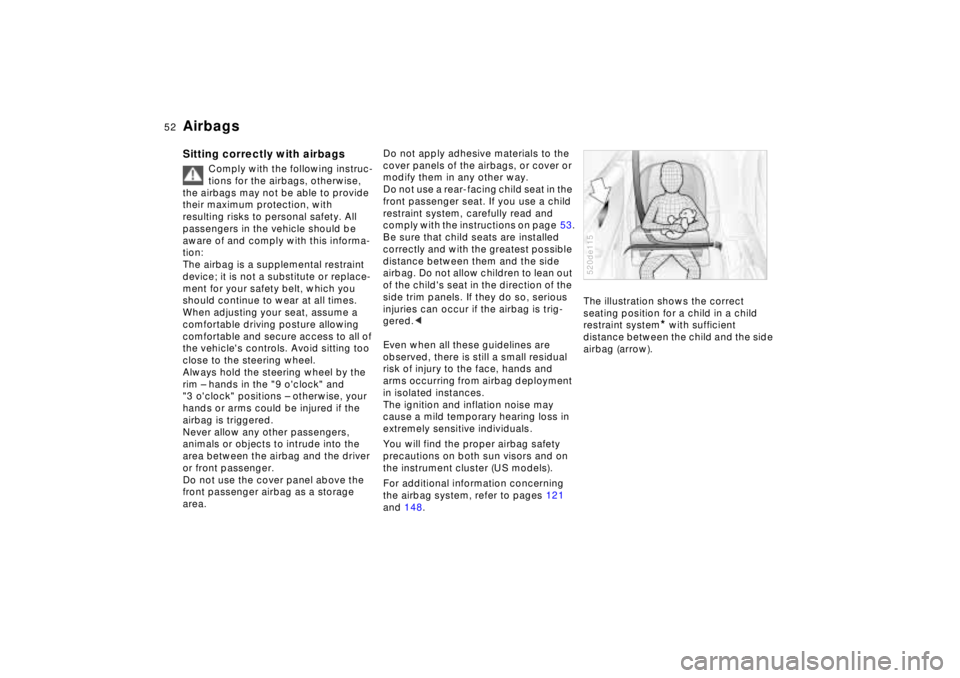
and 148.The illustration shows the correct
seating position for a child in a child
restraint system
* with sufficient
distance between the child and the side
airbag (arrow).
520de115
Page 54 of 170
54n
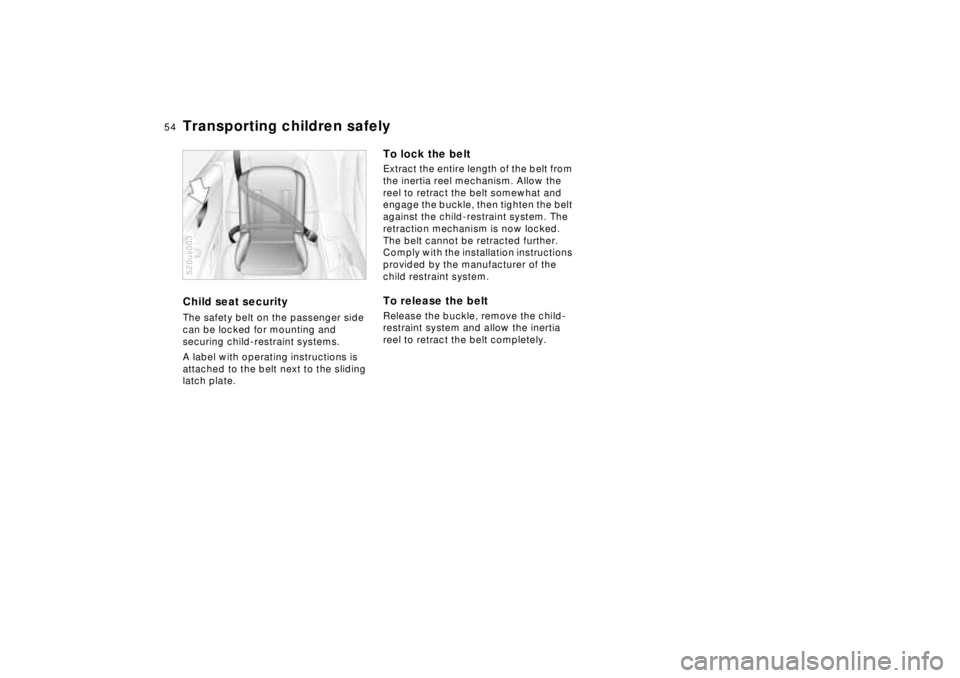
Transporting children safelyChild seat securityThe safety belt on the passenger side
can be locked for mounting and
securing child-restraint systems.
A label with operating instructions is
attached to the belt next to the sliding
latch plate.520us003
To lock the beltExtract the entire length of the belt from
the inertia reel mechanism. Allow the
reel to retract the belt somewhat and
engage the buckle, then tighten the belt
against the child-restraint system. The
retraction mechanism is now locked.
The belt cannot be retracted further.
Comply with the installation instructions
provided by the manufacturer of the
child restraint system.To release the beltRelease the buckle, remove the child-
restraint system and allow the inertia
reel to retract the belt completely.
Page 55 of 170
55n
IndexDataTechnologyRepairsCar careControlsOverview
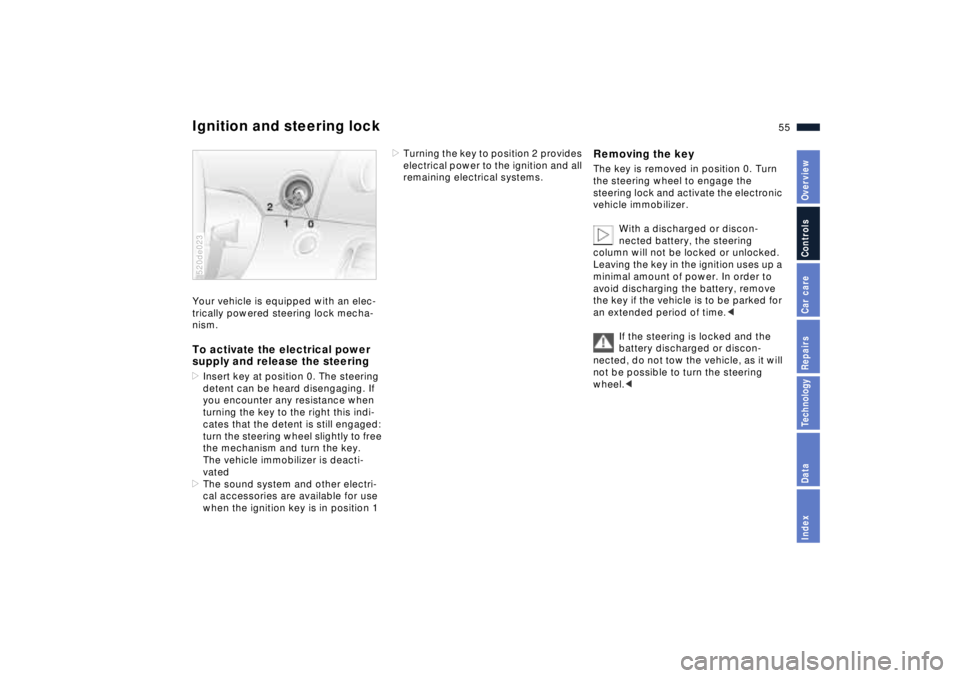
Your vehicle is equipped with an elec-
trically powered steering lock mecha-
nism.To activate the electrical power
supply and release the steering>Insert key at position 0. The steering
detent can be heard disengaging. If
you encounter any resistance when
turning the key to the right this indi-
cates that the detent is still engaged:
turn the steering wheel slightly to free
the mechanism and turn the key.
The vehicle immobilizer is deacti-
vated
>The sound system and other electri-
cal accessories are available for use
when the ignition key is in position 1 520de023
>Turning the key to position 2 provides
electrical power to the ignition and all
remaining electrical systems.
Removing the keyThe key is removed in position 0. Turn
the steering wheel to engage the
steering lock and activate the electronic
vehicle immobilizer.
With a discharged or discon-
nected battery, the steering
column will not be locked or unlocked.
Leaving the key in the ignition uses up a
minimal amount of power. In order to
avoid discharging the battery, remove
the key if the vehicle is to be parked for
an extended period of time.<
If the steering is locked and the
battery discharged or discon-
nected, do not tow the vehicle, as it will
not be possible to turn the steering
wheel.<
Ignition and steering lock
Page 56 of 170
56n
Starting the engine Turning the engine off Before starting>Engage the parking brake
>Make sure that the transmission is in
neutral
>Depress the clutch pedal
>Turn ignition key to position 2.
Do not allow the engine to run in
enclosed areas. The exhaust
gases contain carbon monoxide, an
odorless and colorless, but highly toxic
gas. Breathing the exhaust gases poses
an extreme health risk, and can lead to
unconsciousness and death.
Do not leave the vehicle unattended
with the engine running. An unattended
vehicle with a running engine repre-
sents a potential safety hazard.<520de141
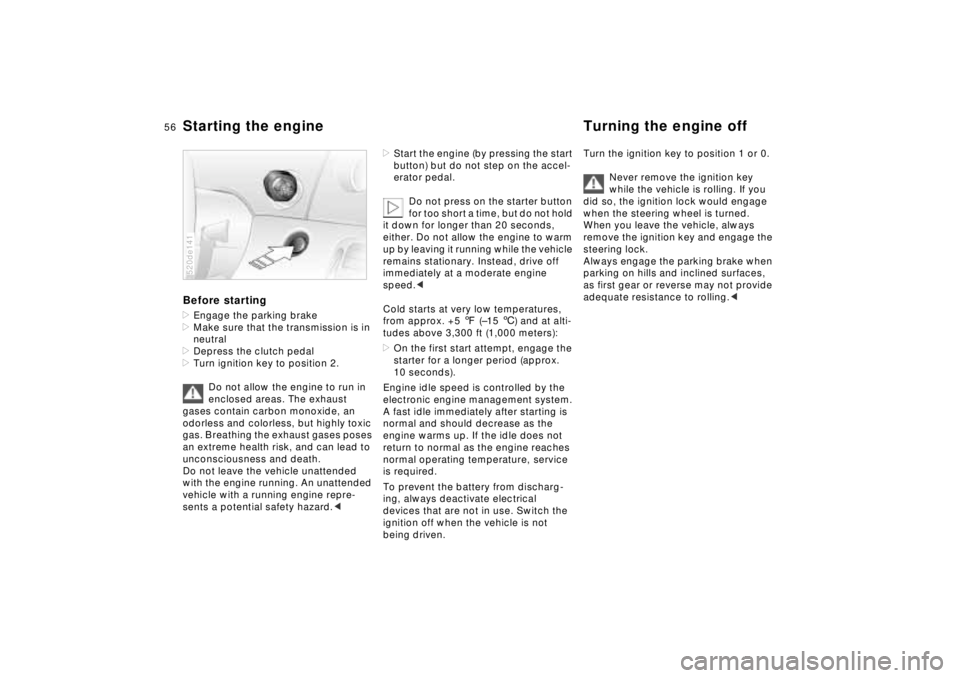
>Start the engine (by pressing the start
button) but do not step on the accel-
erator pedal.
Do not press on the starter button
for too short a time, but do not hold
it down for longer than 20 seconds,
either. Do not allow the engine to warm
up by leaving it running while the vehicle
remains stationary. Instead, drive off
immediately at a moderate engine
speed.<
Cold starts at very low temperatures,
from approx. +5 7 (Ð15 6) and at alti-
tudes above 3,300 ft (1,000 meters):
>On the first start attempt, engage the
starter for a longer period (approx.
10 seconds).
Engine idle speed is controlled by the
electronic engine management system.
A fast idle immediately after starting is
normal and should decrease as the
engine warms up. If the idle does not
return to normal as the engine reaches
normal operating temperature, service
is required.
To prevent the battery from discharg-
ing, always deactivate electrical
devices that are not in use. Switch the
ignition off when the vehicle is not
being driven.
Turn the ignition key to position 1 or 0.
Never remove the ignition key
while the vehicle is rolling. If you
did so, the ignition lock would engage
when the steering wheel is turned.
When you leave the vehicle, always
remove the ignition key and engage the
steering lock.
Always engage the parking brake when
parking on hills and inclined surfaces,
as first gear or reverse may not provide
adequate resistance to rolling.<