tire size BUICK CENTURY 1994 Owners Manual
[x] Cancel search | Manufacturer: BUICK, Model Year: 1994, Model line: CENTURY, Model: BUICK CENTURY 1994Pages: 308, PDF Size: 16.3 MB
Page 206 of 308
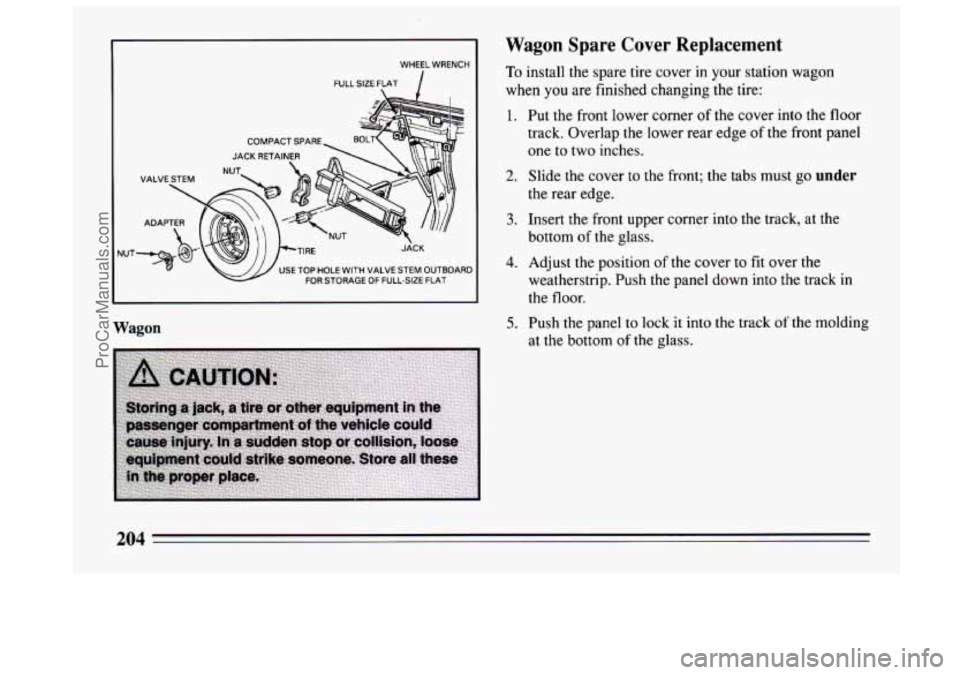
UT WHEEL
WRENCH
FULL SIZE FLAT /
JACK
USE TOP HOLE WITH VALVE STEM OUTBOARD FOR STORAGE OF
FULL-SIZE FLAT
Wagon Spare Cover Replacement
To install the spare tire cover in your station wagon
when
you are finished changing the tire:
1.
2.
3.
4.
Wagon 5.
Put the front lower corner of the cover into the floor
track. Overlap the lower rear edge of the front panel
one to two inches.
Slide the cover to the front;. the tabs must go
under
the rear edge.
Insert the front upper corner into the track, at the
bottom of the glass.
Adjust the position
of the cover to fit over the
weatherstrip. Push the panel down into the track in
the floor.
Push the panel to lock it into the track
of the molding
at
the bottom of the glass.
204
ProCarManuals.com
Page 207 of 308
Compact Spare Tire
Although the compact spare was fully inflated when
your vehicle was new, it can lose air after a time. Check
the inflation pressure regularly. It should be 60 psi
(420 kPa). After installing the compact spare on your
vehicle, you should stop as soon as possible and make
sure your spare tire is correctly inflated. The compact
spare is made to perform well at posted speed limits for
distances up to
3,000 miles (5 000 km). The compact
spare is made to go up to
3,000 miles (5 000 km), so you
can finish your trip and have your full-size tire repaired
or replaced where you want. Of course, it’s best to
replace your spare
with a full-size tire as soon as you
can. Your spare will last longer and be in good shape
in
case you need it again.
I NOTICE:
Don’t take your compact spare through an
automatic car wash with guide rails. The
compact spare can get caught on the rails. That
can damage the tire and wheel, and maybe other
parts of your vehicle.
Don’t use your compact spare on some other vehicle.
And don’t
mix your compact spare or wheel with other
wheels or tires. They won’t fit. Keep your spare and its
wheel together.
NOTICE:
Tire chains won’t fit yoUP-Cijimpct spare. Using
them will damage your vehicle and destroy the
chains too. Don’t use tire chains
on your
compact spare.
205
ProCarManuals.com
Page 238 of 308
Loading Your Vehicle
TIRE-LOADING INFORMATION
OCCUPANTS VEHICLE CAP. WT.
FRT. CTR. RR. TOTAL LBS. KG
MAX. LOADING & GVWR SAME AS VEHICLE
CAPACITY WEIGHT
XXX COLD TIRE
TIRE SIZE SPEED PRESSURE RTG
PSI/KPa
FRT.
RR.
SPA.
IF TIRES ARE HOT, ADD 4PSD28KPa
SEE OWNER‘S MANUAL FOR ADDITIONAL
INFORMATION IlrmlI :$#
~
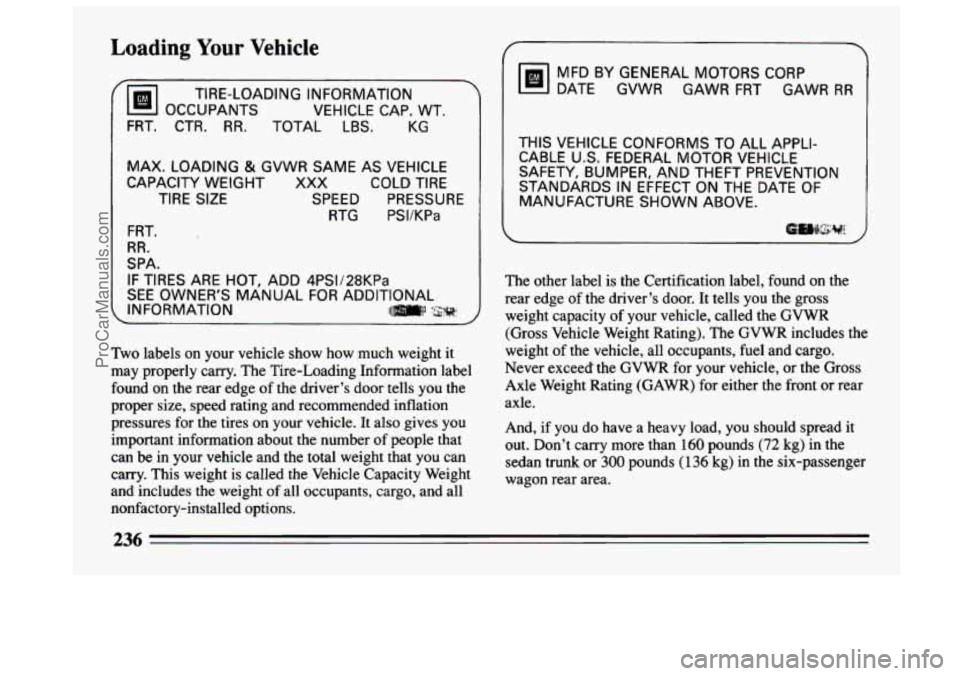
Two labels on your vehicle show how much weight it
may properly carry. The Tire-Loading Information label
found on
the rear edge of the driver’s door tells you the
proper size, speed rating and recommended inflation
pressures for the tires
on your vehicle. It also gives you
important information about the number
of people that
can be in your vehicle and the total weight that you can
carry. This weight is called the Vehicle Capacity Weight
and includes the weight
of all occupants, cargo, and all
nonfactory-installed options.
MFD BY GENERAL MOTORS CORP
DATE GVWR GAWR FRT GAWR RR
THIS VEHICLE CONFORMS TO ALL APPLI-
CABLE
U.S. FEDERAL MOTOR VEHICLE
SAFETY, BUMPER, AND THEFT PREVENTION
STANDARDS
IN EFFECT ON THE DATE OF
MANUFACTURE
SHOWN ABOVE.
The other label is the Certification label, found on the
rear edge of the driver’s door. It tells you the gross
weight capacity of your vehicle, called the GVWR
(Gross Vehicle Weight Rating). The GVWR includes the
weight of the vehicle,
all occupants, fuel and cargo.
Never exceed the GVWR for your vehicle, or the Gross
Axle Weight Rating (GAWR) for either the front or rear
axle.
And, if you do have a heavy load, you should spread it
out. Don’t carry more than
160 pounds (72 kg) in the
sedan
trunk or 300 pounds (136 kg) in the six-passenger
wagon rear area.
ProCarManuals.com
Page 243 of 308
When It’s Time for New Tires
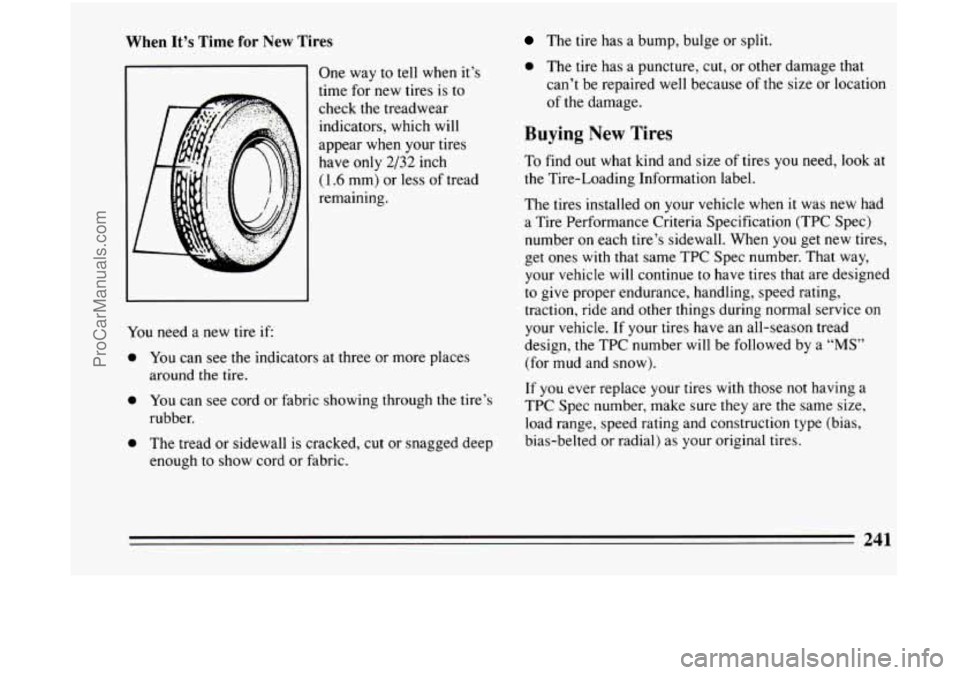
One way to tell when it’s
time for new tires is to
check the treadwear
indicators, which will
appear when your tires
have
only 2/32 inch
(1.6 mm) or less of tread
remaining.
You need a new tire if
0 You can see the indicators at three or more places
around the tire.
0 You can see cord or fabric showing through the tire’s
rubber.
0 The tread or sidewall is cracked, cut or snagged deep
enough to show cord or fabric.
The tire has a bump, bulge or split.
0 The tire has a puncture, cut, or other damage that
can’t be repaired well because of the size or location
of the damage.
Buying New Tires
To find out what kind and size of tires you need, look at
the Tire-Loading Information label.
The tires installed on your vehicle when it was new had
a Tire Performance Criteria Specification (TPC Spec)
number on each tire’s sidewall. When you get new tires,
get ones with that same TPC Spec number. That way,
your vehicle will continue to have tires that are designed
to give proper endurance, handling, speed rating,
traction, ride and other things during normal service on
your vehicle. If your tires have an all-season tread
design, the TPC number
will be followed by a “MS”
(for mud and snow).
If you ever replace your tires with those not having a
TPC Spec number, make sure they are the same size,
load range, speed rating and construction type (bias,
bias-belted or radial) as your original tires.
241
ProCarManuals.com
Page 246 of 308
If you need to replace any of your wheels, wheel bolts,
or wheel nuts, replace them only with new
GM original
equipment parts. This way,
you will be sure to have the
right wheel, wheel bolts, and wheel nuts for your Buick
model.
NOTICE:
The wrong wheel can also cause problems with
bearing life, brake cooling, speedometer/odometer
calibration, headlight aim, bumper height, vehicle
ground clearance, and tire
or tire chain clearance
to the body and chassis.
Used Replacement Wheels
Tire Chains
NOTICE:
Use tire chains only where legal and only when
you must. Use only
SAE Class “S” type chains
that are the proper size for your tires. Install
them on the front tires and tighten them as
tightly
as possible with the ends securely
fastened. Drive slowly and follow the chain
manufacturer’s instructions.
If you can hear the
chains contacting your vehicle, stop and
retighten them.
If the contact continues, slow
down
until it stops. Driving too fast with chains
on will damage your vehicle.
244
ProCarManuals.com