radiator cap BUICK CENTURY 2004 Owner's Manual
[x] Cancel search | Manufacturer: BUICK, Model Year: 2004, Model line: CENTURY, Model: BUICK CENTURY 2004Pages: 358, PDF Size: 4.01 MB
Page 213 of 358
Service............................................................5-3
Doing Your Own Service Work.........................5-3
Adding Equipment to the Outside of Your
Vehicle......................................................5-4
Fuel................................................................5-4
Gasoline Octane............................................5-4
Gasoline Specications....................................5-5
California Fuel...............................................5-5
Additives.......................................................5-6
Fuels in Foreign Countries...............................5-6
Filling Your Tank............................................5-7
Filling a Portable Fuel Container.......................5-9
Checking Things Under the Hood....................5-10
Hood Release..............................................5-10
Engine Compartment Overview.......................5-12
Engine Oil...................................................5-13
Engine Air Cleaner/Filter................................5-18
Automatic Transaxle Fluid..............................5-19
Engine Coolant.............................................5-22
Radiator Pressure Cap..................................5-25
Engine Overheating.......................................5-25
Cooling System............................................5-28
Power Steering Fluid.....................................5-35
Windshield Washer Fluid................................5-36
Brakes........................................................5-38Battery........................................................5-41
Jump Starting...............................................5-42
Headlamp Aiming...........................................5-49
Bulb Replacement..........................................5-51
Halogen Bulbs..............................................5-51
Headlamps..................................................5-51
Front Turn Signal and Parking Lamps..............5-52
Center High-Mounted Stoplamp (CHMSL).........5-53
Taillamps, Turn Signal, and Stoplamps............5-54
Back-Up Lamps............................................5-55
Windshield Wiper Blade Replacement..............5-56
Tires..............................................................5-57
Ination - Tire Pressure.................................5-64
Tire Pressure Monitor System.........................5-65
Tire Inspection and Rotation...........................5-67
When It Is Time for New Tires.......................5-68
Buying New Tires.........................................5-69
Uniform Tire Quality Grading..........................5-70
Wheel Alignment and Tire Balance..................5-71
Wheel Replacement......................................5-72
Tire Chains..................................................5-73
If a Tire Goes Flat........................................5-74
Changing a Flat Tire.....................................5-75
Compact Spare Tire......................................5-87
Section 5 Service and Appearance Care
5-1
Page 225 of 358
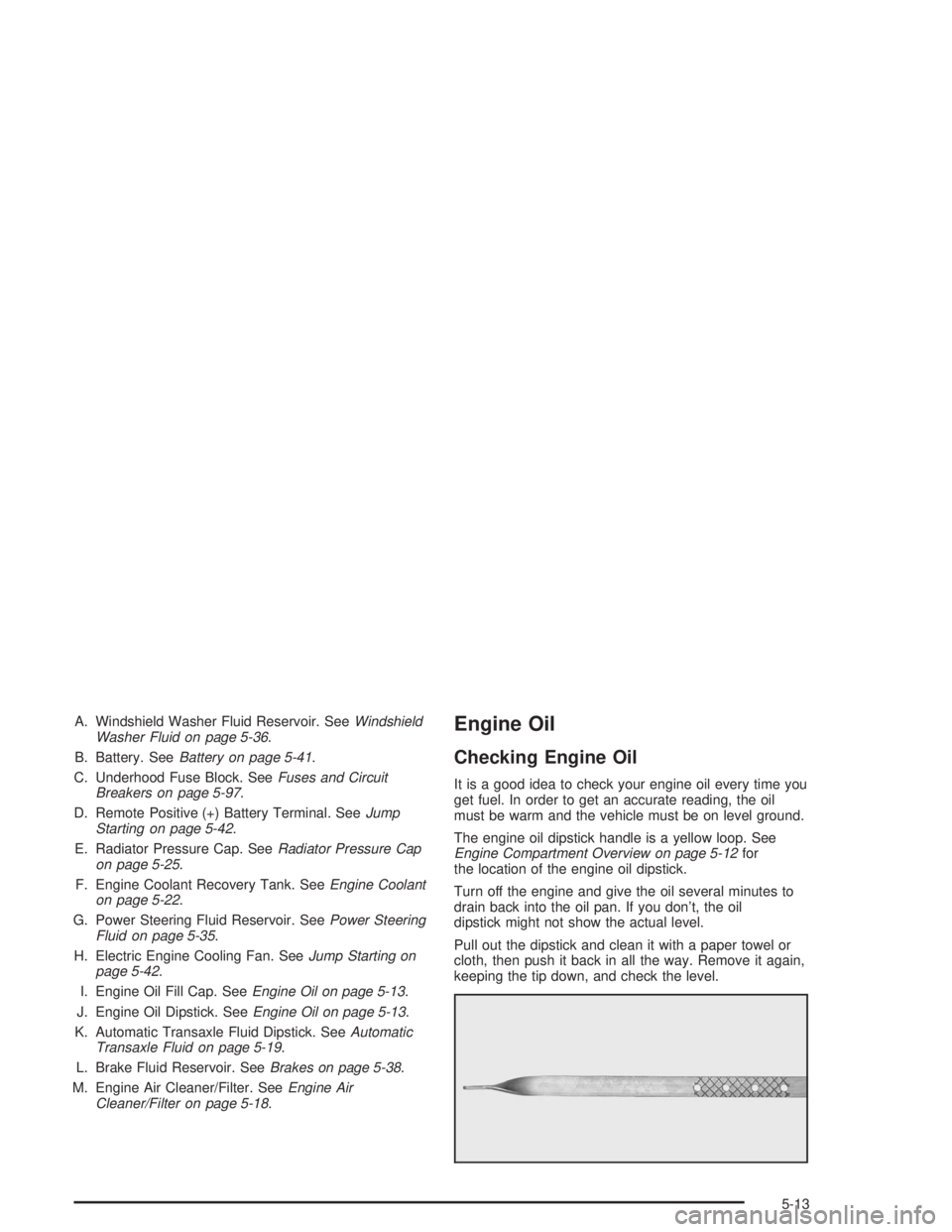
A. Windshield Washer Fluid Reservoir. SeeWindshield
Washer Fluid on page 5-36.
B. Battery. SeeBattery on page 5-41.
C. Underhood Fuse Block. SeeFuses and Circuit
Breakers on page 5-97.
D. Remote Positive (+) Battery Terminal. SeeJump
Starting on page 5-42.
E. Radiator Pressure Cap. SeeRadiator Pressure Cap
on page 5-25.
F. Engine Coolant Recovery Tank. SeeEngine Coolant
on page 5-22.
G. Power Steering Fluid Reservoir. SeePower Steering
Fluid on page 5-35.
H. Electric Engine Cooling Fan. SeeJump Starting on
page 5-42.
I. Engine Oil Fill Cap. SeeEngine Oil on page 5-13.
J. Engine Oil Dipstick. SeeEngine Oil on page 5-13.
K. Automatic Transaxle Fluid Dipstick. SeeAutomatic
Transaxle Fluid on page 5-19.
L. Brake Fluid Reservoir. SeeBrakes on page 5-38.
M. Engine Air Cleaner/Filter. SeeEngine Air
Cleaner/Filter on page 5-18.Engine Oil
Checking Engine Oil
It is a good idea to check your engine oil every time you
get fuel. In order to get an accurate reading, the oil
must be warm and the vehicle must be on level ground.
The engine oil dipstick handle is a yellow loop. See
Engine Compartment Overview on page 5-12for
the location of the engine oil dipstick.
Turn off the engine and give the oil several minutes to
drain back into the oil pan. If you don’t, the oil
dipstick might not show the actual level.
Pull out the dipstick and clean it with a paper towel or
cloth, then push it back in all the way. Remove it again,
keeping the tip down, and check the level.
5-13
Page 236 of 358
Adding Coolant
If more coolant is needed, add the proper DEX-COOL®
coolant mixture at the coolant recovery tank, but be
careful not to spill it.
If the coolant recovery tank is completely empty, add
coolant to the radiator. See “How to Add Coolant to the
Radiator” later in this section.
{CAUTION:
Turning the radiator pressure cap when the
engine and radiator are hot can allow steam
and scalding liquids to blow out and burn you
badly. With the coolant recovery tank, you will
almost never have to add coolant at the
radiator. Never turn the radiator pressure
cap — even a little — when the engine and
radiator are hot.
{CAUTION:
You can be burned if you spill coolant on hot
engine parts. Coolant contains ethylene glycol,
and it will burn if the engine parts are hot
enough. Do not spill coolant on a hot engine.
Occasionally check the coolant level in the radiator.
For information on how to add coolant to the radiator,
seeCooling System on page 5-28.
5-24
Page 237 of 358
Radiator Pressure Cap
Notice:The radiator cap on your vehicle is a
pressure-type cap and must be tightly installed to
prevent coolant loss and possible engine damage
from overheating. Be sure the arrows on the cap
line up with the overow tube on the radiator
ller neck.
The radiator pressure cap is located near the front of
the engine compartment on the passenger’s side of the
vehicle. SeeEngine Compartment Overview on
page 5-12for more information on location.
Engine Overheating
The coolant temperature gage and the engine coolant
temperature warning light on the instrument panel
can indicate an overheated engine condition. See
Engine Coolant Temperature Gage on page 3-35and
Engine Coolant Temperature Warning Light on
page 3-35.
Overheated Engine Protection
Operating Mode
The emergency engine protection operating mode
allows the vehicle to be driven to a safe place in an
emergency situation. If an overheated engine condition
exists, this protection mode alternates ring groups
of cylinders to help prevent engine damage. In
this mode, there will be a signicant loss in power and
engine performance. The engine coolant temperature
gage indicator will move to the red area, and, the engine
coolant temperature warning light will come on,
showing that an overheated engine condition exists.
Driving extended miles (km) and/or towing a trailer in the
overheated protection mode should be avoided.
Notice:After driving in the overheated engine
protection operating mode, to avoid engine damage,
allow the engine to cool before attempting any
repair. The engine oil will be severely degraded.
Repair the cause of coolant loss, change the oil and
reset the oil life system. SeeEngine Oil on
page 5-13.
5-25
Page 240 of 358
Cooling System
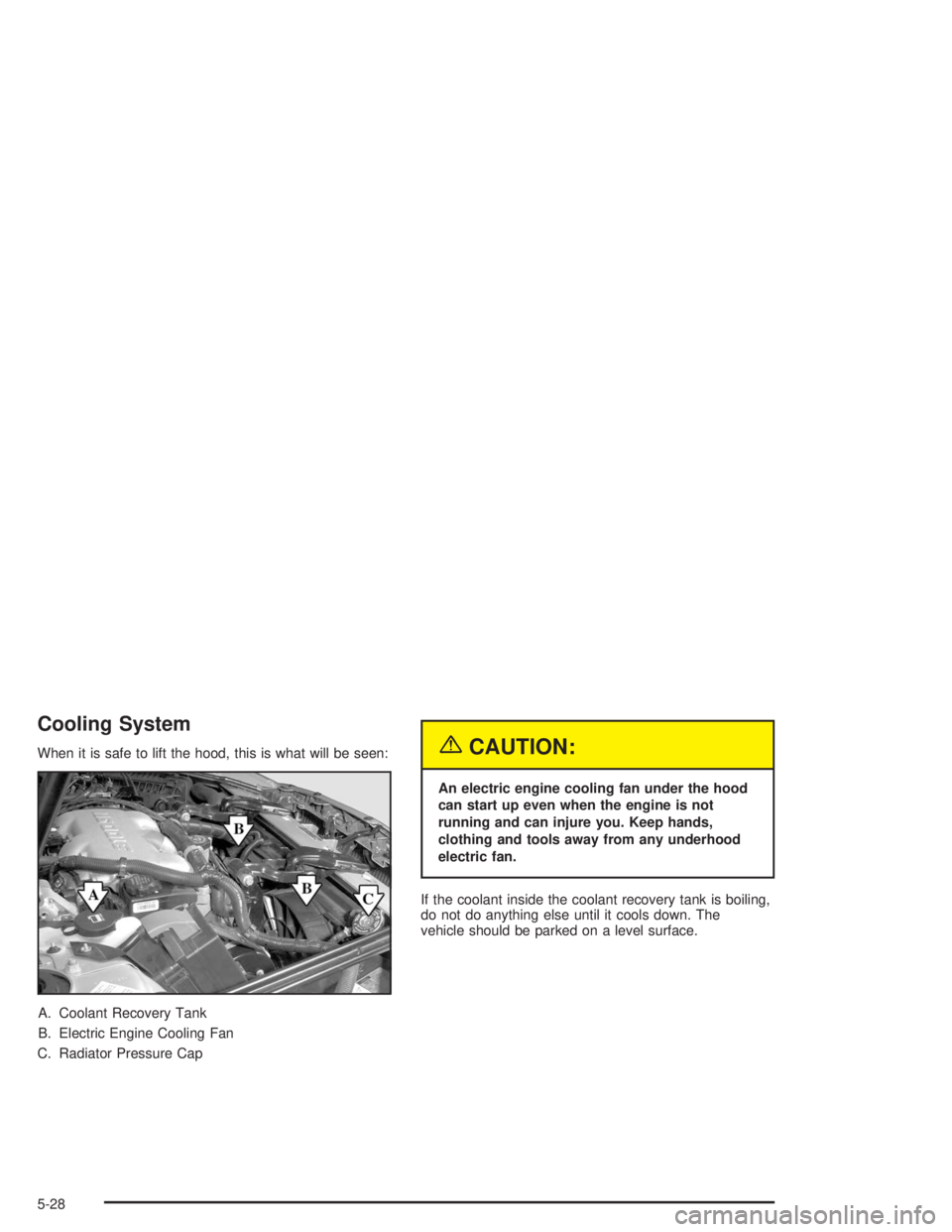
When it is safe to lift the hood, this is what will be seen:
A. Coolant Recovery Tank
B. Electric Engine Cooling Fan
C. Radiator Pressure Cap{CAUTION:
An electric engine cooling fan under the hood
can start up even when the engine is not
running and can injure you. Keep hands,
clothing and tools away from any underhood
electric fan.
If the coolant inside the coolant recovery tank is boiling,
do not do anything else until it cools down. The
vehicle should be parked on a level surface.
5-28
Page 241 of 358
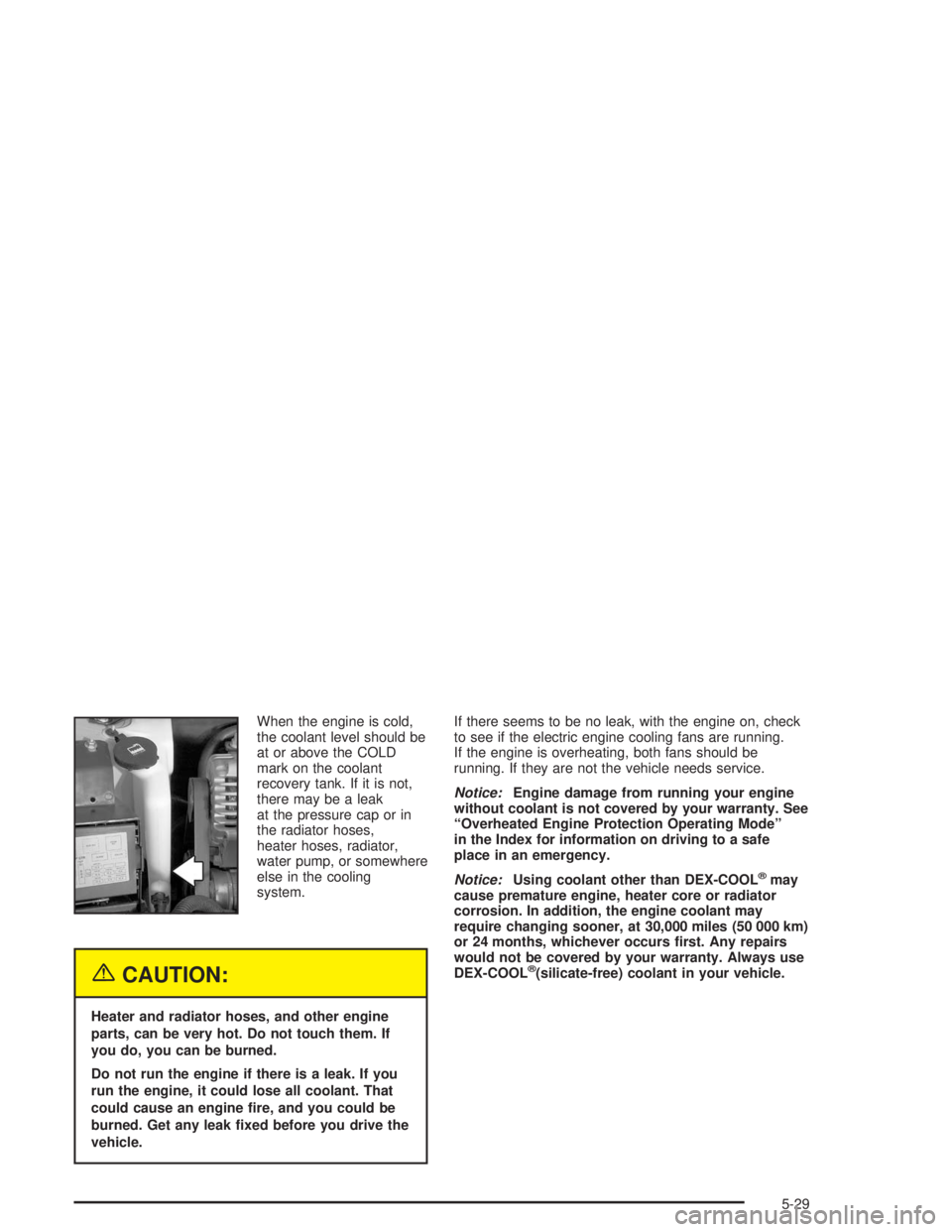
When the engine is cold,
the coolant level should be
at or above the COLD
mark on the coolant
recovery tank. If it is not,
there may be a leak
at the pressure cap or in
the radiator hoses,
heater hoses, radiator,
water pump, or somewhere
else in the cooling
system.
{CAUTION:
Heater and radiator hoses, and other engine
parts, can be very hot. Do not touch them. If
you do, you can be burned.
Do not run the engine if there is a leak. If you
run the engine, it could lose all coolant. That
could cause an engine re, and you could be
burned. Get any leak xed before you drive the
vehicle.If there seems to be no leak, with the engine on, check
to see if the electric engine cooling fans are running.
If the engine is overheating, both fans should be
running. If they are not the vehicle needs service.
Notice:Engine damage from running your engine
without coolant is not covered by your warranty. See
“Overheated Engine Protection Operating Mode”
in the Index for information on driving to a safe
place in an emergency.
Notice:Using coolant other than DEX-COOL
®may
cause premature engine, heater core or radiator
corrosion. In addition, the engine coolant may
require changing sooner, at 30,000 miles (50 000 km)
or 24 months, whichever occurs rst. Any repairs
would not be covered by your warranty. Always use
DEX-COOL
®(silicate-free) coolant in your vehicle.
5-29
Page 243 of 358
When the coolant in the coolant recovery tank is at the
COLD mark, start the vehicle.
If the overheated engine warnings continue, there is
one more thing that can be done. Add the proper coolant
mixture directly to the radiator, but be sure the cooling
system is cool before this is done.
{CAUTION:
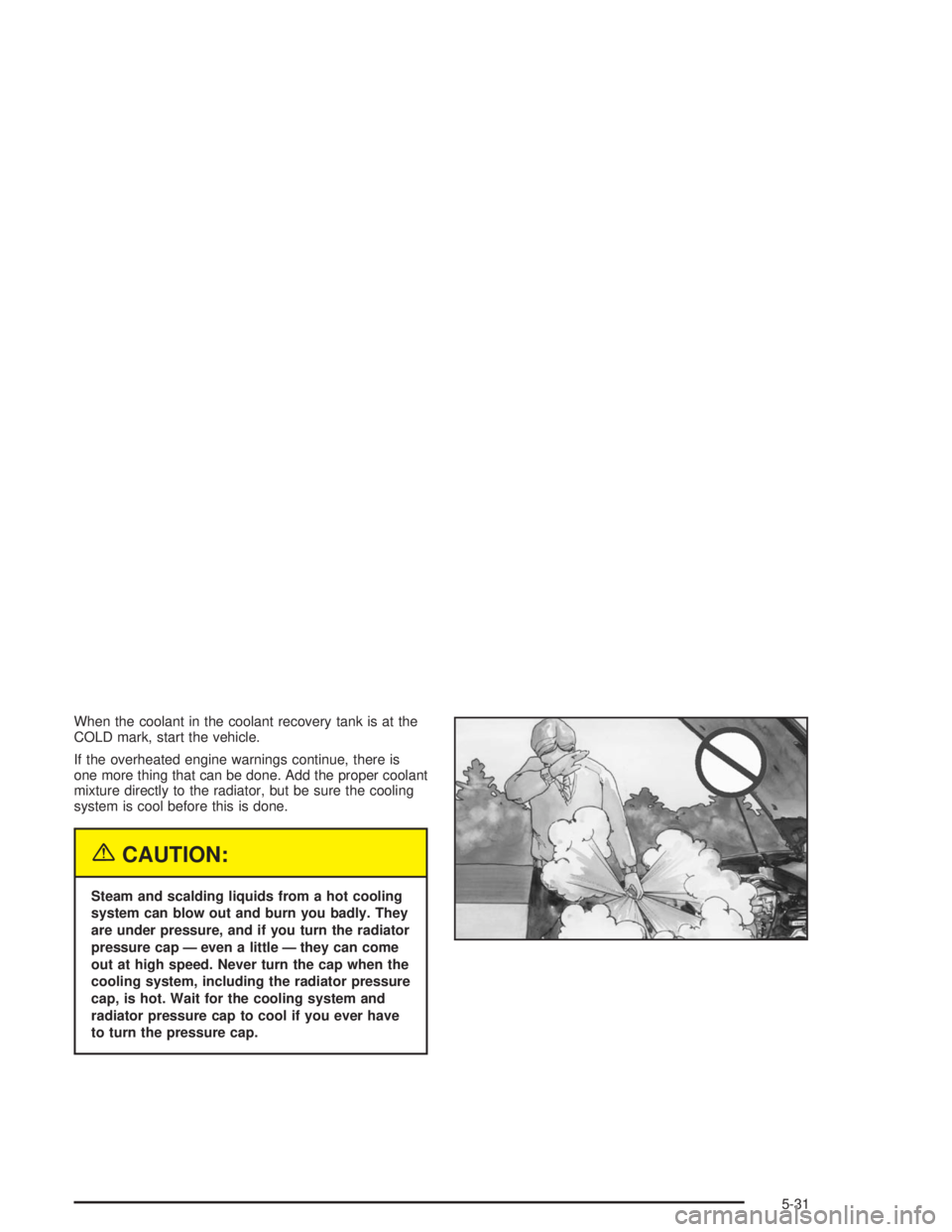
Steam and scalding liquids from a hot cooling
system can blow out and burn you badly. They
are under pressure, and if you turn the radiator
pressure cap — even a little — they can come
out at high speed. Never turn the cap when the
cooling system, including the radiator pressure
cap, is hot. Wait for the cooling system and
radiator pressure cap to cool if you ever have
to turn the pressure cap.
5-31
Page 244 of 358
How to Add Coolant to the Radiator
Notice:Your engine has a specic radiator
ll procedure. Failure to follow this procedure could
cause your engine to overheat and be severely
damaged.
Remove the radiator pressure cap when the cooling
system, including the radiator pressure cap and upper
radiator hose, is no longer hot.
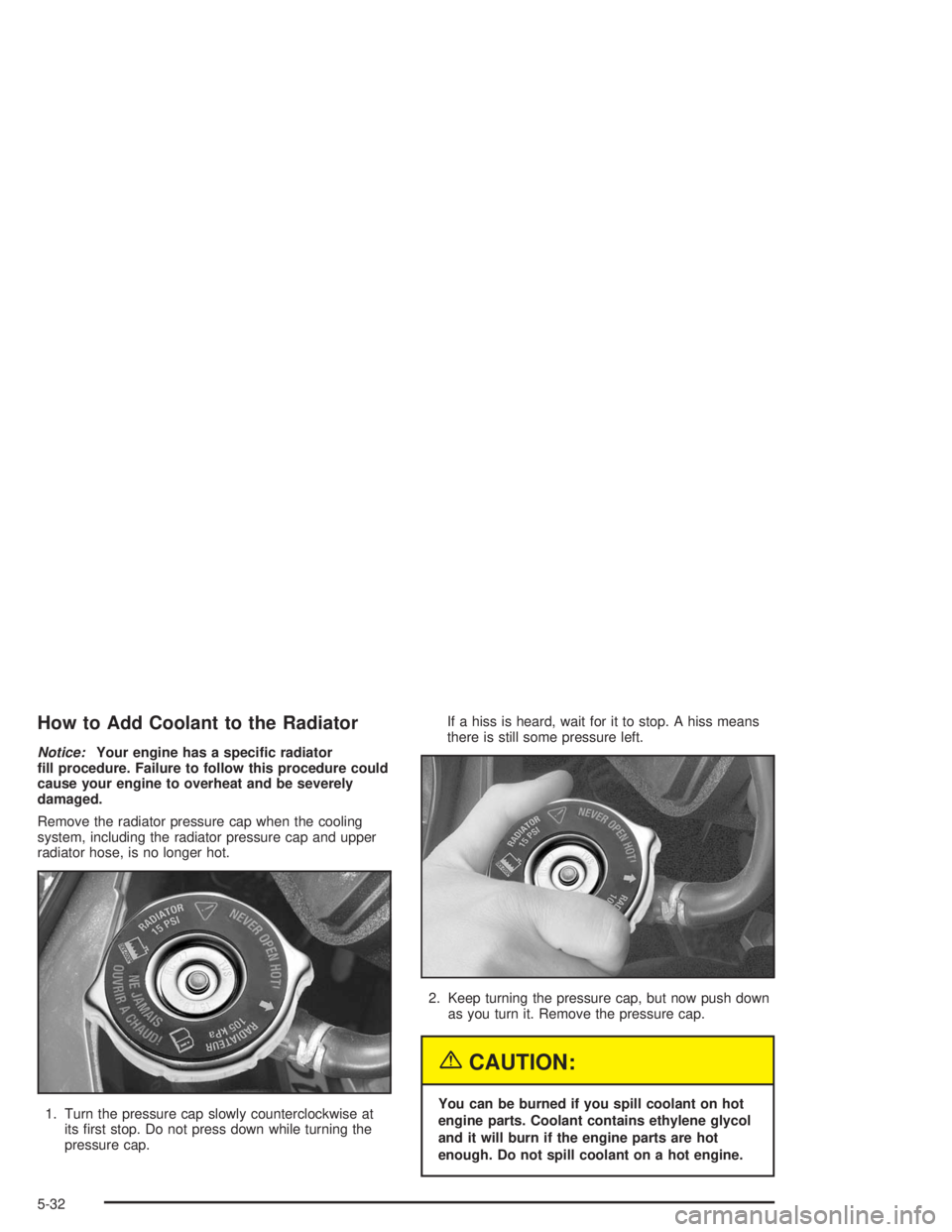
1. Turn the pressure cap slowly counterclockwise at
its rst stop. Do not press down while turning the
pressure cap.If a hiss is heard, wait for it to stop. A hiss means
there is still some pressure left.
2. Keep turning the pressure cap, but now push down
as you turn it. Remove the pressure cap.
{CAUTION:
You can be burned if you spill coolant on hot
engine parts. Coolant contains ethylene glycol
and it will burn if the engine parts are hot
enough. Do not spill coolant on a hot engine.
5-32
Page 246 of 358
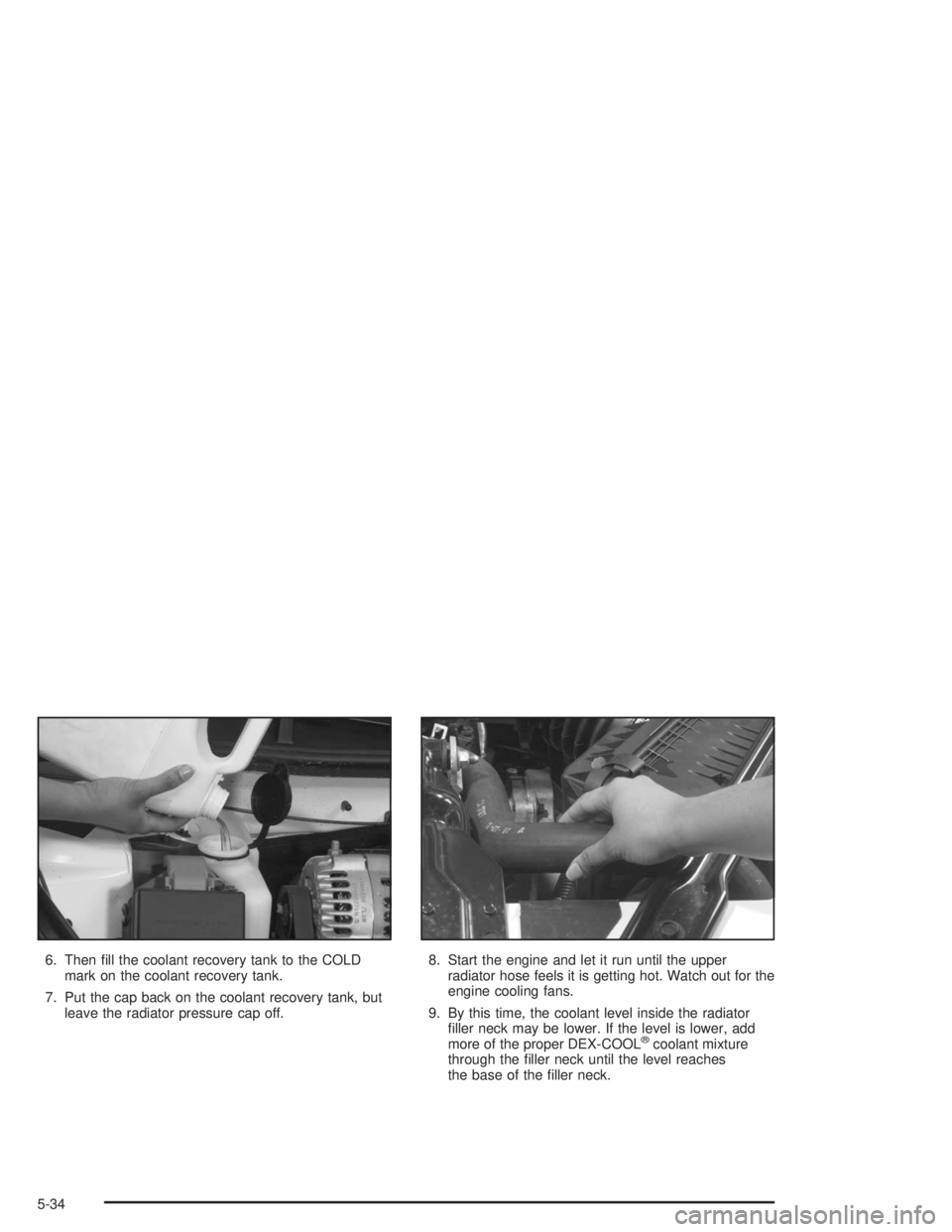
6. Then ll the coolant recovery tank to the COLD
mark on the coolant recovery tank.
7. Put the cap back on the coolant recovery tank, but
leave the radiator pressure cap off.8. Start the engine and let it run until the upper
radiator hose feels it is getting hot. Watch out for the
engine cooling fans.
9. By this time, the coolant level inside the radiator
ller neck may be lower. If the level is lower, add
more of the proper DEX-COOL
®coolant mixture
through the ller neck until the level reaches
the base of the ller neck.
5-34
Page 323 of 358
Maintenance Footnotes
†The U.S. Environmental Protection Agency or the
California Air Resources Board has determined that the
failure to perform this maintenance item will not nullify
the emission warranty or limit recall liability prior to
the completion of the vehicle’s useful life. We, however,
urge that all recommended maintenance services be
performed at the indicated intervals and the
maintenance be recorded.
(a)Visually inspect brake lines and hoses for proper
hook-up, binding, leaks, cracks, chang, etc. Inspect
disc brake pads for wear and rotors for surface
condition. Inspect other brake parts, including calipers,
parking brake, etc.
(b)Visually inspect front and rear suspension and
steering system for damaged, loose or missing parts or
signs of wear. Inspect power steering lines and
hoses for proper hook-up, binding, leaks, cracks,
chang, etc.
(c)Visually inspect hoses and have them replaced if
they are cracked, swollen or deteriorated. Inspect
all pipes, ttings and clamps; replace with genuine
GM parts as needed. To help ensure proper operation,
a pressure test of the cooling system and pressure
cap and cleaning the outside of the radiator and
air conditioning condenser is recommended at least
once a year.(d)Visually inspect wiper blades for wear or cracking.
Replace blade inserts that appear worn or damaged
or that streak or miss areas of the windshield.
(e)Make sure the safety belt reminder light and all your
belts, buckles, latch plates, retractors and anchorages
are working properly. Look for any other loose or
damaged safety belt system parts. If you see anything
that might keep a safety belt system from doing its
job, have it repaired. Have any torn or frayed safety belts
replaced. Also look for any opened or broken air bag
coverings, and have them repaired or replaced. (The air
bag system does not need regular maintenance.)
(f)Lubricate all key lock cylinders. Lubricate all hinges
and latches, including those for the body doors,
hood, secondary latch, pivots, spring anchor, release
pawl, rear compartment, glove box door and console
door. More frequent lubrication may be required
when exposed to a corrosive environment. Applying
silicone grease on weatherstrips with a clean cloth will
make them last longer, seal better and not stick or
squeak.
(g)If you drive regularly under dusty conditions, the
lter may require replacement more often.
6-7