RKE BUICK ENCORE 2021 Service Manual
[x] Cancel search | Manufacturer: BUICK, Model Year: 2021, Model line: ENCORE, Model: BUICK ENCORE 2021Pages: 313, PDF Size: 11.21 MB
Page 197 of 313
Buick Encore Owner Manual (GMNA-Localizing-U.S./Canada-14607636) -
2021 - CRC - 8/18/20
196 Driving and Operating
Warning (Continued)
and maintain proper vehicle position
within the lane, or vehicle damage,
injury, or death could occur. Always keep
the windshield, headlamps, and camera
sensors clean and in good repair. Do not
use LDW in bad weather conditions.
How the System Works
LDW utilizes camera sensor installed on the
windshield ahead of the rearview mirror to
detect lane markings.
To turn LDW on and off, press
@on the
center stack. The control indicator will light
when LDW is on.
When LDW is on,
@is green if LDW is
available to warn of a lane departure. If the
vehicle crosses a detected lane marking
without using the turn signal in that
direction,
@changes to amber and flashes.
Additionally, there will be three beeps on
the right or left, depending on the lane
departure direction. LDW will not alert if the
turn signal is active in the direction of lane
departure, or if LDW detects that you are
accelerating, braking or actively steering.
Fuel
Top Tier Fuel
GM recommends the use of TOP TIER
Detergent Gasoline to keep the engine clean,
reduce engine deposits, and maintain
optimal vehicle performance. Look for the
TOP TIER Logo or see www.toptiergas.com
for a list of TOP TIER Detergent Gasoline
marketers and applicable countries.
Recommended Fuel
Use regular unleaded gasoline meeting
ASTM specification D4814 with a posted
octane rating of 87 —(R+M)/2 —or higher.
Do not use gasoline with a posted octane
rating of less than 87, as this may cause
engine knock and will lower fuel economy.
Do not use any fuel labeled E85 or FlexFuel.
Do not use gasoline with ethanol levels
greater than 15% by volume.
Prohibited Fuels
Caution
Do not use fuels with any of the
following conditions; doing so may
damage the vehicle and void its
warranty:
(Continued)
Page 201 of 313

Buick Encore Owner Manual (GMNA-Localizing-U.S./Canada-14607636) -
2021 - CRC - 8/18/20
200 Driving and Operating
Filling a Portable Fuel Container
{Warning
Never fill a portable fuel container while
it is in the vehicle. Static electricity
discharge from the container can ignite
the fuel vapor. You or others could be
badly burned and the vehicle could be
damaged. To help avoid injury to you
and others:
.Dispense fuel only into approved
containers.
.Do not fill a container while it is
inside a vehicle, in a vehicle's trunk, in
a pickup bed, or on any surface other
than the ground.
.Bring the fill nozzle in contact with
the inside of the fill opening before
operating the nozzle. Maintain contact
until filling is complete.
.Keep sparks, flames, and smoking
materials away from fuel.
.Avoid using electronic devices while
pumping fuel.
Trailer Towing
General Towing Information
{Warning
Never tow a trailer with your vehicle.
It was not designed or intended to tow a
trailer.
Conversions and Add-Ons
Add-On Electrical Equipment
{Warning
The Data Link Connector (DLC) is used for
vehicle service and Emission Inspection/
Maintenance testing. SeeMalfunction
Indicator Lamp (Check Engine Light) 081.
A device connected to the DLC —such as
an aftermarket fleet or driver-behavior
tracking device —may interfere with
vehicle systems. This could affect vehicle
operation and cause a crash. Such devices
may also access information stored in the
vehicle’s systems.
Caution
Some electrical equipment can damage
the vehicle or cause components to not
work and would not be covered by the
vehicle warranty. Always check with your
dealer before adding electrical equipment.
Add-on equipment can drain the vehicle's
12-volt battery, even if the vehicle is not
operating.
The vehicle has an airbag system. Before
attempting to add anything electrical to the
vehicle, see Servicing the Airbag-Equipped
Vehicle 047 and
Adding Equipment to the Airbag-Equipped
Vehicle 047.
Page 202 of 313
Buick Encore Owner Manual (GMNA-Localizing-U.S./Canada-14607636) -
2021 - CRC - 8/18/20
Vehicle Care 201
Vehicle Care
General Information
General Information . . . . . . . . . . . . . . . . . . . 202
California Proposition 65 Warning . . . . . 202
California Perchlorate MaterialsRequirements . . . . . . . . . . . . . . . . . . . . . . . . 202
Accessories and Modifications . . . . . . . . . 202
Vehicle Checks
Doing Your Own Service Work . . . . . . . . 203
Hood . . . . . . . . . . . . . . . . . . . . . . . . . . . . . . . . . . 203
Engine Compartment Overview . . . . . . . . 205
Engine Oil . . . . . . . . . . . . . . . . . . . . . . . . . . . . . 208
Engine Oil Life System . . . . . . . . . . . . . . . . . 210
Automatic Transmission Fluid . . . . . . . . . . 210
Engine Air Cleaner/Filter . . . . . . . . . . . . . . . 211
Cooling System . . . . . . . . . . . . . . . . . . . . . . . . 212
Engine Overheating . . . . . . . . . . . . . . . . . . . . 215
Washer Fluid . . . . . . . . . . . . . . . . . . . . . . . . . . 216
Brakes . . . . . . . . . . . . . . . . . . . . . . . . . . . . . . . . . 217
Brake Fluid . . . . . . . . . . . . . . . . . . . . . . . . . . . . 218
Battery - North America . . . . . . . . . . . . . . . 219
All-Wheel Drive . . . . . . . . . . . . . . . . . . . . . . . . 219
Starter Switch Check . . . . . . . . . . . . . . . . . . . 219
Automatic Transmission Shift Lock Control Function Check . . . . . . . . . . . . . . 220
Park Brake and P (Park) Mechanism Check . . . . . . . . . . . . . . . . . . . . . . . . . . . . . . . . 220
Wiper Blade Replacement . . . . . . . . . . . . . 220 Windshield Replacement . . . . . . . . . . . . . . . 221
Gas Strut(s) . . . . . . . . . . . . . . . . . . . . . . . . . . . . 222
Headlamp Aiming
Front Headlamp Aiming . . . . . . . . . . . . . . . 223
Bulb Replacement
Bulb Replacement . . . . . . . . . . . . . . . . . . . . . 223
Halogen Bulbs . . . . . . . . . . . . . . . . . . . . . . . . . 223
LED Lighting . . . . . . . . . . . . . . . . . . . . . . . . . . . 223
Headlamps, Front Turn Signal and
Parking Lamps . . . . . . . . . . . . . . . . . . . . . . . 223
Taillamps, Turn Signal, Sidemarker, Stoplamps, and Back-Up Lamps . . . . . . 224
License Plate Lamp . . . . . . . . . . . . . . . . . . . . 225
Electrical System
Electrical System Overload . . . . . . . . . . . . 226
Fuses and Circuit Breakers . . . . . . . . . . . . . 226
Engine Compartment Fuse Block . . . . . . . 227
Instrument Panel Fuse Block . . . . . . . . . . 230
Rear Compartment Fuse Block . . . . . . . . . 231
Wheels and Tires
Tires . . . . . . . . . . . . . . . . . . . . . . . . . . . . . . . . . . . 232
All-Season Tires . . . . . . . . . . . . . . . . . . . . . . . . 233
Winter Tires . . . . . . . . . . . . . . . . . . . . . . . . . . . 233
Tire Sidewall Labeling . . . . . . . . . . . . . . . . . 234
Tire Designations . . . . . . . . . . . . . . . . . . . . . . 235
Tire Terminology and Definitions . . . . . . 236
Tire Pressure . . . . . . . . . . . . . . . . . . . . . . . . . . 238
Tire Pressure Monitor System . . . . . . . . . 239 Tire Pressure Monitor Operation . . . . . . 240
Tire Inspection . . . . . . . . . . . . . . . . . . . . . . . . 242
Tire Rotation . . . . . . . . . . . . . . . . . . . . . . . . . . 242
When It Is Time for New Tires . . . . . . . . 243
Buying New Tires . . . . . . . . . . . . . . . . . . . . . 244
Different Size Tires and Wheels . . . . . . . 245
Uniform Tire Quality Grading . . . . . . . . . 245
Wheel Alignment and Tire Balance . . . . 247
Wheel Replacement . . . . . . . . . . . . . . . . . . . 247
Tire Chains . . . . . . . . . . . . . . . . . . . . . . . . . . . . 247
If a Tire Goes Flat . . . . . . . . . . . . . . . . . . . . . 248
Tire Changing . . . . . . . . . . . . . . . . . . . . . . . . . 249
Compact Spare Tire . . . . . . . . . . . . . . . . . . . . 252
Jump Starting
Jump Starting - North America . . . . . . . . 253
Towing the Vehicle
Towing the Vehicle . . . . . . . . . . . . . . . . . . . . 255
Recreational Vehicle Towing . . . . . . . . . . . 256
Appearance Care
Exterior Care . . . . . . . . . . . . . . . . . . . . . . . . . . 258
Interior Care . . . . . . . . . . . . . . . . . . . . . . . . . . . 262
Floor Mats . . . . . . . . . . . . . . . . . . . . . . . . . . . . 264
Page 205 of 313
Buick Encore Owner Manual (GMNA-Localizing-U.S./Canada-14607636) -
2021 - CRC - 8/18/20
204 Vehicle Care
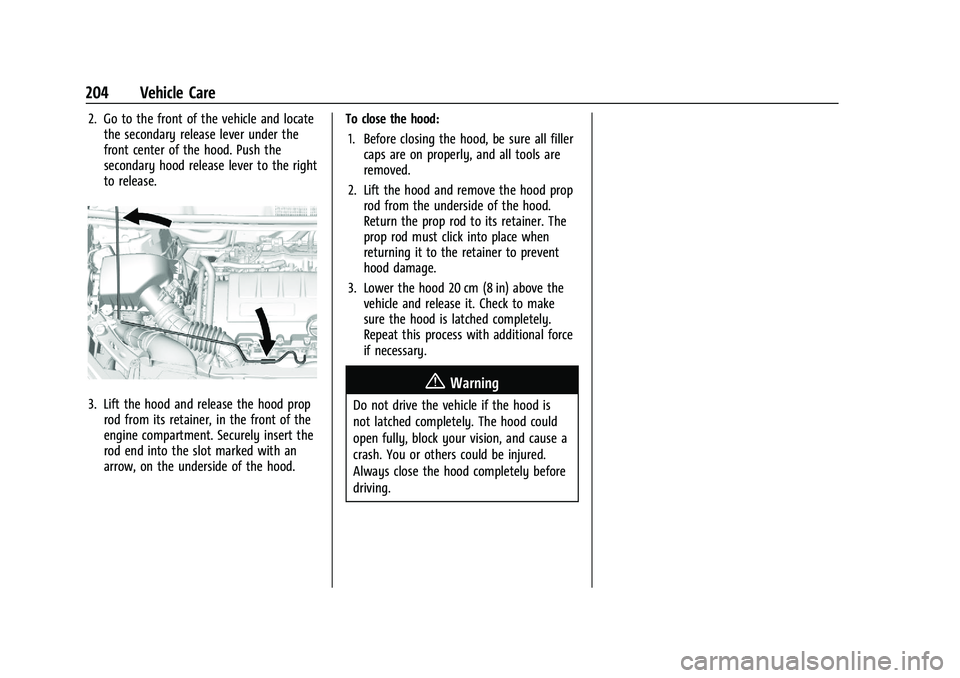
2. Go to the front of the vehicle and locatethe secondary release lever under the
front center of the hood. Push the
secondary hood release lever to the right
to release.
3. Lift the hood and release the hood proprod from its retainer, in the front of the
engine compartment. Securely insert the
rod end into the slot marked with an
arrow, on the underside of the hood. To close the hood:
1. Before closing the hood, be sure all filler caps are on properly, and all tools are
removed.
2. Lift the hood and remove the hood prop rod from the underside of the hood.
Return the prop rod to its retainer. The
prop rod must click into place when
returning it to the retainer to prevent
hood damage.
3. Lower the hood 20 cm (8 in) above the vehicle and release it. Check to make
sure the hood is latched completely.
Repeat this process with additional force
if necessary.
{Warning
Do not drive the vehicle if the hood is
not latched completely. The hood could
open fully, block your vision, and cause a
crash. You or others could be injured.
Always close the hood completely before
driving.
Page 210 of 313
Buick Encore Owner Manual (GMNA-Localizing-U.S./Canada-14607636) -
2021 - CRC - 8/18/20
Vehicle Care 209
Caution
Do not add too much oil. Oil levels above
or below the acceptable operating range
shown on the dipstick are harmful to the
engine. If you find that you have an oil
level above the operating range, i.e., the
engine has so much oil that the oil level
gets above the MAX mark, the engine
could be damaged. You should drain out
the excess oil or limit driving of the
vehicle and seek a service professional to
remove the excess amount of oil.
See Engine Compartment Overview 0205 for
the location of the engine oil fill cap.
Add enough oil to put the level somewhere
in the proper operating range between the
MIN and MAX marks. Push the dipstick all
the way back in when through.
Selecting the Right Engine Oil
Selecting the right engine oil depends on
both the proper oil specification and
viscosity grade. See Recommended Fluids
and Lubricants 0275. Specification
Use full synthetic engine oils that meet the
dexos1 specification.
Engine oils that have been approved by GM
as meeting the dexos1 specification are
marked with the dexos1 approved logo. See
www.gmdexos.com.
Caution
Failure to use the recommended engine
oil or equivalent can result in engine
damage not covered by the vehicle
warranty.
Viscosity Grade
For the 1.4L L4 turbo (LE2 - VIN M) engine,
use SAE 0W-20 viscosity grade engine oil.
For the 1.4L L4 turbo (LUV - VIN B) engine,
use SAE 5W-30 viscosity grade engine oil.
Cold Temperature Operation: In an area of
extreme cold, where the temperature falls below
−29 °C (−20 °F), an SAE 0W-30 oil may
be used. An oil of this viscosity grade will
provide easier cold starting for the engine at
extremely low temperatures.
When selecting an oil of the appropriate
viscosity grade, it is recommended to select
an oil of the correct specification. See
“Specification” earlier in this section.
Engine Oil Additives/Engine Oil Flushes
Do not add anything to the oil. The
recommended oils meeting the dexos1
specification are all that is needed for good
performance and engine protection.
Engine oil system flushes are not
recommended and could cause engine
damage not covered by the vehicle
warranty.
What to Do with Used Oil
Used engine oil contains certain elements
that can be unhealthy for your skin and
could even cause cancer. Do not let used oil
stay on your skin for very long. Clean your
skin and nails with soap and water, or a
good hand cleaner. Wash or properly
dispose of clothing or rags containing used
engine oil. See the manufacturer's warnings
about the use and disposal of oil products.
Page 216 of 313
Buick Encore Owner Manual (GMNA-Localizing-U.S./Canada-14607636) -
2021 - CRC - 8/18/20
Vehicle Care 215
50/50 mixture of clean, drinkable water and
DEX-COOL coolant at the coolant surge tank,
but be sure the cooling system, including
the coolant surge tank pressure cap, is cool
before you do it.
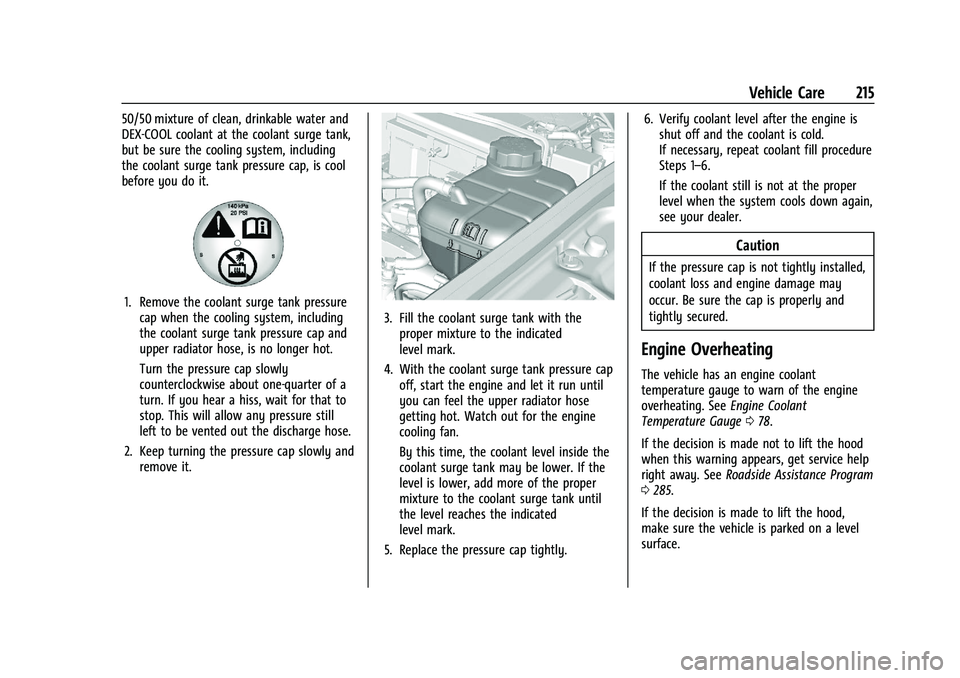
1. Remove the coolant surge tank pressurecap when the cooling system, including
the coolant surge tank pressure cap and
upper radiator hose, is no longer hot.
Turn the pressure cap slowly
counterclockwise about one-quarter of a
turn. If you hear a hiss, wait for that to
stop. This will allow any pressure still
left to be vented out the discharge hose.
2. Keep turning the pressure cap slowly and remove it.
3. Fill the coolant surge tank with theproper mixture to the indicated
level mark.
4. With the coolant surge tank pressure cap off, start the engine and let it run until
you can feel the upper radiator hose
getting hot. Watch out for the engine
cooling fan.
By this time, the coolant level inside the
coolant surge tank may be lower. If the
level is lower, add more of the proper
mixture to the coolant surge tank until
the level reaches the indicated
level mark.
5. Replace the pressure cap tightly. 6. Verify coolant level after the engine is
shut off and the coolant is cold.
If necessary, repeat coolant fill procedure
Steps 1–6.
If the coolant still is not at the proper
level when the system cools down again,
see your dealer.
Caution
If the pressure cap is not tightly installed,
coolant loss and engine damage may
occur. Be sure the cap is properly and
tightly secured.
Engine Overheating
The vehicle has an engine coolant
temperature gauge to warn of the engine
overheating. See Engine Coolant
Temperature Gauge 078.
If the decision is made not to lift the hood
when this warning appears, get service help
right away. See Roadside Assistance Program
0 285.
If the decision is made to lift the hood,
make sure the vehicle is parked on a level
surface.
Page 217 of 313
Buick Encore Owner Manual (GMNA-Localizing-U.S./Canada-14607636) -
2021 - CRC - 8/18/20
216 Vehicle Care
Then check to see if the engine cooling fan
is running. If the engine is overheating, the
fan should be running. If it is not, do not
continue to run the engine. Have the vehicle
serviced.
Caution
Do not run the engine if there is a leak
in the engine cooling system. This can
cause a loss of all coolant and can
damage the system and vehicle. Have
any leaks fixed right away.
If Steam Is Coming from the Engine
Compartment
{Warning
Steam and scalding liquids from a hot
cooling system are under pressure.
Turning the pressure cap, even a little,
can cause them to come out at high
speed and you could be burned. Never
turn the cap when the cooling system,
including the pressure cap, is hot. Wait
for the cooling system and pressure cap
to cool.
If No Steam Is Coming from the Engine
Compartment
If an engine overheat warning is displayed
but no steam can be seen or heard, the
problem may not be too serious. Sometimes
the engine can get a little too hot when the
vehicle:
.Climbs a long hill on a hot day
.Stops after high-speed driving
.Idles for long periods in traffic
If the overheat warning is displayed with no
sign of steam: 1. Turn the air conditioning off.
2. Turn the heater on to the highest temperature and to the highest fan
speed. Open the windows as necessary.
3. When it is safe to do so, pull off the road, shift to P (Park) or N (Neutral), and
let the engine idle.
If the engine coolant temperature gauge is
no longer in the overheat zone, the vehicle
can be driven. Continue to drive the vehicle
slowly for about 10 minutes. Keep a safe
vehicle distance from the vehicle in front.
If the warning does not come back on, continue to drive normally and have the
cooling system checked for proper fill and
function.
If the warning continues, pull over, stop, and
park the vehicle right away.
If there is no sign of steam, idle the engine
for three minutes while parked. If the
warning is still displayed, turn off the
engine until it cools down.Washer Fluid
What to Use
When the vehicle needs windshield washer
fluid, be sure to read the manufacturer's
instructions before use. If operating the
vehicle in an area where the temperature
may fall below freezing, use a fluid that has
sufficient protection against freezing.
Adding Washer Fluid
Page 221 of 313
Buick Encore Owner Manual (GMNA-Localizing-U.S./Canada-14607636) -
2021 - CRC - 8/18/20
220 Vehicle Care
Automatic Transmission Shift Lock
Control Function Check
{Warning
When you are doing this inspection, the
vehicle could move suddenly. If the
vehicle moves, you or others could be
injured.
1. Before starting this check, be sure there is enough room around the vehicle.
It should be parked on a level surface.
2. Apply the parking brake. Be ready to apply the regular brake immediately if
the vehicle begins to move.
3. With the engine off, turn the ignition on, but do not start the engine. Without
applying the regular brake, try to move
the shift lever out of P (Park) with
normal effort. If the shift lever moves
out of P (Park), contact your dealer for
service.
Park Brake and P (Park)
Mechanism Check
{Warning
When you are doing this check, the
vehicle could begin to move. You or
others could be injured and property
could be damaged. Make sure there is
room in front of the vehicle in case it
begins to roll. Be ready to apply the
regular brake at once should the vehicle
begin to move.
Park on a fairly steep hill, with the vehicle
facing downhill. Keeping your foot on the
regular brake, set the parking brake.
.To check the parking brake's holding
ability: With the engine running and the
transmission in N (Neutral), slowly remove
foot pressure from the regular brake
pedal. Do this until the vehicle is held by
the parking brake only.
.To check the P (Park) mechanism's holding
ability: With the engine running, shift to
P (Park). Then release the parking brake
followed by the regular brake.
Contact your dealer if service is required.
Wiper Blade Replacement
Windshield wiper blades should be replaced
periodically. See Maintenance Schedule
0 267.
Replacement blades come in different types
and are removed in different ways. For
proper type and length, see Maintenance
Replacement Parts 0276.
Caution
Allowing the wiper arm to touch the
windshield when no wiper blade is
installed could damage the windshield.
Any damage that occurs would not be
covered by the vehicle warranty. Do not
allow the wiper arm to touch the
windshield.
Front Wiper Blade Replacement
To replace the front wiper blades:
1. Lift the wiper arm from the windshield until no further movement is possible.
Page 224 of 313
Buick Encore Owner Manual (GMNA-Localizing-U.S./Canada-14607636) -
2021 - CRC - 8/18/20
Vehicle Care 223
Headlamp Aiming
Front Headlamp Aiming
Headlamp aim has been preset and should
need no further adjustment.
If the vehicle is damaged in a crash, the
headlamp aim may be affected.
If adjustment to the headlamps is necessary,
see your dealer.
Bulb Replacement
For the proper type of replacement bulbs,
or any bulb changing procedure not listed in
this section, contact your dealer.
Caution
Do not replace incandescent bulbs with
aftermarket LED replacement bulbs. This
can cause damage to the vehicle electrical
system.
Halogen Bulbs
{Warning
Halogen bulbs have pressurized gas inside
and can burst if you drop or scratch the
bulb. You or others could be injured. Be
sure to read and follow the instructions
on the bulb package.
LED Lighting
This vehicle has several LED lamps. For
replacement of any LED lighting assembly,
contact your dealer.
Headlamps, Front Turn Signal and
Parking Lamps
Headlamp Assembly
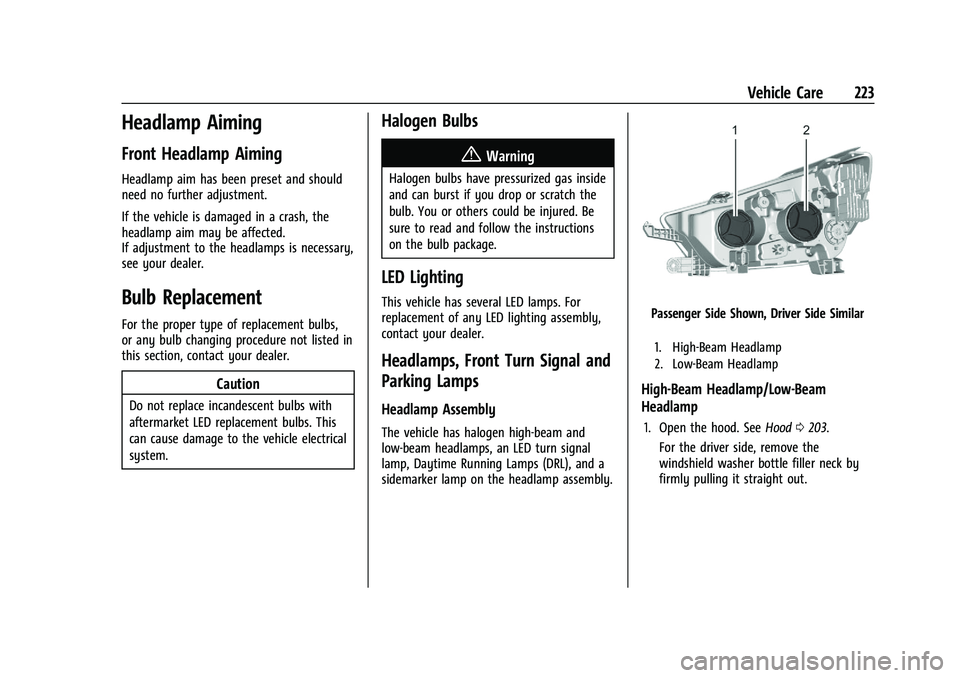
The vehicle has halogen high-beam and
low-beam headlamps, an LED turn signal
lamp, Daytime Running Lamps (DRL), and a
sidemarker lamp on the headlamp assembly.
Passenger Side Shown, Driver Side Similar
1. High-Beam Headlamp
2. Low-Beam Headlamp
High-Beam Headlamp/Low-Beam
Headlamp
1. Open the hood. SeeHood0203.
For the driver side, remove the
windshield washer bottle filler neck by
firmly pulling it straight out.
Page 225 of 313

Buick Encore Owner Manual (GMNA-Localizing-U.S./Canada-14607636) -
2021 - CRC - 8/18/20
224 Vehicle Care
2. Remove the headlamp bulb access cover.
3. Turn the bulb counterclockwise and pullstraight back.
4. Disconnect the wiring harness connectorfrom the bulb.
5. Install the new bulb in the headlamp assembly by turning clockwise.
6. Reconnect the wiring harness connector.
7. Install the headlamp bulb access cover.
For the driver side, reinstall the
windshield washer bottle filler neck by
firmly pushing it straight into the bottle.
Ensure that the filler neck clip engages
into the engine compartment fuse block
retainer.
Taillamps, Turn Signal,
Sidemarker, Stoplamps, and
Back-Up Lamps
Taillamp Assembly
The vehicle has halogen turn signal lamps
and back-up lamps, LED tail/stoplamps, and
a sidemarker lamp on the taillamp
assembly.
Driver Side
1. Remove the cover and screws attachingthe panel to the vehicle interior. Remove
the panel.
2. Remove the cover.