ignition BUICK LACROSSE 2006 Owner's Guide
[x] Cancel search | Manufacturer: BUICK, Model Year: 2006, Model line: LACROSSE, Model: BUICK LACROSSE 2006Pages: 444, PDF Size: 2.66 MB
Page 102 of 444
Starting the Engine
Move your shift lever to PARK (P) or NEUTRAL (N).
The engine will not start in any other position — that is
a safety feature. To restart when you are already
moving, use NEUTRAL (N) only.
Notice:Shifting into PARK (P) with the vehicle
moving could damage the transaxle. Shift into
PARK (P) only when your vehicle is stopped.
1. With your foot off the accelerator pedal, turn the
ignition key to START. When the engine starts,
let go of the key. The idle speed will go down as
the engine gets warm.
Your vehicle has a Computer-Controlled Cranking
System. This feature assists in starting the engine
and protects the electrical system. If the ignition key
is turned to START, and then released when the
engine begins cranking, the engine will continue
cranking until the vehicle starts or until it exceeds
the maximum cranking time allowed, approximately
15 seconds to prevent cranking motor damage. To
prevent starter-motor gear damage, this system also
prevents cranking if the engine is already running.
The engine cranking can be stopped by turning the
ignition switch to the ACCESSORY or OFF.Notice:Holding your key in START for longer than
15 seconds at a time will cause your battery to be
drained much sooner. And the excessive heat can
damage your starter motor. Wait about 15 seconds
between each try to help avoid draining your battery
or damaging your starter.
2. If the engine does not start within 10 seconds, hold
your key in START for about 10 seconds at a time
until the engine starts. Wait about 15 seconds
between each try.
When your engine has run for about 10 seconds
to warm up, your vehicle is ready to be driven.
Do not race your engine when it is cold.
If the weather is below freezing (32°F or 0°C),
let the engine run for a few minutes to warm up.
3. If your engine still will not start, or starts but then
stops, it could be ooded with too much gasoline.
Try pushing your accelerator pedal all the way to
the oor and holding it there as you hold the key in
START for about three seconds. If the vehicle starts
briey but then stops again, do the same thing. This
time keep the pedal down for ve or six seconds to
clear the extra gasoline from the engine. After
waiting about 15 seconds, repeat the normal
starting procedure.
2-24
Page 105 of 444
{CAUTION:
It is dangerous to get out of your vehicle if the
shift lever is not fully in PARK (P) with the
parking brake rmly set. Your vehicle can roll.
Do not leave your vehicle when the engine is
running unless you have to. If you have left the
engine running, the vehicle can move
suddenly. You or others could be injured. To
be sure your vehicle will not move, even when
you are on fairly level ground, always set your
parking brake and move the shift lever to
PARK (P). SeeShifting Into Park (P) on
page 2-31. If you are pulling a trailer, see
Towing a Trailer on page 4-38.The positions for the shift lever are:
PARK (P): This position locks the vehicle’s front
wheels. It is the best position to use when the engine
is started because the vehicle cannot move easily.
Make sure the shift lever is fully in PARK (P) before
starting the engine. The vehicle has an automatic
transaxle shift lock control system. You must fully apply
the regular brakes rst and then press the shift lever
button before shifting from PARK (P) when the ignition
is in RUN. If you cannot shift out of PARK (P), ease
pressure on the shift lever by pushing it all the way into
PARK (P) while keeping the brake pedal pushed down.
Then press the shift lever button and move the shift lever
into another gear. SeeShifting Out of Park (P) on
page 2-33
Notice:Shifting to REVERSE (R) while your vehicle
is moving forward could damage the transaxle.
The repairs would not be covered by your warranty.
Shift to REVERSE (R) only after your vehicle is
stopped.
REVERSE (R): Use this gear to back up.
To rock the vehicle back and forth in order to get it out
of snow, ice, or sand without damaging the transaxle,
seeIf Your Vehicle is Stuck in Sand, Mud, Ice, or Snow
on page 4-30.
2-27
Page 108 of 444
Parking Brake
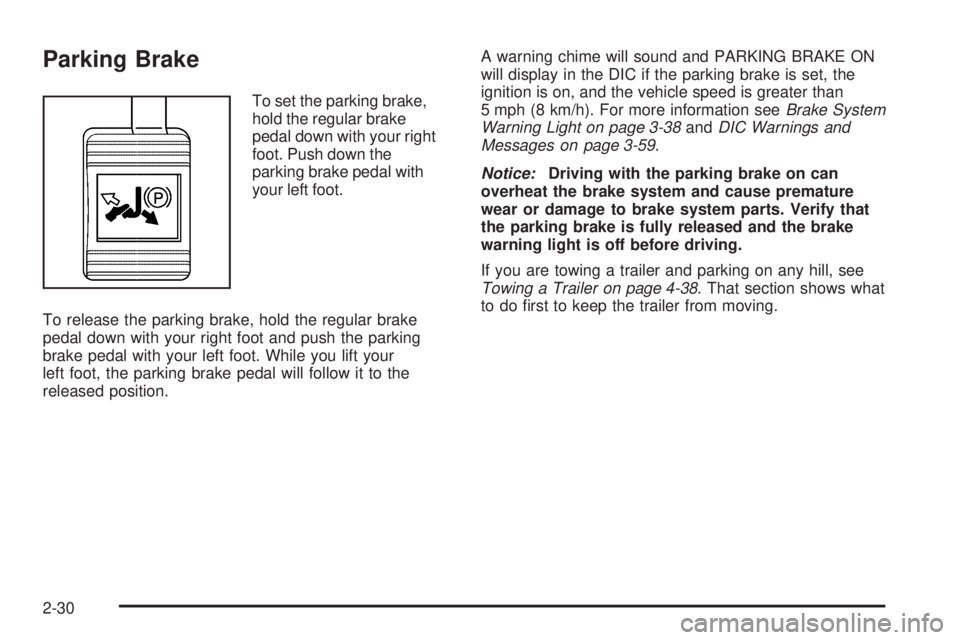
To set the parking brake,
hold the regular brake
pedal down with your right
foot. Push down the
parking brake pedal with
your left foot.
To release the parking brake, hold the regular brake
pedal down with your right foot and push the parking
brake pedal with your left foot. While you lift your
left foot, the parking brake pedal will follow it to the
released position.A warning chime will sound and PARKING BRAKE ON
will display in the DIC if the parking brake is set, the
ignition is on, and the vehicle speed is greater than
5 mph (8 km/h). For more information seeBrake System
Warning Light on page 3-38andDIC Warnings and
Messages on page 3-59.
Notice:Driving with the parking brake on can
overheat the brake system and cause premature
wear or damage to brake system parts. Verify that
the parking brake is fully released and the brake
warning light is off before driving.
If you are towing a trailer and parking on any hill, see
Towing a Trailer on page 4-38. That section shows what
to do rst to keep the trailer from moving.
2-30
Page 109 of 444
Shifting Into Park (P)
{CAUTION:
It can be dangerous to get out of your vehicle
if the shift lever is not fully in PARK (P) with
the parking brake rmly set. Your vehicle can
roll. If you have left the engine running, the
vehicle can move suddenly. You or others
could be injured. To be sure your vehicle will
not move, even when you are on fairly level
ground, use the steps that follow. If you are
pulling a trailer, seeTowing a Trailer on
page 4-38.
Steering Column Shift Lever
1. Hold the brake pedal down and set the
parking brake.
2. Move the shift lever into the PARK (P) like this:
Pull the lever toward you.
Move the lever up as far as it will go.
3. Turn the ignition key to OFF.
4. Remove the key and take it with you. If you
can leave your vehicle with the ignition key in
your hand, your vehicle is in PARK (P).
Console Shift Lever
1. Hold the brake pedal down and set the
parking brake.
2. Move the shift lever into the PARK (P) position by
holding in the button on the shift lever and pushing
it all the way toward the front of the vehicle.
3. Turn the ignition key to OFF.
4. Remove the key and take it with you. If you can
leave your vehicle with the ignition key in your
hand, your vehicle is in PARK (P).
2-31
Page 111 of 444
Shifting Out of Park (P)
Automatic Transaxle Shift Lock
This vehicle is equipped with an electronic shift lock
release system. The shift lock release is designed to:
Prevent ignition key removal unless the shift
lever is in PARK (P)
Prevent movement of the shift lever out of PARK (P)
unless the ignition is in a position other than OFF.
The shift lock is always functional except in the case
of a an uncharged or low voltage (less than 9 volt)
battery.
If your vehicle has an uncharged battery or a battery
with low voltage, try charging or jump starting the
battery. SeeJump Starting on page 5-42.
Console Shift
If your console shift cannot be moved out of PARK (P)
1. Apply and maintain the regular brakes.
2. Turn the ignition to the RUN position. SeeIgnition
Positions on page 2-23for more information.
3. Let up on the shift lever and make sure the shift
lever is pushed all the way into PARK (P).
4. Then, move the shift into the desired gear.
If you still cannot move the shift lever from PARK (P),
consult your dealer or a professional towing service.
Column Shift
If your park lock cable cannot be moved out of PARK (P)
1. Apply and maintain the regular brakes.
2. Turn the Ignition key to the ACCESSORY or RUN
position. SeeIgnition Positions on page 2-23for
more information.
3. Shift out of the PARK (P) position to the
NEUTRAL (N) position.
4. Move the vehicle to a safe location.
If you still cannot move the shift lever from PARK (P),
consult your dealer or a professional towing service.
2-33
Page 125 of 444
Sunroof
The vehicle may have a sunroof. It includes a sliding
glass panel and a sunshade.
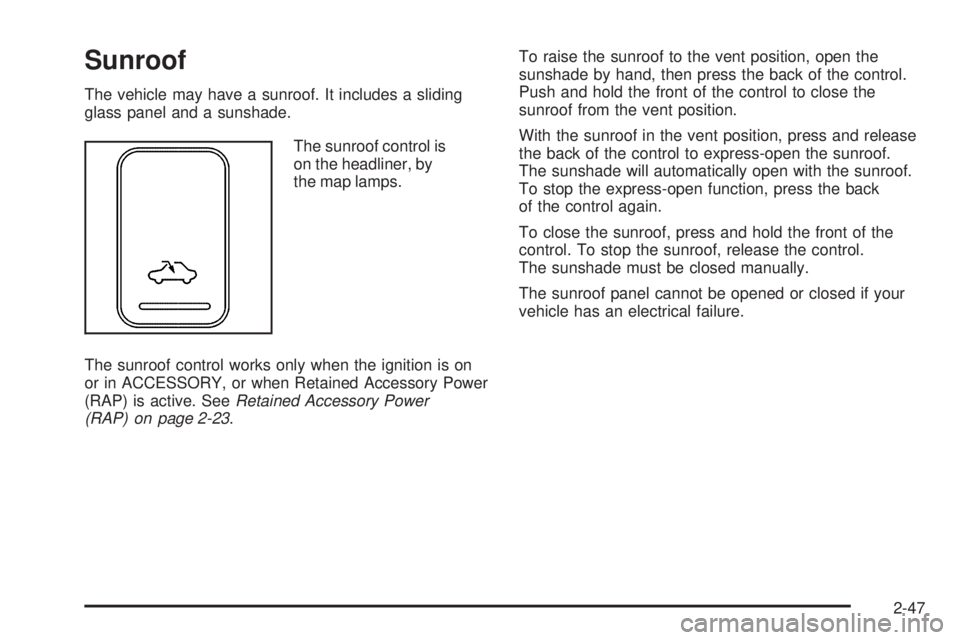
The sunroof control is
on the headliner, by
the map lamps.
The sunroof control works only when the ignition is on
or in ACCESSORY, or when Retained Accessory Power
(RAP) is active. SeeRetained Accessory Power
(RAP) on page 2-23.To raise the sunroof to the vent position, open the
sunshade by hand, then press the back of the control.
Push and hold the front of the control to close the
sunroof from the vent position.
With the sunroof in the vent position, press and release
the back of the control to express-open the sunroof.
The sunshade will automatically open with the sunroof.
To stop the express-open function, press the back
of the control again.
To close the sunroof, press and hold the front of the
control. To stop the sunroof, release the control.
The sunshade must be closed manually.
The sunroof panel cannot be opened or closed if your
vehicle has an electrical failure.
2-47
Page 132 of 444
Hazard Warning Flashers
Your hazard warning ashers let you warn others. They
also let police know you have a problem. Your front
and rear turn signal lamps will ash on and off.
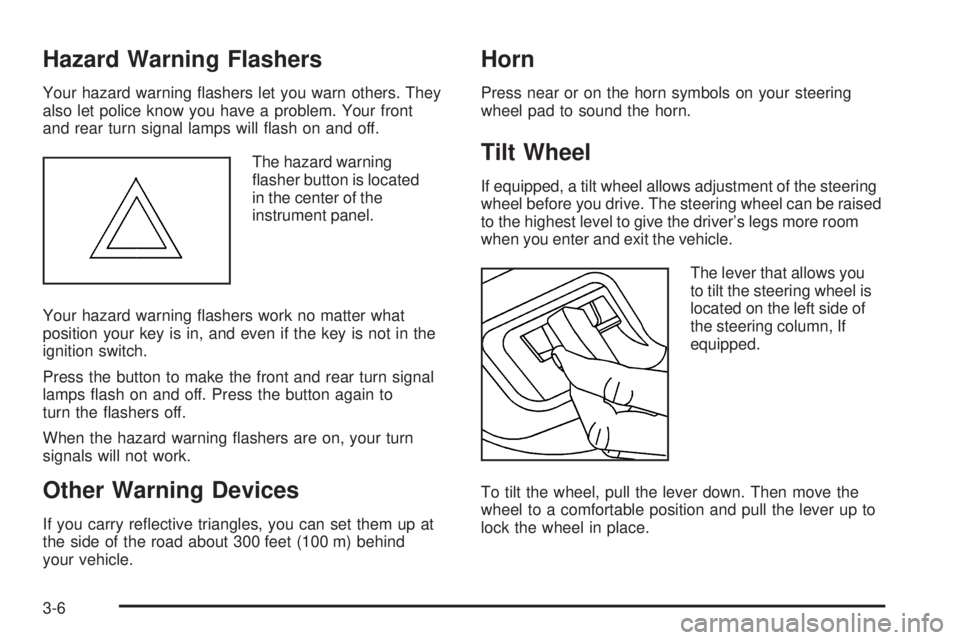
The hazard warning
asher button is located
in the center of the
instrument panel.
Your hazard warning ashers work no matter what
position your key is in, and even if the key is not in the
ignition switch.
Press the button to make the front and rear turn signal
lamps ash on and off. Press the button again to
turn the ashers off.
When the hazard warning ashers are on, your turn
signals will not work.
Other Warning Devices
If you carry reective triangles, you can set them up at
the side of the road about 300 feet (100 m) behind
your vehicle.
Horn
Press near or on the horn symbols on your steering
wheel pad to sound the horn.
Tilt Wheel
If equipped, a tilt wheel allows adjustment of the steering
wheel before you drive. The steering wheel can be raised
to the highest level to give the driver’s legs more room
when you enter and exit the vehicle.
The lever that allows you
to tilt the steering wheel is
located on the left side of
the steering column, If
equipped.
To tilt the wheel, pull the lever down. Then move the
wheel to a comfortable position and pull the lever up to
lock the wheel in place.
3-6
Page 134 of 444
Turn and Lane-Change Signals
To signal a turn, move the lever up or down. The lever
returns to its original position when the turn is
completed.
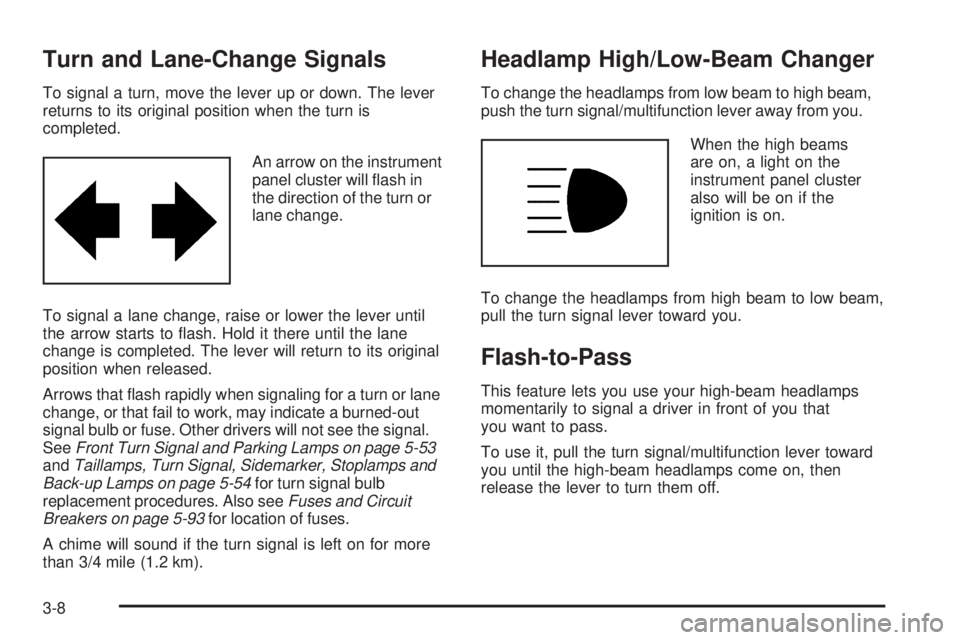
An arrow on the instrument
panel cluster will ash in
the direction of the turn or
lane change.
To signal a lane change, raise or lower the lever until
the arrow starts to ash. Hold it there until the lane
change is completed. The lever will return to its original
position when released.
Arrows that ash rapidly when signaling for a turn or lane
change, or that fail to work, may indicate a burned-out
signal bulb or fuse. Other drivers will not see the signal.
SeeFront Turn Signal and Parking Lamps on page 5-53
andTaillamps, Turn Signal, Sidemarker, Stoplamps and
Back-up Lamps on page 5-54for turn signal bulb
replacement procedures. Also seeFuses and Circuit
Breakers on page 5-93for location of fuses.
A chime will sound if the turn signal is left on for more
than 3/4 mile (1.2 km).
Headlamp High/Low-Beam Changer
To change the headlamps from low beam to high beam,
push the turn signal/multifunction lever away from you.
When the high beams
are on, a light on the
instrument panel cluster
also will be on if the
ignition is on.
To change the headlamps from high beam to low beam,
pull the turn signal lever toward you.
Flash-to-Pass
This feature lets you use your high-beam headlamps
momentarily to signal a driver in front of you that
you want to pass.
To use it, pull the turn signal/multifunction lever toward
you until the high-beam headlamps come on, then
release the lever to turn them off.
3-8
Page 138 of 444
Reducing Speed While Using Cruise
Control
There are two ways to reduce your speed while using
cruise control:
Press the SET−button until you reach the lower
speed you want, then release it.
To slow down in very small amounts, briey press
the SET−button. Each time you do this, you will
go about 1 mph (1.6 km/h) slower.
Passing Another Vehicle While Using
Cruise Control
Use the accelerator pedal to increase the vehicle’s
speed. When you take your foot off the pedal, the
vehicle will slow down to the cruise control speed
you set earlier.
Using Cruise Control on Hills
How well the cruise control will work on hills depends
upon the speed and load of the vehicle, and the
steepness of the hills. When going up steep hills, you
may have to step on the accelerator pedal to maintain the
vehicle’s speed. When going downhill, you may have to
brake or shift to a lower gear to keep the vehicle’s speed
down. Of course, applying the brake takes the vehicle out
of cruise control. Many drivers nd this to be too much
trouble and do not use cruise control on steep hills.
Ending Cruise Control
To end a cruise control session, step lightly on the
brake pedal.
Stepping on the brake will end the current cruise control
session only. Press the cruise on/off button to turn off
the system completely.
Erasing Speed Memory
When you turn off the cruise control or the ignition, your
cruise control set speed memory is erased.
3-12
Page 140 of 444
<(Parking Lamps):Turn the control to this position
to turn on the parking lamps together with the
following:
Taillamps
License Plate Lamps
Sidemarker Lamps
Instrument Panel Lights
2(Headlamps):Turn the control to this position to
turn your headlamps on, together with the previously
listed lamps and lights.
A warning chime will sound if the driver’s door is
opened when the ignition switch is turned to OFF
or ACCESSORY and the headlamps are on.
-(Foglamps):If your vehicle is equipped with fog
lamps, press this button to turn them on and off. See
Fog Lamps on page 3-15for additional information.
Daytime Running Lamps (DRL)/
Automatic Headlamp System
Daytime Running Lamps (DRL) can make it easier
for others to see the front of your vehicle during the day.
DRL can be helpful in many different driving conditions,
but they can be especially helpful in the short periods
after dawn and before sunset. Daytime running lamps
are required to function at all times on all vehicles rst
sold in Canada.
A light sensor on top of the instrument panel makes the
DRL work, so be sure it is not covered.
The DRL system will make the low-beam headlamps
come on at reduced brightness when the following
conditions are met:
The ignition is on.
The exterior lamps control is off.
The parking brake is released.
While the DRL are on, only the vehicle’s low-beam
headlamps will be on at reduced brightness. The turn
signal, taillamps, sidemarker and other lamps will not be
on. The instrument panel will not be lit up either.
3-14