towing BUICK LACROSSE 2006 Owner's Guide
[x] Cancel search | Manufacturer: BUICK, Model Year: 2006, Model line: LACROSSE, Model: BUICK LACROSSE 2006Pages: 444, PDF Size: 2.66 MB
Page 300 of 444
When You Are Ready to Leave After
Parking on a Hill
1. Apply the regular brakes and hold the pedal down
while you:
Start the engine.
Shift into a gear.
Release the parking brake.
2. Let up on the brake pedal.
3. Drive slowly until the trailer is clear of the chocks.
4. Stop and have someone pick up and store the
chocks.
Maintenance When Trailer Towing
The vehicle will need service more often when it pulls a
trailer. SeeScheduled Maintenance on page 6-4for more
information. Things that are especially important in trailer
operation are automatic transaxle uid; which should not
be overlled; engine oil, drive belt(s), and cooling and
brake systems. Each of these is covered in this manual,
and the Index will help you nd them quickly. If trailering,
it is a good idea to review this information before starting
on a trip.
Check periodically to see that all hitch nuts and bolts
are tight.
Engine Cooling When Trailer Towing
The cooling system may temporarily overheat during
severe operating conditions. SeeEngine Overheating
on page 5-27.
4-44
Page 305 of 444
Your vehicle has an airbag system. Before attempting
to do your own service work, seeServicing Your
Airbag-Equipped Vehicle on page 1-69.
You should keep a record with all parts receipts and
list the mileage and the date of any service work
you perform. SeeMaintenance Record on page 6-14.
Adding Equipment to the Outside
of Your Vehicle
Things you might add to the outside of your vehicle can
affect the airow around it. This may cause wind noise
and affect windshield washer performance. Check with
your dealer before adding equipment to the outside of
your vehicle.
Fuel
The 8th digit of your vehicle identication number (VIN)
shows the code letter or number that identies your
engine. You will nd the VIN at the top left of the
instrument panel. SeeVehicle Identication Number
(VIN) on page 5-92.
Gasoline Octane
If your vehicle has the 3.8L V6 engine (VIN Code 2),
use regular unleaded gasoline with a posted octane
rating of 87 or higher. If the octane rating is less than 87,
you may notice an audible knocking noise when you
drive, commonly referred to as spark knock. If this
occurs, use a gasoline rated at 87 octane or higher as
soon as possible. If you are using gasoline rated at
87 octane or higher and you hear heavy knocking, your
engine needs service.
If your vehicle has the 3.6L V6 engine (VIN Code 7),
use regular unleaded gasoline with a posted octane
rating of 87 or higher. For best performance or trailer
towing, you may choose to use middle grade 89 octane
unleaded gasoline. If the octane rating is less than
87, you may notice an audible knocking noise when you
drive, commonly referred to as spark knock. If this
occurs, use a gasoline rated at 87 octane or higher as
soon as possible. If you are using gasoline rated at
87 octane or higher and you hear heavy knocking, your
engine needs service.
5-5
Page 329 of 444
If you get the overheat warning with no sign of steam,
try this for a minute or so:
1. In heavy traffic, let the engine idle in NEUTRAL (N)
while stopped. If it is safe to do so, pull off the road,
shift to PARK (P) or NEUTRAL (N) and let the
engine idle.
2. Set the climate controls to the highest heat setting
and fan speed and open the windows as necessary.
If you no longer have the overheat warning, you
can drive. Just to be safe, drive slower for about
10 minutes. If the warning does not come back on,
you can drive normally.
If the warning continues and you have not stopped,
pull over, stop, and park your vehicle right away.
If there is still no sign of steam, you can idle the
engine for three minutes while you are parked. If you
still have the warning, turn off the engine and get
everyone out of the vehicle until it cools down.
Also, see “Overheated Engine Protection Operating
Mode” later in this section.
You may decide not to lift the hood but to get service
help right away.Overheated Engine Protection
Operating Mode
This emergency operating mode allows your vehicle to
be driven to a safe place in an emergency situation.
If an overheated engine condition exists, an overheat
protection mode which alternates ring groups of
cylinders helps prevent engine damage. In this mode,
you will notice a signicant loss in power and engine
performance. The REDUCED POWER STOP WHEN
SAFE message will come on in the Driver Information
Center (DIC), along with the engine coolant temperature
warning light on the instrument panel, to indicate the
vehicle has entered overheated engine protection
operating mode. The temperature gage will also indicate
an overheat condition exists. Driving extended miles
(km) and/or towing a trailer in the overheat protection
mode should be avoided.
Notice:After driving in the overheated engine
protection operating mode, to avoid engine damage,
allow the engine to cool before attempting any
repair. The engine oil will be severely degraded.
Repair the cause of coolant loss, change the oil
and reset the oil life system. SeeEngine Oil
on page 5-15.
5-29
Page 406 of 444
(h)Change automatic transaxle uid and lter if the
vehicle is mainly driven under one or more of these
conditions:
In heavy city traffic where the outside temperature
regularly reaches 90°F (32°C) or higher.
In hilly or mountainous terrain.
When doing frequent trailer towing.
Uses such as found in taxi, police, or delivery
service.
(i)Drain, ush, and rell cooling system. This service
can be complex; you should have your dealer perform
this service. See Engine Coolant on page 5-24 for
what to use. Inspect hoses. Clean radiator, condenser,
pressure cap, and ller neck. Pressure test the
cooling system and pressure cap.
(j)Check throttle system for interference or binding and
for damaged or missing parts. Replace parts as needed.
Replace any components that have high effort or
excessive wear. Do not lubricate accelerator or cruise
control cables.
(k)A uid loss in any vehicle system could indicate a
problem. Have the system inspected and repaired and
the uid level checked. Add uid if needed.
(l)If you drive regularly under dusty conditions, inspect
the lter at each engine oil change.
(m)Visually inspect belt for fraying, excessive cracks, or
obvious damage. Replace belt if necessary.Owner Checks and Services
These owner checks and services should be performed
at the intervals specied to help ensure the safety,
dependability, and emission control performance of your
vehicle. Your GM Goodwrench
®dealer can assist you
with these checks and services.
Be sure any necessary repairs are completed at once.
Whenever any uids or lubricants are added to your
vehicle, make sure they are the proper ones, as shown
inRecommended Fluids and Lubricants on page 6-12.
At Each Fuel Fill
It is important to perform these underhood checks at
each fuel ll.
Engine Oil Level Check
Check the engine oil level and add the proper oil if
necessary. SeeEngine Oil on page 5-15for further
details.
Notice:It is important to check your oil regularly
and keep it at the proper level. Failure to keep your
engine oil at the proper level can cause damage
to your engine not covered by your warranty.
6-8
Page 426 of 444
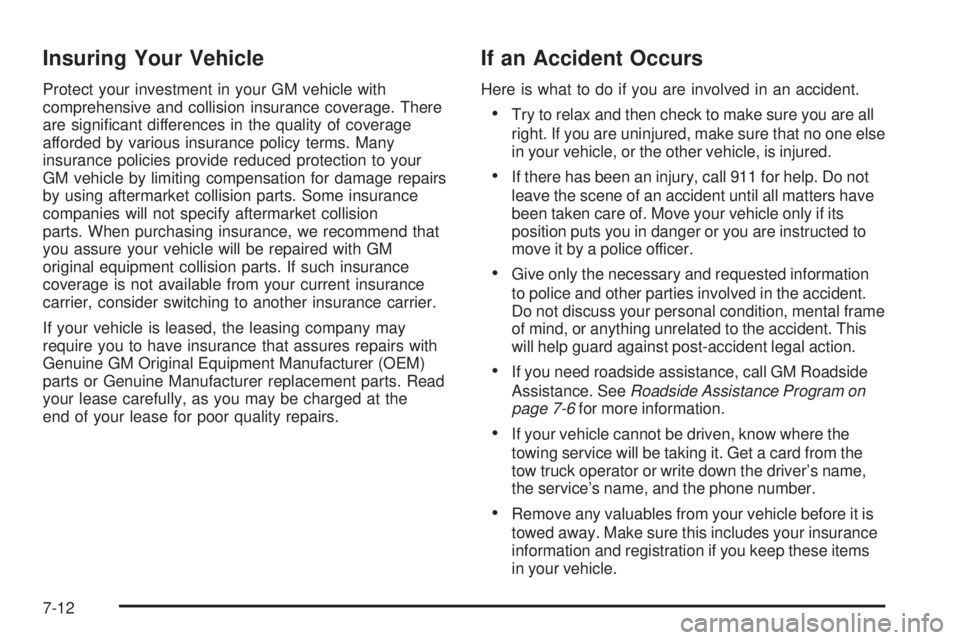
Insuring Your Vehicle
Protect your investment in your GM vehicle with
comprehensive and collision insurance coverage. There
are signicant differences in the quality of coverage
afforded by various insurance policy terms. Many
insurance policies provide reduced protection to your
GM vehicle by limiting compensation for damage repairs
by using aftermarket collision parts. Some insurance
companies will not specify aftermarket collision
parts. When purchasing insurance, we recommend that
you assure your vehicle will be repaired with GM
original equipment collision parts. If such insurance
coverage is not available from your current insurance
carrier, consider switching to another insurance carrier.
If your vehicle is leased, the leasing company may
require you to have insurance that assures repairs with
Genuine GM Original Equipment Manufacturer (OEM)
parts or Genuine Manufacturer replacement parts. Read
your lease carefully, as you may be charged at the
end of your lease for poor quality repairs.
If an Accident Occurs
Here is what to do if you are involved in an accident.
Try to relax and then check to make sure you are all
right. If you are uninjured, make sure that no one else
in your vehicle, or the other vehicle, is injured.
If there has been an injury, call 911 for help. Do not
leave the scene of an accident until all matters have
been taken care of. Move your vehicle only if its
position puts you in danger or you are instructed to
move it by a police officer.
Give only the necessary and requested information
to police and other parties involved in the accident.
Do not discuss your personal condition, mental frame
of mind, or anything unrelated to the accident. This
will help guard against post-accident legal action.
If you need roadside assistance, call GM Roadside
Assistance. SeeRoadside Assistance Program on
page 7-6for more information.
If your vehicle cannot be driven, know where the
towing service will be taking it. Get a card from the
tow truck operator or write down the driver’s name,
the service’s name, and the phone number.
Remove any valuables from your vehicle before it is
towed away. Make sure this includes your insurance
information and registration if you keep these items
in your vehicle.
7-12
Page 440 of 444
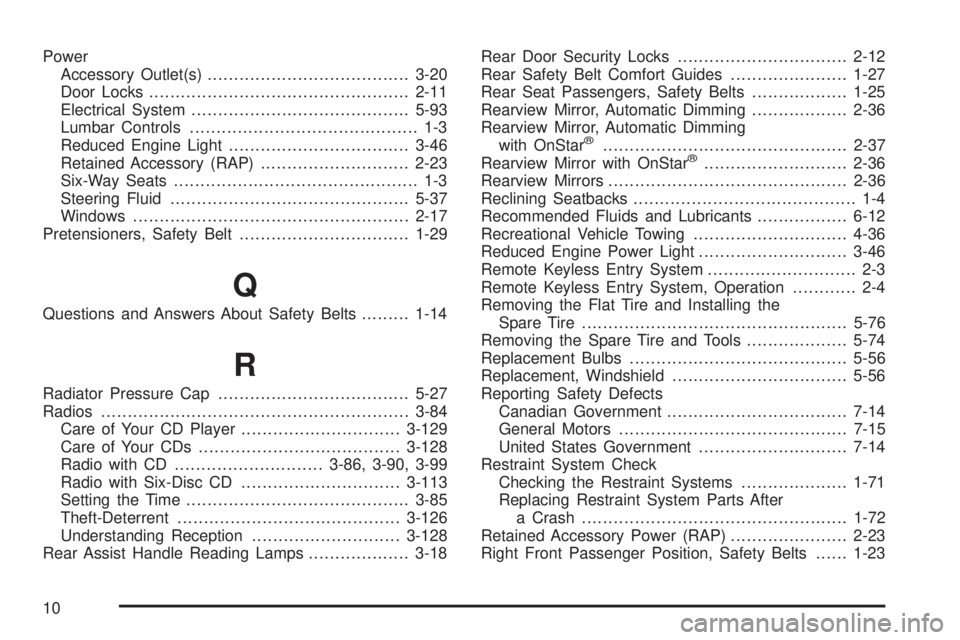
Power
Accessory Outlet(s)......................................3-20
Door Locks.................................................2-11
Electrical System.........................................5-93
Lumbar Controls........................................... 1-3
Reduced Engine Light..................................3-46
Retained Accessory (RAP)............................2-23
Six-Way Seats.............................................. 1-3
Steering Fluid.............................................5-37
Windows....................................................2-17
Pretensioners, Safety Belt................................1-29
Q
Questions and Answers About Safety Belts.........1-14
R
Radiator Pressure Cap....................................5-27
Radios..........................................................3-84
Care of Your CD Player..............................3-129
Care of Your CDs......................................3-128
Radio with CD............................3-86, 3-90, 3-99
Radio with Six-Disc CD..............................3-113
Setting the Time..........................................3-85
Theft-Deterrent..........................................3-126
Understanding Reception............................3-128
Rear Assist Handle Reading Lamps...................3-18Rear Door Security Locks................................2-12
Rear Safety Belt Comfort Guides......................1-27
Rear Seat Passengers, Safety Belts..................1-25
Rearview Mirror, Automatic Dimming..................2-36
Rearview Mirror, Automatic Dimming
with OnStar
®..............................................2-37
Rearview Mirror with OnStar®...........................2-36
Rearview Mirrors.............................................2-36
Reclining Seatbacks.......................................... 1-4
Recommended Fluids and Lubricants.................6-12
Recreational Vehicle Towing.............................4-36
Reduced Engine Power Light............................3-46
Remote Keyless Entry System............................ 2-3
Remote Keyless Entry System, Operation............ 2-4
Removing the Flat Tire and Installing the
Spare Tire..................................................5-76
Removing the Spare Tire and Tools...................5-74
Replacement Bulbs.........................................5-56
Replacement, Windshield.................................5-56
Reporting Safety Defects
Canadian Government..................................7-14
General Motors...........................................7-15
United States Government............................7-14
Restraint System Check
Checking the Restraint Systems....................1-71
Replacing Restraint System Parts After
a Crash..................................................1-72
Retained Accessory Power (RAP)......................2-23
Right Front Passenger Position, Safety Belts......1-23
10
Page 443 of 444
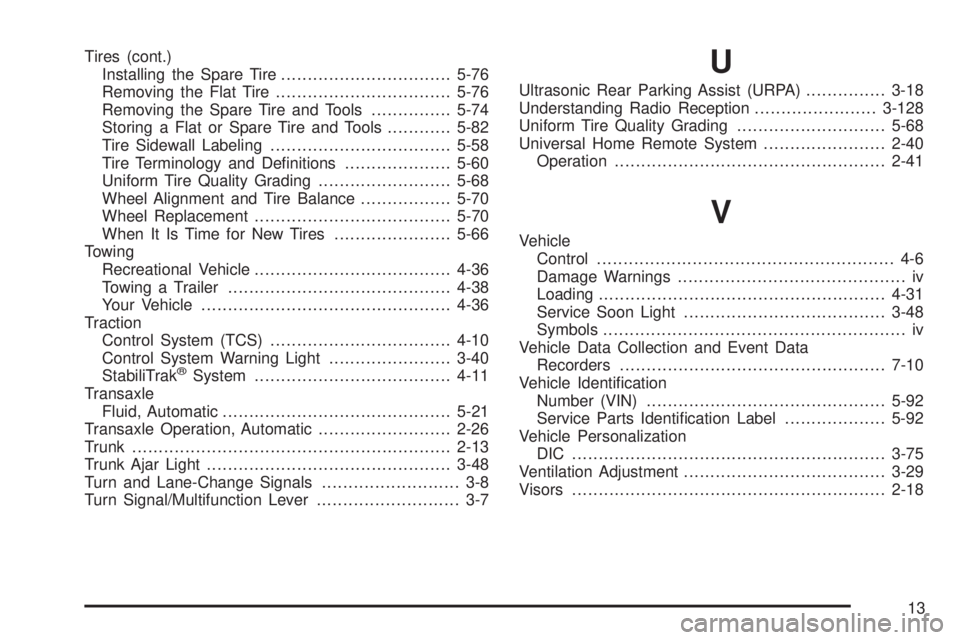
Tires (cont.)
Installing the Spare Tire................................5-76
Removing the Flat Tire.................................5-76
Removing the Spare Tire and Tools...............5-74
Storing a Flat or Spare Tire and Tools............5-82
Tire Sidewall Labeling..................................5-58
Tire Terminology and Denitions....................5-60
Uniform Tire Quality Grading.........................5-68
Wheel Alignment and Tire Balance.................5-70
Wheel Replacement.....................................5-70
When It Is Time for New Tires......................5-66
Towing
Recreational Vehicle.....................................4-36
Towing a Trailer..........................................4-38
Your Vehicle...............................................4-36
Traction
Control System (TCS)..................................4-10
Control System Warning Light.......................3-40
StabiliTrak
®System.....................................4-11
Transaxle
Fluid, Automatic...........................................5-21
Transaxle Operation, Automatic.........................2-26
Trunk............................................................2-13
Trunk Ajar Light..............................................3-48
Turn and Lane-Change Signals.......................... 3-8
Turn Signal/Multifunction Lever........................... 3-7
U
Ultrasonic Rear Parking Assist (URPA)...............3-18
Understanding Radio Reception.......................3-128
Uniform Tire Quality Grading............................5-68
Universal Home Remote System.......................2-40
Operation...................................................2-41
V
Vehicle
Control........................................................ 4-6
Damage Warnings........................................... iv
Loading......................................................4-31
Service Soon Light......................................3-48
Symbols......................................................... iv
Vehicle Data Collection and Event Data
Recorders..................................................7-10
Vehicle Identication
Number (VIN).............................................5-92
Service Parts Identication Label...................5-92
Vehicle Personalization
DIC ...........................................................3-75
Ventilation Adjustment......................................3-29
Visors...........................................................2-18
13