brakes BUICK LACROSSE 2007 Owner's Guide
[x] Cancel search | Manufacturer: BUICK, Model Year: 2007, Model line: LACROSSE, Model: BUICK LACROSSE 2007Pages: 512
Page 327 of 512
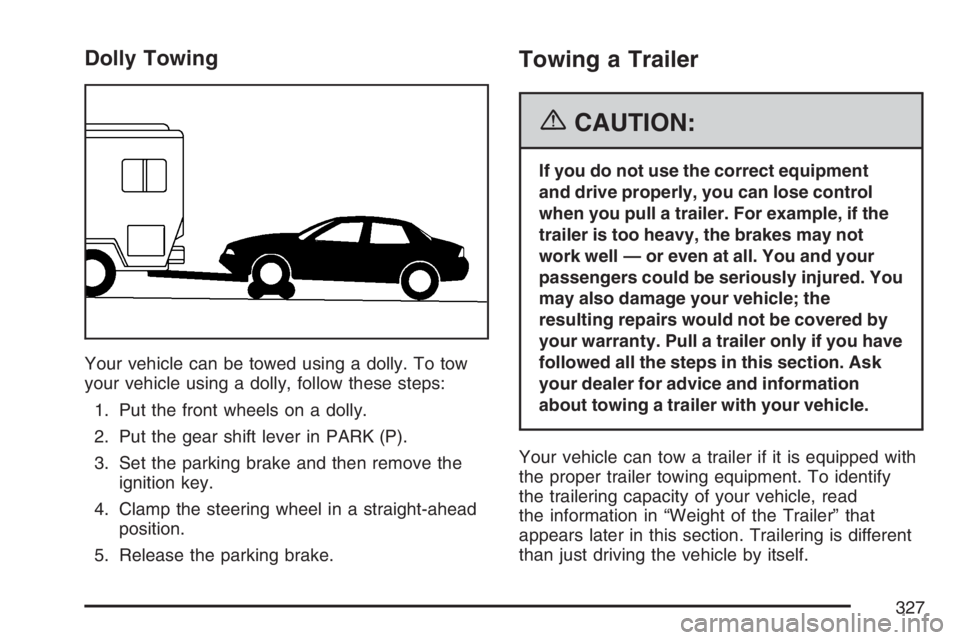
Dolly Towing
Your vehicle can be towed using a dolly. To tow
your vehicle using a dolly, follow these steps:
1. Put the front wheels on a dolly.
2. Put the gear shift lever in PARK (P).
3. Set the parking brake and then remove the
ignition key.
4. Clamp the steering wheel in a straight-ahead
position.
5. Release the parking brake.
Towing a Trailer
{CAUTION:
If you do not use the correct equipment
and drive properly, you can lose control
when you pull a trailer. For example, if the
trailer is too heavy, the brakes may not
work well — or even at all. You and your
passengers could be seriously injured. You
may also damage your vehicle; the
resulting repairs would not be covered by
your warranty. Pull a trailer only if you have
followed all the steps in this section. Ask
your dealer for advice and information
about towing a trailer with your vehicle.
Your vehicle can tow a trailer if it is equipped with
the proper trailer towing equipment. To identify
the trailering capacity of your vehicle, read
the information in “Weight of the Trailer” that
appears later in this section. Trailering is different
than just driving the vehicle by itself.
327
Page 332 of 512
Trailer Brakes
Does your trailer have its own brakes? Be sure to
read and follow the instructions for the trailer
brakes so you’ll be able to install, adjust
and maintain them properly.
If your vehicle has anti-lock brakes, do not try
to tap into your vehicle’s brake system. If you
do, both brake systems won’t work well, or
at all.
Even if your vehicle doesn’t have anti-lock
brakes, don’t tap into your vehicle’s brake
system if the trailer’s brake system will
use more than 0.02 cubic inch (0.3 cc) of uid
from your vehicle’s master cylinder. If it
does, both braking systems won’t work well.
You could even lose your brakes.
Will the trailer brake parts take 3,000 psi
(20 650 kPa) of pressure? If not, the
trailer brake system must not be used with
your vehicle.
If everything checks out this far, then make
the brake uid tap at the upper rear master
cylinder port. But don’t use copper tubing
for this. If you do, it will bend and break off.
Use steel brake tubing.
Driving with a Trailer
Towing a trailer requires a certain amount of
experience. Before setting out for the open road,
get to know the rig. Acquaint yourself with the
feel of handling and braking with the added weight
of the trailer. And always keep in mind that the
vehicle is now a good deal longer and not nearly
as responsive as the vehicle is by itself.
Before starting, check all trailer hitch parts and
attachments, safety chains, electrical connector,
lamps, tires, and mirror adjustment. If the
trailer has electric brakes, start the vehicle and
trailer moving and then apply the trailer brake
controller by hand to be sure the brakes are
working. This lets you check the electrical
connection at the same time.
During your trip, check occasionally to be sure
that the load is secure, and that the lamps and any
trailer brakes are still working.
332
Page 334 of 512
Driving On Grades
Reduce speed and shift to a lower gearbefore
starting down a long hill or steep downgrade. If the
vehicle is not shifted down, the brakes might
have to be used so much that they would get hot
and no longer work well.
On a long uphill grade, shift down and reduce the
vehicle’s speed to around 45 mph (70 km/h) to
reduce the possibility of engine and transaxle
overheating.
If towing a trailer, you may want to drive in
THIRD (3) instead of DRIVE (D). Shift to a lower
gear as needed.
Parking on Hills
{CAUTION:
You really should not park your vehicle,
with a trailer attached, on a hill. If
something goes wrong, your rig could
start to move. People can be injured, and
both your vehicle and the trailer can be
damaged.
But if the rig ever has to be parked on a hill, here
is how to do it:
1. Apply the regular brakes, but do not shift into
PARK (P) yet.
2. Have someone place chocks under the
trailer’s wheels.
3. When the wheel chocks are in place, release
the regular brakes until the chocks absorb
the load.
4. Reapply the regular brakes. Then apply the
parking brake, and shift to PARK (P).
5. Release the regular brakes.
334
Page 335 of 512
When You Are Ready to Leave After
Parking on a Hill
1. Apply the regular brakes and hold the pedal
down while you:
Start the engine.
Shift into a gear.
Release the parking brake.
2. Let up on the brake pedal.
3. Drive slowly until the trailer is clear of the
chocks.
4. Stop and have someone pick up and store the
chocks.
Maintenance When Trailer Towing
The vehicle will need service more often when it
pulls a trailer. SeeScheduled Maintenance
on page 462for more information. Things that are
especially important in trailer operation are
automatic transaxle uid; which should not be
overlled; engine oil, drive belt(s), and cooling and
brake systems. Each of these is covered in this
manual, and the Index will help you nd them
quickly. If trailering, it is a good idea to review this
information before starting on a trip.
Check periodically to see that all hitch nuts and
bolts are tight.
Engine Cooling When Trailer Towing
The cooling system may temporarily overheat
during severe operating conditions. SeeEngine
Overheating on page 367.
335
Page 337 of 512
Service........................................................ 340
Accessories and Modications................... 341
California Proposition 65 Warning.............. 341
Doing Your Own Service Work.................. 342
Adding Equipment to the Outside
of Your Vehicle...................................... 343
Fuel............................................................. 343
Gasoline Octane........................................ 343
Gasoline Specications.............................. 344
California Fuel........................................... 344
Additives................................................... 344
Fuels in Foreign Countries........................ 345
Filling the Tank......................................... 346
Filling a Portable Fuel Container............... 348
Checking Things Under the Hood.............. 348
Hood Release........................................... 349
Engine Compartment Overview.................. 350
Engine Oil................................................. 353
Engine Oil Life System.............................. 356
Engine Air Cleaner/Filter............................ 358
Automatic Transaxle Fluid......................... 360Engine Coolant.......................................... 363
Radiator Pressure Cap.............................. 367
Engine Overheating................................... 367
Overheated Engine Protection
Operating Mode..................................... 370
Cooling System......................................... 370
Power Steering Fluid ................................. 378
Windshield Washer Fluid........................... 380
Brakes...................................................... 381
Battery...................................................... 384
Jump Starting............................................ 385
Headlamp Aiming........................................ 391
Bulb Replacement....................................... 394
Halogen Bulbs........................................... 394
Headlamps and Sidemarker Lamps........... 395
Front Turn Signal and Parking Lamps....... 397
Taillamps, Turn Signal, Sidemarker,
Stoplamps and Back-up Lamps.............. 398
License Plate Lamp................................... 400
Replacement Bulbs................................... 400
Windshield Replacement............................ 401
Section 5 Service and Appearance Care
337
Page 341 of 512
Accessories and Modications
When you add non-GM accessories to your vehicle
they can affect your vehicle’s performance and
safety, including such things as, airbags, braking,
stability, ride and handling, emissions systems,
aerodynamics, durability, and electronic systems
like anti-lock brakes, traction control and
stability control. Some of these accessories may
even cause malfunction or damage not covered
by warranty.
GM Accessories are designed to complement
and function with other systems on your vehicle.
Your GM dealer can accessorize your vehicle
using genuine GM Accessories. When you go to
your GM dealer and ask for GM Accessories,
you will know that GM-trained and supported
service technicians will perform the work using
genuine GM Accessories.
California Proposition 65 Warning
Most motor vehicles, including this one, contain
and/or emit chemicals known to the State of
California to cause cancer and birth defects or
other reproductive harm. Engine exhaust,
many parts and systems (including some inside
the vehicle), many uids, and some component
wear by-products contain and/or emit these
chemicals.
341
Page 351 of 512
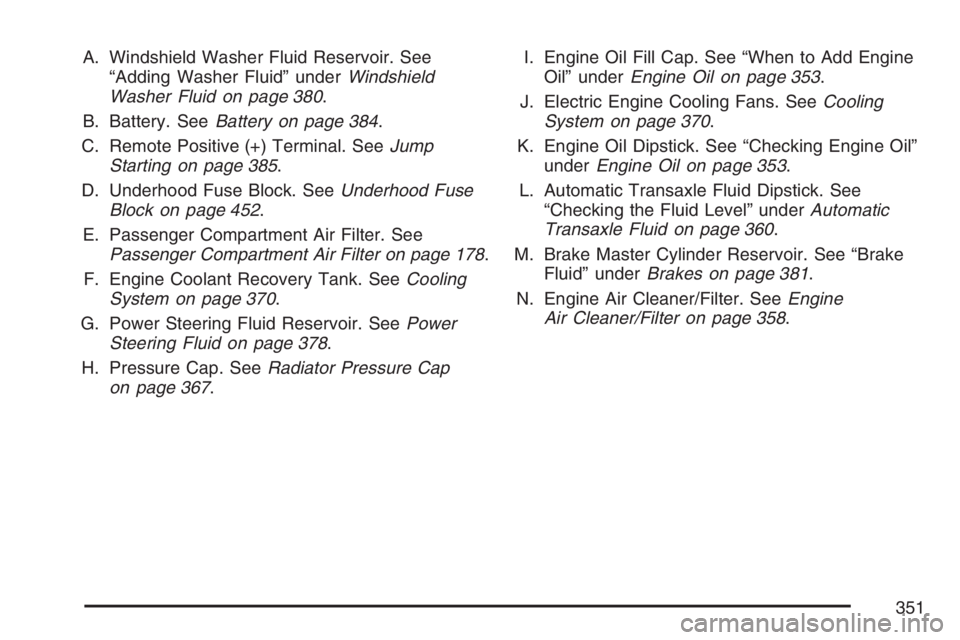
A. Windshield Washer Fluid Reservoir. See
“Adding Washer Fluid” underWindshield
Washer Fluid on page 380.
B. Battery. SeeBattery on page 384.
C. Remote Positive (+) Terminal. SeeJump
Starting on page 385.
D. Underhood Fuse Block. SeeUnderhood Fuse
Block on page 452.
E. Passenger Compartment Air Filter. See
Passenger Compartment Air Filter on page 178.
F. Engine Coolant Recovery Tank. SeeCooling
System on page 370.
G. Power Steering Fluid Reservoir. SeePower
Steering Fluid on page 378.
H. Pressure Cap. SeeRadiator Pressure Cap
on page 367.I. Engine Oil Fill Cap. See “When to Add Engine
Oil” underEngine Oil on page 353.
J. Electric Engine Cooling Fans. SeeCooling
System on page 370.
K. Engine Oil Dipstick. See “Checking Engine Oil”
underEngine Oil on page 353.
L. Automatic Transaxle Fluid Dipstick. See
“Checking the Fluid Level” underAutomatic
Transaxle Fluid on page 360.
M. Brake Master Cylinder Reservoir. See “Brake
Fluid” underBrakes on page 381.
N. Engine Air Cleaner/Filter. SeeEngine
Air Cleaner/Filter on page 358.
351
Page 353 of 512
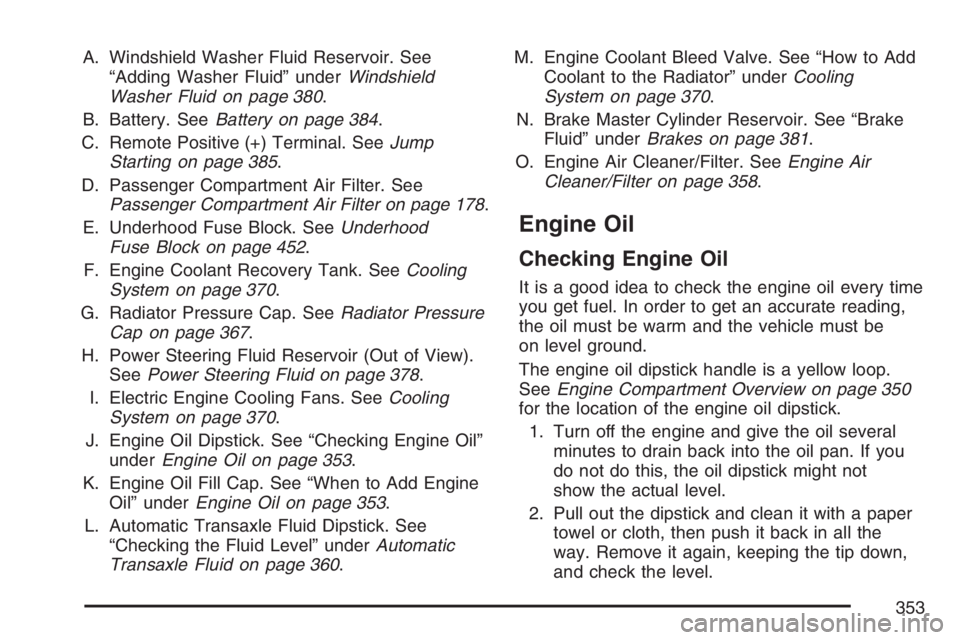
A. Windshield Washer Fluid Reservoir. See
“Adding Washer Fluid” underWindshield
Washer Fluid on page 380.
B. Battery. SeeBattery on page 384.
C. Remote Positive (+) Terminal. SeeJump
Starting on page 385.
D. Passenger Compartment Air Filter. See
Passenger Compartment Air Filter on page 178.
E. Underhood Fuse Block. SeeUnderhood
Fuse Block on page 452.
F. Engine Coolant Recovery Tank. SeeCooling
System on page 370.
G. Radiator Pressure Cap. SeeRadiator Pressure
Cap on page 367.
H. Power Steering Fluid Reservoir (Out of View).
SeePower Steering Fluid on page 378.
I. Electric Engine Cooling Fans. SeeCooling
System on page 370.
J. Engine Oil Dipstick. See “Checking Engine Oil”
underEngine Oil on page 353.
K. Engine Oil Fill Cap. See “When to Add Engine
Oil” underEngine Oil on page 353.
L. Automatic Transaxle Fluid Dipstick. See
“Checking the Fluid Level” underAutomatic
Transaxle Fluid on page 360.M. Engine Coolant Bleed Valve. See “How to Add
Coolant to the Radiator” underCooling
System on page 370.
N. Brake Master Cylinder Reservoir. See “Brake
Fluid” underBrakes on page 381.
O. Engine Air Cleaner/Filter. SeeEngine Air
Cleaner/Filter on page 358.
Engine Oil
Checking Engine Oil
It is a good idea to check the engine oil every time
you get fuel. In order to get an accurate reading,
the oil must be warm and the vehicle must be
on level ground.
The engine oil dipstick handle is a yellow loop.
SeeEngine Compartment Overview on page 350
for the location of the engine oil dipstick.
1. Turn off the engine and give the oil several
minutes to drain back into the oil pan. If you
do not do this, the oil dipstick might not
show the actual level.
2. Pull out the dipstick and clean it with a paper
towel or cloth, then push it back in all the
way. Remove it again, keeping the tip down,
and check the level.
353
Page 381 of 512
Brakes
Brake Fluid
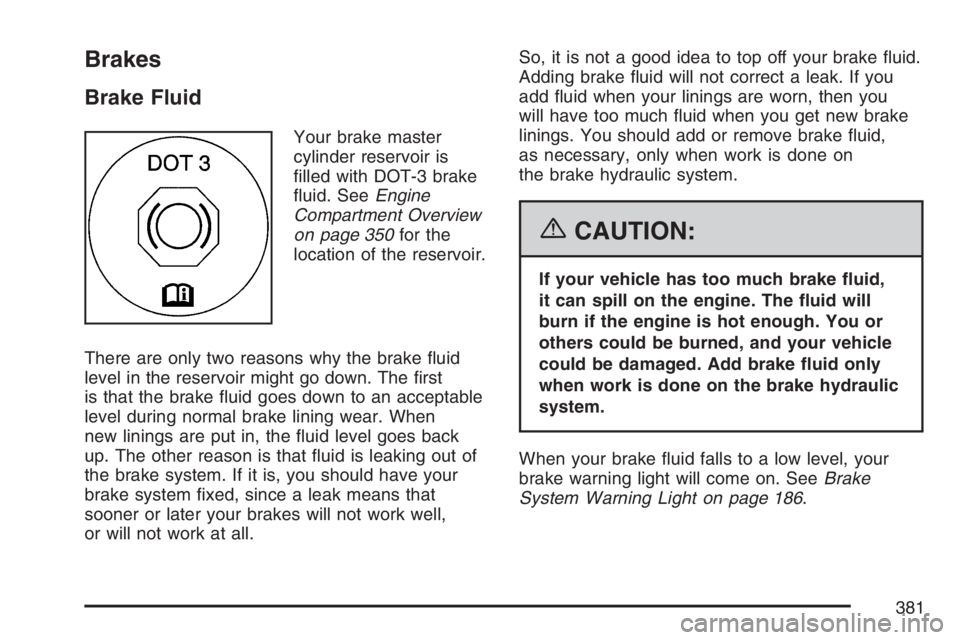
Your brake master
cylinder reservoir is
lled with DOT-3 brake
uid. SeeEngine
Compartment Overview
on page 350for the
location of the reservoir.
There are only two reasons why the brake uid
level in the reservoir might go down. The rst
is that the brake uid goes down to an acceptable
level during normal brake lining wear. When
new linings are put in, the uid level goes back
up. The other reason is that uid is leaking out of
the brake system. If it is, you should have your
brake system xed, since a leak means that
sooner or later your brakes will not work well,
or will not work at all.So, it is not a good idea to top off your brake uid.
Adding brake uid will not correct a leak. If you
add uid when your linings are worn, then you
will have too much uid when you get new brake
linings. You should add or remove brake uid,
as necessary, only when work is done on
the brake hydraulic system.
{CAUTION:
If your vehicle has too much brake uid,
it can spill on the engine. The uid will
burn if the engine is hot enough. You or
others could be burned, and your vehicle
could be damaged. Add brake uid only
when work is done on the brake hydraulic
system.
When your brake uid falls to a low level, your
brake warning light will come on. SeeBrake
System Warning Light on page 186.
381
Page 382 of 512
What to Add
When you do need brake uid, use only DOT-3
brake uid. Use new brake uid from a sealed
container only. SeeRecommended Fluids
and Lubricants on page 470.
Always clean the brake uid reservoir cap and the
area around the cap before removing it. This
will help keep dirt from entering the reservoir.
{CAUTION:
With the wrong kind of uid in the brake
system, the brakes may not work well, or
they may not even work at all. This could
cause a crash. Always use the proper
brake uid.Notice:
Using the wrong uid can badly damage
brake system parts. For example, just a
few drops of mineral-based oil, such
as engine oil, in the brake system can
damage brake system parts so badly that
they will have to be replaced. Do not
let someone put in the wrong kind of uid.
If you spill brake uid on your vehicle’s
painted surfaces, the paint nish can
be damaged. Be careful not to spill brake
uid on your vehicle. If you do, wash it
off immediately. SeeWashing Your Vehicle
on page 442.
Brake Wear
Your vehicle has four-wheel disc brakes.
Disc brake pads have built-in wear indicators that
make a high-pitched warning sound when the
brake pads are worn and new pads are needed.
The sound may come and go or be heard all
the time your vehicle is moving, except when you
are pushing on the brake pedal rmly.
382