brakes BUICK LACROSSE 2007 Owner's Guide
[x] Cancel search | Manufacturer: BUICK, Model Year: 2007, Model line: LACROSSE, Model: BUICK LACROSSE 2007Pages: 512
Page 383 of 512
{CAUTION:
The brake wear warning sound means that
soon the brakes will not work well. That
could lead to an accident. When you hear
the brake wear warning sound, have your
vehicle serviced.
Notice:Continuing to drive with worn-out
brake pads could result in costly brake repair.
Some driving conditions or climates may cause
a brake squeal when the brakes are rst applied or
lightly applied. This does not mean something is
wrong with your brakes.
Properly torqued wheel nuts are necessary to help
prevent brake pulsation. When tires are rotated,
inspect brake pads for wear and evenly tighten
wheel nuts in the proper sequence to GM torque
specications.
Brake linings should always be replaced as
complete axle sets.
Brake Pedal Travel
See your dealer if the brake pedal does not return
to normal height, or if there is a rapid increase in
pedal travel. This could be a sign of brake trouble.
Brake Adjustment
Every time you apply the brakes, with or without
the vehicle moving, your brakes adjust for wear.
Replacing Brake System Parts
The braking system on a vehicle is complex. Its
many parts have to be of top quality and work
well together if the vehicle is to have really good
braking. Your vehicle was designed and tested
with top-quality GM brake parts. When you replace
parts of your braking system — for example, when
your brake linings wear down and you need new
ones put in — be sure you get new approved
GM replacement parts. If you do not, your brakes
may no longer work properly. For example, if
someone puts in brake linings that are wrong for
your vehicle, the balance between your front
and rear brakes can change — for the worse.
The braking performance you have come to expect
can change in many other ways if someone puts
in the wrong replacement brake parts.
383
Page 406 of 512
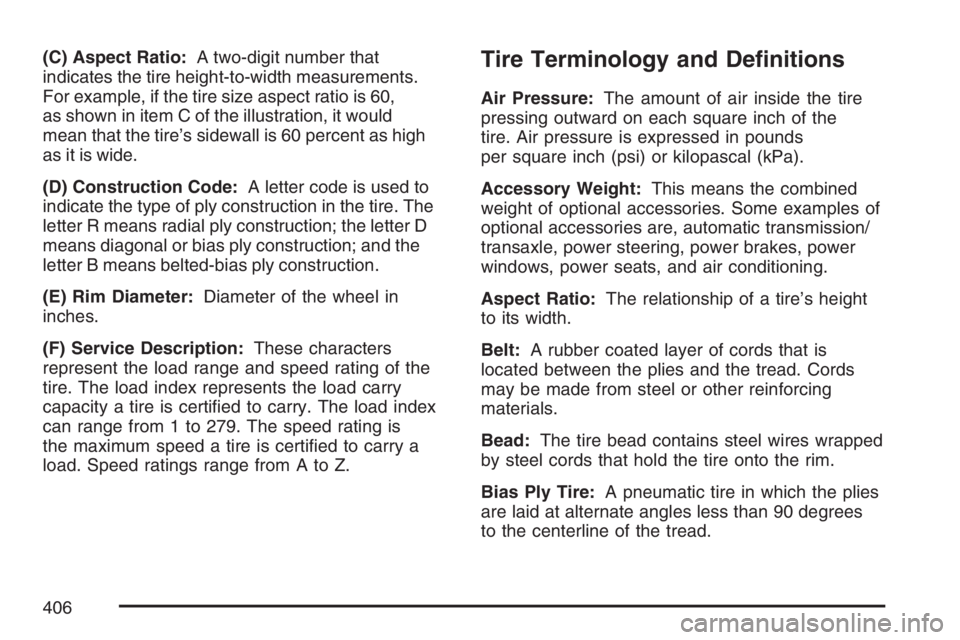
(C) Aspect Ratio:A two-digit number that
indicates the tire height-to-width measurements.
For example, if the tire size aspect ratio is 60,
as shown in item C of the illustration, it would
mean that the tire’s sidewall is 60 percent as high
as it is wide.
(D) Construction Code:A letter code is used to
indicate the type of ply construction in the tire. The
letter R means radial ply construction; the letter D
means diagonal or bias ply construction; and the
letter B means belted-bias ply construction.
(E) Rim Diameter:Diameter of the wheel in
inches.
(F) Service Description:These characters
represent the load range and speed rating of the
tire. The load index represents the load carry
capacity a tire is certied to carry. The load index
can range from 1 to 279. The speed rating is
the maximum speed a tire is certied to carry a
load. Speed ratings range from A to Z.Tire Terminology and Denitions
Air Pressure:The amount of air inside the tire
pressing outward on each square inch of the
tire. Air pressure is expressed in pounds
per square inch (psi) or kilopascal (kPa).
Accessory Weight:This means the combined
weight of optional accessories. Some examples of
optional accessories are, automatic transmission/
transaxle, power steering, power brakes, power
windows, power seats, and air conditioning.
Aspect Ratio:The relationship of a tire’s height
to its width.
Belt:A rubber coated layer of cords that is
located between the plies and the tread. Cords
may be made from steel or other reinforcing
materials.
Bead:The tire bead contains steel wires wrapped
by steel cords that hold the tire onto the rim.
Bias Ply Tire:A pneumatic tire in which the plies
are laid at alternate angles less than 90 degrees
to the centerline of the tread.
406
Page 420 of 512
Different Size Tires and Wheels
If you add wheels or tires that are a different
size than your original equipment wheels and
tires, this may affect the way your vehicle
performs, including its braking, ride and handling
characteristics, stability, and resistance to
rollover. Additionally, if your vehicle has electronic
systems such as, anti-lock brakes, traction
control, and electronic stability control, the
performance of these systems can be affected.{CAUTION:
If you add different sized wheels, your
vehicle may not provide an acceptable
level of performance and safety if tires
not recommended for those wheels are
selected. You may increase the chance
that you will crash and suffer serious
injury. Only use GM specic wheel and
tire systems developed for your vehicle,
and have them properly installed by a
GM certied technician.
SeeBuying New Tires on page 418and
Accessories and Modications on page 341for
additional information.
420
Page 424 of 512
Tire Chains
{CAUTION:
If your vehicle has P225/55R17 size tires,
do not use tire chains, there is not
enough clearance.
Tire chains used on a vehicle without the
proper amount of clearance can cause
damage to the brakes, suspension or
other vehicle parts. The area damaged by
the tire chains could cause you to lose
control of your vehicle and you or others
may be injured in a crash.
Use another type of traction device
only if its manufacturer recommends
it for use on your vehicle and tire size
combination and road conditions.
Follow that manufacturer’s instructions.
CAUTION: (Continued)
CAUTION: (Continued)
To help avoid damage to your vehicle,
drive slowly, readjust or remove the
device if it is contacting your vehicle,
and do not spin your wheels.
If you do nd traction devices that will t,
install them on the front tires.
Notice:If your vehicle has a tire size other
than P225/55R17 size tires, use tire chains only
where legal and only when you must. Use only
SAE Class “S” type chains that are the proper
size for your tires. Install them on the front tires
and tighten them as tightly as possible with the
ends securely fastened. Drive slowly and follow
the chain manufacturer’s instructions. If you
can hear the chains contacting your vehicle,
stop and retighten them. If the contact
continues, slow down until it stops. Driving too
fast or spinning the wheels with chains on will
damage your vehicle.
424
Page 495 of 512
Reporting Safety Defects to
General Motors
In addition to notifying NHTSA (or Transport
Canada) in a situation like this, we certainly hope
you will notify us.
Please call us at 1-800-521-7300, or write:
Buick Customer Assistance Center
P.O. Box 33136
Detroit, MI 48232-5136
In Canada, please call us at 1-800-263-3777
(English) or 1-800-263-7854 (French). Or, write:
General Motors of Canada Limited
Customer Communication Centre, CA1-163-005
1908 Colonel Sam Drive
Oshawa, Ontario L1H 8P7
Service Publications Ordering
Information
Service Manuals
Service Manuals have the diagnosis and repair
information on engines, transmission, axle
suspension, brakes, electrical, steering, body, etc.
Transmission, Transaxle, Transfer
Case Unit Repair Manual
This manual provides information on unit repair
service procedures, adjustments, and
specications for GM transmissions, transaxles,
and transfer cases.
Service Bulletins
Service Bulletins give technical service information
needed to knowledgeably service General
Motors cars and trucks. Each bulletin contains
instructions to assist in the diagnosis and service
of your vehicle.
In Canada, the service bulletin reference number
can be obtained by contacting your General Motors
dealer or by calling 1-800-GM-DRIVE
(1-800-463-7483). This reference number is
needed to order the service bulletin from Helm, Inc.
RETAIL SELL PRICE: $6.00 US + Processing Fee
495
Page 498 of 512
Audio System(s).......................................... 238
Audio Steering Wheel Controls................. 280
Backglass Antenna................................... 283
Care of Your CD Player........................... 282
Care of Your CDs.................................... 282
Chime Level Adjustment........................... 284
Radio with CD........................240, 245, 252
Radio with Six-Disc CD............................ 260
Setting the Time...................................... 239
Theft-Deterrent Feature............................ 280
Understanding Radio Reception............... 281
XM™ Satellite Radio Antenna System...... 284
Automatic Door Lock..................................... 98
Automatic Transaxle
Fluid........................................................ 360
Operation................................................. 114
B
Backglass Antenna...................................... 283
Battery........................................................ 384
Electric Power Management..................... 163
Exterior Lighting Battery Saver................. 160
Run-Down Protection............................... 164
Before Leaving on a Long Trip.................... 310Brake
Anti-Lock Brake System (ABS)................. 291
Emergencies............................................ 293
Parking.................................................... 117
System Warning Light.............................. 186
Brakes........................................................ 381
Braking....................................................... 290
Braking in Emergencies............................... 293
Break-In, New Vehicle................................. 109
Bulb Replacement....................................... 394
Front Turn Signal and Parking Lamps...... 397
Halogen Bulbs......................................... 394
Headlamp Aiming..................................... 391
License Plate Lamps................................ 400
Replacement Bulbs.................................. 400
Taillamps, Turn Signal, Sidemarker,
Stoplamps, and Back-Up Lamps........... 398
Buying New Tires........................................ 418
498