body BUICK LACROSSE 2007 Owner's Manual
[x] Cancel search | Manufacturer: BUICK, Model Year: 2007, Model line: LACROSSE, Model: BUICK LACROSSE 2007Pages: 512
Page 12 of 512
To return the seatback to an upright position, do
the following:
1. Lift the lever fully without applying pressure to
the seatback and the seatback will return to
the upright position.
2. Push and pull on the seatback to make sure it
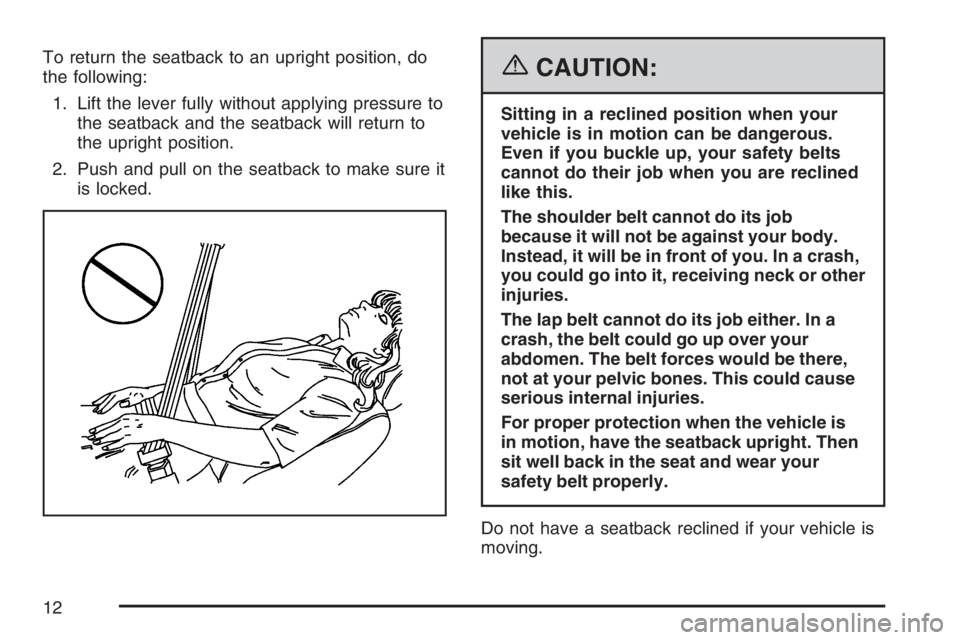
is locked.{CAUTION:
Sitting in a reclined position when your
vehicle is in motion can be dangerous.
Even if you buckle up, your safety belts
cannot do their job when you are reclined
like this.
The shoulder belt cannot do its job
because it will not be against your body.
Instead, it will be in front of you. In a crash,
you could go into it, receiving neck or other
injuries.
The lap belt cannot do its job either. In a
crash, the belt could go up over your
abdomen. The belt forces would be there,
not at your pelvic bones. This could cause
serious internal injuries.
For proper protection when the vehicle is
in motion, have the seatback upright. Then
sit well back in the seat and wear your
safety belt properly.
Do not have a seatback reclined if your vehicle is
moving.
12
Page 23 of 512
6. To make the lap part tight, pull up on the
shoulder belt.
It may be necessary to pull stitching on the
safety belt through the latch plate to fully
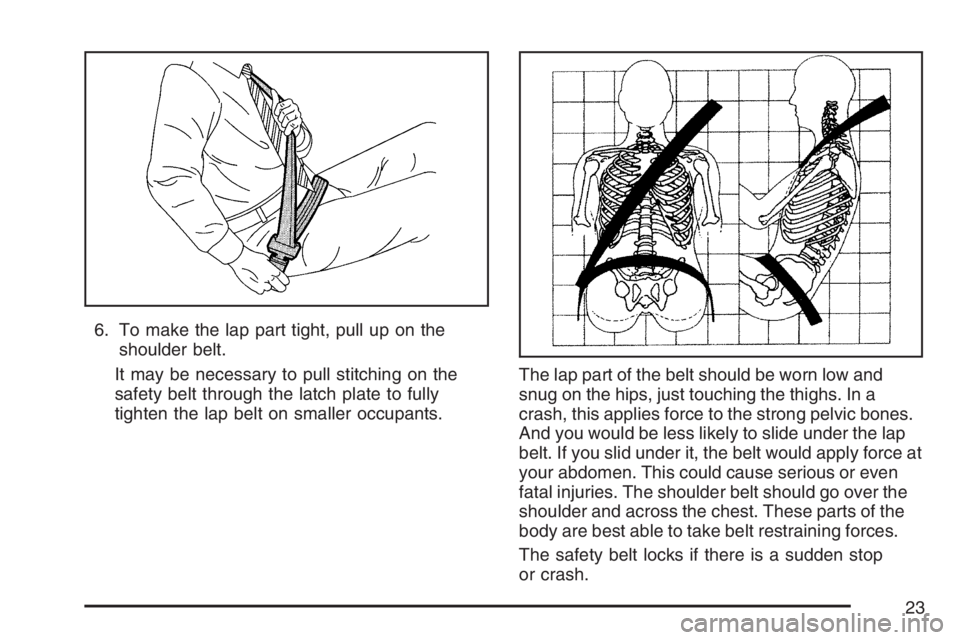
tighten the lap belt on smaller occupants.The lap part of the belt should be worn low and
snug on the hips, just touching the thighs. In a
crash, this applies force to the strong pelvic bones.
And you would be less likely to slide under the lap
belt. If you slid under it, the belt would apply force at
your abdomen. This could cause serious or even
fatal injuries. The shoulder belt should go over the
shoulder and across the chest. These parts of the
body are best able to take belt restraining forces.
The safety belt locks if there is a sudden stop
or crash.
23
Page 24 of 512
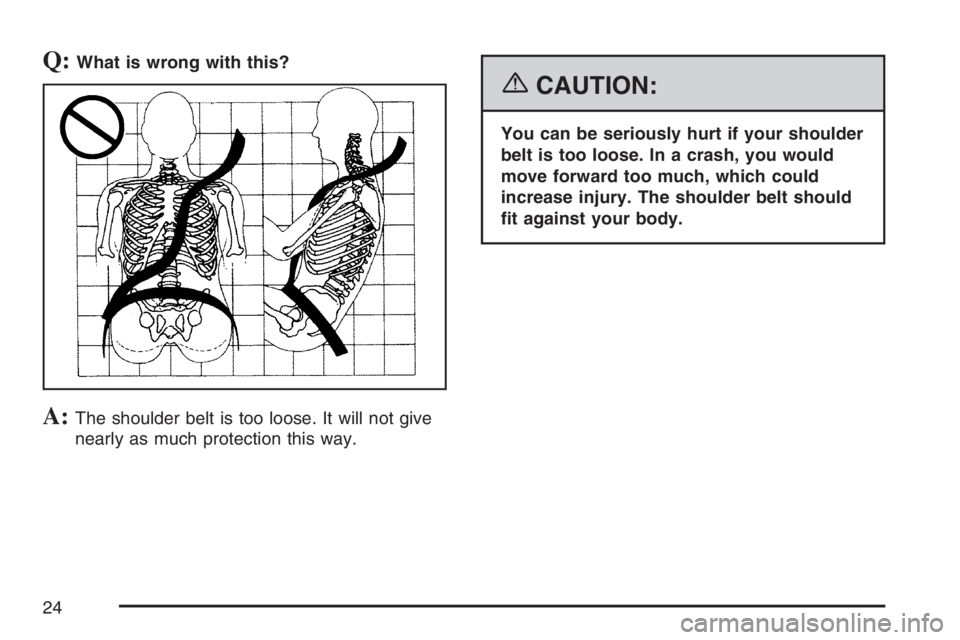
Q:What is wrong with this?
A:The shoulder belt is too loose. It will not give
nearly as much protection this way.
{CAUTION:
You can be seriously hurt if your shoulder
belt is too loose. In a crash, you would
move forward too much, which could
increase injury. The shoulder belt should
t against your body.
24
Page 27 of 512
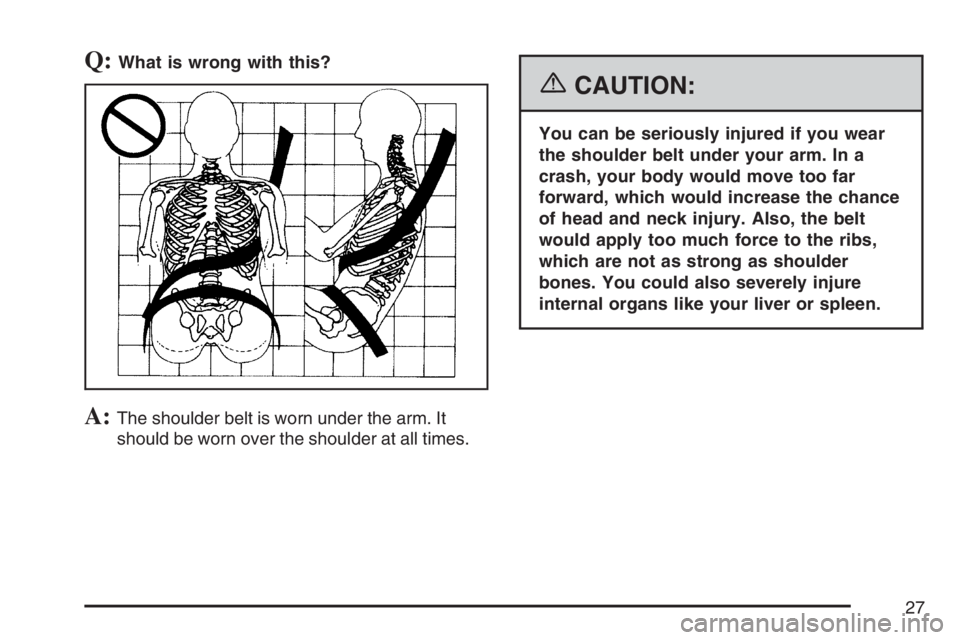
Q:What is wrong with this?
A:The shoulder belt is worn under the arm. It
should be worn over the shoulder at all times.
{CAUTION:
You can be seriously injured if you wear
the shoulder belt under your arm. In a
crash, your body would move too far
forward, which would increase the chance
of head and neck injury. Also, the belt
would apply too much force to the ribs,
which are not as strong as shoulder
bones. You could also severely injure
internal organs like your liver or spleen.
27
Page 28 of 512
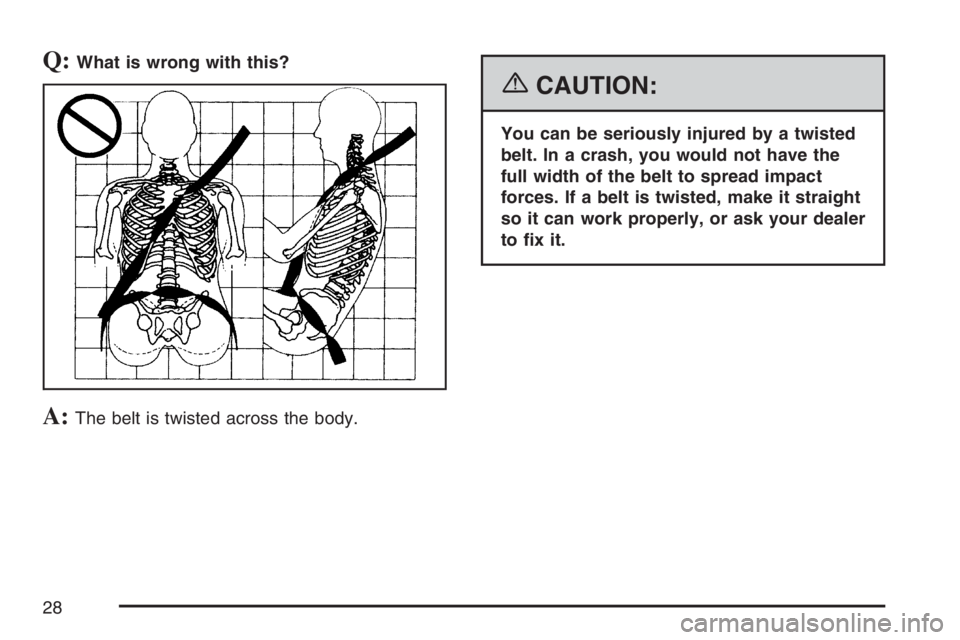
Q:What is wrong with this?
A:The belt is twisted across the body.
{CAUTION:
You can be seriously injured by a twisted
belt. In a crash, you would not have the
full width of the belt to spread impact
forces. If a belt is twisted, make it straight
so it can work properly, or ask your dealer
to x it.
28
Page 34 of 512
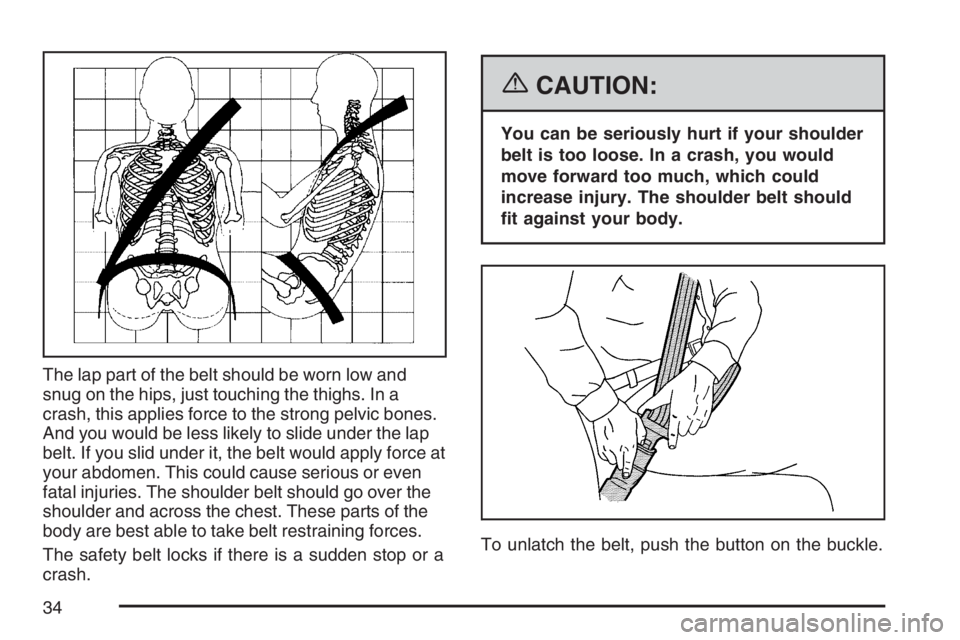
The lap part of the belt should be worn low and
snug on the hips, just touching the thighs. In a
crash, this applies force to the strong pelvic bones.
And you would be less likely to slide under the lap
belt. If you slid under it, the belt would apply force at
your abdomen. This could cause serious or even
fatal injuries. The shoulder belt should go over the
shoulder and across the chest. These parts of the
body are best able to take belt restraining forces.
The safety belt locks if there is a sudden stop or a
crash.
{CAUTION:
You can be seriously hurt if your shoulder
belt is too loose. In a crash, you would
move forward too much, which could
increase injury. The shoulder belt should
t against your body.
To unlatch the belt, push the button on the buckle.
34
Page 35 of 512
Rear Safety Belt Comfort Guides
Rear shoulder belt comfort guides may provide
added safety belt comfort for older children
who have outgrown booster seats and for some
adults. When installed on a shoulder belt, the
comfort guide positions the belt away from
the neck and head.There is one guide for each outboard passenger
position in the rear seat. Here is how to install
a comfort guide to the safety belt:
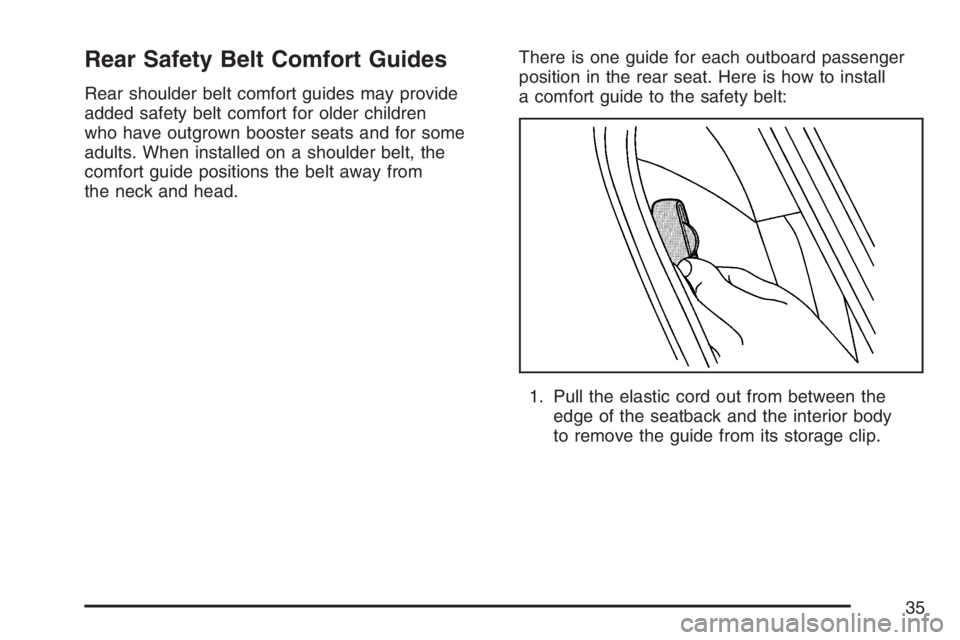
1. Pull the elastic cord out from between the
edge of the seatback and the interior body
to remove the guide from its storage clip.
35
Page 37 of 512
{CAUTION:
A safety belt that is not properly worn may
not provide the protection needed in a
crash. The person wearing the belt could
be seriously injured. The shoulder belt
should go over the shoulder and across
the chest. These parts of the body are best
able to take belt restraining forces.
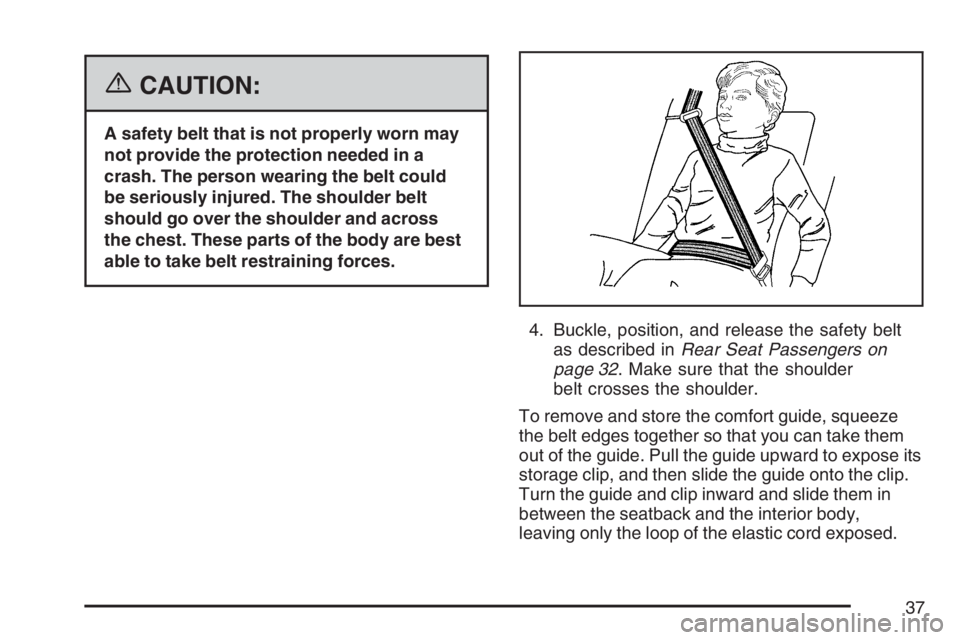
4. Buckle, position, and release the safety belt
as described inRear Seat Passengers on
page 32. Make sure that the shoulder
belt crosses the shoulder.
To remove and store the comfort guide, squeeze
the belt edges together so that you can take them
out of the guide. Pull the guide upward to expose its
storage clip, and then slide the guide onto the clip.
Turn the guide and clip inward and slide them in
between the seatback and the interior body,
leaving only the loop of the elastic cord exposed.
37
Page 40 of 512
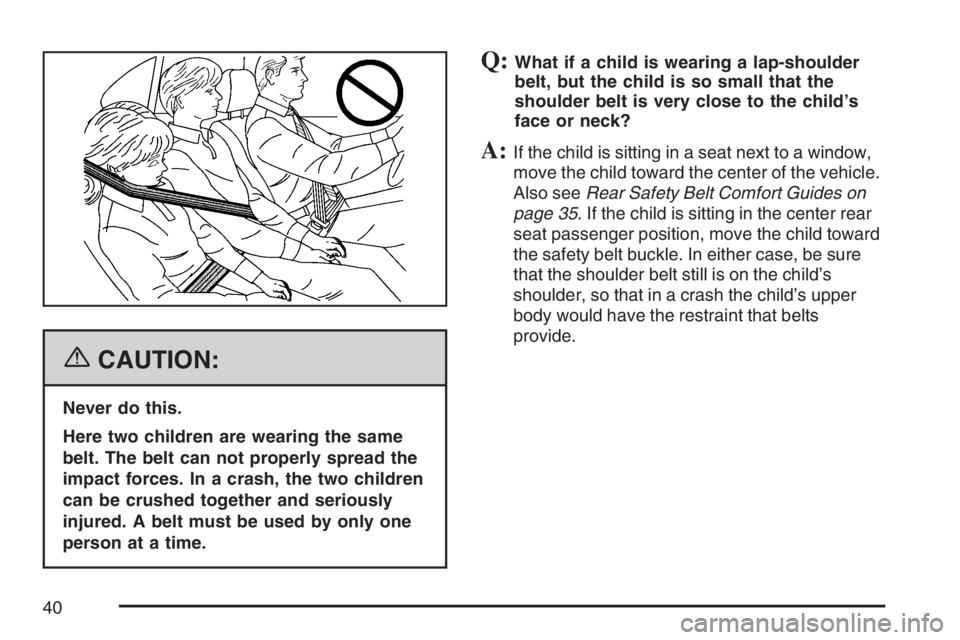
{CAUTION:
Never do this.
Here two children are wearing the same
belt. The belt can not properly spread the
impact forces. In a crash, the two children
can be crushed together and seriously
injured. A belt must be used by only one
person at a time.
Q:What if a child is wearing a lap-shoulder
belt, but the child is so small that the
shoulder belt is very close to the child’s
face or neck?
A:If the child is sitting in a seat next to a window,
move the child toward the center of the vehicle.
Also seeRear Safety Belt Comfort Guides on
page 35. If the child is sitting in the center rear
seat passenger position, move the child toward
the safety belt buckle. In either case, be sure
that the shoulder belt still is on the child’s
shoulder, so that in a crash the child’s upper
body would have the restraint that belts
provide.
40
Page 44 of 512
Q:What are the different types of add-on
child restraints?
A:Add-on child restraints, which are purchased by
the vehicle’s owner, are available in four basic
types. Selection of a particular restraint should
take into consideration not only the child’s
weight, height, and age but also whether or not
the restraint will be compatible with the motor
vehicle in which it will be used.
For most basic types of child restraints, there
are many different models available. When
purchasing a child restraint, be sure it is
designed to be used in a motor vehicle. If it is,
the restraint will have a label saying that it
meets federal motor vehicle safety standards.
The restraint manufacturer’s instructions that
come with the restraint state the weight and
height limitations for a particular child restraint.
In addition, there are many kinds of restraints
available for children with special needs.
{CAUTION:
Newborn infants need complete support,
including support for the head and neck.
This is necessary because a newborn
infant’s neck is weak and its head weighs
so much compared with the rest of its
body. In a crash, an infant in a rear-facing
seat settles into the restraint, so the crash
forces can be distributed across the
strongest part of an infant’s body, the back
and shoulders. Infants always should be
secured in appropriate infant restraints.
44