battery BUICK LACROSSE 2009 Owner's Guide
[x] Cancel search | Manufacturer: BUICK, Model Year: 2009, Model line: LACROSSE, Model: BUICK LACROSSE 2009Pages: 428
Page 314 of 428
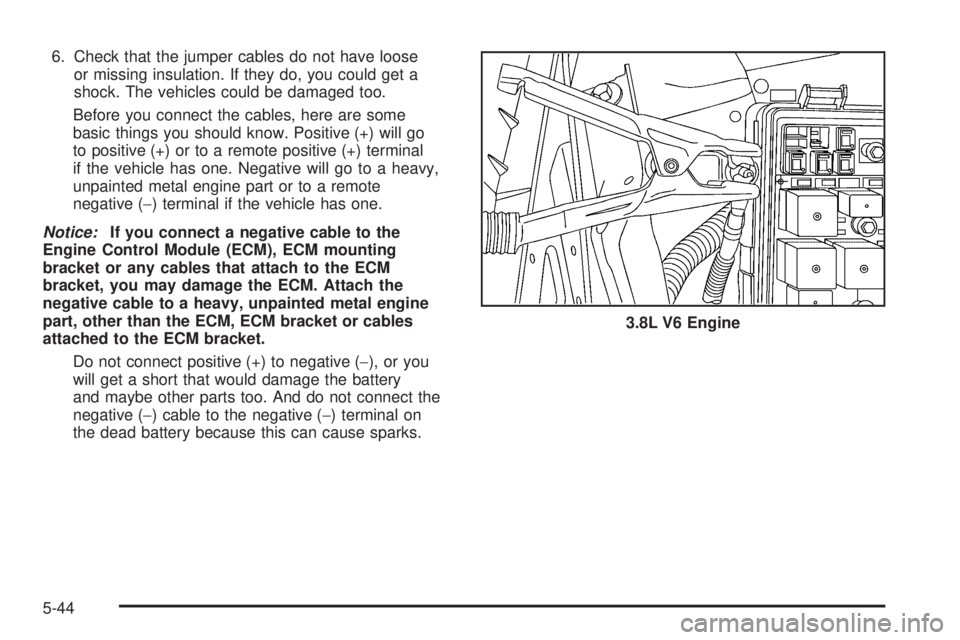
6. Check that the jumper cables do not have loose
or missing insulation. If they do, you could get a
shock. The vehicles could be damaged too.
Before you connect the cables, here are some
basic things you should know. Positive (+) will go
to positive (+) or to a remote positive (+) terminal
if the vehicle has one. Negative will go to a heavy,
unpainted metal engine part or to a remote
negative (−) terminal if the vehicle has one.
Notice:If you connect a negative cable to the
Engine Control Module (ECM), ECM mounting
bracket or any cables that attach to the ECM
bracket, you may damage the ECM. Attach the
negative cable to a heavy, unpainted metal engine
part, other than the ECM, ECM bracket or cables
attached to the ECM bracket.
Do not connect positive (+) to negative (−), or you
will get a short that would damage the battery
and maybe other parts too. And do not connect the
negative (−) cable to the negative (−) terminal on
the dead battery because this can cause sparks.3.8L V6 Engine
5-44
Page 315 of 428
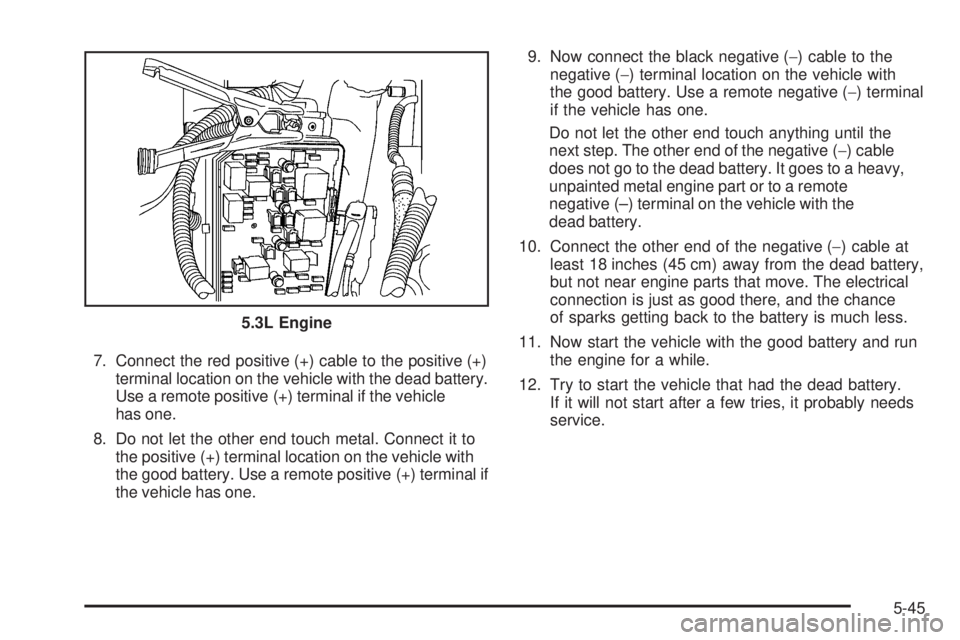
7. Connect the red positive (+) cable to the positive (+)
terminal location on the vehicle with the dead battery.
Use a remote positive (+) terminal if the vehicle
has one.
8. Do not let the other end touch metal. Connect it to
the positive (+) terminal location on the vehicle with
the good battery. Use a remote positive (+) terminal if
the vehicle has one.9. Now connect the black negative (−) cable to the
negative (−) terminal location on the vehicle with
the good battery. Use a remote negative (−) terminal
if the vehicle has one.
Do not let the other end touch anything until the
next step. The other end of the negative (−) cable
does not go to the dead battery. It goes to a heavy,
unpainted metal engine part or to a remote
negative (–) terminal on the vehicle with the
dead battery.
10. Connect the other end of the negative (−) cable at
least 18 inches (45 cm) away from the dead battery,
but not near engine parts that move. The electrical
connection is just as good there, and the chance
of sparks getting back to the battery is much less.
11. Now start the vehicle with the good battery and run
the engine for a while.
12. Try to start the vehicle that had the dead battery.
If it will not start after a few tries, it probably needs
service. 5.3L Engine
5-45
Page 316 of 428
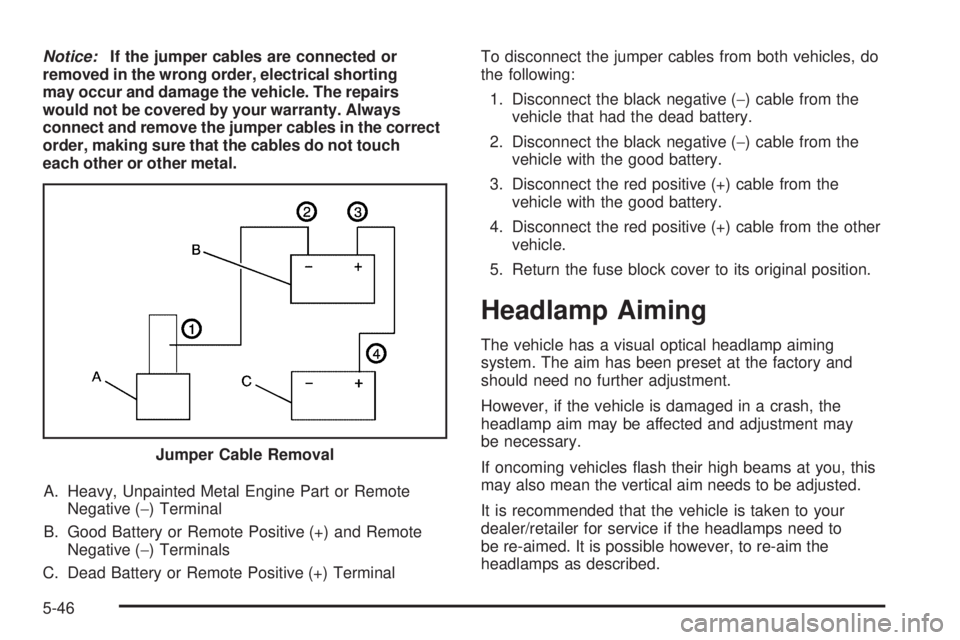
Notice:If the jumper cables are connected or
removed in the wrong order, electrical shorting
may occur and damage the vehicle. The repairs
would not be covered by your warranty. Always
connect and remove the jumper cables in the correct
order, making sure that the cables do not touch
each other or other metal.
A. Heavy, Unpainted Metal Engine Part or Remote
Negative (−) Terminal
B. Good Battery or Remote Positive (+) and Remote
Negative (−) Terminals
C. Dead Battery or Remote Positive (+) TerminalTo disconnect the jumper cables from both vehicles, do
the following:
1. Disconnect the black negative (−) cable from the
vehicle that had the dead battery.
2. Disconnect the black negative (−) cable from the
vehicle with the good battery.
3. Disconnect the red positive (+) cable from the
vehicle with the good battery.
4. Disconnect the red positive (+) cable from the other
vehicle.
5. Return the fuse block cover to its original position.
Headlamp Aiming
The vehicle has a visual optical headlamp aiming
system. The aim has been preset at the factory and
should need no further adjustment.
However, if the vehicle is damaged in a crash, the
headlamp aim may be affected and adjustment may
be necessary.
If oncoming vehicles ash their high beams at you, this
may also mean the vertical aim needs to be adjusted.
It is recommended that the vehicle is taken to your
dealer/retailer for service if the headlamps need to
be re-aimed. It is possible however, to re-aim the
headlamps as described. Jumper Cable Removal
5-46
Page 369 of 428
Electrical System
Add-On Electrical Equipment
Notice:Do not add anything electrical to the
vehicle unless you check with your dealer/retailer
rst. Some electrical equipment can damage
the vehicle and the damage would not be covered
by the vehicle’s warranty. Some add-on electrical
equipment can keep other components from
working as they should.
Add-on equipment can drain the vehicle battery, even if
the vehicle is not operating.
The vehicle has an airbag system. Before attempting to
add anything electrical to the vehicle, seeServicing
Your Airbag-Equipped Vehicle on page 1-66.
Headlamp Wiring
The headlamp wiring is protected by a circuit breaker.
An electrical overload will cause the lamps to go on
and off, or in some cases to remain off. If this happens,
have your headlamp wiring checked right away.
Windshield Wiper Fuses
The windshield wiper motor is protected by a circuit
breaker and a fuse. If the motor overheats due to heavy
snow, etc., the wiper will stop until the motor cools.
If the overload is caused by some electrical problem,
have it xed.
Power Windows and Other Power
Options
Circuit breakers in the fuse block protect the power
windows and other power accessories. When the current
load is too heavy, the circuit breaker opens and closes,
protecting the circuit until the problem is xed or
goes away.
Fuses and Circuit Breakers
The wiring circuits in the vehicle are protected from
short circuits by a combination of fuses, circuit breakers
and in the fuse block wiring itself. This greatly reduces
the chance of res caused by electrical problems.
Look at the silver-colored band inside the fuse. If the
band is broken or melted, replace the fuse. Make sure
a bad fuse is replaced with a new one of the identical
size and rating.
5-99
Page 373 of 428
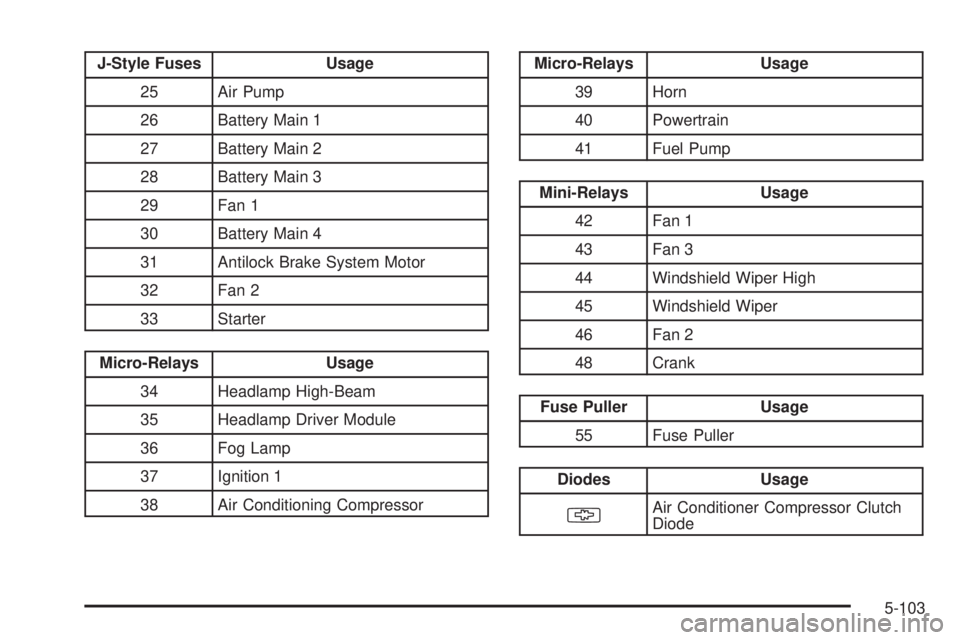
J-Style Fuses Usage
25 Air Pump
26 Battery Main 1
27 Battery Main 2
28 Battery Main 3
29 Fan 1
30 Battery Main 4
31 Antilock Brake System Motor
32 Fan 2
33 Starter
Micro-Relays Usage
34 Headlamp High-Beam
35 Headlamp Driver Module
36 Fog Lamp
37 Ignition 1
38 Air Conditioning Compressor
Micro-Relays Usage
39 Horn
40 Powertrain
41 Fuel Pump
Mini-Relays Usage
42 Fan 1
43 Fan 3
44 Windshield Wiper High
45 Windshield Wiper
46 Fan 2
48 Crank
Fuse Puller Usage
55 Fuse Puller
Diodes Usage
§Air Conditioner Compressor Clutch
Diode
5-103
Page 374 of 428
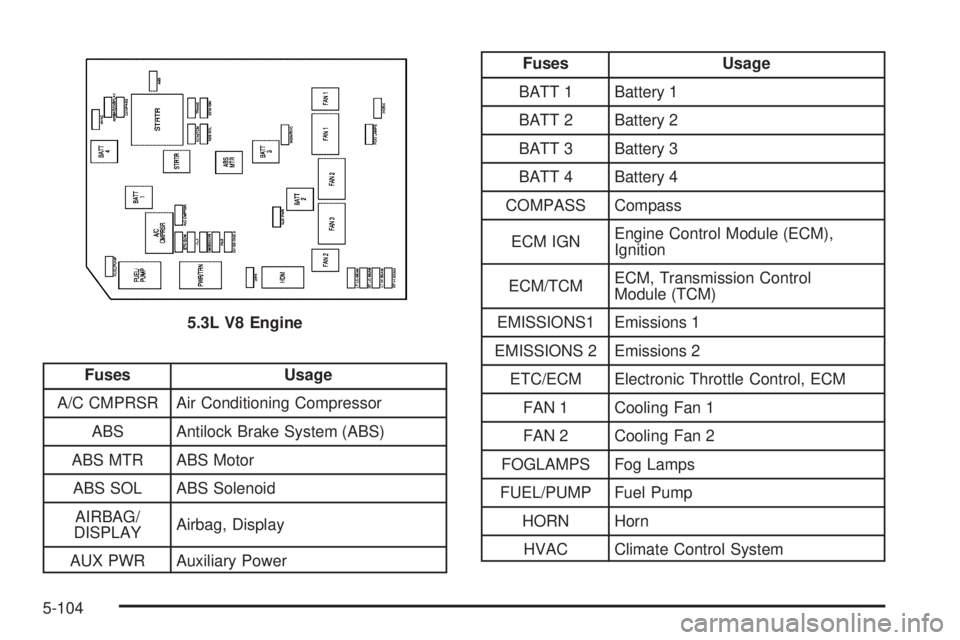
Fuses Usage
A/C CMPRSR Air Conditioning Compressor
ABS Antilock Brake System (ABS)
ABS MTR ABS Motor
ABS SOL ABS Solenoid
AIRBAG/
DISPLAYAirbag, Display
AUX PWR Auxiliary Power
Fuses Usage
BATT 1 Battery 1
BATT 2 Battery 2
BATT 3 Battery 3
BATT 4 Battery 4
COMPASS Compass
ECM IGNEngine Control Module (ECM),
Ignition
ECM/TCMECM, Transmission Control
Module (TCM)
EMISSIONS1 Emissions 1
EMISSIONS 2 Emissions 2
ETC/ECM Electronic Throttle Control, ECM
FAN 1 Cooling Fan 1
FAN 2 Cooling Fan 2
FOGLAMPS Fog Lamps
FUEL/PUMP Fuel Pump
HORN Horn
HVAC Climate Control System 5.3L V8 Engine
5-104
Page 404 of 428
Coverage
Services are provided up to 5 years/100,000 miles
(160 000 km), whichever comes rst.
In the U.S., anyone driving the vehicle is covered.
In Canada, a person driving the vehicle without
permission from the owner is not covered.
Roadside Assistance is not a part of the New Vehicle
Limited Warranty. Buick and General Motors of Canada
Limited reserve the right to make any changes or
discontinue the Roadside Assistance program at any
time without notication.
Buick and General Motors of Canada Limited reserve
the right to limit services or payment to an owner
or driver if they decide the claims are made too often,
or the same type of claim is made many times.
Services Provided
Emergency Fuel Delivery:Delivery of enough fuel
for the vehicle to get to the nearest service station.
Lock-Out Service:Service is provided to unlock the
vehicle if you are locked out. A remote unlock may
be available if you have OnStar
®. For security
reasons, the driver must present identication
before this service is given.
Emergency Tow From a Public Road or
Highway:Tow to the nearest Buick dealer for
warranty service, or if the vehicle was in a crash and
cannot be driven. Assistance is also given when
the vehicle is stuck in sand, mud, or snow.
Flat Tire Change:Service is provided to change
a at tire with the spare tire. The spare tire, if
equipped, must be in good condition and properly
inated. It is the owner’s responsibility for the repair
or replacement of the tire if it is not covered by
the warranty.
Battery Jump Start:Service is provided to jump
start a dead battery.
Trip Interruption Benets and Assistance:
If your trip is interrupted due to a warranty failure,
incidental expenses may be reimbursed during
the 5 years/100,000 miles (160 000 km) Powertrain
warranty period. Items considered are hotel,
meals, and rental car.
7-8
Page 416 of 428
Audio System(s).............................................3-83
Automatic Door Lock.......................................2-10
Automatic Transmission
Fluid..........................................................5-22
Operation...................................................2-26
B
Backglass Antenna........................................3-113
Battery..........................................................5-40
Electric Power Management..........................3-18
Exterior Lighting Battery Saver......................3-15
Run-Down Protection...................................3-19
Bluetooth
®.....................................................3-99
Brake
Emergencies................................................ 4-5
Brake Fluid....................................................5-37
Brakes..........................................................5-37
System Warning Light..................................3-35
Braking........................................................... 4-4
Braking in Emergencies..................................... 4-5
Break-In, New Vehicle.....................................2-21
Bulb Replacement...........................................5-49
Halogen Bulbs............................................5-49
Headlamp Aiming........................................5-46
License Plate Lamps....................................5-52Bulb Replacement (cont.)
Replacement Bulbs......................................5-52
Taillamps, Turn Signal, Sidemarker,
Stoplamps, and Back-Up Lamps.................5-50
Buying New Tires...........................................5-69
C
Calibration.....................................................3-54
California Fuel.................................................. 5-6
California Perchlorate Materials
Requirements............................................... 5-4
California Proposition 65 Warning....................... 5-4
Canadian Owners................................................ ii
Capacities and Specications..........................5-106
Carbon Monoxide...........................2-12, 2-33, 4-17
Care of
Safety Belts................................................5-93
CD, MP3 .......................................................3-95
Center Console Storage Area...........................2-47
Center Seat..................................................... 1-7
Chains, Tire...................................................5-75
Charging System Light....................................3-35
Check
Engine Lamp..............................................3-40
Check Gas Cap Light......................................3-47
Checking Things Under the Hood......................5-10
2
Page 419 of 428
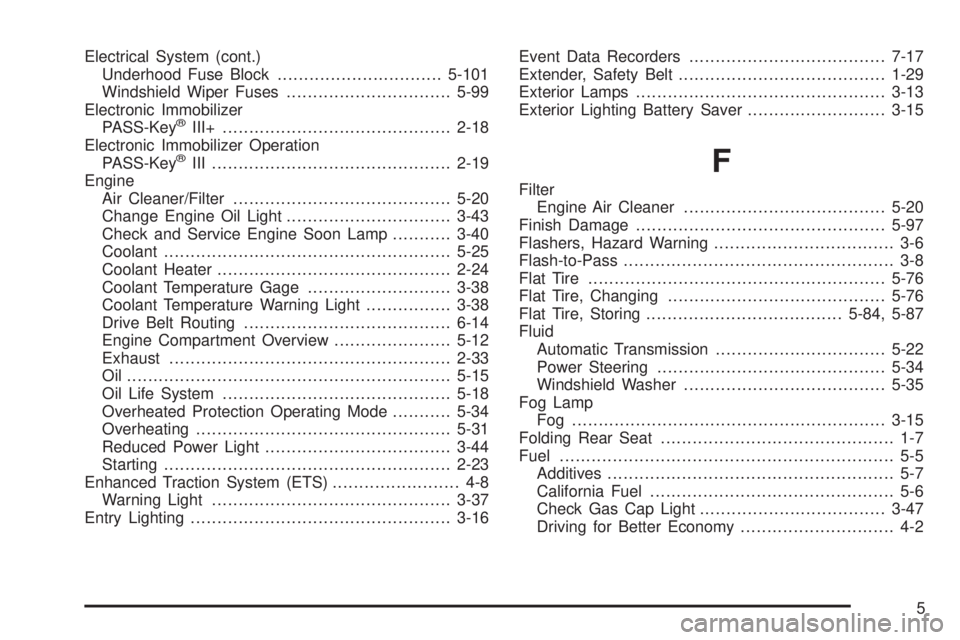
Electrical System (cont.)
Underhood Fuse Block...............................5-101
Windshield Wiper Fuses...............................5-99
Electronic Immobilizer
PASS-Key
®III+...........................................2-18
Electronic Immobilizer Operation
PASS-Key
®III .............................................2-19
Engine
Air Cleaner/Filter.........................................5-20
Change Engine Oil Light...............................3-43
Check and Service Engine Soon Lamp...........3-40
Coolant......................................................5-25
Coolant Heater............................................2-24
Coolant Temperature Gage...........................3-38
Coolant Temperature Warning Light................3-38
Drive Belt Routing.......................................6-14
Engine Compartment Overview......................5-12
Exhaust.....................................................2-33
Oil .............................................................5-15
Oil Life System...........................................5-18
Overheated Protection Operating Mode...........5-34
Overheating................................................5-31
Reduced Power Light...................................3-44
Starting......................................................2-23
Enhanced Traction System (ETS)........................ 4-8
Warning Light.............................................3-37
Entry Lighting.................................................3-16Event Data Recorders.....................................7-17
Extender, Safety Belt.......................................1-29
Exterior Lamps...............................................3-13
Exterior Lighting Battery Saver..........................3-15F
Filter
Engine Air Cleaner......................................5-20
Finish Damage...............................................5-97
Flashers, Hazard Warning.................................. 3-6
Flash-to-Pass................................................... 3-8
Flat Tire........................................................5-76
Flat Tire, Changing.........................................5-76
Flat Tire, Storing.....................................5-84, 5-87
Fluid
Automatic Transmission................................5-22
Power Steering...........................................5-34
Windshield Washer......................................5-35
Fog Lamp
Fog ...........................................................3-15
Folding Rear Seat............................................ 1-7
Fuel............................................................... 5-5
Additives...................................................... 5-7
California Fuel.............................................. 5-6
Check Gas Cap Light...................................3-47
Driving for Better Economy............................. 4-2
5
Page 421 of 428
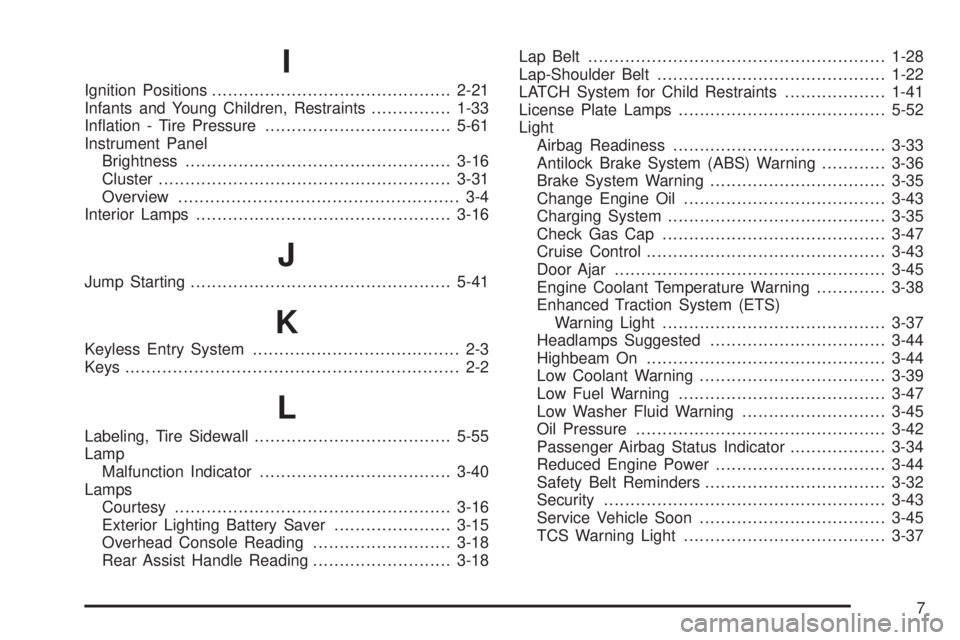
I
Ignition Positions.............................................2-21
Infants and Young Children, Restraints...............1-33
Ination - Tire Pressure...................................5-61
Instrument Panel
Brightness..................................................3-16
Cluster.......................................................3-31
Overview..................................................... 3-4
Interior Lamps................................................3-16
J
Jump Starting.................................................5-41
K
Keyless Entry System....................................... 2-3
Keys............................................................... 2-2
L
Labeling, Tire Sidewall.....................................5-55
Lamp
Malfunction Indicator....................................3-40
Lamps
Courtesy....................................................3-16
Exterior Lighting Battery Saver......................3-15
Overhead Console Reading..........................3-18
Rear Assist Handle Reading..........................3-18Lap Belt........................................................1-28
Lap-Shoulder Belt...........................................1-22
LATCH System for Child Restraints...................1-41
License Plate Lamps.......................................5-52
Light
Airbag Readiness........................................3-33
Antilock Brake System (ABS) Warning............3-36
Brake System Warning.................................3-35
Change Engine Oil......................................3-43
Charging System.........................................3-35
Check Gas Cap..........................................3-47
Cruise Control.............................................3-43
Door Ajar...................................................3-45
Engine Coolant Temperature Warning.............3-38
Enhanced Traction System (ETS)
Warning Light..........................................3-37
Headlamps Suggested.................................3-44
Highbeam On.............................................3-44
Low Coolant Warning...................................3-39
Low Fuel Warning.......................................3-47
Low Washer Fluid Warning...........................3-45
Oil Pressure...............................................3-42
Passenger Airbag Status Indicator..................3-34
Reduced Engine Power................................3-44
Safety Belt Reminders..................................3-32
Security.....................................................3-43
Service Vehicle Soon...................................3-45
TCS Warning Light......................................3-37
7