ECU BUICK LACROSSE 2009 Service Manual
[x] Cancel search | Manufacturer: BUICK, Model Year: 2009, Model line: LACROSSE, Model: BUICK LACROSSE 2009Pages: 428
Page 281 of 428
Hood Release
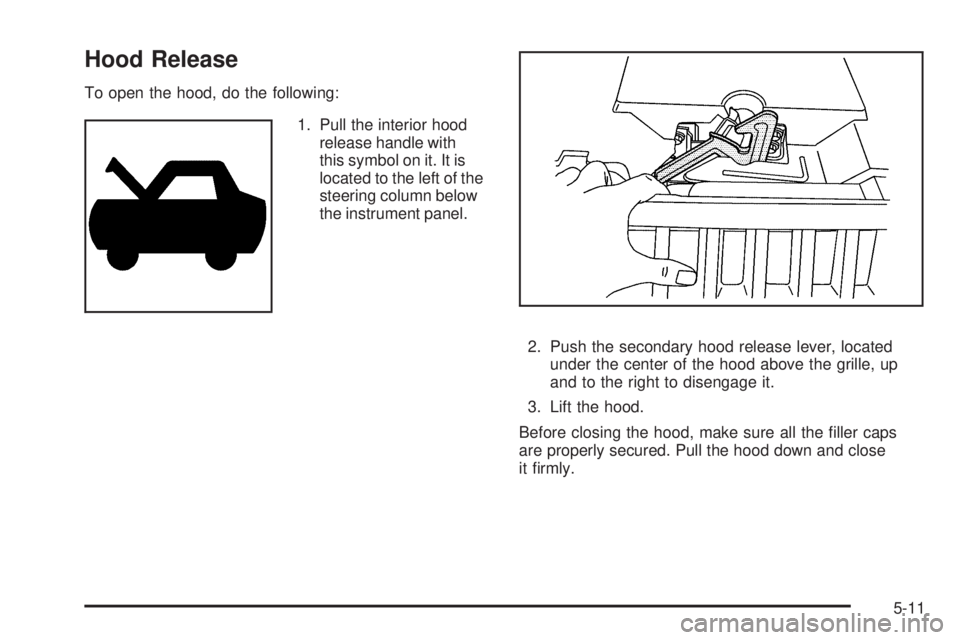
To open the hood, do the following:
1. Pull the interior hood
release handle with
this symbol on it. It is
located to the left of the
steering column below
the instrument panel.
2. Push the secondary hood release lever, located
under the center of the hood above the grille, up
and to the right to disengage it.
3. Lift the hood.
Before closing the hood, make sure all the ller caps
are properly secured. Pull the hood down and close
it rmly.
5-11
Page 301 of 428
Radiator Pressure Cap
Notice:If the pressure cap is not tightly installed,
coolant loss and possible engine damage may
occur. Be sure the cap is properly and tightly
secured.
The radiator pressure cap is located in the front of the
engine compartment on the passenger’s side of the
vehicle. SeeEngine Compartment Overview on
page 5-12for more information on location.
Pressure Cap
Notice:If the pressure cap is not tightly installed,
coolant loss and possible engine damage may
occur. Be sure the cap is properly and tightly
secured.
SeeEngine Compartment Overview on page 5-12for
more information on location.
Engine Overheating
The vehicle has several indicators to warn of engine
overheating.
There is a coolant temperature gage and a warning
light on the instrument panel cluster that indicate an
overheated engine condition. SeeEngine Coolant
Temperature Gage on page 3-38andEngine Coolant
Temperature Warning Light on page 3-38for more
information.
In addition, if your vehicle is equipped with a Driver
Information Center (DIC), you will nd an ENGINE
COOLANT HOT and a REDUCED POWER STOP
WHEN SAFE message displayed on the DIC.
SeeDIC Warnings and Messages on page 3-56
for more information.
5-31
Page 345 of 428
Used Replacement Wheels
{CAUTION:
Putting a used wheel on the vehicle is dangerous.
You cannot know how it has been used or how
far it has been driven. It could fail suddenly and
cause a crash. If you have to replace a wheel,
use a new GM original equipment wheel.
Tire Chains
{CAUTION:
If your vehicle has P225/55R17 or P235/50R18
size tires, do not use tire chains, there is not
enough clearance.
Tire chains used on a vehicle without the proper
amount of clearance can cause damage to the
brakes, suspension or other vehicle parts. The
CAUTION: (Continued)
CAUTION: (Continued)
area damaged by the tire chains could cause you
to lose control of your vehicle and you or others
may be injured in a crash.
Use another type of traction device only if its
manufacturer recommends it for use on your
vehicle and tire size combination and road
conditions. Follow that manufacturer’s instructions.
To help avoid damage to your vehicle, drive slowly,
readjust or remove the device if it is contacting your
vehicle, and do not spin your wheels.
If you do nd traction devices that will t, install
them on the front tires.
Notice:If your vehicle has a tire size other than
P225/55R17 or P235/50R18 size tires, use tire chains
only where legal and only when you must. Use only
SAE Class “S” type chains that are the proper size for
your tires. Install them on the front tires and tighten
them as tightly as possible with the ends securely
fastened. Drive slowly and follow the chain
manufacturer’s instructions. If you can hear the
chains contacting your vehicle, stop and retighten
them. If the contact continues, slow down until it
stops. Driving too fast or spinning the wheels with
chains on will damage your vehicle.
5-75
Page 354 of 428
Storing a Flat or Spare Tire and
Tools (Base Model)
{CAUTION:
Storing a jack, a tire, or other equipment in the
passenger compartment of the vehicle could
cause injury. In a sudden stop or collision, loose
equipment could strike someone. Store all these
in the proper place.
After the compact spare tire has been installed on the
vehicle, store the at tire in the trunk.
When storing a full-size tire, use the extension with
the extension protector, located in the foam holder,
to help avoid wheel surface damage.To store a full-size tire:
1. Install the tools in their original location in the trunk
area and secure.
2. Place the tire valve stem facing down and the
protector/guide placed through a wheel bolt hole.
3. Remove the protector and attach the retainer
securely.
4. Store the cover as far forward as possible.
When storing a compact spare tire in the trunk, put the
protector back in the foam holder.
The compact spare is for temporary use only. Replace
the compact spare tire with a full-size tire as soon as you
can. SeeCompact Spare Tire on page 5-89. Use this as
a guide for storing the compact spare tire and tools.
5-84
Page 357 of 428
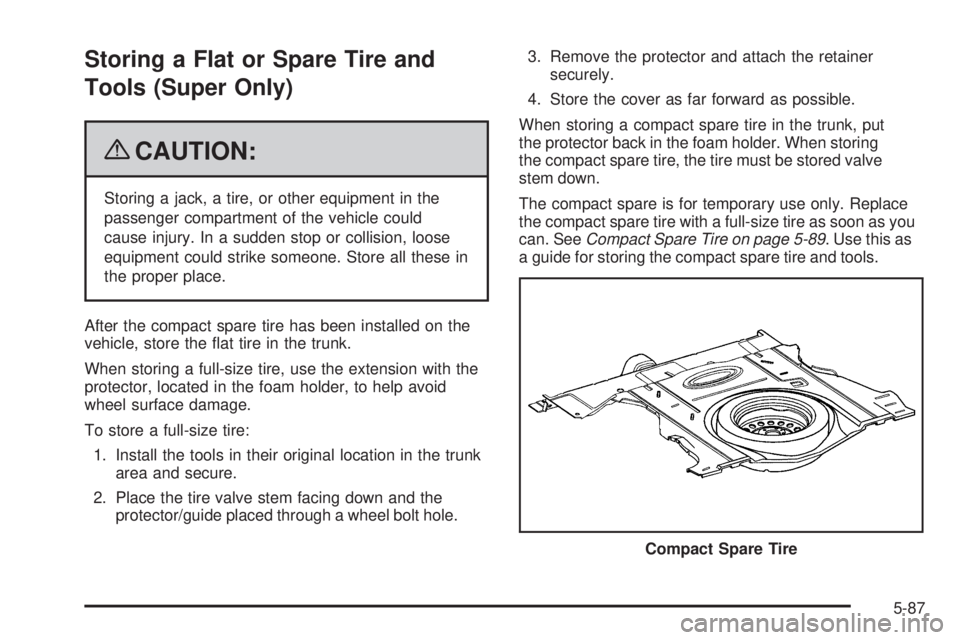
Storing a Flat or Spare Tire and
Tools (Super Only)
{CAUTION:
Storing a jack, a tire, or other equipment in the
passenger compartment of the vehicle could
cause injury. In a sudden stop or collision, loose
equipment could strike someone. Store all these in
the proper place.
After the compact spare tire has been installed on the
vehicle, store the at tire in the trunk.
When storing a full-size tire, use the extension with the
protector, located in the foam holder, to help avoid
wheel surface damage.
To store a full-size tire:
1. Install the tools in their original location in the trunk
area and secure.
2. Place the tire valve stem facing down and the
protector/guide placed through a wheel bolt hole.3. Remove the protector and attach the retainer
securely.
4. Store the cover as far forward as possible.
When storing a compact spare tire in the trunk, put
the protector back in the foam holder. When storing
the compact spare tire, the tire must be stored valve
stem down.
The compact spare is for temporary use only. Replace
the compact spare tire with a full-size tire as soon as you
can. SeeCompact Spare Tire on page 5-89. Use this as
a guide for storing the compact spare tire and tools.
Compact Spare Tire
5-87
Page 387 of 428
Engine Coolant Level Check
Check the engine coolant level and add DEX-COOL®
coolant mixture if necessary. SeeEngine Coolant
on page 5-25.
Windshield Washer Fluid Level Check
Check the windshield washer uid level in the windshield
washer uid reservoir and add the proper uid if
necessary.
At Least Once a Month
Tire Ination Check
Inspect the vehicle’s tires and make sure they are
inated to the correct pressures. Do not forget to
check the spare tire. SeeInflation - Tire Pressure on
page 5-61. Check to make sure the spare tire is stored
securely. SeeChanging a Flat Tire on page 5-76.
Tire Wear Inspection
Tire rotation may be required for high mileage highway
drivers prior to the Engine Oil Life System service
notication. Check the tires for wear and, if necessary,
rotate the tires. SeeTire Inspection and Rotation on
page 5-67.
At Least Once a Year
Starter Switch Check
{CAUTION:
When you are doing this inspection, the vehicle
could move suddenly. If the vehicle moves, you or
others could be injured.
1. Before starting this check, be sure there is enough
room around the vehicle.
2. Firmly apply both the parking brake and the regular
brake. SeeParking Brake on page 2-29.
Do not use the accelerator pedal, and be ready to
turn off the engine immediately if it starts.
3. Try to start the engine in each gear. The vehicle
should start only in P (Park) or N (Neutral). If the
vehicle starts in any other position, contact your
dealer/retailer for service.
6-9
Page 404 of 428
Coverage
Services are provided up to 5 years/100,000 miles
(160 000 km), whichever comes rst.
In the U.S., anyone driving the vehicle is covered.
In Canada, a person driving the vehicle without
permission from the owner is not covered.
Roadside Assistance is not a part of the New Vehicle
Limited Warranty. Buick and General Motors of Canada
Limited reserve the right to make any changes or
discontinue the Roadside Assistance program at any
time without notication.
Buick and General Motors of Canada Limited reserve
the right to limit services or payment to an owner
or driver if they decide the claims are made too often,
or the same type of claim is made many times.
Services Provided
Emergency Fuel Delivery:Delivery of enough fuel
for the vehicle to get to the nearest service station.
Lock-Out Service:Service is provided to unlock the
vehicle if you are locked out. A remote unlock may
be available if you have OnStar
®. For security
reasons, the driver must present identication
before this service is given.
Emergency Tow From a Public Road or
Highway:Tow to the nearest Buick dealer for
warranty service, or if the vehicle was in a crash and
cannot be driven. Assistance is also given when
the vehicle is stuck in sand, mud, or snow.
Flat Tire Change:Service is provided to change
a at tire with the spare tire. The spare tire, if
equipped, must be in good condition and properly
inated. It is the owner’s responsibility for the repair
or replacement of the tire if it is not covered by
the warranty.
Battery Jump Start:Service is provided to jump
start a dead battery.
Trip Interruption Benets and Assistance:
If your trip is interrupted due to a warranty failure,
incidental expenses may be reimbursed during
the 5 years/100,000 miles (160 000 km) Powertrain
warranty period. Items considered are hotel,
meals, and rental car.
7-8
Page 414 of 428
To read data recorded by an EDR, special equipment is
required, and access to the vehicle or the EDR is
needed. In addition to the vehicle manufacturer, other
parties, such as law enforcement, that have the special
equipment, can read the information if they have
access to the vehicle or the EDR.
GM will not access this data or share it with others
except: with the consent of the vehicle owner or, if the
vehicle is leased, with the consent of the lessee; in
response to an official request of police or similar
government office; as part of GM’s defense of litigation
through the discovery process; or, as required by
law. Data that GM collects or receives may also be used
for GM research needs or may be made available to
others for research purposes, where a need is shown
and the data is not tied to a specic vehicle or
vehicle owner.
OnStar®
If your vehicle has OnStar and you subscribe to the
OnStar services, please refer to the OnStar Terms and
Conditions for information on data collection and
use. See alsoOnStar
®System on page 2-39in this
manual for more information.
Navigation System
If your vehicle has a navigation system, use of the
system may result in the storage of destinations,
addresses, telephone numbers, and other trip
information. Refer to the navigation system operating
manual for information on stored data and for deletion
instructions.
Radio Frequency
Identication (RFID)
RFID technology is used in some vehicles for functions
such as tire pressure monitoring and ignition system
security, as well as in connection with conveniences
such as key fobs for remote door locking/unlocking and
starting, and in-vehicle transmitters for garage door
openers. RFID technology in GM vehicles does not use
or record personal information or link with any other
GM system containing personal information.
7-18
Page 417 of 428
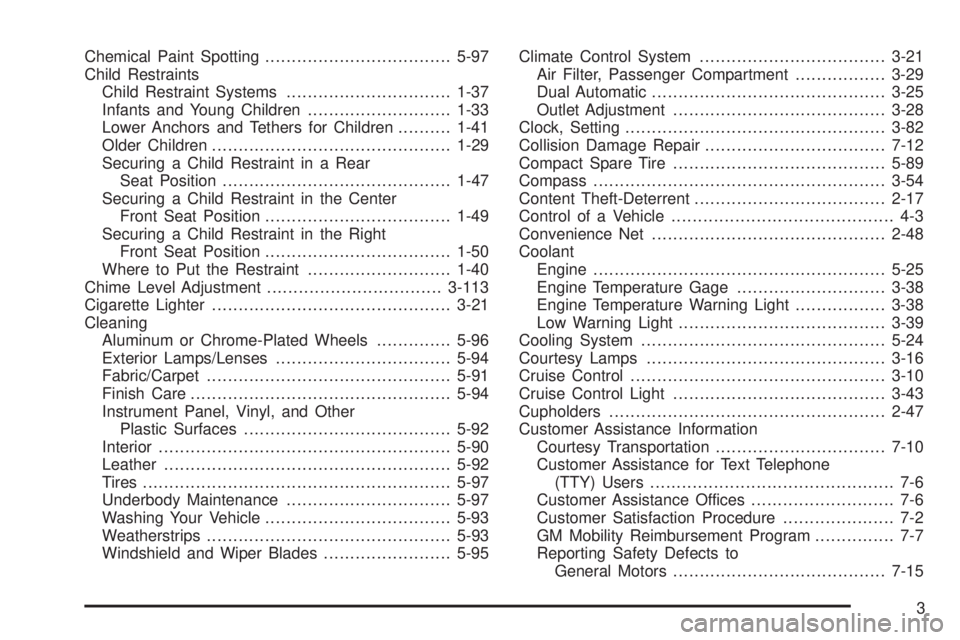
Chemical Paint Spotting...................................5-97
Child Restraints
Child Restraint Systems...............................1-37
Infants and Young Children...........................1-33
Lower Anchors and Tethers for Children..........1-41
Older Children.............................................1-29
Securing a Child Restraint in a Rear
Seat Position...........................................1-47
Securing a Child Restraint in the Center
Front Seat Position...................................1-49
Securing a Child Restraint in the Right
Front Seat Position...................................1-50
Where to Put the Restraint...........................1-40
Chime Level Adjustment.................................3-113
Cigarette Lighter.............................................3-21
Cleaning
Aluminum or Chrome-Plated Wheels..............5-96
Exterior Lamps/Lenses.................................5-94
Fabric/Carpet..............................................5-91
Finish Care.................................................5-94
Instrument Panel, Vinyl, and Other
Plastic Surfaces.......................................5-92
Interior.......................................................5-90
Leather......................................................5-92
Tires..........................................................5-97
Underbody Maintenance...............................5-97
Washing Your Vehicle...................................5-93
Weatherstrips..............................................5-93
Windshield and Wiper Blades........................5-95Climate Control System...................................3-21
Air Filter, Passenger Compartment.................3-29
Dual Automatic............................................3-25
Outlet Adjustment........................................3-28
Clock, Setting.................................................3-82
Collision Damage Repair..................................7-12
Compact Spare Tire........................................5-89
Compass.......................................................3-54
Content Theft-Deterrent....................................
2-17
Control of a Vehicle.......................................... 4-3
Convenience Net............................................2-48
Coolant
Engine.......................................................5-25
Engine Temperature Gage............................3-38
Engine Temperature Warning Light.................3-38
Low Warning Light.......................................3-39
Cooling System..............................................5-24
Courtesy Lamps.............................................3-16
Cruise Control................................................3-10
Cruise Control Light........................................3-43
Cupholders....................................................2-47
Customer Assistance Information
Courtesy Transportation................................7-10
Customer Assistance for Text Telephone
(TTY) Users.............................................. 7-6
Customer Assistance Offices........................... 7-6
Customer Satisfaction Procedure..................... 7-2
GM Mobility Reimbursement Program............... 7-7
Reporting Safety Defects to
General Motors........................................7-15
3
Page 418 of 428
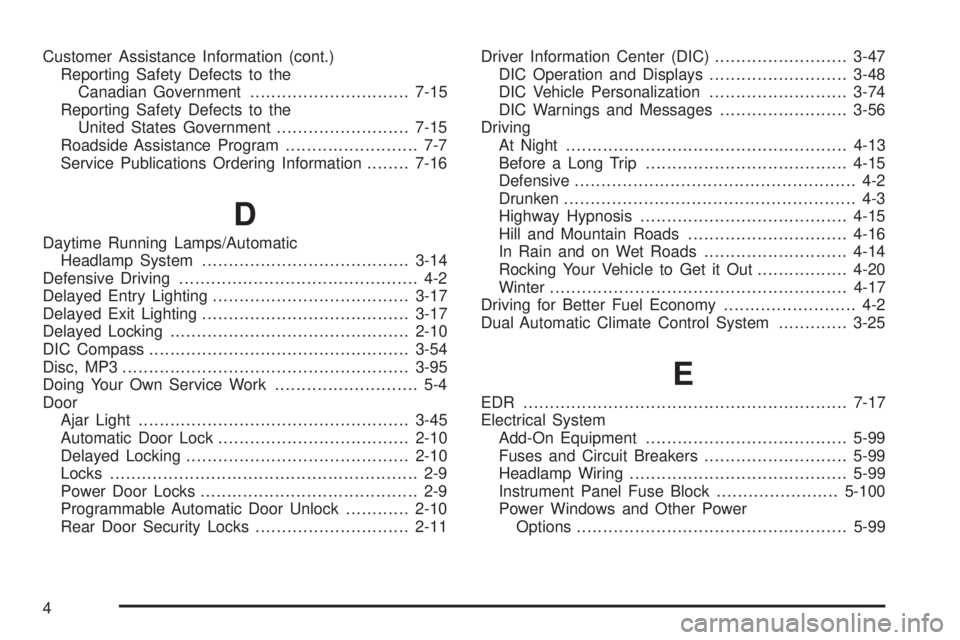
Customer Assistance Information (cont.)
Reporting Safety Defects to the
Canadian Government..............................7-15
Reporting Safety Defects to the
United States Government.........................7-15
Roadside Assistance Program......................... 7-7
Service Publications Ordering Information........7-16
D
Daytime Running Lamps/Automatic
Headlamp System.......................................3-14
Defensive Driving............................................. 4-2
Delayed Entry Lighting.....................................3-17
Delayed Exit Lighting.......................................3-17
Delayed Locking.............................................2-10
DIC Compass.................................................3-54
Disc, MP3......................................................3-95
Doing Your Own Service Work........................... 5-4
Door
Ajar Light...................................................3-45
Automatic Door Lock....................................2-10
Delayed Locking..........................................2-10
Locks.......................................................... 2-9
Power Door Locks......................................... 2-9
Programmable Automatic Door Unlock............2-10
Rear Door Security Locks.............................2-11Driver Information Center (DIC).........................3-47
DIC Operation and Displays..........................3-48
DIC Vehicle Personalization..........................3-74
DIC Warnings and Messages........................3-56
Driving
At Night.....................................................4-13
Before a Long Trip......................................4-15
Defensive..................................................... 4-2
Drunken....................................................... 4-3
Highway Hypnosis.......................................4-15
Hill and Mountain Roads..............................4-16
In Rain and on Wet Roads...........................4-14
Rocking Your Vehicle to Get it Out.................4-20
Winter........................................................4-17
Driving for Better Fuel Economy......................... 4-2
Dual Automatic Climate Control System.............3-25
E
EDR .............................................................7-17
Electrical System
Add-On Equipment......................................5-99
Fuses and Circuit Breakers...........................5-99
Headlamp Wiring.........................................5-99
Instrument Panel Fuse Block.......................5-100
Power Windows and Other Power
Options...................................................5-99
4