display BUICK LACROSSE 2009 Manual PDF
[x] Cancel search | Manufacturer: BUICK, Model Year: 2009, Model line: LACROSSE, Model: BUICK LACROSSE 2009Pages: 428
Page 245 of 428
If cruise control is being used when ETS begins to limit
wheel spin, the cruise control automatically disengages.
The cruise control can be reengaged when road
conditions allow. SeeCruise Control on page 3-10for
more information.
ETS operates in all transmission shift lever positions. But
the system can upshift the transmission only as high as
the chosen shift lever position, so use the lower gears
only when necessary. SeeAutomatic Transmission
Operation on page 2-26for more information.
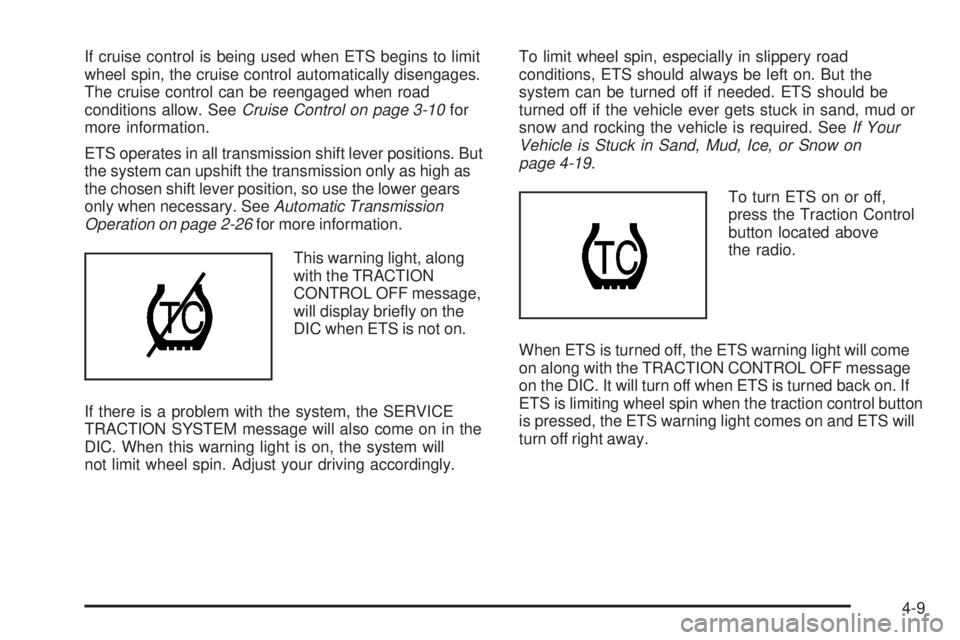
This warning light, along
with the TRACTION
CONTROL OFF message,
will display briey on the
DIC when ETS is not on.
If there is a problem with the system, the SERVICE
TRACTION SYSTEM message will also come on in the
DIC. When this warning light is on, the system will
not limit wheel spin. Adjust your driving accordingly.To limit wheel spin, especially in slippery road
conditions, ETS should always be left on. But the
system can be turned off if needed. ETS should be
turned off if the vehicle ever gets stuck in sand, mud or
snow and rocking the vehicle is required. SeeIf Your
Vehicle is Stuck in Sand, Mud, Ice, or Snow on
page 4-19.
To turn ETS on or off,
press the Traction Control
button located above
the radio.
When ETS is turned off, the ETS warning light will come
on along with the TRACTION CONTROL OFF message
on the DIC. It will turn off when ETS is turned back on. If
ETS is limiting wheel spin when the traction control button
is pressed, the ETS warning light comes on and ETS will
turn off right away.
4-9
Page 279 of 428
{CAUTION:
Fuel can spray out on you if you open the fuel cap
too quickly. If you spill fuel and then something
ignites it, you could be badly burned. This spray
can happen if the tank is nearly full, and is more
likely in hot weather. Open the fuel cap slowly and
wait for any hiss noise to stop. Then unscrew the
cap all the way.
Be careful not to spill fuel. Do not top off or overll the
tank and wait a few seconds after you have nished
pumping before removing the nozzle. Clean fuel from
painted surfaces as soon as possible. SeeWashing
Your Vehicle on page 5-93.
When replacing the fuel cap, turn it clockwise until it
clicks. Make sure the cap is fully installed. The diagnostic
system can determine if the fuel cap has been left off or
improperly installed. This would allow fuel to evaporate
into the atmosphere. SeeMalfunction Indicator Lamp on
page 3-40.The vehicle may also have a check gas cap warning
light, which displays on the instrument panel cluster
if the fuel cap is not properly installed. SeeCheck
Gas Cap Light on page 3-47for more information.
If the vehicle has a Driver Information Center (DIC),
the CHECK GAS CAP message displays if the fuel
cap is not properly installed. SeeDIC Warnings
and Messages on page 3-56for more information.
{CAUTION:
If a re starts while you are refueling, do not
remove the nozzle. Shut off the ow of fuel by
shutting off the pump or by notifying the station
attendant. Leave the area immediately.
Notice:If you need a new fuel cap, be sure to get
the right type. Your dealer/retailer can get one
for you. If you get the wrong type, it may not t
properly. This may cause the malfunction indicator
lamp to light and may damage the fuel tank and
emissions system. SeeMalfunction Indicator Lamp
on page 3-40.
5-9
Page 301 of 428
Radiator Pressure Cap
Notice:If the pressure cap is not tightly installed,
coolant loss and possible engine damage may
occur. Be sure the cap is properly and tightly
secured.
The radiator pressure cap is located in the front of the
engine compartment on the passenger’s side of the
vehicle. SeeEngine Compartment Overview on
page 5-12for more information on location.
Pressure Cap
Notice:If the pressure cap is not tightly installed,
coolant loss and possible engine damage may
occur. Be sure the cap is properly and tightly
secured.
SeeEngine Compartment Overview on page 5-12for
more information on location.
Engine Overheating
The vehicle has several indicators to warn of engine
overheating.
There is a coolant temperature gage and a warning
light on the instrument panel cluster that indicate an
overheated engine condition. SeeEngine Coolant
Temperature Gage on page 3-38andEngine Coolant
Temperature Warning Light on page 3-38for more
information.
In addition, if your vehicle is equipped with a Driver
Information Center (DIC), you will nd an ENGINE
COOLANT HOT and a REDUCED POWER STOP
WHEN SAFE message displayed on the DIC.
SeeDIC Warnings and Messages on page 3-56
for more information.
5-31
Page 303 of 428
If No Steam Is Coming From The
Engine Compartment
If an engine overheat warning is displayed but no steam
can be seen or heard, the problem may not be too
serious. Sometimes the engine can get a little too hot
when the vehicle:
Climbs a long hill on a hot day.
Stops after high-speed driving.
Idles for long periods in traffic.
Tows a trailer.
If the overheat warning is displayed with no sign of
steam:
1. Turn the air off.
2. Turn the heater on to the highest temperature and
to the highest fan speed. Open the windows as
necessary.3. In heavy traffic, let the engine idle in N (Neutral)
while stopped. If it is safe to do so, pull off the
road, shift to P (Park) or N (Neutral) and let
the engine idle.
If the temperature overheat gage is no longer in the
overheat zone or an overheat warning no longer displays,
the vehicle can be driven. Continue to drive the vehicle
slow for about 10 minutes. Keep a safe vehicle distance
from the car in front of you. If the warning does not come
back on, continue to drive normally.
If the warning continues, pull over, stop, and park the
vehicle right away.
If there is no sign of steam, idle the engine for
three minutes while parked. If the warning is still
displayed, turn off the engine until it cools down. Also,
see″Overheated Engine Protection Operating Mode″
later in this section.
5-33
Page 306 of 428
Adding Washer Fluid
When the windshield washer uid is low, a low washer
uid light may appear on the instrument panel cluster.
SeeLow Washer Fluid Warning Light on page 3-45
for more information.
In addition, if your vehicle has a Driver Information
Center (DIC), the LOW WASHER FLUID message will
display when the uid level is low. SeeDIC Warnings
and Messages on page 3-56for more information.
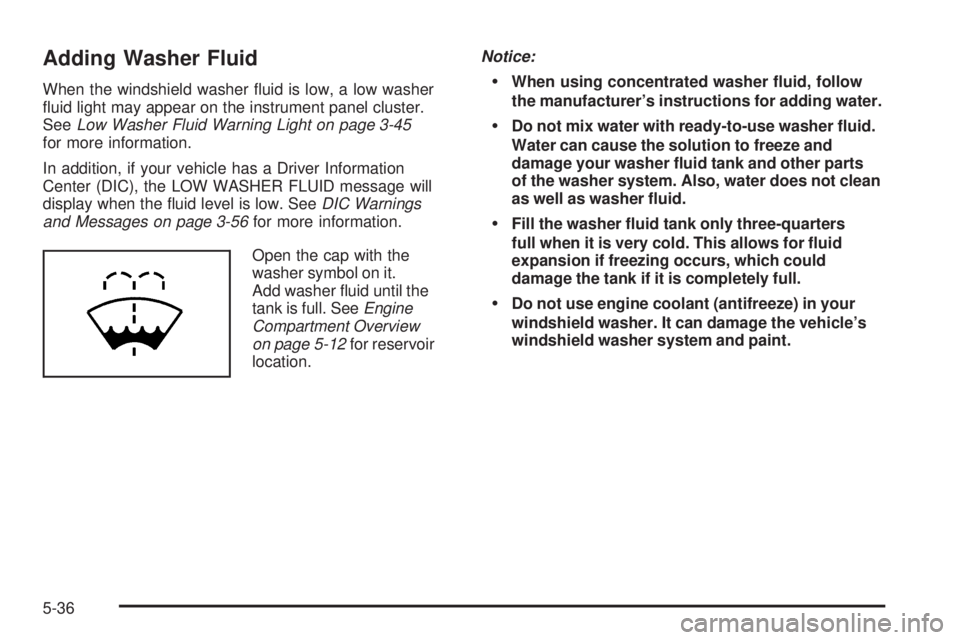
Open the cap with the
washer symbol on it.
Add washer uid until the
tank is full. SeeEngine
Compartment Overview
on page 5-12for reservoir
location.Notice:When using concentrated washer uid, follow
the manufacturer’s instructions for adding water.
Do not mix water with ready-to-use washer uid.
Water can cause the solution to freeze and
damage your washer uid tank and other parts
of the washer system. Also, water does not clean
as well as washer uid.
Fill the washer uid tank only three-quarters
full when it is very cold. This allows for uid
expansion if freezing occurs, which could
damage the tank if it is completely full.
Do not use engine coolant (antifreeze) in your
windshield washer. It can damage the vehicle’s
windshield washer system and paint.
5-36
Page 334 of 428
Tire Pressure Monitor Operation
This vehicle may have a Tire Pressure Monitor System
(TPMS). The TPMS is designed to warn the driver when
a low tire pressure condition exists. TPMS sensors are
mounted onto each tire and wheel assembly, excluding
the spare tire and wheel assembly. The TPMS sensors
monitor the air pressure in the vehicle’s tires and
transmits the tire pressure readings to a receiver
located in the vehicle.
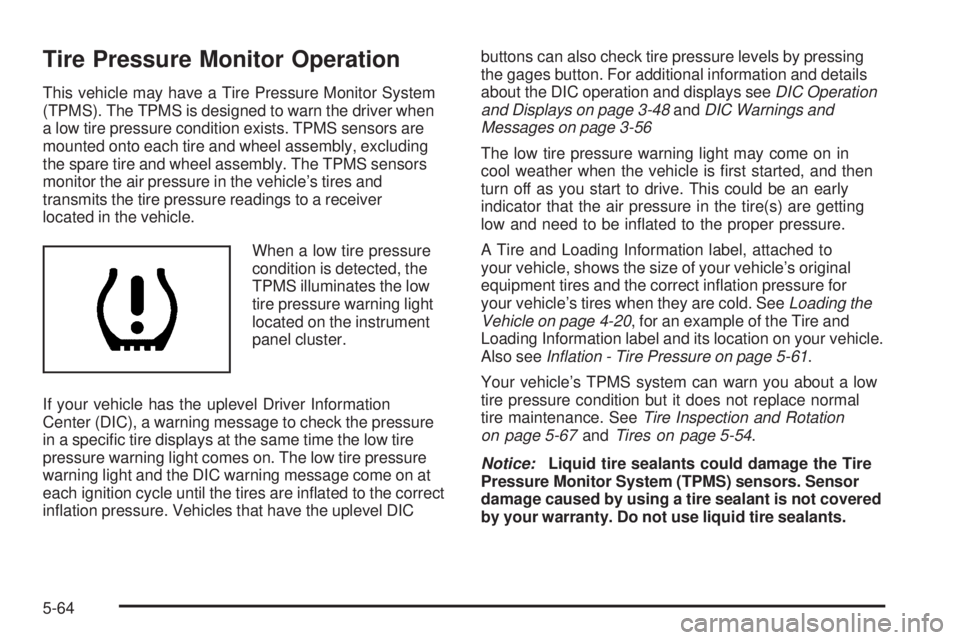
When a low tire pressure
condition is detected, the
TPMS illuminates the low
tire pressure warning light
located on the instrument
panel cluster.
If your vehicle has the uplevel Driver Information
Center (DIC), a warning message to check the pressure
in a specic tire displays at the same time the low tire
pressure warning light comes on. The low tire pressure
warning light and the DIC warning message come on at
each ignition cycle until the tires are inated to the correct
ination pressure. Vehicles that have the uplevel DICbuttons can also check tire pressure levels by pressing
the gages button. For additional information and details
about the DIC operation and displays seeDIC Operation
and Displays on page 3-48andDIC Warnings and
Messages on page 3-56
The low tire pressure warning light may come on in
cool weather when the vehicle is rst started, and then
turn off as you start to drive. This could be an early
indicator that the air pressure in the tire(s) are getting
low and need to be inated to the proper pressure.
A Tire and Loading Information label, attached to
your vehicle, shows the size of your vehicle’s original
equipment tires and the correct ination pressure for
your vehicle’s tires when they are cold. SeeLoading the
Vehicle on page 4-20, for an example of the Tire and
Loading Information label and its location on your vehicle.
Also seeInflation - Tire Pressure on page 5-61.
Your vehicle’s TPMS system can warn you about a low
tire pressure condition but it does not replace normal
tire maintenance. SeeTire Inspection and Rotation
on page 5-67andTires on page 5-54.
Notice:Liquid tire sealants could damage the Tire
Pressure Monitor System (TPMS) sensors. Sensor
damage caused by using a tire sealant is not covered
by your warranty. Do not use liquid tire sealants.
5-64
Page 335 of 428
TPMS Malfunction Light and Message
The TPMS will not function properly if one or more of
the TPMS sensors are missing or inoperable. When the
system detects a malfunction, the low tire warning light
ashes for about one minute and then stays on for the
remainder of the ignition cycle. If your vehicle has the
uplevel Driver Information Center (DIC), A DIC warning
message is also displayed. The low tire warning light and
DIC warning message come on at each ignition cycle
until the problem is corrected. Some of the conditions
that can cause the malfunction light and DIC message
to come on are:
One of the road tires has been replaced with the
spare tire. The spare tire does not have a TPMS
sensor. The TPMS malfunction light should go off
once you re-install the road tire containing the
TPMS sensor.
The TPMS sensor matching process was started but
not completed or not completed successfully after
rotating the vehicle’s tires. The TPMS malfunction
light should go off once the TPMS sensor matching
process is performed successfully. See “TPMS
Sensor Matching Process” later in this section.
One or more TPMS sensors are missing or
damaged. The TPMS malfunction light should
go off when the TPMS sensors are installed and the
sensor matching process is performed successfully.
See your dealer/retailer for service.
Replacement tires or wheels do not match your
vehicle’s original equipment tires or wheels. Tires
and wheels other than those recommended for your
vehicle could prevent the TPMS from functioning
properly. SeeBuying New Tires on page 5-69.
Operating electronic devices or being near facilities
using radio wave frequencies similar to the TPMS
could cause the TPMS sensors to malfunction.
If the TPMS is not functioning it cannot detect or
signal a low tire condition. See your dealer/retailer
for service if the TPMS malfunction light comes on
and stays on.
5-65
Page 372 of 428
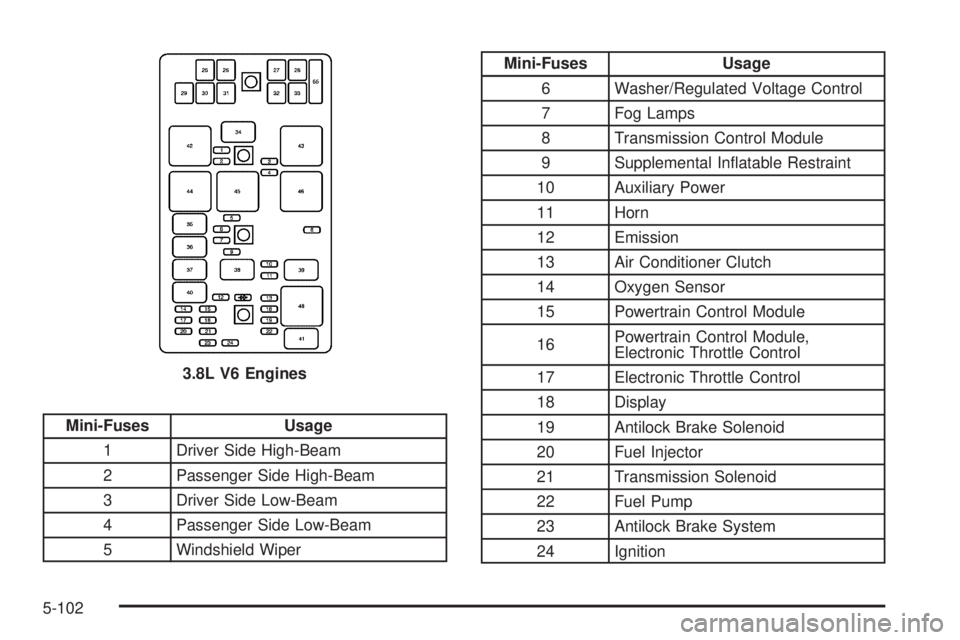
Mini-Fuses Usage
1 Driver Side High-Beam
2 Passenger Side High-Beam
3 Driver Side Low-Beam
4 Passenger Side Low-Beam
5 Windshield Wiper
Mini-Fuses Usage
6 Washer/Regulated Voltage Control
7 Fog Lamps
8 Transmission Control Module
9 Supplemental Inatable Restraint
10 Auxiliary Power
11 Horn
12 Emission
13 Air Conditioner Clutch
14 Oxygen Sensor
15 Powertrain Control Module
16Powertrain Control Module,
Electronic Throttle Control
17 Electronic Throttle Control
18 Display
19 Antilock Brake Solenoid
20 Fuel Injector
21 Transmission Solenoid
22 Fuel Pump
23 Antilock Brake System
24 Ignition 3.8L V6 Engines
5-102
Page 374 of 428
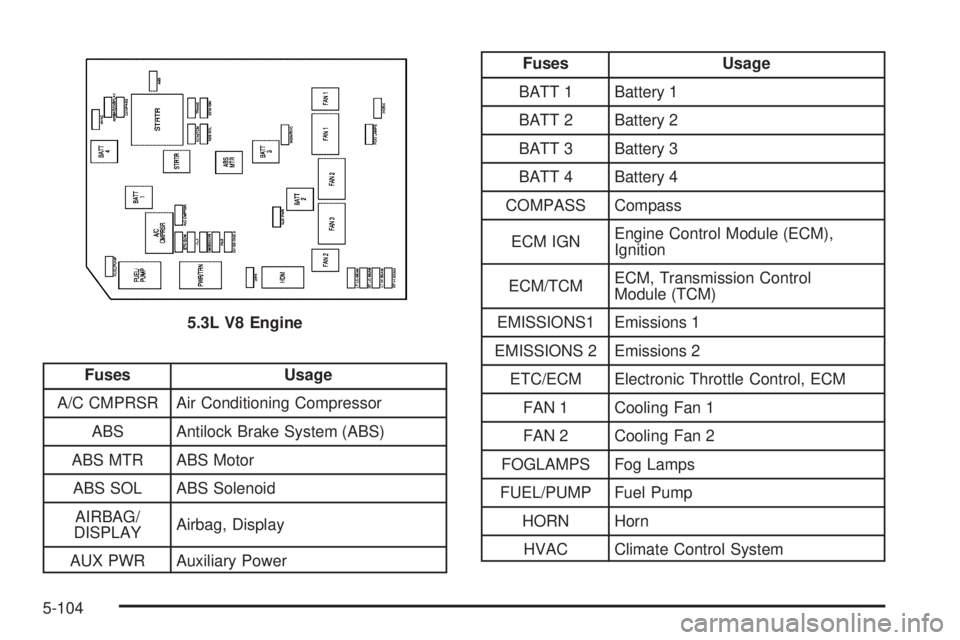
Fuses Usage
A/C CMPRSR Air Conditioning Compressor
ABS Antilock Brake System (ABS)
ABS MTR ABS Motor
ABS SOL ABS Solenoid
AIRBAG/
DISPLAYAirbag, Display
AUX PWR Auxiliary Power
Fuses Usage
BATT 1 Battery 1
BATT 2 Battery 2
BATT 3 Battery 3
BATT 4 Battery 4
COMPASS Compass
ECM IGNEngine Control Module (ECM),
Ignition
ECM/TCMECM, Transmission Control
Module (TCM)
EMISSIONS1 Emissions 1
EMISSIONS 2 Emissions 2
ETC/ECM Electronic Throttle Control, ECM
FAN 1 Cooling Fan 1
FAN 2 Cooling Fan 2
FOGLAMPS Fog Lamps
FUEL/PUMP Fuel Pump
HORN Horn
HVAC Climate Control System 5.3L V8 Engine
5-104
Page 382 of 428
Owner Checks and Services on page 6-8tells what
should be checked, when to check it, and what
can easily be done to help keep the vehicle in good
condition.
The proper replacement parts, uids, and lubricants to
use are listed inRecommended Fluids and Lubricants
on page 6-11andMaintenance Replacement Parts
on page 6-13. When the vehicle is serviced, make sure
these are used. All parts should be replaced and all
necessary repairs done before you or anyone else
drives the vehicle. We recommend the use of genuine
parts from your dealer/retailer.
Scheduled Maintenance
When the change engine oil light or CHANGE OIL
SOON DIC message displays, service is required for
the vehicle. Have the vehicle serviced as soon as
possible within the next 600 miles (1 000 km). It is
possible that, if driving under the best conditions, the
engine oil life system may not indicate that vehicle
service is necessary for over a year. However,
the engine oil and lter must be changed at least
once a year and at this time the system must be reset.
Your dealer/retailer has trained service technicians
who will perform this work using genuine parts and reset
the system.If the engine oil life system is ever reset accidentally,
service the vehicle within 3,000 miles (5 000 km)
since the last service. Remember to reset the oil life
system whenever the oil is changed. SeeEngine Oil Life
System on page 5-18for information on the Engine
Oil Life System and resetting the system.
When the light or message appears, certain services,
checks, and inspections are required. Required services
are described in the following for “MaintenanceI” and
“MaintenanceII.” Generally, it is recommended that the
rst service be MaintenanceI, the second service be
MaintenanceII, and then alternate MaintenanceI
and MaintenanceIIthereafter. However, in some cases,
MaintenanceIImay be required more often.
MaintenanceI— Use MaintenanceIif the light or
message displays within 10 months since the vehicle
was purchased or MaintenanceIIwas performed.
MaintenanceII— Use MaintenanceIIif the previous
service performed was MaintenanceI. Always use
MaintenanceIIwhenever the light or message displays
10 months or more since the last service or if the
light or message has not come on at all for one year.
6-4