climate control BUICK LACROSSE 2009 Owner's Manual
[x] Cancel search | Manufacturer: BUICK, Model Year: 2009, Model line: LACROSSE, Model: BUICK LACROSSE 2009Pages: 428
Page 1 of 428
Seats and Restraint System............................. 1-1
Front Seats
............................................... 1-2
Rear Seats
............................................... 1-7
Safety Belts
.............................................. 1-8
Child Restraints
.......................................1-29
Airbag System
.........................................1-53
Restraint System Check
............................1-68
Features and Controls..................................... 2-1
Keys
........................................................ 2-2
Doors and Locks
....................................... 2-9
Windows
.................................................2-14
Theft-Deterrent Systems
............................2-16
Starting and Operating Your Vehicle
...........2-21
Mirrors
....................................................2-35
Object Detection Systems
..........................2-37
OnStar
®System
......................................2-39
Universal Home Remote System
................2-43
Storage Areas
.........................................2-47
Sunroof
..................................................2-48
Instrument Panel............................................. 3-1
Instrument Panel Overview
.......................... 3-4
Climate Controls
......................................3-21
Warning Lights, Gages, and Indicators
........3-30
Driver Information Center (DIC)
..................3-47
Audio System(s)
.......................................3-82Driving Your Vehicle....................................... 4-1
Your Driving, the Road, and the Vehicle
....... 4-2
Towing
...................................................4-26
Service and Appearance Care.......................... 5-1
Service
..................................................... 5-3
Fuel
......................................................... 5-5
Checking Things Under
the Hood
.............................................5-10
Headlamp Aiming
.....................................5-46
Bulb Replacement
....................................5-49
Windshield Replacement
...........................5-53
Windshield Wiper Blade Replacement
.........5-53
Tires
......................................................5-54
Appearance Care
.....................................5-90
Vehicle Identication
.................................5-98
Electrical System
......................................5-99
Capacities and Specications
...................5-106
Maintenance Schedule..................................... 6-1
Maintenance Schedule
................................ 6-2
Customer Assistance Information.................... 7-1
Customer Assistance and Information
........... 7-2
Reporting Safety Defects
...........................7-15
Vehicle Data Recording and Privacy
...........7-17
Index................................................................ 1
2009 Buick LaCrosse Owner ManualM
Page 7 of 428
Power Lumbar
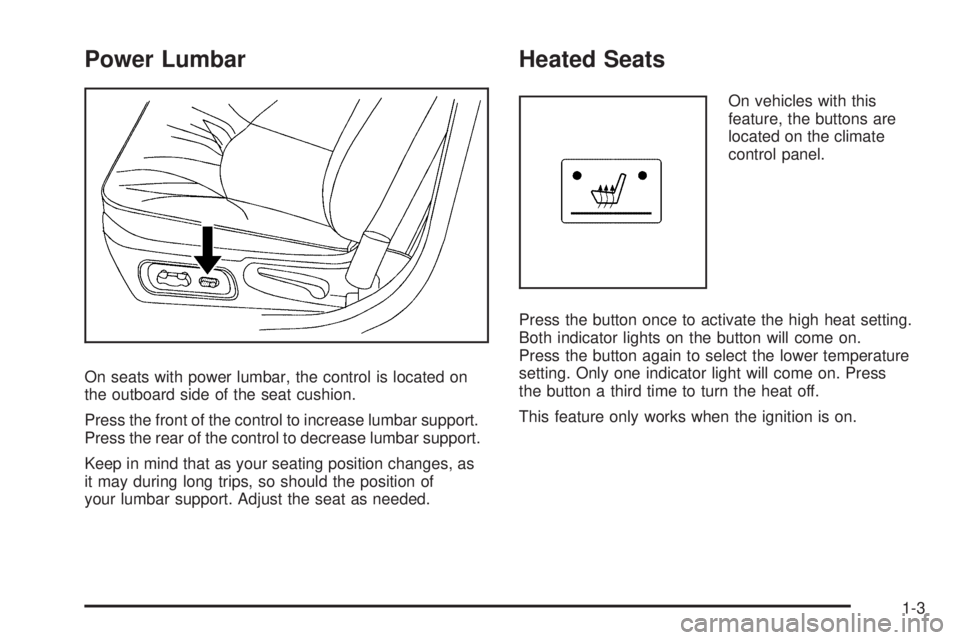
On seats with power lumbar, the control is located on
the outboard side of the seat cushion.
Press the front of the control to increase lumbar support.
Press the rear of the control to decrease lumbar support.
Keep in mind that as your seating position changes, as
it may during long trips, so should the position of
your lumbar support. Adjust the seat as needed.
Heated Seats
On vehicles with this
feature, the buttons are
located on the climate
control panel.
Press the button once to activate the high heat setting.
Both indicator lights on the button will come on.
Press the button again to select the lower temperature
setting. Only one indicator light will come on. Press
the button a third time to turn the heat off.
This feature only works when the ignition is on.
1-3
Page 81 of 428
Remote Vehicle Start
Your vehicle may have a remote starting feature that
allows you to start the engine from outside the vehicle.
It may also start the vehicle’s heating or air conditioning
systems and rear window defogger. When the remote
start system is active and the vehicle has an automatic
climate control system, it will automatically regulate
the inside temperature. Normal operation of these
systems will return after the ignition key is turned to
ON/RUN.
Laws in some communities may restrict the use of
remote starters. For example, some laws may require a
person using remote start to have the vehicle in view
when doing so. Check local regulations for any
requirements on remote starting of vehicles.
Do not use the remote start feature if your vehicle
is low on fuel. Your vehicle may run out of fuel.
If your vehicle has the remote start feature, the RKE
transmitter functions will have an increased range
of operation. However, the range may be less while the
vehicle is running.
There are other conditions which can affect the
performance of the transmitter, seeRemote Keyless
Entry (RKE) System on page 2-3for additional
information.
/(Remote Start):This button will be on the RKE
transmitter if you have remote start.
To start the vehicle using the remote start feature:
1. Aim the transmitter at the vehicle.
2. Press and release the transmitter’s lock button,
then immediately press and hold the transmitter’s
remote start button for about four seconds or
until the vehicle’s turn signal lamps ash. The doors
will lock.
When the vehicle starts, the parking lamps turn on
and remain on while the engine is running.
The remote start feature provides two separate starts
per ignition cycle, each with 10 minutes of engine
running time, or one start with a time extension. The
rst start must expire or be canceled to get two separate
10 minute starts.
If it is the rst remote start since the vehicle has been
driven, repeat the previous steps, while the engine is still
running, to extend the engine running time by 10 minutes
from the time you repeat the steps for remote starting.
The remote start running time can be extended one time
and only after the rst remote start.
After entering the vehicle during a remote start, insert
and turn the key to ON/RUN to drive the vehicle.
2-7
Page 86 of 428
Trunk
{CAUTION:
Exhaust gases may enter the vehicle if it is driven
with the liftgate, trunk/hatch open, or with any
objects that pass through the seal between the
body and the trunk/hatch or liftgate. Engine
exhaust contains Carbon Monoxide (CO) which
cannot be seen or smelled. It can cause
unconsciousness and even death.
If the vehicle must be driven with the liftgate, or
trunk/hatch open:
Close all of the windows
Fully open the air outlets on or under the
instrument panel
Adjust the Climate Control system to a setting
that brings in only outside air and set the fan
speed to the highest setting. See Climate
Control System in the Index.
If the vehicle is equipped with a power liftgate,
disable the power liftgate function.
For more information about carbon monoxide, see
Engine Exhaust on page 2-33.
Opening the Trunk
To open the trunk from the outside, use the Remote
Keyless Entry (RKE) transmitter. SeeRemote Keyless
Entry (RKE) System Operation on page 2-4for more
information.
The ignition must be off, or the transmission must be in
(P) Park to open the trunk.
Remote Trunk Release
This feature is used to unlock the trunk from inside the
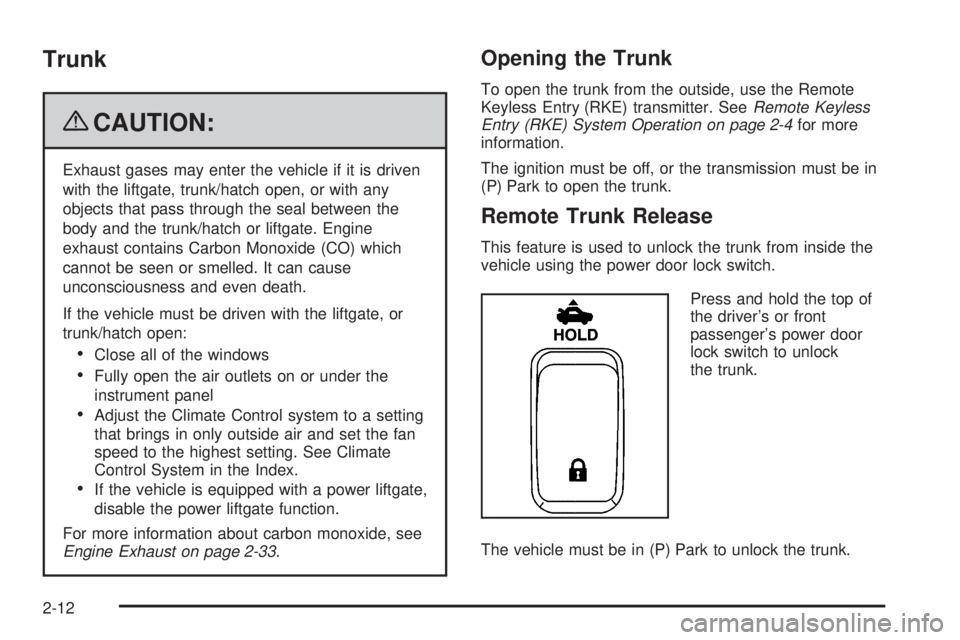
vehicle using the power door lock switch.
Press and hold the top of
the driver’s or front
passenger’s power door
lock switch to unlock
the trunk.
The vehicle must be in (P) Park to unlock the trunk.
2-12
Page 110 of 428
Outside Power Mirrors
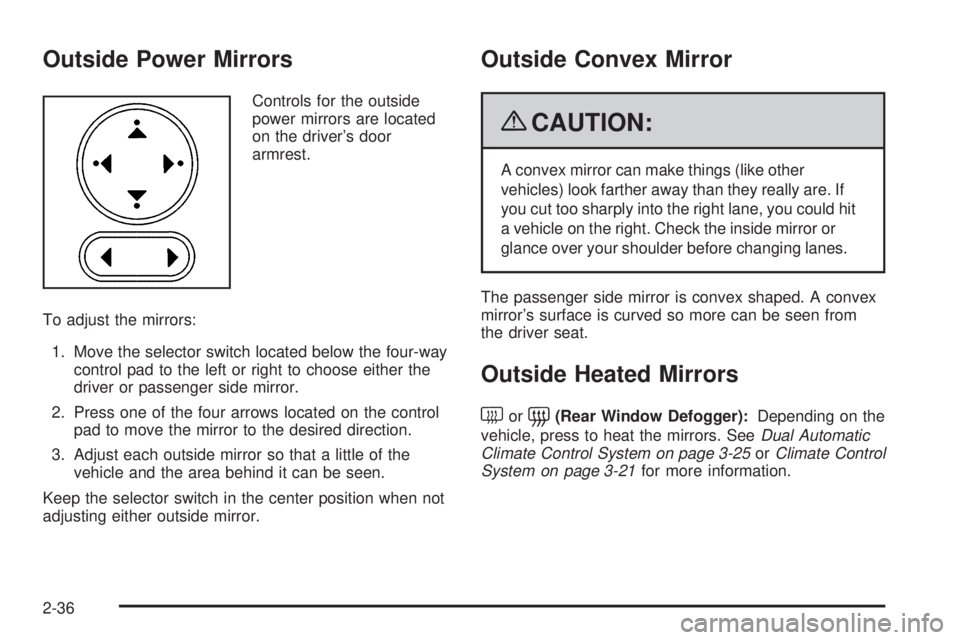
Controls for the outside
power mirrors are located
on the driver’s door
armrest.
To adjust the mirrors:
1. Move the selector switch located below the four-way
control pad to the left or right to choose either the
driver or passenger side mirror.
2. Press one of the four arrows located on the control
pad to move the mirror to the desired direction.
3. Adjust each outside mirror so that a little of the
vehicle and the area behind it can be seen.
Keep the selector switch in the center position when not
adjusting either outside mirror.
Outside Convex Mirror
{CAUTION:
A convex mirror can make things (like other
vehicles) look farther away than they really are. If
you cut too sharply into the right lane, you could hit
a vehicle on the right. Check the inside mirror or
glance over your shoulder before changing lanes.
The passenger side mirror is convex shaped. A convex
mirror’s surface is curved so more can be seen from
the driver seat.
Outside Heated Mirrors
Climate Control System on page 3-25orClimate Control
System on page 3-21for more information.
2-36
Page 123 of 428
Instrument Panel Overview...............................3-4
Hazard Warning Flashers................................3-6
Horn .............................................................3-6
Tilt Wheel.....................................................3-6
Turn Signal/Multifunction Lever.........................3-7
Turn and Lane-Change Signals........................3-8
Headlamp High/Low-Beam Changer..................3-8
Flash-to-Pass.................................................3-8
Windshield Wipers..........................................3-9
Windshield Washer.........................................3-9
Cruise Control..............................................3-10
Exterior Lamps.............................................3-13
Daytime Running Lamps (DRL)/Automatic
Headlamp System......................................3-14
Fog Lamps ..................................................3-15
Exterior Lighting Battery Saver........................3-15
Interior Lamps..............................................3-16
Instrument Panel Brightness...........................3-16
Courtesy Lamps...........................................3-16
Entry Lighting...............................................3-16
Delayed Entry Lighting...................................3-17
Theater Dimming..........................................3-17
Delayed Exit Lighting.....................................3-17
Perimeter Lighting.........................................3-18
Overhead Console Reading Lamps.................3-18
Rear Assist Handle Reading Lamps................3-18Electric Power Management...........................3-18
Battery Run-Down Protection..........................3-19
Accessory Power Outlet(s).............................3-20
Ashtray(s) and Cigarette Lighter......................3-21
Climate Controls............................................3-21
Climate Control System.................................3-21
Dual Automatic Climate Control System...........3-25
Outlet Adjustment.........................................3-28
Passenger Compartment Air Filter...................3-29
Warning Lights, Gages, and Indicators............3-30
Instrument Panel Cluster................................3-31
Speedometer and Odometer...........................3-32
Tachometer.................................................3-32
Safety Belt Reminders...................................3-32
Airbag Readiness Light..................................3-33
Passenger Airbag Status Indicator...................3-34
Charging System Light..................................3-35
Brake System Warning Light..........................3-35
Antilock Brake System (ABS) Warning Light........3-36
Traction Control System (TCS)
Warning Light...........................................3-37
Enhanced Traction System
Warning Light...........................................3-37
Engine Coolant Temperature Warning Light........3-38
Engine Coolant Temperature Gage..................3-38
Section 3 Instrument Panel
3-1
Page 127 of 428
The main components of the instrument panel are the following:
A.Outlet Adjustment on page 3-28.
B.Interior Lamps on page 3-16.
C.Exterior Lamps on page 3-13.Fog Lamps on
page 3-15.
D.Turn Signal/Multifunction Lever on page 3-7.
E.Cruise Control on page 3-10.
F.Instrument Panel Cluster on page 3-31.
G.DIC Operation and Displays on page 3-48
(If Equipped) andHazard Warning Flashers
on page 3-6.
H.Passenger Airbag Status Indicator on page 3-34.
I.Audio System(s) on page 3-82.J.Hood Release on page 5-11.
K.Parking Brake on page 2-29.
L.Tilt Wheel on page 3-6.
M.Horn on page 3-6.
N.Audio Steering Wheel Controls on page 3-110
(If Equipped).
O. Shift Lever. SeeShifting Into Park on page 2-29.
P.Accessory Power Outlet(s) on page 3-20.
Q.Climate Control System on page 3-21orDual
Automatic Climate Control System on page 3-25.
R.Glove Box on page 2-47.
3-5
Page 141 of 428
A high electrical load occurs when several of the
following are on, such as: headlamps, high beams,
fog lamps, rear window defogger, climate control fan at
high speed, heated seats, engine cooling fans, trailer
loads, and loads plugged into accessory power outlets.
EPM works to prevent excessive discharge of the
battery. It does this by balancing the generator’s output
and the vehicle’s electrical needs. It can increase engine
idle speed to generate more power, whenever needed.
It can temporarily reduce the power demands of some
accessories.
Normally, these actions occur in steps or levels, without
being noticeable. In rare cases at the highest levels of
corrective action, this action may be noticeable to the
driver. If so, a Driver Information Center (DIC) message
might be displayed, such as BATTERY SAVER ACTIVE,
BATTERY VOLTAGE LOW, or LOW BATTERY. If this
message is displayed, it is recommended that the driver
reduce the electrical loads as much as possible. SeeDIC
Warnings and Messages on page 3-56.Battery Run-Down Protection
This helps prevent the vehicle’s battery from draining
in case the interior courtesy lamps, reading lamps, trunk
lamp, underhood lamp, glove box lamps, or sun visor
vanity lamps, if equipped, are accidently left on. If any of
these lamps are left on while the ignition is off, they will
automatically turn off after 10 minutes. The lamps will not
come back on again until one of the following occurs:
The ignition is turned on.
The interior lamps control is turned off, then to
door or on.
3-19
Page 142 of 428
Accessory Power Outlet(s)
The accessory power outlets enable power electrical
equipment, such as a cellular telephone.
The vehicle has 12-volt outlets. One outlet is located on
the center console below the climate controls. There may
be another outlet located inside the center storage
console or in the ip and fold console.
Open the cover to use the outlet. Be sure to close the
cover when the outlet is not in use.
Notice:Adding any electrical equipment to the
vehicle can damage it or keep other components
from working as they should. The repairs would
not be covered by the vehicle warranty. Do not use
equipment exceeding maximum amperage rating
of 20 amperes. Check with your dealer/retailer before
adding electrical equipment.Certain power accessory plugs may not be compatible
to the power accessory outlet and could result in
blown vehicle or adapter fuses. If you experience a
problem, see your dealer/retailer.
Notice:Improper use of the power outlet can cause
damage not covered by the warranty. Do not hang
any type of accessory or accessory bracket from the
plug because the power outlets are designed for
accessory power plugs only.
Notice:Leaving electrical equipment plugged in for
an extended period of time while the vehicle is off
will drain the battery. Power is always supplied
to the outlets. Always unplug electrical equipment
when not in use and do not plug in equipment
that exceeds the maximum 20 ampere rating.
When adding electrical equipment, be sure to follow
the proper installation instructions included with
the equipment.
3-20
Page 143 of 428
Ashtray(s) and Cigarette Lighter
The vehicle may have a removable ashtray and cigarette
lighter. The cigarette lighter may be located under the
climate control system. The removable ashtray can
be placed into the front console cupholder.
Notice:If papers, pins, or other ammable items
are put in the ashtray, hot cigarettes or other
smoking materials could ignite them and possibly
damage the vehicle. Never put ammable items
in the ashtray.
To use the cigarette lighter, push it in all the way, and
let go. When the heating element is ready, it will pop back
out by itself.
Notice:Holding a cigarette lighter in while it is
heating will not allow the lighter to back away from
the heating element when it is hot. Damage from
overheating may occur to the lighter or heating
element, or a fuse could be blown. Do not hold a
cigarette lighter in while it is heating. Do not use
equipment exceeding maximum amperage rating
of 20 amperes.
Climate Controls
Climate Control System
With this system the heating, cooling and ventilation can
be controlled.
For vehicles with the remote start feature and it is
activated, the climate control system automatically cools
the vehicle if the temperature is greater than 90°F (32°C)
and heats the vehicle if the temperature is below 37°F
(3°C). If the temperature is between 37°F (3°C) and
90°F (32°C), the last control setting selected when the
engine was running will be used. Normal operation and
the last setting of the climate control system will return
after the key is turned to the ON/RUN position.
3-21