trunk BUICK LACROSSE 2009 Owner's Manual
[x] Cancel search | Manufacturer: BUICK, Model Year: 2009, Model line: LACROSSE, Model: BUICK LACROSSE 2009Pages: 428
Page 11 of 428
Center Seat
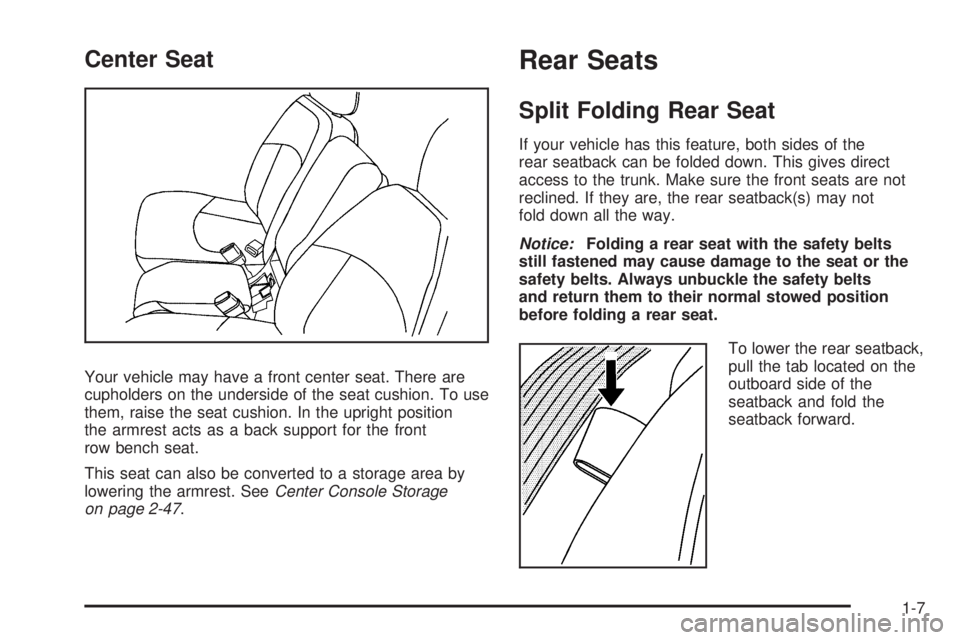
Your vehicle may have a front center seat. There are
cupholders on the underside of the seat cushion. To use
them, raise the seat cushion. In the upright position
the armrest acts as a back support for the front
row bench seat.
This seat can also be converted to a storage area by
lowering the armrest. SeeCenter Console Storage
on page 2-47.
Rear Seats
Split Folding Rear Seat
If your vehicle has this feature, both sides of the
rear seatback can be folded down. This gives direct
access to the trunk. Make sure the front seats are not
reclined. If they are, the rear seatback(s) may not
fold down all the way.
Notice:Folding a rear seat with the safety belts
still fastened may cause damage to the seat or the
safety belts. Always unbuckle the safety belts
and return them to their normal stowed position
before folding a rear seat.
To lower the rear seatback,
pull the tab located on the
outboard side of the
seatback and fold the
seatback forward.
1-7
Page 75 of 428

Keys...............................................................2-2
Remote Keyless Entry (RKE) System................2-3
Remote Keyless Entry (RKE) System
Operation...................................................2-4
Remote Vehicle Start......................................2-7
Doors and Locks.............................................2-9
Door Locks....................................................2-9
Power Door Locks..........................................2-9
Delayed Locking...........................................2-10
Automatic Door Lock.....................................2-10
Programmable Automatic Door Unlock.............2-10
Rear Door Security Locks..............................2-11
Lockout Protection........................................2-11
Trunk..........................................................2-12
Windows........................................................2-14
Power Windows............................................2-15
Sun Visors...................................................2-16
Theft-Deterrent Systems..................................2-16
Content Theft-Deterrent.................................2-17
PASS-Key
®III Electronic Immobilizer...............2-18
PASS-Key®III Electronic Immobilizer
Operation.................................................2-19
Starting and Operating Your Vehicle................2-21
New Vehicle Break-In....................................2-21
Ignition Positions..........................................2-21
Retained Accessory Power (RAP)...................2-22
Starting the Engine.......................................2-23Engine Coolant Heater..................................2-24
Active Fuel Management™.............................2-25
Automatic Transmission Operation...................2-26
Parking Brake..............................................2-29
Shifting Into Park..........................................2-29
Shifting Out of Park......................................2-32
Parking Over Things That Burn.......................2-33
Engine Exhaust............................................2-33
Running the Vehicle While Parked..................2-34
Mirrors...........................................................2-35
Manual Rearview Mirror.................................2-35
Automatic Dimming Rearview Mirror................2-35
Outside Power Mirrors...................................2-36
Outside Convex Mirror...................................2-36
Outside Heated Mirrors..................................2-36
Object Detection Systems...............................2-37
Ultrasonic Rear Parking
Assist (URPA)...........................................2-37
OnStar
®System.............................................2-39
Universal Home Remote System......................2-43
Universal Home Remote System Operation......2-43
Storage Areas................................................2-47
Glove Box...................................................2-47
Cupholders..................................................2-47
Center Console Storage.................................2-47
Convenience Net..........................................2-48
Sunroof.........................................................2-48
Section 2 Features and Controls
2-1
Page 79 of 428
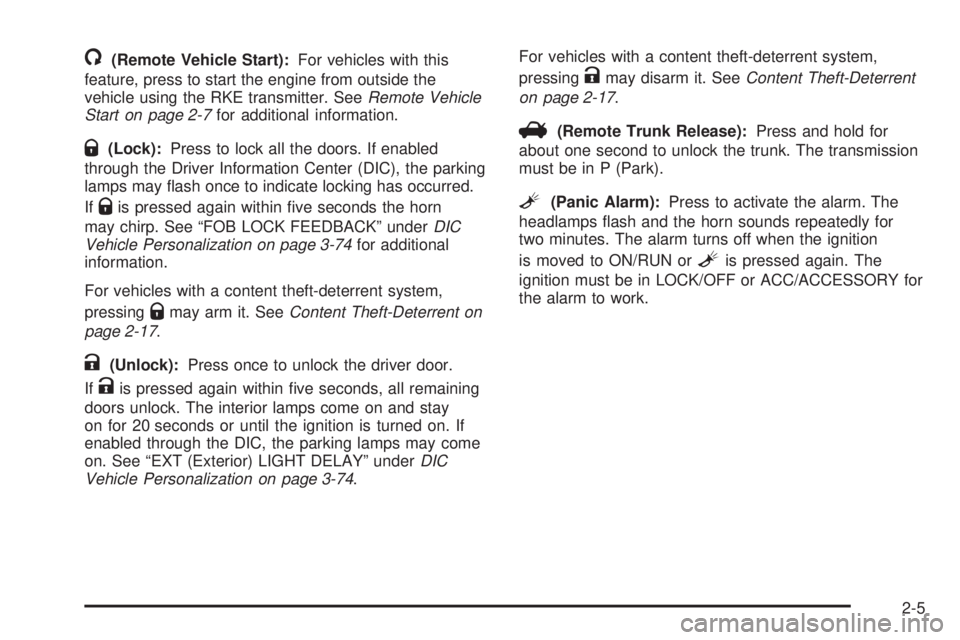
/(Remote Vehicle Start):For vehicles with this
feature, press to start the engine from outside the
vehicle using the RKE transmitter. SeeRemote Vehicle
Start on page 2-7for additional information.
Q(Lock):Press to lock all the doors. If enabled
through the Driver Information Center (DIC), the parking
lamps may ash once to indicate locking has occurred.
If
Qis pressed again within ve seconds the horn
may chirp. See “FOB LOCK FEEDBACK” underDIC
Vehicle Personalization on page 3-74for additional
information.
For vehicles with a content theft-deterrent system,
pressing
Qmay arm it. SeeContent Theft-Deterrent on
page 2-17.
K(Unlock):Press once to unlock the driver door.
If
Kis pressed again within ve seconds, all remaining
doors unlock. The interior lamps come on and stay
on for 20 seconds or until the ignition is turned on. If
enabled through the DIC, the parking lamps may come
on. See “EXT (Exterior) LIGHT DELAY” underDIC
Vehicle Personalization on page 3-74.For vehicles with a content theft-deterrent system,
pressing
Kmay disarm it. SeeContent Theft-Deterrent
on page 2-17.
V(Remote Trunk Release):Press and hold for
about one second to unlock the trunk. The transmission
must be in P (Park).
L(Panic Alarm):Press to activate the alarm. The
headlamps ash and the horn sounds repeatedly for
two minutes. The alarm turns off when the ignition
is moved to ON/RUN or
Lis pressed again. The
ignition must be in LOCK/OFF or ACC/ACCESSORY for
the alarm to work.
2-5
Page 86 of 428
Trunk
{CAUTION:
Exhaust gases may enter the vehicle if it is driven
with the liftgate, trunk/hatch open, or with any
objects that pass through the seal between the
body and the trunk/hatch or liftgate. Engine
exhaust contains Carbon Monoxide (CO) which
cannot be seen or smelled. It can cause
unconsciousness and even death.
If the vehicle must be driven with the liftgate, or
trunk/hatch open:
Close all of the windows
Fully open the air outlets on or under the
instrument panel
Adjust the Climate Control system to a setting
that brings in only outside air and set the fan
speed to the highest setting. See Climate
Control System in the Index.
If the vehicle is equipped with a power liftgate,
disable the power liftgate function.
For more information about carbon monoxide, see
Engine Exhaust on page 2-33.
Opening the Trunk
To open the trunk from the outside, use the Remote
Keyless Entry (RKE) transmitter. SeeRemote Keyless
Entry (RKE) System Operation on page 2-4for more
information.
The ignition must be off, or the transmission must be in
(P) Park to open the trunk.
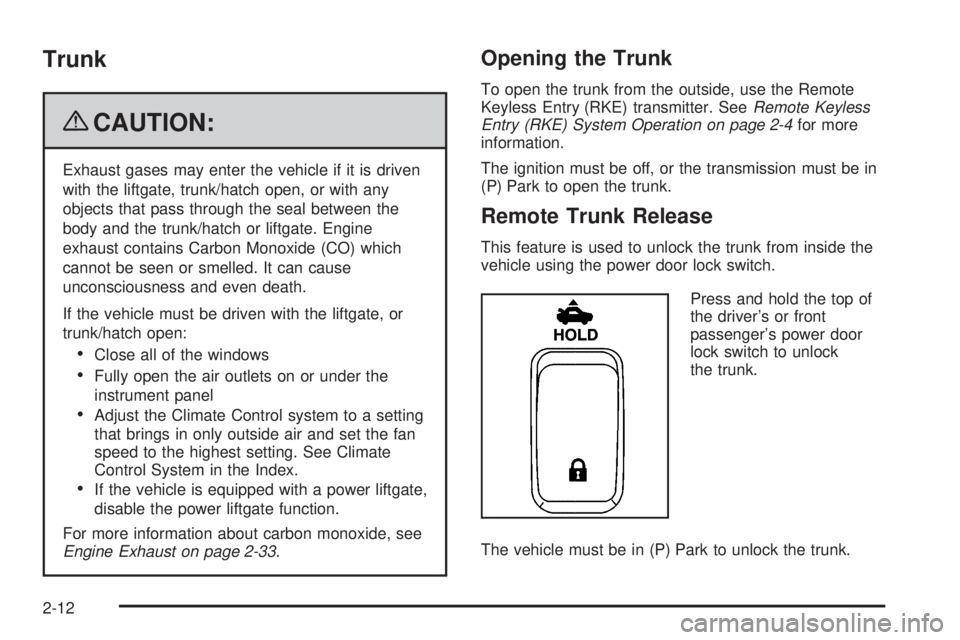
Remote Trunk Release
This feature is used to unlock the trunk from inside the
vehicle using the power door lock switch.
Press and hold the top of
the driver’s or front
passenger’s power door
lock switch to unlock
the trunk.
The vehicle must be in (P) Park to unlock the trunk.
2-12
Page 87 of 428
Emergency Trunk Release Handle
Notice:Do not use the emergency trunk release
handle as a tie-down or anchor point when securing
items in the trunk as it could damage the handle.
The emergency trunk release handle is only
intended to aid a person trapped in a latched trunk,
enabling them to open the trunk from the inside.
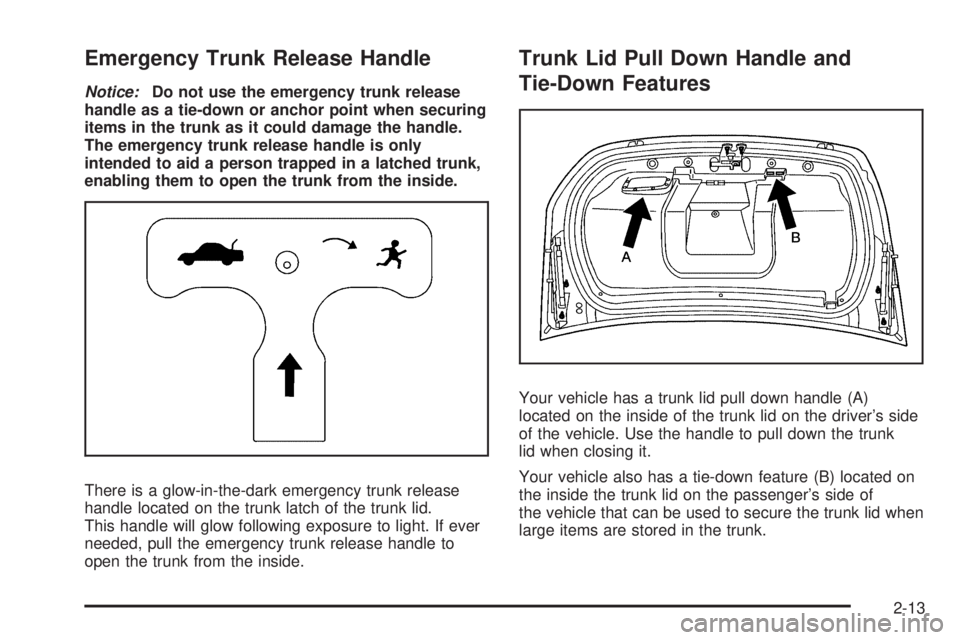
There is a glow-in-the-dark emergency trunk release
handle located on the trunk latch of the trunk lid.
This handle will glow following exposure to light. If ever
needed, pull the emergency trunk release handle to
open the trunk from the inside.
Trunk Lid Pull Down Handle and
Tie-Down Features
Your vehicle has a trunk lid pull down handle (A)
located on the inside of the trunk lid on the driver’s side
of the vehicle. Use the handle to pull down the trunk
lid when closing it.
Your vehicle also has a tie-down feature (B) located on
the inside the trunk lid on the passenger’s side of
the vehicle that can be used to secure the trunk lid when
large items are stored in the trunk.
2-13
Page 91 of 428
Content Theft-Deterrent
Your vehicle may have a content theft-deterrent alarm
system.
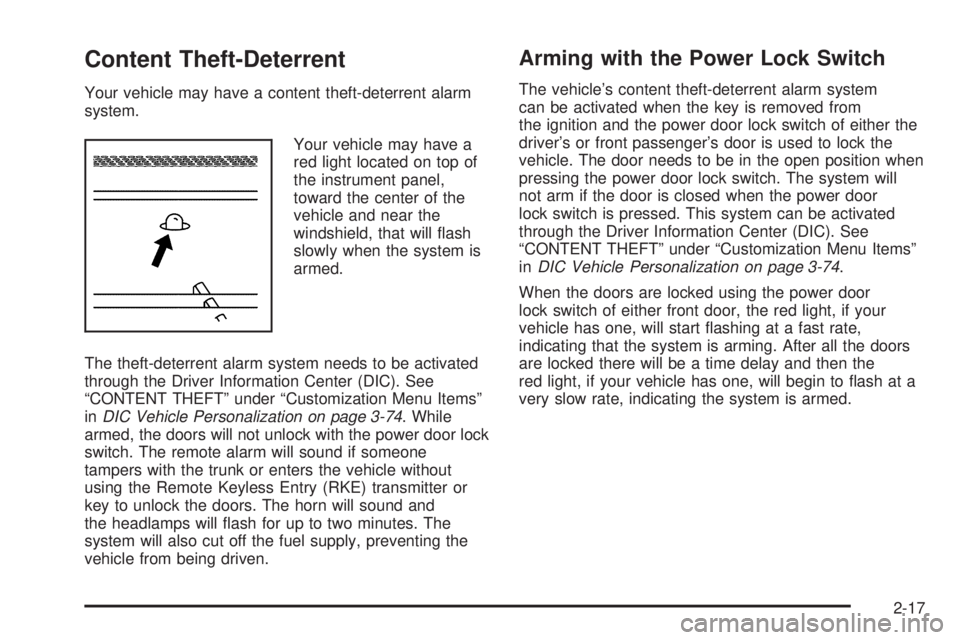
Your vehicle may have a
red light located on top of
the instrument panel,
toward the center of the
vehicle and near the
windshield, that will ash
slowly when the system is
armed.
The theft-deterrent alarm system needs to be activated
through the Driver Information Center (DIC). See
“CONTENT THEFT” under “Customization Menu Items”
inDIC Vehicle Personalization on page 3-74. While
armed, the doors will not unlock with the power door lock
switch. The remote alarm will sound if someone
tampers with the trunk or enters the vehicle without
using the Remote Keyless Entry (RKE) transmitter or
key to unlock the doors. The horn will sound and
the headlamps will ash for up to two minutes. The
system will also cut off the fuel supply, preventing the
vehicle from being driven.
Arming with the Power Lock Switch
The vehicle’s content theft-deterrent alarm system
can be activated when the key is removed from
the ignition and the power door lock switch of either the
driver’s or front passenger’s door is used to lock the
vehicle. The door needs to be in the open position when
pressing the power door lock switch. The system will
not arm if the door is closed when the power door
lock switch is pressed. This system can be activated
through the Driver Information Center (DIC). See
“CONTENT THEFT” under “Customization Menu Items”
inDIC Vehicle Personalization on page 3-74.
When the doors are locked using the power door
lock switch of either front door, the red light, if your
vehicle has one, will start ashing at a fast rate,
indicating that the system is arming. After all the doors
are locked there will be a time delay and then the
red light, if your vehicle has one, will begin to ash at a
very slow rate, indicating the system is armed.
2-17
Page 112 of 428
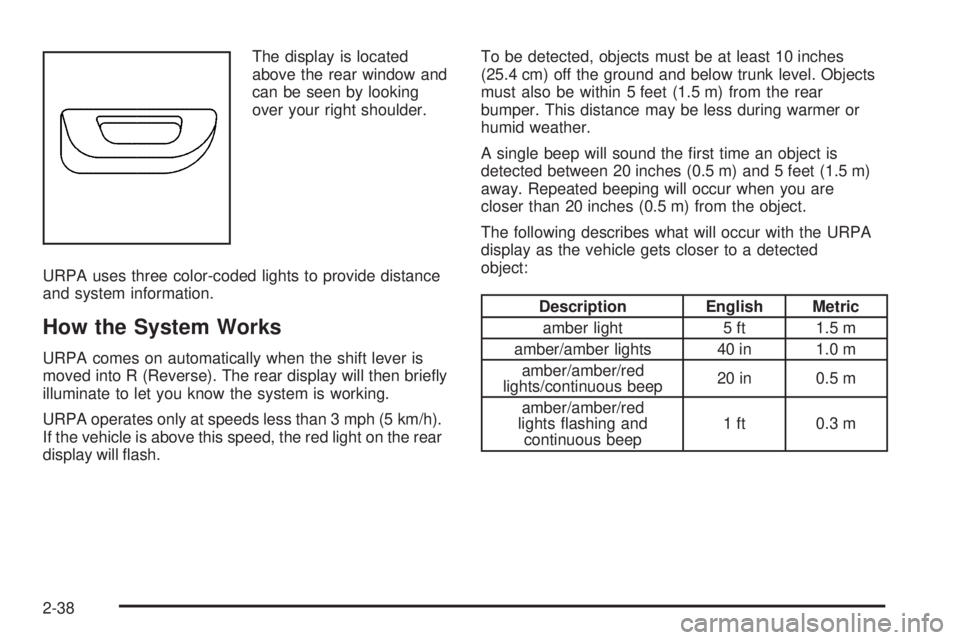
The display is located
above the rear window and
can be seen by looking
over your right shoulder.
URPA uses three color-coded lights to provide distance
and system information.
How the System Works
URPA comes on automatically when the shift lever is
moved into R (Reverse). The rear display will then briey
illuminate to let you know the system is working.
URPA operates only at speeds less than 3 mph (5 km/h).
If the vehicle is above this speed, the red light on the rear
display will ash.To be detected, objects must be at least 10 inches
(25.4 cm) off the ground and below trunk level. Objects
must also be within 5 feet (1.5 m) from the rear
bumper. This distance may be less during warmer or
humid weather.
A single beep will sound the rst time an object is
detected between 20 inches (0.5 m) and 5 feet (1.5 m)
away. Repeated beeping will occur when you are
closer than 20 inches (0.5 m) from the object.
The following describes what will occur with the URPA
display as the vehicle gets closer to a detected
object:
Description English Metric
amber light 5 ft 1.5 m
amber/amber lights 40 in 1.0 m
amber/amber/red
lights/continuous beep20 in 0.5 m
amber/amber/red
lights ashing and
continuous beep1 ft 0.3 m
2-38
Page 113 of 428
When the System Does Not Seem to
Work Properly
The ultrasonic sensors are not clean, a red URPA
display light may illuminate when the vehicle is in
R (Reverse). Keep the rear bumper free of
mud, dirt, snow, ice and slush. For cleaning
instructions, seeWashing Your Vehicle on
page 5-93.
A trailer was attached to the vehicle, or a bicycle or
an object was hanging out of the trunk during the
last drive cycle, the red light may illuminate.
Once the attached object is removed, URPA will
return to normal operation.
A tow bar is attached to the vehicle.
The vehicle’s bumper is damaged. Take the vehicle
to your dealer/retailer to repair the system.
Other conditions may affect system performance,
such as vibrations from a jackhammer or the
compression of air brakes on a very large truck.
If the system is still disabled, after driving forward at
least 15 mph (25 km/h), take the vehicle to your
dealer/retailer.
OnStar®System
OnStar uses several innovative technologies and live
advisors to provide a wide range of safety, security,
information, and convenience services. If the airbags
deploy, the system is designed to make an automatic
call to OnStar Emergency advisors who can request
emergency services be sent to your location. If
the keys are locked in the vehicle, call OnStar at
1-888-4-ONSTAR to have a signal sent to unlock
the doors. OnStar Hands-Free Calling, including
30 trial minutes good for 60 days, is available on most
vehicles. OnStar Turn-by-Turn Navigation service,
with one trial route, is available on most vehicles. Press
the OnStar button to have an OnStar advisor contact
Roadside Service.
OnStar service is provided subject to the OnStar Terms
and Conditions included in the OnStar Subscriber
glove box literature.
2-39
Page 124 of 428
Low Coolant Warning Light............................3-39
Tire Pressure Light.......................................3-39
Malfunction Indicator Lamp.............................3-40
Oil Pressure Light.........................................3-42
Change Engine Oil Light................................3-43
Security Light...............................................3-43
Cruise Control Light......................................3-43
Reduced Engine Power Light.........................3-44
Highbeam On Light.......................................3-44
Headlamps Suggested Light...........................3-44
Low Washer Fluid Warning Light.....................3-45
Door Ajar Light.............................................3-45
Trunk Ajar Light............................................3-45
Service Vehicle Soon Light............................3-45
Fuel Gage...................................................3-46
Low Fuel Warning Light.................................3-47
Check Gas Cap Light....................................3-47Driver Information Center (DIC).......................3-47
DIC Operation and Displays...........................3-48
DIC Compass (Uplevel Only)..........................3-54
DIC Warnings and Messages.........................3-56
DIC Vehicle Personalization............................3-74
Audio System(s).............................................3-82
Setting the Clock..........................................3-82
Radio(s)......................................................3-83
Using an MP3..............................................3-95
XM Radio Messages.....................................3-98
Bluetooth
®...................................................3-99
Theft-Deterrent Feature................................3-110
Audio Steering Wheel Controls......................3-110
Radio Reception.........................................3-112
Backglass Antenna......................................3-113
XM™ Satellite Radio Antenna System............3-113
Chime Level Adjustment...............................3-113
Section 3 Instrument Panel
3-2
Page 141 of 428
A high electrical load occurs when several of the
following are on, such as: headlamps, high beams,
fog lamps, rear window defogger, climate control fan at
high speed, heated seats, engine cooling fans, trailer
loads, and loads plugged into accessory power outlets.
EPM works to prevent excessive discharge of the
battery. It does this by balancing the generator’s output
and the vehicle’s electrical needs. It can increase engine
idle speed to generate more power, whenever needed.
It can temporarily reduce the power demands of some
accessories.
Normally, these actions occur in steps or levels, without
being noticeable. In rare cases at the highest levels of
corrective action, this action may be noticeable to the
driver. If so, a Driver Information Center (DIC) message
might be displayed, such as BATTERY SAVER ACTIVE,
BATTERY VOLTAGE LOW, or LOW BATTERY. If this
message is displayed, it is recommended that the driver
reduce the electrical loads as much as possible. SeeDIC
Warnings and Messages on page 3-56.Battery Run-Down Protection
This helps prevent the vehicle’s battery from draining
in case the interior courtesy lamps, reading lamps, trunk
lamp, underhood lamp, glove box lamps, or sun visor
vanity lamps, if equipped, are accidently left on. If any of
these lamps are left on while the ignition is off, they will
automatically turn off after 10 minutes. The lamps will not
come back on again until one of the following occurs:
The ignition is turned on.
The interior lamps control is turned off, then to
door or on.
3-19