key BUICK LACROSSE 2010 Workshop Manual
[x] Cancel search | Manufacturer: BUICK, Model Year: 2010, Model line: LACROSSE, Model: BUICK LACROSSE 2010Pages: 414
Page 304 of 414
9-22 Vehicle Care
Power Steering Fluid
SeeEngine Compartment Overviewon page 9‑6for information on the
location of the power steering fluid
reservoir.
When to Check Power Steering
Fluid
It is not necessary to regularly
check power steering fluid unless a
leak is suspected in the system or
an unusual noise is heard. A fluid
loss in this system could indicate a
problem. Have the system inspected
and repaired.
How to Check Power Steering
Fluid
Check the level after the vehicle has
been driven for at least
twenty minutes so the fluid is warm.
To check the power steering fluid:
1. Turn the ignition key to LOCK/ OFF and let the engine
compartment cool down.
2. Wipe the cap and the top of the reservoir clean.
3. Unscrew the cap and pull it straight up.
4. Wipe the dipstick with a clean rag.
5. Replace the cap and completely tighten it.
6. Remove the cap again and look at the fluid level on the dipstick.
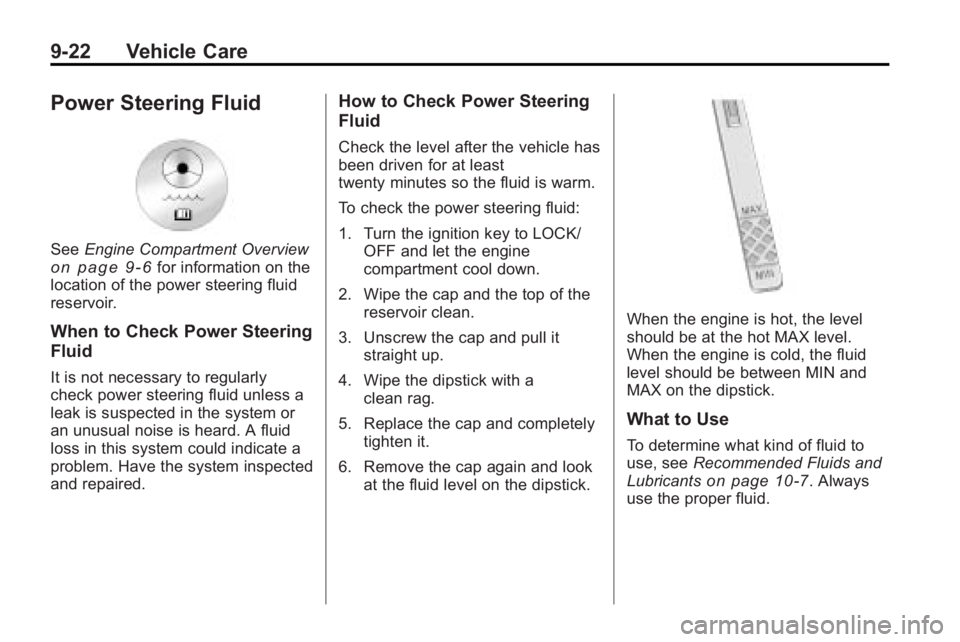
When the engine is hot, the level
should be at the hot MAX level.
When the engine is cold, the fluid
level should be between MIN and
MAX on the dipstick.
What to Use
To determine what kind of fluid to
use, see Recommended Fluids and
Lubricants
on page 10‑7. Always
use the proper fluid.
Page 308 of 414
9-26 Vehicle Care
What to Add
Use only new DOT 3 brake fluid
from a sealed container. See
Recommended Fluids and
Lubricants on page 10‑7.
Always clean the brake fluid
reservoir cap and the area around
the cap before removing it. This
helps keep dirt from entering the
reservoir.
{WARNING
With the wrong kind of fluid in the
brake hydraulic system, the
brakes might not work well. This
could cause a crash. Always use
the proper brake fluid.Notice:
.Using the wrong fluid can
badly damage brake
hydraulic system parts. For
example, just a few drops of
mineral-based oil, such as
engine oil, in the brake
hydraulic system can
damage brake hydraulic
system parts so badly that
they will have to be replaced.
Do not let someone put in
the wrong kind of fluid.
.If brake fluid is spilled on
the vehicle's painted
surfaces, the paint finish can
be damaged. Be careful not
to spill brake fluid on the
vehicle. If you do, wash it off
immediately.
Battery
Refer to the replacement number on
the original battery label when a
new battery is needed.
{WARNING
Battery posts, terminals, and
related accessories contain lead
and lead compounds, chemicals
known to the State of California to
cause cancer and reproductive
harm. Wash hands after handling.
If the battery has a very low charge
or is dead, it might not be possible
to remove the ignition key from the
ignition switch or shift out of
P (Park). See Shifting Out of Park
on page 8‑25.
Page 310 of 414
9-28 Vehicle Care
3. With the engine off, turn theignition to ON/RUN, but do not
start the engine. Without
applying the regular brake, try to
move the shift lever out of
P (Park) with normal effort. If the
shift lever moves out of P (Park),
contact your dealer/retailer for
service.
Ignition Transmission
Lock Check
While parked, and with the parking
brake set, try to turn the ignition to
LOCK/OFF in each shift lever
position.
.The ignition should turn to
LOCK/OFF only when the shift
lever is in P (Park).
.The ignition key should come
out only in LOCK/OFF.
Contact your dealer/retailer if
service is required.
Park Brake and P (Park)
Mechanism Check
{WARNING
When you are doing this check,
the vehicle could begin to move.
You or others could be injured
and property could be damaged.
Make sure there is room in front
of the vehicle in case it begins to
roll. Be ready to apply the regular
brake at once should the vehicle
begin to move. Park on a fairly steep hill, with the
vehicle facing downhill. Keeping
your foot on the regular brake, set
the parking brake.
.To check the parking brake's
holding ability: With the engine
running and the transmission in
N (Neutral), slowly remove foot
pressure from the regular brake
pedal. Do this until the vehicle is
held by the parking brake only.
.To check the P (Park)
mechanism's holding ability:
With the engine running, shift to
P (Park). Then release the
parking brake followed by the
regular brake.
Contact your dealer/retailer if
service is required.
Page 339 of 414
Vehicle Care 9-57
.The TPMS sensor matching
process was started but not
completed or not completed
successfully after rotating the
vehicle's tires. The DIC message
and TPMS malfunction light
should go off once the TPMS
sensor matching process is
performed successfully. See
“TPMS Sensor Matching
Process”later in this section.
.One or more TPMS sensors are
missing or damaged. The DIC
message and the TPMS
malfunction light should go off
when the TPMS sensors are
installed and the sensor
matching process is performed
successfully. See your dealer/
retailer for service.
.Replacement tires or wheels do
not match your vehicle's original
equipment tires or wheels. Tires
and wheels other than those
recommended for your vehicle
could prevent the TPMS from
functioning properly. See Buying
New Tires on page 9‑61.
.Operating electronic devices or
being near facilities using radio
wave frequencies similar to the
TPMS could cause the TPMS
sensors to malfunction.
If the TPMS is not functioning it
cannot detect or signal a low tire
condition. See your dealer/retailer
for service if the TPMS malfunction
light and DIC message comes on
and stays on.
TPMS Sensor Matching
Process
Each TPMS sensor has a unique
identification code. Any time you
rotate your vehicle's tires or replace
one or more of the TPMS sensors,
the identification codes will need to
be matched to the new tire/wheel
position. The sensors are matched
to the tire/wheel positions in the
following order: driver side front tire,
passenger side front tire, passenger
side rear tire, and driver side rear
tire using a TPMS diagnostic tool.
See your dealer/retailer for service. The TPMS sensors can also be
matched to each tire/wheel position
by increasing or decreasing the
tire's air pressure. If increasing the
tire's air pressure, do not exceed
the maximum inflation pressure
indicated on the tire's sidewall.
To decrease air-pressure out of a
tire you can use the pointed end of
the valve cap, a pencil-style air
pressure gage, or a key.
You have two minutes to match the
first tire/wheel position, and
five minutes overall to match all four
tire/wheel positions. If it takes longer
than two minutes, to match the first
tire and wheel, or more than
five minutes to match all four tire
and wheel positions the matching
process stops and you need to
start over.
Page 374 of 414
10-4 Service and Maintenance
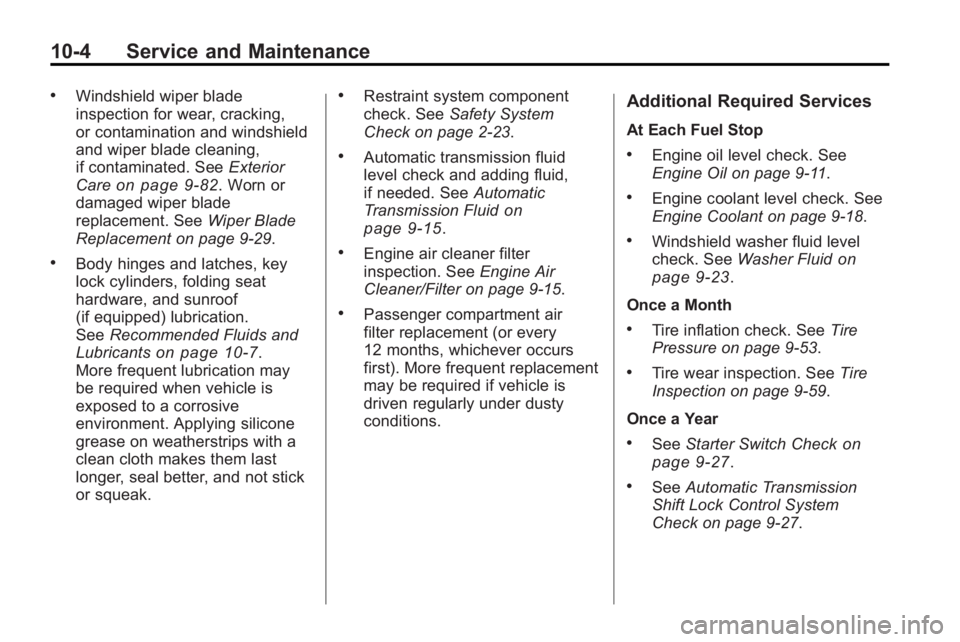
.Windshield wiper blade
inspection for wear, cracking,
or contamination and windshield
and wiper blade cleaning,
if contaminated. SeeExterior
Care
on page 9‑82. Worn or
damaged wiper blade
replacement. See Wiper Blade
Replacement on page 9‑29.
.Body hinges and latches, key
lock cylinders, folding seat
hardware, and sunroof
(if equipped) lubrication.
See Recommended Fluids and
Lubricants
on page 10‑7.
More frequent lubrication may
be required when vehicle is
exposed to a corrosive
environment. Applying silicone
grease on weatherstrips with a
clean cloth makes them last
longer, seal better, and not stick
or squeak.
.Restraint system component
check. See Safety System
Check on page 2‑23.
.Automatic transmission fluid
level check and adding fluid,
if needed. See Automatic
Transmission Fluid
on
page 9‑15.
.Engine air cleaner filter
inspection. See Engine Air
Cleaner/Filter on page 9‑15.
.Passenger compartment air
filter replacement (or every
12 months, whichever occurs
first). More frequent replacement
may be required if vehicle is
driven regularly under dusty
conditions.
Additional Required Services
At Each Fuel Stop
.Engine oil level check. See
Engine Oil on page 9‑11.
.Engine coolant level check. See
Engine Coolant on page 9‑18.
.Windshield washer fluid level
check. See Washer Fluidon
page 9‑23.
Once a Month
.Tire inflation check. See Tire
Pressure on page 9‑53.
.Tire wear inspection. See Tire
Inspection on page 9‑59.
Once a Year
.See Starter Switch Checkon
page 9‑27.
.See Automatic Transmission
Shift Lock Control System
Check on page 9‑27.
Page 378 of 414
10-8 Service and Maintenance
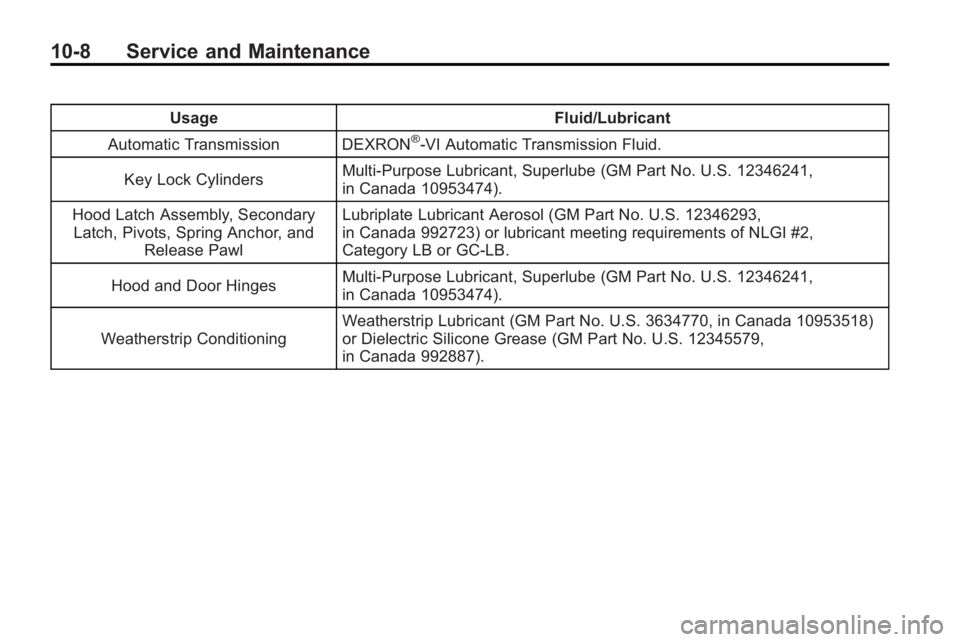
UsageFluid/Lubricant
Automatic Transmission DEXRON
®-VI Automatic Transmission Fluid.
Key Lock Cylinders Multi-Purpose Lubricant, Superlube (GM Part No. U.S. 12346241,
in Canada 10953474).
Hood Latch Assembly, Secondary Latch, Pivots, Spring Anchor, and
Release Pawl Lubriplate Lubricant Aerosol (GM Part No. U.S. 12346293,
in Canada 992723) or lubricant meeting requirements of NLGI #2,
Category LB or GC-LB.
Hood and Door Hinges Multi-Purpose Lubricant, Superlube (GM Part No. U.S. 12346241,
in Canada 10953474).
Weatherstrip Conditioning Weatherstrip Lubricant (GM Part No. U.S. 3634770, in Canada 10953518)
or Dielectric Silicone Grease (GM Part No. U.S. 12345579,
in Canada 992887).
Page 402 of 414
12-16 Customer Information
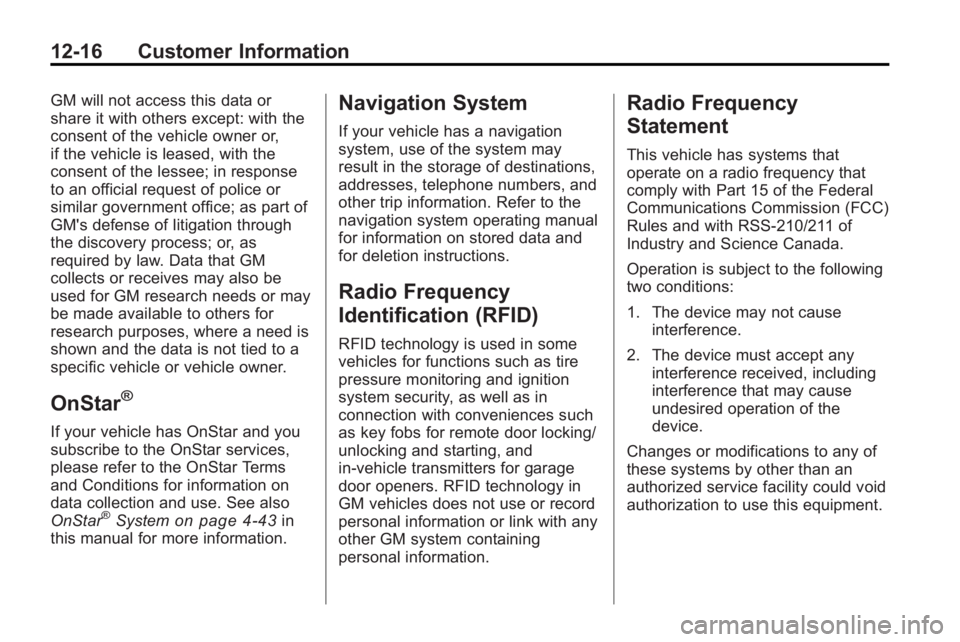
GM will not access this data or
share it with others except: with the
consent of the vehicle owner or,
if the vehicle is leased, with the
consent of the lessee; in response
to an official request of police or
similar government office; as part of
GM's defense of litigation through
the discovery process; or, as
required by law. Data that GM
collects or receives may also be
used for GM research needs or may
be made available to others for
research purposes, where a need is
shown and the data is not tied to a
specific vehicle or vehicle owner.
OnStar®
If your vehicle has OnStar and you
subscribe to the OnStar services,
please refer to the OnStar Terms
and Conditions for information on
data collection and use. See also
OnStar
®Systemon page 4‑43in
this manual for more information.
Navigation System
If your vehicle has a navigation
system, use of the system may
result in the storage of destinations,
addresses, telephone numbers, and
other trip information. Refer to the
navigation system operating manual
for information on stored data and
for deletion instructions.
Radio Frequency
Identification (RFID)
RFID technology is used in some
vehicles for functions such as tire
pressure monitoring and ignition
system security, as well as in
connection with conveniences such
as key fobs for remote door locking/
unlocking and starting, and
in-vehicle transmitters for garage
door openers. RFID technology in
GM vehicles does not use or record
personal information or link with any
other GM system containing
personal information.
Radio Frequency
Statement
This vehicle has systems that
operate on a radio frequency that
comply with Part 15 of the Federal
Communications Commission (FCC)
Rules and with RSS-210/211 of
Industry and Science Canada.
Operation is subject to the following
two conditions:
1. The device may not cause interference.
2. The device must accept any interference received, including
interference that may cause
undesired operation of the
device.
Changes or modifications to any of
these systems by other than an
authorized service facility could void
authorization to use this equipment.
Page 408 of 414
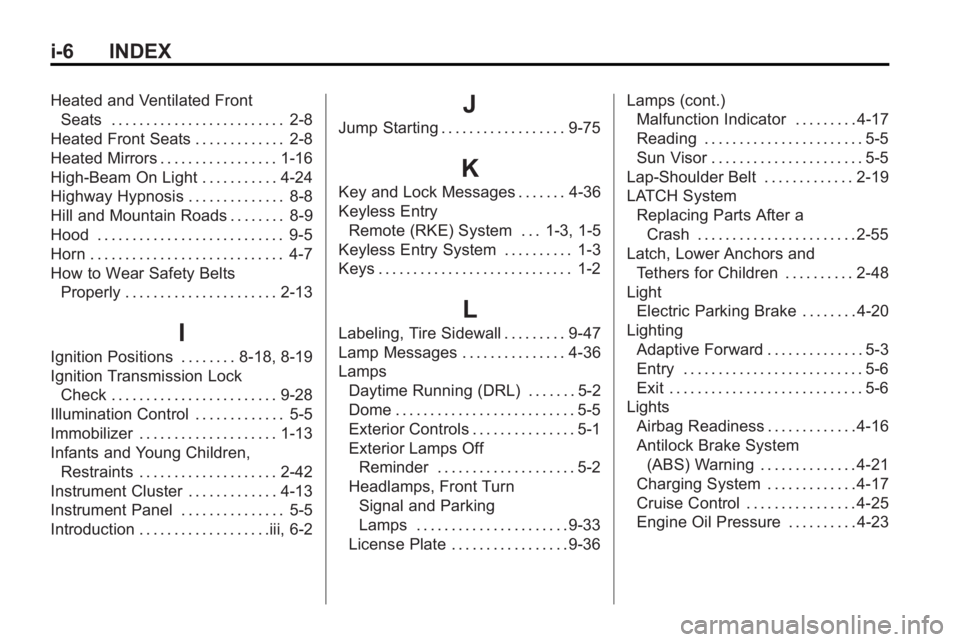
i-6 INDEX
Heated and Ventilated FrontSeats . . . . . . . . . . . . . . . . . . . . . . . . . 2-8
Heated Front Seats . . . . . . . . . . . . . 2-8
Heated Mirrors . . . . . . . . . . . . . . . . . 1-16
High-Beam On Light . . . . . . . . . . . 4-24
Highway Hypnosis . . . . . . . . . . . . . . 8-8
Hill and Mountain Roads . . . . . . . . 8-9
Hood . . . . . . . . . . . . . . . . . . . . . . . . . . . 9-5
Horn . . . . . . . . . . . . . . . . . . . . . . . . . . . . 4-7
How to Wear Safety Belts Properly . . . . . . . . . . . . . . . . . . . . . . 2-13
I
Ignition Positions . . . . . . . . 8-18, 8-19
Ignition Transmission Lock
Check . . . . . . . . . . . . . . . . . . . . . . . . 9-28
Illumination Control . . . . . . . . . . . . . 5-5
Immobilizer . . . . . . . . . . . . . . . . . . . . 1-13
Infants and Young Children, Restraints . . . . . . . . . . . . . . . . . . . . 2-42
Instrument Cluster . . . . . . . . . . . . . 4-13
Instrument Panel . . . . . . . . . . . . . . . 5-5
Introduction . . . . . . . . . . . . . . . . . . .iii, 6-2
J
Jump Starting . . . . . . . . . . . . . . . . . . 9-75
K
Key and Lock Messages . . . . . . . 4-36
Keyless Entry Remote (RKE) System . . . 1-3, 1-5
Keyless Entry System . . . . . . . . . . 1-3
Keys . . . . . . . . . . . . . . . . . . . . . . . . . . . . 1-2
L
Labeling, Tire Sidewall . . . . . . . . . 9-47
Lamp Messages . . . . . . . . . . . . . . . 4-36
Lamps Daytime Running (DRL) . . . . . . . 5-2
Dome . . . . . . . . . . . . . . . . . . . . . . . . . . 5-5
Exterior Controls . . . . . . . . . . . . . . . 5-1
Exterior Lamps Off
Reminder . . . . . . . . . . . . . . . . . . . . 5-2
Headlamps, Front Turn
Signal and Parking
Lamps . . . . . . . . . . . . . . . . . . . . . . 9-33
License Plate . . . . . . . . . . . . . . . . . 9-36 Lamps (cont.)
Malfunction Indicator . . . . . . . . . 4-17
Reading . . . . . . . . . . . . . . . . . . . . . . . 5-5
Sun Visor . . . . . . . . . . . . . . . . . . . . . . 5-5
Lap-Shoulder Belt . . . . . . . . . . . . . 2-19
LATCH System Replacing Parts After aCrash . . . . . . . . . . . . . . . . . . . . . . . 2-55
Latch, Lower Anchors and
Tethers for Children . . . . . . . . . . 2-48
Light Electric Parking Brake . . . . . . . . 4-20
Lighting Adaptive Forward . . . . . . . . . . . . . . 5-3
Entry . . . . . . . . . . . . . . . . . . . . . . . . . . 5-6
Exit . . . . . . . . . . . . . . . . . . . . . . . . . . . . 5-6
Lights Airbag Readiness . . . . . . . . . . . . . 4-16
Antilock Brake System
(ABS) Warning . . . . . . . . . . . . . . 4-21
Charging System . . . . . . . . . . . . . 4-17
Cruise Control . . . . . . . . . . . . . . . . 4-25
Engine Oil Pressure . . . . . . . . . . 4-23
Page 409 of 414
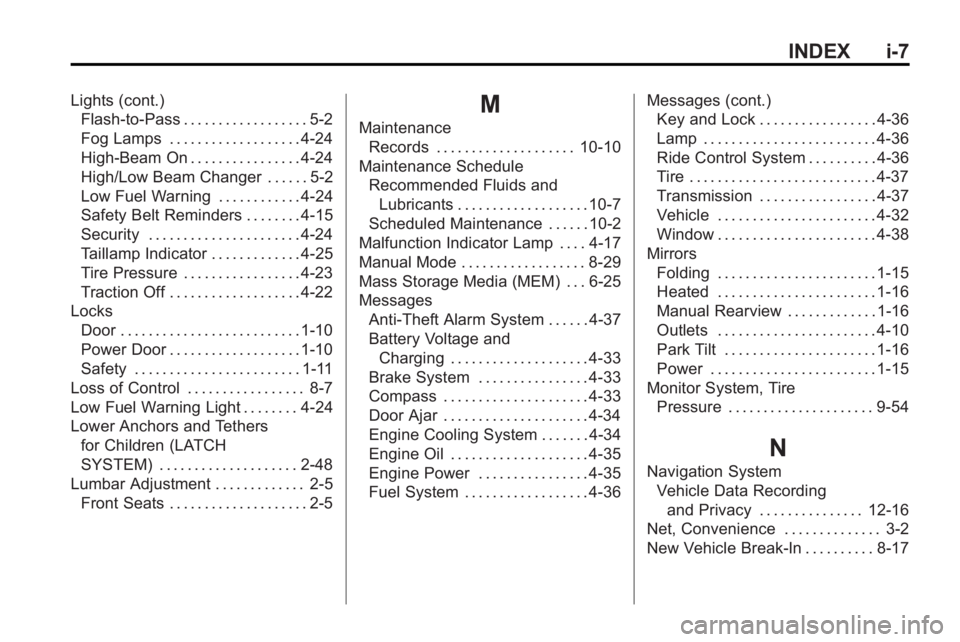
INDEX i-7
Lights (cont.)Flash-to-Pass . . . . . . . . . . . . . . . . . . 5-2
Fog Lamps . . . . . . . . . . . . . . . . . . . 4-24
High-Beam On . . . . . . . . . . . . . . . . 4-24
High/Low Beam Changer . . . . . . 5-2
Low Fuel Warning . . . . . . . . . . . . 4-24
Safety Belt Reminders . . . . . . . . 4-15
Security . . . . . . . . . . . . . . . . . . . . . . 4-24
Taillamp Indicator . . . . . . . . . . . . . 4-25
Tire Pressure . . . . . . . . . . . . . . . . . 4-23
Traction Off . . . . . . . . . . . . . . . . . . . 4-22
Locks Door . . . . . . . . . . . . . . . . . . . . . . . . . . 1-10
Power Door . . . . . . . . . . . . . . . . . . . 1-10
Safety . . . . . . . . . . . . . . . . . . . . . . . . 1-11
Loss of Control . . . . . . . . . . . . . . . . . 8-7
Low Fuel Warning Light . . . . . . . . 4-24
Lower Anchors and Tethers for Children (LATCH
SYSTEM) . . . . . . . . . . . . . . . . . . . . 2-48
Lumbar Adjustment . . . . . . . . . . . . . 2-5 Front Seats . . . . . . . . . . . . . . . . . . . . 2-5M
MaintenanceRecords . . . . . . . . . . . . . . . . . . . . 10-10
Maintenance Schedule Recommended Fluids andLubricants . . . . . . . . . . . . . . . . . . . 10-7
Scheduled Maintenance . . . . . . 10-2
Malfunction Indicator Lamp . . . . 4-17
Manual Mode . . . . . . . . . . . . . . . . . . 8-29
Mass Storage Media (MEM) . . . 6-25
Messages Anti-Theft Alarm System . . . . . . 4-37
Battery Voltage andCharging . . . . . . . . . . . . . . . . . . . . 4-33
Brake System . . . . . . . . . . . . . . . . 4-33
Compass . . . . . . . . . . . . . . . . . . . . . 4-33
Door Ajar . . . . . . . . . . . . . . . . . . . . . 4-34
Engine Cooling System . . . . . . . 4-34
Engine Oil . . . . . . . . . . . . . . . . . . . . 4-35
Engine Power . . . . . . . . . . . . . . . . 4-35
Fuel System . . . . . . . . . . . . . . . . . . 4-36 Messages (cont.)
Key and Lock . . . . . . . . . . . . . . . . . 4-36
Lamp . . . . . . . . . . . . . . . . . . . . . . . . . 4-36
Ride Control System . . . . . . . . . . 4-36
Tire . . . . . . . . . . . . . . . . . . . . . . . . . . . 4-37
Transmission . . . . . . . . . . . . . . . . . 4-37
Vehicle . . . . . . . . . . . . . . . . . . . . . . . 4-32
Window . . . . . . . . . . . . . . . . . . . . . . . 4-38
Mirrors
Folding . . . . . . . . . . . . . . . . . . . . . . . 1-15
Heated . . . . . . . . . . . . . . . . . . . . . . . 1-16
Manual Rearview . . . . . . . . . . . . . 1-16
Outlets . . . . . . . . . . . . . . . . . . . . . . . 4-10
Park Tilt . . . . . . . . . . . . . . . . . . . . . . 1-16
Power . . . . . . . . . . . . . . . . . . . . . . . . 1-15
Monitor System, Tire Pressure . . . . . . . . . . . . . . . . . . . . . 9-54
N
Navigation SystemVehicle Data Recordingand Privacy . . . . . . . . . . . . . . . 12-16
Net, Convenience . . . . . . . . . . . . . . 3-2
New Vehicle Break-In . . . . . . . . . . 8-17
Page 411 of 414
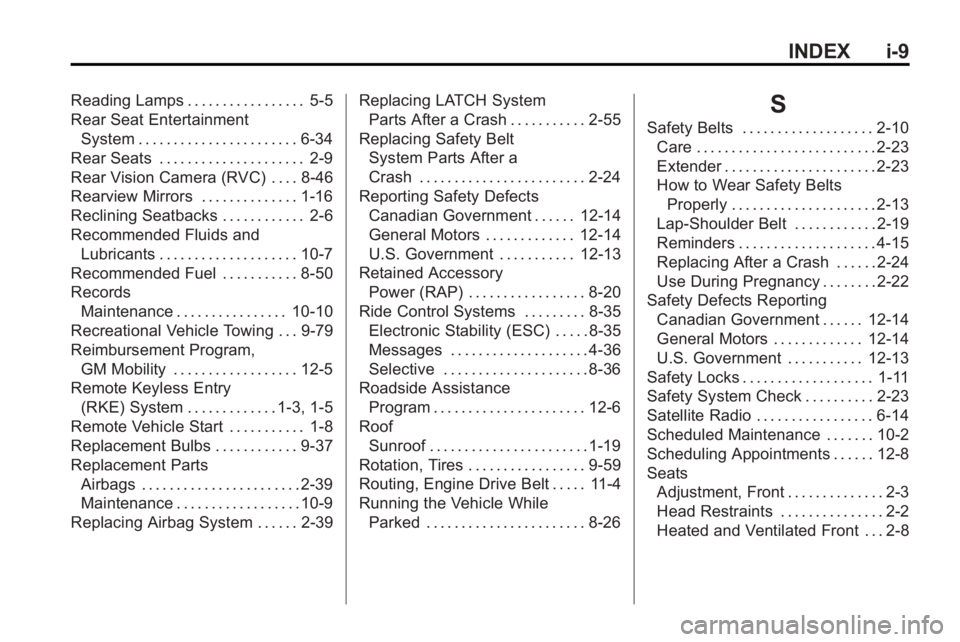
INDEX i-9
Reading Lamps . . . . . . . . . . . . . . . . . 5-5
Rear Seat EntertainmentSystem . . . . . . . . . . . . . . . . . . . . . . . 6-34
Rear Seats . . . . . . . . . . . . . . . . . . . . . 2-9
Rear Vision Camera (RVC) . . . . 8-46
Rearview Mirrors . . . . . . . . . . . . . . 1-16
Reclining Seatbacks . . . . . . . . . . . . 2-6
Recommended Fluids and Lubricants . . . . . . . . . . . . . . . . . . . . 10-7
Recommended Fuel . . . . . . . . . . . 8-50
Records Maintenance . . . . . . . . . . . . . . . . 10-10
Recreational Vehicle Towing . . . 9-79
Reimbursement Program, GM Mobility . . . . . . . . . . . . . . . . . . 12-5
Remote Keyless Entry
(RKE) System . . . . . . . . . . . . . 1-3, 1-5
Remote Vehicle Start . . . . . . . . . . . 1-8
Replacement Bulbs . . . . . . . . . . . . 9-37
Replacement Parts Airbags . . . . . . . . . . . . . . . . . . . . . . . 2-39
Maintenance . . . . . . . . . . . . . . . . . . 10-9
Replacing Airbag System . . . . . . 2-39 Replacing LATCH System
Parts After a Crash . . . . . . . . . . . 2-55
Replacing Safety Belt System Parts After a
Crash . . . . . . . . . . . . . . . . . . . . . . . . 2-24
Reporting Safety Defects Canadian Government . . . . . . 12-14
General Motors . . . . . . . . . . . . . 12-14
U.S. Government . . . . . . . . . . . 12-13
Retained Accessory Power (RAP) . . . . . . . . . . . . . . . . . 8-20
Ride Control Systems . . . . . . . . . 8-35 Electronic Stability (ESC) . . . . . 8-35
Messages . . . . . . . . . . . . . . . . . . . . 4-36
Selective . . . . . . . . . . . . . . . . . . . . . 8-36
Roadside Assistance
Program . . . . . . . . . . . . . . . . . . . . . . 12-6
Roof Sunroof . . . . . . . . . . . . . . . . . . . . . . . 1-19
Rotation, Tires . . . . . . . . . . . . . . . . . 9-59
Routing, Engine Drive Belt . . . . . 11-4
Running the Vehicle While Parked . . . . . . . . . . . . . . . . . . . . . . . 8-26S
Safety Belts . . . . . . . . . . . . . . . . . . . 2-10Care . . . . . . . . . . . . . . . . . . . . . . . . . . 2-23
Extender . . . . . . . . . . . . . . . . . . . . . . 2-23
How to Wear Safety BeltsProperly . . . . . . . . . . . . . . . . . . . . . 2-13
Lap-Shoulder Belt . . . . . . . . . . . . 2-19
Reminders . . . . . . . . . . . . . . . . . . . . 4-15
Replacing After a Crash . . . . . . 2-24
Use During Pregnancy . . . . . . . . 2-22
Safety Defects Reporting
Canadian Government . . . . . . 12-14
General Motors . . . . . . . . . . . . . 12-14
U.S. Government . . . . . . . . . . . 12-13
Safety Locks . . . . . . . . . . . . . . . . . . . 1-11
Safety System Check . . . . . . . . . . 2-23
Satellite Radio . . . . . . . . . . . . . . . . . 6-14
Scheduled Maintenance . . . . . . . 10-2
Scheduling Appointments . . . . . . 12-8
Seats Adjustment, Front . . . . . . . . . . . . . . 2-3
Head Restraints . . . . . . . . . . . . . . . 2-2
Heated and Ventilated Front . . . 2-8