light BUICK LACROSSE 2011 Owner's Manual
[x] Cancel search | Manufacturer: BUICK, Model Year: 2011, Model line: LACROSSE, Model: BUICK LACROSSE 2011Pages: 462, PDF Size: 5.73 MB
Page 327 of 462
Black plate (15,1)Buick LaCrosse Owner Manual - 2011
Vehicle Care 10-15
Automatic Transmission
Fluid
How to Check Automatic
Transmission Fluid
It is not necessary to check
the transmission fluid level.
A transmission fluid leak is the
only reason for fluid loss. If a leak
occurs, take the vehicle to your
dealer service department and
have it repaired as soon as
possible.
There is a special procedure
for checking and changing the
transmission fluid. Because
this procedure is difficult, you
should have this done at your
dealer service department.Contact your dealer for additional
information or the procedure can
be found in the service manual.
To purchase a service manual,
see
Service Publications Ordering
Information on page 13‑15.
Change the fluid and filter at
the intervals listed in Scheduled
Maintenance on page 11‑2, and
be sure to use the fluid listed
in Recommended Fluids and
Lubricants on page 11‑7.
Engine Air Cleaner/Filter
The engine air cleaner/filter is
located in the engine compartment
on the driver side of the vehicle.
See Engine Compartment Overview
on page 10‑6 for more information
on location.
When to Inspect the Engine Air
Cleaner/Filter
Inspect the air cleaner/filter at
the scheduled maintenance
intervals and replace it at the first
oil change after each 80 000 km
(50,000 mi) interval. See Scheduled
Maintenance on page 11‑2 for more
information. If you are driving in
dusty/dirty conditions, inspect the
filter at each engine oil change.
How to Inspect the Engine Air
Cleaner/Filter
To inspect the air cleaner/filter,
remove the filter from the vehicle
and lightly shake the filter to release
loose dust and dirt. If the filter
remains covered with dirt, a new
filter is required.
Page 333 of 462
Black plate (21,1)Buick LaCrosse Owner Manual - 2011
Vehicle Care 10-21
4. With the coolant surge tank capoff, start the engine and let it
run until the upper radiator hose
starts getting hot. Watch out
for the engine cooling fan(s).
By this time, the coolant level
inside the coolant surge tank
may be lower. If the level is
lower, add more of the proper
mixture to the coolant surge
tank until the level reaches the
mark pointed to on the front of
the coolant surge tank.
5. Replace the cap. Be sure the cap is hand–tight and fully
seated.
Notice: If the pressure cap is
not tightly installed, coolant loss
and possible engine damage may
occur. Be sure the cap is properly
and tightly secured.
If coolant is needed, add the proper
DEX-COOL coolant mixture at the
coolant surge tank.Engine Overheating
The vehicle has several indicators
to warn of engine overheating.
There is a coolant temperature
gauge and a warning light on
the instrument panel cluster that
indicate an overheated engine
condition. See Engine Coolant
Temperature Gauge on page 5‑13
for more information.
You may decide not to lift the hood
when this warning appears, but
instead get service help right away.
See Roadside Assistance Program
(U.S. and Canada) on page 13‑8
or Roadside Assistance Program
(Mexico) on page 13‑10.
If you do decide to lift the hood,
make sure the vehicle is parked
on a level surface. Then check to see if the engine
cooling fans are running. If the
engine is overheating, the fan(s)
should be running. If not, do not
continue to run the engine and
have the vehicle serviced.
Notice:
Engine damage from
running the engine without
coolant is not covered by the
warranty.
If Steam is Coming from the
Engine Compartment
See Overheated Engine Protection
Operating Mode on page 10‑22 for
information on driving to a safe
place in an emergency.
Page 334 of 462
Black plate (22,1)Buick LaCrosse Owner Manual - 2011
10-22 Vehicle Care
If No Steam is Coming from
the Engine Compartment
If an engine overheat warning is
displayed but no steam can be seen
or heard, the problem might not be
too serious. Sometimes the engine
can get a little too hot when the
vehicle:
.Climbs a long hill on a hot day
.Stops after high-speed driving
.Idles for long periods in traffic
.Tows a trailer
If the overheat warning displays with
no sign of steam:
1. Turn the air conditioning off.
2. Turn the heater on to the highest temperature and to the highest
fan speed. Open the windows
as necessary. 3. In heavy traffic, let the engine
idle in N (Neutral) while stopped.
If it is safe to do so, pull off
the road, shift to P (Park)
or N (Neutral) and let the
engine idle.
If the temperature overheat gauge
is no longer in the overheat zone
or an overheat warning no longer
displays, the vehicle can be driven.
Continue to drive the vehicle slowly
for about 10 minutes. Keep a safe
vehicle distance from the vehicle in
front. If the warning does not come
back on, continue to drive normally.
If the warning continues, pull
over, stop, and park the vehicle
right away.
If there is no sign of steam,
idle the engine for three minutes
while parked. If the warning is still
displayed, turn off the engine until it
cools down. Also, see Overheated
Engine Protection Operating Mode
on page 10‑22.
Overheated Engine
Protection
Operating Mode
This emergency operating mode
allows the vehicle to be driven
to a safe place in an emergency
situation. If an overheated engine
condition exists, an overheat
protection mode which alternates
firing groups of cylinders helps
prevent engine damage. In this
mode, there is significant loss in
power and engine performance.
The engine coolant temperature
warning light comes on the
instrument panel, to indicate the
vehicle has entered overheated
engine protection operating mode.
The temperature gauge also
indicates an overheat condition
exists. Driving extended km (mi)
and/or towing a trailer in the
overheat protection mode should
be avoided.
Page 337 of 462
Black plate (25,1)Buick LaCrosse Owner Manual - 2011
Vehicle Care 10-25
Some driving conditions or climates
can cause a brake squeal when
the brakes are first applied or
lightly applied. This does not mean
something is wrong with the brakes.
Properly torqued wheel nuts are
necessary to help prevent brake
pulsation. When tires are rotated,
inspect brake pads for wear
and evenly tighten wheel nuts
in the proper sequence to torque
specifications inCapacities and
Specifications on page 12‑2.
Brake linings should always be
replaced as complete axle sets.
Brake Pedal Travel
See your dealer if the brake
pedal does not return to normal
height, or if there is a rapid increase
in pedal travel. This could be a
sign that brake service might be
required.
Brake Adjustment
Every time the brakes are applied,
with or without the vehicle moving,
the brakes adjust for wear.
Replacing Brake System Parts
The braking system on a vehicle is
complex. Its many parts have to be
of top quality and work well together
if the vehicle is to have really good
braking. The vehicle was designed
and tested with top-quality brake
parts. When parts of the braking
system are replaced, be sure to get
new, approved replacement parts.
If this is not done, the brakes might
not work properly. For example,
installing disc brake pads that are
wrong for the vehicle, can change
the balance between the front
and rear brakes —for the worse.
The braking performance expected
can change in many other ways if
the wrong replacement brake parts
are installed.
Brake Fluid
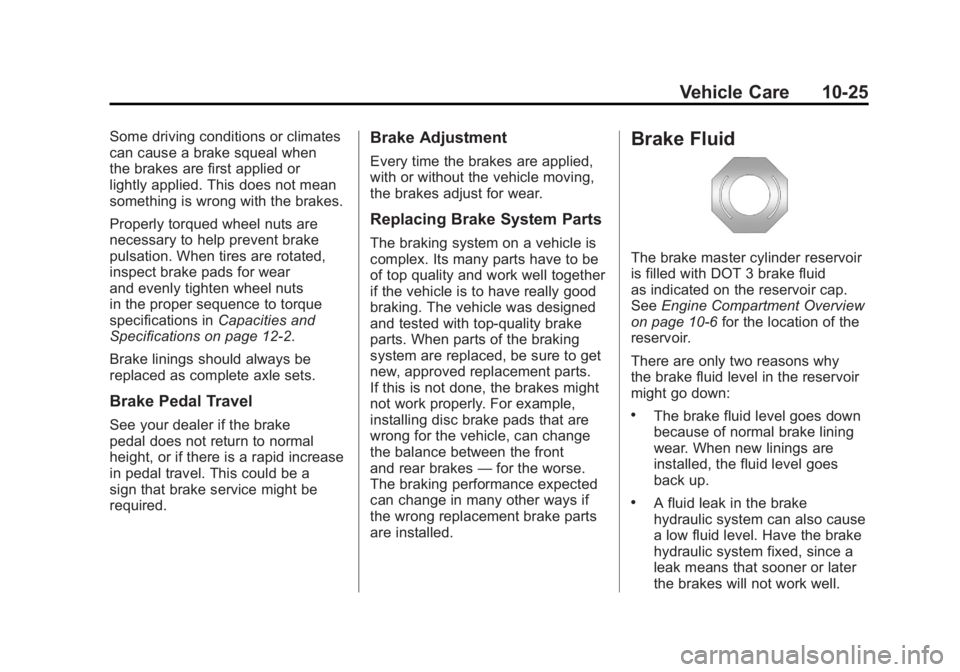
The brake master cylinder reservoir
is filled with DOT 3 brake fluid
as indicated on the reservoir cap.
See Engine Compartment Overview
on page 10‑6 for the location of the
reservoir.
There are only two reasons why
the brake fluid level in the reservoir
might go down:
.The brake fluid level goes down
because of normal brake lining
wear. When new linings are
installed, the fluid level goes
back up.
.A fluid leak in the brake
hydraulic system can also cause
a low fluid level. Have the brake
hydraulic system fixed, since a
leak means that sooner or later
the brakes will not work well.
Page 338 of 462
Black plate (26,1)Buick LaCrosse Owner Manual - 2011
10-26 Vehicle Care
Do not top off the brake fluid.
Adding fluid does not correct a
leak. If fluid is added when the
linings are worn, there will be too
much fluid when new brake linings
are installed. Add or remove brake
fluid, as necessary, only when work
is done on the brake hydraulic
system.
{WARNING
If too much brake fluid is added,
it can spill on the engine
and burn, if the engine is hot
enough. You or others could be
burned, and the vehicle could be
damaged. Add brake fluid only
when work is done on the brake
hydraulic system.
When the brake fluid falls to a low
level, the brake warning light comes
on. See Brake System Warning
Light on page 5‑19. What to Add
Use only new DOT 3 brake
fluid from a sealed container.
See
Recommended Fluids and
Lubricants on page 11‑7.
Always clean the brake fluid
reservoir cap and the area
around the cap before removing it.
This helps keep dirt from entering
the reservoir.{WARNING
With the wrong kind of fluid in
the brake hydraulic system,
the brakes might not work well.
This could cause a crash. Always
use the proper brake fluid. Notice:
.Using the wrong fluid
can badly damage brake
hydraulic system parts.
For example, just a few
drops of mineral-based oil,
such as engine oil, in the
brake hydraulic system can
damage brake hydraulic
system parts so badly that
they will have to be replaced.
Do not let someone put in
the wrong kind of fluid.
.If brake fluid is spilled
on the vehicle's painted
surfaces, the paint finish
can be damaged. Be careful
not to spill brake fluid on the
vehicle. If you do, wash it off
immediately.
Page 342 of 462
Black plate (30,1)Buick LaCrosse Owner Manual - 2011
10-30 Vehicle Care
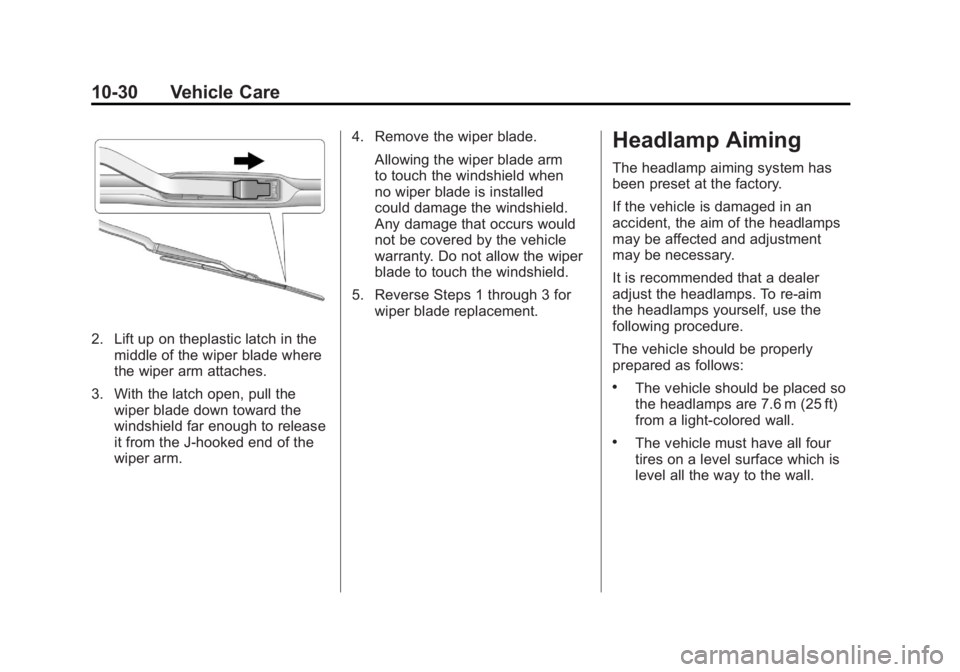
2. Lift up on theplastic latch in themiddle of the wiper blade where
the wiper arm attaches.
3. With the latch open, pull the wiper blade down toward the
windshield far enough to release
it from the J-hooked end of the
wiper arm. 4. Remove the wiper blade.
Allowing the wiper blade arm
to touch the windshield when
no wiper blade is installed
could damage the windshield.
Any damage that occurs would
not be covered by the vehicle
warranty. Do not allow the wiper
blade to touch the windshield.
5. Reverse Steps 1 through 3 for wiper blade replacement.
Headlamp Aiming
The headlamp aiming system has
been preset at the factory.
If the vehicle is damaged in an
accident, the aim of the headlamps
may be affected and adjustment
may be necessary.
It is recommended that a dealer
adjust the headlamps. To re-aim
the headlamps yourself, use the
following procedure.
The vehicle should be properly
prepared as follows:
.The vehicle should be placed so
the headlamps are 7.6 m (25 ft)
from a light‐colored wall.
.The vehicle must have all four
tires on a level surface which is
level all the way to the wall.
Page 344 of 462
Black plate (32,1)Buick LaCrosse Owner Manual - 2011
10-32 Vehicle Care
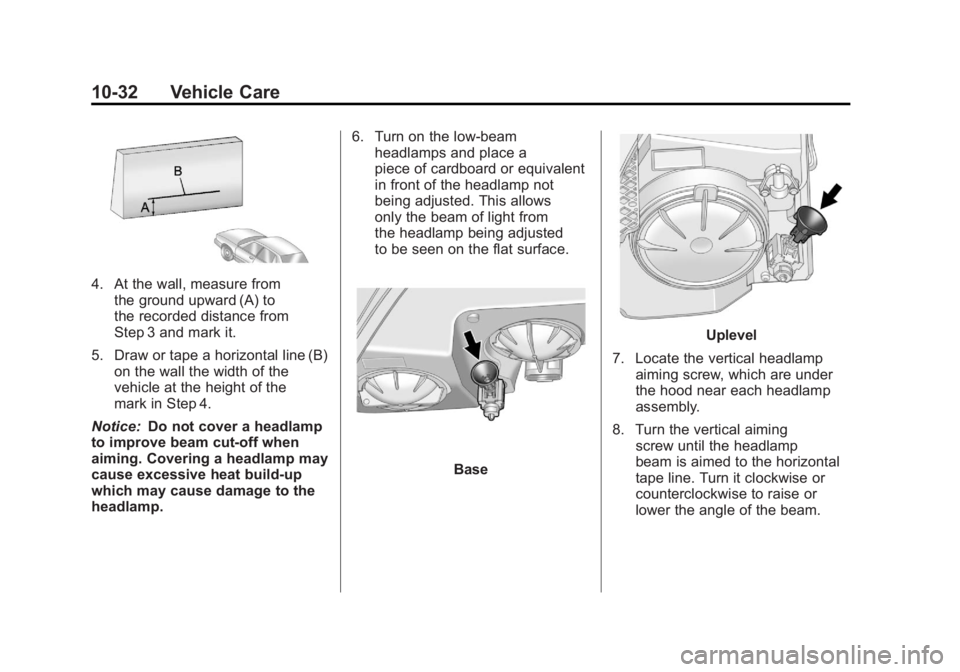
4. At the wall, measure fromthe ground upward (A) to
the recorded distance from
Step 3 and mark it.
5. Draw or tape a horizontal line (B) on the wall the width of the
vehicle at the height of the
mark in Step 4.
Notice: Do not cover a headlamp
to improve beam cut-off when
aiming. Covering a headlamp may
cause excessive heat build-up
which may cause damage to the
headlamp. 6. Turn on the low-beam
headlamps and place a
piece of cardboard or equivalent
in front of the headlamp not
being adjusted. This allows
only the beam of light from
the headlamp being adjusted
to be seen on the flat surface.
Base
Uplevel
7. Locate the vertical headlamp aiming screw, which are under
the hood near each headlamp
assembly.
8. Turn the vertical aiming screw until the headlamp
beam is aimed to the horizontal
tape line. Turn it clockwise or
counterclockwise to raise or
lower the angle of the beam.
Page 345 of 462
Black plate (33,1)Buick LaCrosse Owner Manual - 2011
Vehicle Care 10-33
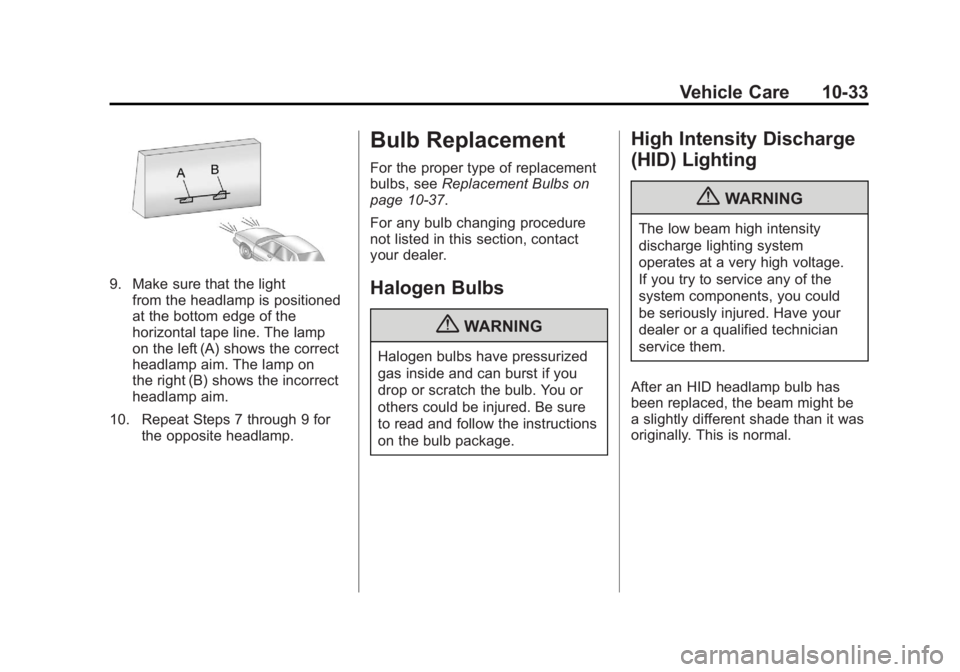
9. Make sure that the lightfrom the headlamp is positioned
at the bottom edge of the
horizontal tape line. The lamp
on the left (A) shows the correct
headlamp aim. The lamp on
the right (B) shows the incorrect
headlamp aim.
10. Repeat Steps 7 through 9 for the opposite headlamp.
Bulb Replacement
For the proper type of replacement
bulbs, see Replacement Bulbs on
page 10‑37.
For any bulb changing procedure
not listed in this section, contact
your dealer.
Halogen Bulbs
{WARNING
Halogen bulbs have pressurized
gas inside and can burst if you
drop or scratch the bulb. You or
others could be injured. Be sure
to read and follow the instructions
on the bulb package.
High Intensity Discharge
(HID) Lighting
{WARNING
The low beam high intensity
discharge lighting system
operates at a very high voltage.
If you try to service any of the
system components, you could
be seriously injured. Have your
dealer or a qualified technician
service them.
After an HID headlamp bulb has
been replaced, the beam might be
a slightly different shade than it was
originally. This is normal.
Page 347 of 462
Black plate (35,1)Buick LaCrosse Owner Manual - 2011
Vehicle Care 10-35
6. Install the bulb socket by turningclockwise one‐quarter turn.
7. If a headlamp bulb was replaced, install the dust cover
in the back of the headlamp
housing by turning clockwise
one‐quarter turn.
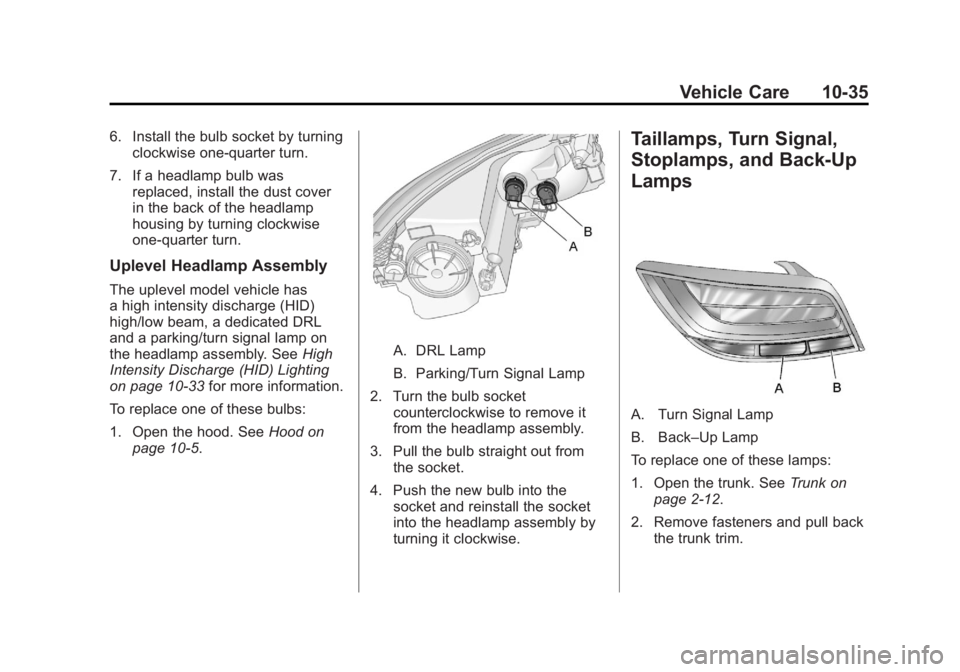
Uplevel Headlamp Assembly
The uplevel model vehicle has
a high intensity discharge (HID)
high/low beam, a dedicated DRL
and a parking/turn signal lamp on
the headlamp assembly. See High
Intensity Discharge (HID) Lighting
on page 10‑33 for more information.
To replace one of these bulbs:
1. Open the hood. See Hood on
page 10‑5.
A. DRL Lamp
B. Parking/Turn Signal Lamp
2. Turn the bulb socket counterclockwise to remove it
from the headlamp assembly.
3. Pull the bulb straight out from the socket.
4. Push the new bulb into the socket and reinstall the socket
into the headlamp assembly by
turning it clockwise.
Taillamps, Turn Signal,
Stoplamps, and Back-Up
Lamps
A. Turn Signal Lamp
B. Back–Up Lamp
To replace one of these lamps:
1. Open the trunk. See Trunk on
page 2‑12.
2. Remove fasteners and pull back the trunk trim.
Page 355 of 462
Black plate (43,1)Buick LaCrosse Owner Manual - 2011
Vehicle Care 10-43
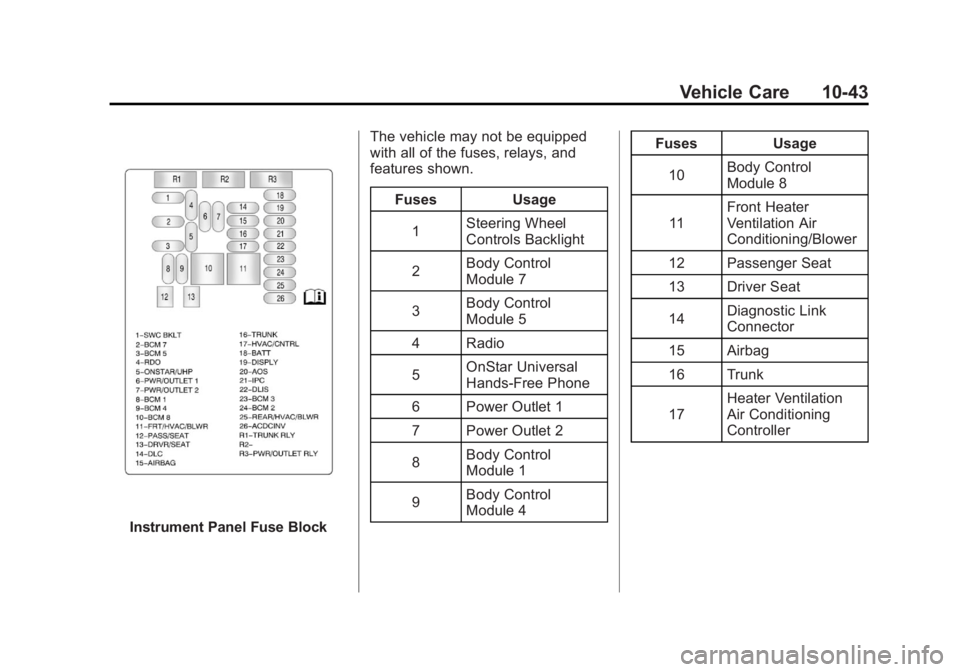
Instrument Panel Fuse BlockThe vehicle may not be equipped
with all of the fuses, relays, and
features shown.
Fuses Usage
1 Steering Wheel
Controls Backlight
2 Body Control
Module 7
3 Body Control
Module 5
4 Radio
5 OnStar Universal
Hands‐Free Phone
6 Power Outlet 1
7 Power Outlet 2
8 Body Control
Module 1
9 Body Control
Module 4 Fuses Usage
10 Body Control
Module 8
11 Front Heater
Ventilation Air
Conditioning/Blower
12 Passenger Seat
13 Driver Seat
14 Diagnostic Link
Connector
15 Airbag
16 Trunk
17 Heater Ventilation
Air Conditioning
Controller